Physics › Waves › Longitudinal and transverse waves
Longitudinal and transverse waves
Transverse waves oscillate at right angles to the direction of energy transfer, and longitudinal waves, sound among them, oscillate along it. Both are drawn on the same displacement-distance graph, where a compression sits at a zero crossing running positive to negative and never at a crest.

Choose your exam board to show the notes and questions relevant to your specification. You can change this setting at any time, and content for other boards remains available.
Longitudinal, transverse and polarisation, part 1 of 2. Part 2 is Polarisation and electromagnetic waves.
Builds on Progressive waves.
IN THIS TOPIC
- Classify a wave as transverse or longitudinal from the direction of its oscillations.
- Mark the compressions and rarefactions on the displacement-distance graph of a longitudinal wave, and say why they are not at the crests.
COMMON MISCONCEPTION
On a displacement-distance graph of a sound wave, the compressions are at the crests.
A crest is maximum displacement, and there every particle nearby has moved forwards by much the same amount, so the spacing and the pressure are ordinary. A compression is where the curve crosses the axis on its way down, from positive displacement to negative, because the particles behind it have moved forwards and those ahead of it have moved back.
Two ways to oscillate
In a transverse wave, the oscillations are at right angles to the direction the energy travels. Waves on a rope are transverse, and so are all electromagnetic waves, from radio to gamma rays, every one of them travelling at the same speed c in a vacuum.

Describe the drawing
Two media carry the same wave speed and wavelength. Above, transverse: each particle bobs across the travel direction. Below, longitudinal: each shuttles along it, so the crowd bunches and spreads, and those compressions (amber markers) sweep to the right while every particle only shuttles about its home. The coral particle in each channel wears its oscillation direction as a double arrow, set against the amber travel arrow.
In a longitudinal wave, the oscillations are parallel to the direction of energy transfer. The particles bunch together and spread apart as the wave passes, forming compressions, where the pressure is highest, and rarefactions, where it is lowest. Sound is the example that matters. Air particles shuffle back and forth along the very line the sound is travelling.
Graphing a longitudinal wave
Both kinds of wave are graphed the same way: the displacement of every particle at one instant, plotted against its rest position. For a longitudinal wave, the graph does not show the physical shape of the medium. A sound wave is a pattern of bunching and spreading along one line, and the curve on the page records how far along that line each particle has moved, not what the line looks like.
Everything then turns on what the sign of a displacement means. A longitudinal particle has only two ways to move, forwards or backwards along the line the wave travels, and the graph gives forwards the positive half. A particle plotted at +0.2 mm sits 0.2 mm ahead of its rest position, in the direction the wave is going, and one plotted at −0.2 mm sits the same distance behind.
Now look for a compression. The air is bunched there, which can only happen if the particles just behind it have moved forwards and the particles just ahead of it have moved backwards, closing in from both sides. The particle at the very centre of the crowd is pressed equally from either side and has not moved at all. So a compression sits where the curve crosses the axis on its way down, from positive displacement to negative. A rarefaction is the same argument reversed: the particles behind have dropped back and those ahead have run on, the air between them is stretched thin, and the curve crosses the axis on its way up.
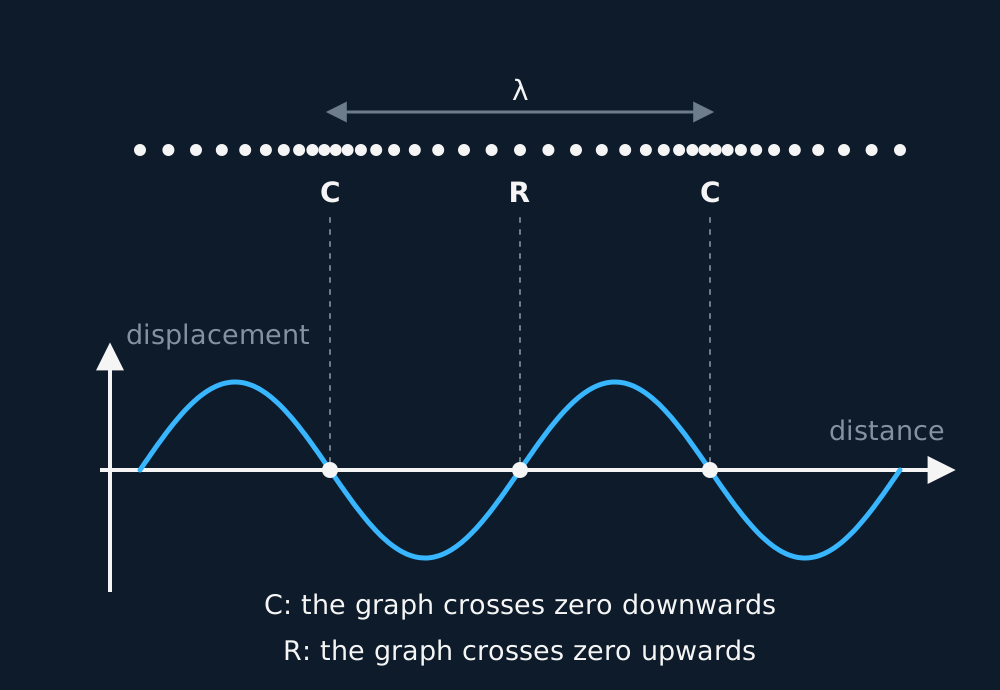
The crests and troughs are the places to leave alone. At a crest every particle nearby has moved forwards by much the same amount, so nobody is crowding anybody: the spacing is normal there and so is the pressure. A crest marks maximum displacement, and a question asking you to label C and R on a graph is asking whether you know that displacement and pressure peak in different places.
The spacings follow from the picture. Adjacent compressions are one wavelength apart, adjacent rarefactions likewise, and a compression sits half a wavelength from its nearest rarefaction. Plot pressure instead of displacement and the graph peaks at every compression and dips at every rarefaction, which puts the pressure curve a quarter of a cycle out of step with the displacement curve.
WORKED EXAMPLE
Finding the compressions on a graph
A sound wave travels in the direction of increasing x. Its displacement-distance graph crosses zero at x = 0, 0.25 m, 0.50 m, 0.75 m and 1.00 m, and its first crest is at x = 0.125 m. Give the wavelength, and the positions of the first compression and the first rarefaction.
Two zeros fit into each cycle, so the pattern repeats every 0.50 m: λ = 0.50 m. Sketch it before going further, because the rest of the question is read off the sketch.
The curve rises from x = 0 to the crest at 0.125 m and comes back down through the axis at 0.25 m. That is a crossing from positive to negative, so the first compression is at x = 0.25 m.
It carries on down to a trough at 0.375 m and rises back through the axis at 0.50 m, a crossing from negative to positive, so the first rarefaction is at x = 0.50 m. The two sit half a wavelength apart, as they must.
x = 0.125 m is the crest, not the compression: there the particles are furthest forward and the air is at ordinary pressure.
Polarisation has moved to the next part of this lesson.
The electromagnetic family has moved to the next part of this lesson.
Where you meet it has moved to the next part of this lesson.
ASSESSMENT FOCUS
- A definition here is a comparison. Oscillations lie perpendicular to the direction of energy transfer in a transverse wave and parallel to it in a longitudinal one. Name both the oscillation direction and the direction of energy transfer, since either one on its own fits both kinds of wave.
- On a displacement-distance graph of a longitudinal wave, a compression is a zero crossing running positive to negative and a rarefaction is the crossing the other way. Crests and troughs are maximum displacement at ordinary pressure. Every board sets this graph, and Edexcel names it in the specification, so learn the two crossings rather than guessing at the peaks.
CHECK YOURSELF
A loudspeaker sends a sound wave along a tube, in the direction of increasing x. (a) State the direction in which the air particles oscillate, relative to the direction the energy travels. (b) The wave's displacement-distance graph has a crest at x = 0.30 m and crosses the axis going downwards at x = 0.45 m. State what the air is doing at each of those two positions.
Show a hint
Which way can a particle of a longitudinal wave move at all?
Show the answer
(a) The particles oscillate along the direction of energy transfer, parallel to the tube. That is what makes sound longitudinal.
(b) At x = 0.30 m the displacement is a maximum, so every particle nearby has moved forwards by much the same amount. Nobody is crowding anybody: the spacing is normal there and so is the pressure.
At x = 0.45 m the curve crosses the axis running positive to negative, so the particles behind have moved forwards and those ahead have moved back. That is a compression, the point of highest pressure, and the particle at its centre is pressed equally from both sides and has not moved at all.
Displacement and pressure peak a quarter of a cycle apart, which is the whole reason the crest is not the compression.
Transverse oscillates across the travel direction.
Longitudinal oscillates along it.
WORKBOOK
Printable practice for this topic: original exam-style questions with room to work, and a fully worked answer book. Free to use; please do not redistribute or sell.
Or read them with their mark schemes on the longitudinal and transverse waves questions page.
WHERE TO GO NEXT
- Trigonometry and resolving vectors is the maths this lesson leans on, worked through step by step.
USED LATER IN
CHECK YOUR PROGRESS
Rate how confident you feel with each objective for this lesson. Ratings are saved in this browser, on this device, unless you sign in.
- Classify a wave as transverse or longitudinal from the direction of its oscillations.
- Mark the compressions and rarefactions on the displacement-distance graph of a longitudinal wave, and say why they are not at the crests.
Open the full revision checklist to track your progress across the whole unit.