Physics › Waves › Stationary waves on strings
Stationary waves on strings
Two waves of the same frequency travelling in opposite directions superpose into a pattern that stays put, its nodes half a wavelength apart. A string fixed at both ends has a node at each, so only whole loops fit and the harmonics are whole-number multiples of the first. Tension and mass per unit length set the wave speed.
Choose your exam board to show the notes and questions relevant to your specification. You can change this setting at any time, and content for other boards remains available.
Stationary waves, part 1 of 2. Part 2 is Stationary waves in air columns.
Builds on Progressive waves.
IN THIS TOPIC
- Describe how two travelling waves superpose to form a stationary wave, and define node and antinode.
- Use the node and antinode spacings, and , to get from a measured distance to a wavelength.
- Find the allowed wavelengths of a string fixed at both ends, and use and the first-harmonic frequency equation.
- State the amplitude and phase relationships that separate stationary waves from progressive ones.
COMMON MISCONCEPTION
A stationary wave is a wave that has stopped moving.
Nothing has stopped: two progressive waves are still travelling in opposite directions through each other. Their superposition holds a fixed pattern of nodes and antinodes: the pattern stands still, not the waves.
Two waves, one string
Send a single pulse along a rope tied to a wall and it reflects and comes back. Drive the rope continuously instead, and the reflected wave has to travel back through the incoming one. The rope now carries two waves at the same time. They have the same frequency and the same speed, their amplitudes are similar, and they move in opposite directions.
Wherever two waves overlap, the displacement of the rope is the sum of the displacements each wave would produce on its own. That sentence is the principle of superposition. Two waves of the same frequency and similar amplitude travelling opposite ways sum to a pattern that stays where it is, a stationary wave, also called a standing wave.
On a driven string a second idea joins the first. Only at the frequencies whose pattern fits the fixed ends do the repeated reflections reinforce cycle after cycle, building the pattern to a size worth seeing. That build-up is resonance, the driven string answering at one of its natural frequencies, and it is a separate idea from the superposition that shapes the pattern.

Describe the drawing
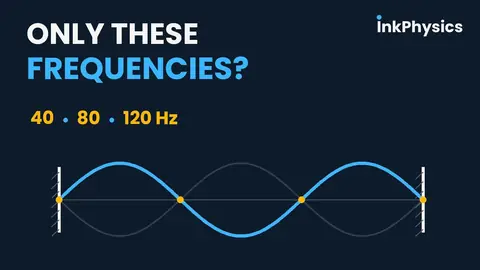
Two identical waves, one travelling each way (faint), and their point-by-point sum (cyan). The sum never travels: it pumps in place, pinned at the amber nodes, which never move; between them the string pumps within the envelope. Every three periods the travelling pair fades and the dashed envelope appears, the second figure this animation replaces.
Be careful with the name. The rope itself is still moving, in places more violently than either travelling wave would move it alone. What has stopped is the pattern. The crests no longer travel along the rope. Instead, each point of the rope oscillates about its rest position with a fixed amplitude of its own.
Nodes and antinodes
At certain points the two waves always arrive in antiphase, so they cancel and the rope there never moves at all. These points are called nodes. Midway between them the waves always arrive in phase and reinforce, so the rope swings with the largest amplitude found anywhere on the pattern. These points are antinodes.
That cancellation is total only when the two waves carry equal amplitudes, which is the condition for a pure stationary wave and the case every exam question means. A real support absorbs a little, so the returning wave comes back slightly weaker and the pattern is a partial one, its minima shallow rather than dead still. The spacing is unaffected: nodes and antinodes sit where they always sat, and only the depth of the minima changes.
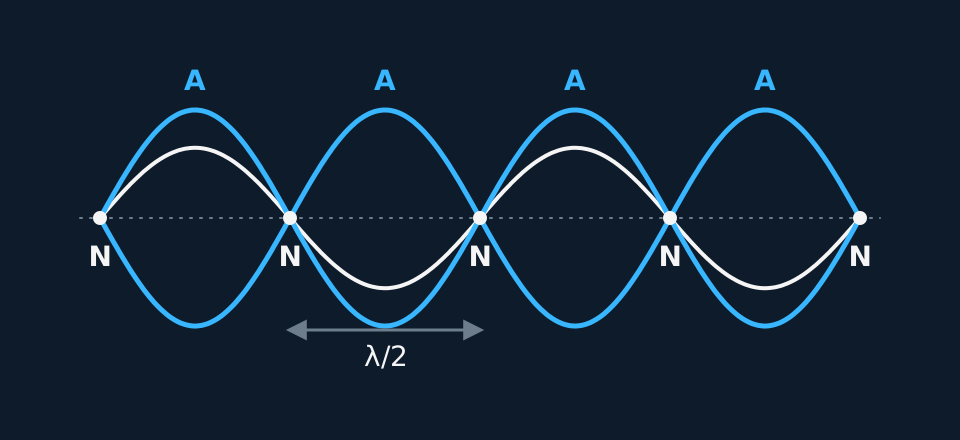
Two distances are worth learning. Adjacent nodes are apart, because one complete wavelength contains two loops of the pattern, not one. The distance from a node to the nearest antinode is .
A stationary wave also transfers no net energy along the rope. Each section keeps its own energy, which passes back and forth between kinetic and potential forms as the rope oscillates. Contrast this with a progressive wave, which carries energy from one place to another.
WORKED EXAMPLE
From node spacing to wave speed
Adjacent nodes on a vibrating string are 0.25 m apart, and the string is driven at 660 Hz. Find the wavelength and the wave speed on the string.
Adjacent nodes are half a wavelength apart, never a whole one, so λ = 2 × 0.25 = 0.50 m.
The speed belongs to the travelling waves the pattern is built from. v = fλ = 660 × 0.50 = 330 m s−1.
One wavelength spans two loops, so the node spacing is doubled to reach λ. Halving it instead gives an answer four times too small in the speed.
Harmonics on a stretched string
A string fixed at both ends must have a node at each end, because a fixed point cannot move. That single condition restricts the wavelengths the string can support: a pattern only fits if it places a whole number of loops between the two ends.
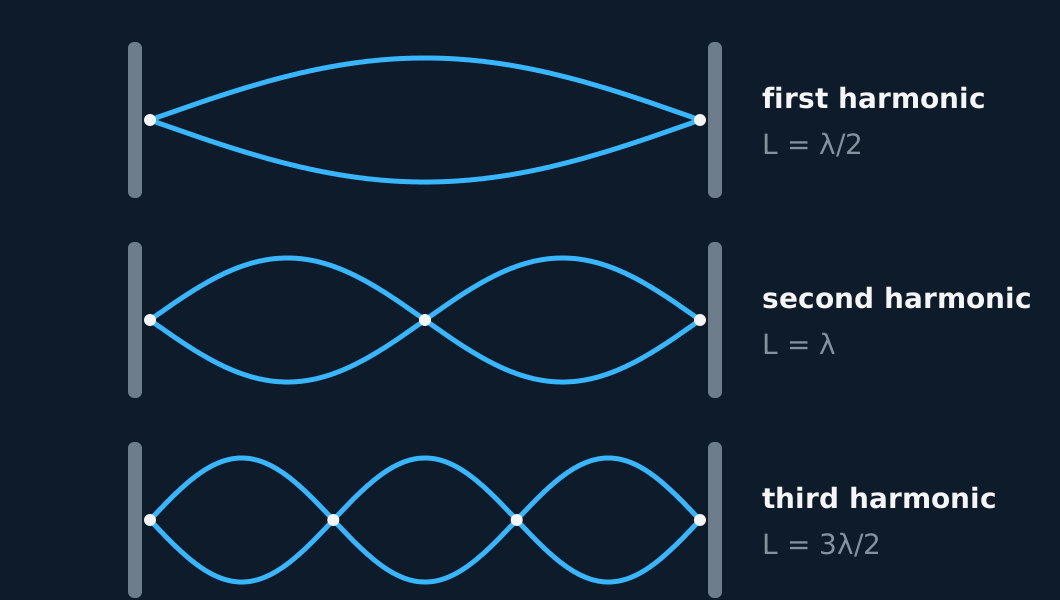
Each loop is half a wavelength, so a pattern of n loops on a string of length L has
The simplest pattern, n = 1, is the first harmonic. Many books call it the fundamental, and the two names mean the same pattern. It has the longest wavelength the string allows, 2L, and therefore the lowest frequency. The string fixes the wave speed, so forces the harmonic frequencies into whole-number multiples of the first, .
Two things fix that speed, and neither of them is the oscillator. A transverse wave travels along a stretched string at
where T is the tension in newtons and is the mass per unit length in kg m−1. Tighten the string and the wave runs faster; hang the same tension on a heavier string and it runs slower. Be clear about which speed this is. It is the speed of the travelling waves the pattern is built from, moving along the string, and not the speed of any point of the string, which is bobbing across it and passes through zero at every node. Edexcel prints this form and sets questions straight on it; the other boards print only the frequency it leads to.
That frequency is one substitution away. The first harmonic has , so , and putting the speed in gives
Raising the tension or using a lighter string raises the frequency. A guitarist works both handles, tightening the tuning pegs to change T and reaching for the thicker, heavier strings to play low notes.
WORKED EXAMPLE
A wave speed, then a note
A wire of length 0.65 m is stretched to a tension of 84 N. Its mass per unit length is 3.4 × 10⁻³ kg m−1. Find the speed of transverse waves on it, and its first-harmonic frequency.
Speed first, because the frequency is built from it. v = √(T/μ) = √(84/(3.4 × 10−3)) = √(2.47 × 10⁴) = 157 m s−1.
The first harmonic fits one loop, so λ = 2L = 1.30 m, and f1 = v/λ = 157/1.30 = 121 Hz, a note sitting between the open A and D strings of a guitar.
Doing it in two steps is worth the extra line. The speed belongs to the wire alone, so it stays the same however you fret or damp the wire, and every harmonic in the ladder is that one speed divided by a different wavelength.
GUIDED PRACTICE
The harmonic ladder on one string
A string 0.60 m long carries waves at 48 m s−1. Find the first-harmonic frequency and the second harmonic, starting from the first harmonic's wavelength.
Show the working
The fundamental fits one loop, so λ = 2L = 1.2 m, and f1 = v/λ = 48/1.2 = 40 Hz.
The second harmonic fits two loops, halving the wavelength and doubling the frequency: 80 Hz. The ladder climbs in integer multiples of the fundamental.
INDEPENDENT PRACTICE
Standing waves in a microwave oven
The melted spots on a chocolate bar in a microwave oven (turntable removed) sit 6.1 cm apart. Find the microwaves' wavelength and frequency, taking c = 3.0 × 10⁸ m s−1.
Show the working
The hot spots are antinodes, and adjacent antinodes sit half a wavelength apart, so λ = 2 × 0.061 = 0.12 m.
f = c/λ = 3.0 × 10⁸/0.122 = 2.5 GHz, the real operating frequency of a domestic oven. A chocolate bar and a ruler have just measured the wavelength that, with the known frequency, gives the speed of light.
Phase along a stationary wave
On a progressive wave, every point oscillates with the same amplitude, and there is a steady phase difference between one point and the next. A stationary wave differs on both counts. The amplitude depends on position, running from zero at a node to a maximum at an antinode, and only two phase relationships exist anywhere on the pattern.
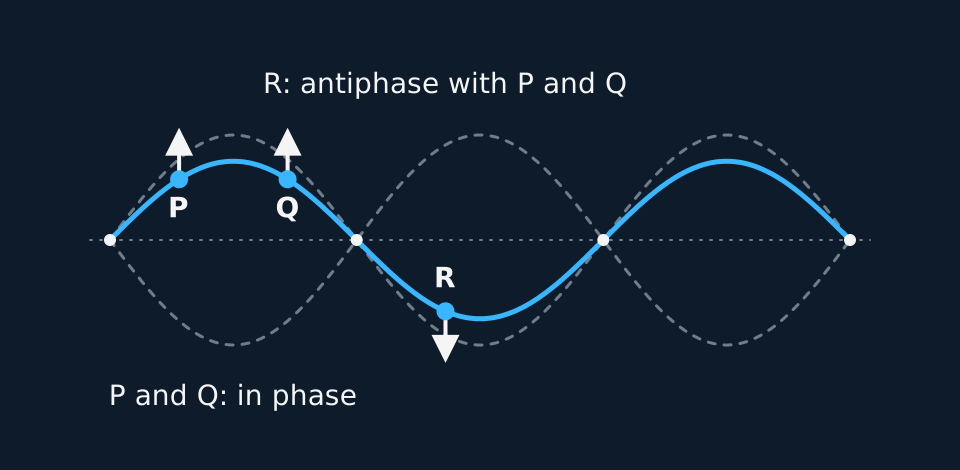
All the points between one pair of adjacent nodes move in phase. They reach their maximum displacements at the same instant, though each has its own amplitude. Points on opposite sides of a node move in antiphase, a phase difference of rad or 180°. Cross two nodes and the motion is back in phase.
The two ends a pipe can have has moved to the next part of this lesson.
Measuring the speed of sound in a resonance tube has moved to the next part of this lesson.
ASSESSMENT FOCUS
- Describing formation, say that two waves of the same frequency and equal amplitude, travelling in opposite directions, superpose. Describing the wave as “bouncing back and interfering with itself” names neither the equal amplitudes nor the opposite directions, so it is not a complete description of the formation.
- Adjacent nodes are apart, never . If in doubt, sketch two loops and read the wavelength off your own diagram.
- Write first harmonic on AQA papers: it is the term AQA's specification uses. “Fundamental” names the same pattern.
- In the first-harmonic equation, is mass per unit length. Grams convert to kilograms before you divide by the length, and the unit kg m−1 is there to remind you.
- Edexcel prints on its own and asks for the wave speed on a string as a question in its own right. The other boards print only , which is the same physics with already substituted in, so recover the speed from if a paper wants it.
- A phase-difference question about a stationary wave has only two possible answers, 0 or rad.
- The required practical asks for the proportionalities, so know them cold. At fixed length, . At fixed tension, and . A graph of against should be a straight line through the origin, and a conclusion is complete only when it states that.
CHECK YOURSELF
A string 1.20 m long is fixed at both ends and vibrates in its third harmonic. (a) What is the wavelength? (b) At the same tension, how does its frequency compare with the first harmonic?
Show a hint
How many half-wavelengths fit into the 1.20 m?
Show the answer
(a) The third harmonic has three loops. Each loop is half a wavelength, so , which gives = 2 × 1.20 / 3 = 0.80 m.
(b) The wave speed depends only on the tension and the mass per unit length, so it has not changed. In the first harmonic the wavelength is 2L = 2.40 m. The wavelength has fallen by a factor of three, so by the frequency has risen by the same factor: the third harmonic is three times the frequency of the first.
The fixed ends select which wavelengths can resonate, and the wave speed, unchanged here, turns each of those wavelengths into a frequency. The oscillator sets the driving frequency; the ends and the wave speed on the string decide which driving frequencies resonate.
In an ideal stationary wave, there is no net energy transfer along the string.
Adjacent nodes are half a wavelength apart.
WORKBOOK
Printable practice for this topic: original exam-style questions with room to work, and a fully worked answer book. Free to use; please do not redistribute or sell.
Or read them with their mark schemes on the stationary waves on strings questions page.
WHERE TO GO NEXT
- Required practical 1: stationary waves on a string puts this topic in the lab, and the written papers ask about it.
CHECK YOUR PROGRESS
Rate how confident you feel with each objective for this lesson. Ratings are saved in this browser, on this device, unless you sign in.
- Describe how two travelling waves superpose to form a stationary wave, and define node and antinode.
- Use the node and antinode spacings, and , to get from a measured distance to a wavelength.
- Find the allowed wavelengths of a string fixed at both ends, and use and the first-harmonic frequency equation.
- State the amplitude and phase relationships that separate stationary waves from progressive ones.
Open the full revision checklist to track your progress across the whole unit.