Physics › Waves › Stationary waves in air columns
Stationary waves in air columns
A closed end of a pipe is a displacement node and an open end an antinode, and those two conditions fix which wavelengths an air column holds. A closed tube fits an odd number of quarter wavelengths and sounds only the odd harmonics; an open tube sounds every one. Two resonance lengths give the speed of sound.
Choose your exam board to show the notes and questions relevant to your specification. You can change this setting at any time, and content for other boards remains available.
Stationary waves, part 2 of 2. Part 1 is Stationary waves on strings.
IN THIS TOPIC
- Say why a closed end of a pipe must be a displacement node and an open end an antinode.
- Work out the harmonics of an air column in a closed and in an open tube, and say why a closed tube sounds only the odd ones.
- Describe the resonance-tube method for the speed of sound, and say why it uses two lengths rather than one.
COMMON MISCONCEPTION
Two pipes of the same length sound the same note.
Length is only half of what decides the note. A pipe closed at one end fits a quarter of a wavelength, so it sounds 4L; a pipe open at both ends fits a half, so it sounds 2L, an octave higher on the same length. The ends decide the pattern, and the length then decides its size.
The two ends a pipe can have
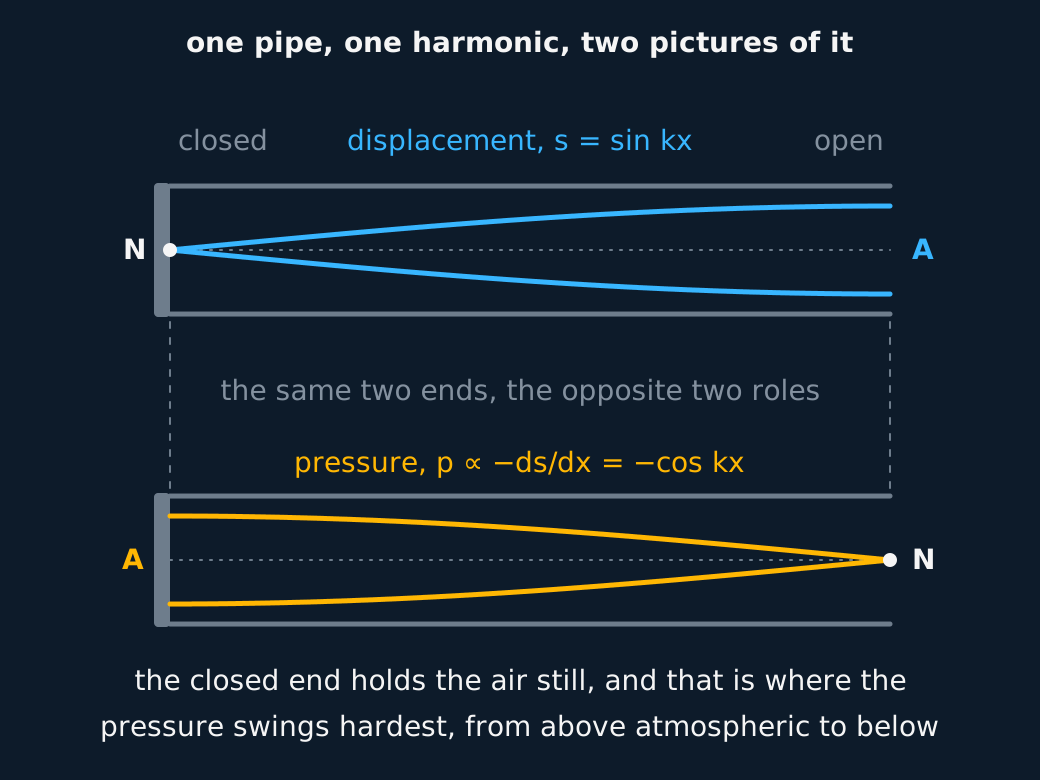
A closed end is a displacement node and an open end is a displacement antinode. Blow across the mouth of a bottle, or into an organ pipe, and the note you hear is a stationary wave in the column of air inside: a sound wave runs down the tube, reflects at the far end, and superposes with the wave still arriving. What differs from a string is the boundary conditions, because a pipe can have one end of each kind.
The air touching a solid wall cannot move back and forth along the tube, which is why a closed end is a node. The air at an open end is free, and moves further than anywhere else in the pipe, which is why an open end is an antinode. Those are displacement nodes and antinodes, which is how pipe diagrams are drawn; the pressure variation is the inverse, largest at the closed end and smallest at the open end.
The spacings are unchanged from the string: node to node or antinode to antinode is , and node to the nearest antinode is . Name the two ends first, then count quarters and halves between them.
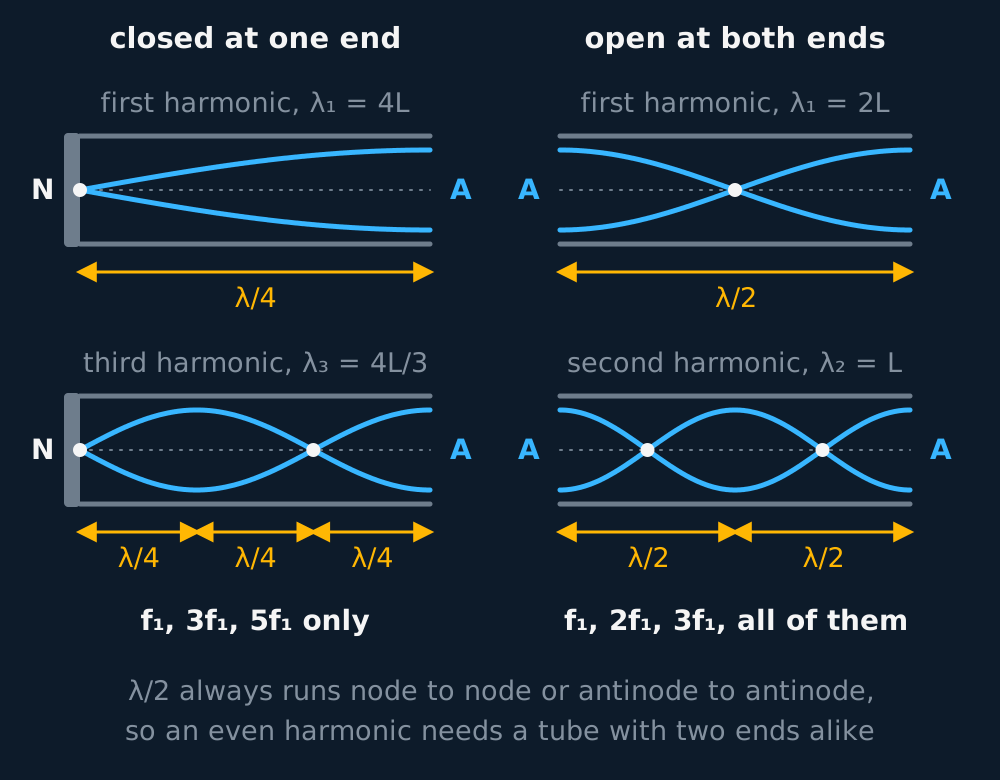
Take a tube closed at one end and open at the other. It needs a node at one end and an antinode at the other, and the shortest pattern that manages that is a single quarter of a wavelength. So the first harmonic of a closed tube of length L has
which is already a result worth pausing on: the pipe sounds a wavelength four times its own length, twice as long as the longest wavelength a string of the same length can carry.
Why a closed tube sounds only the odd harmonics
The next pattern that fits must still start at a node and finish at an antinode, so it adds half a wavelength: , then , and onwards. Every length the tube allows is an odd number of quarter wavelengths, so with n odd,
and the frequencies climb , , , with the even harmonics missing altogether. The reason is the mismatch between the ends. An even number of quarter wavelengths is a whole number of half wavelengths, and half a wavelength always runs node to node or antinode to antinode, which would demand the same kind of end at both ends of the tube. A closed tube has one of each and can never fit one. The gap is audible, and it is what gives a stopped organ pipe and a clarinet their hollow tone.
A tube open at both ends needs an antinode at each end instead. Antinode to antinode is half a wavelength, so its first harmonic has and every whole number of half wavelengths fits after that, with n taking every whole value. An open tube therefore supports all integer harmonics, , , , the same series as the stretched string but built between two antinodes rather than two nodes. Compare the two pipes at equal length and the closed one starts from the longer wavelength, 4L against 2L, so it sounds an octave lower and on half as many harmonics.
WORKED EXAMPLE
Two pipes of the same length
A tube 0.30 m long is closed at one end. Sound travels at 340 m s−1. Find its first-harmonic frequency and the next frequency it can sound, then find what its first harmonic would be with both ends open.
Closed at one end means a node there and an antinode at the open top, so a quarter wavelength fits the tube: λ1 = 4L = 1.20 m.
f1 = v/λ = 340/1.20 = 283 Hz. The next resonance is the third harmonic, since no even one can fit, so the tube's next strong response is at 850 Hz; driven between the two it still responds, only far more quietly.
Open both ends and an antinode sits at each, so half a wavelength fits: λ1 = 2L = 0.60 m and f1 = 340/0.60 = 567 Hz, an octave above the closed pipe of identical length. That one is free to sound 1130 Hz next rather than skipping it.
GUIDED PRACTICE
Which pipe is this?
A pipe sounds strongly at 200 Hz and again at 600 Hz, with nothing in between. Say which kind of pipe it is, and find its length, taking the speed of sound as 340 m s−1.
Show the working
The second resonance is three times the first, not twice, so the even harmonics are missing and the pipe is closed at one end.
The first harmonic has λ = v/f = 340/200 = 1.70 m, and a closed tube holds a quarter of that: L = λ/4 = 0.425 m. Reading the ratio of the two frequencies before touching a length is what identifies the pipe.
Measuring the speed of sound in a resonance tube
The closed pipe gives a way to measure the speed of sound with nothing more than a tuning fork and a metre rule. Stand a long tube upright with its lower end in a tall cylinder of water, so the water surface closes the bottom while the top stays open. Raising or lowering the tube changes the length of the trapped air column, which makes it a closed pipe you can tune.
Strike a tuning fork of known frequency f and hold it flat, a centimetre or so above the open top, taking care that it never touches the glass. Start with the air column short and lengthen it slowly. At one length the sound swells suddenly, because the column's first harmonic has come into step with the fork and the column is resonating. Record that length , measured from the top of the tube down to the water surface. Keep going and a second, quieter resonance arrives at , where the same column is running in its third harmonic.
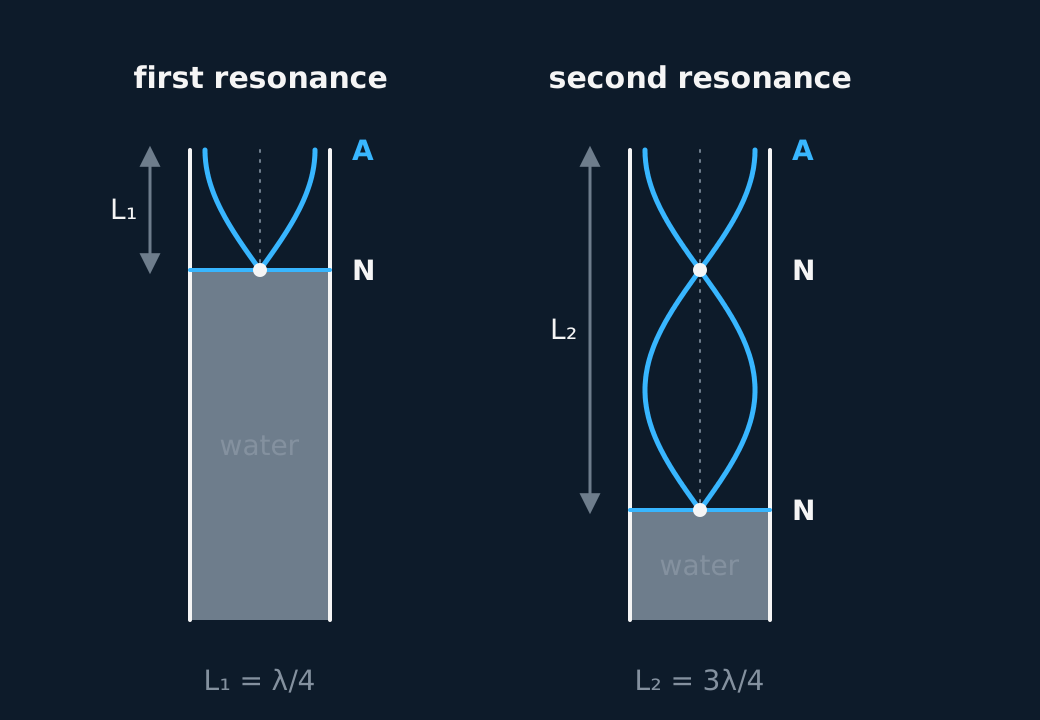
Those two lengths are a quarter and three quarters of the same wavelength, so their difference is half a wavelength, , and the speed follows.
Taking the difference rather than trusting alone is the reason for the second reading. The antinode actually forms slightly above the open end rather than exactly at it, so every length you measure is short by the same small amount, and subtracting one reading from the other cancels it out. CIE tells you to treat that offset as negligible, and this is the measurement that lets you.
Two habits sharpen the result. Approach each resonance from both directions, once lengthening the column and once shortening it, and average the pair, because the loudness peak is broad and easy to overshoot. Then swap the fork for others of different frequency and repeat: since is close to , a graph of against comes out straight with gradient v/4, and its small negative intercept is the offset you have just been cancelling.
INDEPENDENT PRACTICE
The speed of sound from two lengths
A 512 Hz fork resonates with a closed air column first at 15.8 cm and again at 49.0 cm. Find the wavelength and the speed of sound, then work out what the first length alone would have given.
Show the working
The two resonances sit at λ/4 and 3λ/4, so the gap between them is half a wavelength: λ = 2 × (0.490 − 0.158) = 0.664 m.
v = fλ = 512 × 0.664 = 340 m s−1, the textbook value, out of a fork and a ruler.
From alone, λ = 4 × 0.158 = 0.632 m and v = 324 m s−1, five per cent low. The eight millimetres by which the antinode overshoots the open end is exactly what the subtraction removed.
ASSESSMENT FOCUS
- In a pipe, mark the ends before drawing the pattern: closed end a node, open end an antinode. A curve drawn first and labelled afterwards can be one that the ends do not allow.
- A closed tube sounds only the odd harmonics, , , . Doubling a closed pipe's first harmonic names a frequency it cannot produce, so the next note up is three times the first, not twice.
- Pipe diagrams are displacement patterns unless a question says otherwise, so the closed end is where the curve is pinned. A question about pressure needs the inverse pattern: pressure varies most at the end where displacement varies least, so a displacement pattern offered as a pressure pattern states the maximum at the wrong end.
- In the resonance tube, quote rather than . The difference of two lengths needs no end correction at the open end, and an explanation is complete only when it says so.
- OCR lists the resonance tube as a technique in its own right, so the method is examinable as a method: which two lengths are measured, what the column is doing at each, and why their difference rather than either one is the quantity the speed is built from.
CHECK YOURSELF
An organ pipe 0.55 m long and closed at one end sounds a first harmonic of 155 Hz. (a) Find the speed of sound in the pipe. (b) The stopper is removed, so the pipe is now open at both ends. What is its first-harmonic frequency?
Show a hint
Mark the ends before anything else. What must the air do at a closed end, and what at an open one?
Show the answer
(a) Closed at one end means a node there and an antinode at the open end, so a quarter wavelength fits the pipe: = 4 × 0.55 = 2.20 m. Then v = fλ = 155 × 2.20 = 341 m s−1.
(b) Open at both ends puts an antinode at each, so a half wavelength fits: = 1.10 m. The speed of sound has not changed, because it belongs to the air rather than to the pipe, so f = 341/1.10 = 310 Hz.
Exactly double, and that is the general result rather than a coincidence of these numbers: at the same length, opening the far end halves the first-harmonic wavelength from 4L to 2L, so the pipe jumps an octave. It also stops skipping, and can now sound 620 Hz next instead of 930 Hz.
A closed end is a node and an open end an antinode.
A closed tube fits an odd number of quarter wavelengths, so it sounds only the odd harmonics.
In the resonance tube it is the difference of two lengths that gives the wavelength.
Or read them with their mark schemes on the stationary waves on strings questions page.
CHECK YOUR PROGRESS
Rate how confident you feel with each objective for this lesson. Ratings are saved in this browser, on this device, unless you sign in.
- Say why a closed end of a pipe must be a displacement node and an open end an antinode.
- Work out the harmonics of an air column in a closed and in an open tube, and say why a closed tube sounds only the odd ones.
- Describe the resonance-tube method for the speed of sound, and say why it uses two lengths rather than one.
Open the full revision checklist to track your progress across the whole unit.