Physics › Waves › Total internal reflection and optical fibres
Total internal reflection and optical fibres
Light leaving a denser medium bends away from the normal, and past the critical angle it stops crossing the boundary and reflects back inside. Total internal reflection needs a lower refractive index on the far side as well as that steep angle. A step-index optical fibre uses it thousands of times a metre; modal and material dispersion set the limit.
Choose your exam board to show the notes and questions relevant to your specification. You can change this setting at any time, and content for other boards remains available.
Refraction and total internal reflection, part 2 of 2. Part 1 is Refraction and Snell's law.
IN THIS TOPIC
- State both conditions for total internal reflection, and calculate a critical angle.
- Describe a step-index optical fibre and the three jobs the cladding does.
- Separate modal from material dispersion, and match each one to its fix.
COMMON MISCONCEPTION
Total internal reflection happens at any boundary, as long as you hit it steeply enough.
A steep hit is not enough. Total internal reflection needs the light to travel towards a medium of lower refractive index, with the angle of incidence greater than the critical angle.
The critical angle and total internal reflection
Now send the light the other way, from glass towards air. It bends away from the normal, so the refracted ray is always at a larger angle than the ray inside the glass. Increase the angle of incidence and the refracted ray leans further and further towards the surface. At one particular incidence, the critical angle , the refracted ray runs exactly along the boundary. Setting in Snell's law gives
valid when . For glass to air, , so .

Beyond the critical angle no angle satisfies Snell's law, and the light cannot leave. All of it reflects back into the glass, obeying the ordinary law of reflection. That is total internal reflection, and it needs two conditions at once. The light must be travelling towards a lower refractive index, and it must meet the boundary beyond the critical angle. Light going from air into glass can never be totally internally reflected, however steep the angle you choose.
Optical fibres
A step-index optical fibre is a thin glass core wrapped in cladding, a layer of glass with a slightly lower refractive index. Light entering the core meets the core-cladding wall beyond the critical angle and reflects, again and again, until it emerges at the far end.
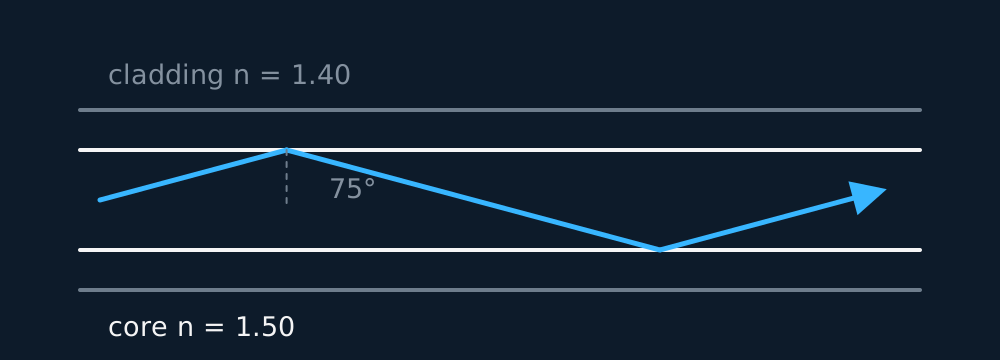
The cladding earns its place three times over: it provides the lower refractive index that makes TIR possible, it protects the core surface from scratches that would let light leak away, and it stops light crossing between fibres bundled side by side, which would scramble their signals.
Real signals are pulses, and a pulse smears out as it travels, an effect called pulse broadening. Two things cause it. Modal dispersion comes from geometry, because rays bouncing at different angles cover different total distances and so arrive at different times. Make the core very narrow and every ray is forced onto much the same path. Material dispersion comes from the glass, in which different wavelengths travel at slightly different speeds, so a pulse of white light spreads in time. Monochromatic light removes that spread.
A broadened pulse can overlap its neighbour and corrupt the information. Separately, absorption in the glass weakens the pulse, and long lines therefore need repeaters.
INDEPENDENT PRACTICE
The critical angle inside a fibre
A fibre's core has n = 1.52 and its cladding n = 1.43. Find the critical angle at the core-cladding boundary, and state what becomes of rays that meet the wall at a larger angle to the normal.
Show the working
At a boundary between two media, sin C = n2/n1 = 1.43/1.52 = 0.941, so C = 70°.
Rays meeting the wall beyond 70° from the normal are skimming along the fibre, and they are totally internally reflected back into the core, which is how light is meant to travel down a fibre. Rays that strike the wall inside the critical angle leak away into the cladding, so the steep zigzag paths, the ones that smear pulses worst, are shed early.
ASSESSMENT FOCUS
- Every angle in this topic is measured from the normal. When a question quotes an angle from the surface, subtract it from 90° first.
- In a critical angle the smaller index goes on top, with . A calculator complaining about is telling you the fraction is upside down.
- State both TIR conditions, into a lower refractive index and beyond the critical angle. Either condition alone is satisfied by rays that do escape.
- “Explain the purpose of the cladding” has three creditable points. It supplies the lower n that makes TIR possible, it protects the core surface from scratches, and it stops signals crossing between fibres in a bundle.
- Pulse broadening questions want the cause named and the fix matched to it. Narrow core for modal dispersion, monochromatic light for material dispersion.
CHECK YOURSELF
A glass block has a refractive index of 1.50. Calculate the critical angle for light travelling from this glass into air.
Show a hint
Which refractive index belongs on top of the fraction?
Show the answer
Going from glass () into air (), the condition holds, so a critical angle exists.
= 1.00 / 1.50 = 0.667, so = sin−1(0.667) = 41.8°.
Any ray inside this glass that meets the surface at more than 41.8° to the normal cannot get out; it is totally internally reflected as if the surface were a mirror.
TIR needs a lower n on the far side,
and an angle past the critical one.
Or read them with their mark schemes on the refraction and snell's law questions page.
CHECK YOUR PROGRESS
Rate how confident you feel with each objective for this lesson. Ratings are saved in this browser, on this device, unless you sign in.
- State both conditions for total internal reflection, and calculate a critical angle.
- Describe a step-index optical fibre and the three jobs the cladding does.
- Separate modal from material dispersion, and match each one to its fix.
Open the full revision checklist to track your progress across the whole unit.