Chemistry › Alkanes and halogenoalkanes › Alkanes: fractional distillation, cracking and combustion
Alkanes: fractional distillation, cracking and combustion
The gas in a Bunsen burner, the petrol in a car and the bitumen on a road all come out of one barrel of crude oil, separated by boiling point. Cracking turns the long molecules nobody wants into short ones and alkenes that everybody does, and burning them makes the pollutants that catalytic converters and flue-gas scrubbers are built to remove.
Key terms Every definition in alkanes and halogenoalkanes, lesson by lesson
Before this Electronegativity, polarity and intermolecular forces – van der Waals forces and why they grow with the number of electrons · Naming and representing organic molecules – homologous series, general formulae and branched-chain names · Reacting masses, percentage yield and atom economy – moles from mass and the mole ratio
COMMON MISCONCEPTION
Longer alkanes boil at higher temperatures because there are more covalent bonds to break.
Boiling breaks no covalent bonds; the molecules leave the liquid whole. A longer alkane has more electrons and more surface contact, so the induced dipole–dipole forces between its molecules are stronger and more energy is needed to separate them. Branching lowers the boiling point by reducing contact.
What you should be able to do
- Explain why the boiling points of alkanes rise with chain length and fall with branching, in terms of van der Waals forces.
- Describe how crude oil is separated by fractional distillation, and say where in the column each fraction condenses.
- Compare thermal and catalytic cracking: conditions, intermediates, products and the economic reason for each.
- Write equations for complete and incomplete combustion, and give the origin of each pollutant from an engine or a power station.
- Write equations for the reactions in a catalytic converter and in flue-gas desulfurisation, and outline the greenhouse effect.
- Outline reforming, and explain the part nitrogen oxides play in photochemical smog and acid rain.CAIE · Edexcel
Saturated hydrocarbons and their boiling points
The gas in a Bunsen burner, the liquid sloshing in a camping-stove canister and the wax of a candle are all alkanes. Methane, CH₄, has one carbon atom; the butane in the canister has four; candle wax has twenty to forty. They belong to one homologous series, with the general formula CₙH₂ₙ₊₂, and each member differs from the next by CH₂.
An alkane is a hydrocarbon, made of carbon and hydrogen only, and it is saturated: every bond between carbon atoms is a single bond, so each carbon forms four single bonds and no further atoms can be added. The four bonds round each carbon point to the corners of a tetrahedron at 109.5°, so a carbon chain is a zigzag, not a straight line.
Alkanes are unreactive towards acids, alkalis and most oxidising agents. C–C and C–H bonds are strong, and they are almost non-polar, because carbon and hydrogen have similar electronegativities, so there is no δ+ or δ− site for an ion to attack. Two reactions matter at A level: alkanes burn, and they react with halogens in ultraviolet light.
- Hydrocarbon
- A compound that contains hydrogen and carbon atoms only.
- Saturated
- Containing only single bonds between carbon atoms, so that no more atoms can be added to the molecule.
- Homologous series
- A family of compounds with the same functional group and general formula, in which each member differs from the next by CH₂.
Boiling points rise along the series, from −162 °C for methane to 69 °C for hexane. Molecules of an alkane are held to one another only by van der Waals forces, the attractions between induced dipoles. A longer chain has more electrons and a larger surface in contact with its neighbours, so the induced dipoles are larger and there are more points of contact between molecules. The forces between molecules are stronger and more energy is needed to separate them. Boiling an alkane breaks none of its covalent bonds. Write 'van der Waals forces between molecules' in an answer, not 'bonds': the word suggests that the C–C or C–H bonds break, and they do not.
| Alkane | Formula | Boiling point / °C |
|---|---|---|
| Methane | CH₄ | −162 |
| Ethane | C₂H₆ | −89 |
| Propane | C₃H₈ | −42 |
| Butane | C₄H₁₀ | −1 |
| Pentane | C₅H₁₂ | 36 |
| 2-methylbutane | C₅H₁₂ | 28 |
| 2,2-dimethylpropane | C₅H₁₂ | 10 |
| Hexane | C₆H₁₄ | 69 |
Branching lowers the boiling point. Pentane, 2-methylbutane and 2,2-dimethylpropane are isomers with the same number of electrons, yet they boil at 36 °C, 28 °C and 10 °C. A branched molecule is more compact, closer to a sphere, and cannot lie alongside its neighbours as a zigzag chain can. The surface in contact is smaller, so the van der Waals forces between the molecules are weaker.
Putting three alkanes in order
Put heptane, hexane and 2-methylpentane in order of boiling point, lowest first, and explain the order.
Show the working
Hexane and 2-methylpentane are both C₆H₁₄, so they have the same number of electrons. Heptane, C₇H₁₆, has eight more electrons and a longer chain than either.
Heptane therefore has the strongest van der Waals forces between its molecules and the highest boiling point (98 °C).
Of the two C₆ isomers, 2-methylpentane is branched, so its molecules have less surface in contact and weaker van der Waals forces between them than hexane's. It boils lower (60 °C against 69 °C).
So the order, lowest first, is 2-methylpentane, hexane, heptane. No covalent bond is broken in any of them.
Fractional distillation of crude oil
Crude oil is a mixture of hundreds of hydrocarbons, most of them alkanes, with anything from one carbon atom to more than fifty. As it comes out of the ground it is no use to anyone. Separated into fractions, groups of hydrocarbons with similar chain lengths and so similar boiling points, it gives bottled gas, petrol, jet fuel, diesel, lubricating oil and the bitumen on a road.
The oil is heated in a furnace to about 350 °C, which vaporises most of it, and fed into the bottom of a tall column. The column is hottest at the bottom and coolest at the top. Vapour rises through it, bubbling up through a series of trays. At each tray the vapour meets liquid at that tray's temperature: hydrocarbons with boiling points above it condense, and the rest carry on upwards. Each tray therefore collects a liquid with a narrow range of boiling points, and it is drawn off at the side.
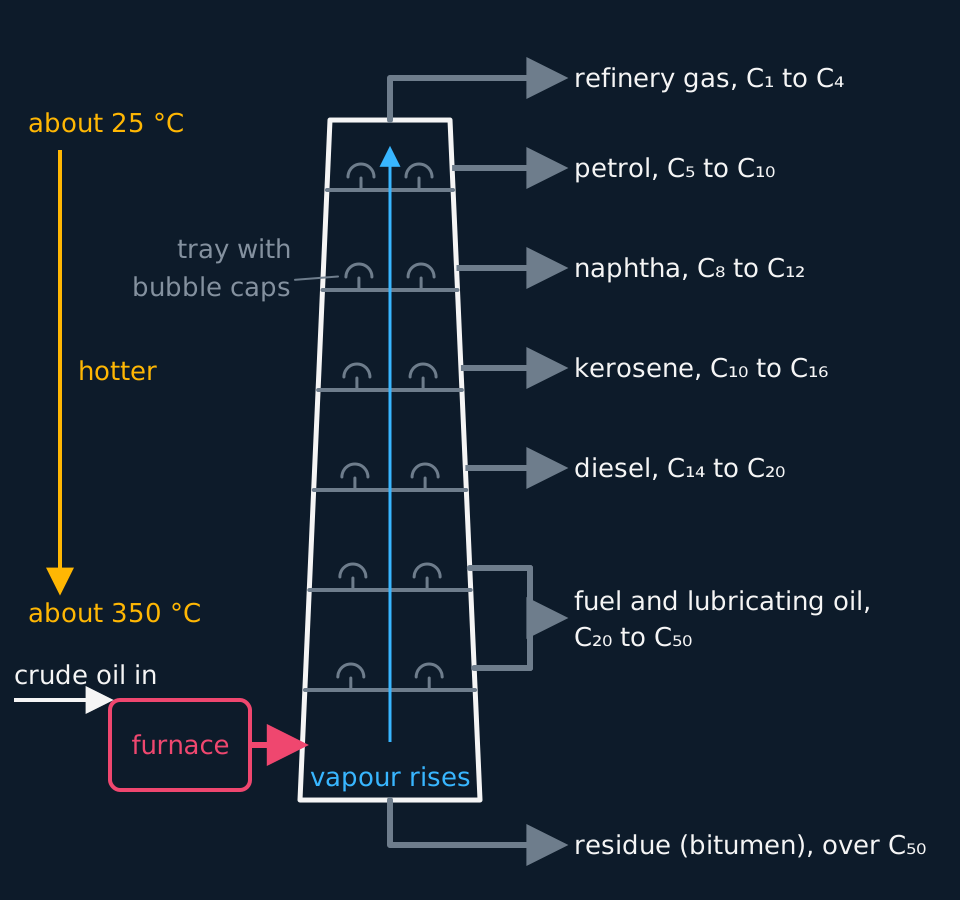
Describe the drawing
A tall fractionating column, narrower at the top, with six horizontal trays inside, each carrying two bubble caps. Crude oil is heated in a furnace at the bottom left and enters the base of the column as vapour, which rises up the centre. A temperature arrow on the left runs from about 25 °C at the top down to about 350 °C at the bottom. Pipes lead off to the right: refinery gas, C₁ to C₄, from the top, then petrol, naphtha, kerosene and diesel from the upper four trays, fuel and lubricating oil, C₂₀ to C₅₀, from the lowest two, and the bitumen residue from the very bottom.
The smallest molecules, with the weakest van der Waals forces, never condense in the column and leave the top as refinery gas. The largest do not vaporise at 350 °C at all; they leave the bottom as a residue. That residue is distilled a second time at reduced pressure, which lowers its boiling points enough to separate it without heating it to the temperature at which its molecules would break up.
| Fraction | Carbon atoms | Boiling range / °C | Used for |
|---|---|---|---|
| Refinery gas | 1 to 4 | below 25 | Bottled gas, chemical feedstock |
| Petrol (gasoline) | 5 to 10 | 25 to 110 | Car fuel |
| Naphtha | 8 to 12 | 110 to 180 | Feedstock for chemicals |
| Kerosene | 10 to 16 | 180 to 250 | Jet fuel, paraffin |
| Diesel (gas oil) | 14 to 20 | 250 to 350 | Diesel fuel, heating oil |
| Fuel oil and lubricating oil | 20 to 50 | above 350 | Ships, power stations, lubricants |
| Bitumen | over 50 | residue | Roads and roofing |
- Fraction
- A mixture of hydrocarbons with similar chain lengths, and so with boiling points in a narrow range.
- Fractional distillation
- Separation of a mixture into fractions by boiling point, in a column with a temperature gradient that is hottest at the bottom.
Cracking
Fractional distillation gives whatever proportions the crude oil contains, and those are not the proportions that sell. A typical crude yields more of the heavy fractions than the market takes, and less petrol and naphtha than it wants. Cracking breaks long-chain alkanes from the surplus fractions into shorter, more valuable molecules. It also makes alkenes, which crude oil barely contains and which the chemical industry needs as the starting point for polymers.
Cracking breaks C–C bonds. A long alkane does not have enough hydrogen to make two shorter alkanes, so at least one product is always an alkene:
C₁₀H₂₂(g) → C₈H₁₈(g) + C₂H₄(g)decane gives octane, for petrol, and ethene, for poly(ethene)
Thermal cracking uses a high temperature, 400 to 900 °C, and a high pressure, up to 7000 kPa, for about a second, so that the products do not decompose further. The C–C bonds break homolytically and the reaction goes through radicals. The products contain a high proportion of alkenes, ethene in particular, and thermal cracking is the main source of the alkenes the polymer industry uses.
Catalytic cracking passes the vapour over a zeolite catalyst, a crystalline aluminosilicate riddled with pores, at about 450 °C and a slight pressure. The catalyst lets the reaction run at a lower temperature, which saves energy. The reaction goes through ions rather than radicals, and the products are mainly branched alkanes, cycloalkanes and aromatic hydrocarbons. Those are the molecules a petrol engine needs, because they burn smoothly without igniting too early, so catalytic cracking is the main source of motor fuel.
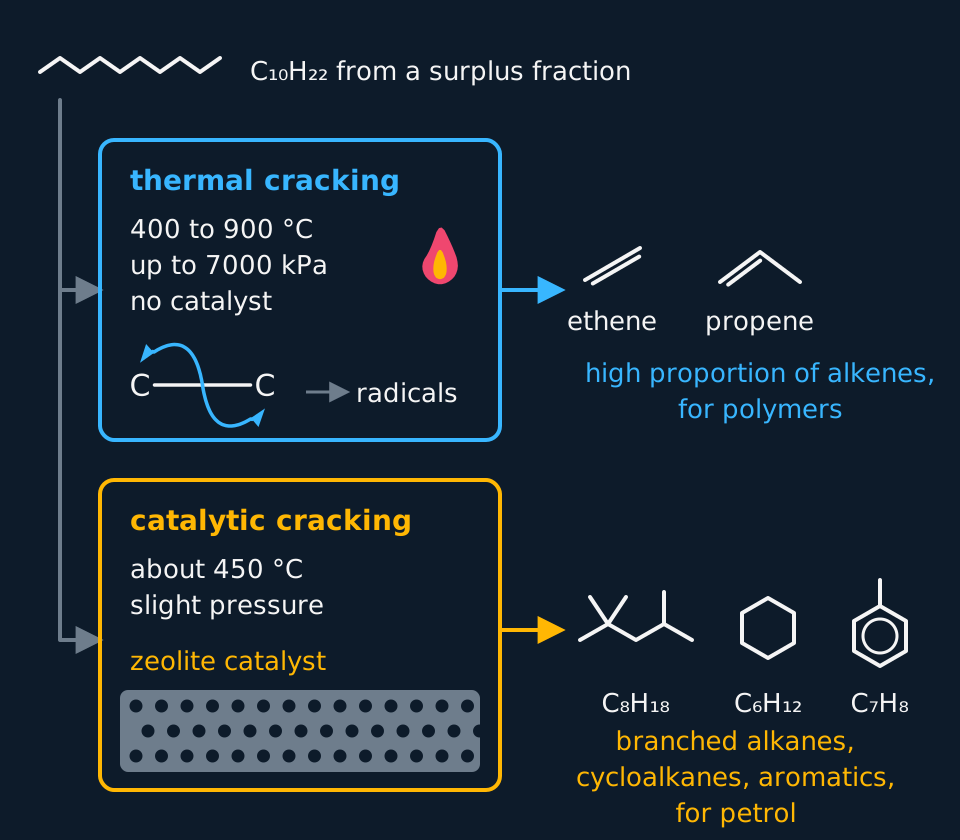
Describe the drawing
One long alkane, decane, drawn as a zigzag at the top left, feeds two processes. The thermal cracking box gives 400 to 900 °C, up to 7000 kPa and no catalyst, with a flame and a sketch of a C–C bond splitting into two radicals by two half-headed arrows; it leads to ethene and propene, a high proportion of alkenes for polymers. The catalytic cracking box gives about 450 °C and slight pressure over a porous zeolite catalyst; it leads to a branched alkane, cyclohexane and methylbenzene, for petrol.
| Thermal cracking | Catalytic cracking | |
|---|---|---|
| Temperature | 400 to 900 °C | about 450 °C |
| Pressure | High, up to 7000 kPa | Slight, just above atmospheric |
| Catalyst | None | Zeolite |
| Intermediates | Radicals | Carbocations (ions) |
| Main products | A high proportion of alkenes | Branched alkanes, cycloalkanes, aromatic hydrocarbons |
| Made for | Ethene and propene for polymers | Petrol |
Both kinds are chosen by what the refinery needs more of. Where the demand is for ethene and propene, thermal cracking is run; where it is for petrol, catalytic cracking. The economic reason has two halves, and an answer needs both: the surplus heavy fractions sell for less than the products, and the products are ones crude oil cannot supply in the amounts wanted.
- Cracking
- The breaking of C–C bonds in long-chain alkanes to form shorter alkanes and alkenes.
TRY IT: An equation for thermal cracking
Dodecane, C₁₂H₂₆, is thermally cracked to give octane and ethene only. Write the equation, and state why thermal cracking is chosen when ethene is the product wanted.
Check your answer
Octane is C₈H₁₈. That leaves 12 − 8 = 4 carbon atoms and 26 − 18 = 8 hydrogen atoms, which is two molecules of ethene, C₂H₄.
C₁₂H₂₆(g) → C₈H₁₈(g) + 2C₂H₄(g). Check: 12 carbon and 26 hydrogen atoms on each side.
Thermal cracking goes through radicals and gives a high proportion of alkenes, whereas catalytic cracking gives mainly branched alkanes and aromatics for fuel.
Combustion and what comes out of the exhaust
Burned in plenty of oxygen, an alkane gives carbon dioxide and water and releases a great deal of energy, and that energy is what the alkanes are burned for. This is complete combustion:
C₈H₁₈(l) + 12½O₂(g) → 8CO₂(g) + 9H₂O(l)complete combustion of octane
In a limited supply of oxygen, as in a gas fire with a blocked flue or an engine running short of air, there is not enough oxygen to take all the carbon to carbon dioxide. Carbon monoxide forms, and so does carbon itself, as soot. That is incomplete combustion:
CH₄(g) + 1½O₂(g) → CO(g) + 2H₂O(l)carbon monoxide
CH₄(g) + O₂(g) → C(s) + 2H₂O(l)soot
Carbon monoxide is toxic. It binds to the iron in haemoglobin more strongly than oxygen does, so the blood carries less oxygen, and it has neither colour nor smell, so a home with a gas boiler needs a detector to warn of it. Soot particles irritate the airways, worsen asthma and are linked to lung cancer.
Two more pollutants come from something other than the fuel's carbon. The spark and the high temperature in an engine cylinder make nitrogen and oxygen from the air react, so the nitrogen in nitrogen oxides, NOₓ, was never in the petrol. Sulfur compounds are impurities in crude oil and coal, and burn to sulfur dioxide. Both oxides dissolve in rain to make it acidic.
N₂(g) + O₂(g) → 2NO(g)in the cylinder; outside, 2NO(g) + O₂(g) → 2NO₂(g)
Nitrogen is four-fifths of the air and passes through an ordinary flame untouched. The N≡N triple bond, 945 kJ mol⁻¹, is one of the strongest bonds there is, and the molecule is non-polar, so its reaction with oxygen has a very high activation energy. Only at the temperature of an engine cylinder or a lightning bolt do enough collisions have that energy. Lightning is the natural source of NOₓ; engines and power stations are the man-made ones.
| Pollutant | Where it comes from | What it does |
|---|---|---|
| Carbon monoxide | Incomplete combustion | Toxic: reduces the oxygen the blood carries |
| Carbon particulates (soot) | Incomplete combustion | Lung damage, asthma, blackened buildings |
| Nitrogen oxides, NOₓ | N₂ and O₂ from the air, at high temperature in the engine | Acid rain, photochemical smog; NO₂ is toxic |
| Sulfur dioxide | Sulfur impurities in the fuel | Acid rain, which damages lakes, trees and limestone |
| Unburnt hydrocarbons | Fuel that passes through the engine unburnt | Photochemical smog, with NOₓ in sunlight |
| Carbon dioxide | Complete combustion | Greenhouse gas |
Unburnt hydrocarbons are fuel that went through the engine without burning, either because the mixture was too rich or because the flame went out near the cold cylinder walls. They are a waste of fuel, some are toxic, and with NOₓ in sunlight they make smog.
Carbon dioxide from a kilogram of petrol
Taking petrol to be pure octane, calculate the mass of carbon dioxide produced when 1.00 kg burns completely. Ar: H 1.0, C 12.0, O 16.0.
Show the working
Mr(C₈H₁₈) = (8 × 12.0) + (18 × 1.0) = 114.0, so the amount of octane is 1000 ÷ 114.0 = 8.772 mol.
From the equation, 1 mol of octane gives 8 mol of CO₂, so the amount of CO₂ is 8 × 8.772 = 70.18 mol.
Mr(CO₂) = 12.0 + (2 × 16.0) = 44.0, so the mass of CO₂ is 70.18 × 44.0 = 3088 g = 3.09 kg to three significant figures.
The carbon dioxide weighs about three times as much as the fuel, because each carbon atom of mass 12 leaves with two oxygen atoms of mass 16 taken from the air.
- Complete combustion
- Burning in a plentiful supply of oxygen, in which the carbon in a fuel is oxidised to carbon dioxide and the hydrogen to water.
- Incomplete combustion
- Burning in a limited supply of oxygen, giving carbon monoxide or carbon as well as, or instead of, carbon dioxide.
Catalytic converters, desulfurisation and the greenhouse effect
A car's catalytic converter sits in the exhaust pipe. Inside is a ceramic honeycomb, which gives a large surface area for a small mass of catalyst, coated with a thin layer of platinum, palladium and rhodium. The exhaust gases are adsorbed onto the metal, react and leave. Carbon monoxide, nitrogen oxides and unburnt hydrocarbons are all removed together:
2CO(g) + 2NO(g) → 2CO₂(g) + N₂(g)
C₈H₁₈(g) + 25NO(g) → 8CO₂(g) + 12½N₂(g) + 9H₂O(g)
In both reactions nitrogen monoxide is the oxidising agent. Its oxygen oxidises the carbon monoxide or the hydrocarbon, and its nitrogen leaves as N₂, which is harmless. The converter does nothing to the carbon dioxide; it adds to it. It also works only when hot, so the first few minutes of a journey from cold pass through it largely unchanged.
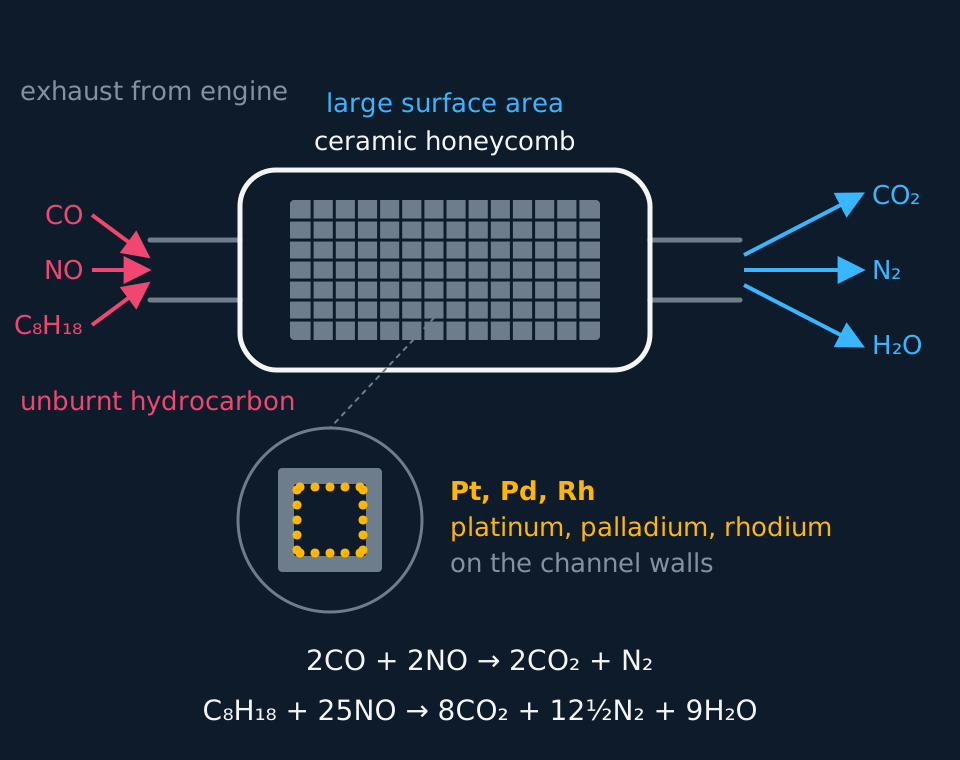
Describe the drawing
Cutaway of a catalytic converter in an exhaust pipe, with gas flowing left to right through a ceramic honeycomb of many small channels. Carbon monoxide, nitrogen monoxide and unburnt hydrocarbon enter on the left; carbon dioxide, nitrogen and water leave on the right. A circular inset magnifies one channel, its walls dotted with platinum, palladium and rhodium. Below: 2CO + 2NO gives 2CO₂ + N₂, and C₈H₁₈ + 25NO gives 8CO₂ + 12½N₂ + 9H₂O.
Sulfur dioxide from road traffic has largely gone, because sulfur is removed from petrol and diesel at the refinery. Sulfur cannot be taken out of coal so easily, so coal-fired power stations remove the sulfur dioxide from the flue gases instead: flue-gas desulfurisation. The gases pass through a wet slurry of calcium oxide or calcium carbonate. Sulfur dioxide is an acidic oxide and these are bases, so they react to give calcium sulfite, which is oxidised to calcium sulfate and sold as gypsum for plasterboard.
CaO(s) + SO₂(g) → CaSO₃(s)
CaCO₃(s) + SO₂(g) → CaSO₃(s) + CO₂(g)
Carbon dioxide, water vapour and methane are greenhouse gases. The Earth's surface, warmed by sunlight, emits infrared radiation. Molecules of these gases absorb some of it, because infrared makes their bonds vibrate, and re-emit it in all directions, some of it back towards the surface, so the lower atmosphere stays warmer than it otherwise would.
Burning fossil fuels has raised the carbon dioxide in the air from about 280 parts per million before industry to more than 420 today, and the stronger greenhouse effect is the cause of the warming measured since. No catalyst removes carbon dioxide from an exhaust; it can be cut only by burning less fuel, or captured and stored.
- Greenhouse gas
- A gas whose molecules absorb infrared radiation emitted by the Earth's surface and re-emit it, warming the lower atmosphere.
TRY IT: A converter equation for heptane
Write an equation for the reaction of heptane, C₇H₁₆, with nitrogen monoxide in a catalytic converter.
Check your answer
The carbon leaves as CO₂, the hydrogen as H₂O and the nitrogen as N₂. Balance carbon and hydrogen first: 7CO₂ and 8H₂O.
Those products hold 14 + 8 = 22 oxygen atoms, and all of them came from NO, so 22NO is needed. Its 22 nitrogen atoms make 11N₂.
C₇H₁₆(g) + 22NO(g) → 7CO₂(g) + 11N₂(g) + 8H₂O(g).
Other boards: reforming, smog and nitrogen dioxide as a catalyst
Edexcel examines reforming, which changes the shape of a molecule without shortening it. Straight-chain alkanes from the naphtha fraction pass over a platinum catalyst at about 500 °C and come out as branched alkanes, cycloalkanes and arenes, with hydrogen as the by-product. Hexane can become its isomer 2-methylpentane, or close into a ring and then lose more hydrogen:
C₆H₁₄(g) → C₆H₁₂(g) + H₂(g)hexane to cyclohexane
C₆H₁₂(g) → C₆H₆(g) + 3H₂(g)cyclohexane to benzene
The reason is the one behind catalytic cracking. Squeezed in a petrol engine, a straight-chain alkane can ignite from the compression alone, before the spark, which makes the engine knock. Branched and cyclic molecules resist that, so the fuel burns smoothly and the engine can run at a higher compression, which gets more work from each litre. The hydrogen is used at the refinery to strip sulfur out of fuels.
- Reforming
- The conversion of straight-chain alkanes into branched alkanes and cyclic hydrocarbons, over a platinum catalyst, to give fuels that burn more efficiently.
Cambridge examines two more things the nitrogen oxides do. In sunlight, NOₓ and unburnt hydrocarbons react together to make photochemical smog, the brown haze over a city on a still summer afternoon. Among its components are ozone at ground level and peroxyacetyl nitrate, PAN, CH₃CO₃NO₂, which stings the eyes and damages lungs and leaves.
Nitrogen dioxide also speeds up the oxidation of sulfur dioxide in the air, and is remade as it does so:
SO₂(g) + NO₂(g) → SO₃(g) + NO(g)
NO(g) + ½O₂(g) → NO₂(g)NO₂ regenerated
Nitrogen dioxide is used in the first step and returned by the second, so it is a catalyst, and the sulfur trioxide dissolves in rain as sulfuric acid, SO₃(g) + H₂O(l) → H₂SO₄(aq). Nitrogen dioxide makes rain acidic directly as well, by dissolving to give nitric acid. A Cambridge answer on acid rain from a power station is expected to give both equations and to call NO₂ a catalyst.
- Photochemical smog
- A haze formed when nitrogen oxides and unburnt hydrocarbons react in sunlight, containing ground-level ozone and PAN.
In the exam
- A boiling-point explanation earns its marks for naming van der Waals forces between molecules, saying why they are stronger (more electrons, more surface contact) and that more energy is needed to overcome them. Covalent bonds breaking contradicts the answer, and the scheme withholds the mark it appears in.
- A comparison of the two kinds of cracking needs each of temperature, catalyst and main product stated for both kinds, with a number for each temperature; 'catalytic cracking uses a catalyst' does not earn the catalyst mark without the zeolite.
- NOₓ comes from nitrogen and oxygen from the air reacting at the high temperature of the engine. Schemes reject nitrogen in the fuel as the source.
- Converter equations are balanced on oxygen last: count the oxygen in the CO₂ and H₂O first, then supply it as NO and halve the nitrogen into N₂.
Check yourself
A refinery has more of the gas-oil fraction, around C₁₆, than it can sell, and a polymer plant next door needs propene. Suggest which kind of cracking the refinery should use, write an equation for cracking hexadecane, C₁₆H₃₄, into decane and propene only, and say why the two plants cannot simply use the propene already in the crude oil.
Answer
Thermal cracking: it goes through radicals at 400 to 900 °C and high pressure, and gives a high proportion of alkenes, which is what the polymer plant wants. Catalytic cracking would give mainly branched alkanes and aromatics for petrol.
Decane is C₁₀H₂₂. That leaves 16 − 10 = 6 carbon atoms and 34 − 22 = 12 hydrogen atoms, which is two molecules of propene, C₃H₆: C₁₆H₃₄(g) → C₁₀H₂₂(g) + 2C₃H₆(g).
Crude oil is almost entirely alkanes, with very little alkene in it, because alkenes are reactive and do not survive the millions of years the oil spent underground. Alkenes have to be made, and cracking is how they are made.
Questions
Question 16 marks
Explain the two trends in the boiling points of the alkanes given in the table: along the unbranched series, and among the three isomers of C₈H₁₈.
| Alkane | Formula | Boiling point / °C |
|---|---|---|
| Propane | C₃H₈ | −42 |
| Pentane | C₅H₁₂ | 36 |
| Octane | C₈H₁₈ | 126 |
| Decane | C₁₀H₂₂ | 174 |
| 2-methylheptane | C₈H₁₈ | 118 |
| 2,2,4-trimethylpentane | C₈H₁₈ | 99 |
Mark scheme
Indicative content
- along the unbranched series the boiling point rises steadily as the chain gets longer, from −42 °C for propane to 174 °C for decane
- the only forces between alkane molecules are van der Waals forces between induced dipoles, and no covalent bonds break when an alkane boils
- a longer chain has more electrons, so larger induced dipoles form, and it has a larger surface in contact with neighbouring molecules
- the van der Waals forces between longer molecules are therefore stronger, and more energy is needed to overcome them, so the boiling point is higher
- the three C₈H₁₈ isomers have the same number of electrons, yet the boiling point falls from 126 °C to 118 °C to 99 °C as the branching increases
- a more branched molecule is more compact, cannot lie as closely alongside its neighbours and has less surface contact, so its van der Waals forces are weaker
Levels
- Level 3 (5–6 marks) both trends are described with values from the table and both are explained: the rise along the series through more electrons and more surface contact giving stronger van der Waals forces, and the fall with branching through compact molecules touching less; the answer says that only intermolecular forces, not covalent bonds, are overcome
- Level 2 (3–4 marks) the rise along the series is put down to stronger van der Waals forces from more electrons and branching is said to lower the boiling point; why branching does so is not explained through surface contact, or the table's values go unused
- Level 1 (1–2 marks) the boiling point is said to rise with chain length or fall with branching, typically because longer chains have more covalent bonds to break
Question 24 marksAQA · Edexcel · CAIE
Explain, using the general formula of the alkanes, what is meant by describing an alkane as saturated, and why cracking a long-chain alkane always produces at least one alkene.
Mark scheme
- B1 the general formula of the alkanes is CₙH₂ₙ₊₂
- B1 saturated means the molecule has only single bonds between carbon atoms, so no more atoms can be added to it
- B1 two alkanes sharing n carbon atoms would need 2n + 4 hydrogen atoms between them, but the alkane CₙH₂ₙ₊₂ has only 2n + 2
- B1 so at least one product must have fewer hydrogens, CₙH₂ₙ, and contain a C=C double bond; allow a correct example equation that shows this
Question 34 marksAQA · Edexcel
Describe how crude oil is separated into fractions by fractional distillation.
Mark scheme
- B1 the crude oil is heated in a furnace so that most of it vaporises, and the vapour is fed into the bottom of a column
- B1 the column has a temperature gradient, hottest at the bottom and coolest at the top
- B1 vapour rises and each hydrocarbon condenses on the tray where the temperature falls below its boiling point
- B1 fractions with similar boiling points are drawn off at different heights; short chains near the top, long chains near the bottom, and the residue leaves at the base
All 20 questions with mark schemes, the other 17 set out in full on the question page.
Worth remembering
- Explain a longer alkane's higher boiling point by stronger induced dipole–dipole forces (van der Waals forces) between molecules; no covalent bond breaks on boiling.
- A fraction is a range of boiling points, not one compound: 'petrol boils at 40 °C' is not credited.
- Balance a cracking equation in carbon and hydrogen: C₁₀H₂₂(g) → C₈H₁₈(g) + C₂H₄(g), not C₈H₁₆(g) + C₂H₄(g).
- A catalytic converter removes CO, NO and unburnt hydrocarbons; an answer that has it removing CO₂ is rejected.
- Name the products of incomplete combustion, carbon monoxide or carbon with water; 'less energy released' answers a different question.
CHECK YOUR PROGRESS
Rate how confident you are with each objective for this lesson. Ratings are saved in this browser, on this device, unless you sign in.
- Explain why the boiling points of alkanes rise with chain length and fall with branching, in terms of van der Waals forces.
- Describe how crude oil is separated by fractional distillation, and say where in the column each fraction condenses.
- Compare thermal and catalytic cracking: conditions, intermediates, products and the economic reason for each.
- Write equations for complete and incomplete combustion, and give the origin of each pollutant from an engine or a power station.
- Write equations for the reactions in a catalytic converter and in flue-gas desulfurisation, and outline the greenhouse effect.
- Outline reforming, and explain the part nitrogen oxides play in photochemical smog and acid rain.CAIE · Edexcel
Open the full revision checklist to see every objective in the curriculum in one place.
Practise this lesson
WORKBOOK
The written questions from this topic, on paper with room to work, and a separate book of mark schemes. The question that is set on a diagram stays on this page, where the diagram can be drawn. Free to use; please do not redistribute or sell.