Chemistry › Introduction to organic chemistry › Reaction types, curly arrows and how a mechanism is written
Reaction types, curly arrows and how a mechanism is written
Organic reactions are sorted in two ways: by what happens to the molecule, such as addition, substitution or elimination, and by what attacks it, a radical, a nucleophile or an electrophile. A mechanism shows how the change happens bond by bond, in curly arrows that each move a pair of electrons, and a mechanism drawn to the rules is marked one arrow at a time.
Key terms Every definition in introduction to organic chemistry, lesson by lesson
Before this Electronegativity, polarity and intermolecular forces – why a C–Br bond is polar · Covalent, dative covalent and metallic bonding – a covalent bond as a shared pair of electrons, and lone pairs · Naming and representing organic molecules – displayed formulae
COMMON MISCONCEPTION
A curly arrow shows an atom or an ion moving from one place to another.
A curly arrow shows a pair of electrons moving. It starts at the pair, a lone pair or a bond, and ends where the pair goes, a new bond or an atom that takes it. Atoms are moved by the bonds the arrows make and break, never by an arrow of their own. A half-headed arrow, in a radical mechanism, moves one electron.
What you should be able to do
- Classify an organic reaction as addition, substitution, elimination, oxidation, reduction, hydrolysis, condensation or polymerisation.
- Describe homolytic and heterolytic fission, and state what each produces.
- Define a radical, a nucleophile and an electrophile, and identify each from its formula.
- Explain what a curly arrow and a fishhook arrow represent, and where each may start and end.
- Draw a two-arrow nucleophilic substitution mechanism with its dipole, lone pair and charges, and check that the charges balance.
What happens to the molecule
An organic reaction is named first by what happens to the molecule. In an addition reaction two molecules join to make one product: an alkene takes bromine across its C=C, and hex-1-ene decolourises orange bromine water in seconds as it does so. In a substitution one atom or group takes the place of another. Hexane leaves bromine water orange, and reacts with bromine only in ultraviolet light, when a bromine atom replaces a hydrogen atom and HBr is given off.
CH₂=CH₂(g) + Br₂(l) → CH₂BrCH₂Br(l)Addition: two reactants, one product, nothing left over.
CH₄(g) + Cl₂(g) → CH₃Cl(g) + HCl(g)Substitution in ultraviolet light: a chlorine atom takes the place of a hydrogen atom.
Elimination runs addition backwards: a small molecule is removed from a larger one and a C=C forms where it left. Bromoethane heated with potassium hydroxide dissolved in ethanol loses HBr and gives ethene. Ethanol heated with concentrated phosphoric acid loses H₂O and gives ethene as well; an elimination of water is also called a dehydration.
CH₃CH₂OH(l) → CH₂=CH₂(g) + H₂O(l)Elimination of water, catalysed by concentrated H₃PO₄ or H₂SO₄.
Hydrolysis splits a molecule by reaction with water. A halogenoalkane in warm water slowly gives an alcohol; an ester boiled with dilute acid gives back a carboxylic acid and an alcohol. Condensation is the reverse: two molecules join and a small molecule, usually water, is released. A carboxylic acid and an alcohol warmed with a few drops of concentrated sulfuric acid condense to an ester.
CH₃COOH(l) + CH₃CH₂OH(l) ⇌ CH₃COOCH₂CH₃(l) + H₂O(l)Read forwards, a condensation; read backwards, a hydrolysis.
Oxidation and reduction in organic chemistry are usually counted in oxygen and hydrogen rather than electrons. Oxidation adds oxygen or removes hydrogen; reduction does the reverse. Equations write the oxidising agent as [O] and the reducing agent as [H], since only the organic molecule is of interest. Acidified potassium dichromate(VI) is the usual oxidising agent and sodium tetrahydridoborate(III), NaBH₄, the usual reducing agent.
CH₃CH₂OH(l) + [O] → CH₃CHO(l) + H₂O(l)Oxidation of a primary alcohol to an aldehyde: two hydrogen atoms are removed.
Polymerisation joins many small molecules, the monomers, into one long chain. Addition polymerisation joins alkenes through their C=C with nothing lost, as ethene becomes poly(ethene). Condensation polymerisation releases a small molecule at every link, as in polyesters and polyamides.
| Reaction type | What happens | Example |
|---|---|---|
| Addition | Two molecules join to give one product | ethene and bromine give 1,2-dibromoethane |
| Substitution | One atom or group replaces another | methane and chlorine give chloromethane and HCl |
| Elimination | A small molecule is removed, leaving a C=C | bromoethane loses HBr to give ethene |
| Oxidation | Oxygen added or hydrogen removed | ethanol to ethanal |
| Reduction | Hydrogen added or oxygen removed | ethanal to ethanol |
| Hydrolysis | A bond is split by reaction with water | ethyl ethanoate to ethanoic acid and ethanol |
| Condensation | Two molecules join, releasing a small molecule | ethanoic acid and ethanol give ethyl ethanoate and water |
| Polymerisation | Many monomers join into one long chain | ethene to poly(ethene) |
One reaction can carry two of these names. Bromoethane reacting with water is a substitution, since OH replaces Br, and a hydrolysis. The full name of a reaction joins the attacking species to the reaction type: free-radical substitution, nucleophilic substitution, electrophilic addition, and later nucleophilic addition and electrophilic substitution.
The reaction type also decides how much of the reactants can end up in the product. Percentage atom economy is the mass of the desired product as a percentage of the total mass of the reactants, both read from the balanced equation. An addition has one product, so every atom of the reactants is in it and the atom economy is 100%. Substitution, elimination and condensation always make a second product as well, so their atom economy is lower, however high the yield.
% atom economy = (Mr of desired product ÷ total Mr of all reactants) × 100Mass is conserved, so the total Mr of all the products gives the same bottom line.
Two routes to ethene
Ethene can be made by dehydrating ethanol, or by eliminating HBr from bromoethane with potassium hydroxide in ethanol. Calculate the percentage atom economy of each route, using Ar values H 1.0, C 12.0, O 16.0, K 39.1, Br 79.9.
Show the working
Route 1: CH₃CH₂OH → CH₂=CH₂ + H₂O. Mr of ethanol = 2 × 12.0 + 6 × 1.0 + 16.0 = 46.0, and Mr of ethene = 2 × 12.0 + 4 × 1.0 = 28.0.
Atom economy = 28.0 ÷ 46.0 × 100 = 60.9%.
Route 2: CH₃CH₂Br + KOH → CH₂=CH₂ + KBr + H₂O. Mr of bromoethane = 24.0 + 5.0 + 79.9 = 108.9, and Mr of KOH = 39.1 + 16.0 + 1.0 = 56.1, so the reactants total 165.0.
Atom economy = 28.0 ÷ 165.0 × 100 = 17.0%. Both routes are eliminations, but in the second the heavy bromine atom and the potassium end up in waste KBr, so less than a fifth of the mass of the reactants becomes ethene.
- Addition
- A reaction in which two molecules join together to form a single product.
- Substitution
- A reaction in which an atom or group of atoms in a molecule is replaced by a different atom or group.
- Elimination
- A reaction in which a small molecule is removed from a larger one, leaving a double bond.
- Hydrolysis
- The splitting of a molecule by reaction with water.
- Condensation
- A reaction in which two molecules join together with the loss of a small molecule such as water.
- Percentage atom economy
- The mass of the desired product as a percentage of the total mass of all the reactants in the balanced equation.
Breaking a bond: homolytic and heterolytic fission
Every mechanism is a sequence of covalent bonds breaking and forming, and a covalent bond is a shared pair of electrons. A bond can break in two ways, and the difference is where the two electrons go.
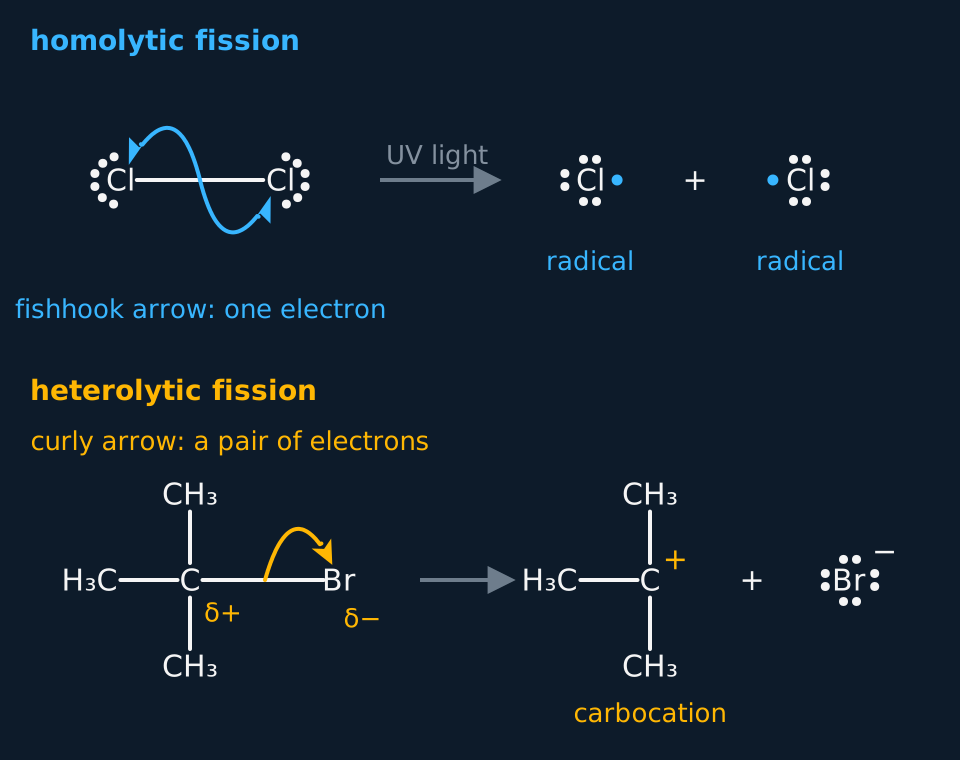
In homolytic fission each atom takes one electron from the shared pair. Chlorine in ultraviolet light is the example: the Cl–Cl bond, 243 kJ mol⁻¹, splits into two chlorine atoms, each with seven outer electrons, one of them unpaired. A species with an unpaired electron is a radical, written with a dot: Cl•. Radicals are very reactive, because the unpaired electron pairs readily with an electron taken from another molecule.
Cl₂(g) → 2Cl•(g)Homolytic fission, with the energy supplied as ultraviolet light.
In heterolytic fission one atom takes both electrons and becomes a negative ion, and the other is left without them and becomes a positive ion. It happens most readily to a polar bond, and the more electronegative atom takes the pair. In 2-bromo-2-methylpropane, (CH₃)₃CBr, the C–Br bond can break this way in a polar solvent: the bromine leaves as Br⁻ and the carbon is left as a carbocation, (CH₃)₃C⁺, with only six outer electrons.
Describe the drawing
Two rows. In the top row a chlorine molecule, each atom with three lone pairs, has two half-headed fishhook arrows leaving the middle of the Cl–Cl bond, one curving up onto the left chlorine and one curving down onto the right; an arrow labelled UV light leads to two chlorine radicals, each with one unpaired dot. In the bottom row 2-bromo-2-methylpropane has δ+ on the central carbon and δ− on bromine, and one full curly arrow runs from the middle of the C–Br bond onto the bromine, giving the carbocation with a positive charge on the central carbon and a bromide ion with four lone pairs and a negative charge.
The arrows are the notation for the rest of organic chemistry. A half-headed arrow, a fishhook, moves one electron, so homolytic fission needs two of them, one to each atom. A full-headed arrow moves a pair, so heterolytic fission needs one, from the bond to the atom that keeps both electrons.
Which way a bond breaks depends on the bond and the conditions. A non-polar bond given energy by ultraviolet light or a high temperature, often in the gas phase, breaks homolytically: the chlorination of methane and the thermal cracking of alkanes both start this way. A polar bond in a polar solvent breaks heterolytically, because the solvent molecules cluster round the ions it forms and stabilise them.
- Homolytic fission
- The breaking of a covalent bond in which each atom takes one electron from the shared pair, forming two radicals.
- Heterolytic fission
- The breaking of a covalent bond in which one atom takes both electrons from the shared pair, forming a positive and a negative ion.
- Radical
- A species with an unpaired electron, shown by a dot in its formula.
Radicals, nucleophiles and electrophiles
Three kinds of species attack organic molecules, and each is defined by what it does with electrons.
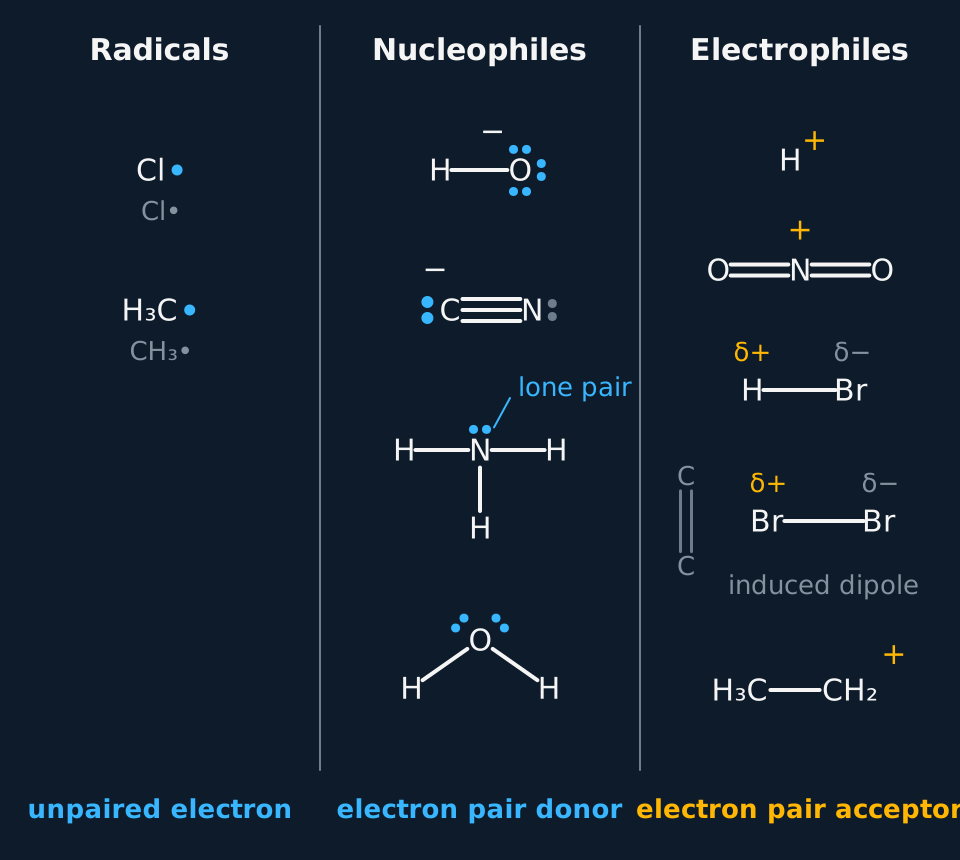
A nucleophile is an electron pair donor. It has a lone pair, often with a negative charge, and it is attracted to a carbon atom carrying a partial positive charge; the name means nucleus-loving, because it seeks out a positive centre. Hydroxide, OH⁻, cyanide, CN⁻, ammonia, NH₃, and water, H₂O, are the four met in the first year. Ammonia and water carry no charge. The lone pair is what makes them nucleophiles.
An electrophile is an electron pair acceptor. It is attracted to a region of high electron density, such as the π electrons of a C=C or the ring of benzene. H⁺ is the simplest. The hydrogen of H–Br, made δ+ by the more electronegative bromine, acts as one, and so does Br₂, although it is not polar: the electrons of the C=C repel the electrons in the Br–Br bond as the molecule approaches and induce a dipole in it. The nitronium ion, NO₂⁺, and carbocations are electrophiles too.
A radical reacts through its single unpaired electron. It needs no polar bond to attack, so it reacts with the C–H bonds of an alkane, which nucleophiles and electrophiles leave alone. That is why the first reaction of the alkanes at A level, with chlorine in ultraviolet light, is a radical reaction.
Whether a nucleophile has anything to attack depends on bond polarity. Bromine, with an electronegativity of 2.8, is more electronegative than carbon, 2.5, so the C–Br bond is polar, Cδ+–Brδ−, and the carbon is open to a nucleophile. The C–H bond, carbon 2.5 and hydrogen 2.1, is almost non-polar, which is one reason alkanes do not react with nucleophiles or electrophiles.
Describe the drawing
Three columns. Radicals: Cl and CH₃ each with a single dot for the unpaired electron. Nucleophiles: hydroxide with three lone pairs on oxygen and a negative charge, cyanide with a prominent lone pair on carbon and a negative charge, ammonia with one lone pair on nitrogen, and water with two lone pairs on oxygen. Electrophiles: H⁺, the nitronium ion O=N⁺=O, hydrogen bromide with δ+ on hydrogen, bromine with an induced δ+ on the end nearer a faint C=C, and the ethyl carbocation. Beneath the columns: unpaired electron, electron pair donor, electron pair acceptor.
| Radical | Nucleophile | Electrophile | |
|---|---|---|---|
| What it has | An unpaired electron | A lone pair | A positive or δ+ centre |
| What it does with electrons | Pairs its single electron | Donates a pair | Accepts a pair |
| What it attacks | C–H bonds, C=C bonds | A δ+ carbon | A C=C or a benzene ring |
| Examples | Cl•, Br•, CH₃• | OH⁻, CN⁻, NH₃, H₂O | H⁺, NO₂⁺, Br₂, Hδ+ of HBr |
A nucleophile and a base are both lone-pair donors, and OH⁻ is both. The difference is the target: a base donates its pair to a hydrogen ion, a nucleophile to an electron-deficient carbon. Hydroxide acts mainly as a nucleophile in warm water, giving substitution, and mainly as a base in hot ethanol, where it removes H⁺ from the carbon next to the C–Br and causes elimination.
- Nucleophile
- An electron pair donor, which is attracted to an electron-deficient atom such as a δ+ carbon.
- Electrophile
- An electron pair acceptor, which is attracted to a region of high electron density.
Curly arrows
A curly arrow shows the movement of a pair of electrons. It does not show an atom moving. Its tail sits where the pair is now: on a lone pair, or in the middle of a bond. Its head points to where the pair ends up: between two atoms, where it becomes a new bond, or onto an atom that keeps it as a lone pair and takes the negative charge that comes with it.
Nothing else is a correct start. An arrow cannot begin on a positive charge, on a hydrogen atom, or on an atom with no lone pair, because there is no pair there to move. An arrow from a δ+ carbon to a hydroxide ion points the wrong way: the hydroxide gives the pair, so the arrow starts on the oxygen.
Describe the drawing
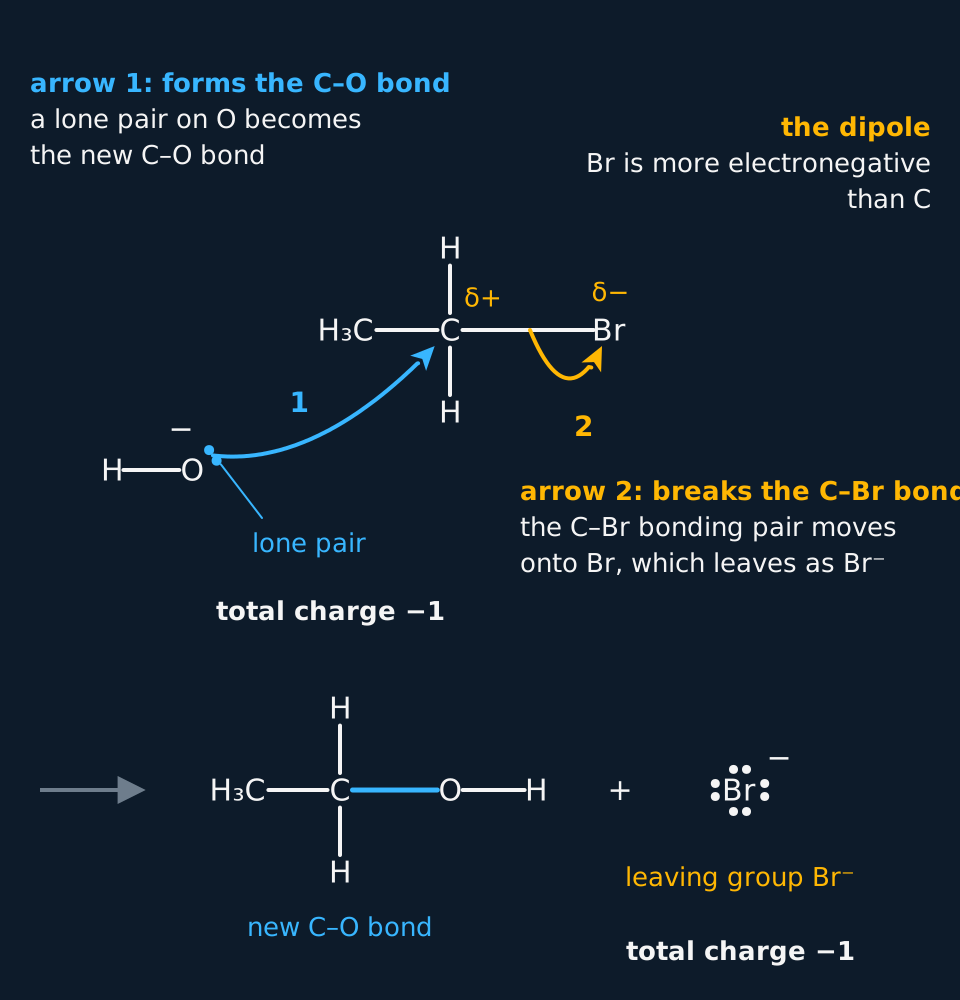
The reaction of hydroxide with bromoethane drawn as a mechanism. Hydroxide carries a lone pair and a negative charge on oxygen; bromoethane has δ+ on the carbon bonded to bromine and δ− on bromine, because bromine is more electronegative. Arrow 1 runs from the lone pair on oxygen to the δ+ carbon and forms the new C–O bond; arrow 2 runs from the middle of the C–Br bond onto bromine, which leaves as bromide. The products are ethanol, with the new C–O bond highlighted, and a bromide ion with four lone pairs, and the total charge is minus one on both sides.
Read the figure one arrow at a time. The C–Br bond is polar, carbon δ+ and bromine δ−. The first arrow starts on a lone pair of the oxygen in OH⁻ and ends on the δ+ carbon; that pair becomes the new C–O bond. Carbon cannot hold five bonds, so as the C–O bond forms the C–Br bond must break. The second arrow starts in the middle of the C–Br bond and ends on the bromine, which leaves with both electrons as Br⁻.
CH₃CH₂Br(l) + OH⁻(aq) → CH₃CH₂OH(aq) + Br⁻(aq)Nucleophilic substitution, with warm aqueous sodium hydroxide.
Charges balance at every stage. One negative charge goes in on the hydroxide ion and one comes out on the bromide ion, and the organic product is neutral. A mechanism whose charges do not add up has an arrow missing or pointing the wrong way.
This substitution is drawn in a single step, both arrows on one diagram, with no transition state. Each arrow is a separate mark, so a mechanism with the right products and one arrow reversed still loses that arrow's mark.
- Curly arrow
- An arrow showing the movement of a pair of electrons, from a lone pair or a bond to where a new bond or lone pair forms.
Drawing a mechanism that can be marked
Each arrow in a mechanism is marked for where it starts and where it ends, so draw each one deliberately. Show the dipole on any polar bond the attack depends on, with δ+ and δ−. Draw the lone pair on the nucleophile as two dots and start the arrow on it. Draw the arrow that breaks a bond from the middle of that bond. Put the charge on every ion and intermediate, and finish with the products and their charges.
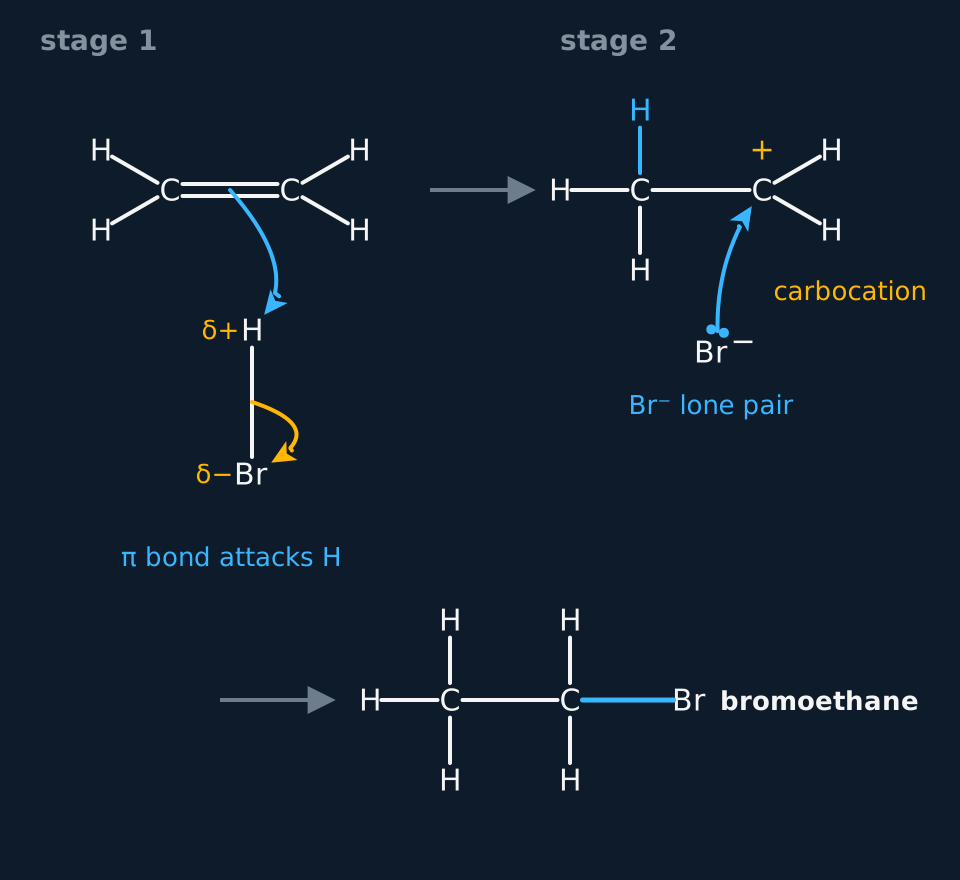
An electrophile attacks the other way round, with the organic molecule giving the pair, as when hydrogen bromide adds to ethene. HBr is polar, Hδ+–Brδ−. The first arrow starts on the C=C, from the π bond, and ends on the δ+ hydrogen. The second starts in the H–Br bond and ends on the bromine, which leaves as Br⁻.
Describe the drawing
Two stages of the addition of hydrogen bromide to ethene. In stage 1 ethene is drawn with its C=C double bond and hydrogen bromide below it with δ+ on hydrogen and δ− on bromine; arrow 1 leaves the middle of the double bond for the hydrogen and arrow 2 leaves the middle of the H–Br bond for the bromine. In stage 2 the new hydrogen sits on the left carbon, the right carbon carries the positive charge, and arrow 3 runs from a lone pair on the bromide ion to that positive carbon. The product is bromoethane.
The carbon that did not receive the hydrogen has lost its share of the π pair and carries a full positive charge: a carbocation, CH₃CH₂⁺. The third arrow starts on a lone pair of the Br⁻ ion and ends on that positive carbon, forming the C–Br bond. The product is bromoethane, and the charges again balance: none at the start, a positive and a negative in the middle, none at the end.
The same rules mark wrong arrows wrong. An arrow from the C=C to the bromine end of HBr sends electrons towards the δ− atom, which has no room for them, so it is wrong. An arrow that starts on Br⁻ but ends on the hydrogen of the carbocation forms the wrong bond. A carbocation drawn without its + has lost track of where the electrons went.
The mechanism for 2-bromopropane and hydroxide
2-bromopropane, CH₃CHBrCH₃, is warmed with aqueous sodium hydroxide. Describe the mechanism, saying where each curly arrow starts and ends, and name the organic product.
Show the working
Draw the C–Br bond on the middle carbon displayed, and mark the carbon δ+ and the bromine δ−, since bromine is more electronegative than carbon.
Draw the hydroxide ion with its negative charge and a lone pair on the oxygen. The first arrow starts on that lone pair and ends on the δ+ carbon.
The second arrow starts in the middle of the C–Br bond and ends on the bromine atom.
The products are CH₃CH(OH)CH₃, propan-2-ol, and Br⁻. The reaction is nucleophilic substitution, with one negative charge in and one out.
TRY IT: Finding the faults in a drawn mechanism
A student draws the reaction of cyanide ions with bromoethane. The first arrow starts on the δ+ carbon of bromoethane and ends on the carbon of CN⁻. The second starts on the bromine atom and ends on the carbon. No dipole is shown, and the product is written as CH₃CH₂NC. Identify every fault.
Check your answer
Both arrows point the wrong way. The first must start on the lone pair on the carbon of CN⁻ and end on the δ+ carbon of bromoethane, because the cyanide ion donates the pair. The second must start in the middle of the C–Br bond and end on the bromine, which leaves with the pair as Br⁻.
The C–Br bond needs its dipole, Cδ+–Brδ−, to show why the carbon is attacked.
The new bond forms from the carbon of the cyanide, so the product is CH₃CH₂CN, propanenitrile, with one carbon more than bromoethane.
All the mechanisms, listed
Eleven mechanisms cover every curly-arrow question the course can set, and nine of them are AQA's. In each, a radical, a nucleophile or an electrophile attacks, and the molecule is added to, substituted, or stripped of a small molecule. The arrows follow the same rules in every case.
| Mechanism | Reaction | Taught in |
|---|---|---|
| Free-radical substitution | An alkane with chlorine or bromine in ultraviolet light: initiation, propagation, termination | Free-radical substitution |
| Electrophilic addition | An alkene with HBr, with Br₂ or with concentrated sulfuric acid, through a carbocation | Alkenes: structure, electrophilic addition and Markovnikov's rule |
| Nucleophilic substitution | A halogenoalkane with hydroxide, cyanide or ammonia | Halogenoalkanes: nucleophilic substitution and rates of hydrolysis |
| Elimination | A halogenoalkane with hot ethanolic potassium hydroxide acting as a base | Elimination from halogenoalkanes, and CFCs and the ozone layer |
| Elimination (dehydration) | An alcohol with hot concentrated sulfuric or phosphoric acid | Oxidation and elimination of alcohols |
| Nucleophilic addition | An aldehyde or ketone with NaBH₄, or with KCN followed by dilute acid | Aldehydes and ketones: nucleophilic addition and the tests that tell them apart |
| Nucleophilic addition–elimination | An acyl chloride with water, an alcohol, ammonia or a primary amine | Acylation: acyl chlorides and acid anhydrides |
| Electrophilic substitution | Benzene: nitration with the nitronium ion, and Friedel–Crafts acylation | Electrophilic substitution: nitration and Friedel–Crafts acylation |
| Nucleophilic substitution, repeated | Ammonia or an amine with a halogenoalkane, and why a mixture forms | Amines: preparation, basicity and nucleophilic reactions |
| SN1 and SN2 (other boards only) | The one-step and two-step substitutions, and optical activity as evidence | Halogenoalkanes: nucleophilic substitution and rates of hydrolysis |
| Halogenation and alkylation (other boards only) | Benzene with Br₂ and a halogen carrier, or a halogenoalkane with AlCl₃ | Electrophilic substitution: nitration and Friedel–Crafts acylation |
The nucleophilic substitution of a halogenoalkane is the one to learn first, because the addition to a carbonyl group, the addition–elimination of an acyl chloride and the second step of electrophilic addition all reuse its first arrow, a lone pair to a δ+ carbon.
Other boards: SN1, SN2 and the transition state
Edexcel and Cambridge separate nucleophilic substitution into two mechanisms and name them. SN2, substitution, nucleophilic, bimolecular, is the two-arrow, one-step route: the nucleophile attacks the δ+ carbon from the side opposite the halogen as the C–X bond breaks, and both species are in the rate-determining step. Edexcel and Cambridge may ask for the transition state, drawn in square brackets with the nucleophile and the halogen both partly bonded to the carbon by dashed lines and an overall negative charge.
SN1, unimolecular, takes two steps. The C–X bond breaks heterolytically on its own, leaving a carbocation and a halide ion, and the nucleophile then bonds to the carbocation. Only the halogenoalkane is in the slow first step. Tertiary halogenoalkanes react this way, because three alkyl groups push electron density towards the positive carbon and stabilise it, and they also crowd the back of the carbon that an SN2 attack needs. Primary halogenoalkanes react by SN2, and secondary ones by either route.
OCR draws nucleophilic substitution as AQA does, in one step without naming it, and asks for neither the transition state nor the SN1 route.
In the exam
- The scheme gives the definition mark for 'electron pair donor' for a nucleophile and 'electron pair acceptor' for an electrophile. 'Attracted to positive charge' describes behaviour, not the definition.
- Each curly arrow is marked for where it starts and where it ends: on a lone pair or a bond, to an atom or between two atoms. An arrow from a δ+ atom or a positive charge loses that arrow's mark.
- In nucleophilic substitution, show the δ+ and δ− on the C–X bond, the lone pair on the nucleophile, and the halide ion leaving with its charge.
- Define a radical as a species with an unpaired electron, not as an atom: CH₃• is a radical too.
- For homolytic fission state that each atom gets one electron from the bond; for heterolytic fission, that one atom gets both.
Check yourself
Hydroxide ions react with bromoethane in two ways: in warm water the product is ethanol, and in hot ethanol it is ethene. Name the type of each reaction, state the role the hydroxide ion plays in each, and say which bond breaks heterolytically in both.
Answer
In warm water the reaction is a nucleophilic substitution: OH replaces Br. The hydroxide ion acts as a nucleophile, donating a lone pair from its oxygen to the δ+ carbon of the C–Br bond.
In hot ethanol the reaction is an elimination: HBr is removed and a C=C forms. The hydroxide ion acts as a base, donating its lone pair to a hydrogen atom on the carbon next to the C–Br carbon, and that hydrogen leaves as part of a water molecule.
In both, the C–Br bond breaks heterolytically. Bromine is more electronegative than carbon, so it takes both electrons of the bond and leaves as a bromide ion.
Questions
Question 16 marks
Explain the difference between homolytic and heterolytic fission, giving an example of each and describing how the curly arrows used to show them differ.
Mark scheme
Indicative content
- in homolytic fission each atom takes one electron from the shared pair
- this forms two radicals, for example Cl₂ in ultraviolet light giving two Cl• radicals
- it is shown by two half-headed (fishhook) arrows starting on the bond, one ending on each atom
- in heterolytic fission one atom, the more electronegative, takes both electrons of the shared pair
- this forms a positive and a negative ion, for example (CH₃)₃CBr giving (CH₃)₃C⁺ and Br⁻
- it is shown by one full-headed curly arrow from the bond to the atom that keeps the pair
Levels
- Level 3 (5–6 marks) both kinds of fission are defined in terms of where the electrons go, each has a correct example with the species formed, and the curly arrows are distinguished with the fishhook arrows for homolysis and the full-headed arrow for heterolysis
- Level 2 (3–4 marks) both kinds of fission are defined with an example each; the two kinds of curly arrow are not told apart, or one example gives the wrong species
- Level 1 (1–2 marks) one kind of fission is defined, commonly with homolytic fission said to give ions, and the examples and arrows are largely missing
Question 24 marks
State what is meant by a nucleophile and by an electrophile, and identify the species acting as each in two reactions: cyanide ions with bromoethane, and hydrogen bromide with ethene.
Mark scheme
- B1 a nucleophile is an electron pair donor; reject 'attracted to a positive charge' as the definition
- B1 an electrophile is an electron pair acceptor
- B1 the cyanide ion is the nucleophile, donating the lone pair on its carbon to the δ+ carbon of bromoethane
- B1 hydrogen bromide is the electrophile, its δ+ hydrogen accepting a pair of electrons from the C=C; accept H⁺ or Hδ+
Question 34 marks
Draw the mechanism of the reaction between hydroxide ions and bromoethane, showing the dipole, the lone pair and both curly arrows.
Mark scheme
- B1 the C–Br bond is shown polar, with δ+ on the carbon and δ− on the bromine
- B1 the first arrow starts on a lone pair on the oxygen of OH⁻ and ends on the δ+ carbon; allow the arrow from the minus sign on O, reject an arrow from the H
- B1 the second arrow starts on the C–Br bond and ends on the bromine atom
- B1 the products are ethanol, CH₃CH₂OH, and a bromide ion, Br⁻
All 21 questions with mark schemes, the other 18 set out in full on the question page.
Worth remembering
- 'Addition' for bromoethane with hydroxide is wrong: a group is replaced, so the reaction is a substitution.
- Draw homolytic fission with two fishhook arrows, one electron to each atom; one double-headed arrow gives ions.
- Define a nucleophile as an electron pair donor; 'attracted to a positive charge' describes one without defining it.
- Start the arrow on the nucleophile's lone pair and end it on the δ+ carbon.
- A carbocation without its + sign, or a leaving halide without its − sign, loses the charge mark; count the charges in and out.
CHECK YOUR PROGRESS
Rate how confident you are with each objective for this lesson. Ratings are saved in this browser, on this device, unless you sign in.
- Classify an organic reaction as addition, substitution, elimination, oxidation, reduction, hydrolysis, condensation or polymerisation.
- Describe homolytic and heterolytic fission, and state what each produces.
- Define a radical, a nucleophile and an electrophile, and identify each from its formula.
- Explain what a curly arrow and a fishhook arrow represent, and where each may start and end.
- Draw a two-arrow nucleophilic substitution mechanism with its dipole, lone pair and charges, and check that the charges balance.
Open the full revision checklist to see every objective in the curriculum in one place.
Practise this lesson
WORKBOOK
The written questions from this topic, on paper with room to work, and a separate book of mark schemes. The question that is set on a diagram stays on this page, where the diagram can be drawn. Free to use; please do not redistribute or sell.
Used later in Free-radical substitution · Halogenoalkanes: nucleophilic substitution and rates of hydrolysis · Alkenes: structure, electrophilic addition and Markovnikov's rule · Aldehydes and ketones: nucleophilic addition and the tests that tell them apart