Chemistry › Amount of substance › Reacting masses, percentage yield and atom economy
Reacting masses, percentage yield and atom economy
A balanced equation predicts the mass of product a reaction can give, but only from the reactant that runs out first. Percentage yield compares the mass collected with that prediction. Atom economy asks a different question, how much of the mass of the reactants ends up in the product wanted, and an industrial chemist needs both numbers.
Key terms Every definition in amount of substance, lesson by lesson
Before this The mole, the Avogadro constant and molar mass – reacting masses from a balanced equation · Concentration, volumetric solutions and titration calculations – n = cV · Gases and the ideal gas equation – the molar gas volume
COMMON MISCONCEPTION
A reaction with a 100% yield wastes nothing, so yield and atom economy measure the same thing.
Yield compares the product obtained with the most the equation allows; atom economy compares the wanted product's mass with the mass of all the products. A reaction can give every molecule it promises and still send most of its mass out as by-product. Aspirin made from ethanoic anhydride has an atom economy of 75% whatever its yield.
What you should be able to do
- Calculate the mass of a product from the mass of a reactant using a balanced equation.
- Identify the limiting reagent from the amounts of two reactants.
- Calculate percentage yield, and explain why it is below 100% in a real preparation.
- Calculate atom economy from a balanced equation, and explain why addition reactions have an atom economy of 100%.
- Distinguish atom economy from percentage yield, and evaluate a process using both.
Masses from an equation
A blast furnace takes in iron ore, coke and hot air at the top and runs molten iron out at the bottom. The ore is mainly haematite, Fe₂O₃, and carbon monoxide made from the coke reduces it. The equation says how much iron a tonne of ore can give before anyone has lit the furnace.
Fe₂O₃(s) + 3CO(g) → 2Fe(l) + 3CO₂(g)
The method is the one for any reacting mass. Convert the mass known into moles, use the mole ratio, and convert the moles of the substance wanted back into a mass. For one tonne of pure Fe₂O₃: 1.00 × 10⁶ g ÷ 159.6 g mol⁻¹ = 6266 mol. Each mole gives two moles of iron, so 12 530 mol of Fe, which is 12 530 × 55.8 = 6.99 × 10⁵ g, or 0.699 tonnes.
A shorter route uses masses in the same ratio. 159.6 g of Fe₂O₃ gives 2 × 55.8 = 111.6 g of iron, so one tonne gives 111.6 ÷ 159.6 = 0.699 tonnes. It works because a mole ratio becomes a mass ratio once each side is multiplied by its molar mass. Either way the answer is a theoretical yield: what the equation allows if every particle of the reactant that runs out becomes product.
The limiting reagent
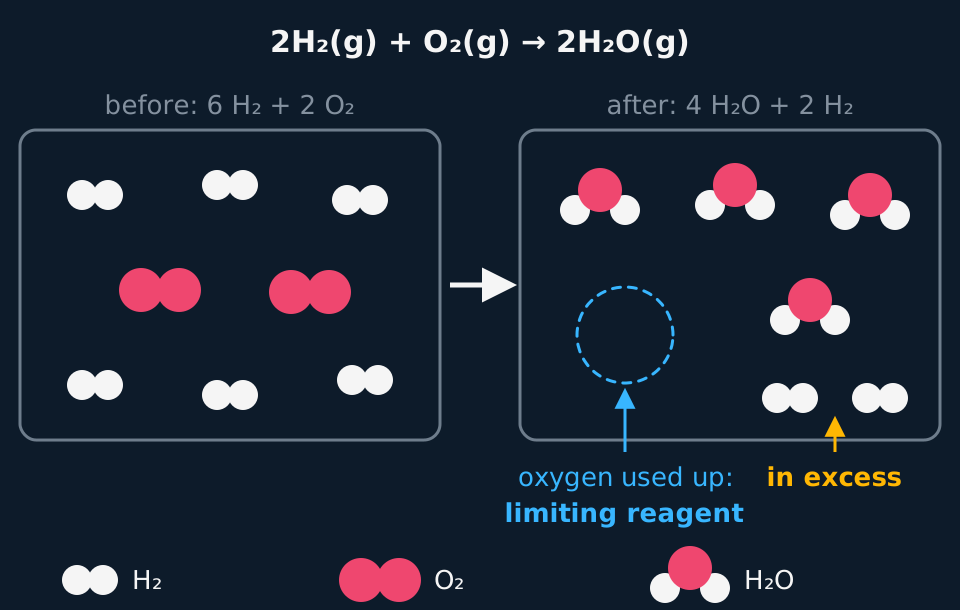
Reactants are rarely mixed in exactly the ratio of the equation. One runs out first, and when it has gone the reaction stops, however much of the other is left. That one is the limiting reagent; the other is in excess. The amount of product is set by the limiting reagent alone.
Describe the drawing
Two boxes joined by an arrow under the equation 2H2 plus O2 gives 2H2O. Before: six hydrogen molecules, each a pair of small white spheres, and two oxygen molecules, each a pair of larger red spheres. After: four water molecules and two hydrogen molecules left over, tagged in excess, and a dashed empty circle where oxygen was, tagged oxygen used up, the limiting reagent. Twelve hydrogen atoms and four oxygen atoms appear on each side.
To find it, convert every reactant into moles and compare each with the equation. Take 0.486 g of magnesium added to 20.0 cm³ of 1.00 mol dm⁻³ hydrochloric acid: Mg(s) + 2HCl(aq) → MgCl₂(aq) + H₂(g). The magnesium is 0.486 ÷ 24.3 = 0.0200 mol and the acid is 1.00 × 0.0200 = 0.0200 mol. The magnesium would need 0.0400 mol of acid and there is only half that, so the acid is limiting.
The acid makes 0.0200 ÷ 2 = 0.0100 mol of hydrogen, 240 cm³ at room temperature and pressure, and half the magnesium is left in the flask. Comparing the raw amounts, 0.0200 against 0.0200, would suggest neither is in excess, and that is wrong. Divide each amount by its coefficient in the equation first: magnesium 0.0200 ÷ 1 = 0.0200, acid 0.0200 ÷ 2 = 0.0100. The smaller result belongs to the limiting reagent.
Chemists often put one reactant in deliberate excess. When one reagent is expensive, or hard to separate from the product, an excess of a cheap one makes sure the expensive one reacts as fully as possible. In a reaction that reaches equilibrium, such as making an ester, an excess of one reactant also moves the position of equilibrium towards the products.
- Limiting reagent
- The reactant that is completely used up first, and so determines the maximum amount of product.
- In excess
- Present in more than the amount needed to react with the limiting reagent, so that some is left at the end.
- Theoretical yield
- The mass of product that would form if all of the limiting reagent reacted as the equation shows.
Percentage yield
No real preparation collects the theoretical yield. Ethyl ethanoate, a solvent in some nail-varnish removers, is made by heating ethanol with ethanoic acid and a little concentrated sulfuric acid, and even after a careful distillation a school preparation collects perhaps two thirds of what the equation allows. Percentage yield measures how much.
percentage yield = actual mass of product ÷ theoretical mass of product × 100
The yield of an ester
3.00 g of ethanol is heated with an excess of ethanoic acid and a little concentrated sulfuric acid. After separation and distillation, 4.10 g of ethyl ethanoate is collected. Calculate the percentage yield.
Show the working
Equation: CH₃COOH(l) + CH₃CH₂OH(l) ⇌ CH₃COOCH₂CH₃(l) + H₂O(l). One mole of ethanol gives at most one mole of ester. The acid is in excess, so ethanol is the limiting reagent.
Moles of ethanol: M(C₂H₅OH) = 2 × 12.0 + 6 × 1.0 + 16.0 = 46.0 g mol⁻¹, so n = 3.00 ÷ 46.0 = 0.06522 mol.
Theoretical mass of ester: M(CH₃COOCH₂CH₃) = 4 × 12.0 + 8 × 1.0 + 2 × 16.0 = 88.0 g mol⁻¹, so 0.06522 × 88.0 = 5.739 g.
Percentage yield = 4.10 ÷ 5.739 × 100 = 71.4%, to three significant figures. A yield above 100% would mean the product was impure or still wet, never that the reaction made extra.
Two weighed reactants and a yield
2.70 g of aluminium is heated with 7.10 g of chlorine: 2Al(s) + 3Cl₂(g) → 2AlCl₃(s). 7.12 g of aluminium chloride is collected. Identify the limiting reagent, and calculate the percentage yield and the mass of the other reactant left over. Use Al 27.0, Cl 35.5.
Show the working
Moles: Al 2.70 ÷ 27.0 = 0.100 mol; Cl₂ 7.10 ÷ 71.0 = 0.100 mol.
Divide by the coefficients: Al 0.100 ÷ 2 = 0.0500; Cl₂ 0.100 ÷ 3 = 0.0333. Chlorine gives the smaller result, so chlorine is the limiting reagent.
Theoretical yield: 3 mol of Cl₂ give 2 mol of AlCl₃, so n(AlCl₃) = 0.100 × 2 ÷ 3 = 0.06667 mol. M(AlCl₃) = 27.0 + 3 × 35.5 = 133.5 g mol⁻¹, so the theoretical mass is 0.06667 × 133.5 = 8.90 g.
Percentage yield = 7.12 ÷ 8.90 × 100 = 80.0%.
Aluminium used: 0.06667 mol, which is 0.06667 × 27.0 = 1.80 g, so 2.70 − 1.80 = 0.90 g is left.
Chlorine limits, the yield is 80.0% and 0.90 g of aluminium is left in excess. The masses check: 1.80 g of aluminium and 7.10 g of chlorine make 8.90 g of product, the theoretical yield.
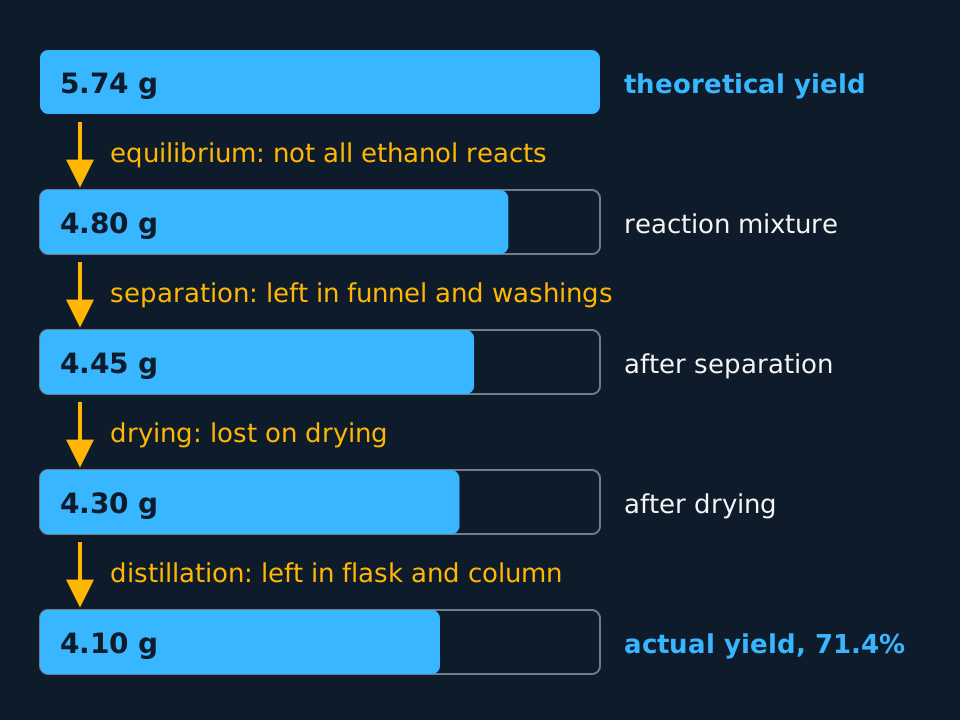
The losses come from four places. The reaction may not go to completion: esterification is an equilibrium, so some ethanol is still ethanol when the mixture stops changing. Side reactions turn some reactant into something else. Product is left behind on glassware, in the separating funnel and on filter paper. And every purification, whether distillation, washing or recrystallisation, throws some product away with the impurities.
Describe the drawing
Five boxes stacked from top to bottom, each as wide as the mass of ethyl ethanoate at that stage: theoretical 5.74 g, 4.80 g in the reaction mixture, 4.45 g after separation, 4.30 g after drying and 4.10 g collected, a 71.4 per cent yield. An amber arrow between each pair names the loss: equilibrium, as not all the ethanol reacts, which is the largest; material left in the separating funnel and washings; some lost on drying; and some left in the flask and column on distillation.
In a synthesis of several steps the yields multiply. Three steps of 80% each give 0.80 × 0.80 × 0.80 = 0.512, an overall yield of 51%. A drug made in ten steps at 90% each keeps only 35% of what it started with, which is one reason chemists look hard for shorter routes.
- Percentage yield
- The actual mass of product obtained as a percentage of the theoretical maximum mass.
- Actual yield
- The mass of pure, dry product actually collected at the end of a preparation.
- Overall yield
- The yield of a synthesis of several steps, found by multiplying together the fractional yields of the steps.
Atom economy
Percentage yield measures how well a reaction was carried out. Atom economy measures something else: how much of the mass of the reactants ends up in the product that is wanted, if the reaction goes exactly as the equation says. It belongs to the equation, and it is fixed before anyone does the experiment.
atom economy = Mr of desired product ÷ sum of Mr of all reactants × 100each Mr multiplied by its coefficient in the balanced equation
An addition reaction has a single product, so every atom of the reactants ends up in it and its atom economy is 100%. The hydration of ethene is one: C₂H₄(g) + H₂O(g) → C₂H₅OH(g). A substitution swaps one atom or group for another, so the group that leaves becomes a second product, and the atom economy is below 100% however good the yield. An elimination also makes a small molecule alongside the one wanted.
Three routes to ethanol
Ethanol can be made by hydration of ethene, by fermentation of glucose, or by substitution from bromoethane with sodium hydroxide. Calculate the atom economy of each route, and the mass of carbon dioxide formed for each kilogram of ethanol made by fermentation.
Show the working
Hydration: C₂H₄(g) + H₂O(g) → C₂H₅OH(g). Mr of the reactants = 28.0 + 18.0 = 46.0, all of which is ethanol. Atom economy = 46.0 ÷ 46.0 × 100 = 100%.
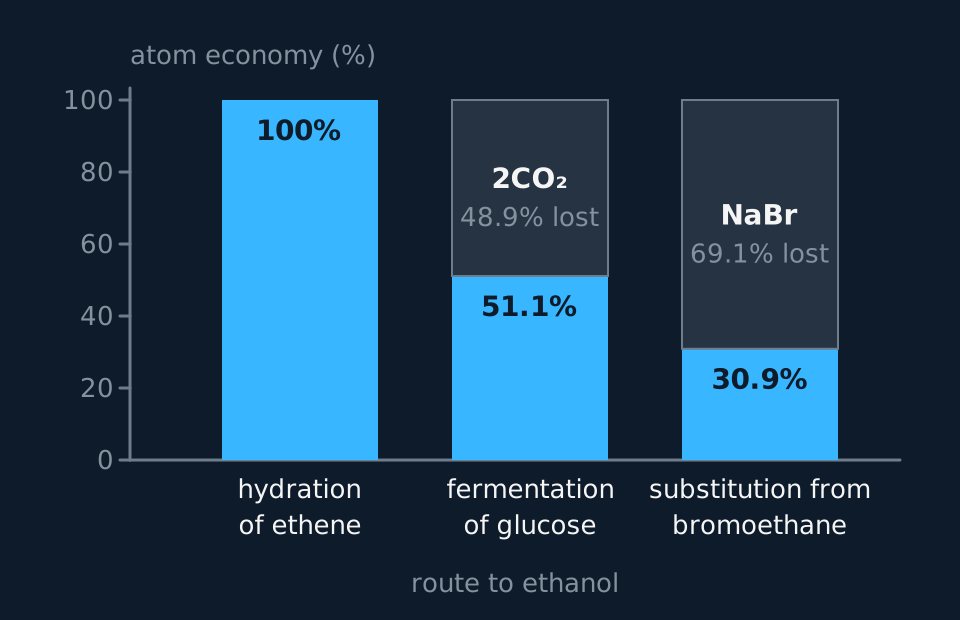
Fermentation: C₆H₁₂O₆(aq) → 2C₂H₅OH(aq) + 2CO₂(g). Mr of glucose = 6 × 12.0 + 12 × 1.0 + 6 × 16.0 = 180.0. Two moles of ethanol form, so the desired mass is 2 × 46.0 = 92.0. Atom economy = 92.0 ÷ 180.0 × 100 = 51.1%.
Substitution: C₂H₅Br(l) + NaOH(aq) → C₂H₅OH(aq) + NaBr(aq). Mr of the reactants = 108.9 + 40.0 = 148.9. Atom economy = 46.0 ÷ 148.9 × 100 = 30.9%.
Carbon dioxide from fermentation: 92.0 g of ethanol forms with 2 × 44.0 = 88.0 g of carbon dioxide. Per kilogram of ethanol, 1000 × 88.0 ÷ 92.0 = 957 g.
The atom economies are 100%, 51.1% and 30.9%, and fermentation forms 957 g of carbon dioxide per kilogram of ethanol. The coefficient 2 in front of ethanol matters: using 46.0 in place of 92.0 would halve the fermentation atom economy and double the carbon dioxide per kilogram.
Describe the drawing
A bar chart of atom economy in per cent for three routes to ethanol, all bars in one colour. Hydration of ethene reaches 100 per cent. Fermentation of glucose reaches 51.1 per cent, with a pale outline above it up to 100 labelled 2CO2, the mass lost as carbon dioxide. Substitution from bromoethane reaches 30.9 per cent, with a pale outline above labelled NaBr.
Atom economy and yield answer different questions, and one can be high while the other is low. Ethene hydration has an atom economy of 100%, but only about 5% of the ethene reacts on each pass over the catalyst. The unreacted ethene is recycled, so the overall conversion reaches about 95%. A substitution can give a 95% yield and still turn most of its reactant mass into a by-product, because the by-product is written into the equation.
| Percentage yield | Atom economy | |
|---|---|---|
| Compares | Mass of product collected with the mass the equation allows | Mass of desired product with the mass of all the reactants |
| Found from | A measured mass, after the experiment | The balanced equation, before any experiment |
| Raised by | Better technique, conditions that favour the products, smaller losses in purification | Choosing a different reaction, or a use for the by-product |
| 100% means | Every particle of the limiting reagent became collected product | The equation has no by-product |
| Ethene hydration | About 5% per pass; about 95% with recycling | 100% |
- Atom economy
- The mass of the desired product as a percentage of the total mass of all the reactants, calculated from the balanced equation.
- Addition reaction
- A reaction in which two or more molecules join together to form a single product.
- By-product
- A substance formed in a reaction alongside the desired product.
Why atom economy matters to industry
Every atom that ends up in a by-product was bought as a reactant, and then has to be separated from the product and either sold, treated or disposed of. A process with a high atom economy uses less raw material for each tonne of product and makes less waste, so it is usually cheaper and less damaging to run. It is one of the measures of how sustainable a process is.
The painkiller ibuprofen is the standard industrial case. Boots patented the first route in the 1960s: six steps, with an atom economy of about 40%, so for every kilogram of ibuprofen about one and a half kilograms of other substances had to be dealt with. In the 1990s a route from a partnership of Boots, Hoechst and Celanese made the same drug in three steps, with an atom economy of about 77%. Its one by-product is ethanoic acid, which is recovered and used, and its catalysts are recovered and reused.
Atom economy is not the whole comparison. Fermentation scores 51.1% against hydration's 100%, yet its glucose comes from crops that can be grown again each year, while ethene comes from crude oil. A fair comparison sets the atom economy beside the yield, the energy each route uses, where the raw materials come from, the rate and the purity of the product.
TRY IT: Hydrogen from methane
Most hydrogen is made by steam reforming: CH₄(g) + H₂O(g) → CO(g) + 3H₂(g). Calculate the atom economy for hydrogen, and suggest why the plant's operators do not treat the carbon monoxide as waste.
Check your answer
Desired product: 3 × 2.0 = 6.0. Reactants: 16.0 + 18.0 = 34.0. Atom economy = 6.0 ÷ 34.0 × 100 = 17.6%.
Carbon monoxide is a fuel and a feedstock. It can be burned to heat the reformer, or reacted with hydrogen to make methanol, CO(g) + 2H₂(g) → CH₃OH(g). A by-product that is used or sold is not wasted, even though the atom economy for hydrogen alone counts it as waste.
Processes that need no solvent
Neither yield nor atom economy counts the solvent. A solvent is not in the equation, so atom economy ignores it, yet in making a medicine the solvents used for the reactions, the washes and the recrystallisations can weigh many times more than the product. Every tonne has to be bought, separated from the product, and then recovered by distillation, which costs energy, or disposed of. Many organic solvents are also flammable or toxic, and escape into the air as volatile organic compounds.
Chemists designing a process therefore aim for one that needs no solvent at all, beside the other aims of the A-level organic synthesis statement: fewer steps, a high atom economy and reagents that are not hazardous. A reaction can run with no solvent in three ways. The reactants can be liquids that mix, so that each is the other's solvent. They can be gases that react over a solid catalyst, as ethene and steam do in hydration. Or the solvent can be one that leaves nothing behind: water, or supercritical carbon dioxide, which becomes a gas again when the pressure is released.
| Organic solvent | Water | Supercritical CO₂ | No solvent | |
|---|---|---|---|---|
| Example | Dichloromethane or hexane in an extraction | Many reactions of ionic or polar reagents | Decaffeinating coffee; some hydrogenations | Ethene hydration; gas-phase esterification |
| Hazard | Often flammable or toxic; a source of volatile organic compounds | None | None once vented; needs high pressure equipment | Only the reagents' own |
| Separating it from the product | Distillation, which costs energy | Product must be extracted or crystallised from it | Release the pressure and the CO₂ leaves as gas | Nothing to separate |
| Waste if not recovered | All of it | Water to be treated | CO₂, which can be captured and reused | None |
The size of the effect shows in a comparison of two routes to the same ester, ethyl ethanoate, a solvent itself and a flavouring. Route A is the laboratory esterification, worked up by extraction into an organic solvent. Route B adds ethanoic acid across the double bond of ethene in the gas phase over a solid acid catalyst, with the unreacted gases recycled.
| Route A: ethanol and ethanoic acid | Route B: ethene and ethanoic acid | |
|---|---|---|
| Equation | C₂H₅OH(l) + CH₃COOH(l) ⇌ CH₃COOC₂H₅(l) + H₂O(l) | C₂H₄(g) + CH₃COOH(g) → CH₃COOC₂H₅(g) |
| Percentage yield | 67% | 95% overall, with recycling |
| Solvent used per kg of ester | 4.0 kg, 90% recovered | None |
| Mr | ethanol 46.0, ethanoic acid 60.0, ester 88.0 | ethene 28.0, ethanoic acid 60.0, ester 88.0 |
Waste from two routes to ethyl ethanoate
Use the data in the table to calculate the atom economy of each route and the mass of waste for each kilogram of ester made. Assume reactant that does not become ester is not recovered.
Show the working
Atom economy, route A: 88.0 ÷ (46.0 + 60.0) × 100 = 83.0%. Route B: 88.0 ÷ (28.0 + 60.0) × 100 = 100%.
Reactants needed per kg of ester, route A: at 100% yield, 1.00 ÷ 0.830 = 1.205 kg; at 67% yield, 1.205 ÷ 0.67 = 1.798 kg. Route B: 1.00 ÷ 1.00 = 1.00 kg; at 95%, 1.00 ÷ 0.95 = 1.053 kg.
Waste from the reactants is what does not become ester: route A 1.798 − 1.00 = 0.798 kg; route B 1.053 − 1.00 = 0.053 kg.
Solvent lost, route A: 10% of 4.0 kg = 0.40 kg. Route B uses none.
Total waste per kg of ester: route A 0.798 + 0.40 = 1.20 kg; route B 0.053 kg, more than twenty times less. A third of route A's waste is solvent, which neither its atom economy nor its yield shows.
In the exam
- The limiting reagent is identified by dividing the moles of each reactant by its coefficient; the scheme wants that comparison shown, and a bare name with no working does not earn the mark.
- Percentage yield is marked with error carried forward: a wrong theoretical mass loses its own mark, but the percentage still scores if it is calculated correctly from it. Work the theoretical mass from the limiting reagent.
- Atom economy multiplies each Mr by its coefficient in the equation and divides by the total for all the reactants.
- A yield below 100% is explained by specific causes: an equilibrium or incomplete reaction, side reactions, and losses in transfer and purification. 'Human error' is not accepted.
- An evaluation of a process sets atom economy beside yield, energy, raw materials, solvent and the use of by-products, and ends with a judgement.
Check yourself
Aspirin is made from 2-hydroxybenzoic acid (Mr 138.0) and ethanoic anhydride (Mr 102.0): C₇H₆O₃(s) + C₄H₆O₃(l) → C₉H₈O₄(s) + CH₃COOH(l). A student uses 2.76 g of 2-hydroxybenzoic acid with excess ethanoic anhydride and collects 2.52 g of aspirin (Mr 180.0). Calculate the percentage yield and the atom economy, and say which of the two the student could improve.
Answer
n(2-hydroxybenzoic acid) = 2.76 ÷ 138.0 = 0.0200 mol, and it is the limiting reagent. Theoretical yield = 0.0200 × 180.0 = 3.60 g, so the percentage yield = 2.52 ÷ 3.60 × 100 = 70.0%.
Atom economy = 180.0 ÷ (138.0 + 102.0) × 100 = 75.0%. The other 25.0% of the reactant mass leaves as ethanoic acid.
The student can raise the yield, for example by losing less product on the filter paper and in recrystallisation. The atom economy is fixed by the equation: only a different reaction, or a use for the ethanoic acid, changes it.
Questions
Question 16 marks
Compare the hydration of ethene with the fermentation of glucose as industrial methods of making ethanol. Consider atom economy, yield, raw materials, rate, energy and the purity of the product.
Mark scheme
Indicative content
- hydration has an atom economy of 100% because ethanol is the only product, whereas fermentation has 51.1% because carbon dioxide is formed as well
- only about 5% of the ethene reacts on each pass, but unreacted ethene is recycled so the overall conversion is about 95%; fermentation stops when the ethanol reaches about 15%
- hydration uses ethene from crude oil, a finite resource, whereas fermentation uses sugars from crops that can be grown again each year
- hydration is fast and continuous over a phosphoric acid catalyst, whereas fermentation is a slow batch process that takes days at about 35 °C
- hydration needs high temperature and pressure, which costs energy, whereas fermentation runs warm at atmospheric pressure but needs energy for distillation
- hydration gives nearly pure ethanol, whereas fermentation gives a dilute aqueous solution that must be fractionally distilled before use
Levels
- Level 3 (5–6 marks) all six aspects named in the question are compared, each with both processes in the same point and a correct figure where one applies, such as the 100% and 51.1% atom economies and the 95% conversion with recycling; no point describes one process without the other
- Level 2 (3–4 marks) four or five of the aspects are compared with both processes in each point, or all six appear and some describe one process only or carry a wrong figure
- Level 1 (1–2 marks) two or three statements, mostly about one process; fermentation is usually called the 'greener' method on every count, with no figures
Question 24 marks
Calculate the mass of waste for each kilogram of a drug intermediate made by route P and by route Q, from the data given in the table, and state which route makes less waste. Assume reactant that does not become product is not recovered.
| Measure | Route P | Route Q |
|---|---|---|
| Atom economy | 60% | 45% |
| Percentage yield | 80% | 90% |
| Solvent used per kg of product | 10 kg, 95% recovered | None |
Mark scheme
- M1 route P: reactants per kg of product = 1.00 ÷ 0.60 ÷ 0.80 = 2.08 kg, so 1.08 kg of reactant waste
- M1 route Q: reactants per kg of product = 1.00 ÷ 0.45 ÷ 0.90 = 2.47 kg, so 1.47 kg of reactant waste
- M1 solvent lost by route P = 5% of 10 kg = 0.50 kg, added to its reactant waste
- A1 route P 1.6 kg and route Q 1.5 kg of waste per kg, to two significant figures as the data are given (accept 1.58 and 1.47 kg), so route Q makes less waste despite its lower atom economy; allow error carried forward
Question 34 marks
Calculate the volume of hydrogen at room temperature and pressure formed when 0.486 g of magnesium is added to 20.0 cm³ of 1.00 mol dm⁻³ hydrochloric acid: Mg(s) + 2HCl(aq) → MgCl₂(aq) + H₂(g). The molar gas volume is 24.0 dm³ mol⁻¹; Mg is 24.3.
Mark scheme
- M1 n(Mg) = 0.486 ÷ 24.3 = 0.0200 mol and n(HCl) = 1.00 × 0.0200 = 0.0200 mol
- M1 0.0200 mol of Mg would need 0.0400 mol of HCl, so the hydrochloric acid is the limiting reagent
- M1 n(H₂) = 0.0200 ÷ 2 = 0.0100 mol
- A1 volume of hydrogen = 0.0100 × 24.0 = 0.240 dm³, to three significant figures
All 21 questions with mark schemes, the other 18 set out in full on the question page.
Worth remembering
- Divide each reactant's moles by its coefficient before comparing them to find the limiting reagent.
- A theoretical yield worked from the reactant in excess is too large.
- Leaving out a coefficient in atom economy halves or doubles the answer.
- Read a yield over 100% as a wet or impure product, not as extra product.
- Calling a high-yield process 'efficient' says nothing about its atom economy or solvent.
CHECK YOUR PROGRESS
Rate how confident you are with each objective for this lesson. Ratings are saved in this browser, on this device, unless you sign in.
- Calculate the mass of a product from the mass of a reactant using a balanced equation.
- Identify the limiting reagent from the amounts of two reactants.
- Calculate percentage yield, and explain why it is below 100% in a real preparation.
- Calculate atom economy from a balanced equation, and explain why addition reactions have an atom economy of 100%.
- Distinguish atom economy from percentage yield, and evaluate a process using both.
Open the full revision checklist to see every objective in the curriculum in one place.
Practise this lesson
WORKBOOK
The written questions from this topic, on paper with room to work, and a separate book of mark schemes. The 4 questions that are set on a diagram stay on this page, where the diagram can be drawn. Free to use; please do not redistribute or sell.
Used later in Alkanes: fractional distillation, cracking and combustion · Addition polymers · Alcohols: hydration, fermentation and classification · Preparing, purifying and testing an organic solid and liquid