Chemistry › Energetics › Mean bond enthalpies
Mean bond enthalpies
Every reaction breaks bonds, which takes in energy, and makes new ones, which gives energy out. Adding up the bonds on each side gives an estimate of ΔH for a gas-phase reaction from a short table of numbers. The values in that table are means, which is why the estimate is close to the measured value but rarely equal to it.
Key terms Every definition in energetics, lesson by lesson
Before this Covalent, dative covalent and metallic bonding – a covalent bond as a shared pair of electrons · Enthalpy change, standard conditions and the definitions – the sign of ΔH and standard states · Hess's law and enthalpy cycles – going round a cycle by an indirect route
COMMON MISCONCEPTION
Breaking bonds releases energy, which is where the heat of a fuel comes from.
Breaking a bond always takes energy in; it is making bonds that gives energy out. A fuel is exothermic because the C=O and O–H bonds formed in the products are stronger, in total, than the C–H, C–C and O=O bonds broken in the reactants. ΔH = Σ(bonds broken) − Σ(bonds made), and for a fuel the second term is the larger.
What you should be able to do
- Define bond dissociation enthalpy and mean bond enthalpy, and explain why most tabulated values are means.
- Explain why bond breaking is endothermic and bond making is exothermic.
- Calculate ΔH for a reaction from mean bond enthalpies as bonds broken minus bonds made.
- Calculate an unknown bond enthalpy from a measured ΔH.
- Explain why ΔH from bond enthalpies differs from a value found by calorimetry or from enthalpies of formation.
- Use enthalpies of formation and atomisation in a cycle to calculate a mean bond enthalpy, and relate bond length to bond strength.
Breaking takes energy in, making gives it out
A mixture of hydrogen and chlorine can sit in a stoppered flask in a dark cupboard for days. Take it into sunlight and it explodes. Light breaks a few Cl–Cl bonds into chlorine atoms. Each atom starts a chain of reactions that makes H–Cl bonds, and the heat released as they form speeds the chain up until the mixture explodes.
A covalent bond is an attraction between two nuclei and the pair of electrons they share. Pulling the atoms apart works against that attraction, so breaking a bond is always endothermic. When two atoms come together to form the bond, the same amount of energy is released, so making a bond is always exothermic. A fuel releases heat because the bonds in its products are stronger, in total, than the bonds in its reactants, not because breaking anything releases energy.
For a diatomic molecule the energy to break the bond can be measured exactly. Breaking one mole of H–H bonds in hydrogen gas takes 436 kJ:
H₂(g) → 2H(g) ΔH = +436 kJ mol⁻¹The bond dissociation enthalpy of hydrogen. Both atoms leave with one electron of the pair, and everything is gaseous.
Values like this are always measured in the gas phase. In a liquid or a solid, the molecules are also held together by intermolecular forces, and separating them first would add energy that has nothing to do with the covalent bond.
- Bond dissociation enthalpy
- The enthalpy change when one mole of a specified covalent bond is broken, with reactants and products in the gaseous state.
- Covalent bond
- The strong electrostatic attraction between a shared pair of electrons and the nuclei of the two bonded atoms.
- Homolytic fission
- The breaking of a covalent bond so that each atom takes one electron from the shared pair, forming two radicals.
Why the value is a mean
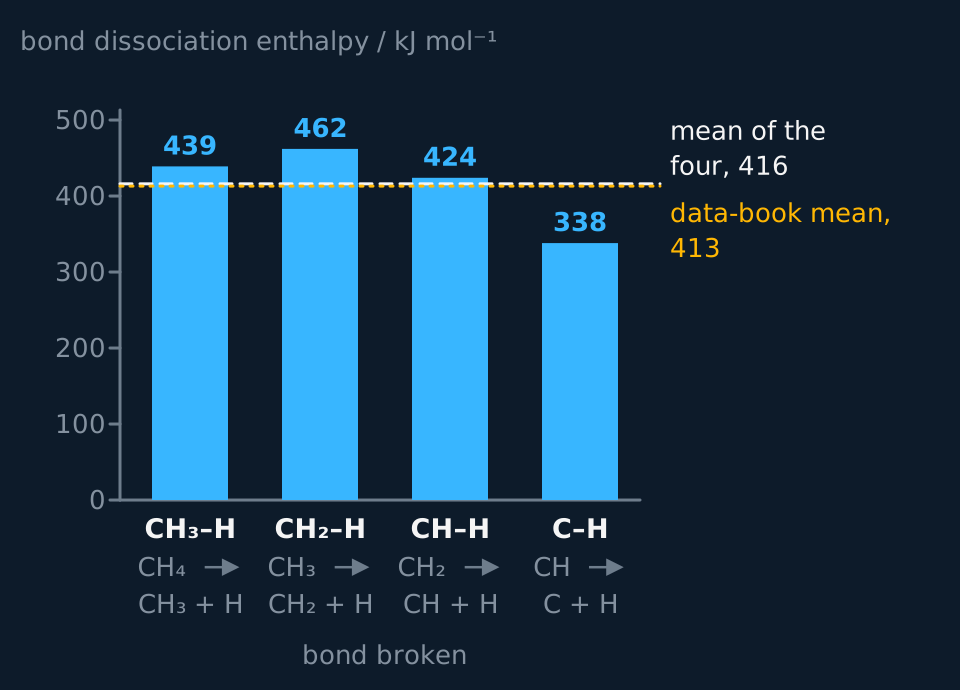
Methane has four C–H bonds that are identical in the molecule. Removing the hydrogens one at a time does not take the same energy each time, because after the first goes, the remaining bonds are in a different fragment with a different arrangement of electrons.
Describe the drawing
A bar chart of the four bond dissociation enthalpies met in pulling methane apart one hydrogen at a time: 439, 462, 424 and 338 kilojoules per mole. A dashed white line marks their mean, 416, and a dotted amber line just below it marks the data-book mean of 413; none of the four bars stops at either line.
The four steps take 439, 462, 424 and 338 kJ mol⁻¹, a total of 1663 kJ for the mole of methane, and a mean of 416 kJ mol⁻¹. A C–H bond in ethane, in chloromethane or in benzene has its own value again, because the other atoms attached to that carbon pull on its electrons differently. A data table cannot list every C–H bond in every molecule, so it gives one value, averaged over a range of compounds: 413 kJ mol⁻¹.
- Mean bond enthalpy
- The enthalpy needed to break one mole of a given type of covalent bond in the gaseous state, averaged over a range of different compounds.
- Enthalpy of atomisation
- The enthalpy change when one mole of gaseous atoms is formed from an element in its standard state.
A mean bond enthalpy is therefore an approximation for any one molecule. Only the bond in a diatomic element or compound, such as H–H, Cl–Cl or H–Cl, has a single exact value, because that bond exists in only one environment.
Bond strength follows bond length. Down Group 7 the halogen atom gets larger, the shared pair is further from its nucleus, and the bond to hydrogen gets weaker: H–Cl 432, H–Br 366 and H–I 298 kJ mol⁻¹. That trend is why hydrogen iodide decomposes on a hot wire and hydrogen chloride does not.
| Bond | Mean bond enthalpy / kJ mol⁻¹ | Bond | Mean bond enthalpy / kJ mol⁻¹ |
|---|---|---|---|
| H–H | 436 | C=O (in CO₂) | 805 |
| C–H | 413 | O=O | 498 |
| C–C | 347 | O–H | 464 |
| C=C | 612 | N≡N | 945 |
| C–O | 358 | N–H | 391 |
| Cl–Cl | 243 | H–Cl | 432 |
| Br–Br | 193 | H–Br | 366 |
A double bond is stronger than a single bond between the same atoms, but C=C at 612 is less than twice C–C at 347. The second pair of electrons is held less effectively than the first.
Between the same two atoms a triple bond is shorter than a double, and a double shorter than a single; the shorter bond holds its electrons between the nuclei more tightly and is the stronger. Nitrogen's N≡N, at 945 kJ mol⁻¹, is the strongest bond in the table. Nitrogen makes up most of the air yet reacts with almost nothing at room temperature: any reaction must begin to break that bond, so its activation energy is high, and the Haber process needs an iron catalyst and about 450 °C.
- Bond length
- The distance between the nuclei of two atoms joined by a covalent bond.
Every value in the table is positive, because each is the energy to break a bond. The sign of an answer comes only from the subtraction, never from the table.
ΔH from bond enthalpies
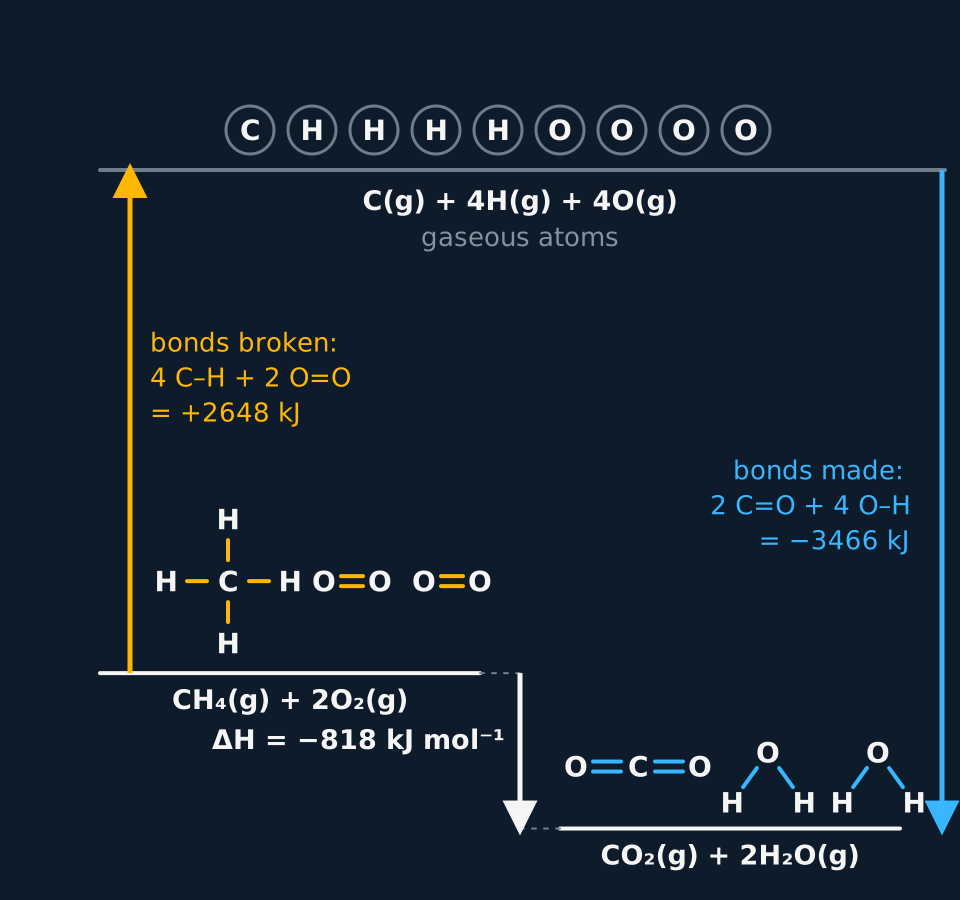
A bond enthalpy calculation treats a reaction as two steps: every bond in the reactants broken, leaving separate gaseous atoms, and then every bond in the products made from those atoms. The first step takes in energy, the second gives it out, and by Hess's law the overall ΔH is the sum of the two.
ΔH = Σ(bond enthalpies of bonds broken) − Σ(bond enthalpies of bonds made)Both sums are positive numbers; the subtraction supplies the sign.
Describe the drawing
An enthalpy level diagram drawn roughly to scale. Displayed methane and two oxygen molecules sit on a level at the middle left; a high level at the top holds one carbon, four hydrogen and four oxygen atoms as separate circles; a low level at the bottom right holds displayed carbon dioxide and two waters as gas. An amber arrow up is bonds broken, plus 2648 kJ; a cyan arrow down is bonds made, minus 3466 kJ; and an arrow from reactants to products gives ΔH = −818 kJ mol⁻¹. The bonds are coloured to match.
The combustion of methane
Calculate ΔH for CH₄(g) + 2O₂(g) → CO₂(g) + 2H₂O(g) from the mean bond enthalpies in the table.
Show the working
Draw the molecules with every bond showing, then count. Broken: 4 C–H and 2 O=O. Made: 2 C=O and 4 O–H.
Bonds broken: 4 × 413 + 2 × 498 = 1652 + 996 = 2648 kJ mol⁻¹.
Bonds made: 2 × 805 + 4 × 464 = 1610 + 1856 = 3466 kJ mol⁻¹.
ΔH = 2648 − 3466 = −818 kJ mol⁻¹.
The water in that equation is a gas on purpose. Bond enthalpies refer to gaseous molecules, so the calculation describes a reaction with every species in the gas phase.
The totals show where the heat of a fuel comes from. The bonds made, C=O at 805 and O–H at 464 kJ mol⁻¹, are among the strongest in the table, so making them releases more than breaking the C–H and O=O bonds took in. Every hydrocarbon makes those same strong bonds when it burns. A positive answer for a combustion therefore means a bond has been miscounted or a sign dropped.
In larger molecules it is often quicker to count only the bonds that change. When ethene adds water to become ethanol, the four C–H bonds of ethene survive untouched, and counting them on both sides would only cancel.
Most of the work is counting. Ethanol, CH₃CH₂OH, has five C–H bonds, not six, because the sixth hydrogen is on the oxygen; it also has one C–C, one C–O and one O–H. Drawing the displayed formula before counting, and ticking each bond as it is listed, prevents both missing one and counting one twice. A double bond counts once, at the C=C or C=O value, not as two single bonds.
Bromination of methane, counting only the bonds that change
Calculate ΔH for CH₄(g) + Br₂(g) → CH₃Br(g) + HBr(g) from the table, with C–Br = 290 kJ mol⁻¹.
Show the working
Three C–H bonds pass unchanged into bromomethane, so leave them out. Broken: one C–H and one Br–Br. Made: one C–Br and one H–Br.
Bonds broken: 413 + 193 = 606 kJ mol⁻¹. Bonds made: 290 + 366 = 656 kJ mol⁻¹.
ΔH = 606 − 656 = −50 kJ mol⁻¹.
The measured value, with every species a gas, is about −28 kJ mol⁻¹. The C–H bond actually broken is the first one in methane, CH₃–H, which the bar chart puts at 439 kJ mol⁻¹, not 413. With 439 the answer is 632 − 656 = −24 kJ mol⁻¹, within a few kJ of the measurement: most of the error came from one mean.
Working back to a bond enthalpy
The same equation can be run backwards. If ΔH has been measured and all but one bond enthalpy is known, the unknown one is the only thing left to find.
Values for bonds in diatomic molecules are found directly, by measuring the energy needed to split the molecule. Most other values in the table were found this way instead: by measuring ΔH for a reaction, or for atomising a compound completely, and subtracting the bonds already known.
The C=C bond enthalpy from the hydrogenation of ethene
Use ΔfH° values, C₂H₄(g) +52 kJ mol⁻¹ and C₂H₆(g) −84 kJ mol⁻¹, to find ΔH for C₂H₄(g) + H₂(g) → C₂H₆(g). Then use it with the table to calculate the C=C bond enthalpy in ethene.
Show the working
From the formation data: ΔH = ΣΔfH°(products) − ΣΔfH°(reactants) = (−84) − (+52 + 0) = −136 kJ mol⁻¹. Hydrogen is an element, so its ΔfH° is zero.
Bonds broken: one C=C, one H–H and four C–H. Bonds made: one C–C and six C–H. Four C–H bonds appear on both sides, so the change is C=C + H–H broken, C–C + 2 C–H made.
−136 = (C=C + 436) − (347 + 2 × 413) = C=C + 436 − 1173 = C=C − 737.
C=C = −136 + 737 = 601 kJ mol⁻¹.
That is 11 kJ mol⁻¹ below the table's 612. The 612 is a mean over many alkenes, and the C–C and C–H values used are means too, so the bond in ethene need not match it.
Atomising a compound breaks every bond in it at once, and a cycle through the elements gives that total from enthalpies of formation and atomisation. For methane, divided by four, it is the mean C–H bond enthalpy of that one molecule.
The mean C–H bond enthalpy in methane
Calculate the mean C–H bond enthalpy in methane from ΔfH°(CH₄, g) = −75 kJ mol⁻¹ and the enthalpies of atomisation of carbon, +717 kJ mol⁻¹, and of hydrogen, +218 kJ mol⁻¹ per mole of H atoms.
Show the working
The target is CH₄(g) → C(g) + 4H(g), which breaks all four C–H bonds. Put the elements, C(s) + 2H₂(g), at the bottom of the cycle, below both methane and the atoms.
Elements to atoms: 717 + 4 × 218 = 717 + 872 = +1589 kJ mol⁻¹. Elements to methane: −75 kJ mol⁻¹.
Methane to atoms runs against the formation arrow and with the atomisation arrow: ΔH = −(−75) + 1589 = +1664 kJ mol⁻¹.
Mean C–H = 1664 ÷ 4 = 416 kJ mol⁻¹. That is the mean of the four steps in the bar chart, whose sum is 1663 kJ, and 3 kJ mol⁻¹ above the 413 averaged over many compounds.
The method has a use beyond the classroom. A chemist designing a new fuel, or a compound that has never been made, has no enthalpies of formation to work from. Bond enthalpies give an estimate of ΔH from the structure alone, usually within about ten per cent for reactions of gases, before anything is synthesised.
- Radical
- A species with an unpaired electron, such as a hydrogen or chlorine atom formed by homolytic fission.
Why the answers differ from the data book
Bond enthalpy estimates and measured values agree well in some reactions and poorly in others, and the pattern follows from what the values are.
Describe the drawing
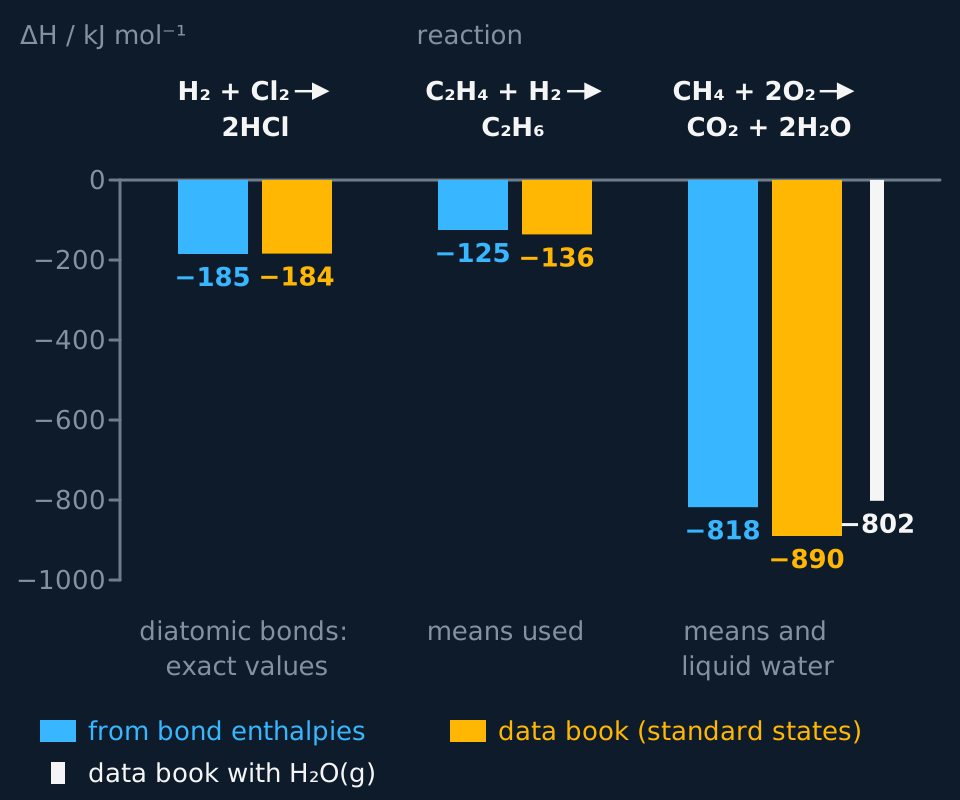
A grouped bar chart with every bar hanging down from zero. For hydrogen with chlorine the bond-enthalpy and data-book bars are minus 185 and minus 184, within a kilojoule because every bond is diatomic. For ethene with hydrogen they are minus 125 and minus 136. For methane burning they are minus 818 and minus 890, with a thin third bar at minus 802 for the data-book value corrected to gaseous water.
The first reason is that mean values are not the actual values in the molecules reacting. The C–H bonds in methane are not exactly 413 kJ mol⁻¹. The H–H, Cl–Cl and H–Cl bonds are diatomic, so their values are exact, and the hydrogen and chlorine reaction gives −185 kJ mol⁻¹ from bond enthalpies and −184 kJ mol⁻¹, twice ΔfH°(HCl), from the data book.
The middle pair of bars shows that reason on its own. In C₂H₄(g) + H₂(g) → C₂H₆(g) every species is a gas in its standard state, so no change of state is involved, and the whole gap between −125 and −136 kJ mol⁻¹ comes from using means for the C=C, C–C and C–H bonds.
The second reason is state. Bond enthalpies give ΔH for all species as gases, but standard values use standard states. The standard enthalpy of combustion of methane forms liquid water, and condensing two moles of steam releases a further 88 kJ. That difference has nothing to do with covalent bonds; it is intermolecular forces forming.
- Enthalpy of vaporisation
- The enthalpy change when one mole of a liquid is converted into a gas at the same temperature.
Taking out the state difference, ΔcH° of methane with gaseous water is −890 + 88 = −802 kJ mol⁻¹. The bond enthalpy answer of −818 kJ mol⁻¹ is still 16 kJ mol⁻¹ off, and that remainder is the error from using means. Where enthalpies of formation are available, a Hess cycle gives the more accurate answer.
TRY IT: Hydrogen and bromine
Calculate ΔH for H₂(g) + Br₂(g) → 2HBr(g) from the table. The standard enthalpy change for H₂(g) + Br₂(l) → 2HBr(g) is −72 kJ mol⁻¹. Explain why the two values differ, even though every bond involved is in a diatomic molecule.
Check your answer
Broken: H–H + Br–Br = 436 + 193 = 629 kJ mol⁻¹. Made: 2 × H–Br = 2 × 366 = 732 kJ mol⁻¹. ΔH = 629 − 732 = −103 kJ mol⁻¹.
All three bonds are diatomic, so the values are exact and means are not the cause. The difference is the state of the bromine. Its standard state is liquid, and the standard reaction must first vaporise it, which takes in about 31 kJ mol⁻¹.
−103 + 31 = −72 kJ mol⁻¹, the standard value. A bond enthalpy calculation needs every species as a gas before the bonds are counted.
Other boards: bond energies, bond length and reactivity
Cambridge calls these values bond energies, and OCR calls the mean an average bond enthalpy. The definition and the arithmetic are the same, and either name is accepted for the quantity.
Cambridge also asks for bond length alongside bond energy, and for what the two say about reactivity. The answer it credits has three steps: between the same two atoms the shorter bond is the stronger; a strong bond gives any reaction that must break it a high activation energy; so the molecule is unreactive. Nitrogen, with the short N≡N triple bond at 945 kJ mol⁻¹, is the standard example, and the halogen–hydrogen bonds, weakening from H–Cl to H–I as the bond lengthens, are the other.
In the exam
- A definition of mean bond enthalpy earns a mark for each of three parts: one mole of a given bond broken, in the gaseous state, averaged over a range of compounds. 'The energy in a bond' earns none of them.
- List the bonds broken and made, with their numbers, before any arithmetic; the method marks are for the two sums and the answer mark needs the sign and kJ mol⁻¹. A miscounted bond is penalised once and the rest is marked with error carried forward.
- For a difference from a data-book value, the scheme accepts 'the values are means, not the actual values in this molecule' and 'a species is not gaseous in its standard state'. 'Heat loss' is rejected: nothing was measured.
- To explain why a reaction is exothermic in terms of bonds, compare totals: more energy is released making the bonds in the products than is taken in breaking the bonds in the reactants.
- The sign of an answer comes from bonds broken minus bonds made, in that order. Reversing the subtraction gives the right size with the wrong sign, and the answer mark is lost.
Check yourself
A student calculates ΔH for the combustion of ethanol vapour from mean bond enthalpies and gets −1276 kJ mol⁻¹. The data book gives ΔcH°(C₂H₅OH) = −1367 kJ mol⁻¹. Give two reasons for the difference, and say which way each one acts.
Answer
The data-book value has ethanol as a liquid and the water formed as a liquid. The bond enthalpy calculation has both as gases. Vaporising the liquid ethanol takes in energy, making the standard value less exothermic, but condensing three moles of water gives out more, about 132 kJ, making it more exothermic. Overall the change of state makes the data-book value the more exothermic by roughly 90 kJ mol⁻¹.
The bond enthalpies used are means across many compounds, not the exact values for the C–H, C–C, C–O and O–H bonds in ethanol, so the estimate can be off in either direction.
The state difference accounts for almost all of the 91 kJ mol⁻¹ gap. For ethanol the errors from the means happen nearly to cancel, which is luck rather than a property of the method.
Questions
Question 16 marks
Evaluate the use of mean bond enthalpies, rather than standard enthalpies of formation in a Hess cycle, to find the enthalpy change of a reaction.
Mark scheme
Indicative content
- bond enthalpies need only the structures of the molecules, so they give an estimate for compounds whose enthalpies of formation have never been measured
- the values are means over many compounds, not the actual bond energies in the molecules reacting, so the answer is only approximate
- bond enthalpies apply only to gases, so a reaction with a liquid or solid in its standard state needs a change-of-state correction
- where every bond is in a diatomic molecule, as in hydrogen with chlorine, the values are exact and the agreement with the data book is close
- a Hess cycle uses measured enthalpies of formation of the actual compounds in their standard states, so it is more accurate where those data exist
- bond enthalpies are therefore best used as an estimate, usually within about ten per cent for gases, with a formation cycle preferred whenever its data are available
Levels
- Level 3 (5–6 marks) both sides are weighed: the usefulness of mean bond enthalpies where formation data do not exist, their inaccuracy from being averages and applying to gases only, the exact case of diatomic molecules, and the greater accuracy of a formation cycle, ending with a justified view of when each should be used
- Level 2 (3–4 marks) the mean-value and gas-phase limits are given and the formation cycle called more accurate; the case for bond enthalpies, or when each method should be used, is not made
- Level 1 (1–2 marks) bond enthalpies are called approximate with no reason, or more accurate because each bond is measured separately
Question 24 marks
Calculate ΔH for C₂H₄(g) + Br₂(g) → C₂H₄Br₂(g), counting only the bonds that change, using the mean bond enthalpies in the table.
| Bond | Mean bond enthalpy / kJ mol⁻¹ |
|---|---|
| C=C | 612 |
| Br–Br | 193 |
| C–C | 347 |
| C–Br | 290 |
Mark scheme
- M1 bonds broken: one C=C and one Br–Br, 612 + 193 = 805
- M1 bonds made: one C–C and two C–Br, 347 + 2 × 290 = 927; the four C–H bonds are unchanged and may be left out
- M1 ΔH = bonds broken − bonds made = 805 − 927
- A1 ΔH = −122 kJ mol⁻¹ to three significant figures; +122 kJ mol⁻¹, from reversing the subtraction, scores the first two marks only
Question 34 marks
Calculate ΔH for C₃H₈(g) + 5O₂(g) → 3CO₂(g) + 4H₂O(g) from the mean bond enthalpies in the table.
| Bond | Mean bond enthalpy / kJ mol⁻¹ |
|---|---|
| C–H | 413 |
| C–C | 347 |
| O=O | 498 |
| C=O | 805 |
| O–H | 464 |
Mark scheme
- M1 bonds broken: 2 C–C + 8 C–H + 5 O=O = 694 + 3304 + 2490 = 6488
- M1 bonds made: 6 C=O + 8 O–H = 4830 + 3712 = 8542
- M1 ΔH = bonds broken − bonds made = 6488 − 8542
- A1 ΔH = −2054 kJ mol⁻¹, to four significant figures; allow error carried forward from one miscounted bond
All 19 questions with mark schemes, the other 16 set out in full on the question page.
Worth remembering
- Copy every bond enthalpy as a positive number; the sign of ΔH comes from the subtraction.
- Ethanol counted with six C–H bonds has one too many; the sixth hydrogen is on the oxygen.
- Take a double bond once at the C=C value, never as two single bonds or at the C–C value.
- 'Heat loss' as the reason a bond enthalpy answer misses the data book is rejected; nothing was measured.
- Comparing a bond enthalpy answer with a ΔcH° that forms liquid water ignores the state difference; bond enthalpies are for gases only.
CHECK YOUR PROGRESS
Rate how confident you are with each objective for this lesson. Ratings are saved in this browser, on this device, unless you sign in.
- Define bond dissociation enthalpy and mean bond enthalpy, and explain why most tabulated values are means.
- Explain why bond breaking is endothermic and bond making is exothermic.
- Calculate ΔH for a reaction from mean bond enthalpies as bonds broken minus bonds made.
- Calculate an unknown bond enthalpy from a measured ΔH.
- Explain why ΔH from bond enthalpies differs from a value found by calorimetry or from enthalpies of formation.
- Use enthalpies of formation and atomisation in a cycle to calculate a mean bond enthalpy, and relate bond length to bond strength.
Open the full revision checklist to see every objective in the curriculum in one place.
Practise this lesson
Practise mean bond enthalpies with 19 original questions and point-by-point mark schemes
WORKBOOK
The written questions from this topic, on paper with room to work, and a separate book of mark schemes. The 6 questions that are set on a diagram stay on this page, where the diagram can be drawn. Free to use; please do not redistribute or sell.
Used later in Free-radical substitution