Chemistry › Transition metals › Transition metal characteristics and complex formation
Transition metal characteristics and complex formation
Copper(II) sulfate solution is blue, iron rusts through two oxidation states, and iron turns nitrogen and hydrogen into ammonia by the tonne. All of it follows from a 3d subshell left incomplete in the metal's ions. That one feature gives the definition of a transition metal, the electron configurations of its ions, and the coordinate bonds by which a metal ion holds six water molecules or one wrapped EDTA⁴⁻ ion.
Key terms Every definition in transition metals, lesson by lesson
Before this Electron configuration: shells, subshells and orbitals – the order the subshells fill, 4s before 3d · Covalent, dative covalent and metallic bonding – a dative bond as a shared pair donated by one atom · Oxidation states and the rules for assigning them – the oxidation states in an ion add up to its charge
COMMON MISCONCEPTION
Every metal in the middle block of the periodic table is a transition metal, so zinc must be one.
A transition metal forms at least one stable ion with a partly filled d subshell. Zinc's only ion, Zn²⁺, is [Ar] 3d¹⁰, full, so its compounds are white and it has one oxidation state. Scandium's only ion, Sc³⁺, is 3d⁰, empty. Both sit in the d block and neither is a transition metal; titanium to copper are.
What you should be able to do
- State the definition of a transition metal and explain why scandium and zinc are excluded.
- Write the electron configurations of the atoms titanium to copper and of their common ions, removing the 4s electrons first.
- Name the four characteristic properties of transition metals.
- Define ligand, coordinate bond, complex and coordination number, and deduce the charge or the oxidation state in a complex.
- Distinguish monodentate, bidentate and multidentate ligands, with a named example of each.
- Explain how haem carries oxygen and why carbon monoxide is toxic.
What makes a transition metal
The sulfates of the metals in the middle of Period 4 dissolve to give coloured solutions: iron(II) sulfate pale green, cobalt(II) sulfate pink, nickel(II) sulfate green and copper(II) sulfate blue. The sulfates of the two metals at the ends of the row, scandium and zinc, give colourless solutions. The metals in between share a set of properties that the two at the ends lack, and the reason is the same each time: an incomplete 3d subshell.
The d block runs from scandium to zinc in Period 4. A transition metal is a narrower group: an element that forms at least one stable ion with an incomplete d subshell. The eight elements examined are titanium to copper, and the characteristic properties of all eight arise from that incomplete d sub-level, in their atoms or in their ions. The definition is about a stable ion: one that talks only about the atom lets zinc in.
Four properties follow from the incomplete subshell. Transition metals form complexes, in which ligands bond to a central ion. They form coloured ions, because light is absorbed as a d electron moves between d orbitals that the ligands have split apart. They show variable oxidation states, because the 3d and 4s electrons are close in energy. And the metals and their compounds are catalysts, because they can change oxidation state and can bond weakly to reactants at a surface.
Scandium and zinc are d-block elements but not transition metals. Scandium forms only one ion, Sc³⁺, by losing all three of its outer electrons, which leaves [Ar] with an empty 3d subshell. Zinc forms only Zn²⁺, [Ar] 3d¹⁰, with the 3d subshell full. Neither has a stable ion with a partly filled d subshell. Their compounds are white, their solutions are colourless, and each has a single oxidation state in its compounds.
- Transition metal
- An element that forms at least one stable ion with an incomplete d subshell.
- d-block element
- An element whose highest-energy electron is in a d subshell; scandium to zinc in Period 4.
Electron configurations from titanium to copper
Across Period 4 the 4s subshell fills first, at potassium and calcium, and then the five 3d orbitals take ten electrons from scandium to zinc. Two atoms break the pattern. Chromium is [Ar] 3d⁵ 4s¹, not 3d⁴ 4s², and copper is [Ar] 3d¹⁰ 4s¹, not 3d⁹ 4s². A half-filled or completely filled 3d subshell, with the electron density spread evenly round the atom, is lower in energy, and moving one electron out of 4s achieves it. The two exceptions are learned rather than worked out.
When a transition metal atom forms an ion, the 4s electrons are lost before any 3d electrons. That looks backwards, since 4s filled first, but once the 3d orbitals hold electrons they are lower in energy than 4s, so the 4s electrons are the outermost and the easiest to remove. An iron atom is [Ar] 3d⁶ 4s². Fe²⁺ has lost both 4s electrons and is [Ar] 3d⁶; Fe³⁺ has lost one 3d electron as well and is [Ar] 3d⁵.
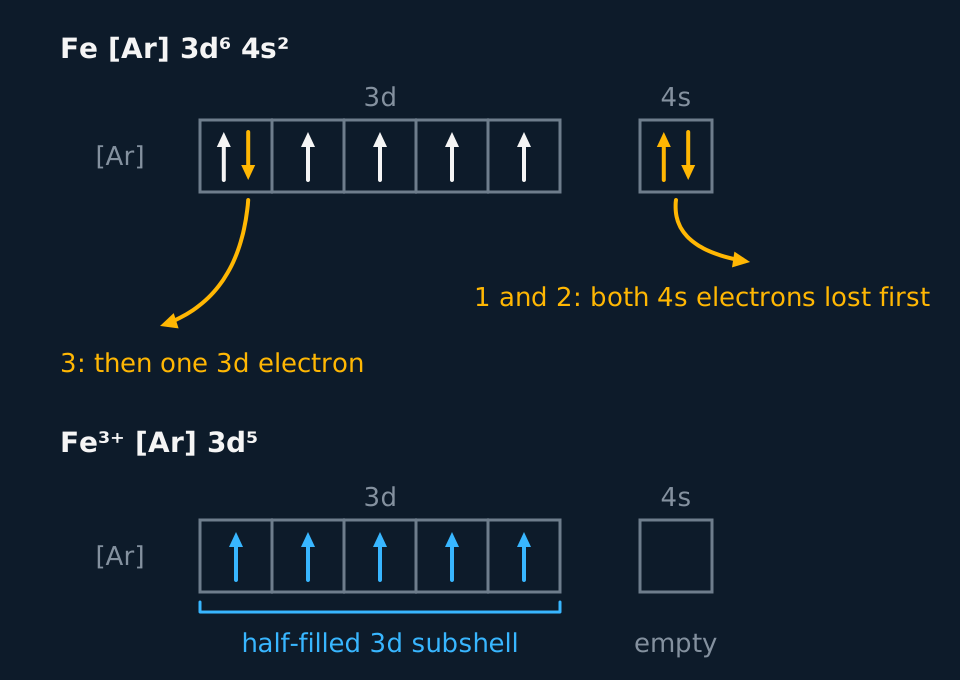
Describe the drawing
Electrons in boxes for iron and for the iron(III) ion. Each row starts with argon in brackets, then five joined 3d boxes and a separate 4s box. Iron has one pair and four single electrons in 3d and a pair in 4s. Curved arrows show the two 4s electrons lost first and then the second electron of the 3d pair. Fe³⁺ is left with one unpaired electron in each of the five 3d boxes and an empty 4s box: a half-filled subshell.
| Atom | Common ions | |
|---|---|---|
| Ti | [Ar] 3d² 4s² | Ti³⁺ [Ar] 3d¹ |
| V | [Ar] 3d³ 4s² | V³⁺ [Ar] 3d², V²⁺ [Ar] 3d³ |
| Cr | [Ar] 3d⁵ 4s¹ | Cr³⁺ [Ar] 3d³ |
| Mn | [Ar] 3d⁵ 4s² | Mn²⁺ [Ar] 3d⁵ |
| Fe | [Ar] 3d⁶ 4s² | Fe²⁺ [Ar] 3d⁶, Fe³⁺ [Ar] 3d⁵ |
| Co | [Ar] 3d⁷ 4s² | Co²⁺ [Ar] 3d⁷ |
| Ni | [Ar] 3d⁸ 4s² | Ni²⁺ [Ar] 3d⁸ |
| Cu | [Ar] 3d¹⁰ 4s¹ | Cu²⁺ [Ar] 3d⁹, Cu⁺ [Ar] 3d¹⁰ |
The same closeness in energy explains the variable oxidation states. The 3d and 4s electrons are so near each other in energy that the successive ionisation energies climb steadily, with no sudden jump of the kind that separates sodium's first electron from its second. Taking one more electron needs only a little more energy, and the larger lattice or hydration enthalpy of a more highly charged ion can repay it. Iron is found as +2 and +3, and manganese in every state from +2 to +7.
Copper's two ions against the definition
Give the electron configurations of Cu, Cu⁺ and Cu²⁺, and use them to decide whether copper is a transition metal.
Show the working
Copper, element 29, is one of the two exceptions: [Ar] 3d¹⁰ 4s¹. The 4s electron is lost first, so Cu⁺ is [Ar] 3d¹⁰. Cu²⁺ loses one 3d electron as well and is [Ar] 3d⁹.
Cu⁺ has a full 3d subshell, and like Zn²⁺ its compounds are white: copper(I) iodide is a white solid. Cu²⁺ has nine 3d electrons, an incomplete subshell, and its compounds are blue or green.
The definition asks for at least one stable ion with an incomplete d subshell. Cu²⁺ is that ion, so copper is a transition metal. Zinc fails the same test because its only ion, Zn²⁺, is 3d¹⁰.
Ligands and coordinate bonds
The Cu²⁺ ion in copper(II) sulfate solution is not free. Six water molecules surround it, each bonded to the ion through a lone pair on its oxygen atom, and the blue species is [Cu(H₂O)₆]²⁺. Anhydrous copper(II) sulfate, with no water bonded to the copper, is a white powder, and it turns blue the moment water reaches it. The square brackets enclose the whole complex, and the charge outside them belongs to all of it.
Each of those six bonds is a coordinate bond, also called a dative covalent bond: a shared pair of electrons in which both electrons came from the same atom, here the oxygen. The water molecule is a ligand, and the metal ion accepts its lone pair into an empty orbital. A ligand is therefore a Lewis base, an electron-pair donor, and the metal ion a Lewis acid, an electron-pair acceptor. Use 'coordinate bond' or 'dative covalent bond' in an answer; 'the water is attracted to the ion' describes an ion–dipole attraction, which is something weaker and different.
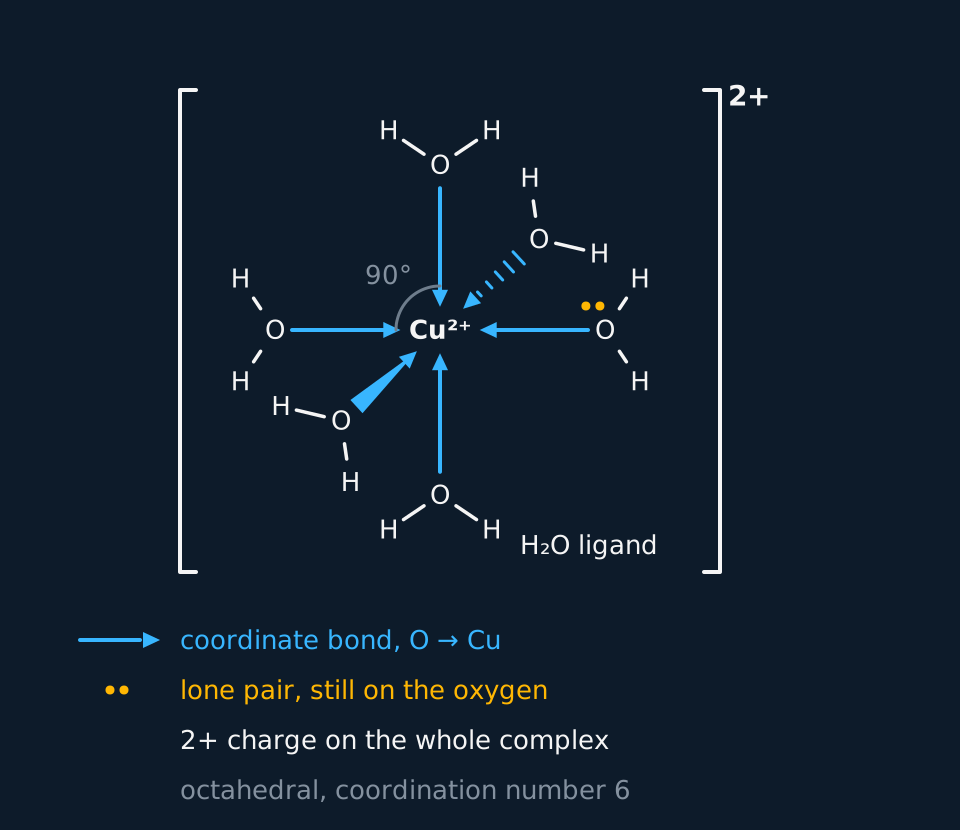
Describe the drawing
The hexaaquacopper(II) ion drawn in three dimensions. Cu²⁺ sits at the centre of an octahedron with a water molecule at each corner: one above, one below, one left and one right in the plane of the page, one on a solid wedge towards the viewer and one on a hashed wedge away. Every water is bonded through its oxygen, each bond carries an arrowhead pointing from oxygen to copper, one oxygen shows its second lone pair, a right angle is marked between two ligands, and the whole ion sits in square brackets with a 2+ charge outside.
The number of coordinate bonds from the ligands to the central ion is the coordination number, six in [Cu(H₂O)₆]²⁺. Count bonds, not ligands: the two numbers are equal only when each ligand bonds through one atom. Six is the commonest coordination number for the ions of titanium to copper, and four the next.
The charge on a complex is the charge on the metal ion plus the charges on the ligands. Water and ammonia are neutral, so [Co(NH₃)₆]³⁺ carries the 3+ of cobalt(III). Chloride carries 1−, so four chloride ions on Cu²⁺ give [CuCl₄]²⁻, and six cyanide ions on Fe³⁺ give [Fe(CN)₆]³⁻. Working backwards from the overall charge gives the oxidation state of the metal, which is how most questions use it.
In a solid salt the complex ion is balanced by ions written outside the square brackets, and those ions are not ligands. Potassium hexacyanoferrate(III) is K₃[Fe(CN)₆]: three K⁺ ions balance the 3− complex. When [Co(NH₃)₆]Cl₃ dissolves, all three chloride ions are free in solution, and silver nitrate precipitates all three as silver chloride. In [Co(NH₃)₅Cl]Cl₂ one chloride ion is a ligand, held to the cobalt by a coordinate bond, and only two of the three precipitate. Counts of this kind were the first evidence of which ions are bonded to the metal.
- Ligand
- A molecule or ion that forms a coordinate bond with a transition metal ion by donating a pair of electrons.
- Coordinate bond
- A covalent bond in which both electrons of the shared pair come from the same atom.
- Complex
- A central metal atom or ion surrounded by ligands bonded to it by coordinate bonds.
- Coordination number
- The number of coordinate bonds from the ligands to the central metal atom or ion.
TRY IT: Oxidation state and coordination number
Give the oxidation state of the metal and the coordination number in [Cr(H₂O)₄Cl₂]⁺ and in [Fe(CN)₆]⁴⁻.
Check your answer
In [Cr(H₂O)₄Cl₂]⁺ the water is neutral and the two chloride ligands carry 2− between them. The chromium supplies the rest: x − 2 = +1, so x = +3, chromium(III). Four water molecules and two chloride ions each form one coordinate bond, so the coordination number is 6.
In [Fe(CN)₆]⁴⁻ the six cyanide ions carry 6−, so x − 6 = −4 and iron is +2, iron(II). Six cyanide ligands each bond once: coordination number 6. Its iron(III) partner, [Fe(CN)₆]³⁻, differs by one electron and one unit of charge.
Ligands with more than one lone pair to give
Water, ammonia and chloride ions are monodentate: each forms one coordinate bond to the metal. Some ligands have lone pairs on two or more atoms far enough apart that both can reach the same metal ion. Ethane-1,2-diamine, H₂NCH₂CH₂NH₂, has a lone pair on each nitrogen, and the two-carbon chain between them is just long enough for both to bond to one ion. It is bidentate, and is often written en in formulae. The ethanedioate ion, C₂O₄²⁻, is bidentate through one oxygen atom on each carboxylate group.
Three bidentate ligands fill six positions, so the coordination number of [Cr(C₂O₄)₃]³⁻ is 6 although only three ligands are attached. The charge works as before: chromium(III) with three 2− ligands gives 3− overall. Each bidentate ligand closes a five-membered ring on the metal: metal, oxygen, carbon, carbon and oxygen for ethanedioate, and metal, nitrogen, carbon, carbon and nitrogen for ethane-1,2-diamine.
EDTA⁴⁻, the anion of ethylenediaminetetraacetic acid, is multidentate. It has six donor atoms, two nitrogen atoms and four oxygen atoms on its carboxylate groups, and it wraps round a metal ion to fill all six positions of an octahedron at once. One EDTA⁴⁻ ion replaces six water molecules: [Cu(H₂O)₆]²⁺ becomes [Cu(EDTA)]²⁻, a 2+ ion and a 4− ligand giving 2− overall.
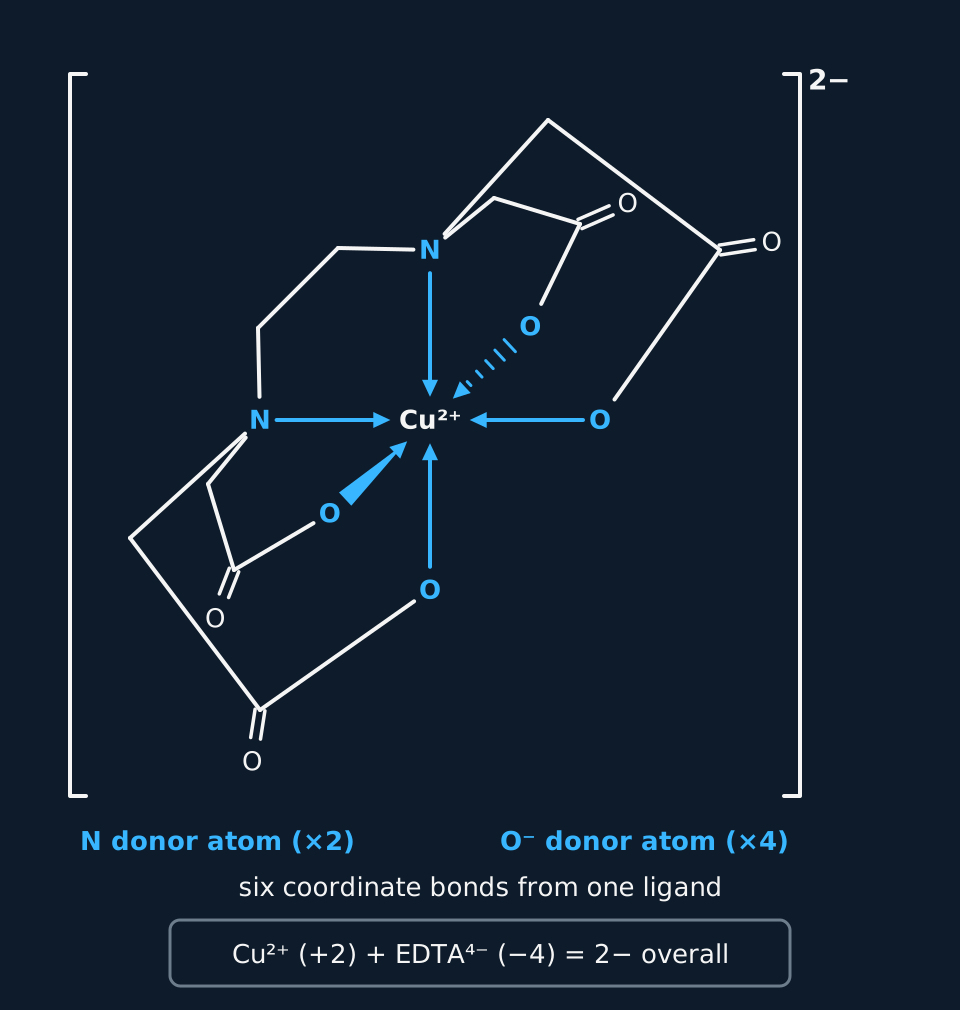
Describe the drawing
The copper(II) EDTA complex drawn in three dimensions. Copper sits at the centre of an octahedron. The two nitrogen atoms of EDTA, joined by a two-carbon bridge, take the top corner and the left corner. Each nitrogen carries two arms ending in carboxylate groups, and one oxygen of each of the four carboxylates takes one of the remaining corners, including the wedge towards the viewer and the hashed wedge away. Six arrows point from the donor atoms to copper, the other carboxylate oxygens are drawn but not bonded, and a box beneath adds the charges: plus two and minus four make two minus overall.
A ligand that grips this tightly holds a metal ion in solution where it can do nothing else. EDTA in bath products takes up the Ca²⁺ ions of hard water, which would otherwise form scum with soap. Given by drip as its calcium salt, it treats lead poisoning: the Pb²⁺ is complexed and excreted. And because EDTA⁴⁻ always binds one metal ion per ligand, a titration with EDTA solution measures the Ca²⁺ and Mg²⁺ in a water sample from a 1 : 1 ratio.
Hardness of water by EDTA titration
A 50.0 cm³ sample of hard water is buffered at pH 10 and a metal-ion indicator is added. It needs 8.65 cm³ of 0.0100 mol dm⁻³ EDTA⁴⁻ solution to complex all of its calcium ions. Calculate the concentration of Ca²⁺ in the water, and the mass of calcium in each dm³ in mg. Ar of Ca = 40.1.
Show the working
Moles of EDTA⁴⁻ in the titre = 0.0100 × 8.65 ÷ 1000 = 8.65 × 10⁻⁵ mol.
One EDTA⁴⁻ ion binds one metal ion, whatever its charge, so the sample held 8.65 × 10⁻⁵ mol of Ca²⁺.
Concentration = 8.65 × 10⁻⁵ ÷ 0.0500 = 1.73 × 10⁻³ mol dm⁻³, to three significant figures.
Mass of calcium in 1 dm³ = 1.73 × 10⁻³ × 40.1 = 0.0694 g, which is 69.4 mg. In a real sample the titre counts the Mg²⁺ ions as well, so the result is the total hardness expressed as calcium.
- Monodentate ligand
- A ligand that forms one coordinate bond to a metal ion, such as water, ammonia or the chloride ion.
- Bidentate ligand
- A ligand that forms two coordinate bonds to the same metal ion, such as ethane-1,2-diamine or the ethanedioate ion.
- Multidentate ligand
- A ligand that forms more than two coordinate bonds to the same metal ion, such as EDTA⁴⁻, which forms six.
Haem, oxygen and carbon monoxide
Haemoglobin carries oxygen because of a complex. Each of its four protein chains holds one haem group, an Fe²⁺ ion at the centre of a flat ring called a porphyrin. The ring is a multidentate ligand that bonds to the iron through four nitrogen atoms arranged in a square. A nitrogen atom from the protein chain bonds from below, making five, and the sixth position, above the ring, is free. The complex is octahedral, with iron in the +2 oxidation state.
In the lungs an oxygen molecule forms a coordinate bond to that sixth position. The bond is weak enough to break again in respiring tissue, where the oxygen concentration is low, so the oxygen is released where it is needed. Taking up and releasing oxygen is a reversible ligand substitution, with a water molecule in the sixth position when oxygen is absent.
HbO₂(aq) + CO(aq) ⇌ HbCO(aq) + O₂(aq)Hb stands for one haem site in haemoglobin. The position of equilibrium lies far to the right.
Carbon monoxide is toxic because it is a ligand for the same position. It bonds to the Fe²⁺ through its carbon atom, and the coordinate bond it forms is far stronger than the one to oxygen: haemoglobin binds carbon monoxide about two hundred times more strongly. Once carbon monoxide has replaced oxygen it is released only very slowly, and the haem group holding it cannot carry oxygen. A low concentration in the air is therefore enough to occupy a large fraction of the haem groups. Breathing pure oxygen shifts the equilibrium back, slowly.
Other boards: the definition and the shapes of the d orbitals
OCR, Edexcel and Cambridge state the definition directly: an element that forms one or more stable ions with an incomplete d subshell. AQA's specification words it from the other end, saying that the characteristic properties of the elements titanium to copper arise from an incomplete d sub-level in their atoms or ions. The two wordings give the same list, and either earns the mark.
Cambridge also asks for the shapes of the d orbitals, and in particular for sketches of 3dxy and 3dz². The five 3d orbitals have the same energy in a free atom but not the same shape. Four of them have four lobes, like a four-leaf clover. The 3dxy orbital lies in the plane of the x and y axes with its lobes pointing between the axes, at 45° to them, and 3dxz and 3dyz are the same shape in the other two planes. The 3dx²−y² orbital is the same clover in the xy plane turned through 45°, so its lobes lie along the x and y axes.
The fifth, 3dz², is a different shape: two lobes along the z axis, one each side of the nucleus, with a ring of electron density round its middle in the xy plane. The difference the sketches show, between orbitals that point along the axes and orbitals that point between them, is what splits the d orbitals in an octahedral complex and makes it coloured: the two that point along the axes meet the ligands' lone pairs head on and are raised in energy more than the other three.
In the exam
- A list of characteristic properties earns its marks only for the four that come from the d subshell: complex formation, coloured ions, variable oxidation states and catalytic activity. High density and high melting point are true of most metals and are not credited.
- Zinc is excluded by its ion. The scheme awards the mark for saying that Zn²⁺, its only ion, is [Ar] 3d¹⁰, with a full d subshell; the configuration of the zinc atom alone is not credited, because the definition is about ions.
- Fe³⁺ written as [Ar] 3d³ 4s² loses the configuration mark: it is [Ar] 3d⁵. Schemes accept the full form, 1s² 2s² 2p⁶ 3s² 3p⁶ 3d⁵, as well as the [Ar] shorthand.
- Define a ligand with both parts: a molecule or ion that donates a lone pair of electrons, and so forms a coordinate (dative) bond to the metal. The scheme accepts 'electron pair donor' for the first part.
- For carbon monoxide the answer must contain the substitution: CO forms a stronger coordinate bond to the Fe²⁺ in haem than O₂ does, replaces the oxygen and is released only very slowly, so less oxygen reaches the tissues.
Check yourself
Solid iron(II) sulfate left in air slowly turns yellow-brown on the surface as Fe²⁺ is oxidised to Fe³⁺. Use electron configurations to explain why Fe³⁺ is the more stable ion of iron, and why the same argument makes Mn²⁺ hard to oxidise to Mn³⁺.
Answer
Fe is [Ar] 3d⁶ 4s². Fe²⁺ has lost the two 4s electrons and is [Ar] 3d⁶. Fe³⁺ has lost one 3d electron as well and is [Ar] 3d⁵.
In Fe³⁺ each of the five 3d orbitals holds one electron. The sixth electron in Fe²⁺ has to pair with an electron already in an orbital, and the repulsion between the pair raises its energy, so it is relatively easy to remove. Removing it gives the half-filled subshell, which is why Fe²⁺ is readily oxidised to Fe³⁺.
Mn²⁺ is already [Ar] 3d⁵. Oxidising it to Mn³⁺ would take an electron from a half-filled subshell, with no paired electron to lose, so Mn²⁺ is the stable state of manganese in water and Mn³⁺ is not.
Questions
Question 16 marksAQA · OCR A · Edexcel
Explain, with reference to the structure of the haem group, how haemoglobin carries oxygen round the body and why carbon monoxide is toxic.
Mark scheme
Indicative content
- haem contains an Fe²⁺ ion at the centre of a flat porphyrin ring, which bonds to the iron through four nitrogen atoms arranged in a square
- a nitrogen atom from the protein chain bonds from below, so five of the six octahedral positions are filled and the sixth, above the ring, is free
- in the lungs an oxygen molecule forms a coordinate bond to the Fe²⁺ at that sixth position, replacing a water molecule by ligand substitution
- the bond to oxygen is weak and reversible, so the oxygen is released in respiring tissues where its concentration is low
- carbon monoxide bonds to the same position through its carbon atom, and its coordinate bond to Fe²⁺ is much stronger than the bond to oxygen
- carbon monoxide replaces the oxygen and is released only very slowly, so that haem cannot carry oxygen and less oxygen reaches the cells
Levels
- Level 3 (5–6 marks) both parts are fully answered: the haem structure is described with the four nitrogen atoms of the ring, the protein nitrogen below and the free sixth position, the reversible coordinate bond to oxygen is explained with its release in the tissues, and the toxicity of carbon monoxide is explained through its much stronger bond at the same position, released only very slowly
- Level 2 (3–4 marks) the Fe²⁺ in the ring and the coordinate bond to oxygen are described and carbon monoxide is said to bind more strongly; the free sixth position, the reversibility of the oxygen bond, or the ligand substitution is not mentioned
- Level 1 (1–2 marks) iron is said to bond to oxygen; carbon monoxide is often said to react with the oxygen in the blood, and the structure of haem is largely absent
Question 25 marks
Name the four characteristic properties of the transition metals, and explain why the transition metals show variable oxidation states.
Mark scheme
- B1 they form complexes and they form coloured ions; allow coloured compounds
- B1 they show variable oxidation states, and they and their compounds act as catalysts; ignore high density or melting point
- B1 the 3d and 4s electrons are similar in energy
- B1 so the successive ionisation energies rise gradually, with no large jump after the 4s electrons are removed
- B1 the energy needed to form a more highly charged ion can be repaid by its larger lattice or hydration enthalpy, so several ions are stable
Question 34 marks
State what is meant by the term transition metal. Ti⁴⁺ has no d electrons; use the electron configurations of Ti²⁺, Ti³⁺ and Ti⁴⁺ to explain why titanium is still a transition metal.
Mark scheme
- B1 an element that forms at least one stable ion with an incomplete (partly filled) d subshell; ignore any reference to the d block
- B1 Ti⁴⁺ is [Ar] 3d⁰: the two 4s and the two 3d electrons have all been removed, so it has no d electrons
- B1 Ti³⁺ is [Ar] 3d¹ and Ti²⁺ is [Ar] 3d², each with an incomplete d subshell
- B1 the definition needs only one such stable ion, so titanium qualifies; a definition in terms of the atom is not accepted
All 16 questions with mark schemes, the other 13 set out in full on the question page.
Worth remembering
- A definition of a transition metal that mentions only the atom, not a stable ion, lets zinc in.
- Writing Fe³⁺ as [Ar] 3d³ 4s² takes the electrons from the wrong subshell: 4s goes first.
- 'A ligand bonds to the metal' is half a definition: say it donates a lone pair, and that the bond formed is coordinate.
- Three ethane-1,2-diamine ligands give coordination number 6; counting ligands instead of bonds gives 3.
- Explain carbon monoxide's toxicity by its much stronger bond to the Fe²⁺ of haem, released only very slowly, not by 'blocking the blood'.
CHECK YOUR PROGRESS
Rate how confident you are with each objective for this lesson. Ratings are saved in this browser, on this device, unless you sign in.
- State the definition of a transition metal and explain why scandium and zinc are excluded.
- Write the electron configurations of the atoms titanium to copper and of their common ions, removing the 4s electrons first.
- Name the four characteristic properties of transition metals.
- Define ligand, coordinate bond, complex and coordination number, and deduce the charge or the oxidation state in a complex.
- Distinguish monodentate, bidentate and multidentate ligands, with a named example of each.
- Explain how haem carries oxygen and why carbon monoxide is toxic.
Open the full revision checklist to see every objective in the curriculum in one place.
Practise this lesson
WORKBOOK
The written questions from this topic, on paper with room to work, and a separate book of mark schemes. The question that is set on a diagram stays on this page, where the diagram can be drawn. Free to use; please do not redistribute or sell.
Used later in Colour in transition metal complexes and colorimetry · Variable oxidation states: vanadium, chromium and manganate(VII) titrations · Metal-aqua ions and the acidity of their solutions