Chemistry › Transition metals › Catalysis: heterogeneous, homogeneous and autocatalytic
Catalysis: heterogeneous, homogeneous and autocatalytic
A car's catalytic converter holds a few grams of platinum and rhodium spread over a ceramic honeycomb, and in the moment the exhaust takes to pass through, it turns carbon monoxide and nitrogen monoxide into carbon dioxide and nitrogen. Transition metals catalyse in two ways: at a surface, where reactants are adsorbed, react and leave, and in solution, where an ion changes oxidation state and changes back. A reaction that makes its own catalyst speeds up as it goes.
Key terms Every definition in transition metals, lesson by lesson
Before this The Maxwell–Boltzmann distribution, temperature and catalysts – a catalyst provides a route with a lower activation energy · Variable oxidation states: vanadium, chromium and manganate(VII) titrations – E° values and the manganate–ethanedioate titration · Dynamic equilibrium, Le Chatelier's principle and industrial compromise – the Haber and Contact processes
COMMON MISCONCEPTION
A catalyst takes no part in the reaction; it just sits there and makes it go faster.
A catalyst reacts and is then regenerated. Fe²⁺ catalysing the peroxodisulfate and iodide reaction is oxidised to Fe³⁺ by S₂O₈²⁻ and reduced back by I⁻: two steps between oppositely charged ions in place of one between ions that repel, so the activation energy is lower.
What you should be able to do
- Describe heterogeneous catalysis as adsorption, reaction and desorption, and explain why the strength of adsorption matters.
- Write the two steps by which vanadium(V) oxide catalyses the Contact process, and explain the part variable oxidation states play.
- Explain how a support medium reduces cost, and how lead and sulfur poison catalysts.
- Explain why the reaction between peroxodisulfate and iodide ions is slow, and how Fe²⁺ catalyses it, with equations.
- Describe and explain autocatalysis by Mn²⁺, including the shape of its concentration–time curve.AQA · Edexcel
Two kinds of catalyst
A catalyst increases the rate of a reaction by providing an alternative route with a lower activation energy, and it is chemically unchanged at the end. It does take part in the reaction; it is regenerated by the end of it. Transition metals and their compounds are good catalysts for two reasons that come from the incomplete d subshell. They can change oxidation state and change back, and they can form weak bonds to reactant molecules at a surface, using their d electrons and empty d orbitals.
A heterogeneous catalyst is in a different phase from the reactants, usually a solid with gases or a liquid passing over it. A homogeneous catalyst is in the same phase, usually ions dissolved in the same solution as the reactants. Both lower the activation energy, by different routes.
Lowering the activation energy matters because of the spread of energies among the molecules. At a given temperature only the molecules in the high-energy tail of the Maxwell–Boltzmann distribution have energy equal to or above the activation energy. Move the activation energy lower and a far greater proportion of collisions succeed, so the rate rises with no change in temperature. The catalyst changes the rate of the forward and reverse reactions equally, so it does not move the position of an equilibrium; it brings the mixture to equilibrium sooner.
- Catalyst
- A substance that increases the rate of a reaction by providing an alternative route with a lower activation energy, and is chemically unchanged at the end.
- Heterogeneous catalyst
- A catalyst in a different phase from the reactants.
- Homogeneous catalyst
- A catalyst in the same phase as the reactants.
| Heterogeneous | Homogeneous | |
|---|---|---|
| Phase | Different from the reactants, usually a solid with gases or liquids | The same as the reactants, usually ions in solution |
| Where the reaction happens | At active sites on the surface | Throughout the mixture |
| How the activation energy is lowered | Adsorption weakens bonds and holds reactants in a favourable orientation | An intermediate forms, by a route of two steps, each with a lower activation energy |
| Separating it from the products | Easy: the gases or liquid flow away | Harder: it stays mixed with the products |
| Examples | Fe in the Haber process; V₂O₅ in the Contact process | Fe²⁺ with S₂O₈²⁻ and I⁻; Mn²⁺ with MnO₄⁻ and C₂O₄²⁻ |
Reactions on a surface
On a heterogeneous catalyst the reaction happens at active sites on the surface, in three steps. Reactant molecules are adsorbed: they form weak bonds to atoms of the surface. Those bonds weaken bonds inside the reactant molecules and hold the molecules close together in a favourable orientation, so less energy is needed for them to react. The product forms on the surface and is then desorbed, breaking away and leaving the site free for the next molecules.
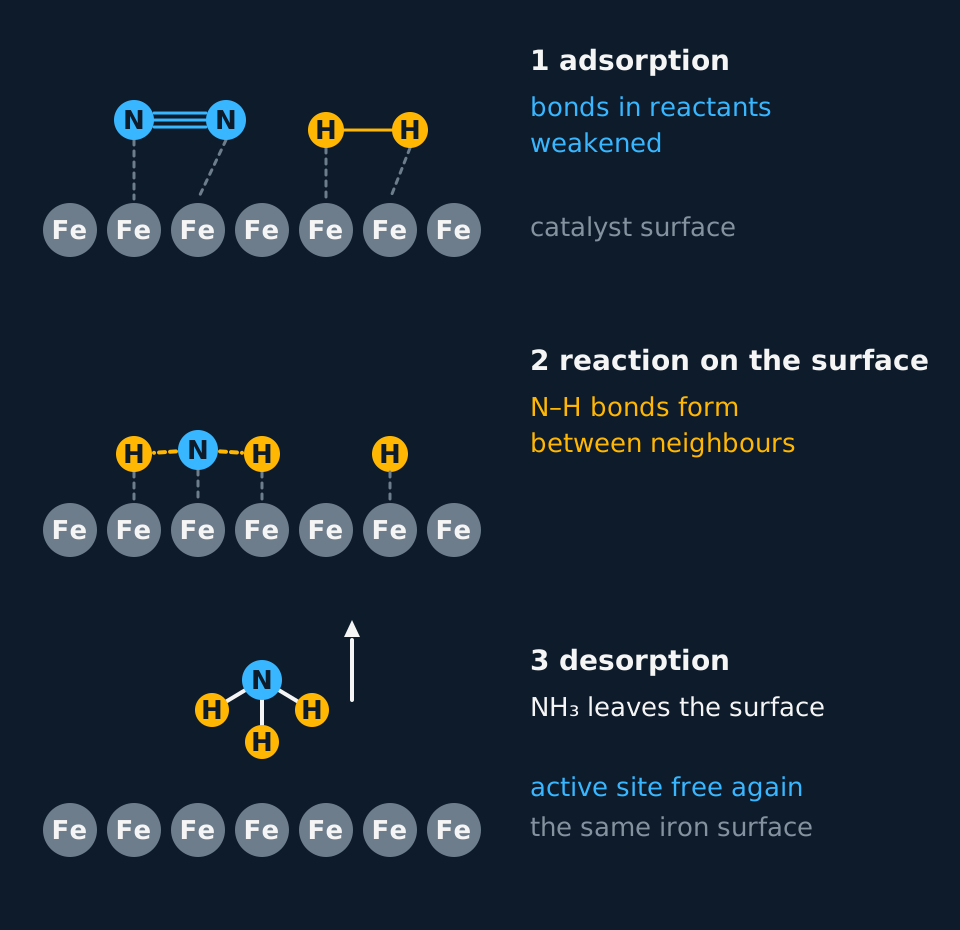
Describe the drawing
Three panels stacked from top to bottom, each showing the same row of seven iron atoms as the catalyst surface. First, adsorption: a nitrogen molecule and a hydrogen molecule held to surface atoms by dashed bonds, their own bonds drawn stretched and weakened. Second, reaction on the surface: a nitrogen atom and hydrogen atoms on neighbouring sites joining as N–H bonds form. Third, desorption: an ammonia molecule leaving upwards and the iron atoms beneath it bare again.
The strength of adsorption decides whether a metal is any use. Tungsten adsorbs so strongly that the products do not leave, and its active sites are soon blocked. Silver adsorbs too weakly, and molecules leave before they have reacted. Nickel, platinum and iron lie between: strong enough to weaken the reactants' bonds, weak enough to let the products go.
Because the reaction happens only at the surface, a heterogeneous catalyst is made with as much surface as possible for its mass. The iron of the Haber process is used as small porous lumps; ammonia is oxidised on a gauze of fine platinum–rhodium wire; vanadium(V) oxide is used as pellets. Halving the size of the particles doubles the surface area for each gram, and with it the number of active sites.
The Haber process uses iron, which adsorbs nitrogen and hydrogen and weakens the N≡N triple bond, the strongest bond that has to be broken.
N₂(g) + 3H₂(g) ⇌ 2NH₃(g)Iron catalyst, about 450 °C and 200 atm
The Contact process for sulfuric acid makes sulfur trioxide from sulfur dioxide and oxygen over vanadium(V) oxide. Here the catalyst does more than hold the molecules: it changes oxidation state. Vanadium(V) oxide oxidises sulfur dioxide and is reduced to vanadium(IV) oxide, and oxygen then oxidises it back.
SO₂(g) + V₂O₅(s) → SO₃(g) + V₂O₄(s)Vanadium +5 to +4
V₂O₄(s) + ½O₂(g) → V₂O₅(s)Vanadium +4 to +5
2SO₂(g) + O₂(g) ⇌ 2SO₃(g)Overall: twice each step, with the vanadium oxides cancelled
- Adsorption
- The formation of weak bonds between reactant molecules and atoms on the surface of a solid.
- Desorption
- The breaking of the bonds between product molecules and a catalyst surface, which releases the products.
- Active site
- A place on the surface of a heterogeneous catalyst where reactant molecules are adsorbed and react.
Showing that V₂O₅ is a catalyst
Use the two steps of the Contact process to show that vanadium(V) oxide is a catalyst and not a reactant, and identify the property of vanadium that makes the route possible.
Show the working
Double each step: 2SO₂ + 2V₂O₅ → 2SO₃ + 2V₂O₄, and 2V₂O₄ + O₂ → 2V₂O₅.
V₂O₅ appears on the left of the first and the right of the second, and V₂O₄ the other way round, so both cancel when the steps are added. The sum is 2SO₂ + O₂ → 2SO₃: the vanadium oxide is regenerated and not consumed.
In V₂O₅, 2x + 5(−2) = 0, so x = +5; in V₂O₄, 2x + 4(−2) = 0, so x = +4. The route depends on vanadium moving from +5 to +4 and back, which is its variable oxidation state.
Supports and poisons
Only the surface atoms of a heterogeneous catalyst do any catalysing, so the atoms beneath them are wasted. Platinum and rhodium are expensive, and the answer is a support medium: a thin layer of the metal spread over an unreactive material with a very large surface area. A catalytic converter coats a ceramic honeycomb, with thousands of narrow channels, in a layer of platinum, palladium and rhodium only a few atoms thick, so a few grams of metal present a very large area to the exhaust gas.
2CO(g) + 2NO(g) → 2CO₂(g) + N₂(g)One of the reactions on the surface of the converter
The reaction follows the same three steps as any surface reaction. Carbon monoxide and nitrogen monoxide are adsorbed onto the rhodium and platinum. The N–O bond is weakened and breaks; two nitrogen atoms on the surface join as N₂, and the oxygen atoms bond to adsorbed carbon monoxide to form carbon dioxide. The nitrogen and carbon dioxide are then desorbed and leave with the exhaust, freeing the sites. Name all three steps when describing the converter: 'the gases react on the catalyst' describes none of them.
The same surface also oxidises unburnt hydrocarbons to carbon dioxide and water. A converter works only once it is hot, at a few hundred degrees Celsius, and most of the carbon monoxide a car emits comes out in the first minutes after a cold start. The honeycomb is mounted close to the engine so that it warms up quickly.
A catalyst is poisoned when an impurity is adsorbed so strongly that it does not desorb, blocking the active sites. Lead compounds were once added to petrol; lead coats the platinum and rhodium of a converter, so cars fitted with one must run on unleaded petrol. The iron catalyst of the Haber process is poisoned by sulfur compounds carried in with hydrogen made from natural gas, so the gas is cleaned of sulfur before it reaches the reactor. Poisoning raises costs: the catalyst works less well and has to be replaced more often.
- Support medium
- An unreactive material with a large surface area over which a thin layer of catalyst is spread, to increase the surface area for each gram of catalyst.
- Catalyst poisoning
- The loss of catalytic activity when an impurity is strongly adsorbed onto the active sites, blocking them to the reactants.
Iron ions in solution
Peroxodisulfate ions oxidise iodide ions to iodine, and the reaction is feasible, with E° for S₂O₈²⁻/SO₄²⁻ at +2.01 V against +0.54 V for I₂/I⁻. Without a catalyst it is slow. The reason is the charges: both reactants are negative ions, which repel each other, so collisions with enough energy to overcome the repulsion and react are rare. The activation energy is high.
S₂O₈²⁻(aq) + 2I⁻(aq) → 2SO₄²⁻(aq) + I₂(aq)Slow without a catalyst: both reactants are negative ions.
Add a little Fe²⁺ and the reaction speeds up. Peroxodisulfate oxidises the Fe²⁺ to Fe³⁺, and the Fe³⁺ oxidises iodide, returning to Fe²⁺. Each step is between oppositely charged ions, which attract, so each has a lower activation energy than the direct reaction.
S₂O₈²⁻(aq) + 2Fe²⁺(aq) → 2SO₄²⁻(aq) + 2Fe³⁺(aq)Step 1: iron oxidised, +2 to +3
2Fe³⁺(aq) + 2I⁻(aq) → 2Fe²⁺(aq) + I₂(aq)Step 2: iron reduced, +3 to +2
Adding the two steps gives the overall equation, with the iron cancelled. Fe³⁺ works equally well, because it enters the cycle at the second step. Iron qualifies because the E° of the Fe³⁺/Fe²⁺ couple, +0.77 V, lies between the other two: peroxodisulfate, at +2.01 V, can oxidise Fe²⁺, and Fe³⁺ can oxidise iodide, at +0.54 V. A couple outside that range would make one of the steps infeasible.
A reaction profile shows the two routes. The uncatalysed reaction has one high hump. The catalysed reaction has two lower humps, one for each step, with a trough between them where the intermediate, Fe³⁺, has formed. Each hump is lower than the single one. The reactants start, and the products finish, at the same levels on both profiles, because the catalyst changes the route but not ΔH.
The effect is easy to see as an iodine clock. Mix potassium peroxodisulfate, potassium iodide, a small fixed amount of sodium thiosulfate and starch, and time how long the mixture takes to turn blue-black: the thiosulfate removes the first iodine formed, and the colour appears when it is used up. Repeat with a few drops of iron(II) sulfate solution added and the blue-black appears in a fraction of the time. Iron(III) chloride gives the same shortening.
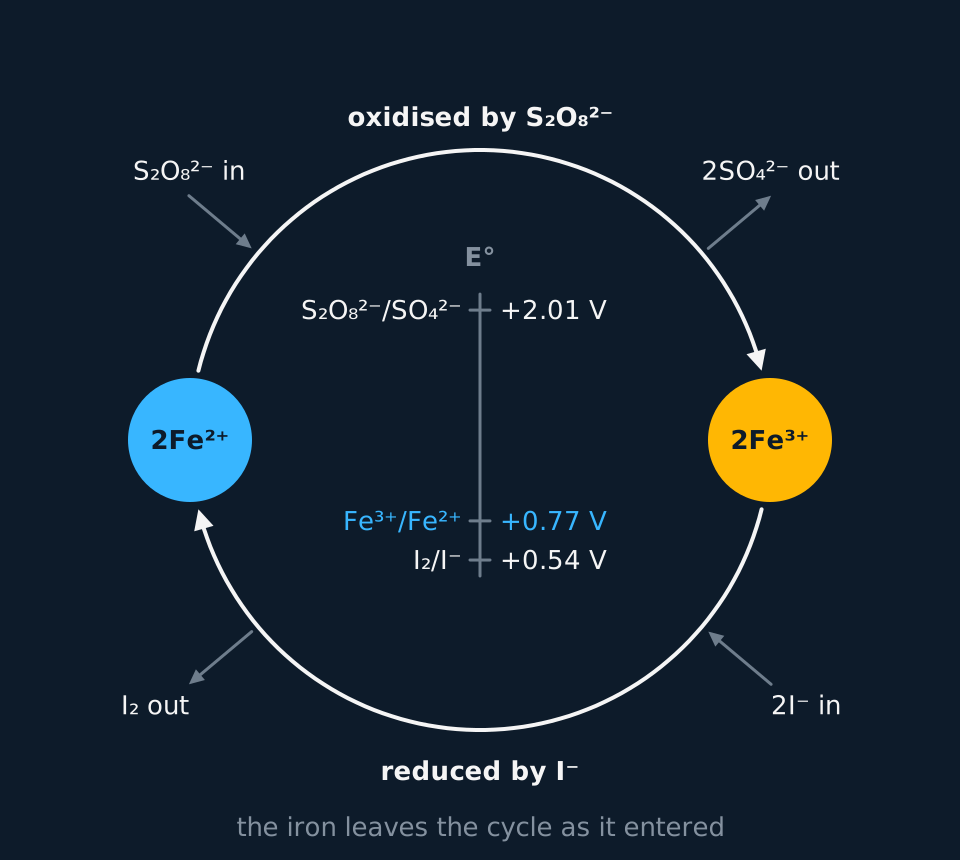
Describe the drawing
A circular cycle with two Fe²⁺ on the left and two Fe³⁺ on the right. The upper arc carries Fe²⁺ to Fe³⁺, oxidised by peroxodisulfate, with S₂O₈²⁻ entering and two sulfate ions leaving. The lower arc carries Fe³⁺ back to Fe²⁺, reduced by iodide, with two iodide ions entering and iodine leaving. In the centre a short electrode potential scale puts S₂O₈²⁻/SO₄²⁻ at +2.01 V at the top, Fe³⁺/Fe²⁺ at +0.77 V in the middle and I₂/I⁻ at +0.54 V at the bottom.
- Intermediate
- A species formed in one step of a reaction and used up in a later step, so it does not appear in the overall equation.
TRY IT: Choosing another catalyst
Suggest, using E° values, whether each of these couples could catalyse the reaction between peroxodisulfate and iodide ions: Co³⁺/Co²⁺, E° = +1.82 V, and Cr³⁺/Cr²⁺, E° = −0.41 V.
Check your answer
A catalyst couple must lie between +0.54 V and +2.01 V, so that its higher oxidation state can oxidise I⁻ and its lower oxidation state can be oxidised by S₂O₈²⁻.
Co³⁺/Co²⁺, at +1.82 V, lies in that range: S₂O₈²⁻ can oxidise Co²⁺, E°cell = 2.01 − 1.82 = +0.19 V, and Co³⁺ can oxidise I⁻, E°cell = 1.82 − 0.54 = +1.28 V. It could catalyse the reaction.
Cr³⁺/Cr²⁺, at −0.41 V, lies outside it. Cr³⁺ oxidising I⁻ gives E°cell = −0.41 − 0.54 = −0.95 V, which is negative, so the second step fails and chromium cannot complete the cycle.
Autocatalysis
The reaction between manganate(VII) and ethanedioate ions is catalysed by Mn²⁺, one of its own products, so it starts slowly and speeds up as Mn²⁺ builds up. A reaction catalysed by one of its own products is autocatalytic. The titration shows it: the first few drops of manganate(VII) run into warm acidified ethanedioate take a while to lose their purple colour, and after that each drop loses its colour almost at once.
2MnO₄⁻(aq) + 16H⁺(aq) + 5C₂O₄²⁻(aq) → 2Mn²⁺(aq) + 8H₂O(l) + 10CO₂(g)
The uncatalysed reaction is slow because, as with peroxodisulfate and iodide, both reactants are negative ions. Mn²⁺ opens a route through Mn³⁺, in two steps. First Mn²⁺ reduces manganate(VII), forming Mn³⁺; then Mn³⁺ oxidises ethanedioate and returns to Mn²⁺. Each step is between oppositely charged ions.
4Mn²⁺(aq) + MnO₄⁻(aq) + 8H⁺(aq) → 5Mn³⁺(aq) + 4H₂O(l)Step 1: Mn²⁺ oxidised to Mn³⁺
2Mn³⁺(aq) + C₂O₄²⁻(aq) → 2Mn²⁺(aq) + 2CO₂(g)Step 2: Mn³⁺ reduced back to Mn²⁺
A graph of manganate(VII) concentration against time has a shape that marks out autocatalysis. At first the line is almost flat: there is little Mn²⁺ and the rate is low. Then it steepens as Mn²⁺ accumulates and the catalysed route takes over, even though the reactant concentrations are falling. Finally it levels off towards zero as the manganate(VII) runs out. The rate rises and then falls, where an ordinary reaction is fastest at the start.
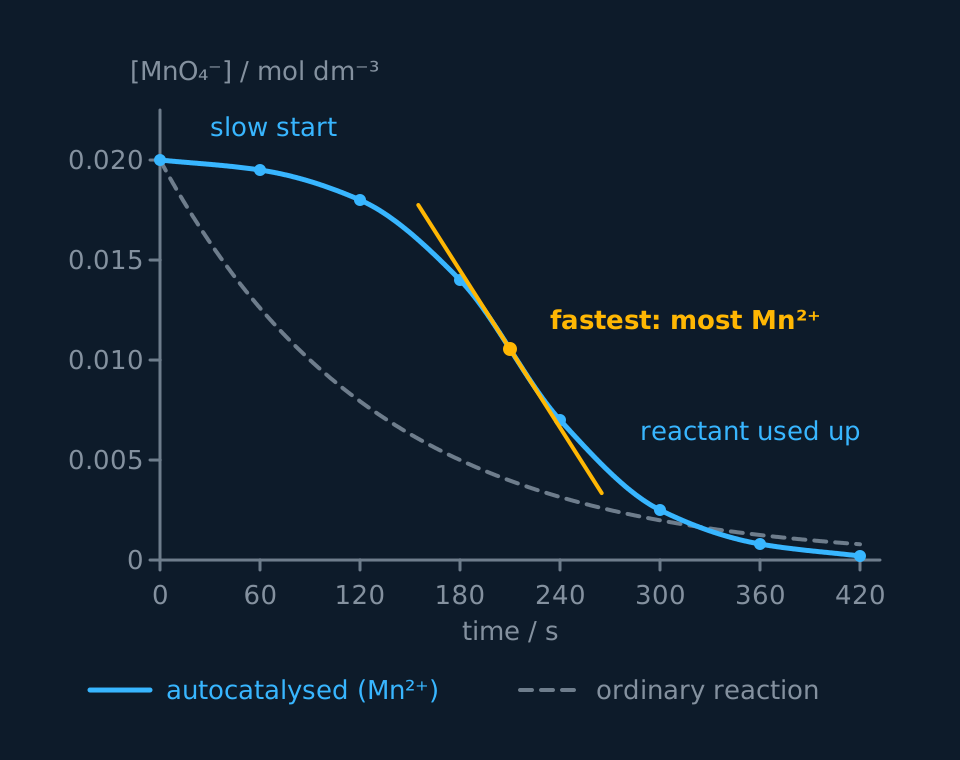
Describe the drawing
Two curves of manganate(VII) concentration against time from the same starting value of 0.0200 mol dm⁻³. The solid autocatalysed curve is an inverted S: almost flat for the first minute, steepest between about 150 and 250 seconds where a tangent at 210 seconds is labelled fastest, most Mn²⁺, then levelling towards zero as the reactant is used up. The dashed ordinary first-order curve is steepest at the start and less steep throughout.
Adding a little manganese(II) sulfate at the start removes the slow beginning, which confirms that Mn²⁺ is the catalyst. The concentration of manganate(VII) can be followed with a colorimeter fitted with a green filter, the complementary colour of purple.
The titration flask is warmed to 60 °C only to get the reaction started at a sensible rate before much Mn²⁺ has formed. Once the first few cubic centimetres have reacted, the flask has cooled a little but the drops decolourise faster than before, which temperature cannot explain and the growing concentration of catalyst can.
- Autocatalysis
- Catalysis of a reaction by one of its own products, so that the rate increases as the product forms.
Other boards: oxides of nitrogen, and what each board asks for
A homogeneous catalyst need not be in solution, and Cambridge's example is in the air: oxides of nitrogen and the sulfur dioxide that makes acid rain. Sulfur dioxide from burning fuel is oxidised only slowly by oxygen, but nitrogen dioxide, from car engines and power stations, catalyses the change in the gas phase. Nitrogen dioxide oxidises sulfur dioxide to sulfur trioxide and is reduced to nitrogen monoxide; oxygen then oxidises the nitrogen monoxide back to nitrogen dioxide.
NO₂(g) + SO₂(g) → NO(g) + SO₃(g)Nitrogen +4 to +2; sulfur +4 to +6
NO(g) + ½O₂(g) → NO₂(g)Nitrogen +2 to +4: the catalyst is regenerated.
The sulfur trioxide dissolves in rain to give sulfuric acid, so the two pollutants together make more acid rain than either would alone. Nitrogen is not a transition metal, but the cycle has the pattern of the transition metal catalysts: the catalyst is reduced in one step and oxidised back in the next. What a catalyst of this kind needs is two oxidation states it can move between.
Edexcel asks for the catalytic converter to be described in the three surface steps, adsorption, reaction and desorption, and for the reaction profile of the iron-catalysed peroxodisulfate reaction to be sketched, with its two humps and the trough for Fe³⁺ between them. AQA and Edexcel examine autocatalysis by name, with the manganate(VII) and ethanedioate reaction as the example; OCR does not name it.
In the exam
- Heterogeneous catalysis is marked on the three steps by name, adsorption, reaction and desorption, with adsorption weakening bonds in the reactants. The scheme does not accept 'absorption' for 'adsorption'.
- For V₂O₅ in the Contact process the marks are for both equations and the oxidation states of vanadium, +5 and +4. 'It lowers the activation energy' is true of every catalyst and is not credit-worthy on its own.
- The slow peroxodisulfate and iodide reaction is explained by charge: both are negative ions that repel, so the activation energy is high. Each catalysed step then earns a mark as an equation, with Fe²⁺ (or Fe³⁺) regenerated.
- An autocatalysis sketch needs a reactant concentration that falls slowly at first, then steeply, then levels off. Schemes reject a curve that is steepest at t = 0.
- Poisoning answers need the mechanism, not just the poison: the impurity is adsorbed strongly onto the active sites and is not desorbed, so fewer sites are available to the reactants.
Check yourself
Explain why Fe²⁺ ions catalyse the reaction between S₂O₈²⁻ and I⁻ ions, and suggest why doubling the amount of Fe²⁺ added does not change the amount of iodine finally formed.
Answer
Without a catalyst the reaction is between two negative ions, which repel each other, so the activation energy is high and the reaction is slow.
Fe²⁺ is oxidised to Fe³⁺ by S₂O₈²⁻, and Fe³⁺ is reduced back to Fe²⁺ by I⁻. Each step is between oppositely charged ions, so each has a lower activation energy. The E° of Fe³⁺/Fe²⁺, +0.77 V, lies between +0.54 V and +2.01 V, so both steps are feasible.
The iron is regenerated, so it does not appear in the overall equation. The amount of iodine is set by the amounts of S₂O₈²⁻ and I⁻; more Fe²⁺ makes the reaction faster but cannot change how far it goes.
Questions
Question 16 marks
Explain, with equations, why the reaction between peroxodisulfate ions and iodide ions is slow, how Fe²⁺ ions catalyse it, and how the reaction profile of the catalysed reaction differs from that of the uncatalysed one.
Mark scheme
Indicative content
- both reactants are negative ions, which repel each other, so the activation energy of the direct reaction is high and it is slow
- step 1: S₂O₈²⁻ + 2Fe²⁺ → 2SO₄²⁻ + 2Fe³⁺, in which the iron(II) is oxidised to iron(III)
- step 2: 2Fe³⁺ + 2I⁻ → 2Fe²⁺ + I₂, in which the iron(III) is reduced back to iron(II) and the catalyst is regenerated
- each step is between oppositely charged ions, which attract, so each has a lower activation energy than the direct reaction
- the uncatalysed profile has one high hump; the catalysed profile has two lower humps with a trough between them for the intermediate, Fe³⁺
- the reactants and the products are at the same energy levels on both profiles, because the catalyst does not change ΔH
Levels
- Level 3 (5–6 marks) the repulsion between the two negative ions is given as the reason for the slow direct reaction, both steps of the catalysis are written with correct equations and the oxidation state changes, the lower activation energy of each step is explained through the attraction of opposite charges, and the two profiles are compared with the intermediate and the unchanged ΔH
- Level 2 (3–4 marks) the repulsion of the ions and both equations are given; the regeneration of Fe²⁺, why each step is faster, or the comparison of the two profiles is thin
- Level 1 (1–2 marks) the ions are said to repel or Fe²⁺ to be a catalyst; the catalysed profile is often drawn with a different ΔH, and one equation at most is given
Question 25 marks
Explain how vanadium(V) oxide acts as a catalyst in the Contact process. Include the two equations for the catalysed route.
Mark scheme
- B1 SO₂ + V₂O₅ → SO₃ + V₂O₄; allow multiples
- B1 V₂O₄ + ½O₂ → V₂O₅; allow 2V₂O₄ + O₂ → 2V₂O₅
- B1 vanadium(V) oxide oxidises sulfur dioxide and is reduced to vanadium(IV) oxide, +5 to +4
- B1 oxygen then oxidises vanadium(IV) oxide back to vanadium(V) oxide, +4 to +5, so the catalyst is regenerated
- B1 the route depends on vanadium's variable oxidation state; 'it lowers the activation energy' alone is not enough
Question 34 marks
Calculate E°cell for each of the two steps in the Fe²⁺-catalysed reaction between S₂O₈²⁻ and I⁻. E°(S₂O₈²⁻/SO₄²⁻) = +2.01 V, E°(Fe³⁺/Fe²⁺) = +0.77 V and E°(I₂/I⁻) = +0.54 V.
Mark scheme
- M1 step 1, S₂O₈²⁻ oxidising Fe²⁺: E°cell = +2.01 − (+0.77)
- A1 E°cell for step 1 = +1.24 V
- M1 step 2, Fe³⁺ oxidising I⁻: E°cell = +0.77 − (+0.54)
- A1 E°cell for step 2 = +0.23 V, to two significant figures; both positive, so both steps are feasible
All 18 questions with mark schemes, the other 15 set out in full on the question page.
Worth remembering
- 'A catalyst takes no part in the reaction' is wrong: it reacts and is regenerated.
- Write 'adsorbed' for reactants held on a catalyst surface; 'absorbed' describes a sponge.
- 'It lowers the activation energy' alone does not explain how V₂O₅ works; the two equations and the change of oxidation state do.
- Explain the faster Fe²⁺ route by charge: the ions in each of its steps are oppositely charged, where S₂O₈²⁻ and I⁻ repel.
- An autocatalysis curve drawn steepest at the start is the shape of an ordinary reaction.
CHECK YOUR PROGRESS
Rate how confident you are with each objective for this lesson. Ratings are saved in this browser, on this device, unless you sign in.
- Describe heterogeneous catalysis as adsorption, reaction and desorption, and explain why the strength of adsorption matters.
- Write the two steps by which vanadium(V) oxide catalyses the Contact process, and explain the part variable oxidation states play.
- Explain how a support medium reduces cost, and how lead and sulfur poison catalysts.
- Explain why the reaction between peroxodisulfate and iodide ions is slow, and how Fe²⁺ catalyses it, with equations.
- Describe and explain autocatalysis by Mn²⁺, including the shape of its concentration–time curve.AQA · Edexcel
Open the full revision checklist to see every objective in the curriculum in one place.
Practise this lesson
WORKBOOK
The written questions from this topic, on paper with room to work, and a separate book of mark schemes. The question that is set on a diagram stays on this page, where the diagram can be drawn. Free to use; please do not redistribute or sell.