Chemistry › Aromatic chemistry and amines › Benzene: its structure and the evidence for delocalisation
Benzene: its structure and the evidence for delocalisation
Benzene, C₆H₆, is a flat ring of six carbon atoms, and for a century chemists drew it with three double bonds. It does not behave like a molecule with three double bonds: its six carbon–carbon bonds are all the same length, it does not decolourise bromine water, and it is 152 kJ mol⁻¹ more stable than that structure predicts. Six electrons spread around the whole ring explain all three.
Key terms Every definition in aromatic chemistry and amines, lesson by lesson
Before this Alkenes: structure, electrophilic addition and Markovnikov's rule – the π bond, and bromine adding across a C=C bond · Hess's law and enthalpy cycles – two routes between the same start and finish have the same enthalpy change · Naming and representing organic molecules – numbering a chain to give substituents the lowest locants
COMMON MISCONCEPTION
Benzene has three double bonds that keep swapping places, so each bond is a double bond half of the time.
Benzene has no double bonds at any moment. All six carbon–carbon bonds are 140 pm, between a single and a double bond, and six electrons are delocalised in a ring of p orbitals above and below the plane. Hydrogenating benzene releases 152 kJ mol⁻¹ less than three separate C=C would, which measures the extra stability delocalisation gives.
What you should be able to do
- Describe the Kekulé structure of benzene and state the three pieces of evidence that show it is wrong.
- Describe the delocalised model of benzene: a planar ring of carbon atoms, p orbitals overlapping above and below it, and six delocalised electrons.
- Calculate the delocalisation energy of benzene from enthalpies of hydrogenation, and explain what it shows about the stability of the ring.
- Explain why benzene does not undergo the addition reactions that alkenes undergo readily.
- Name substituted benzenes, using numbers to give the positions of two or more substituents.
- Explain why phenol is a stronger acid than ethanol yet does not react with carbonates, and, for Cambridge, why chlorobenzene resists hydrolysis.CAIE · OCR A
Kekulé's ring
Benzene, C₆H₆, is a colourless liquid that boils at 80 °C, and its formula sets a puzzle. A hydrocarbon with six carbon atoms and only six hydrogens is far more unsaturated than hexane, C₆H₁₄, and yet benzene reacts far less readily than hex-1-ene, which has one double bond. Any structure proposed for benzene has to explain both facts at once: a great deal of unsaturation, and very little of the reactivity that unsaturation usually brings.
The structure August Kekulé proposed in 1865 is a ring. Six carbon atoms are joined in a hexagon by single and double bonds in turn, and each carbon carries one hydrogen. Every carbon has four bonds, the formula comes out as C₆H₆, and all six hydrogens are in equivalent positions, which fits the fact that benzene forms only one compound of formula C₆H₅Br. In modern naming the Kekulé structure is cyclohexa-1,3,5-triene.
A structure makes predictions. If benzene had three C=C bonds it would behave like an alkene three times over: it would have two lengths of carbon–carbon bond, it would add bromine across its double bonds at room temperature, and it would release three times as much energy as cyclohexene when hydrogen is added to it. Each of those predictions fails.
Three pieces of evidence against it
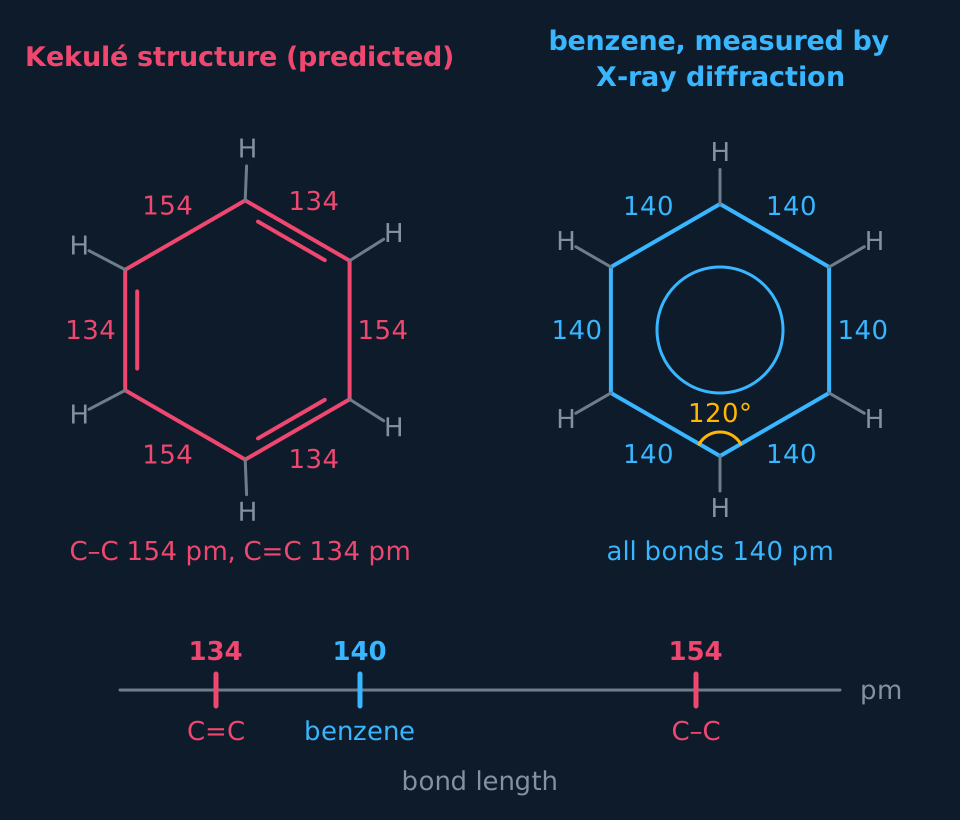
The first failure is in the bond lengths. X-ray diffraction measures the distances between atoms in a crystal. A C–C single bond, as in ethane, is 154 pm long, and a C=C double bond, as in ethene, is 134 pm, because the second shared pair of electrons pulls the two nuclei closer. Kekulé's ring would be an uneven hexagon, long and short sides in turn. Benzene's ring is a regular hexagon: all six carbon–carbon bonds are 140 pm long, between single and double, and every bond angle is 120°.
The first direct measurement was made in 1929 by Kathleen Lonsdale, who used X-rays on crystals of hexamethylbenzene, a benzene ring with a methyl group on every carbon. Her ring was flat and its six sides were equal, and every measurement since has agreed.
Describe the drawing
Two hexagons side by side, each with a hydrogen atom on every corner. The left one, the Kekulé structure, is drawn in coral with three double bonds alternating with three single bonds; the single sides are longer, labelled 154, and the double sides shorter, labelled 134, so the hexagon is uneven. The right one, benzene as measured, is a regular cyan hexagon with a circle inside, every side labelled 140 and one corner angle marked 120 degrees. A scale strip beneath puts 134, 140 and 154 picometres on one line, with benzene's 140 between the double and single bond lengths.
The second failure is the reaction with bromine. Cyclohexene decolourises orange bromine water in seconds, as bromine adds across the double bond to give 1,2-dibromocyclohexane. Benzene shaken with bromine water does not react. The bromine moves into the benzene layer, which turns orange, but the colour stays. Benzene does react with bromine when iron(III) bromide is added as a catalyst, and even then a hydrogen atom is replaced: the product is bromobenzene, not a compound with two bromine atoms added.
C₆H₆(l) + Br₂(l) → C₆H₅Br(l) + HBr(g)With an iron(III) bromide catalyst. One hydrogen is substituted and the ring of six carbons is untouched.
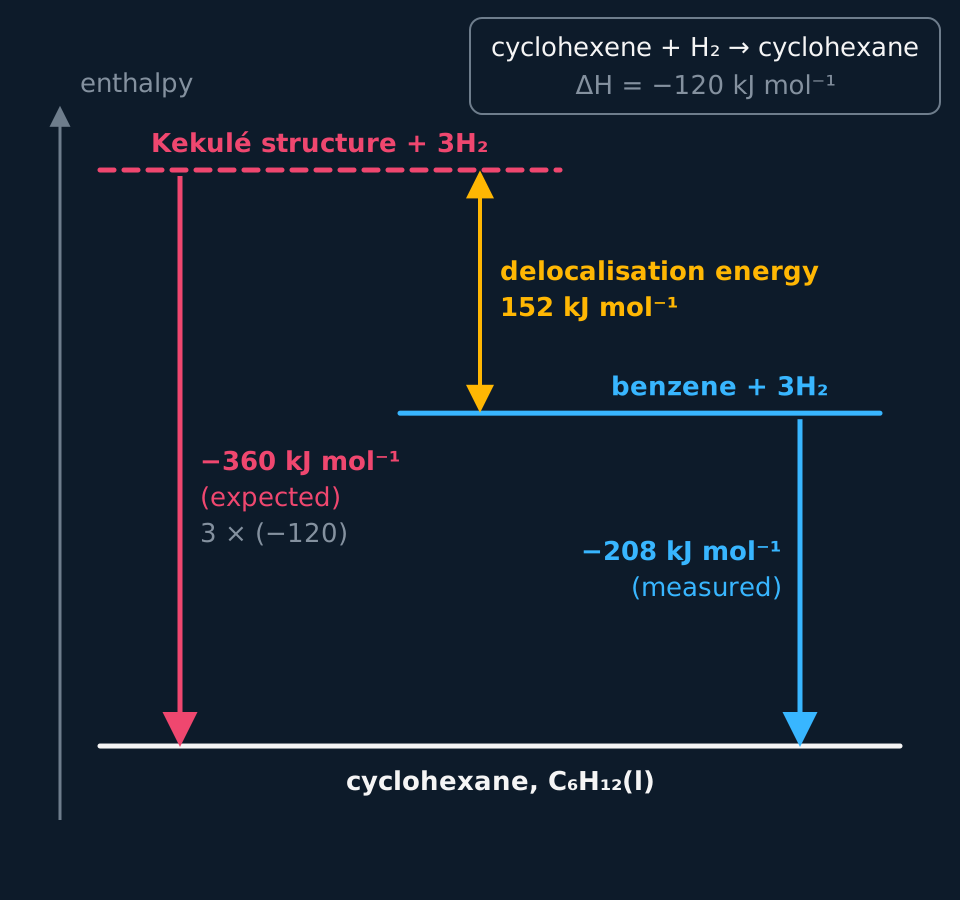
The third failure is a number. Adding hydrogen to cyclohexene, which has one C=C bond, releases 120 kJ for every mole. Three C=C bonds should release three times as much, 360 kJ mol⁻¹. Benzene releases 208 kJ mol⁻¹, which is 152 kJ mol⁻¹ less. Benzene is lower in energy than the Kekulé structure would be, by that 152 kJ mol⁻¹.
A fourth argument was made in the nineteenth century. The Kekulé structure predicts two different 1,2-dibromobenzenes: one with the bromine atoms on carbons joined by a double bond, one with them on carbons joined by a single bond. Only one has ever been made. Kekulé's answer was that the double bonds swap places too quickly for the two forms to be separated. Benzene does not switch between two structures. It has one structure, and every carbon–carbon bond in it is the same.
- Kekulé structure
- A model of benzene as a ring of six carbon atoms joined by alternating single and double bonds, cyclohexa-1,3,5-triene.
The delocalised model
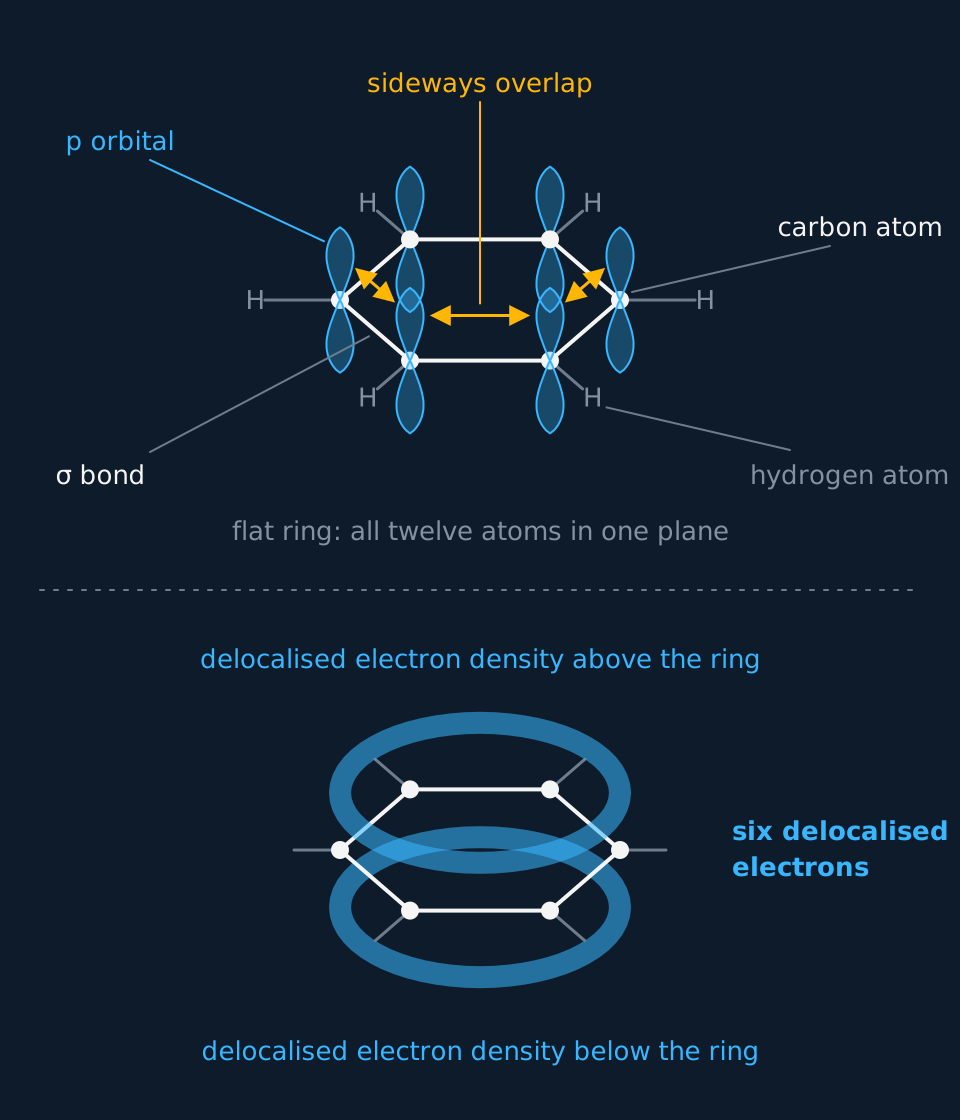
Each carbon atom in benzene has four outer electrons. Three of them form σ bonds, one to each neighbouring carbon and one to a hydrogen. Those three bonds lie in one plane at 120° to each other, so all twelve atoms of the molecule lie in a single flat hexagon.
The fourth electron on each carbon is in a p orbital, a dumbbell standing at right angles to the plane of the ring, with one lobe above it and one below. In ethene two such p orbitals overlap sideways to make a π bond between two carbons. In benzene each p orbital overlaps equally with the p orbitals on both of its neighbours, so the overlap runs all the way round. The result is a ring of electron density above the plane and another below it, holding six electrons that belong to the whole ring and not to any one bond.
Describe the drawing
Two drawings of the benzene ring seen at an angle from above. In the first, a flat hexagon of six carbon atoms with hydrogen atoms around the outside in the same plane has a dumbbell-shaped p orbital standing upright on every carbon, one lobe above the plane and one below, and amber double-headed marks show each upper lobe overlapping sideways with its neighbours; carbon atom, hydrogen atom, p orbital and σ bond are labelled. In the second, the lobes have merged into two doughnut-shaped rings of electron density, one above the plane of the ring and one below it, labelled six delocalised electrons.
Electrons spread over several atoms in this way are delocalised. 'A ring of electrons' or 'resonance' does not say that the electrons are shared by all six carbons; delocalised does. Each pair of neighbouring carbons shares a σ bond and an equal part of the delocalised system, so every bond is the same length, and that length lies between single and double.
The model also accounts for the stability. Spreading six electrons over six atoms lowers their energy compared with holding them in three separate π bonds, so more energy is needed to disrupt the ring. It accounts for the low reactivity too: the electron density is spread round the ring instead of being packed between two carbons, so the ring cannot polarise a bromine molecule as a C=C bond does.
The structure is drawn as a hexagon with a circle inside it. The hexagon stands for the six carbon atoms and their σ bonds, each corner carrying a hydrogen that is not drawn, and the circle stands for the six delocalised electrons. It is the only drawing that can show what happens in electrophilic substitution, where the ring of electrons is broken for a moment and then restored.
- Delocalised electrons
- Electrons that are shared between more than two atoms and are not fixed in one bond.
- Delocalised model of benzene
- A planar ring of six carbon atoms joined by σ bonds, in which a p orbital on each carbon overlaps with those on both neighbours, giving a ring of six delocalised electrons above and below the plane.
- Arene
- A hydrocarbon containing one or more benzene rings; compounds containing a benzene ring are called aromatic.
Measuring the stability
Enthalpies of hydrogenation put a number on the stability. Each is the enthalpy change when one mole of a compound reacts completely with hydrogen, measured with a nickel or platinum catalyst. Cyclohexene and benzene both end up as cyclohexane, so the two values can be compared directly.
C₆H₁₀(l) + H₂(g) → C₆H₁₂(l)ΔH = −120 kJ mol⁻¹. Cyclohexene has one C=C bond.
C₆H₆(l) + 3H₂(g) → C₆H₁₂(l)ΔH = −208 kJ mol⁻¹, the measured value for benzene.
Describe the drawing
An enthalpy level diagram with enthalpy increasing upwards and three levels drawn to scale. The top level, dashed in coral, is the Kekulé structure plus three hydrogen; 152 kilojoules per mole below it is benzene plus three hydrogen, in cyan; at the bottom is cyclohexane. A long coral arrow from the Kekulé level to cyclohexane is labelled expected, three times minus 120, minus 360 kilojoules per mole. A shorter cyan arrow from benzene to cyclohexane is labelled measured, minus 208. An amber double arrow between the top two levels is labelled delocalisation energy, 152 kilojoules per mole. An inset gives cyclohexene plus hydrogen to cyclohexane, minus 120.
The delocalisation energy of benzene
The enthalpy of hydrogenation of cyclohexene is −120 kJ mol⁻¹ and that of benzene is −208 kJ mol⁻¹. Calculate the delocalisation energy of benzene.
Show the working
The Kekulé structure has three C=C bonds, each expected to behave like the one in cyclohexene. Expected ΔH = 3 × (−120) = −360 kJ mol⁻¹.
Measured ΔH = −208 kJ mol⁻¹. Difference = −208 − (−360) = +152 kJ mol⁻¹.
Both reactions give the same product, so the difference lies in the starting materials. Benzene is 152 kJ mol⁻¹ lower in energy, more stable, than cyclohexa-1,3,5-triene would be.
The delocalisation energy of benzene is 152 kJ mol⁻¹.
The same 152 kJ mol⁻¹ explains how benzene reacts. An addition reaction would turn benzene into a compound with no delocalised ring, and would have to give up that stability. A reaction that keeps the ring, by replacing a hydrogen, does not. Benzene therefore reacts by substitution, the subject of the electrophilic substitution mechanisms, and keeps its ring.
TRY IT: Two double bonds in a ring
The enthalpy of hydrogenation of cyclohexa-1,3-diene, C₆H₈, is −232 kJ mol⁻¹. Calculate the value expected from two cyclohexene double bonds, and compare the stabilisation with benzene's.
Check your answer
Expected ΔH = 2 × (−120) = −240 kJ mol⁻¹. The measured value is 8 kJ mol⁻¹ less exothermic, so the diene is stabilised by about 8 kJ mol⁻¹.
Benzene is stabilised by 152 kJ mol⁻¹. Two double bonds next to each other gain little; the large stabilisation comes from a complete ring of six delocalised electrons.
Set side by side, the three compounds show where the stability comes from. Each C=C bond in cyclohexene adds about 120 kJ mol⁻¹ to the enthalpy of hydrogenation. Two double bonds next to each other, in cyclohexa-1,3-diene, give almost exactly twice that, because a chain of four p orbitals gains very little. Only the closed ring of six falls far short of the expected value.
| Compound | C=C bonds drawn | Expected ΔH / kJ mol⁻¹ | Measured ΔH / kJ mol⁻¹ | Stabilisation / kJ mol⁻¹ |
|---|---|---|---|---|
| cyclohexene | 1 | −120 | −120 | 0 |
| cyclohexa-1,3-diene | 2 | −240 | −232 | 8 |
| benzene | 3 (Kekulé) | −360 | −208 | 152 |
A delocalisation answer must make the comparison in words as well as numbers. The measured value is less exothermic than expected, so less energy is released, so benzene started lower in energy. The sign needs care: −208 is a smaller release than −360, and that smaller release is the evidence of extra stability, not of weaker bonds.
- Enthalpy of hydrogenation
- The enthalpy change when one mole of an unsaturated compound reacts completely with hydrogen to give a saturated compound.
- Delocalisation energy
- The difference in energy between benzene and the Kekulé structure, 152 kJ mol⁻¹, by which the delocalised ring is more stable; also called resonance energy.
Naming substituted benzenes
A benzene ring with one hydrogen replaced is usually named by putting the substituent in front of benzene: chlorobenzene, nitrobenzene, methylbenzene. Some compounds are named the other way round, with the ring as the substituent. The ring minus one hydrogen, C₆H₅–, is the phenyl group, which gives phenylamine, phenylethene and phenylethanone. Two names are kept from before systematic naming and are the ones exam papers use: phenol for C₆H₅OH and benzoic acid for C₆H₅COOH.
| Formula | Name | Where it appears |
|---|---|---|
| C₆H₅CH₃ | methylbenzene | the solvent used in place of benzene |
| C₆H₅NO₂ | nitrobenzene | the product of nitration |
| C₆H₅NH₂ | phenylamine | made by reducing nitrobenzene |
| C₆H₅OH | phenol | an antiseptic and a starting material |
| C₆H₅COOH | benzoic acid | a food preservative, E210 |
| C₆H₅COCH₃ | phenylethanone | the product of acylation |
With two or more substituents the ring carbons are numbered 1 to 6, starting at one substituent and going round the way that gives the lowest numbers. In 1,2-dimethylbenzene the methyl groups are on neighbouring carbons; in 1,3-dimethylbenzene one carbon separates them, and in 1,4-dimethylbenzene they are opposite. Older books call these positions ortho, meta and para; an answer should use the numbers.
When one group gives the compound its name, the carbon carrying that group is carbon 1. In 4-nitrophenol the OH group is on carbon 1 and the nitro group is opposite it; in 2,4,6-trichlorophenol, the antiseptic TCP, the chlorine atoms are on both carbons next to the OH and on the carbon opposite it.
Benzene itself causes cancer with long exposure, so school laboratories use methylbenzene for any reaction that would otherwise need benzene. The ring chemistry is the same. Both burn with a very smoky yellow flame, because their high ratio of carbon to hydrogen leaves much of the carbon unburnt as soot.
TRY IT: Naming three substituted benzenes
Name these compounds: a benzene ring with two NO₂ groups on opposite carbons; a benzene ring with an OH group and a CH₃ group on neighbouring carbons; C₆H₅CH₂CH₃.
Check your answer
Two nitro groups opposite each other are on carbons 1 and 4: 1,4-dinitrobenzene.
The OH group gives the compound its name, phenol, so its carbon is carbon 1 and the methyl group is on carbon 2: 2-methylphenol.
One ethyl group on the ring: ethylbenzene.
- Phenyl group
- The C₆H₅– group, a benzene ring with one hydrogen atom removed, attached to the rest of a molecule.
Other boards: phenol and chlorobenzene
An atom bonded to the ring that carries a lone pair can share it with the ring. In phenol the oxygen has two lone pairs, in chlorobenzene the chlorine has three, and in phenylamine the nitrogen has one. A lone pair in a p orbital on that atom lies parallel to the p orbitals of the ring, overlaps with them, and is partly delocalised into the ring. AQA uses this only to explain why phenylamine is a weak base. OCR, Edexcel and Cambridge examine phenol; Cambridge also examines halogenoarenes, and describes each ring carbon as sp² hybridised: three sp² orbitals at 120° make the σ bonds and the p orbital left over joins the delocalised ring.
Phenol, C₆H₅OH, is a white crystalline solid and a weak acid, with a pKa of about 10. Its O–H bond can lose a proton to water, giving the phenoxide ion, C₆H₅O⁻. In that ion one lone pair on the oxygen lies in a p orbital parallel to the ring's p orbitals and overlaps with them, so the negative charge is spread over the oxygen and the ring carbons instead of sitting on one atom. A charge spread over several atoms leaves the ion more stable, so the ionisation of phenol goes further than that of ethanol, whose pKa is about 16: phenol is roughly a million times the stronger acid.
C₆H₅OH(aq) + H₂O(l) ⇌ C₆H₅O⁻(aq) + H₃O⁺(aq)The equilibrium still lies far to the left: a 0.1 mol dm⁻³ solution has a pH of about 5.5.
The pKa decides which bases phenol reacts with. Hydroxide ions are a strong base and take the proton completely, so phenol, barely soluble in cold water, dissolves in sodium hydroxide solution as sodium phenoxide. Releasing carbon dioxide from a carbonate needs an acid strong enough to turn carbonate into carbonic acid, whose pKa is about 6.4. Phenol, at pKa 10, is far too weak, so it gives no fizzing with sodium carbonate. Ethanoic acid, at pKa 4.8, is strong enough, and does fizz.
Ethanol is a weaker acid than phenol, and weaker than water. The ethoxide ion keeps its charge on one oxygen atom, and the ethyl group releases electron density onto that oxygen, so the ion is less stable. Ethanoic acid is stronger than phenol, because the charge on the ethanoate ion is shared between two oxygen atoms, which hold it better than carbon atoms do. The order of acid strength, which OCR and Cambridge ask for, is ethanol < water < phenol < ethanoic acid, and it shows in what each reacts with.
| ethanol | phenol | ethanoic acid | |
|---|---|---|---|
| pKa | about 16 | 10.0 | 4.8 |
| sodium | hydrogen given off | hydrogen given off | hydrogen given off |
| sodium hydroxide solution | no reaction | dissolves, giving sodium phenoxide | neutralised, giving sodium ethanoate |
| sodium carbonate solution | no reaction | no reaction | fizzes, giving carbon dioxide |
C₆H₅OH(s) + NaOH(aq) → C₆H₅O⁻Na⁺(aq) + H₂O(l)Phenol is barely soluble in cold water but dissolves in alkali as sodium phenoxide.
The sodium carbonate row of the table is a test. A compound that dissolves in sodium hydroxide but does not fizz with sodium carbonate is a phenol, not a carboxylic acid. The same drawing in of the oxygen's lone pair makes phenol a poor nucleophile, so it does not form esters with carboxylic acids as ethanol does; an acyl chloride is reactive enough to acylate it.
A halogenoarene resists nucleophiles, and Cambridge asks why. A halogenoarene has a halogen bonded directly to the ring, as in chlorobenzene, C₆H₅Cl, made from benzene and chlorine with a halogen carrier. A lone pair on the chlorine overlaps with the ring, giving the C–Cl bond a little double-bond character. It is shorter than in a chloroalkane, 174 pm against 178 pm, and stronger, and the cloud of delocalised electrons repels a nucleophile approaching the carbon. Boiled with aqueous sodium hydroxide for hours, chlorobenzene is unchanged.
| Chloride | Hydrolysis with water or aqueous alkali | Why |
|---|---|---|
| ethanoyl chloride, CH₃COCl | violent in cold water, steamy fumes of HCl | carbonyl carbon bonded to O and Cl, strongly δ+ |
| 1-chlorobutane, C₄H₉Cl | slow, needs heating under reflux with alkali | one electronegative atom on the carbon |
| chlorobenzene, C₆H₅Cl | none, even on boiling with alkali | C–Cl bond strengthened by overlap with the ring |
Cambridge asks for this order of ease of hydrolysis: acyl chloride, then alkyl chloride, then aryl chloride. Added to aqueous silver nitrate, ethanoyl chloride gives a white precipitate at once, 1-chlorobutane only after warming, and chlorobenzene none at all.
- Phenol
- A compound with an OH group bonded directly to a benzene ring; also the name of the simplest, C₆H₅OH.
- Phenoxide ion
- The ion C₆H₅O⁻ formed when phenol loses a proton, its negative charge delocalised into the ring.
- Halogenoarene
- A compound in which a halogen atom is bonded directly to a carbon atom of a benzene ring, such as chlorobenzene.
In the exam
- For the bonding, the scheme awards one mark for p orbitals overlapping above and below the plane of the ring and another for six delocalised electrons; 'a ring of electrons' or 'resonance' alone earns neither.
- Answers that give benzene stronger double bonds, or bonds that alternate rapidly between two forms, are rejected. The accepted reason for no addition is that addition would disrupt the delocalised system and lose its stability.
- In the stability calculation, write 3 × (−120) = −360 kJ mol⁻¹ before subtracting: that line earns the method mark even if the subtraction slips, and the answer is stated as benzene being 152 kJ mol⁻¹ more stable.
- For the bromine evidence the scheme awards the pair of observations, bromine water decolourised by cyclohexene and left orange by benzene, and the reason: benzene's electron density is spread over six carbons, too low to polarise a bromine molecule.
- A structure or mechanism draws benzene as a hexagon with a circle. The first arrow of a mechanism must start inside the hexagon, on the delocalised electrons, not on one carbon atom.
Check yourself
A student says that benzene does not decolourise bromine water because its double bonds are stronger than the double bond in cyclohexene. Explain what is wrong with this, and give the evidence from hydrogenation that supports the correct explanation.
Answer
Benzene has no double bonds. Its six carbon–carbon bonds are all 140 pm long, between a C–C single bond and a C=C double bond, and six electrons are delocalised around the whole ring in p orbitals that overlap above and below it.
Adding bromine would destroy that delocalised ring, which makes benzene more stable, so benzene does not react by addition. Its electron density is also spread over six carbons, too low to polarise a bromine molecule.
Hydrogenating benzene releases 208 kJ mol⁻¹, not the 3 × 120 = 360 kJ mol⁻¹ that three C=C bonds would release, so the delocalised ring is 152 kJ mol⁻¹ more stable.
Questions
Question 16 marks
Discuss the evidence that the Kekulé structure of benzene is wrong, and explain how the delocalised model accounts for each piece of evidence.
Mark scheme
Indicative content
- X-ray diffraction shows all six carbon–carbon bonds are 140 pm, whereas Kekulé predicts alternating bonds of 154 pm and 134 pm
- in the delocalised model every pair of neighbouring carbons shares the same electron density, so every bond has one length between single and double
- benzene does not decolourise bromine water at room temperature, whereas a compound with C=C bonds would add bromine at once
- the delocalised electron density is spread over six carbons, too low to polarise bromine, and addition would lose the stability of the ring
- the enthalpy of hydrogenation of benzene is −208 kJ mol⁻¹, far less exothermic than the −360 kJ mol⁻¹ expected for three C=C bonds
- delocalising six electrons over the ring lowers the energy of the molecule, so benzene starts about 152 kJ mol⁻¹ lower than the Kekulé structure would
Levels
- Level 3 (5–6 marks) all three pieces of evidence are given with the values, bond length, lack of addition with bromine and the enthalpy of hydrogenation, and each is matched to what the delocalised model predicts and the Kekulé structure does not
- Level 2 (3–4 marks) two pieces of evidence are given with values and explained by delocalisation, or all three are named and one is left unconnected to the model
- Level 1 (1–2 marks) one piece of evidence is named, often with benzene said to have stronger double bonds than an alkene, which is offered as the reason it resists addition
Question 24 marks
Describe the shape of a benzene molecule and the lengths of its carbon–carbon bonds, as X-ray diffraction shows them, and state how each differs from what the Kekulé structure predicts.
Mark scheme
- B1 all twelve atoms lie in one plane, the carbons forming a regular hexagon with every bond angle 120°
- B1 all six carbon–carbon bonds are the same length, 140 pm; accept any value from 139 to 140 pm
- B1 the Kekulé structure predicts two lengths in turn, C–C 154 pm and C=C 134 pm, so an uneven hexagon
- B1 140 pm lies between the single and double bond lengths, so every bond is the same and none is a double bond
Question 34 marks
Describe the bonding in a benzene molecule using the delocalised model.
Mark scheme
- B1 each carbon forms σ bonds to two neighbouring carbons and one hydrogen, so the ring is planar with bond angles of 120°
- B1 each carbon has one electron in a p orbital at right angles to the plane of the ring
- B1 each p orbital overlaps sideways with the p orbitals on both neighbouring carbons, giving rings of electron density above and below the plane
- B1 six electrons are delocalised around the whole ring rather than held in three separate double bonds; ignore 'resonance' unless the delocalisation is described
All 18 questions with mark schemes, the other 15 set out in full on the question page.
Worth remembering
- 'Stronger double bonds' is never the reason for anything benzene does: it has no C=C bonds.
- Describe p orbitals overlapping sideways above and below the plane of the ring; 'a ring of electrons' or 'resonance' leaves that out.
- A delocalisation energy given as −152 kJ mol⁻¹, or as 'more exothermic', inverts the argument: benzene releases less, so it is 152 kJ mol⁻¹ more stable.
- A less exothermic hydrogenation means a lower starting energy, not weaker bonds.
- Name substituted benzenes with numbers for the lowest locants, never with ortho, meta or para.
CHECK YOUR PROGRESS
Rate how confident you are with each objective for this lesson. Ratings are saved in this browser, on this device, unless you sign in.
- Describe the Kekulé structure of benzene and state the three pieces of evidence that show it is wrong.
- Describe the delocalised model of benzene: a planar ring of carbon atoms, p orbitals overlapping above and below it, and six delocalised electrons.
- Calculate the delocalisation energy of benzene from enthalpies of hydrogenation, and explain what it shows about the stability of the ring.
- Explain why benzene does not undergo the addition reactions that alkenes undergo readily.
- Name substituted benzenes, using numbers to give the positions of two or more substituents.
- Explain why phenol is a stronger acid than ethanol yet does not react with carbonates, and, for Cambridge, why chlorobenzene resists hydrolysis.CAIE · OCR A
Open the full revision checklist to see every objective in the curriculum in one place.
Practise this lesson
WORKBOOK
The questions from this topic, on paper with room to work, and a separate book of mark schemes. Free to use; please do not redistribute or sell.