Chemistry › Energetics › Hess's law and enthalpy cycles
Hess's law and enthalpy cycles
Carbon burns to carbon dioxide in one step, or to carbon monoxide first and then on to carbon dioxide, and the total heat released is the same either way. That is Hess's law, and it turns tables of formation and combustion enthalpies into the enthalpy change for almost any reaction, including ones that cannot be carried out in a calorimeter.
Key terms Every definition in energetics, lesson by lesson
Before this Enthalpy change, standard conditions and the definitions – the equations for ΔfH° and ΔcH° · Measuring an enthalpy change: calorimetry – q = mcΔT and the sign of ΔH
COMMON MISCONCEPTION
To find an enthalpy change you have to carry out that reaction and measure it.
Hess's law says the enthalpy change is the same by any route between the same reactants and products. So a reaction that cannot be run cleanly, such as forming methane from carbon and hydrogen, is found from reactions that can: burn the reactants, burn the products, and subtract. Most tabulated enthalpies were found this way.
What you should be able to do
- State Hess's law and explain why it must hold.
- Draw an enthalpy cycle using enthalpies of formation, with the arrows pointing up from the elements, and calculate ΔrH° from it.
- Draw an enthalpy cycle using enthalpies of combustion, with the arrows pointing down to the combustion products, and calculate ΔrH° or ΔfH° from it.
- Use a cycle to find an enthalpy change that cannot be measured directly, including the hydration of anhydrous copper(II) sulfate.
- Evaluate a value calculated from a cycle against the experimental errors in the measured steps.
- Calculate the enthalpy change of a thermal decomposition from two measured reactions with acid, scaling each step by its amount.
One start, one finish
The enthalpy change from one set of substances to another is the same whatever route is taken between them. Carbon shows it. Graphite burned in plenty of oxygen goes straight to carbon dioxide, releasing 394 kJ for each mole. In a limited supply some stops at carbon monoxide, which burns on to carbon dioxide later with its blue flame. The two steps release 111 kJ and 283 kJ, and their sum is 394 kJ.
C(s) + ½O₂(g) → CO(g) ΔH = −111 kJ mol⁻¹
CO(g) + ½O₂(g) → CO₂(g) ΔH = −283 kJ mol⁻¹
C(s) + O₂(g) → CO₂(g) ΔH = −394 kJ mol⁻¹The sum of the first two equations, and the sum of their ΔH values.
The agreement is not luck. Enthalpy depends only on the state a substance is in, not on how it got there. A mole of carbon and a mole of oxygen have one enthalpy; a mole of CO₂ under the same conditions has another; the difference between them is fixed. That is Hess's law.
If two routes between the same start and finish could differ, a cycle could run forwards by one route and back by the other and release energy from nothing on every turn. Hess's law is the law of conservation of energy applied to chemical reactions.
The first of the three equations shows why the law is useful. The enthalpy of formation of carbon monoxide cannot be measured directly: carbon burned in limited oxygen gives a mixture of CO, CO₂ and unburned carbon, never pure CO. The two measurable combustions give it by subtraction: −394 − (−283) = −111 kJ mol⁻¹.
- Hess's law
- The enthalpy change for a reaction is independent of the route taken, provided the initial and final conditions are the same.
- Enthalpy cycle
- A diagram showing two or more routes between the same reactants and products, with the enthalpy change for each step, used to calculate an unknown enthalpy change.
Cycles from enthalpies of formation
Every compound can be made, on paper, from its elements. So for any reaction there is a route from the reactants back down to their elements and up again to the products, and the enthalpies of formation of everything involved give the enthalpy change for that route.
Draw the reaction across the top, reactants on the left and products on the right. Write the elements, balanced, in a box underneath. Both arrows from the elements point up: they are the formation of the reactants and the formation of the products. Going the indirect way, from the reactants down to the elements runs against an arrow, so its sign changes; from the elements up to the products runs with one.
ΔrH° = ΣΔfH°(products) − ΣΔfH°(reactants)
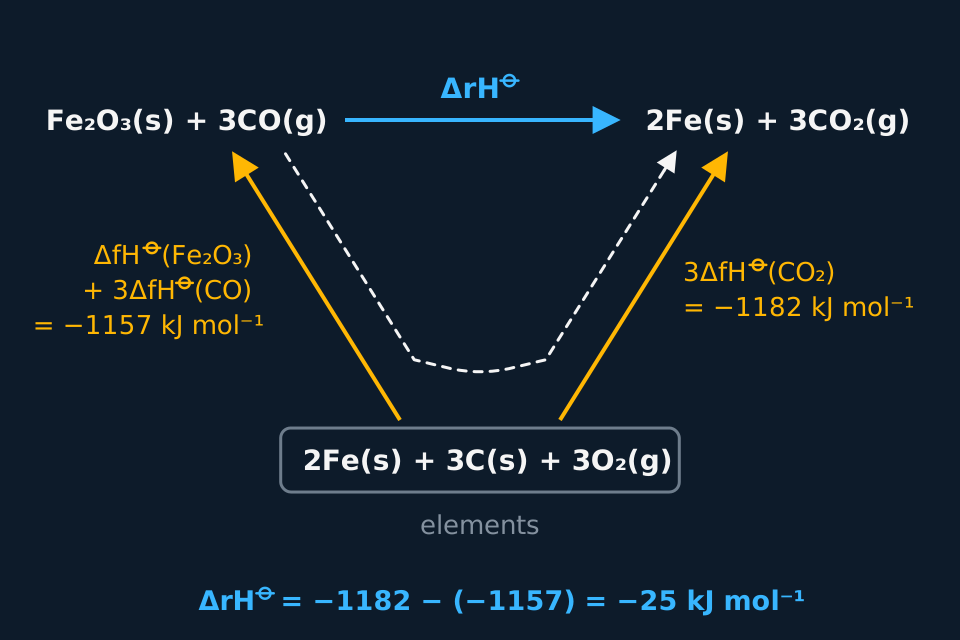
Describe the drawing
A Hess cycle. Across the top, iron(III) oxide and carbon monoxide on the left, iron and carbon dioxide on the right, joined by an arrow labelled ΔrH. Below, a box holds the elements, two iron, three carbon and three oxygen, with an arrow up to each side: minus 1157 to the reactants and minus 1182 to the products. A dashed route runs down from the reactants and up to the products, giving ΔrH = −25 kJ mol⁻¹.
Each ΔfH° is multiplied by the number of moles of that substance in the equation. Any element in its standard state contributes zero, so O₂, Fe and H₂ never need a value. A missing coefficient costs the method mark for that sum: three moles of CO₂ contribute 3 × (−394), not −394.
- Enthalpy of formation of an element
- Zero for an element in its standard state, because forming the element from itself involves no change.
Reducing iron(III) oxide in the blast furnace
Calculate ΔrH° for Fe₂O₃(s) + 3CO(g) → 2Fe(s) + 3CO₂(g). ΔfH° / kJ mol⁻¹: Fe₂O₃(s) −824, CO(g) −111, CO₂(g) −394.
Show the working
Draw the cycle with 2Fe(s) + 3C(s) + 3O₂(g) in the box below, and arrows up to each side.
Products: 2 × 0 + 3 × (−394) = −1182 kJ mol⁻¹. Iron is an element in its standard state.
Reactants: (−824) + 3 × (−111) = −824 − 333 = −1157 kJ mol⁻¹.
ΔrH° = −1182 − (−1157) = −25 kJ mol⁻¹.
Subtracting a negative number is the step where a sign is most easily dropped. Writing each sum in brackets first, then subtracting, keeps the signs visible.
The answer is small compared with the values that went into it, and that is common. The reactants lie 1157 kJ below the elements and the products 1182 kJ below them; ΔrH° is the small difference between those two depths. Checking that an answer is the right size for the difference between two sums catches most arithmetic slips.
An enthalpy of formation can be positive, and the formula handles it without change. For the hydrogenation of ethene, C₂H₄(g) + H₂(g) → C₂H₆(g), with ΔfH° of ethene +52 and ethane −84 kJ mol⁻¹, ΔrH° = −84 − (+52) = −136 kJ mol⁻¹. Combined with bond enthalpies, that value gives the strength of the C=C bond in ethene.
Cycles from enthalpies of combustion
Organic compounds are rarely made from their elements, but almost all of them burn, and enthalpies of combustion are easy to measure. So a second kind of cycle uses the combustion products as the common point instead of the elements.
Draw the reaction across the top again. Underneath, write the combustion products, CO₂(g) and H₂O(l), balanced. Now both arrows point down, because each is a combustion: the reactants burning and the products burning. Going the indirect way runs with the left arrow and against the right one, so the formula is the other way round.
ΔrH° = ΣΔcH°(reactants) − ΣΔcH°(products)
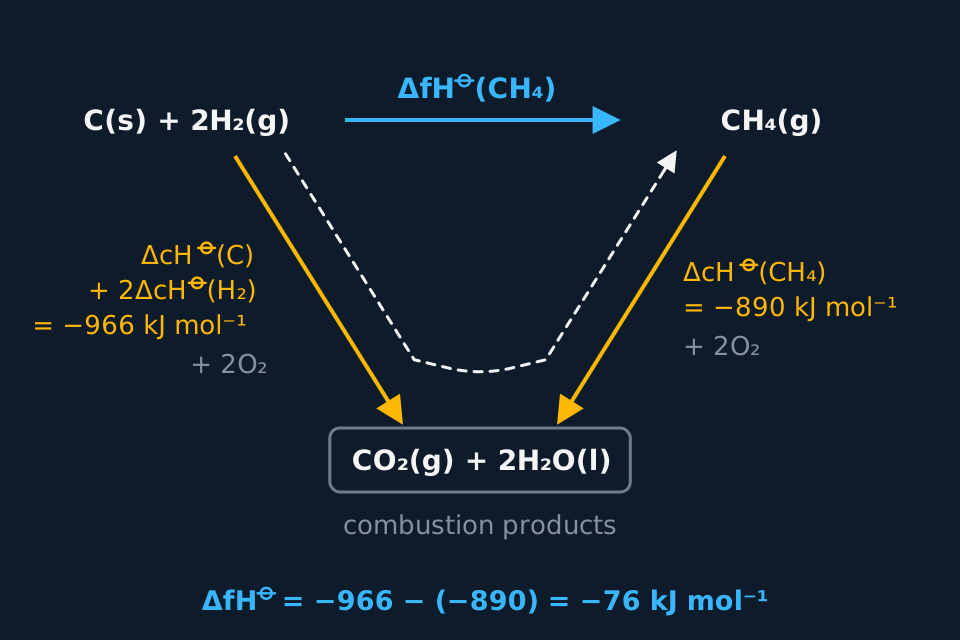
Describe the drawing
A Hess cycle in the same layout as the formation cycle. Across the top, carbon and hydrogen on the left and methane on the right, joined by an arrow labelled the enthalpy of formation of methane. Both side arrows point down, with two oxygen added, into a box of carbon dioxide and liquid water: minus 966 from the elements and minus 890 from methane, giving ΔfH = −76 kJ mol⁻¹.
| Formation cycle | Combustion cycle | |
|---|---|---|
| Box at the bottom | The elements | CO₂(g) and H₂O(l) |
| Arrows | Point up, out of the box | Point down, into the box |
| Formula | Σ products − Σ reactants | Σ reactants − Σ products |
| What contributes zero | Elements in their standard states | O₂, CO₂ and H₂O, which do not burn |
The enthalpy of formation of methane
Carbon and hydrogen do not combine to form methane under any conditions that can be measured. Calculate ΔfH° of CH₄(g) for C(s) + 2H₂(g) → CH₄(g). ΔcH° / kJ mol⁻¹: C(s) −394, H₂(g) −286, CH₄(g) −890.
Show the working
Write the cycle. Across the top, C(s) + 2H₂(g) → CH₄(g). Below, CO₂(g) + 2H₂O(l). Left arrow down: the combustion of one C and two H₂, which needs 2O₂. Right arrow down: the combustion of one CH₄, which also needs 2O₂, so the oxygen cancels.
Left arrow: (−394) + 2 × (−286) = −394 − 572 = −966 kJ mol⁻¹.
Right arrow: −890 kJ mol⁻¹.
ΔfH° = ΣΔcH°(reactants) − ΣΔcH°(products) = −966 − (−890) = −76 kJ mol⁻¹.
The data-book value is −75 kJ mol⁻¹; the difference comes from rounding the combustion values to whole numbers. The answer is small and negative because it is the difference between two large negative numbers, which also means any error in either value is a large fraction of it.
Which cycle to draw depends on which data a question gives: enthalpies of formation go in a cycle with the elements underneath, enthalpies of combustion go in a cycle with the combustion products underneath.
Cycles can also be done without a drawing, by adding equations. Write each equation whose ΔH is known, reverse any that run the wrong way and change the sign of its ΔH, multiply any that are needed more than once, then add them so that everything except the target equation cancels. For methane, the combustions of carbon and of two moles of hydrogen are added as written, and the combustion of methane is reversed. Adding those three leaves C(s) + 2H₂(g) → CH₄(g), with ΔH = −394 − 572 + 890 = −76 kJ mol⁻¹, as before.
Either method gives the same number, and a mark scheme accepts either. The drawing makes the direction of each step visible, which makes a dropped sign easier to spot.
Hydrating copper(II) sulfate
White anhydrous copper(II) sulfate turns blue when water is dripped onto it, and warms noticeably as it does. That is the test for water. The reaction makes the hydrated salt:
CuSO₄(s) + 5H₂O(l) → CuSO₄·5H₂O(s)
Its enthalpy change cannot be measured directly. Water added to the solid does not stop at five moles per mole: some of the salt dissolves, some stays anhydrous inside lumps, and the reaction never finishes cleanly. What can be measured is the enthalpy change when each solid dissolves in a large excess of water, because both end as the same solution.
- Water of crystallisation
- Water molecules held in fixed proportion within the crystal lattice of a hydrated salt.
- Anhydrous
- Describes a salt with no water of crystallisation, such as white CuSO₄(s).
- Enthalpy of solution
- The enthalpy change when one mole of a solute dissolves in enough solvent that further dilution causes no further heat change.
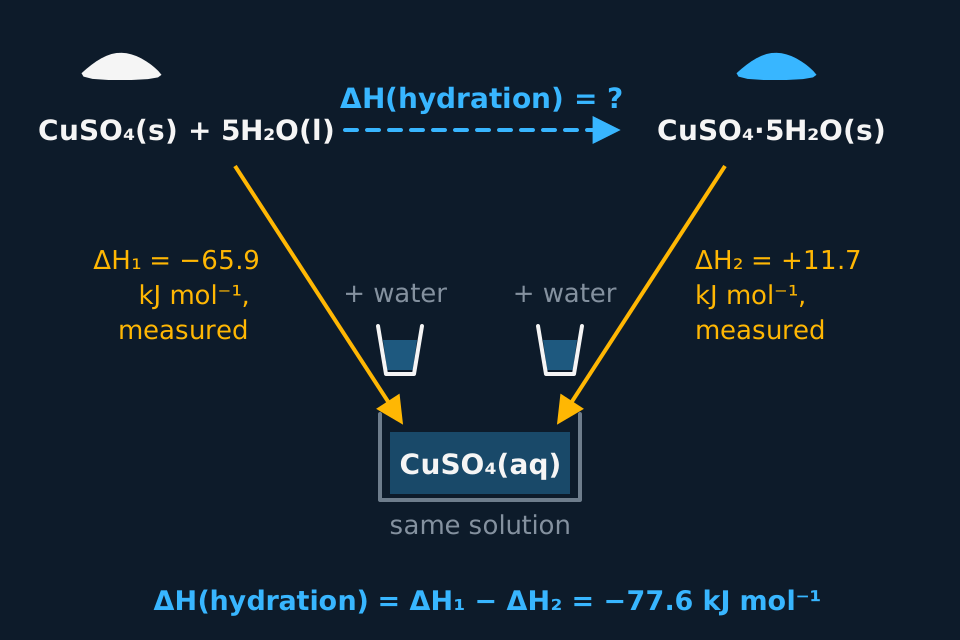
Describe the drawing
A Hess cycle for hydrating copper sulfate. Across the top, white anhydrous copper sulfate with five water on the left and the blue hydrate on the right, joined by a dashed arrow labelled ΔH hydration equals question mark. From each side an arrow points down into the same pale blue copper sulfate solution, each beside a small polystyrene cup: minus 65.9 measured on the left, plus 11.7 measured on the right, giving −77.6 kJ mol⁻¹.
The route from anhydrous salt to hydrated salt via the solution goes with the left arrow and against the right one. So the hydration enthalpy is the first enthalpy of solution minus the second. The same pattern, two measured reactions that end in the same place, is used for other changes that cannot be measured directly. The decomposition of potassium hydrogencarbonate is found from the reactions of potassium hydrogencarbonate and of potassium carbonate with hydrochloric acid.
TRY IT: The enthalpy of hydration of copper(II) sulfate
4.00 g of anhydrous CuSO₄ dissolved in 50.0 cm³ of water raises its temperature by 7.9 °C. 6.24 g of CuSO₄·5H₂O dissolved in 50.0 cm³ of water lowers its temperature by 1.4 °C. Calculate the enthalpy change for CuSO₄(s) + 5H₂O(l) → CuSO₄·5H₂O(s). Mr: CuSO₄ 159.6, CuSO₄·5H₂O 249.6.
Check your answer
Anhydrous salt: q = 50.0 × 4.18 × 7.9 = 1651 J. n = 4.00 ÷ 159.6 = 0.02506 mol. ΔH₁ = −1.651 ÷ 0.02506 = −65.9 kJ mol⁻¹, negative because the water warmed.
Hydrated salt: q = 50.0 × 4.18 × 1.4 = 293 J. n = 6.24 ÷ 249.6 = 0.02500 mol. ΔH₂ = +0.293 ÷ 0.02500 = +11.7 kJ mol⁻¹, positive because the water cooled.
ΔH(hydration) = ΔH₁ − ΔH₂ = −65.9 − (+11.7) = −77.6 kJ mol⁻¹, which to two significant figures, matching the 1.4 °C, is −78 kJ mol⁻¹. The hydration is exothermic, as the warming of the white powder suggests.
This is not the enthalpy of hydration of an ion, which starts from gaseous ions and is the quantity used in Born–Haber and solution cycles. Here the word means adding water of crystallisation to a solid.
The data-book value is −78 kJ mol⁻¹. A school result is rarely that close, and the cycle shows why. Heat lost while the anhydrous salt dissolves makes ΔH₁ less negative, and so makes the hydration less exothermic. While the hydrated salt dissolves the solution is colder than the room, so heat flows in, the fall is smaller, and ΔH₂ is less positive, which pushes the answer the other way. The two errors partly cancel.
Two other errors do not cancel. Anhydrous copper(II) sulfate takes up water from the air, so a sample left open before weighing is partly hydrated already and releases less heat than its mass suggests. And a fall of 1.4 °C read on a thermometer to ±0.1 °C carries an uncertainty of ±0.2 °C, which is 14% of ΔT: the smaller measured step limits the precision of the whole result.
Decomposing potassium hydrogencarbonate: two reactions, one cycle
Potassium hydrogencarbonate breaks down on strong heating to potassium carbonate, carbon dioxide and steam. A solid being heated strongly cannot sit in a polystyrene cup, and the decomposition is rarely complete, so its enthalpy change is not measured directly. Both solids fizz quickly in dilute hydrochloric acid, though, and both reactions end in the same place: potassium chloride solution, carbon dioxide and water. Edexcel sets this pair as core practical 8, and any board can set it as a Hess calculation with results given.
2KHCO₃(s) → K₂CO₃(s) + CO₂(g) + H₂O(l)The target. Two moles of hydrogencarbonate give one of carbonate.
KHCO₃(s) + HCl(aq) → KCl(aq) + CO₂(g) + H₂O(l) ΔH₁Measured: the acid cools.
K₂CO₃(s) + 2HCl(aq) → 2KCl(aq) + CO₂(g) + H₂O(l) ΔH₂Measured: the acid warms.
In the cycle the target runs across the top. Below it sits 2KCl(aq) + 2CO₂(g) + 2H₂O(l), what two moles of hydrogencarbonate become in acid. The left arrow is 2ΔH₁, because the target starts with two moles of KHCO₃ and ΔH₁ is per mole. The right arrow is ΔH₂: the carbonate reacts with the acid, while the CO₂ and water already on that side pass through unchanged. The indirect route runs with the left arrow and against the right one, so ΔH = 2ΔH₁ − ΔH₂.
- Thermal decomposition
- The breaking down of a compound into simpler substances by heating it.
- Indirect determination
- Finding an enthalpy change that cannot be measured directly by combining, in a Hess cycle, enthalpy changes that can be measured.
The decomposition of potassium hydrogencarbonate
3.50 g of KHCO₃ added to 30.0 cm³ of 2.00 mol dm⁻³ hydrochloric acid, an excess, lowers the temperature by 8.0 °C. 2.76 g of K₂CO₃ added to 30.0 cm³ of the same acid, also an excess, raises it by 5.0 °C. Calculate ΔH for 2KHCO₃(s) → K₂CO₃(s) + CO₂(g) + H₂O(l). Mr: KHCO₃ 100.1, K₂CO₃ 138.2; c = 4.18 J g⁻¹ K⁻¹.
Show the working
Reaction 1: q = 30.0 × 4.18 × 8.0 = 1003 J. n(KHCO₃) = 3.50 ÷ 100.1 = 0.03497 mol. ΔH₁ = +1.003 ÷ 0.03497 = +28.7 kJ mol⁻¹, positive because the acid cooled.
Reaction 2: q = 30.0 × 4.18 × 5.0 = 627 J. n(K₂CO₃) = 2.76 ÷ 138.2 = 0.01997 mol. ΔH₂ = −0.627 ÷ 0.01997 = −31.4 kJ mol⁻¹.
ΔH = 2ΔH₁ − ΔH₂ = 2 × (+28.7) − (−31.4) = 57.4 + 31.4 = +88.8 kJ mol⁻¹, which to two significant figures, matching the temperature changes, is +89 kJ mol⁻¹.
The decomposition is endothermic, and the solid has to be heated strongly before it gives off carbon dioxide.
Enthalpies of formation give the value to compare it with. With ΔfH° / kJ mol⁻¹ of KHCO₃(s) −963, K₂CO₃(s) −1151, CO₂(g) −394 and H₂O(l) −286, the products total −1151 − 394 − 286 = −1831 and the reactants 2 × (−963) = −1926, so ΔH = −1831 − (−1926) = +95 kJ mol⁻¹.
The measured +89 kJ mol⁻¹ is about 6% short of +95, and both measured steps err in the direction that explains the shortfall. In reaction 1 the acid is colder than the room, so heat flows in, the fall is too small, and ΔH₁ is too small; doubled in the cycle, that error counts twice. In reaction 2 heat is lost, the rise is too small, and ΔH₂ is not negative enough. Both make 2ΔH₁ − ΔH₂ smaller than it should be.
Other boards: the practicals built on these cycles
OCR assesses enthalpy determination in PAG 3, where either pair, the potassium salts or the copper(II) sulfate salts, can be used to find an enthalpy change that cannot be measured directly. Cambridge can set the same indirect determination in its practical papers, with results to process and a cycle to draw.
In the exam
- A statement of Hess's law earns its second mark only with the condition: the initial and final conditions are the same. 'Independent of the route' alone scores one of the two.
- A drawn cycle is credited for balanced formulae with state symbols in the bottom box and for every arrow having a direction and a ΔH label. Arrows pointing the wrong way for the data lose the cycle mark even when the arithmetic is right.
- Write each sum in brackets before subtracting, and give the answer with its sign and kJ mol⁻¹, a plus sign included: '+95 kJ mol⁻¹', not '95'.
- Schemes allow error carried forward from a wrong measured step in a practical cycle, so a ΔH₁ with the wrong sign still earns the later marks if the cycle is applied correctly to it.
- To explain why an enthalpy change is found indirectly, give the reason it cannot be measured: the elements do not react, the reaction gives a mixture of products, or it does not go to completion.
Check yourself
Calculate ΔrH° for C₃H₆(g) + H₂(g) → C₃H₈(g), the hydrogenation of propene, using ΔcH° / kJ mol⁻¹: C₃H₆(g) −2058, H₂(g) −286, C₃H₈(g) −2220. Then explain why the formation-cycle formula would give the wrong answer with these data.
Answer
The data are enthalpies of combustion, so the box at the bottom holds 3CO₂(g) + 4H₂O(l) and both arrows point down to it.
ΔrH° = ΣΔcH°(reactants) − ΣΔcH°(products) = (−2058) + (−286) − (−2220) = −2344 + 2220 = −124 kJ mol⁻¹.
Products minus reactants would give +124 kJ mol⁻¹, the right size with the wrong sign. In a combustion cycle the arrows point the other way from those in a formation cycle, so the order of subtraction is reversed.
Questions
Question 16 marks
Calculate the enthalpy change for CuSO₄(s) + 5H₂O(l) → CuSO₄·5H₂O(s) from the results in the table. Each salt was dissolved in 40.0 cm³ of water in a polystyrene cup. c = 4.18 J g⁻¹ K⁻¹.
| Salt | Mass dissolved / g | Mr | Temperature change / °C |
|---|---|---|---|
| Anhydrous CuSO₄ | 3.19 | 159.6 | rise of 7.8 |
| CuSO₄·5H₂O | 4.99 | 249.6 | fall of 1.3 |
Mark scheme
- M1 for the anhydrous salt, q = 40.0 × 4.18 × 7.8 = 1304 J, and the amount dissolved is 3.19 ÷ 159.6 = 0.01999 mol
- A1 ΔH₁ = −1.304 ÷ 0.01999 = −65.2 kJ mol⁻¹, negative because the temperature of the water rose
- M1 for the hydrated salt, q = 40.0 × 4.18 × 1.3 = 217 J, and the amount dissolved is 4.99 ÷ 249.6 = 0.01999 mol
- A1 ΔH₂ = +0.217 ÷ 0.01999 = +10.9 kJ mol⁻¹, positive because the temperature of the water fell
- M1 both salts end as the same solution, so from the cycle ΔH(hydration) = ΔH₁ − ΔH₂ = −65.2 − (+10.9)
- A1 ΔH(hydration) = −76 kJ mol⁻¹ to two significant figures, matching the 1.3 °C; allow error carried forward from either ΔH
Question 25 marks
Draw the enthalpy cycle that uses enthalpies of combustion to find the standard enthalpy of formation of propane, and use it to calculate ΔfH°(C₃H₈, g). ΔcH° / kJ mol⁻¹: C(s) −394, H₂(g) −286, C₃H₈(g) −2220.
Mark scheme
- B1 3C(s) + 4H₂(g) → C₃H₈(g) across the top, with the arrow labelled ΔfH°
- B1 3CO₂(g) + 4H₂O(l) in a box underneath, the combustion products; allow + 5O₂(g) shown on the down arrows
- B1 arrows pointing down from both the elements and propane to the box, labelled 3ΔcH°(C) + 4ΔcH°(H₂) and ΔcH°(C₃H₈); arrows pointing up lose this mark
- M1 ΔfH° = 3(−394) + 4(−286) − (−2220) = −1182 − 1144 + 2220
- A1 ΔfH° = −106 kJ mol⁻¹ to three significant figures
Question 35 marks
Calculate ΔH for 2KHCO₃(s) → K₂CO₃(s) + CO₂(g) + H₂O(l) from the enthalpy changes for reaction with excess hydrochloric acid, KHCO₃(s) +27.0 kJ mol⁻¹ and K₂CO₃(s) −34.0 kJ mol⁻¹, explaining why the first of these is multiplied by two in the cycle.
Mark scheme
- B1 the measured enthalpy change for the hydrogencarbonate is per mole of KHCO₃
- B1 the target equation starts with two moles of KHCO₃, so two moles react with acid on the indirect route and that step contributes twice the measured value
- M1 both routes end at 2KCl(aq) + 2CO₂(g) + 2H₂O(l), so ΔH = 2ΔH(KHCO₃ with acid) − ΔH(K₂CO₃ with acid)
- M1 ΔH = 2 × (+27.0) − (−34.0) = 54.0 + 34.0
- A1 ΔH = +88.0 kJ mol⁻¹ to three significant figures; reject +61.0 kJ mol⁻¹, which leaves out the factor of two
All 18 questions with mark schemes, the other 15 set out in full on the question page.
Worth remembering
- A formation cycle drawn with its arrows pointing down, or a combustion cycle with them up, gives the right size with the opposite sign.
- 3CO₂ entered as −394 instead of 3 × (−394) loses the method mark for that sum.
- Write (−1182) − (−1157) with its brackets before working it out: subtracting a negative is where the sign goes.
- Scale each measured step by the amount the target equation needs; a step used once where two moles are needed halves that arrow.
- 'Heat loss' as the reason an enthalpy change is found indirectly is rejected; the reason is that the reaction cannot be carried out cleanly.
CHECK YOUR PROGRESS
Rate how confident you are with each objective for this lesson. Ratings are saved in this browser, on this device, unless you sign in.
- State Hess's law and explain why it must hold.
- Draw an enthalpy cycle using enthalpies of formation, with the arrows pointing up from the elements, and calculate ΔrH° from it.
- Draw an enthalpy cycle using enthalpies of combustion, with the arrows pointing down to the combustion products, and calculate ΔrH° or ΔfH° from it.
- Use a cycle to find an enthalpy change that cannot be measured directly, including the hydration of anhydrous copper(II) sulfate.
- Evaluate a value calculated from a cycle against the experimental errors in the measured steps.
- Calculate the enthalpy change of a thermal decomposition from two measured reactions with acid, scaling each step by its amount.
Open the full revision checklist to see every objective in the curriculum in one place.
Practise this lesson
Practise Hess's law and enthalpy cycles with 18 original questions and point-by-point mark schemes
WORKBOOK
The written questions from this topic, on paper with room to work, and a separate book of mark schemes. The 2 questions that are set on a diagram stay on this page, where the diagram can be drawn. Free to use; please do not redistribute or sell.
Used later in Lattice enthalpy and Born–Haber cycles · Entropy and Gibbs free-energy change · Benzene: its structure and the evidence for delocalisation