Chemistry › Carbonyls and carboxylic acids › Condensation polymers and the disposal of polymers
Condensation polymers and the disposal of polymers
A polyester shirt, a nylon rope and a Kevlar vest are all made the same way: two monomers, each with a reactive group at both ends, join head to tail and give off a small molecule at every link. The ester and amide links that hold them together are also where water can split them, which is why they break down where a polyalkene bag does not.
Key terms Every definition in carbonyls and carboxylic acids, lesson by lesson
Before this Addition polymers – repeating units and why polyalkenes are unreactive · Carboxylic acids, esters and biodiesel – the ester link and its hydrolysis · Acylation: acyl chlorides and acid anhydrides – acyl chlorides react with alcohols and amines, releasing HCl · Electronegativity, polarity and intermolecular forces – hydrogen bonding between N–H and O
COMMON MISCONCEPTION
Condensation polymers give off water because they are made in water, and all plastics last for centuries in the ground.
The water is made, not supplied: each ester or amide link forms by joining an OH from one monomer to an H from the other, and that H₂O is the molecule lost. The same link can be hydrolysed, so polyesters and polyamides are broken down by acids, alkalis and enzymes. Addition polymers, with only C–C and C–H bonds, are the ones that persist.
What you should be able to do
- Describe condensation polymerisation and compare it with addition polymerisation.
- Draw the repeating unit of a polyester or polyamide from its monomers, and identify the monomers from a repeating unit.
- Explain the strength of nylon and Kevlar in terms of hydrogen bonding between chains.
- Explain why polyesters and polyamides can be hydrolysed and are biodegradable, while polyalkenes are not.
- Evaluate landfill, incineration and recycling as ways of disposing of polymers.
Two functional groups on every monomer
Poly(ethene) grows when the C=C bonds of ethene open and the monomers add to one another; nothing is lost, and the polymer has exactly the formula of all the monomers added together. Condensation polymerisation works differently. Each monomer has two functional groups, one at each end, and each time a link forms between two monomers a small molecule, usually water or hydrogen chloride, is given off.
Two kinds of link are examined. A carboxylic acid group reacting with an alcohol group makes an ester link, –COO–, and the polymer is a polyester. A carboxylic acid group reacting with an amine group makes an amide link, –CONH–, and the polymer is a polyamide. If the acid is supplied as an acyl chloride, the reaction is faster and the small molecule lost is HCl instead of water, exactly as in the acylation reactions.
Because each monomer reacts at both ends, a chain can keep growing in both directions. One monomer with two OH groups and one with two COOH groups is the usual pairing, a diol and a dicarboxylic acid; a single monomer with an OH at one end and a COOH at the other also works, as in poly(lactic acid).
Poly(lactic acid), PLA, is made from 2-hydroxypropanoic acid. The OH of one molecule reacts with the COOH of the next, so a single monomer gives a polyester with the repeating unit –OCH(CH₃)CO–. PLA is made from the lactic acid that bacteria produce by fermenting maize starch, and it is used for compostable cups and food packaging and for dissolving surgical stitches, which are hydrolysed in the body over several months.
A repeating unit shows which kind of polymer it came from. If the main chain is carbon atoms only, the polymer is an addition polymer. If the main chain contains oxygen or nitrogen atoms next to a C=O group, it is a condensation polymer, and the C=O tells you where each link is.
- Condensation polymerisation
- The joining of monomers, each with two functional groups, into a polymer with the loss of a small molecule such as water or HCl at each link.
- Polyester
- A condensation polymer in which the monomer residues are joined by ester links, –COO–.
- Polyamide
- A condensation polymer in which the monomer residues are joined by amide links, –CONH–.
- Addition polymerisation
- The joining of many monomers containing C=C bonds into a polymer, with no other product.
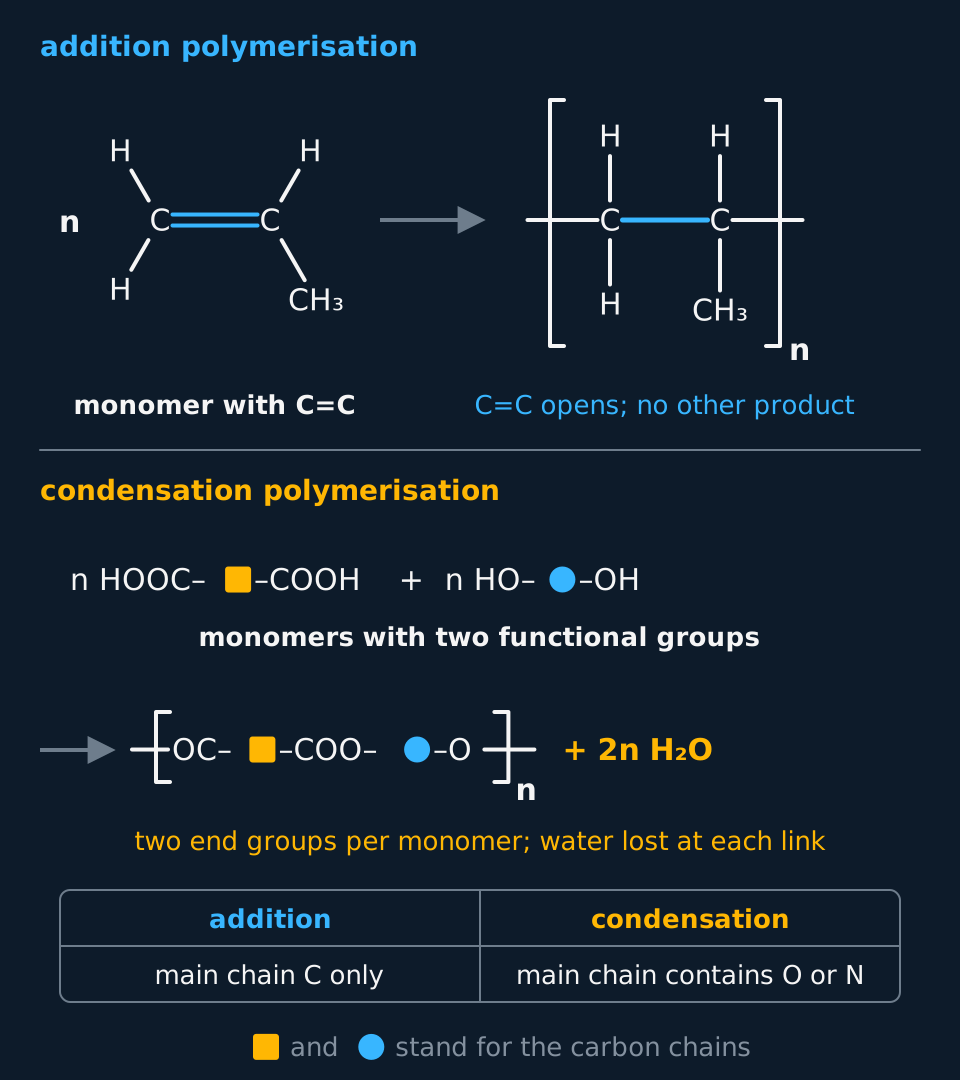
Describe the drawing
Two rows comparing the two kinds of polymerisation. Addition: n propene molecules, each with a C=C, give poly(propene), drawn as a repeating unit of two carbons with a CH₃ on one, in square brackets with n and bonds through both brackets, and nothing else is formed. Condensation: n dicarboxylic acid molecules, a square block between two COOH groups, and n diol molecules, a round block between two OH groups, give a repeating unit with an ester link at each join, plus 2n water molecules.
Polyesters: Terylene
Terylene, sold as polyester fibre for clothing and as PET for drinks bottles, is made from benzene-1,4-dicarboxylic acid, HOOCC₆H₄COOH, and ethane-1,2-diol, HOCH₂CH₂OH. An OH from the acid end and an H from the alcohol end leave as water, and the acid's carbonyl carbon bonds to the alcohol's oxygen, as in esterification.
nHOOCC₆H₄COOH(s) + nHOCH₂CH₂OH(l) → –[OCC₆H₄COOCH₂CH₂O]ₙ–(s) + 2nH₂O(l)Strictly 2n − 1 water molecules form; 2n is accepted
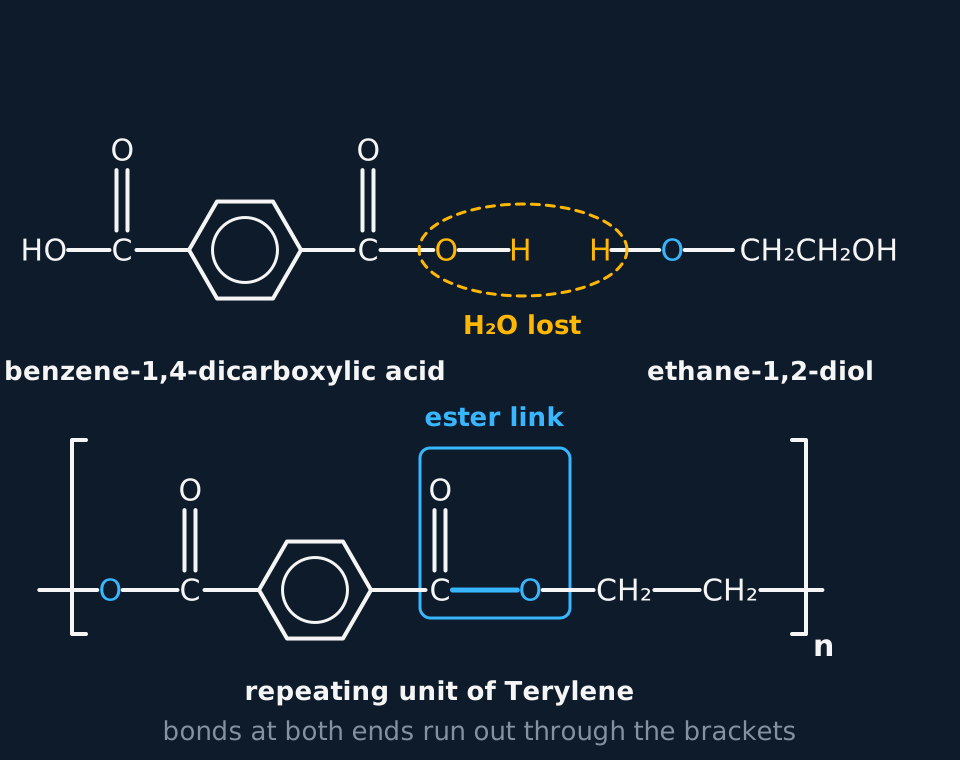
Describe the drawing
Top: benzene-1,4-dicarboxylic acid, a benzene ring with a COOH group on each of two opposite carbons, drawn in a line with ethane-1,2-diol. The OH on the acid's right-hand end and the H on the diol's left-hand end are ringed together and labelled H₂O lost. Below: the repeating unit of Terylene, O–C(=O)–ring–C(=O)–O–CH₂–CH₂, in square brackets with n and a bond running out through each bracket, with the –C(=O)–O– ester link boxed.
The repeating unit holds one residue of each monomer and one ester link, with an open bond at each end. It can be drawn starting at either monomer, so –OCH₂CH₂OOCC₆H₄CO– is the same unit as –OCC₆H₄COOCH₂CH₂O–. Draw each ester link in full, with the C=O displayed.
The repeating unit from two given monomers
Butanedioic acid, HOOCCH₂CH₂COOH, polymerises with propane-1,3-diol, HOCH₂CH₂CH₂OH. Draw the repeating unit and calculate its relative formula mass.
Show the working
Identify the links. Acid plus alcohol gives an ester link, so this is a polyester and each link loses one H₂O.
Remove an OH from each COOH of the acid, leaving –OCCH₂CH₂CO–. Remove an H from each OH of the diol, leaving –OCH₂CH₂CH₂O–.
Join them through an ester link and leave both ends open: –OCCH₂CH₂COOCH₂CH₂CH₂O–, which is C₇H₁₀O₄.
Mr = (7 × 12.0) + (10 × 1.0) + (4 × 16.0) = 84.0 + 10.0 + 64.0 = 158.0. Check: the two monomers have Mr 118.0 and 76.0, and 118.0 + 76.0 − 2 × 18.0 = 158.0.
Polyamides: nylon-6,6 and Kevlar
Nylon-6,6 is made from hexanedioic acid, HOOC(CH₂)₄COOH, and hexane-1,6-diamine, H₂N(CH₂)₆NH₂. The two sixes are the numbers of carbon atoms in the two monomers. Each amide link forms when the OH of an acid group and an H of an amine group leave as water. In the laboratory hexanedioyl dichloride, ClOC(CH₂)₄COCl, is often used instead of the acid, since it reacts faster, and HCl is lost.
nHOOC(CH₂)₄COOH(s) + nH₂N(CH₂)₆NH₂(s) → –[OC(CH₂)₄CONH(CH₂)₆NH]ₙ–(s) + 2nH₂O(l)Nylon-6,6; the repeating unit has two amide links
The amide links are polar. Each N–H on one chain can hydrogen bond to the C=O oxygen of an amide link on a neighbouring chain. Those hydrogen bonds, many of them along the length of each chain, hold the chains together far more strongly than the van der Waals forces between poly(ethene) chains, so nylon fibres are strong and have a higher melting point. Nylon is used for ropes, fishing line and clothing.
The reaction can be run in a beaker. A solution of hexanedioyl dichloride in cyclohexane is floated carefully on a solution of hexane-1,6-diamine in water. The two monomers meet only at the boundary between the layers, and a film of nylon forms there. Gripped with tweezers and lifted, the film draws out as a continuous thread, and the polymer goes on forming at the boundary as long as the thread is pulled.
nClOC(CH₂)₄COCl(l) + nH₂N(CH₂)₆NH₂(aq) → –[OC(CH₂)₄CONH(CH₂)₆NH]ₙ–(s) + 2nHCl(aq)From the diacyl dichloride, HCl is lost at each link
A polyamide can also come from a single monomer with an amine group at one end and a carboxylic acid group at the other. 6-Aminohexanoic acid, H₂N(CH₂)₅COOH, gives nylon-6, with the repeating unit –NH(CH₂)₅CO–. The single 6 counts the carbon atoms of its one monomer, where nylon-6,6 needs two numbers for two. Proteins are head-to-tail polyamides of the same kind, built from amino acids.
Counting repeating units in a nylon chain
The repeating unit of nylon-6,6 is –OC(CH₂)₄CONH(CH₂)₆NH–. A sample has a mean relative molecular mass of 45 200. Calculate the mean number of repeating units in a chain.
Show the working
Count the atoms in the repeating unit: 12 C, 22 H, 2 N and 2 O, so the unit is C₁₂H₂₂N₂O₂.
Mr of the unit = (12 × 12.0) + (22 × 1.0) + (2 × 14.0) + (2 × 16.0) = 144.0 + 22.0 + 28.0 + 32.0 = 226.0.
Number of repeating units = 45 200 ÷ 226.0 = 200. The end groups of the chain are ignored, since they make almost no difference to a mass this large.
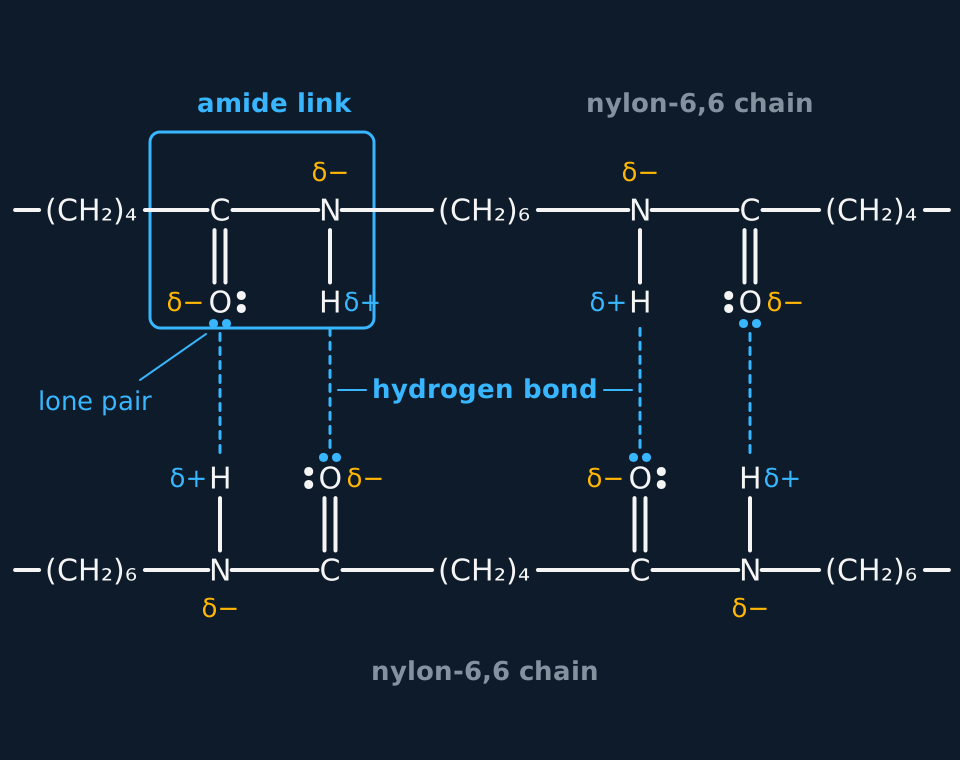
Describe the drawing
Two parallel nylon-6,6 chain segments, the upper running (CH₂)₄–C(=O)–NH–(CH₂)₆–NH–C(=O)–(CH₂)₄ and the lower offset so that every C=O on one chain sits opposite an N–H on the other. Four straight dashed hydrogen bonds join them, each from a δ+ hydrogen on nitrogen to a lone pair on a δ− carbonyl oxygen, with the nitrogens marked δ− too. One –C(=O)–NH– amide link is boxed.
Kevlar is a polyamide made from benzene-1,4-diamine and benzene-1,4-dicarboxylic acid. Its repeating unit is –OCC₆H₄CONHC₆H₄NH–, with the benzene rings joined at opposite corners. The chains are straight and rigid, so they line up parallel and pack closely, and hydrogen bonds form between amide links on every neighbouring chain, holding them in flat sheets. The result is a fibre five times stronger than steel of the same mass, used in bulletproof vests, cut-resistant gloves and boat hulls.
Polyesters have no N–H or O–H in their chains, so they cannot hydrogen bond to each other. Their ester links are polar, and the chains are held by permanent dipole–dipole forces as well as van der Waals forces, so Terylene is strong enough for fibre but weaker than nylon.
Melting points follow the forces between chains. Low-density poly(ethene), with branched chains held only by van der Waals forces, softens at about 110 °C. Nylon-6,6 melts at about 265 °C. Kevlar does not melt at all before it decomposes, above 400 °C, and it is used in fire-resistant clothing for that reason. Kevlar does have weaknesses: ultraviolet light slowly breaks its chains, so Kevlar fabric is kept covered, and strong acids hydrolyse its amide links like any other polyamide.
- Amide link
- The –CONH– group joining monomer residues in a polyamide, formed from a carboxylic acid group and an amine group with loss of water.
- Ester link
- The –COO– group joining monomer residues in a polyester, formed from a carboxylic acid group and an alcohol group with loss of water.
- Repeating unit
- The smallest section of a polymer chain that, repeated, gives the whole chain, drawn with an open bond at each end.
TRY IT: Monomers from a polymer
A polymer has the repeating unit –NH(CH₂)₄NHOC(CH₂)₈CO–. Identify the type of polymer and give the formulae of two monomers that would make it.
Check your answer
The chain contains –NHOC–, an amide link read backwards, so the polymer is a polyamide.
Break each amide link and add back what was lost: OH on the carbonyl carbon, H on the nitrogen. The monomers are butane-1,4-diamine, H₂N(CH₂)₄NH₂, and decanedioic acid, HOOC(CH₂)₈COOH. Decanedioyl dichloride, ClOC(CH₂)₈COCl, would do as well.
Hydrolysis, biodegradability and disposal
The links that formed by losing water can be broken by adding it back. Polyesters and polyamides are both hydrolysed by hot aqueous acid or alkali. The polar C=O in each link has a δ+ carbon, which water or hydroxide ions attack as nucleophiles. Alkaline hydrolysis of Terylene gives ethane-1,2-diol and the salt of benzene-1,4-dicarboxylic acid; acid hydrolysis of nylon gives hexanedioic acid and the ammonium salt of the diamine.
Poly(ethene) and poly(propene) have only C–C and C–H bonds. These are strong and non-polar, so there is no δ+ carbon for a nucleophile and nothing for an electrophile either, now that the C=C bonds are gone. Polyalkenes are therefore chemically inert, so they are useful as containers and last for centuries in the ground. An answer must say why there is nothing to attack: 'polyalkenes are unreactive' restates the fact without the reason.
Condensation polymers are biodegradable, though slowly: the same hydrolysis, catalysed by enzymes from microorganisms, breaks them into small molecules. In a landfill site the waste is compacted, dry and short of oxygen, so few microorganisms are active and even biodegradable polymers can survive for decades. They break down as intended in industrial composting, where the material is kept warm, moist and aerated.
Waste polymer has three fates. Landfill is cheap and needs no sorting, but uses land, and polyalkenes in it do not break down. Incineration reduces the volume and releases energy that can generate electricity, but gives off carbon dioxide, and burning PVC releases hydrogen chloride, which has to be removed from the waste gases.
Recycling saves crude oil and energy: sorted polymer can be melted and remoulded, or cracked back to small molecules used as feedstock, but sorting mixed waste is costly and the recycled polymer is often of lower quality. PET bottles are the most recycled polymer: they are sorted, washed, shredded into flakes and melted, and the polymer is spun into fleece fibre or made into new bottles. A polyester can also be hydrolysed back to its monomers, which are purified and polymerised again to give polymer as good as new.
Recovering monomer from waste PET
1.00 kg of waste PET, repeating unit –OCC₆H₄COOCH₂CH₂O–, is heated with excess aqueous sodium hydroxide until it is completely hydrolysed. Write an equation for one repeating unit and calculate the maximum mass of ethane-1,2-diol recovered. Ar: H 1.0, C 12.0, O 16.0.
Show the working
Each repeating unit holds two ester links, so it takes two hydroxide ions: C₁₀H₈O₄ + 2NaOH → NaOOCC₆H₄COONa + HOCH₂CH₂OH.
Mr of the repeating unit, C₁₀H₈O₄ = 120.0 + 8.0 + 64.0 = 192.0. Amount = 1000 ÷ 192.0 = 5.208 mol.
Each repeating unit gives one ethane-1,2-diol, Mr 62.0, so the maximum mass = 5.208 × 62.0 = 323 g, to 3 significant figures.
The disodium salt is acidified to recover benzene-1,4-dicarboxylic acid, and the two monomers are polymerised again.
| Addition polymers | Condensation polymers | |
|---|---|---|
| Monomer | One C=C bond | Two functional groups |
| Small molecule lost | None | Water or HCl at each link |
| Links in the chain | C–C only | Ester or amide links |
| Hydrolysis | Not possible | Acid or alkali breaks the links |
| Biodegradable | No | Yes, slowly |
- Biodegradable
- Able to be broken down into smaller molecules by microorganisms in the environment.
Other boards: predicting the polymer type and photodegradable polymers
Cambridge asks for the type of polymerisation to be predicted from a monomer, reading the structure forwards. A C=C bond means addition polymerisation, whatever else the molecule carries: propenamide, CH₂=CHCONH₂, polymerises through its C=C and keeps its amide group as a side chain. Two groups that react with each other, OH with COOH, or NH₂ with COOH or COCl, mean condensation, whether they sit on one monomer or are shared between two.
OCR and Cambridge also examine photodegradable polymers. A polyalkene can be made to break down in light by building a few C=O groups into its chains, for example by adding a little carbon monoxide to the ethene as it polymerises. The C=O groups absorb ultraviolet light and the chain bonds next to them break, so the polymer crumbles. Light has to reach it, so a photodegradable bag buried in landfill lasts as long as an ordinary one, and what is left is small fragments of polyalkene, not carbon dioxide and water.
- Photodegradable
- Able to be broken down by absorbing light, usually ultraviolet, which breaks bonds in the polymer chain.
In the exam
- A repeating unit earns its mark with the ester or amide link drawn in full, the C=O displayed, and a bond at each end through the brackets. Ends left closed, with an H or OH on them, are not credited.
- Monomers are found by breaking each link and adding OH to the carbonyl carbon and H to the O or N. The scheme accepts an acyl chloride, with Cl in place of OH, as an alternative monomer.
- To explain Kevlar's strength, name hydrogen bonds between N–H and C=O on adjacent chains, and state that the straight chains pack closely.
- For why polyalkenes do not biodegrade, the scheme credits non-polar, strong C–C and C–H bonds that nucleophiles cannot attack; 'they are unreactive' alone restates the question.
- An evaluation of disposal needs an advantage and a disadvantage for each method, and names the toxic HCl from burning PVC.
Check yourself
A sample of nylon-6,6 and a sample of poly(propene) are each left in warm dilute hydrochloric acid for a month. The nylon loses mass and the poly(propene) does not. Explain both results, and name the products from the nylon.
Answer
Nylon-6,6 is a polyamide. Each amide link contains a polar C=O with a δ+ carbon, which water attacks, so the acid catalyses hydrolysis of the links and the chains are broken into small, soluble molecules.
The products are hexanedioic acid and the hexane-1,6-diammonium ion, because in acid the amine groups are protonated.
Poly(propene) has only non-polar C–C and C–H bonds, so there is no site for a nucleophile to attack. It is not hydrolysed, and its mass is unchanged.
Questions
Question 16 marks
Evaluate a supermarket's plan to replace its poly(ethene) carrier bags with bags made from a polyester, with reference to the bonds in each polymer and to how each can be disposed of.
Mark scheme
Indicative content
- poly(ethene) has a chain of C–C and C–H bonds only, strong and non-polar, so it is chemically inert and is not biodegraded; in landfill it persists for centuries
- the polyester chain contains ester links, whose δ+ carbonyl carbon is attacked by water, acids and alkalis, so the polymer can be hydrolysed
- hydrolysis breaks the polyester back into its diol and its dicarboxylic acid, or its salt in alkali, so it can be chemically recycled to monomer or biodegraded
- in a dry, oxygen-poor landfill even a polyester breaks down slowly, so the gain depends on where the used bags are sent
- the hydrolysis that helps disposal can weaken a polyester bag in use, in contact with damp, acidic or alkaline goods, while poly(ethene) is unaffected by them
- both polymers can be burned to release energy, giving carbon dioxide, so a justified conclusion favours the polyester only if its waste is hydrolysed or composted rather than buried
Levels
- Level 3 (5–6 marks) the inert C–C chain of poly(ethene) and the hydrolysable ester link of the polyester are both explained, the hydrolysis products are named, and the two bags are compared in landfill, incineration and recycling; the judgement allows for how slowly even a polyester breaks down when buried, or for the weakening of the bag in use
- Level 2 (3–4 marks) the ester link is said to be hydrolysed and poly(ethene) to be non-biodegradable, and some disposal routes are compared; the answer usually stops short of the products of hydrolysis or of any drawback of the polyester, so its verdict is one-sided
- Level 1 (1–2 marks) the polyester bag is preferred because it is 'natural' or 'rots', or poly(ethene) is said to break down slowly, with no mention of the ester link or of the bonds in either chain
Question 24 marks
Give the names and formulae of the two monomers used to make nylon-6,6, and the products of its complete hydrolysis by hot dilute hydrochloric acid.
Mark scheme
- B1 hexanedioic acid, HOOC(CH₂)₄COOH; allow hexanedioyl dichloride, ClOC(CH₂)₄COCl
- B1 the other monomer is hexane-1,6-diamine, H₂N(CH₂)₆NH₂
- B1 hydrolysis gives hexanedioic acid, HOOC(CH₂)₄COOH
- B1 and the hexane-1,6-diammonium ion, as its chloride, because the amine groups are protonated by the acid
Question 34 marks
Draw the repeating unit of the polymer formed from ethane-1,2-diol and butanedioic acid, and give the type of polymer and the small molecule lost.
Mark scheme
- B1 –OCCH₂CH₂COOCH₂CH₂O–, one residue of each monomer
- B1 the ester link drawn in full with C=O displayed, and an open bond at each end; ends closed with H or OH are not credited
- B1 the polymer is a polyester
- B1 the small molecule lost is water, two per repeating unit, one per ester link
All 19 questions with mark schemes, the other 16 set out in full on the question page.
Worth remembering
- A repeating unit with a closed end, or with an extra OH or H left on, is not a repeating unit.
- Polyesters have no N–H, so their chains are held by dipoles, not hydrogen bonds.
- Biodegradable does not mean it breaks down in landfill: there is too little air and water.
- Photodegradable plastics need light; buried, they last as long as any other.
- Count 2n water molecules for n of each monomer, or 2n − 1 if the question asks for the exact figure.
CHECK YOUR PROGRESS
Rate how confident you are with each objective for this lesson. Ratings are saved in this browser, on this device, unless you sign in.
- Describe condensation polymerisation and compare it with addition polymerisation.
- Draw the repeating unit of a polyester or polyamide from its monomers, and identify the monomers from a repeating unit.
- Explain the strength of nylon and Kevlar in terms of hydrogen bonding between chains.
- Explain why polyesters and polyamides can be hydrolysed and are biodegradable, while polyalkenes are not.
- Evaluate landfill, incineration and recycling as ways of disposing of polymers.
Open the full revision checklist to see every objective in the curriculum in one place.
Practise this lesson
WORKBOOK
The questions from this topic, on paper with room to work, and a separate book of mark schemes. Free to use; please do not redistribute or sell.
Used later in Amino acids, proteins, enzymes and DNA