Chemistry › Aromatic chemistry and amines › Electrophilic substitution: nitration and Friedel–Crafts acylation
Electrophilic substitution: nitration and Friedel–Crafts acylation
Benzene's ring of delocalised electrons attracts electrophiles, but the ring reacts by losing a hydrogen rather than by adding across a bond, so the delocalised system comes back at the end. AQA examines two reactions of this kind: nitration with concentrated nitric and sulfuric acids, and Friedel–Crafts acylation with an acyl chloride and aluminium chloride. They share one mechanism; only the electrophile and the way it is made change.
Key terms Every definition in aromatic chemistry and amines, lesson by lesson
Before this Benzene: its structure and the evidence for delocalisation – the delocalised ring and its 152 kJ mol⁻¹ of stability · Alkenes: structure, electrophilic addition and Markovnikov's rule – an electrophile, and a carbocation intermediate · Reaction types, curly arrows and how a mechanism is written – a curly arrow starts at a pair of electrons
COMMON MISCONCEPTION
Benzene reacts like an alkene, so the nitro group adds across one of its double bonds.
Addition would end the delocalised ring and lose its stability, so benzene substitutes instead. NO₂⁺ takes a pair of electrons from the ring and bonds to one carbon; the ring then loses the H⁺ from that carbon and restores its six delocalised electrons. The product, nitrobenzene, is still aromatic, which an addition product would not be.
What you should be able to do
- Explain why benzene reacts with electrophiles by substitution and not by addition.
- State the reagents and conditions for the nitration of benzene, and write equations for the formation of the nitronium ion.
- Outline the mechanism of nitration with curly arrows, drawing the intermediate correctly, and show how the catalyst is regenerated.
- State the reagents and conditions for Friedel–Crafts acylation, write the equation for the formation of the acylium ion, and outline the mechanism.
- Describe why nitration and acylation are important in making explosives, dyes and new carbon–carbon bonds.
- Explain why phenol substitutes more readily than benzene, and predict where a group already on the ring sends the next one.CAIE · OCR A
Substitution, not addition
Benzene's six delocalised electrons make a region of high electron density above and below the ring, so benzene attracts electrophiles, species that accept a pair of electrons. In that respect it is like an alkene. The difference is in what happens next. If an electrophile added across a bond, the product would have no delocalised ring, and would lose the 152 kJ mol⁻¹ of stability that the hydrogenation enthalpies measure. Instead, one hydrogen atom leaves as H⁺, the ring re-forms, and the product is a substituted benzene.
The electron density in benzene is spread over six carbon atoms, not concentrated between two as it is in a C=C bond, so the ring cannot polarise a neutral molecule such as bromine. The electrophiles that react with benzene are positive ions, made in the reaction mixture with the help of a catalyst: the nitronium ion, NO₂⁺, for nitration, and an acylium ion such as CH₃CO⁺ for acylation.
Both reactions go in the same two steps. The electrophile accepts a pair of the delocalised electrons and bonds to one carbon of the ring. That breaks the delocalised system and leaves a positively charged intermediate. Then the C–H bond on the same carbon breaks, its pair of electrons goes back into the ring, and H⁺ leaves. The first step is the slow one, because it breaks up the delocalisation; the second is fast, because it restores it.
Set this beside the addition of hydrogen bromide to ethene. There too an electrophile takes a pair of electrons and leaves a positive intermediate, a carbocation. In ethene the carbocation is then attacked by bromide, and the product has added HBr across the double bond. In benzene the intermediate could also be attacked by a negative ion, but the product would have no delocalised ring. Losing H⁺ gives a product that has its ring back, which is much lower in energy, so that is the path taken.
- Electrophile
- An electron pair acceptor: a species that accepts a pair of electrons to form a new covalent bond.
- Electrophilic substitution
- A reaction in which an electrophile replaces an atom, usually hydrogen, on an electron-rich compound such as benzene.
Nitration and the nitronium ion
Benzene is warmed with a mixture of concentrated nitric acid and concentrated sulfuric acid, the nitrating mixture, at 50 °C. Above about 55 °C a second nitro group goes on and 1,3-dinitrobenzene forms alongside the product, so the flask stands in a water bath and the benzene is added a little at a time. The product, nitrobenzene, is a pale yellow oil, denser than water, that smells of almonds. Both acids must be described as concentrated: dilute nitric acid contains too much water for the electrophile to form, and an answer that says only 'nitric acid' does not give the reagent.
C₆H₆(l) + HNO₃(l) → C₆H₅NO₂(l) + H₂O(l)The overall equation. Sulfuric acid is a catalyst and does not appear.
Nitric acid is not itself the electrophile. Sulfuric acid is the stronger acid, and it donates a proton to the nitric acid. The protonated nitric acid then loses a molecule of water, leaving the nitronium ion, NO₂⁺, with the positive charge on its nitrogen atom.
HNO₃(l) + H₂SO₄(l) → H₂NO₃⁺ + HSO₄⁻Sulfuric acid protonates nitric acid. The ions are dissolved in the concentrated acid mixture, so they carry no state symbol.
H₂NO₃⁺ → NO₂⁺ + H₂O(l)The protonated acid loses water, leaving the nitronium ion.
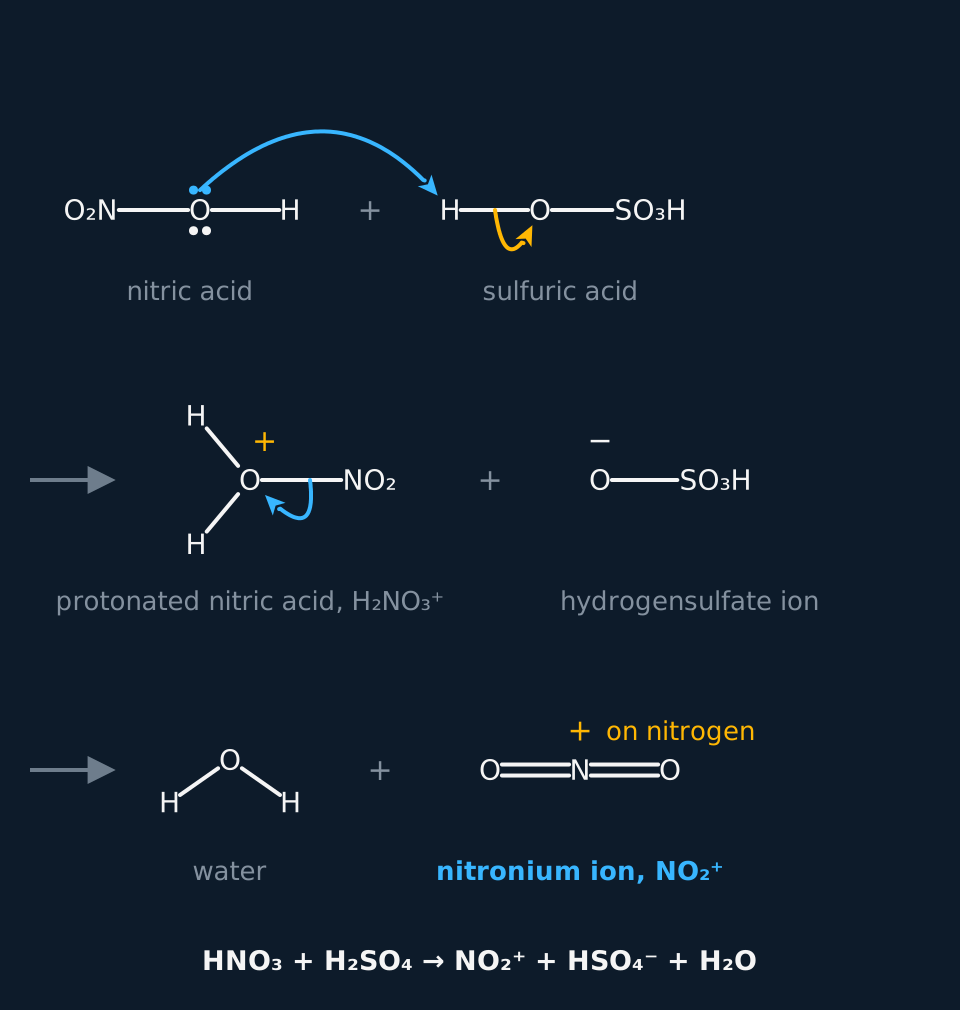
Describe the drawing
The nitronium ion forming in two steps. First, nitric acid and sulfuric acid are drawn side by side; a curly arrow runs from a lone pair on the oxygen of nitric acid's O–H group to a hydrogen of sulfuric acid, and a second arrow from the middle of that O–H bond onto its oxygen. The products are protonated nitric acid, with two hydrogens and a positive charge on one oxygen, and the hydrogensulfate ion. A curly arrow then runs from the middle of the N–O bond onto that positive oxygen, which leaves as water, leaving the linear nitronium ion O=N=O with the positive charge on nitrogen. The overall equation is written underneath.
The two steps add up to HNO₃ + H₂SO₄ → NO₂⁺ + HSO₄⁻ + H₂O. Some books protonate the water as well and use two molecules of sulfuric acid, giving HNO₃ + 2H₂SO₄ → NO₂⁺ + H₃O⁺ + 2HSO₄⁻. Mark schemes accept either combined equation, or the two steps; the electrophile is NO₂⁺ in every version. The name to use for it is the nitronium ion, and its charge belongs on the nitrogen.
- Nitronium ion
- The electrophile in nitration, NO₂⁺, formed when concentrated sulfuric acid protonates nitric acid, which then loses water.
The mechanism of nitration, and its uses
The first curly arrow starts inside the hexagon, on the circle that stands for the delocalised electrons, and ends on the nitrogen atom of NO₂⁺, the atom carrying the positive charge. A pair of the delocalised electrons forms a new bond between one ring carbon and the nitrogen.
That carbon now has four single bonds, to two ring carbons, to a hydrogen and to the nitro group, so it has left the delocalised system. The other five carbons share the four delocalised electrons that remain, and the ring carries the positive charge that the NO₂⁺ brought. This is drawn as a horseshoe: part of a circle running across the five carbons, open at the carbon bearing H and NO₂, with a + inside it.
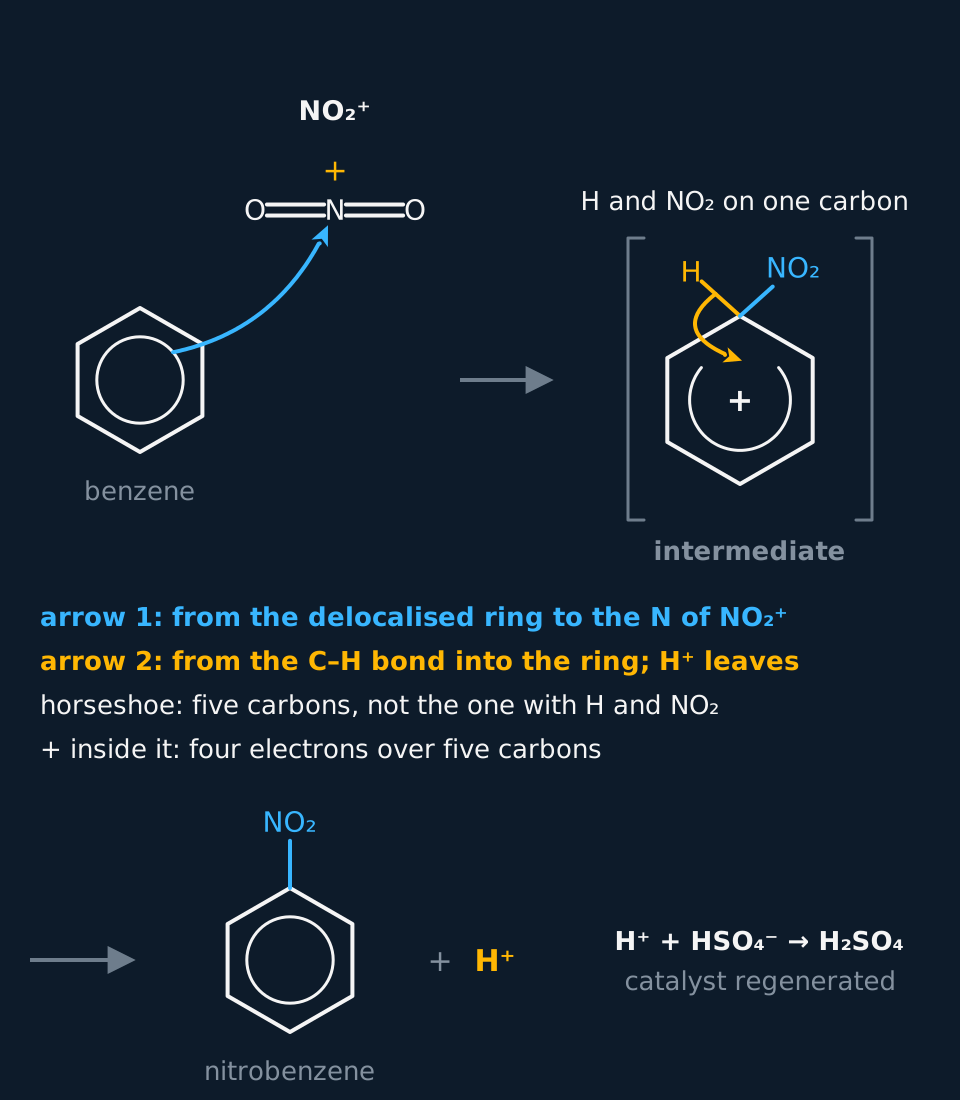
Describe the drawing
The AQA mechanism for nitrating benzene. Benzene is a hexagon with a circle inside and the nitronium ion O=N=O, positive on nitrogen, sits to its upper right; a cyan curly arrow leaves the circle and ends on the nitrogen. In square brackets the intermediate is a hexagon whose top carbon carries both an H and an NO₂ group, with a horseshoe-shaped partial circle running over the other five carbons, open at the top, and a plus sign inside it; an amber curly arrow runs from the middle of the C–H bond into the gap of the horseshoe. The products are nitrobenzene, a hexagon with a circle and NO₂ on one carbon, and H⁺, and beneath, H⁺ and hydrogensulfate re-form sulfuric acid, the catalyst.

Describe the drawing
Electrophilic substitution of benzene by the nitronium ion in three stages. First benzene, a hexagon with a circle, faces O=N=O positive on nitrogen, and a cyan curly arrow leaves the circle and ends on the nitrogen. Second, in square brackets, the intermediate: its top carbon carries both H and NO₂, a horseshoe of delocalised electrons spans the other five carbons with a plus inside, and an amber arrow runs from the C–H bond back into the ring. Third, nitrobenzene with its full circle restored, H⁺, and H⁺ with hydrogensulfate re-forming sulfuric acid.
The second curly arrow starts on the middle of the C–H bond on that same carbon and ends inside the horseshoe. The pair of electrons from the C–H bond completes the delocalised ring again, the hydrogen leaves as H⁺, and nitrobenzene has formed.
H⁺ + HSO₄⁻ → H₂SO₄(l)The hydrogen ion lost from the ring and the hydrogensulfate ion re-form sulfuric acid, so the sulfuric acid is a catalyst.
Outlining the nitration mechanism
Outline the mechanism for the reaction of benzene with a mixture of concentrated nitric acid and concentrated sulfuric acid.
Show the working
The electrophile first: HNO₃ + 2H₂SO₄ → NO₂⁺ + H₃O⁺ + 2HSO₄⁻, or the two-step version.
Arrow 1, from inside the hexagon to the nitrogen of NO₂⁺. An arrow that starts on a single carbon atom, or on a bond drawn into a Kekulé structure, does not show the delocalised electrons moving.
The intermediate: a hexagon with H and NO₂ both on one carbon, and a horseshoe with a + inside it across the other five. The horseshoe must not continue over the carbon carrying H and NO₂, because that carbon is no longer part of the delocalised system.
Arrow 2, from the C–H bond into the ring, with H⁺ shown as a product.
The scheme gives one mark for each of these three parts of the mechanism, and a further mark for the equation forming NO₂⁺ where the question asks for it.
Nitration is the usual way to attach a nitrogen atom to a benzene ring. Reducing nitrobenzene with tin and concentrated hydrochloric acid gives phenylamine, C₆H₅NH₂, the starting material for azo dyes, the bright yellows, oranges and reds used to dye cloth and colour food. Paracetamol is made by a route that passes through 4-nitrophenol and then 4-aminophenol.
Nitrating more than once makes explosives. Methylbenzene nitrated three times gives 2-methyl-1,3,5-trinitrobenzene, trinitrotoluene or TNT. The nitro groups carry their own oxygen, so a TNT molecule can break down into nitrogen, carbon monoxide, water and carbon in a fraction of a millisecond without any air. Each nitro group added makes the next harder to add, so the later nitrations need hotter conditions; at 50 °C benzene stops at one.
Friedel–Crafts acylation
Aluminium chloride lets benzene form new carbon–carbon bonds, a discovery made by Charles Friedel and James Crafts. In acylation, benzene is heated under reflux with an acyl chloride, such as ethanoyl chloride, CH₃COCl, and anhydrous aluminium chloride. The product is a ketone with the ring attached to the carbonyl carbon: from ethanoyl chloride, phenylethanone, C₆H₅COCH₃.
C₆H₆(l) + CH₃COCl(l) → C₆H₅COCH₃(l) + HCl(g)Aluminium chloride is the catalyst. Steamy fumes of hydrogen chloride are given off.
Aluminium chloride acts as a halogen carrier. The aluminium atom in AlCl₃ has only six outer electrons, so it accepts a lone pair from the chlorine of the acyl chloride. The C–Cl bond breaks, the chlorine leaves with both electrons as part of AlCl₄⁻, and the acylium ion, CH₃CO⁺, is left with the positive charge on its carbonyl carbon.
CH₃COCl(l) + AlCl₃(s) → CH₃CO⁺ + AlCl₄⁻The acylium ion forms. Its positive carbon is the atom the ring attacks.
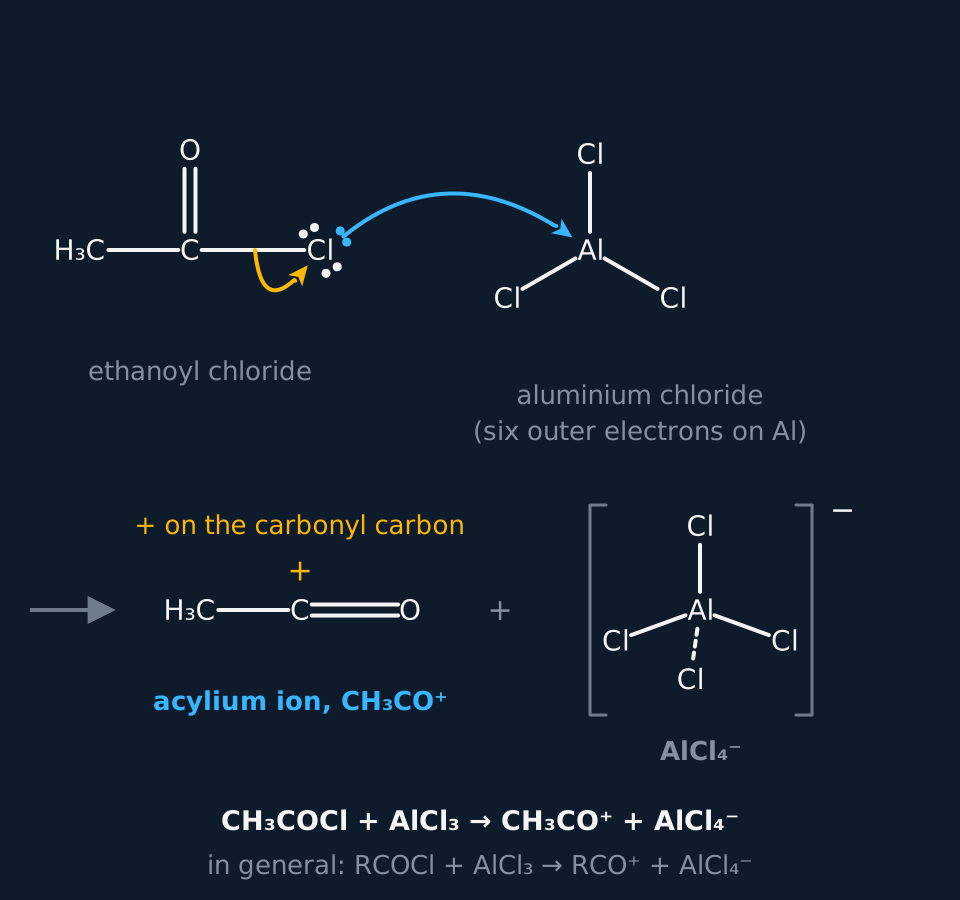
Describe the drawing
Ethanoyl chloride, CH₃–C(=O)–Cl with three lone pairs on chlorine, sits beside trigonal planar aluminium chloride, whose aluminium has only six outer electrons. A cyan curly arrow runs from a lone pair on the chlorine to the aluminium, and an amber arrow from the middle of the C–Cl bond onto the chlorine. The products are the acylium ion, CH₃–C=O with the positive charge on the carbonyl carbon, and the AlCl₄⁻ ion in square brackets. Beneath are the equation CH₃COCl + AlCl₃ → CH₃CO⁺ + AlCl₄⁻ and its general form for any acyl chloride.
From here the mechanism is the nitration mechanism with a different electrophile. The first arrow starts on the delocalised ring and ends on the positive carbon of CH₃CO⁺. The intermediate is a horseshoe across five carbons with a + inside, the sixth carbon bearing H and COCH₃. The second arrow runs from the C–H bond back into the ring, and H⁺ leaves.
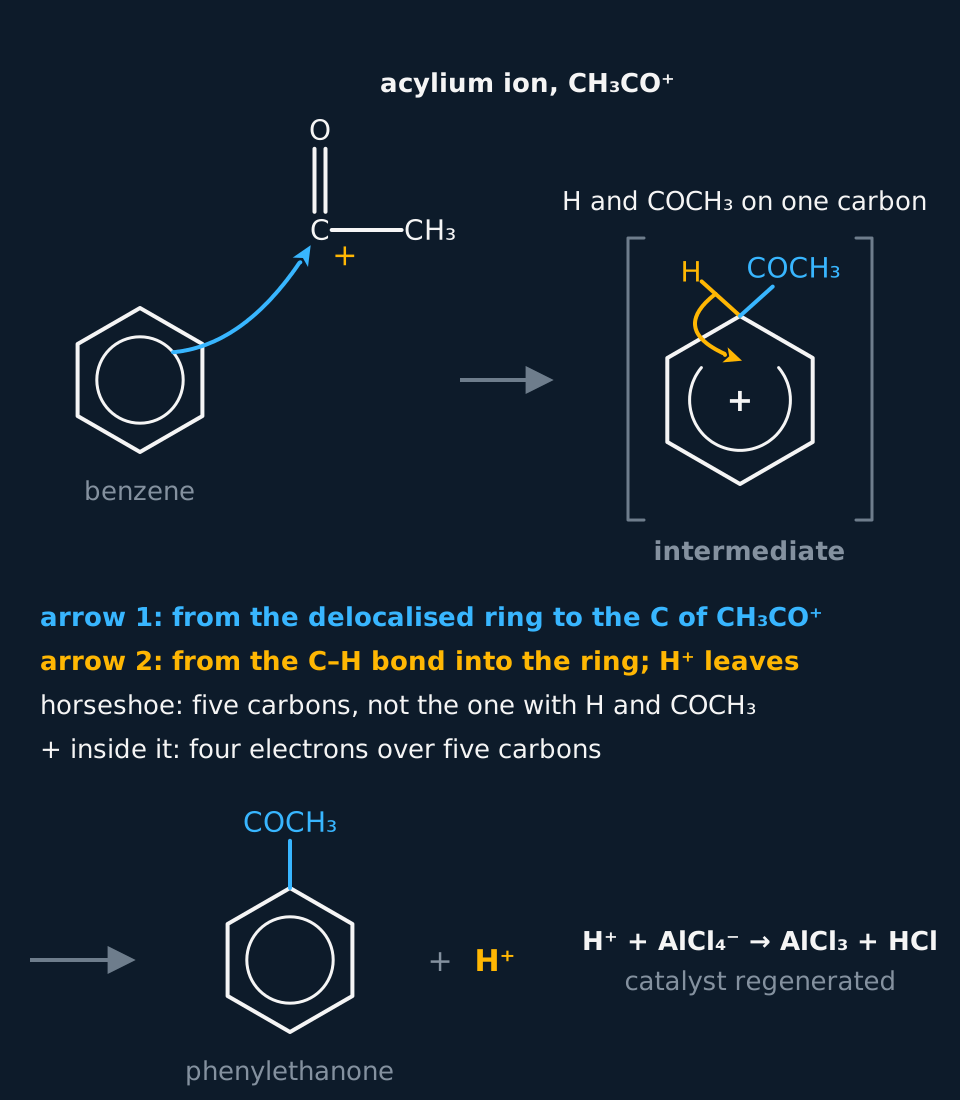
Describe the drawing
The AQA mechanism for the Friedel–Crafts acylation of benzene, laid out as the nitration mechanism is. Benzene is a hexagon with a circle and the acylium ion CH₃–C=O, positive on the carbonyl carbon, sits to its upper right; a cyan curly arrow leaves the circle and ends on that carbon. In square brackets the intermediate has H and COCH₃ on its top carbon and a horseshoe over the other five carbons with a plus sign inside; an amber curly arrow runs from the middle of the C–H bond into the gap of the horseshoe. The products are phenylethanone and H⁺, and beneath, H⁺ and AlCl₄⁻ give aluminium chloride and hydrogen chloride, regenerating the catalyst.
H⁺ + AlCl₄⁻ → AlCl₃(s) + HCl(g)The hydrogen ion from the ring takes a chloride back, and the aluminium chloride catalyst is regenerated.
The aluminium chloride must be dry. Water hydrolyses it, with steamy fumes of hydrogen chloride, and the hydrated compound no longer has an empty orbital to accept a lone pair.
Acylation stops after one acyl group goes on. The C=O group draws electron density out of the ring, so phenylethanone is less attractive to a second acylium ion than benzene was. That makes acylation easy to control: one mole of acyl chloride for each mole of benzene gives one product.
Acylation is the way to join a carbon chain to a benzene ring, and the C=O group in the product is a starting point for further steps. Sodium tetrahydridoborate(III), NaBH₄, reduces phenylethanone to 1-phenylethanol, and dehydrating that alcohol gives phenylethene, the monomer of poly(phenylethene), which is polystyrene.
Acylating benzene with propanoyl chloride
Benzene is heated under reflux with propanoyl chloride, CH₃CH₂COCl, and aluminium chloride. Give the equation for the formation of the electrophile, describe the mechanism, and name the organic product.
Show the working
Electrophile: CH₃CH₂COCl + AlCl₃ → CH₃CH₂CO⁺ + AlCl₄⁻. The positive charge is on the carbonyl carbon.
Arrow 1 runs from the delocalised ring to the carbonyl carbon of CH₃CH₂CO⁺. The intermediate has H and COCH₂CH₃ on one carbon and a horseshoe with + across the other five. Arrow 2 runs from the C–H bond into the ring and H⁺ leaves.
H⁺ + AlCl₄⁻ → AlCl₃ + HCl regenerates the catalyst.
The product is C₆H₅COCH₂CH₃, 1-phenylpropan-1-one: a three-carbon chain on the ring, with the ring on carbon 1, the carbonyl carbon.
TRY IT: The yield of a nitration
7.80 g of benzene is nitrated and 9.84 g of nitrobenzene is collected. Calculate the percentage yield. Mr: C₆H₆ 78.0, C₆H₅NO₂ 123.0.
Check your answer
Amount of benzene = 7.80 ÷ 78.0 = 0.100 mol. The equation is 1 : 1, so the maximum is 0.100 mol of nitrobenzene, 0.100 × 123.0 = 12.3 g.
Percentage yield = 9.84 ÷ 12.3 × 100 = 80.0%.
- Acylium ion
- The electrophile in Friedel–Crafts acylation, RCO⁺, with the positive charge on the carbonyl carbon.
- Halogen carrier
- A compound such as AlCl₃ that accepts a lone pair from a halogen atom and so generates a positive electrophile.
- Friedel–Crafts acylation
- The electrophilic substitution of an acyl group, RCO, onto a benzene ring, using an acyl chloride and an aluminium chloride catalyst, giving a ketone.
Other boards: halogenation, alkylation and activated rings
OCR, Edexcel and Cambridge examine two more reactions that use a halogen carrier; AQA does not. Both follow the acylation pattern: the carrier takes a halide ion off a molecule and leaves a positive electrophile, and the ring reacts with it by the two-step mechanism of nitration.
In halogenation, benzene and bromine react at room temperature once iron(III) bromide or aluminium bromide is added. Iron filings do the same job, because the iron reacts with some of the bromine to make iron(III) bromide in the flask. The carrier accepts a lone pair from one bromine atom, which polarises the Br–Br bond until it breaks heterolytically and leaves Br⁺. Chlorine with aluminium chloride or iron(III) chloride gives chlorobenzene by the matching steps.
Br₂(l) + FeBr₃(s) → Br⁺ + FeBr₄⁻The electrophile. Some books draw the polarised complex Brδ+–Brδ−–FeBr₃ instead of a free Br⁺; the arrow from the ring ends on the δ+ bromine either way.
The first arrow runs from the delocalised ring to Br⁺, the intermediate carries H and Br on one carbon with the horseshoe over the other five, and the second arrow runs from the C–H bond back into the ring. The H⁺ that leaves takes a bromide ion from FeBr₄⁻.
H⁺ + FeBr₄⁻ → FeBr₃(s) + HBr(g)The carrier is regenerated and hydrogen bromide is given off.
In Friedel–Crafts alkylation, a halogenoalkane takes the place of the acyl chloride, and aluminium chloride gives a carbocation. Chloroethane gives CH₃CH₂⁺, which the ring attacks, and the product is ethylbenzene. Alkylation is how a carbon chain with no C=O group is joined to a ring, and ethylbenzene made this way is the starting material for phenylethene.
CH₃CH₂Cl(g) + AlCl₃(s) → CH₃CH₂⁺ + AlCl₄⁻The electrophile in alkylation is a carbocation.
C₆H₆(l) + CH₃CH₂Cl(g) → C₆H₅CH₂CH₃(l) + HCl(g)The overall equation, with AlCl₃ as the catalyst.
Alkylation is harder to control than acylation. An alkyl group releases electron density into the ring, so ethylbenzene reacts faster than benzene did, and some of it is alkylated again to give diethylbenzenes. Benzene is used in large excess to keep the monosubstituted product the main one. An acyl group draws electron density out of the ring, so acylation stops after one group.
- Friedel–Crafts alkylation
- The electrophilic substitution of an alkyl group onto a benzene ring, using a halogenoalkane and an aluminium chloride catalyst.
A group already on the ring changes how fast the ring reacts and where the next group goes. Groups that release electron density into the ring, OH, NH₂ and alkyl groups, make it react faster than benzene and send the electrophile to the carbons at positions 2, 4 and 6 relative to themselves. Groups that draw electron density out, NO₂, COOH and COR, make it react more slowly and send the electrophile to position 3. OCR and Cambridge examine these directing effects.
| Group on the ring | Rate compared with benzene | Where the next group goes |
|---|---|---|
| OH, NH₂ | much faster | 2, 4 and 6 |
| CH₃ and other alkyl groups | faster | 2, 4 and 6 |
| NO₂, COOH, COCH₃ | slower | 3 |
The rules explain two nitration products. A second nitration of nitrobenzene needs a higher temperature and gives 1,3-dinitrobenzene, because NO₂ deactivates the ring and directs to position 3. TNT has its three nitro groups at carbons 2, 4 and 6 around the methyl group, the positions a methyl group directs to.
Phenol shows the activating effect most clearly. One lone pair on phenol's oxygen is partly delocalised into the ring, so the ring holds more electron density than benzene's, enough to polarise a bromine molecule without a halogen carrier. Bromine water added to aqueous phenol is decolourised at once at room temperature, and a white precipitate of 2,4,6-tribromophenol forms. Benzene needs pure bromine and a halogen carrier, and takes one bromine atom, not three.
C₆H₅OH(aq) + 3Br₂(aq) → C₆H₂Br₃OH(s) + 3HBr(aq)The white precipitate is 2,4,6-tribromophenol, which smells of antiseptic.
Phenol is nitrated by dilute nitric acid at room temperature, with no sulfuric acid, giving a mixture of 2-nitrophenol and 4-nitrophenol; benzene needs the concentrated nitrating mixture at 50 °C. Phenylamine's ring is activated by the lone pair on its nitrogen, and with bromine water it gives a white precipitate of 2,4,6-tribromophenylamine. All three boards compare phenol's bromination with benzene's; OCR and Cambridge set its nitration as well, and Cambridge adds phenylamine.
Cambridge also asks what happens to an alkyl group on the ring. Methylbenzene and chlorine with aluminium chloride give substitution on the ring, at carbons 2 and 4. With chlorine in ultraviolet light and no carrier, the methyl group reacts instead, by free-radical substitution as an alkane does, giving (chloromethyl)benzene, C₆H₅CH₂Cl.
Heated under reflux with alkaline potassium manganate(VII), then acidified, an alkyl side chain is oxidised down to the carbon joined to the ring, which becomes COOH. Methylbenzene and ethylbenzene both give benzoic acid. The ring itself is not oxidised.
TRY IT: Predicting where the group goes
Name the main organic products of: nitrobenzene with bromine and iron(III) bromide; methylbenzene with one mole of the nitrating mixture; phenol with excess bromine water.
Check your answer
NO₂ directs to position 3, so the product is 1-bromo-3-nitrobenzene, formed more slowly than bromobenzene.
CH₃ directs to positions 2 and 4, so the products are 1-methyl-2-nitrobenzene and 1-methyl-4-nitrobenzene.
OH activates positions 2, 4 and 6 so strongly that all three are substituted with no carrier: 2,4,6-tribromophenol.
- Activating group
- A group that releases electron density into a benzene ring, so that the ring reacts with electrophiles faster than benzene; OH, NH₂ and alkyl groups direct to positions 2, 4 and 6.
- Deactivating group
- A group that withdraws electron density from a benzene ring, so that the ring reacts with electrophiles more slowly than benzene; NO₂, COOH and COR direct to position 3.
In the exam
- The scheme awards three marks for the mechanism itself: the arrow from inside the hexagon to the electrophile, the intermediate, and the arrow from the C–H bond back into the ring. A fourth is for the equation making the electrophile when the question asks for it.
- The intermediate mark is lost if the horseshoe runs over the carbon that carries H and NO₂, if the + is missing, or if either H or NO₂ is left off that carbon.
- Conditions for nitration need 'concentrated' for both acids and a temperature of about 50 °C. 'Heat' alone does not earn the temperature mark, and dilute nitric acid is rejected.
- Sulfuric acid is credited as a catalyst only with the evidence: the equation H⁺ + HSO₄⁻ → H₂SO₄ that shows it re-formed. Aluminium chloride is a catalyst and a halogen carrier, with H⁺ + AlCl₄⁻ → AlCl₃ + HCl.
- An arrow from the ring to an oxygen of NO₂⁺, or to the oxygen of RCO⁺, does not score: the electrophilic atom is the one with the positive charge.
Check yourself
Explain why benzene reacts with NO₂⁺ by substitution, and describe the intermediate in the mechanism, saying why the horseshoe does not cover all six carbon atoms.
Answer
Addition would leave a product with no delocalised ring, losing the stability that delocalisation gives, so instead an H⁺ is lost and the ring is restored.
In the intermediate the carbon attacked by NO₂⁺ carries both H and NO₂ and has four single bonds, so its p orbital is no longer part of the delocalised system.
The remaining four delocalised electrons are spread over the other five carbons, drawn as a horseshoe open at the attacked carbon, with the positive charge inside it.
Questions
Question 16 marks
Draw the mechanism for the nitration of benzene, including an equation for the formation of the electrophile, and explain why the reaction is a substitution and not an addition.
Mark scheme
Indicative content
- an equation forming NO₂⁺: HNO₃ + 2H₂SO₄ → NO₂⁺ + H₃O⁺ + 2HSO₄⁻; accept HNO₃ + H₂SO₄ → NO₂⁺ + HSO₄⁻ + H₂O or the two steps
- a curly arrow that starts inside the hexagon, on the delocalised electrons, and ends on the nitrogen atom of NO₂⁺; reject an arrow to an oxygen
- the intermediate drawn with H and NO₂ on the same carbon, and a horseshoe with + inside it over the other five carbons only
- a curly arrow from the middle of the C–H bond on that carbon back into the ring, with H⁺ shown leaving and nitrobenzene formed
- H⁺ + HSO₄⁻ → H₂SO₄, showing that the sulfuric acid is regenerated and acts as a catalyst
- losing H⁺ restores the delocalised ring and keeps its stability, which an addition product with no delocalised ring would lose
Levels
- Level 3 (5–6 marks) the equation for NO₂⁺ formation, every curly arrow and the intermediate with its horseshoe and charge are correct, the sulfuric acid is shown to be regenerated, and the loss of H⁺ is explained as restoring the delocalised ring's stability
- Level 2 (3–4 marks) the electrophile is formed correctly, with the arrow into the ring and the intermediate drawn; the arrow from the C–H bond back into the ring, the regenerated catalyst, or the stability argument for substitution is absent
- Level 1 (1–2 marks) NO₂⁺ is named or one arrow drawn; the intermediate commonly keeps a full circle, or nitric acid itself is shown attacking the ring
Question 24 marks
Explain, with equations, how the nitronium ion forms in the nitrating mixture, and why concentrated sulfuric acid is described as a catalyst.
Mark scheme
- B1 HNO₃ + H₂SO₄ → H₂NO₃⁺ + HSO₄⁻, sulfuric acid protonating nitric acid
- B1 H₂NO₃⁺ → NO₂⁺ + H₂O; accept the single equation HNO₃ + 2H₂SO₄ → NO₂⁺ + H₃O⁺ + 2HSO₄⁻ for both marks
- B1 the H⁺ lost from the ring at the end of the mechanism combines with HSO₄⁻
- B1 H⁺ + HSO₄⁻ → H₂SO₄, so the sulfuric acid is regenerated and not used up overall
Question 34 marks
Identify the electrophile and the role of the aluminium chloride when a student heats benzene under reflux with ethanoyl chloride and anhydrous aluminium chloride, and give the equations that show the electrophile forming and the catalyst re-forming.
Mark scheme
- B1 the electrophile is the acylium ion, CH₃CO⁺, with the positive charge on the carbonyl carbon
- B1 aluminium chloride is a catalyst acting as a halogen carrier, accepting a lone pair from chlorine
- B1 CH₃COCl + AlCl₃ → CH₃CO⁺ + AlCl₄⁻
- B1 H⁺ + AlCl₄⁻ → AlCl₃ + HCl, re-forming the catalyst and giving off hydrogen chloride
All 19 questions with mark schemes, the other 16 set out in full on the question page.
Worth remembering
- An arrow that starts on one carbon, or on a Kekulé double bond, does not show the delocalised electrons moving.
- 'Heat' or dilute nitric acid loses the conditions mark: both acids concentrated, about 50 °C, and above 55 °C a second nitro group goes on.
- The horseshoe covers five carbons, not six, with + inside and both H and the new group on the sixth.
- The arrow from the ring ends on the positive atom: N of NO₂⁺, the carbonyl C of RCO⁺.
- A catalyst must be shown coming back: H⁺ + HSO₄⁻, or H⁺ + AlCl₄⁻.
CHECK YOUR PROGRESS
Rate how confident you are with each objective for this lesson. Ratings are saved in this browser, on this device, unless you sign in.
- Explain why benzene reacts with electrophiles by substitution and not by addition.
- State the reagents and conditions for the nitration of benzene, and write equations for the formation of the nitronium ion.
- Outline the mechanism of nitration with curly arrows, drawing the intermediate correctly, and show how the catalyst is regenerated.
- State the reagents and conditions for Friedel–Crafts acylation, write the equation for the formation of the acylium ion, and outline the mechanism.
- Describe why nitration and acylation are important in making explosives, dyes and new carbon–carbon bonds.
- Explain why phenol substitutes more readily than benzene, and predict where a group already on the ring sends the next one.CAIE · OCR A
Open the full revision checklist to see every objective in the curriculum in one place.
Practise this lesson
WORKBOOK
The written questions from this topic, on paper with room to work, and a separate book of mark schemes. The question that is set on a diagram stays on this page, where the diagram can be drawn. Free to use; please do not redistribute or sell.
Used later in Planning a synthetic route