Chemistry › Organic synthesis › Planning a synthetic route
Planning a synthetic route
Every reaction in the organic course turns one functional group into another. Planning a synthesis is choosing two to four of those reactions, in order, to get from a cheap starting material to a target, with the reagents and conditions for each step, and then choosing between routes on yield, atom economy, hazard and the purity of what comes out.
Key terms Every definition in organic synthesis, lesson by lesson
Before this Halogenoalkanes: nucleophilic substitution and rates of hydrolysis – hydroxide, cyanide and ammonia as nucleophiles · Oxidation and elimination of alcohols – what acidified dichromate does to primary and secondary alcohols · Aldehydes and ketones: nucleophilic addition and the tests that tell them apart – reduction with NaBH₄ and addition of cyanide · Electrophilic substitution: nitration and Friedel–Crafts acylation – the first step from benzene · Amines: preparation, basicity and nucleophilic reactions – the two routes to a primary amine
COMMON MISCONCEPTION
A synthesis question is a memory test: either the route was in my notes or I have no way in.
A route is built from known reactions by working backwards. Ask which reaction makes the target's functional group; that names the compound one step before, and the question repeats until a starting material appears. Count carbons too: if the target has one more, a nitrile from KCN and a halogenoalkane is the usual way in.
What you should be able to do
- State the reagents and conditions for each conversion between functional groups in the aliphatic and aromatic reactions of the course.
- Devise a synthesis of two to four steps from a starting material to a target, naming every intermediate.
- Identify when a route must add a carbon to the chain, and use a nitrile to do it.
- Calculate the overall yield of a route with several steps and the atom economy of a step.
- Evaluate two routes to the same product on yield, atom economy, hazard and the purity of the product.
- Use a Grignard reagent to add a carbon: a carboxylic acid from carbon dioxide, or an alcohol from an aldehyde or ketone.Edexcel
Reagents, conditions and products
A chemist asked to make a new compound almost never has a bottle of it, or of anything one step away from it. What is on the shelf is cheap and made by the tonne: ethene from a cracker, benzene from crude oil, ethanol from fermentation. Between the shelf and the target lies a short series of reactions, each one turning one functional group into another, and each one already met somewhere in the course. Planning a synthesis is choosing those reactions and putting them in order.
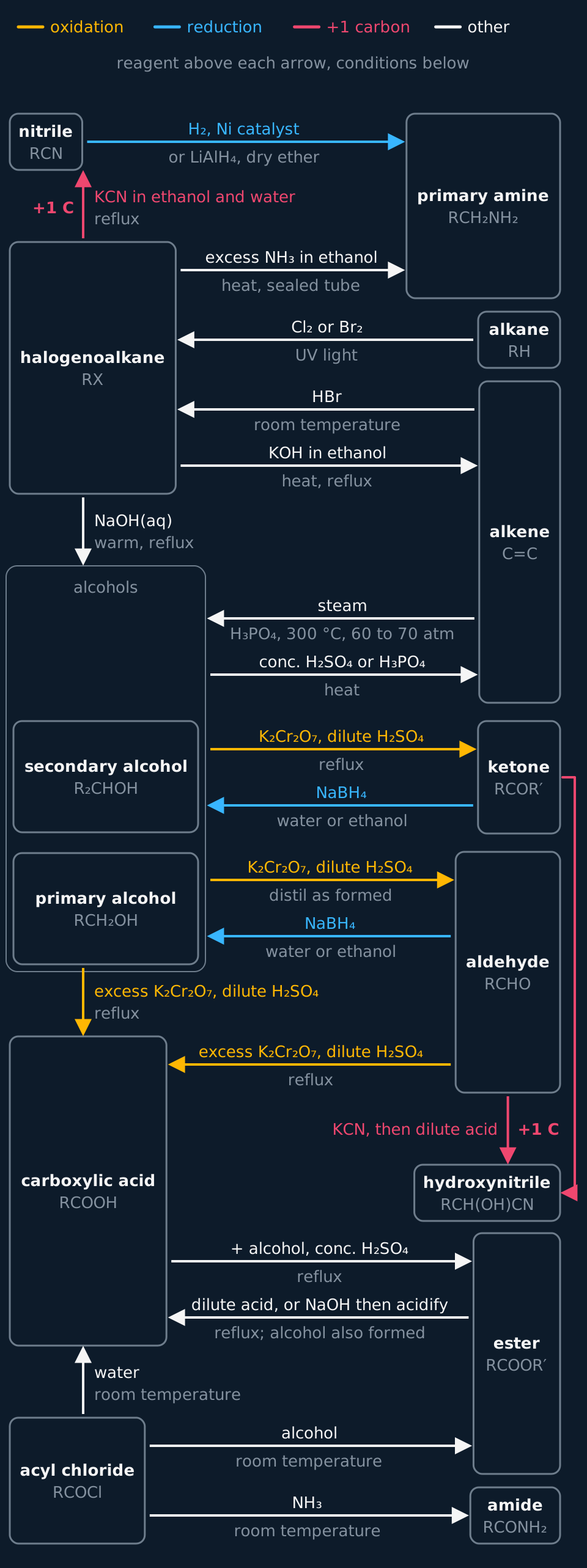
The reactions are easiest to hold as a map, with each functional group a box and each reaction an arrow between two boxes, labelled with what makes the change happen.
Describe the drawing
A reaction map of the aliphatic functional groups drawn as two columns of boxes joined by labelled arrows, each with its reagent above and its conditions below. Halogenoalkane on the left links up to nitrile and primary amine, across to alkane and alkene, and down to the alcohols. The primary and secondary alcohols, framed together, are oxidised by acidified dichromate to aldehyde, ketone and carboxylic acid in amber arrows and regained by NaBH₄ in cyan arrows. Coral arrows tagged plus one carbon run from halogenoalkane to nitrile and from aldehyde and ketone to hydroxynitrile. At the bottom the carboxylic acid forms an ester and the acyl chloride gives the acid, the ester and the amide at room temperature.
Every step carries three pieces of information, and a route answer needs all three for every step. The reagent is the substance added: aqueous sodium hydroxide, potassium cyanide, acidified potassium dichromate(VI). The conditions are what else the reaction needs to go the right way: heating under reflux, a solvent such as ethanol, a catalyst, a temperature. The product is the compound the step makes, given by name or by structure.
Conditions matter because the same reagent can give two products. Warmed with 2-bromopropane, aqueous potassium hydroxide substitutes the bromine to give propan-2-ol; dissolved in ethanol and heated, it eliminates HBr to give propene. Acidified dichromate oxidises propan-1-ol to propanal if the aldehyde is distilled off as it forms, and on to propanoic acid if the mixture is heated under reflux with the oxidising agent in excess. Write aqueous or ethanolic, distil or reflux every time, because a scheme gives the mark for that word.
Reagents and conditions table
Every conversion in the aliphatic course, with the reagent and the conditions a scheme credits for it.
| From | To | Reagents and conditions | Type of reaction |
|---|---|---|---|
| Alkane | Halogenoalkane | Cl₂ or Br₂, ultraviolet light | Free-radical substitution |
| Alkene | Halogenoalkane | HBr (or HCl), room temperature | Electrophilic addition |
| Alkene | Alcohol | Steam, H₃PO₄ catalyst, 300 °C, 60 to 70 atm | Electrophilic addition (hydration) |
| Halogenoalkane | Alcohol | NaOH(aq) or KOH(aq), warm under reflux | Nucleophilic substitution |
| Halogenoalkane | Nitrile (one more carbon) | KCN in ethanol and water, heat under reflux | Nucleophilic substitution |
| Halogenoalkane | Primary amine | Excess NH₃ in ethanol, heat in a sealed tube | Nucleophilic substitution |
| Halogenoalkane | Alkene | KOH in ethanol, heat under reflux | Elimination |
| Alcohol | Alkene | Concentrated H₂SO₄ or H₃PO₄, heat | Elimination (dehydration) |
| Primary alcohol | Aldehyde | K₂Cr₂O₇ and dilute H₂SO₄, warm, distil off the aldehyde as it forms | Oxidation |
| Primary alcohol or aldehyde | Carboxylic acid | Excess K₂Cr₂O₇ and dilute H₂SO₄, heat under reflux | Oxidation |
| Secondary alcohol | Ketone | K₂Cr₂O₇ and dilute H₂SO₄, heat under reflux | Oxidation |
| Aldehyde or ketone | Alcohol | NaBH₄ in water or ethanol, room temperature | Reduction (nucleophilic addition) |
| Aldehyde or ketone | Hydroxynitrile (one more carbon) | KCN, then dilute acid | Nucleophilic addition |
| Nitrile | Primary amine | H₂ with a nickel catalyst, or LiAlH₄ in dry ether | Reduction |
| Carboxylic acid and alcohol | Ester | Concentrated H₂SO₄ catalyst, heat under reflux | Esterification |
| Ester | Carboxylic acid (or its salt) and alcohol | Dilute acid, heat under reflux; or NaOH(aq), heat under reflux, giving the salt, then acidify | Hydrolysis |
| Acyl chloride or acid anhydride | Acid, ester, amide or N-substituted amide | Water, an alcohol, NH₃ or a primary amine; room temperature for an acyl chloride, warm for an anhydride | Nucleophilic addition–elimination |
Those seventeen conversions are the whole aliphatic course, and a route needs no others. Alkenes and halogenoalkanes are the usual ways in from the hydrocarbons, and a halogenoalkane is the most useful intermediate of all: hydroxide, cyanide and ammonia turn it into an alcohol, a nitrile and an amine, and hot ethanolic hydroxide turns it into an alkene.
- Synthetic route
- A sequence of reactions that converts a starting material into a target compound, with the reagents and conditions for each step.
- Reagent
- The substance added to bring about a reaction, named in full or by a correct formula.
- Conditions
- The temperature, solvent, catalyst and method of heating a reaction needs to give the intended product.
- Intermediate
- A compound made in one step of a synthesis and used as the starting material for the next.
Reactions from benzene
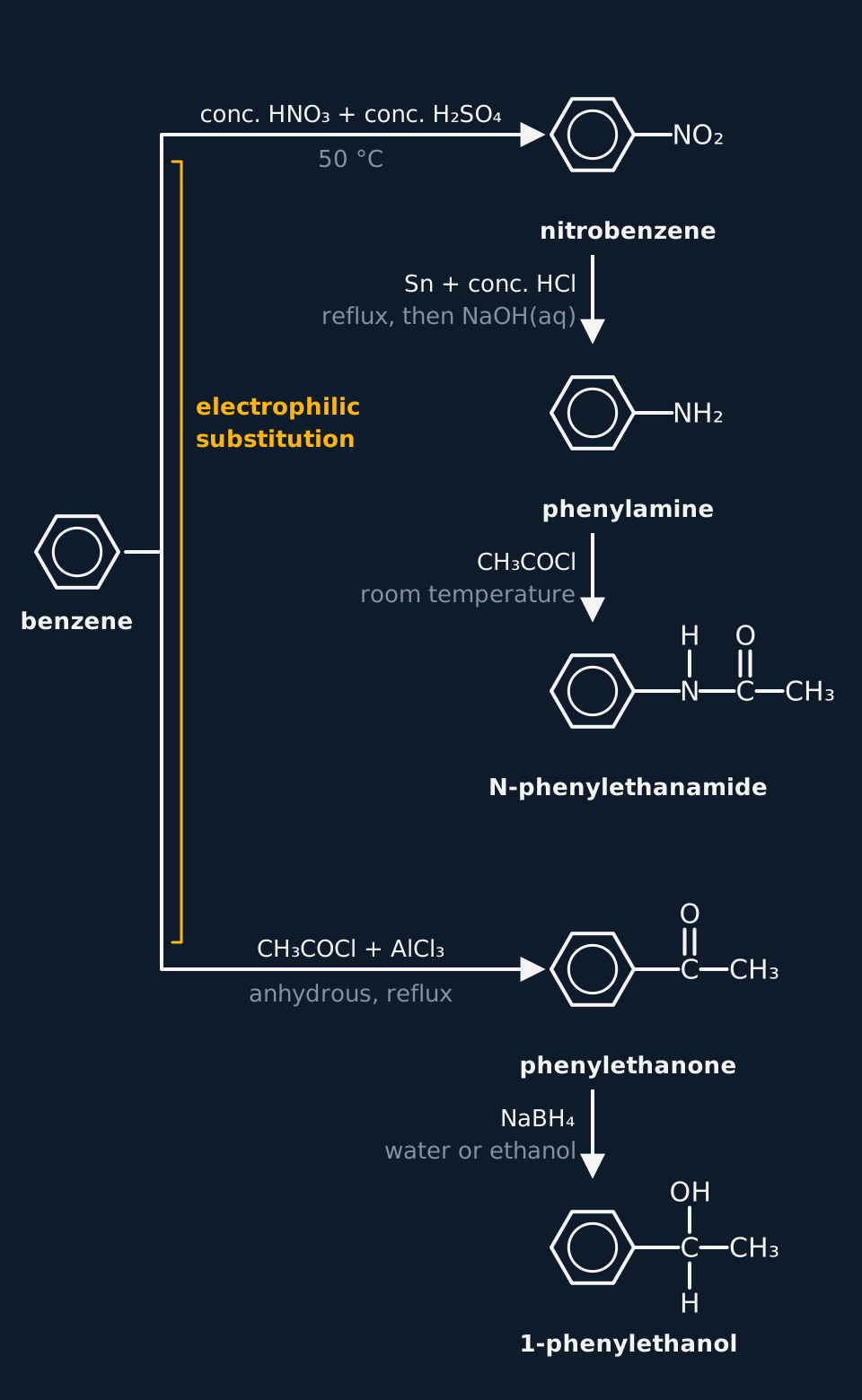
Benzene has fewer reactions, and they all start in the same way. Its delocalised ring does not undergo addition under ordinary conditions, so the first step from benzene is always an electrophilic substitution: a hydrogen on the ring is swapped for a nitro group or an acyl group. What follows is ordinary chemistry of the group that has been attached.
Nitration uses concentrated nitric acid with concentrated sulfuric acid at about 50 °C; above 55 °C a second nitro group starts to go on. Tin and concentrated hydrochloric acid then reduce the nitro group to an amine. In the acid the product is the phenylammonium ion, so excess sodium hydroxide is added afterwards to release phenylamine itself. Phenylamine is the start of the azo dyes, and with ethanoyl chloride it gives N-phenylethanamide.
Friedel–Crafts acylation is the only reaction in the course that puts carbon on a ring. An acyl chloride with an aluminium chloride catalyst, heated under reflux with no water present, puts an acyl group on the ring and gives a phenyl ketone: ethanoyl chloride gives phenylethanone, C₆H₅COCH₃. From there the ketone behaves like any other ketone, and sodium tetrahydridoborate reduces it to the secondary alcohol 1-phenylethanol.
Describe the drawing
A reaction map starting from benzene, drawn as a hexagon with a circle on the left, with two arrows leaving it, bracketed together as electrophilic substitution. The upper arrow, concentrated nitric and sulfuric acids at 50 °C, gives nitrobenzene; tin and concentrated hydrochloric acid under reflux, then sodium hydroxide, reduce it to phenylamine; ethanoyl chloride at room temperature turns that into N-phenylethanamide, with its C=O drawn. The lower arrow, ethanoyl chloride with aluminium chloride, anhydrous under reflux, gives phenylethanone, which NaBH₄ in water or ethanol reduces to 1-phenylethanol.
| From | To | Reagents and conditions |
|---|---|---|
| Benzene | Nitrobenzene | Concentrated HNO₃ and concentrated H₂SO₄, 50 °C |
| Nitrobenzene | Phenylamine | Tin and concentrated HCl, heat under reflux, then excess NaOH(aq) |
| Phenylamine | N-phenylethanamide | Ethanoyl chloride at room temperature, or ethanoic anhydride, warm |
| Benzene | Phenyl ketone | Acyl chloride with AlCl₃ catalyst, anhydrous, heat under reflux |
| Phenyl ketone | Secondary alcohol | NaBH₄ in water or ethanol, room temperature |
C₆H₆(l) + HNO₃(l) → C₆H₅NO₂(l) + H₂O(l)Nitration, with concentrated H₂SO₄ as the catalyst that generates the NO₂⁺ electrophile.
C₆H₅NO₂(l) + 6[H] → C₆H₅NH₂(l) + 2H₂O(l)Reduction, with [H] standing for the reducing agent, tin and concentrated hydrochloric acid.
Designing a route
A route starts from a comparison of the starting material with the target on two counts. The first is the carbon skeleton: count the carbons, and note whether the chain is straight or branched and whether there is a ring. The second is the functional groups: which one the starting material has, which one the target needs, and on which carbon each sits. If the skeleton is the same, the route only moves and changes functional groups. If the target has one more carbon, one step must make a carbon–carbon bond.
Then work backwards from the target. Ask what it could be made from in a single step, then what that could be made from, until the chain of answers reaches the starting material. A primary amine comes from a nitrile or a halogenoalkane. A carboxylic acid comes from a primary alcohol or an aldehyde. An ester comes from an acid and an alcohol, or from an acyl chloride and an alcohol. Two to four steps is the length of an A-level route, so the search never has to go far.
Only two reactions in the course add a carbon to a chain, and both use cyanide: substitution of a halogenoalkane gives a nitrile, and addition to an aldehyde or ketone, followed by dilute acid, gives a hydroxynitrile. Friedel–Crafts acylation adds carbon to a ring. Nothing in a planned route shortens a chain: cracking gives a mixture, and hydrolysis only splits an ester or amide back into the halves it was made from.
Ethene to propylamine
Devise a three-step synthesis of propylamine, CH₃CH₂CH₂NH₂, from ethene. Give the reagents and conditions for each step and name each intermediate.
Show the working
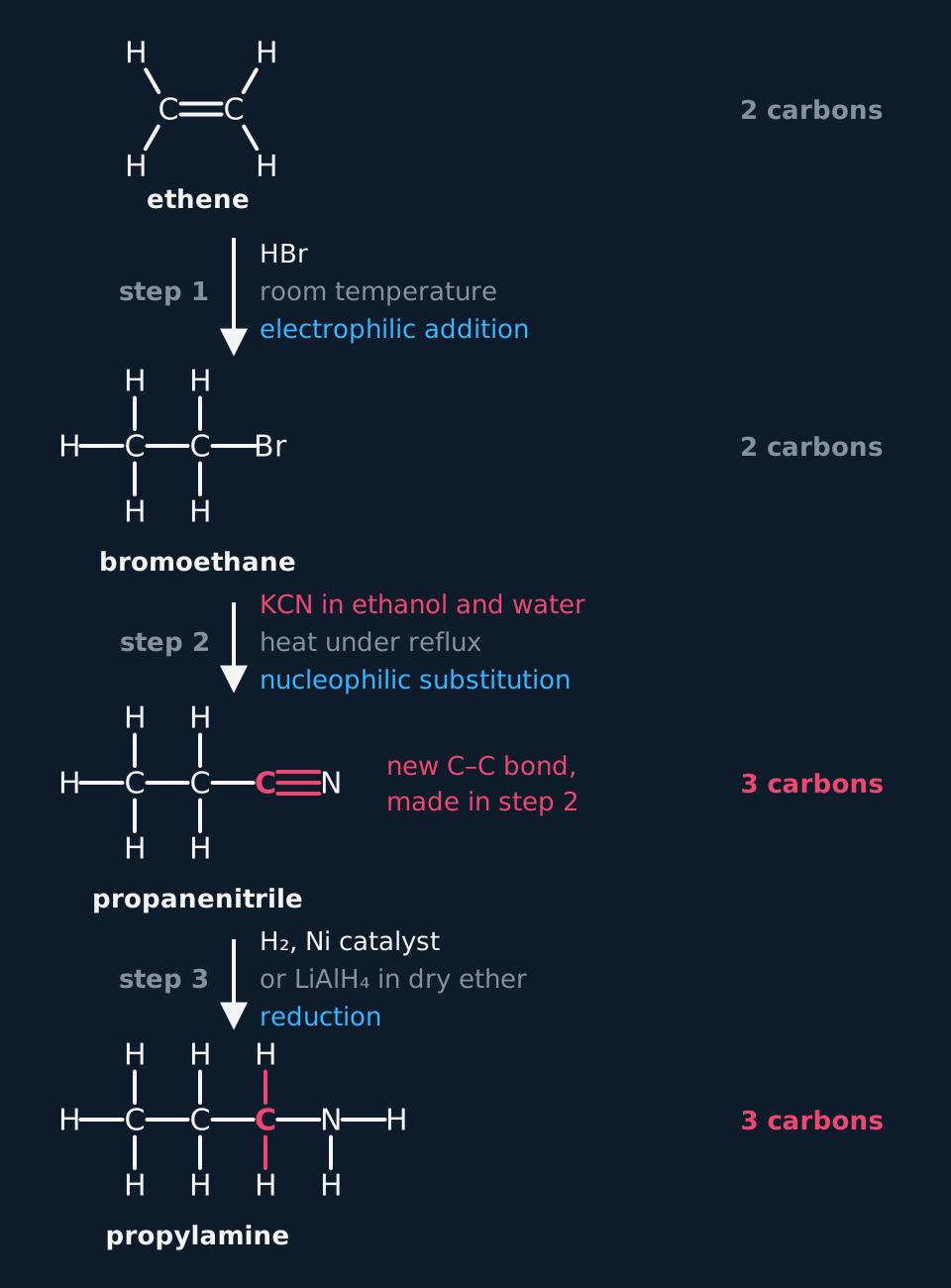
Compare the skeletons. Ethene has two carbons and propylamine three, in a straight chain, so one step must add a carbon by substitution with cyanide, through the nitrile with three carbons, propanenitrile, CH₃CH₂CN.
Work backwards. Propylamine is made by reducing propanenitrile. Propanenitrile is made from bromoethane and cyanide. Bromoethane is made from ethene by adding HBr. That is three steps.
Step 1: ethene with hydrogen bromide at room temperature. Electrophilic addition gives bromoethane, CH₃CH₂Br.
Step 2: bromoethane with potassium cyanide dissolved in ethanol and water, heated under reflux. Nucleophilic substitution gives propanenitrile, CH₃CH₂CN.
Step 3: propanenitrile with hydrogen and a nickel catalyst, or with LiAlH₄ in dry ether. Reduction turns the C≡N into CH₂NH₂ and gives propylamine, also named propan-1-amine.
The route is ethene → bromoethane → propanenitrile → propylamine, and the carbon of the cyanide ion becomes the CH₂ next to the nitrogen.
CH₂=CH₂(g) + HBr(g) → CH₃CH₂Br(l)Step 1, electrophilic addition.
CH₃CH₂Br(l) + CN⁻(aq) → CH₃CH₂CN(l) + Br⁻(aq)Step 2, nucleophilic substitution. The new C–C bond forms here.
CH₃CH₂CN(l) + 2H₂(g) → CH₃CH₂CH₂NH₂(l)Step 3, reduction over a nickel catalyst.
Describe the drawing
A flow chart from top to bottom of four displayed formulae joined by three arrows: ethene, bromoethane, propanenitrile and propylamine, with carbon counts 2, 2, 3 and 3. Step 1, HBr at room temperature, electrophilic addition. Step 2, KCN in ethanol and water heated under reflux, nucleophilic substitution. Step 3, hydrogen with a nickel catalyst or LiAlH₄ in dry ether, reduction. The carbon that arrives with the cyanide is drawn in red in the nitrile and again in propylamine, where it is the CH₂ bonded to nitrogen.
Ethene to ethyl ethanoate, with one source of carbon
Devise a synthesis of ethyl ethanoate, CH₃COOCH₂CH₃, in which ethene is the only organic starting material. Give the reagents and conditions for each step and name each intermediate.
Show the working
Compare the skeletons. The target has four carbons and ethene two, yet no carbon needs adding. Cutting the ester at its C(=O)–O link gives two pieces of two carbons: CH₃CO from ethanoic acid and OCH₂CH₃ from ethanol.
Work backwards along each piece. Ethanol comes from ethene, and ethanoic acid from ethanol, so ethanol is made first and part of it is oxidised.
Step 1: ethene with steam over a phosphoric acid catalyst at 300 °C and 60 to 70 atm gives ethanol.
Step 2: part of the ethanol heated under reflux with excess acidified potassium dichromate(VI) gives ethanoic acid. Distilling as it forms would stop at ethanal.
Step 3: the ethanoic acid heated under reflux with the rest of the ethanol and a concentrated sulfuric acid catalyst gives ethyl ethanoate.
The route branches and joins again, and its last step is an equilibrium that caps the yield. Ethanoyl chloride would react with ethanol completely, but none of the reactions in the course makes an acyl chloride from an acid.
CH₃CH₂OH(l) + 2[O] → CH₃COOH(l) + H₂O(l)Step 2, with [O] standing for the oxidising agent, acidified potassium dichromate(VI).
CH₃COOH(l) + CH₃CH₂OH(l) ⇌ CH₃COOCH₂CH₃(l) + H₂O(l)Step 3, catalysed by concentrated H₂SO₄.
TRY IT: Two steps, one carbon added
Suggest a two-step synthesis of 2-hydroxy-2-methylpropanenitrile, (CH₃)₂C(OH)CN, from propan-2-ol. Give the reagents and conditions and name the intermediate.
Check your answer
The target has four carbons and propan-2-ol has three, so one step adds a carbon. The OH and the CN are on the same carbon, which is the pattern of a hydroxynitrile made from a ketone. The ketone with the right skeleton is propanone.
Step 1: propan-2-ol with acidified potassium dichromate(VI), heated under reflux, gives propanone. Step 2: propanone with potassium cyanide followed by dilute acid gives 2-hydroxy-2-methylpropanenitrile.
The carbon carrying the OH and the CN also carries two identical methyl groups, so this product has no chiral centre and the question of a racemic mixture does not arise.
- Retrosynthesis
- Planning a synthesis by working backwards from the target, asking at each stage which compound could give it in a single step.
Choosing between routes
When more than one route leads to the target, the first thing to weigh is the number of steps, because no step gives all the product it could, and the losses multiply. A route with three steps that give 80%, 75% and 60% has an overall yield of 0.80 × 0.75 × 0.60 = 0.36, or 36%. A two-step route at 70% each gives 0.70 × 0.70 = 0.49, or 49%. Fewer steps usually means more product, as well as less time, solvent and waste.
The second is atom economy: how much of the mass of the reactants ends up in the product rather than in a by-product. An addition reaction puts every atom into one product and has an atom economy of 100%. Hydrating ethene with steam makes ethanol at 100%. Making ethanol from bromoethane and sodium hydroxide also produces sodium bromide, so the atom economy is 46.0 ÷ (108.9 + 40.0) × 100 = 30.9%. More than two thirds of the mass bought becomes waste.
The third is hazard. Potassium cyanide is acutely toxic, and with acid it releases hydrogen cyanide gas. LiAlH₄ reacts violently with water. Concentrated acids, bromine and acyl chlorides are corrosive. Where a safer reagent does the same job it is preferred: NaBH₄ reduces aldehydes and ketones and is stable enough to use in water, and ethanoic anhydride replaces ethanoyl chloride in making aspirin because it reacts less violently and gives ethanoic acid rather than hydrogen chloride.
Green chemistry adds a further aim: a process that needs no solvent. A solvent appears nowhere in the equation, so it never lowers the atom economy, yet it is bought, heated, separated from the product and then recovered or thrown away, which costs energy and makes waste. Most organic solvents are flammable and many are toxic. Hydrating ethene needs none, because gases pass over a solid catalyst; the cyanide step needs ethanol and water.
The fourth is whether the route gives one product or a mixture. Propylamine could be made in one step from 1-bromopropane and ammonia, but propylamine has a lone pair on its nitrogen and is itself a nucleophile. It attacks unreacted 1-bromopropane, and the flask ends up holding primary, secondary and tertiary amines and a quaternary ammonium salt. Excess ammonia reduces this but does not stop it. The nitrile route can only give the primary amine.
| 1-Bromopropane with ammonia | Ethene through the nitrile | |
|---|---|---|
| Steps | One | Three |
| Product | Mixture of amines, to be separated | Primary amine only |
| Hazards | Ammonia under pressure in a sealed tube | Toxic KCN; flammable H₂ or violent LiAlH₄ |
| Solvents | Ethanol | Ethanol and water; dry ether if LiAlH₄ is used |
| Starting material | 1-Bromopropane, made from propene | Ethene, made by cracking |
Chirality is the fifth. Adding cyanide to an aldehyde other than methanal creates a chiral centre, and attack on either face of the planar carbonyl is equally likely, so the product is a racemic mixture. If the target is a drug that must be a single enantiomer, the route needs a separation or a chiral catalyst, and both add cost.
- Overall yield
- The yield of a route of several steps, found by multiplying the fractional yields of the individual steps together.
- Atom economy
- The mass of the desired product divided by the total mass of the reactants, multiplied by 100, from the balanced equation.
- Hazard
- A property of a substance or procedure that could cause harm, such as toxicity, flammability or corrosiveness.
- Risk
- The chance that a hazard causes harm as the substance is actually used, which precautions such as a fume cupboard reduce.
- Racemic mixture
- An equimolar mixture of the two enantiomers of a chiral compound, which has no overall effect on plane-polarised light.
How a route question is marked
A question that asks for a synthesis is marked step by step. A scheme for a three-step route typically has a mark for each intermediate and a mark for the reagents and conditions of each step, six in all. An intermediate can be given by name or by a structure, as long as either is unambiguous: propanenitrile or CH₃CH₂CN, not the nitrile. A mechanism is not part of the answer unless the question asks for one.
Reagents have to be named well enough to be the right substance. Dichromate alone is not acidified potassium dichromate(VI); KCN is not HCN; [O] and [H] are shorthand in equations, never reagents. Conditions are wanted wherever they decide the product: aqueous or ethanolic hydroxide, distil or reflux, excess ammonia, 50 °C for nitration, no water for Friedel–Crafts.
| Written in the answer | Credited | Why |
|---|---|---|
| KCN in ethanol and water, heat under reflux | Yes | Names the substance, the solvent and the heating |
| HCN, for bromoethane to propanenitrile | No | A weak acid with almost no free cyanide ions; the wrong reagent |
| KOH, heat, for 2-bromopropane to propene | No | Without ethanol the same reagent substitutes; the solvent decides |
| [O], for propan-2-ol to propanone | No | Shorthand in an equation, not a substance |
| K₂Cr₂O₇ and H₂SO₄, heat under reflux | Yes | Correct formulae name the substances |
| The nitrile, as an intermediate | No | Does not say which nitrile |
A route also has to be chemically possible in the order given. Reducing a ketone and then trying to add cyanide to the alcohol that results fails, because cyanide adds to C=O, not to C–OH. Reading the route forwards, checking that each product is what the next reagent acts on, catches that kind of error.
Other boards: more reactions and Grignard reagents
OCR, Edexcel and Cambridge each add reactions to the course, and a route set on their papers can use them. The one that matters most is the hydrolysis of a nitrile, which all three examine. Heated under reflux with dilute hydrochloric or sulfuric acid, the C≡N becomes COOH and the nitrogen leaves as ammonium ions. After the cyanide step it gives an acid with one more carbon, so bromoethane becomes propanoic acid in two steps.
CH₃CH₂CN(l) + 2H₂O(l) + H⁺(aq) → CH₃CH₂COOH(aq) + NH₄⁺(aq)Acid hydrolysis of propanenitrile, heated under reflux.
The same three boards turn a carboxylic acid into an acyl chloride: with thionyl chloride, SOCl₂, for OCR and Cambridge, and with phosphorus(V) chloride, PCl₅, for Edexcel and Cambridge. Thionyl chloride is the cleaner choice, because both of its by-products are gases that leave the flask. The acyl chloride reacts with an alcohol at room temperature and goes to completion, so ethyl ethanoate made from ethanoyl chloride escapes the equilibrium that caps an esterification.
CH₃COOH(l) + SOCl₂(l) → CH₃COCl(l) + SO₂(g) + HCl(g)Ethanoyl chloride from ethanoic acid with thionyl chloride.
All three also take benzene further, with two more electrophilic substitutions that need a halogen carrier and no water. Bromine with iron(III) bromide gives bromobenzene. A halogenoalkane with aluminium chloride gives an alkylbenzene: this is Friedel–Crafts alkylation, which adds carbon to a ring as acylation does but tends to add a second and third alkyl group, because the alkylbenzene reacts faster than benzene.
| From | To | Reagents and conditions | Boards |
|---|---|---|---|
| Nitrile | Carboxylic acid | Dilute HCl or H₂SO₄, heat under reflux | OCR, Edexcel, Cambridge |
| Carboxylic acid | Acyl chloride | SOCl₂ (OCR, Cambridge), PCl₅ (Edexcel, Cambridge) or PCl₃ (Cambridge), dry, in a fume cupboard | OCR, Edexcel, Cambridge |
| Alcohol | Halogenoalkane | NaBr or KBr with H₂SO₄, heat under reflux (all three; Edexcel uses 50% acid); PCl₅ (Edexcel, Cambridge); PCl₃ or SOCl₂ (Cambridge); red P with I₂ (Edexcel) | OCR, Edexcel, Cambridge |
| Carboxylic acid | Primary alcohol | LiAlH₄ in dry ether, then dilute acid | Edexcel, Cambridge |
| Benzene | Bromobenzene | Br₂ with FeBr₃ or iron as halogen carrier, dry, room temperature | OCR, Edexcel, Cambridge |
| Benzene | Alkylbenzene | Halogenoalkane with AlCl₃ catalyst, anhydrous, heat under reflux | OCR, Edexcel, Cambridge |
Edexcel adds a third way to make a carbon–carbon bond, the Grignard reagent, an organomagnesium halide RMgX. It is made by heating a halogenoalkane under reflux with magnesium turnings in dry ether (ethoxyethane). Bromoethane gives ethylmagnesium bromide, CH₃CH₂MgBr.
CH₃CH₂Br(l) + Mg(s) → CH₃CH₂MgBrIn dry ether under reflux. The Grignard reagent stays dissolved in the ether, so it is written without a state symbol.
Magnesium is far less electronegative than carbon, so the carbon bonded to it is δ− and acts as a nucleophile: it attacks the δ+ carbon of a C=O group, or of carbon dioxide, and forms a new C–C bond, and dilute acid then turns the O–MgBr into O–H. Everything is kept dry, because water protonates that carbon and turns the reagent into an alkane. With solid carbon dioxide, then dilute acid, the product is a carboxylic acid with one more carbon; with an aldehyde or ketone it is an alcohol whose skeleton is the two pieces joined at the old carbonyl carbon, primary from methanal, secondary from another aldehyde, tertiary from a ketone.
| Ethylmagnesium bromide with | Product after dilute acid | Class of product |
|---|---|---|
| Methanal, HCHO | Propan-1-ol, CH₃CH₂CH₂OH | Primary alcohol |
| Ethanal, CH₃CHO | Butan-2-ol, CH₃CH₂CH(OH)CH₃ | Secondary alcohol |
| Propanone, CH₃COCH₃ | 2-Methylbutan-2-ol, CH₃CH₂C(OH)(CH₃)₂ | Tertiary alcohol |
| Carbon dioxide, CO₂ | Propanoic acid, CH₃CH₂COOH | Carboxylic acid, one carbon longer |
A tertiary alcohol from a Grignard reagent
Devise a synthesis of 3-methylpentan-3-ol, CH₃CH₂C(OH)(CH₃)CH₂CH₃, from bromoethane and butan-2-ol. Give the reagents and conditions for each step.
Show the working
The target is a tertiary alcohol, so its C–OH carbon was the carbon of a ketone. That carbon carries one methyl and two ethyl groups. Taking one ethyl group off leaves butanone, CH₃COCH₂CH₃, and the ethyl group comes from ethylmagnesium bromide.
Step 1: butan-2-ol heated under reflux with acidified potassium dichromate(VI) gives butanone, which is dried before use.
Step 2: bromoethane heated under reflux with magnesium in dry ether gives ethylmagnesium bromide.
Step 3: butanone in dry ether is added to the Grignard reagent, and dilute acid is then added to give 3-methylpentan-3-ol. Its central carbon carries two identical ethyl groups, so the product is not chiral and no racemic mixture forms.
- Grignard reagent
- An organomagnesium halide, RMgX, made from a halogenoalkane and magnesium in dry ether, whose carbon bonded to magnesium acts as a nucleophile and forms a new C–C bond.
In the exam
- A route answer is marked step by step: a three-step route usually carries a mark for each intermediate, named or drawn unambiguously, and a mark for the reagents and conditions of each step.
- Schemes do not accept [O] or [H] as a reagent, and 'dichromate' alone does not score: write acidified potassium dichromate(VI), or K₂Cr₂O₇ with H₂SO₄.
- Where the conditions decide the product, a reagent with no conditions does not score: KOH needs 'aqueous' or 'ethanolic', dichromate needs 'distil' or 'reflux', nitration needs 50 °C.
- For a hydroxynitrile, give potassium cyanide followed by dilute acid; the same reagent written for a halogenoalkane needs ethanol and water and heating under reflux as well.
- An evaluation of two routes earns its final mark only with a judgement that follows from the points made: steps and overall yield, atom economy, hazard and the purity of the product.
Check yourself
A student proposes making propylamine, CH₃CH₂CH₂NH₂, from ethanol in three steps: oxidise to ethanal with acidified potassium dichromate(VI), add KCN then dilute acid, and reduce the nitrile with H₂ and a nickel catalyst. Explain what the route actually makes, and give a route that works.
Answer
Reading the route forwards: ethanal with KCN then acid gives the hydroxynitrile CH₃CH(OH)CN, because cyanide adds across the C=O and the oxygen becomes an OH that stays on the chain.
Reducing that nitrile gives CH₃CH(OH)CH₂NH₂, 1-aminopropan-2-ol. The carbon count is right but the product carries an OH that propylamine does not have.
The carbon has to be added to a halogenoalkane instead. Ethanol with concentrated H₂SO₄, heated, gives ethene; HBr at room temperature gives bromoethane; KCN in ethanol and water under reflux gives propanenitrile; H₂ with a nickel catalyst gives propylamine.
Questions
Question 16 marks
Outline a three-step synthesis of 2-methylpropan-1-amine, (CH₃)₂CHCH₂NH₂, from propene. For each step give the reagents and conditions and name the product, and explain why the route gives a branched chain.
Mark scheme
Indicative content
- step 1: propene reacts with hydrogen bromide at room temperature by electrophilic addition, with no other reagent needed
- the major product of step 1 is 2-bromopropane, CH₃CHBrCH₃, because the secondary carbocation is more stable than the primary one
- step 2: 2-bromopropane is heated under reflux with potassium cyanide dissolved in ethanol and water, in nucleophilic substitution
- the product of step 2 is 2-methylpropanenitrile, (CH₃)₂CHCN, in which the new carbon from cyanide is joined to the middle carbon
- step 3: the nitrile is reduced with hydrogen over a nickel catalyst, or with LiAlH₄ in dry ether; reject NaBH₄, which does not reduce a nitrile
- the product is 2-methylpropan-1-amine, accept 2-methylpropylamine; the branch arises because bromine, and so the cyanide carbon, went onto the middle carbon of propene
Levels
- Level 3 (5–6 marks) all three steps are given with reagents, conditions and the named product of each, the major product of step 1 is justified through carbocation stability, the reducing agent for the nitrile is one that works, and the branch is explained as following from where the bromine went
- Level 2 (3–4 marks) the three steps are given with mostly correct reagents and products; a condition is missing, the nitrile is 'reduced' with a reagent that does not work, or the branch is not explained
- Level 1 (1–2 marks) one or two steps appear, such as HBr or cyanide; 1-bromopropane is typically taken as the major product of step 1, so the route ends at an unbranched amine
Question 25 marks
Evaluate two routes to butylamine, CH₃CH₂CH₂CH₂NH₂: route A, one step from 1-bromobutane with excess ethanolic ammonia in a sealed tube; route B, two steps from 1-bromopropane through butanenitrile.
Mark scheme
- B1 route A has one step, so it loses less product to repeated steps and takes less time
- B1 route A gives a mixture of primary, secondary and tertiary amines and a quaternary salt, which must be separated, lowering the yield of butylamine
- B1 route B has two steps, so its overall yield is the product of two yields
- B1 route B uses toxic potassium cyanide and flammable hydrogen or violently reactive LiAlH₄, but gives only the primary amine
- B1 a justified judgement: for example, route B is preferred where a pure primary amine is needed, route A where a quick product can be purified afterwards
Question 34 marks
State the reagents and conditions for each step when 1-bromobutane is converted into pentylamine, CH₃(CH₂)₄NH₂, in two steps through pentanenitrile, and name the type of reaction in each step.
Mark scheme
- B1 step 1: potassium cyanide dissolved in ethanol and water, heated under reflux; reject HCN
- B1 step 1 is nucleophilic substitution, with cyanide as the nucleophile; ignore 'SN2'
- B1 step 2: hydrogen with a nickel catalyst, or LiAlH₄ in dry ether; reject [H] alone
- B1 step 2 is reduction of the C≡N group to CH₂NH₂
All 23 questions with mark schemes, the other 20 set out in full on the question page.
Worth remembering
- A step with no conditions, or 'the nitrile' for a product, loses its mark.
- [O], [H] and plain 'dichromate' are not reagents; name the substance.
- Cyanide adds to C=O, never to C–OH: add it before reducing, not after.
- Aqueous KOH substitutes, ethanolic KOH eliminates; write which.
- Ammonia on a halogenoalkane gives a mixture, so it is not a route to pure amine.
CHECK YOUR PROGRESS
Rate how confident you are with each objective for this lesson. Ratings are saved in this browser, on this device, unless you sign in.
- State the reagents and conditions for each conversion between functional groups in the aliphatic and aromatic reactions of the course.
- Devise a synthesis of two to four steps from a starting material to a target, naming every intermediate.
- Identify when a route must add a carbon to the chain, and use a nitrile to do it.
- Calculate the overall yield of a route with several steps and the atom economy of a step.
- Evaluate two routes to the same product on yield, atom economy, hazard and the purity of the product.
- Use a Grignard reagent to add a carbon: a carboxylic acid from carbon dioxide, or an alcohol from an aldehyde or ketone.Edexcel
Open the full revision checklist to see every objective in the curriculum in one place.
Practise this lesson
Practise planning a synthetic route with 23 original questions and point-by-point mark schemes
WORKBOOK
The written questions from this topic, on paper with room to work, and a separate book of mark schemes. The 2 questions that are set on a diagram stay on this page, where the diagram can be drawn. Free to use; please do not redistribute or sell.