Chemistry › Aromatic chemistry and amines › Amines: preparation, basicity and nucleophilic reactions
Amines: preparation, basicity and nucleophilic reactions
An amine is ammonia with one or more of its hydrogen atoms replaced by carbon groups, and it keeps the lone pair on the nitrogen. That lone pair accepts a proton, which makes amines bases, and attacks electron-poor carbon, which makes them nucleophiles. How available the lone pair is decides how strong a base each amine is, and the same reactivity explains why making a pure amine from a halogenoalkane is harder than it looks.
Key terms Every definition in aromatic chemistry and amines, lesson by lesson
Before this Halogenoalkanes: nucleophilic substitution and rates of hydrolysis – a nucleophile attacking the δ+ carbon of a C–X bond · Brønsted–Lowry acids and bases, pH and strong acids – a base is a proton acceptor · Electrophilic substitution: nitration and Friedel–Crafts acylation – making nitrobenzene · Acylation: acyl chlorides and acid anhydrides – nucleophilic addition–elimination
COMMON MISCONCEPTION
Phenylamine has a bigger group on the nitrogen than methylamine, so it should be the stronger base.
Base strength depends on how available the lone pair is. A methyl group releases electron density onto the nitrogen, so methylamine is a stronger base than ammonia. In phenylamine the lone pair is partly delocalised into the benzene ring, so it is less available and phenylamine is weaker than ammonia.
What you should be able to do
- Identify primary, secondary and tertiary amines and quaternary ammonium salts, and describe the use of quaternary ammonium salts as cationic surfactants.
- Explain why amines are bases, and explain the order of base strength of phenylamine, ammonia and primary aliphatic amines.
- Outline the mechanism of the reaction between ammonia and a halogenoalkane, and explain why further substitution gives a mixture of products.
- Describe the reactions of amines with acyl chlorides to give N-substituted amides.
- Describe the preparation of aliphatic amines from halogenoalkanes and by reducing nitriles, and of phenylamine by reducing nitrobenzene.
- Describe the hydrolysis and reduction of amides and the making of diazonium salts and azo dyes.CAIE
Ammonia with its hydrogens replaced
The smell of fish that has been kept too long is mostly trimethylamine, (CH₃)₃N, made as bacteria break down a compound in the flesh. Much of the smell of decay comes from amines: putrescine and cadaverine, given off as meat rots, are diamines. An amine is ammonia with one or more of its hydrogen atoms replaced by alkyl or aryl groups, and like ammonia it has a lone pair on the nitrogen.
Amines are classified by the number of carbon groups bonded to the nitrogen. A primary amine such as ethylamine, CH₃CH₂NH₂, has one; a secondary amine such as dimethylamine, (CH₃)₂NH, has two; a tertiary amine such as trimethylamine has three. The count is of groups on the nitrogen, which is not how alcohols are classified. Propan-2-amine, (CH₃)₂CHNH₂, is a primary amine, although its nitrogen is on a carbon that carries two other carbons.
A fourth carbon group can join only if the nitrogen uses its lone pair to bond to it, and the nitrogen is left with a positive charge. That is a quaternary ammonium ion, R₄N⁺. With a negative ion it forms a quaternary ammonium salt, such as tetramethylammonium chloride, (CH₃)₄N⁺Cl⁻. The ion has no lone pair and no hydrogen on the nitrogen, so it cannot act as a base.
Quaternary ammonium salts with one or two long hydrocarbon chains are cationic surfactants. The positive head is attracted to surfaces that carry a negative charge, such as wet fabric and hair, and the hydrocarbon tails point outwards. The surface feels smoother and static charge does not build up on it. Fabric conditioners and hair conditioners work this way, and some of the same salts are used as disinfectants because they disrupt the membranes of bacteria.
Simple amines are named by the carbon groups on the nitrogen followed by amine: methylamine, ethylamine, diethylamine. The systematic names, methanamine and ethanamine, follow the alkane pattern and mean the same compounds. Where the NH₂ group is not on the end of a chain its position is numbered, as in propan-2-amine, and a compound with two NH₂ groups is a diamine, such as hexane-1,6-diamine, one of the monomers of nylon-6,6.
Primary and secondary amines form hydrogen bonds through their N–H bonds, so they boil higher than alkanes of similar Mr. Methylamine is a gas at room temperature, but ethylamine boils at 17 °C where propane boils at −42 °C. The small amines mix with water in any proportion, because the lone pair on nitrogen and the N–H bonds hydrogen bond to water molecules.
- Primary amine
- An amine in which the nitrogen atom is bonded to one carbon group, RNH₂.
- Secondary amine
- An amine in which the nitrogen atom is bonded to two carbon groups, R₂NH.
- Tertiary amine
- An amine in which the nitrogen atom is bonded to three carbon groups, R₃N.
- Quaternary ammonium salt
- An ionic compound containing a nitrogen atom bonded to four carbon groups and carrying a positive charge, R₄N⁺, with a negative ion.
- Cationic surfactant
- A quaternary ammonium salt with a long hydrocarbon chain, whose positive head is attracted to negatively charged surfaces such as fabric and hair.
Amines as bases
The lone pair on the nitrogen can accept a proton, so amines are Brønsted–Lowry bases, as ammonia is. In water a small fraction of the amine molecules take a proton from water molecules, so the solution contains hydroxide ions and is alkaline. A solution of methylamine turns red litmus blue and smells of ammonia with a fishy edge.
CH₃NH₂(aq) + H₂O(l) ⇌ CH₃NH₃⁺(aq) + OH⁻(aq)Methylamine is a weak base: the equilibrium lies well to the left.
With an acid the reaction goes to completion and a salt forms. Methylamine and hydrochloric acid give methylammonium chloride. Many medicines that are amines are sold as their hydrochloride salts: the salt is an ionic solid with no smell that dissolves well in water, where the amine itself may be an oily liquid that barely dissolves. Adding a strong base reverses the change, because hydroxide ions take the proton back and release the free amine.
CH₃NH₂(aq) + HCl(aq) → CH₃NH₃⁺Cl⁻(aq)Methylammonium chloride forms.
How strong a base an amine is depends on how readily its lone pair accepts a proton, and that depends on how much electron density is on the nitrogen. Solutions of equal concentration show the order.
| Base (0.100 mol dm⁻³) | pH of the solution | What is bonded to the nitrogen |
|---|---|---|
| methylamine, CH₃NH₂ | 11.8 | a methyl group, which releases electrons |
| ammonia, NH₃ | 11.1 | three hydrogen atoms |
| phenylamine, C₆H₅NH₂ | 8.8 | a benzene ring, which draws in the lone pair |
An alkyl group releases electron density towards the atom it is bonded to, the positive inductive effect. In methylamine the methyl group pushes electron density onto the nitrogen, so the lone pair is more available than in ammonia, and methylamine is the stronger base. Ethylamine and propylamine are stronger bases than ammonia for that reason too. The scheme's phrase is 'positive inductive effect' or 'electron-releasing'; 'pushes the lone pair' or 'a bigger group' does not earn the mark.
In phenylamine the nitrogen is bonded directly to the ring. Its lone pair overlaps with the delocalised π system of the ring, so the pair is partly delocalised into it. Less electron density stays on the nitrogen, the lone pair is less available to accept a proton, and phenylamine is a weaker base than ammonia. The size of the group is irrelevant; what matters is whether it pushes electron density onto the nitrogen or draws it away.
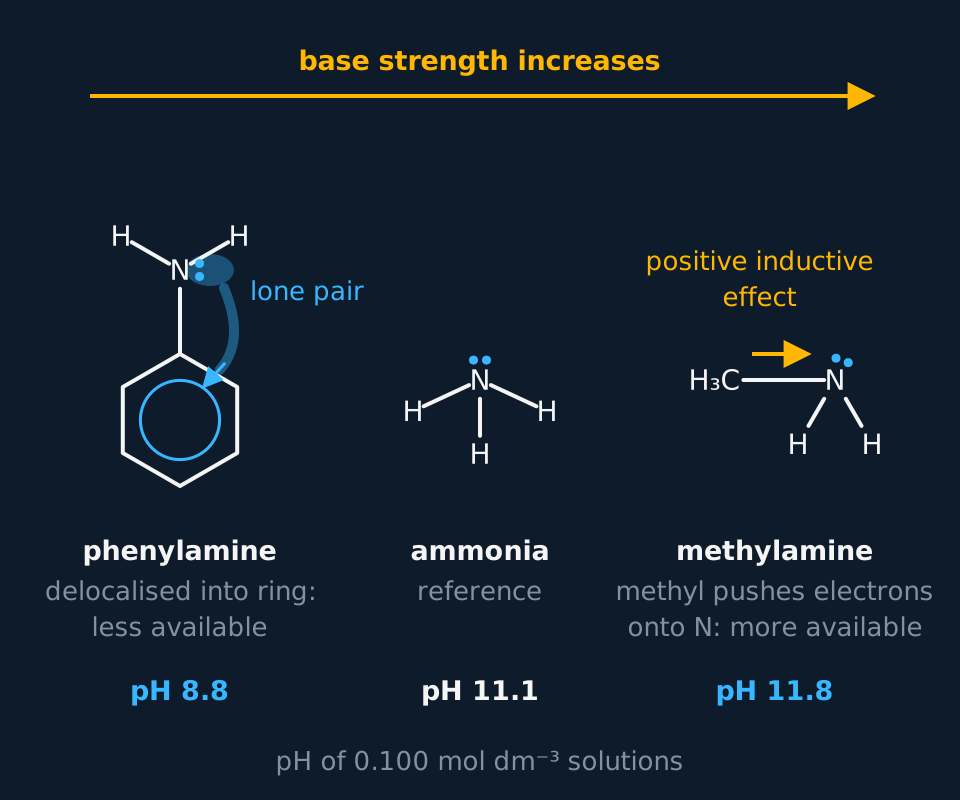
Describe the drawing
Three structures in a row under an amber arrow labelled base strength increases. On the left phenylamine, a benzene ring with an NH₂ group, its nitrogen lone pair drawn in a shaded lobe that spreads down into the ring's delocalised circle: less available. In the middle ammonia, a nitrogen with three hydrogens and one lone pair, the reference. On the right methylamine, CH₃ bonded to an NH₂ with a lone pair, and a small straight arrow along the C–N bond pointing towards nitrogen for the positive inductive effect of the methyl group: more available. Under them the pH of 0.100 mol dm⁻³ solutions reads 8.8, 11.1 and 11.8.
The order is asked for primary amines only. Secondary amines are slightly stronger again, as two alkyl groups would suggest, but tertiary amines in water are weaker than expected, because the ion they form has only one N–H bond to hydrogen bond to the water around it.
A lone pair that accepts a proton can also be donated to a metal ion. Amines act as ligands: ethane-1,2-diamine, with a lone pair on each nitrogen, is a bidentate ligand that replaces water around copper(II) and nickel(II) ions, and amine ligands return in transition metal chemistry.
- Positive inductive effect
- The release of electron density by an alkyl group towards the atom it is bonded to.
Amines as nucleophiles
The same lone pair that accepts a proton can attack a carbon atom that carries a partial positive charge. Amines and ammonia are nucleophiles. With halogenoalkanes they react by nucleophilic substitution, and with acyl chlorides by nucleophilic addition–elimination.
Ammonia attacks bromoethane as hydroxide ions do. The lone pair on the nitrogen forms a bond to the carbon bonded to bromine, the C–Br bond breaks with both electrons going to the bromine, and the product is the ethylammonium ion, CH₃CH₂NH₃⁺, with bromide. A second ammonia molecule uses its lone pair to take a proton from the nitrogen, leaving ethylamine and an ammonium ion. Overall, CH₃CH₂Br + 2NH₃ → CH₃CH₂NH₂ + NH₄Br.
The reaction does not stop there. Ethylamine has a lone pair too, and its ethyl group pushes electron density onto the nitrogen, so it is a better nucleophile than ammonia. When it meets a bromoethane molecule it attacks it in the same two steps, giving diethylamine. Diethylamine goes on to triethylamine, and triethylamine attacks a fourth bromoethane to give the tetraethylammonium ion, which has no lone pair and so reacts no further.
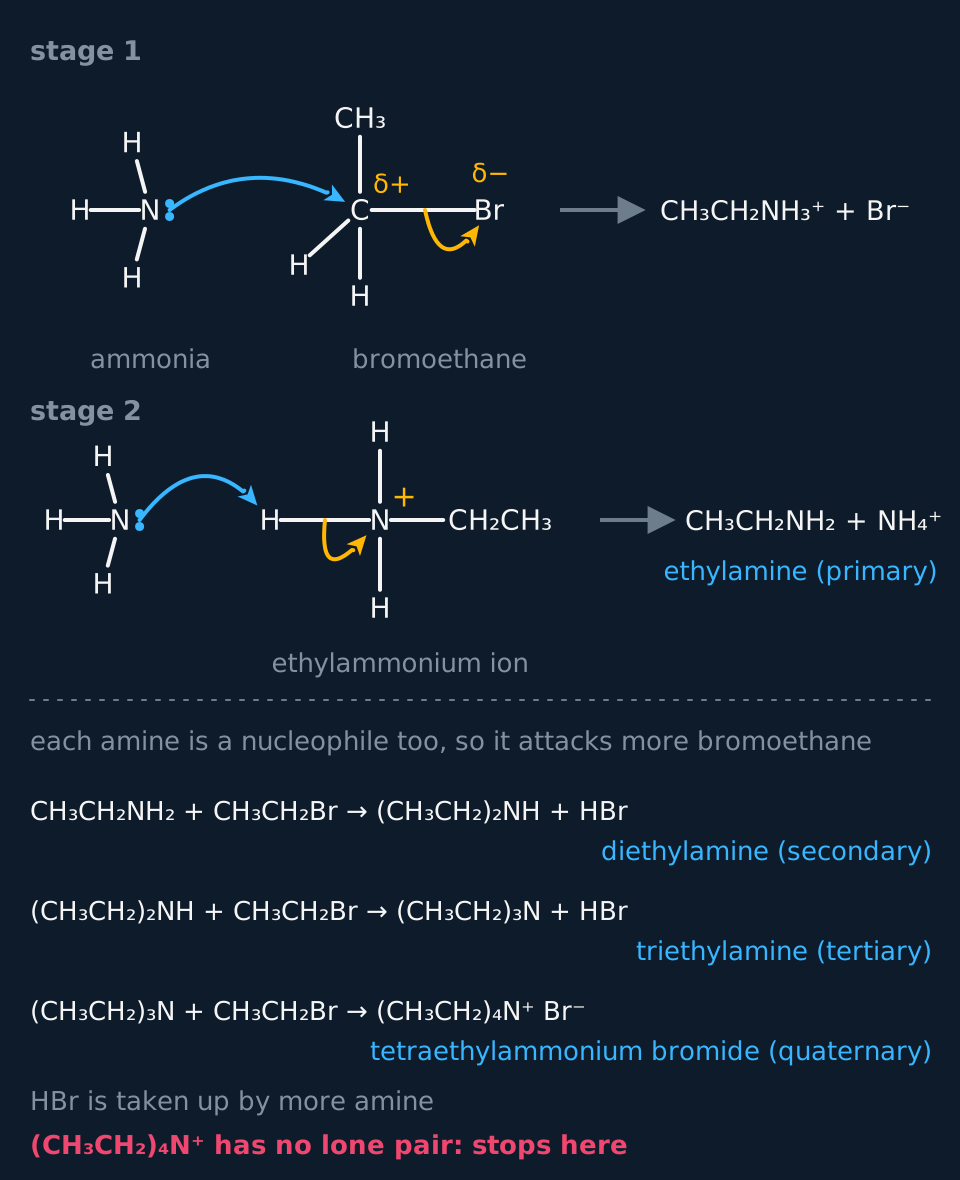
Describe the drawing
The reaction of ammonia with bromoethane. Stage 1: ammonia's lone pair attacks the δ+ carbon of bromoethane with a curly arrow, and a second arrow takes the C–Br bonding pair onto bromine, giving the ethylammonium ion and bromide. Stage 2: a second ammonia uses its lone pair to take an H from the positive nitrogen, and the N–H bonding pair returns to nitrogen, giving ethylamine and the ammonium ion. Below, three equations show ethylamine attacking bromoethane to give diethylamine, diethylamine giving triethylamine, and triethylamine giving tetraethylammonium bromide, which has no lone pair, so the sequence stops there.
An acyl chloride reacts with an amine at room temperature, vigorously, to give an N-substituted amide. Ethanoyl chloride and methylamine give N-methylethanamide, CH₃CONHCH₃. The lone pair on the nitrogen adds to the carbonyl carbon, and then a chloride ion and an H⁺ are eliminated. The hydrogen chloride formed reacts with a second molecule of the amine, so two moles of amine are used for each mole of acyl chloride: CH₃COCl + 2CH₃NH₂ → CH₃CONHCH₃ + CH₃NH₃⁺Cl⁻.
The mechanism is the one acyl chlorides follow with every nucleophile: the lone pair on the nitrogen attacks the δ+ carbonyl carbon, the C=O bond opens onto the oxygen, the C=O re-forms as the chloride ion leaves, and the nitrogen loses H⁺. Name it as nucleophilic addition–elimination; 'substitution' describes the overall change but not the two steps, and does not earn the mark for the type of reaction.
- Nucleophile
- An electron pair donor: a species with a lone pair of electrons that it donates to an electron-deficient atom to form a covalent bond.
Making amines
From a halogenoalkane. A halogenoalkane is heated with excess ammonia dissolved in ethanol, in a sealed tube so that the ammonia cannot escape. Using ammonia in large excess makes each halogenoalkane molecule far more likely to meet ammonia than an amine, so the primary amine is the main product. Some secondary and tertiary amine and some quaternary salt still form, so the yield is lowered and the products have to be separated. Using excess halogenoalkane instead drives the reaction all the way, and is how quaternary ammonium salts are made.
From a nitrile. A halogenoalkane heated under reflux with potassium cyanide in ethanol and water gives a nitrile with one more carbon atom: bromoethane gives propanenitrile, CH₃CH₂CN. Reducing the nitrile gives a primary amine, here propylamine, CH₃CH₂CH₂NH₂, and nothing else, because no halogenoalkane is left for the amine to attack. In the laboratory the reducing agent is lithium tetrahydridoaluminate(III), LiAlH₄, in dry ether; in industry, where LiAlH₄ would be too expensive, it is hydrogen with a nickel catalyst.
CH₃CH₂CN(l) + 2H₂(g) → CH₃CH₂CH₂NH₂(l)With a nickel catalyst. With LiAlH₄ the same change is written CH₃CH₂CN + 4[H] → CH₃CH₂CH₂NH₂.
Phenylamine from nitrobenzene. Chlorobenzene does not undergo nucleophilic substitution under these conditions, so aromatic amines are made by reduction instead. Nitrobenzene is heated under reflux with tin and concentrated hydrochloric acid, which together are the reducing agent. In the acid the product takes a proton and is present as the phenylammonium ion, C₆H₅NH₃⁺. Adding sodium hydroxide solution removes the proton and releases phenylamine, which is then separated from the mixture by steam distillation.
C₆H₅NO₂(l) + 6[H] → C₆H₅NH₂(l) + 2H₂O(l)[H] stands for the reducing agent, tin and concentrated hydrochloric acid.
Phenylamine boils at 184 °C and begins to decompose near that temperature, so it is not distilled on its own. It does not mix with water, and a mixture of two immiscible liquids boils below the boiling point of either, so steam blown through the flask carries phenylamine over below 100 °C. The oily layer is separated from the water in the distillate, dried, and its boiling temperature measured as a check on its purity.
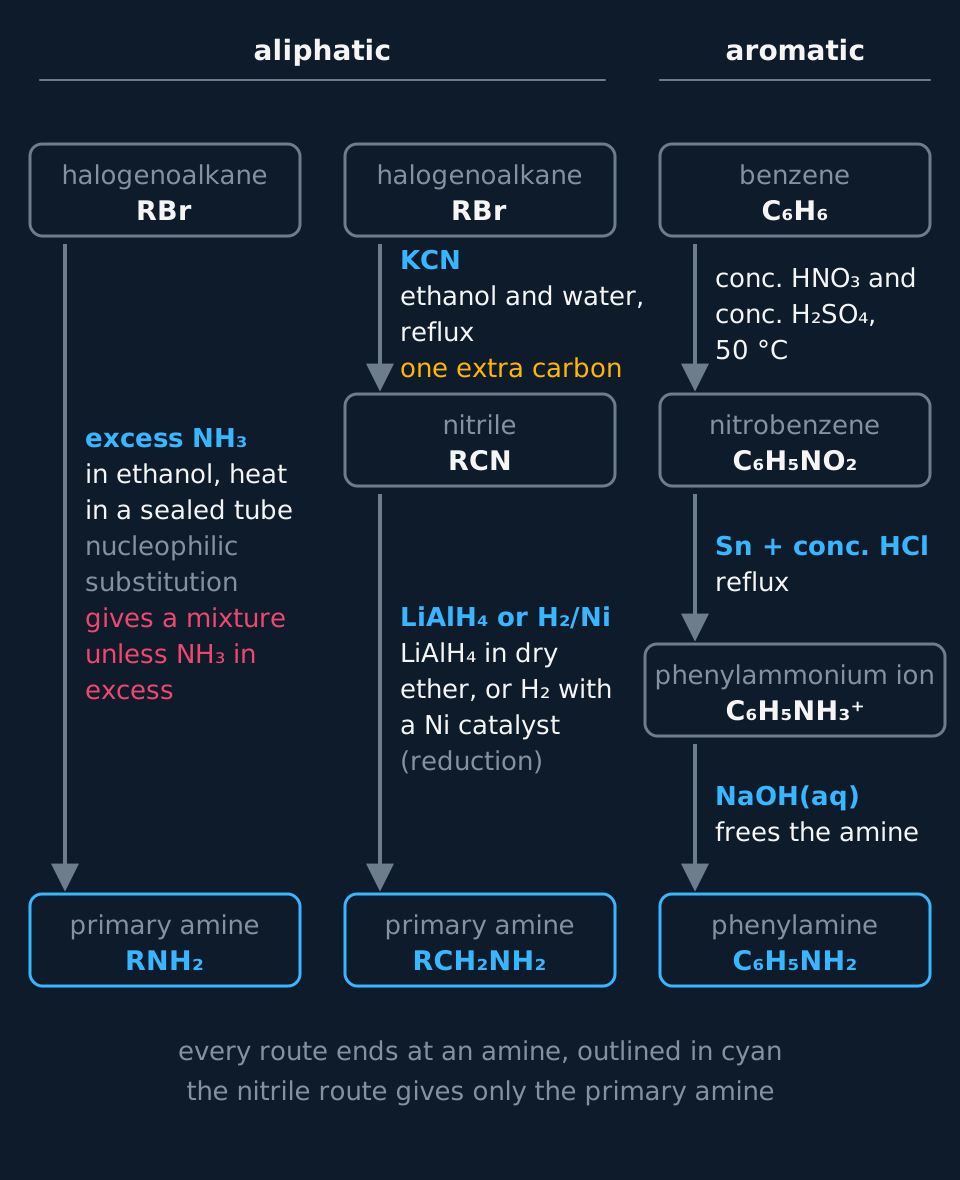
Describe the drawing
A reaction map in three columns, each running downwards to an amine outlined in cyan at the bottom. Aliphatic, first column: a halogenoalkane RBr with excess ammonia in ethanol, heated in a sealed tube, gives the primary amine RNH₂ by nucleophilic substitution, with a coral note that it gives a mixture unless ammonia is in excess. Second column: RBr with KCN in ethanol and water under reflux gives the nitrile RCN, one extra carbon, which LiAlH₄ in dry ether or hydrogen with a nickel catalyst reduces to RCH₂NH₂. Aromatic, third column: benzene with concentrated nitric and sulfuric acids at 50 °C gives nitrobenzene; tin and concentrated hydrochloric acid under reflux give the phenylammonium ion; sodium hydroxide solution frees phenylamine.
Two routes to ethylamine
Ethylamine, CH₃CH₂NH₂, can be made from bromoethane in one step or from bromomethane in two. Give the reagents for each and compare the routes.
Show the working
One step: bromoethane heated with excess ammonia in ethanol in a sealed tube. CH₃CH₂Br + 2NH₃ → CH₃CH₂NH₂ + NH₄Br.
Two steps: bromomethane heated under reflux with KCN in ethanol and water gives ethanenitrile, CH₃CN; LiAlH₄ in dry ether, or hydrogen and nickel, then reduces it to ethylamine.
The one-step route is shorter and avoids cyanide, but it gives a mixture of amines, so the yield of ethylamine is lower and the product needs separating.
The nitrile route gives only the primary amine, at the price of an extra step and the hazard of using cyanide, which is toxic.
TRY IT: Phenylamine from nitrobenzene
24.6 g of nitrobenzene is reduced, and the yield of phenylamine is 70.0%. Calculate the mass of phenylamine obtained. Mr: C₆H₅NO₂ 123.0, C₆H₅NH₂ 93.0.
Check your answer
Amount of nitrobenzene = 24.6 ÷ 123.0 = 0.200 mol, which gives at most 0.200 mol of phenylamine, 0.200 × 93.0 = 18.6 g.
Mass obtained = 18.6 × 70.0 ÷ 100 = 13.0 g.
Phenylamine from benzene in two steps
15.6 g of benzene is nitrated with a yield of 80.0%, and all of the nitrobenzene is reduced to phenylamine with a yield of 70.0%. Calculate the mass of phenylamine obtained and the overall percentage yield. Mr: C₆H₆ 78.0, C₆H₅NH₂ 93.0.
Show the working
Amount of benzene = 15.6 ÷ 78.0 = 0.200 mol.
Nitration is 1 : 1, so nitrobenzene formed = 0.200 × 80.0 ÷ 100 = 0.160 mol.
Reduction is 1 : 1, so phenylamine formed = 0.160 × 70.0 ÷ 100 = 0.112 mol, and its mass = 0.112 × 93.0 = 10.4 g.
Overall yield = 0.112 ÷ 0.200 × 100 = 56.0%, which is also 0.800 × 0.700 × 100: the yields of the steps multiply.
10.4 g of phenylamine is obtained, an overall yield of 56.0%. That is lower than either step alone, because every extra step multiplies in another loss.
Other boards: amides, copper complexes and azo dyes
Edexcel examines butylamine with copper(II) ions, which behaves as ammonia does. A few drops of butylamine added to copper(II) sulfate solution act as a base, taking protons from water ligands, and a pale blue precipitate of copper(II) hydroxide forms. With more butylamine the precipitate dissolves to a deep blue solution, as four butylamine molecules replace four of the water ligands.
[Cu(H₂O)₆]²⁺(aq) + 4CH₃CH₂CH₂CH₂NH₂(aq) → [Cu(CH₃CH₂CH₂CH₂NH₂)₄(H₂O)₂]²⁺(aq) + 4H₂O(l)The deep blue complex, written as Edexcel writes the ammonia complex, with two water ligands left in place.
Edexcel's practical work also asks for the purification of phenylamine by steam distillation, with its boiling temperature measured afterwards as the check on purity.
An amide is hardly basic at all, and Cambridge asks why. The lone pair on an amide's nitrogen overlaps with the C=O group next to it and is drawn towards the electronegative oxygen, so it is almost unavailable to accept a proton. A solution of ethanamide is neutral, where ethylamine's at the same concentration has a pH near 12.
Amides are hydrolysed by heating under reflux with dilute acid or alkali, which reverses their formation. With hydrochloric acid, ethanamide gives ethanoic acid and ammonium chloride. With sodium hydroxide it gives sodium ethanoate and ammonia, which turns damp red litmus blue. An N-substituted amide gives an amine in place of ammonia: N-methylethanamide and alkali give methylamine. Cambridge sets these reactions, and peptide links in proteins are hydrolysed by exactly this chemistry.
Cambridge also adds a fourth route to amines. Lithium tetrahydridoaluminate(III) in dry ether reduces the C=O group of an amide to CH₂, so ethanamide, CH₃CONH₂, gives ethylamine, and N-methylethanamide gives the secondary amine ethylmethylamine, CH₃CH₂NHCH₃. Like the nitrile route, it gives one amine and no mixture.
Cambridge, alone among the four boards, takes phenylamine two steps further, into dyes. Phenylamine is dissolved in hydrochloric acid and cooled in ice to below 10 °C, and sodium nitrite solution is added. Nitrite and acid make nitrous acid, HNO₂, in the flask, and it turns the NH₂ group into –N₂⁺, giving benzenediazonium chloride.
C₆H₅NH₂(aq) + HNO₂(aq) + HCl(aq) → C₆H₅N₂⁺Cl⁻(aq) + 2H₂O(l)Diazotisation, below 10 °C.
The temperature matters. Above about 10 °C the diazonium ion breaks down, losing nitrogen gas, and the ring takes an OH group from the water. Warming the solution is the way phenol is made from phenylamine.
C₆H₅N₂⁺(aq) + H₂O(l) → C₆H₅OH(aq) + N₂(g) + H⁺(aq)On warming: nitrogen bubbles off and phenol forms.
Kept cold, the diazonium ion is a weak electrophile, too weak to attack benzene but able to attack the activated ring of a phenol. Added to phenol dissolved in sodium hydroxide, it substitutes at carbon 4, opposite the oxygen, and the two rings are joined by an azo group, –N=N–. The product, 4-hydroxyazobenzene, comes out at once as a yellow-orange precipitate.
C₆H₅N₂⁺(aq) + C₆H₅O⁻(aq) → C₆H₅N=NC₆H₄OH(s)Azo coupling, in alkali, with the phenoxide ion as the activated ring.
The N=N group joins the delocalised systems of the two rings into one long one, which absorbs visible light, so azo compounds are coloured. Changing the groups on either ring changes the colour, and coupling with other activated arenes, such as naphthalen-2-ol, gives other dyes. Azo compounds dye cotton and colour foods: sunset yellow, E110, is one.
- Diazonium ion
- An ion containing the –N₂⁺ group bonded to a benzene ring, such as C₆H₅N₂⁺, made from an aromatic amine and nitrous acid below 10 °C.
- Azo compound
- A compound in which two benzene rings are joined by an –N=N– group, made by coupling a diazonium ion with a phenol or an aromatic amine.
In the exam
- A base-strength answer earns its marks for what happens to the lone pair and then for linking that to accepting a proton. The scheme rejects answers about the size of the group, and 'phenyl group withdraws electrons' without the lone pair being delocalised into the ring is not enough for phenylamine.
- The mechanism of ammonia with a halogenoalkane has two stages: attack on carbon with the C–X bond breaking, then a second ammonia removing H⁺ from the N⁺. A curly arrow from a nitrogen with no lone pair drawn loses that arrow's mark.
- For phenylamine from nitrobenzene, the scheme credits tin and hydrochloric acid, and allows iron with hydrochloric acid in place of tin. Where a question asks how the free amine is obtained, sodium hydroxide earns a further mark.
- Asked why the halogenoalkane route gives a mixture, state that the amine product is itself a nucleophile, and name the next product, the secondary amine.
Check yourself
Explain why ethylamine is a stronger base than phenylamine, and explain why ethylamine made from bromoethane and ammonia is impure unless the ammonia is in excess.
Answer
Both have a lone pair on the nitrogen that accepts a proton. In ethylamine the ethyl group releases electron density onto the nitrogen, so the lone pair is more available.
In phenylamine the lone pair is partly delocalised into the benzene ring, so it is less available, and phenylamine is the weaker base.
Ethylamine is itself a nucleophile, a better one than ammonia, so it attacks more bromoethane to give diethylamine, then triethylamine and the tetraethylammonium salt. Excess ammonia makes bromoethane far more likely to meet ammonia than an amine.
Questions
Question 16 marks
Explain the order of base strength of phenylamine, ammonia and ethylamine, starting with the weakest.
Mark scheme
Indicative content
- the order is phenylamine weakest, then ammonia, then ethylamine strongest, all compared at the same concentration
- base strength depends on how available the lone pair on the nitrogen is to accept a proton from water or an acid
- in ethylamine the ethyl group releases electron density onto the nitrogen, the positive inductive effect; reject 'larger group'
- so the lone pair on ethylamine's nitrogen is more available than ammonia's, and ethylamine is the stronger base
- in phenylamine the lone pair on nitrogen overlaps with the delocalised π system and is partly delocalised into the benzene ring
- so less electron density remains on the nitrogen, its lone pair is less available to accept a proton, and phenylamine is weaker than ammonia
Levels
- Level 3 (5–6 marks) the order is correct and both comparisons are explained through the availability of the nitrogen lone pair: the positive inductive effect of the ethyl group and the delocalisation of phenylamine's lone pair into the ring; the answer does not rely on size or on 'more alkyl groups'
- Level 2 (3–4 marks) the order is right and one comparison is fully explained through the lone pair; the other is asserted, or put down to the size of the molecule
- Level 1 (1–2 marks) the order is given or the lone pair mentioned; phenylamine is often placed above ammonia because the ring is taken to push electrons towards the nitrogen
Question 25 marks
Outline the mechanism for the reaction of bromoethane with an excess of ammonia to form ethylamine.
Mark scheme
- B1 a curly arrow from the lone pair on the nitrogen of NH₃ to the carbon bonded to bromine
- B1 a curly arrow from the C–Br bond to the bromine atom
- B1 the structure of the intermediate ion, CH₃CH₂NH₃⁺, with the positive charge on nitrogen
- B1 a curly arrow from the lone pair on a second NH₃ molecule to an H atom bonded to the N⁺
- B1 a curly arrow from that N–H bond to the nitrogen, giving ethylamine and NH₄⁺
Question 34 marksAQA · Edexcel
Name the compounds CH₃CH₂CH₂NH₂ and (CH₃)₄N⁺Cl⁻, and explain why the ion in the second compound can act neither as a base nor as a nucleophile.
Mark scheme
- B1 CH₃CH₂CH₂NH₂ is propylamine; allow propan-1-amine
- B1 (CH₃)₄N⁺Cl⁻ is tetramethylammonium chloride
- B1 the nitrogen has used its lone pair to form a fourth bond to carbon
- B1 with no lone pair it cannot accept a proton or donate a pair of electrons to a carbon atom
All 21 questions with mark schemes, the other 18 set out in full on the question page.
Worth remembering
- Count carbon groups on the nitrogen, not on the carbon: propan-2-amine is primary.
- A quaternary ion has no lone pair, so it is neither a base nor a nucleophile.
- Base strength is about the lone pair's availability, never the size of the group.
- The amine product is a better nucleophile than ammonia, so it reacts on unless ammonia is in excess.
- The nitrile route adds a carbon atom: count the chain before choosing the halogenoalkane.
CHECK YOUR PROGRESS
Rate how confident you are with each objective for this lesson. Ratings are saved in this browser, on this device, unless you sign in.
- Identify primary, secondary and tertiary amines and quaternary ammonium salts, and describe the use of quaternary ammonium salts as cationic surfactants.
- Explain why amines are bases, and explain the order of base strength of phenylamine, ammonia and primary aliphatic amines.
- Outline the mechanism of the reaction between ammonia and a halogenoalkane, and explain why further substitution gives a mixture of products.
- Describe the reactions of amines with acyl chlorides to give N-substituted amides.
- Describe the preparation of aliphatic amines from halogenoalkanes and by reducing nitriles, and of phenylamine by reducing nitrobenzene.
- Describe the hydrolysis and reduction of amides and the making of diazonium salts and azo dyes.CAIE
Open the full revision checklist to see every objective in the curriculum in one place.
Practise this lesson
WORKBOOK
The written questions from this topic, on paper with room to work, and a separate book of mark schemes. The 2 questions that are set on a diagram stay on this page, where the diagram can be drawn. Free to use; please do not redistribute or sell.
Used later in Planning a synthetic route