Chemistry › Amount of substance › The mole, the Avogadro constant and molar mass
The mole, the Avogadro constant and molar mass
Chemists count particles by weighing them. The mole is the unit of that count, 6.022 × 10²³ particles, the number of atoms in 12 g of carbon-12, and molar mass turns a mass into moles and back. The same arithmetic finds how much water is locked inside a blue crystal of copper(II) sulfate.
Key terms Every definition in amount of substance, lesson by lesson
Before this Time-of-flight mass spectrometry and relative atomic mass – Ar as the weighted mean mass of an element's atoms · Formulae, equations and state symbols – writing and balancing an equation
COMMON MISCONCEPTION
A mole is a fixed amount of mass, so a mole of hydrogen and a mole of lead ought to weigh the same.
A mole is a fixed number of particles, 6.022 × 10²³, not a fixed mass. One mole of hydrogen atoms has a mass of 1.0 g and one mole of lead atoms 207.2 g, because each lead atom is about 200 times heavier. The molar mass is the relative atomic or molecular mass in grams.
What you should be able to do
- Define the mole and the Avogadro constant, and use L to convert between an amount in moles and a number of particles.
- Calculate relative molecular mass and relative formula mass from Ar values, and say which term applies to which kind of substance.
- Use n = m ÷ M in either direction, with mass in grams and molar mass in g mol⁻¹.
- Use the mole ratio in a balanced equation to calculate the mass of one substance from the mass of another.
- Describe heating to constant mass, and calculate the number of molecules of water of crystallisation in a hydrated salt.
Counting by weighing
Chemists count atoms, molecules and ions by weighing them. Any sample large enough to see holds far too many particles to count one at a time, but every kind of particle has a known mass, so the mass on a balance stands for a number of particles.
The counting unit is the mole, symbol mol. One mole of anything is 6.022 × 10²³ of it, whether atoms, molecules, ions or electrons. That number is the Avogadro constant, L, and it is the number of atoms in 12 g of carbon-12. A teaspoon holds about 5 g of water, which is 0.28 mol, or 1.7 × 10²³ molecules.
Amount of substance, n, is a quantity in its own right, measured in moles as mass is measured in kilograms. It is not a mass. One mole of hydrogen molecules has a mass of 2.0 g and one mole of lead atoms has a mass of 207.2 g, yet the two samples hold the same number of particles. The two samples differ in mass because a lead atom is about a hundred times heavier than a hydrogen molecule, and molar mass is the quantity that converts an amount into a mass.
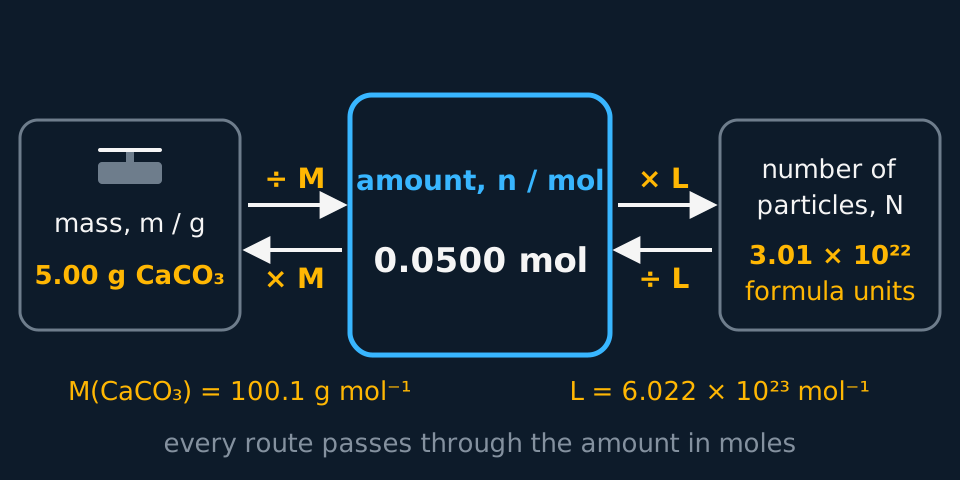
Describe the drawing
Three boxes in a row. The left box, mass in grams, holds 5.00 g of calcium carbonate and a small balance icon. The larger middle box, amount in moles, holds 0.0500 mol. The right box, number of particles, holds 3.01 times ten to the twenty-two formula units. A pair of arrows joins each neighbouring pair: divide by M going from mass to moles and multiply by M coming back, multiply by L going from moles to particles and divide by L coming back. M is 100.1 g per mole and L is 6.022 times ten to the twenty-three per mole. No arrow joins mass to number directly.
The data sheet gives L to four significant figures, 6.022 × 10²³ mol⁻¹, and that is the value to use. Write the unit: L is a number of particles per mole, so an answer that multiplies an amount in mol by L comes out as a plain number of particles.
- Mole
- The amount of substance that contains 6.022 × 10²³ particles, the same number as there are atoms in 12 g of carbon-12.
- Avogadro constant
- The number of particles in one mole of a substance, 6.022 × 10²³ mol⁻¹, symbol L.
- Amount of substance
- The quantity that counts the particles in a sample, measured in moles, symbol n.
Relative masses and molar mass
Relative atomic mass, Ar, is printed on the periodic table to one decimal place: 1.0 for hydrogen, 12.0 for carbon, 16.0 for oxygen, 35.5 for chlorine. It is measured against one twelfth of the mass of a carbon-12 atom, so it has no unit. Add the Ar values of every atom in a formula and the total is the mass of that formula against the same standard.
For a substance made of molecules the total is the relative molecular mass, Mr. Water, H₂O, has Mr = 2 × 1.0 + 16.0 = 18.0. Carbon dioxide has 12.0 + 2 × 16.0 = 44.0. Sodium chloride has no molecules: a crystal is a lattice of Na⁺ and Cl⁻ ions in which no pair belongs together. Its total, 23.0 + 35.5 = 58.5, is a relative formula mass, the mass of one formula unit NaCl. The symbol Mr is used for both.
The electrons gained or lost in forming an ion have too little mass to matter, so Na⁺ is taken as 23.0, the same as a sodium atom.
A bracket multiplies everything inside it. Ca(OH)₂ has one calcium, two oxygens and two hydrogens: Mr = 40.1 + 2 × (16.0 + 1.0) = 74.1. A raised dot joins water of crystallisation to a salt, and the water is added on: CuSO₄·5H₂O has Mr = 159.6 + 5 × 18.0 = 249.6.
Molar mass, M, is the mass of one mole, in g mol⁻¹, and it has the same number as Mr. Water has Mr = 18.0 and a molar mass of 18.0 g mol⁻¹. They are still different quantities. Mr is a ratio and has no unit; M is a mass per mole. Writing 'Mr = 18.0 g mol⁻¹' puts a unit on a ratio, and writing 'M = 18.0' leaves the unit off a quantity that has one.
| Substance | Made of | Relative mass | Molar mass / g mol⁻¹ |
|---|---|---|---|
| Water, H₂O | Molecules | Mr = 18.0 | 18.0 |
| Carbon dioxide, CO₂ | Molecules | Mr = 44.0 | 44.0 |
| Sodium chloride, NaCl | Ions in a lattice | Relative formula mass 58.5 | 58.5 |
| Calcium carbonate, CaCO₃ | Ions in a lattice | Relative formula mass 100.1 | 100.1 |
| Hydrated copper(II) sulfate, CuSO₄·5H₂O | Ions and water molecules in a lattice | Relative formula mass 249.6 | 249.6 |
A definition of relative molecular mass needs two phrases: the average, or weighted mean, mass of a molecule, and compared with one twelfth of the mass of an atom of carbon-12. 'Compared with carbon-12' on its own leaves out the twelfth, and without it the standard is twelve times too large.
- Relative molecular mass
- The weighted mean mass of a molecule compared with one twelfth of the mass of an atom of carbon-12.
- Relative formula mass
- The weighted mean mass of a formula unit of a compound compared with one twelfth of the mass of an atom of carbon-12, used for ionic compounds.
- Molar mass
- The mass of one mole of a substance, in g mol⁻¹, numerically equal to its relative formula mass.
Moles, mass and the number of particles
Almost every calculation about amounts passes through moles. A mass becomes an amount through the molar mass.
n = m ÷ Mn in mol, m in g, M in g mol⁻¹
The mass must be in grams for a molar mass in g mol⁻¹: 2.5 kg is 2500 g, a tonne is 1.00 × 10⁶ g, and 250 mg is 0.250 g. Rearranged, m = n × M gives a mass from an amount, and M = m ÷ n gives the molar mass of an unknown from a weighed sample whose amount is known.
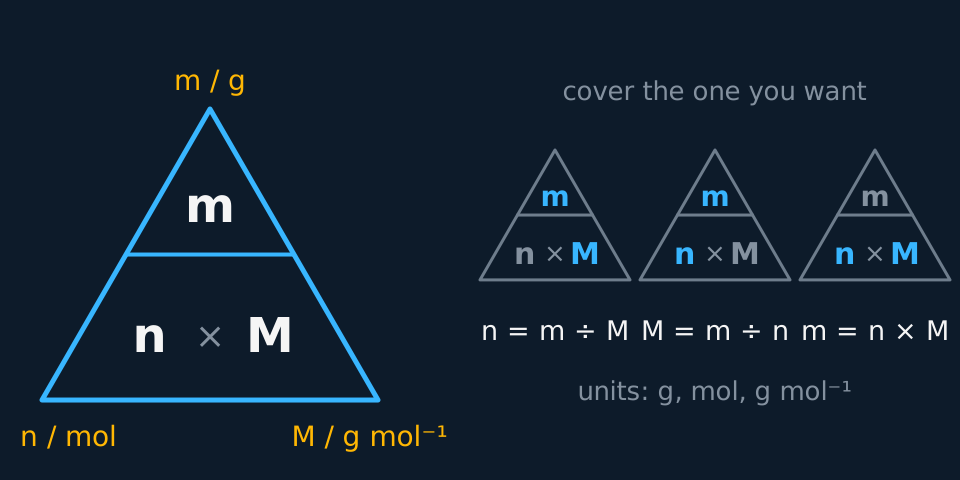
Describe the drawing
A large equilateral triangle split by a horizontal line, with m in the top half and n times M side by side in the bottom half; the units g, mol and g per mol are written outside the three corners. To the right three smaller copies each grey out one letter and give the equation that results: n equals m divided by M, M equals m divided by n, and m equals n times M.
An amount becomes a number of particles through the Avogadro constant, N = n × L. Half a mole of water is 0.500 × 6.022 × 10²³ = 3.01 × 10²³ molecules. A question about atoms or ions needs one more step, because a formula unit holds more than one. Each water molecule has three atoms, so the same 0.500 mol holds 1.50 mol of atoms, 9.03 × 10²³ of them. And 0.100 mol of calcium chloride, CaCl₂, holds 0.100 mol of Ca²⁺ and 0.200 mol of Cl⁻.
Dividing the other way gives the mass of one particle. A mole of water molecules has a mass of 18.0 g, so one molecule has a mass of 18.0 ÷ (6.022 × 10²³) = 2.99 × 10⁻²³ g, and one carbon-12 atom has a mass of 12.0 ÷ (6.022 × 10²³) = 1.99 × 10⁻²³ g. No balance can weigh a mass that small, which is why atoms are counted in moles and weighed by the gram.
A balanced equation relates the amount of one substance to the amount of another. Its coefficients are a ratio of amounts, not of masses. In 2Mg(s) + O₂(g) → 2MgO(s), two moles of magnesium react with one mole of oxygen molecules, which is 48.6 g with 32.0 g. Convert the mass given into moles, use the ratio, and convert back into the mass asked for.
Decomposing 5.00 g of calcium carbonate
5.00 g of calcium carbonate is heated until it has fully decomposed. Calculate the amount of CaCO₃ in moles, and the mass of carbon dioxide given off.
Show the working
Equation and ratio: CaCO₃(s) → CaO(s) + CO₂(g). One mole of CaCO₃ gives one mole of CO₂.
Molar mass: Mr of CaCO₃ = 40.1 + 12.0 + 3 × 16.0 = 100.1, so M = 100.1 g mol⁻¹.
Amount: n = m ÷ M = 5.00 ÷ 100.1 = 0.04995 mol. The unrounded figure goes forward to the next line.
Mass of CO₂: n(CO₂) = 0.04995 mol and M(CO₂) = 12.0 + 2 × 16.0 = 44.0 g mol⁻¹, so m = n × M = 0.04995 × 44.0 = 2.198 g.
Answer: 5.00 g of CaCO₃ is 0.0500 mol and gives 2.20 g of carbon dioxide, both to three significant figures to match the 5.00 g given. The other 2.80 g stays in the crucible as calcium oxide.
Two habits keep these answers right. Carry the unrounded figure from line to line and round only at the end, to the number of significant figures in the data. And check the size of the answer. Carbon dioxide is 44.0 of the 100.1 mass units in calcium carbonate, so a little under half the mass should leave as gas, and 2.20 g out of 5.00 g is a little under half.
The carbon dioxide from a gas canister
A camping stove burns 50.0 g of butane: 2C₄H₁₀(g) + 13O₂(g) → 8CO₂(g) + 10H₂O(l). Calculate the mass of carbon dioxide formed and the number of carbon dioxide molecules.
Show the working
Molar mass: M(C₄H₁₀) = 4 × 12.0 + 10 × 1.0 = 58.0 g mol⁻¹, so n = 50.0 ÷ 58.0 = 0.8621 mol.
Ratio: 2 mol of butane give 8 mol of CO₂, which is 1 : 4, so n(CO₂) = 4 × 0.8621 = 3.448 mol.
Mass: m = 3.448 × 44.0 = 151.7 g.
Molecules: N = 3.448 × 6.022 × 10²³ = 2.077 × 10²⁴.
The stove makes 152 g of carbon dioxide, 2.08 × 10²⁴ molecules, to three significant figures. Three times the mass of fuel leaves as carbon dioxide because each carbon atom in the fuel leaves bonded to two oxygen atoms taken from the air. Using the ratio 2 : 8 without simplifying gives the same answer; leaving it out and using 1 : 1 gives a quarter of it.
Water of crystallisation
Copper(II) sulfate crystals are blue. Heat them in a crucible and they crumble to a white powder, and a drop of water on that powder turns it blue again, warm to the touch. The blue solid is hydrated copper(II) sulfate, CuSO₄·5H₂O, with five water molecules built into the crystal lattice for every CuSO₄ unit. The white solid is anhydrous CuSO₄, with that water driven off.
CuSO₄·5H₂O(s) → CuSO₄(s) + 5H₂O(g)blue to white on heating; the reverse, white to blue, is a test for water
That water is part of the formula, in a fixed ratio, and it counts in the molar mass. A recipe asking for 0.0100 mol of copper(II) sulfate needs 2.50 g of the blue crystals or 1.60 g of the white powder. Other common hydrates are sodium carbonate, Na₂CO₃·10H₂O, magnesium sulfate, MgSO₄·7H₂O, and barium chloride, BaCl₂·2H₂O.
To find the ratio, drive off all the water from a weighed sample and weigh what is left. Weigh an empty crucible, add 2 to 3 g of the hydrate and weigh again. Heat it on a pipeclay triangle, gently at first and then more strongly, for several minutes. Let it cool with the lid on, or in a desiccator, a sealed jar over a drying agent, so that it cannot take water back from the air, and weigh it.
Then heat, cool and weigh again, and keep going until two weighings in a row agree to within 0.01 g. That is heating to constant mass, and it is the only evidence that all the water has gone. A single long heating may be enough, but nothing on the balance shows it until a second weighing agrees with the first.
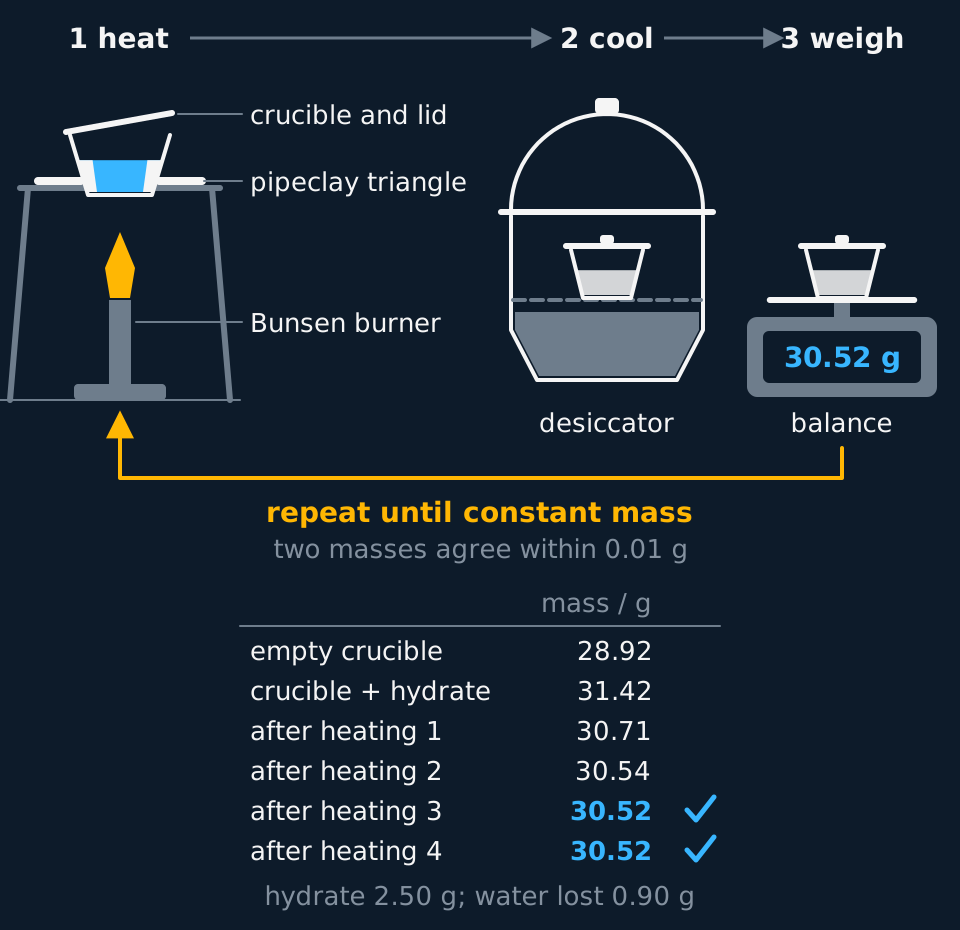
Describe the drawing
Three panels joined by arrows. In the first, a crucible with its lid ajar sits on a pipeclay triangle on a tripod over a Bunsen burner, its blue crystals turning white at the edges. In the second the lidded crucible cools inside a desiccator. In the third it sits on a balance reading 30.52 g. An amber arrow loops from the balance back to the burner: repeat until two masses agree within 0.01 g. A table beneath lists the empty crucible at 28.92 g, crucible and hydrate at 31.42 g, and four readings after heating, 30.71, 30.54, 30.52 and 30.52 g, the last two ticked.
Finding x in CuSO₄·xH₂O
2.50 g of hydrated copper(II) sulfate, CuSO₄·xH₂O, is heated to constant mass. The mass falls by 0.90 g. Find x.
Show the working
Masses: water driven off = 0.90 g. Anhydrous CuSO₄ left = 2.50 − 0.90 = 1.60 g.
Moles of each: M(CuSO₄) = 63.5 + 32.1 + 4 × 16.0 = 159.6 g mol⁻¹, so n = 1.60 ÷ 159.6 = 0.01003 mol. M(H₂O) = 18.0 g mol⁻¹, so n = 0.90 ÷ 18.0 = 0.0500 mol.
Ratio: divide by the smaller amount. 0.0500 ÷ 0.01003 = 4.99, so there are 4.99 mol of water for every mole of CuSO₄.
Formula: x = 5, CuSO₄·5H₂O. x counts whole water molecules per formula unit, so 4.99 rounds to 5. A result such as 4.6 would point to an error in the experiment, not to a crystal with 4.6 waters.
The value of x shows which way an experiment went wrong. If heating stops before constant mass, some water is still in the solid, the loss is too small and x comes out low. If the solid is heated too strongly, the anhydrous copper(II) sulfate itself starts to decompose, to black copper(II) oxide and sulfur trioxide, and that extra loss is counted as water, so x comes out high. Solid spitting out of an uncovered crucible also makes x high.
A balance whose display steps in 0.01 g is uncertain by ±0.01 g a reading, and the loss in mass is the difference of two readings, so ±0.02 g. On a loss of 0.90 g that is about 2%. On a loss of 0.18 g, from a 0.50 g sample, it is 11%. A larger sample gives a smaller percentage uncertainty on the same balance.
TRY IT: Epsom salts
Epsom salts are hydrated magnesium sulfate, MgSO₄·xH₂O. 4.92 g of the crystals is heated to constant mass and 2.40 g of anhydrous MgSO₄ is left. Find x.
Check your answer
Water lost = 4.92 − 2.40 = 2.52 g, so n(H₂O) = 2.52 ÷ 18.0 = 0.140 mol. M(MgSO₄) = 24.3 + 32.1 + 64.0 = 120.4 g mol⁻¹, so n(MgSO₄) = 2.40 ÷ 120.4 = 0.01993 mol.
Ratio: 0.140 ÷ 0.01993 = 7.02, which is 7 to the nearest whole number.
x = 7 and Epsom salts are MgSO₄·7H₂O. More than half of the mass of the crystals is water.
- Water of crystallisation
- Water molecules held in a fixed ratio within the crystal lattice of a hydrated salt.
- Hydrated
- Describes a crystalline compound that contains water of crystallisation.
- Anhydrous
- Describes a substance that contains no water of crystallisation.
- Heating to constant mass
- Repeating the cycle of heating, cooling and weighing until two successive masses agree, which shows the change is complete.
Other boards: x from a percentage of water
OCR and Cambridge also set x from a percentage composition, with no experiment in the question. The method is the one for an empirical formula: take 100 g of the crystals, so each percentage is a mass in grams, turn the water and the anhydrous salt into moles, and divide by the smaller.
The percentage has to be the percentage of water. If a question gives the percentage of the anhydrous salt instead, the water is 100 minus that figure, and the method carries on as before. If it gives the percentage of one element, such as the copper in a copper(II) sulfate hydrate, the salt is found from the element first and the water by difference.
x from a percentage of water
Hydrated sodium sulfate, Na₂SO₄·xH₂O, is 55.9% water by mass. Find x. M(Na₂SO₄) = 142.1 g mol⁻¹.
Show the working
In 100 g: 55.9 g of water and 100 − 55.9 = 44.1 g of Na₂SO₄.
Moles: n(H₂O) = 55.9 ÷ 18.0 = 3.106 mol; n(Na₂SO₄) = 44.1 ÷ 142.1 = 0.3103 mol.
Ratio: 3.106 ÷ 0.3103 = 10.0.
Formula: x = 10, Na₂SO₄·10H₂O. A check runs the other way: 10 × 18.0 = 180.0 of the 322.1 mass units are water, which is 55.9%.
OCR's practical endorsement files the heating of a hydrate under PAG 1, on moles determination, and the method is the same: weigh, heat, cool and reweigh until two masses agree.
In the exam
- The definition of relative molecular mass carries two marks: one for the average (weighted mean) mass of a molecule, one for comparison with one twelfth of the mass of a carbon-12 atom.
- Moles calculations are marked step by step with error carried forward: a wrong Mr loses its own mark, but the later steps still earn theirs if they use that Mr correctly. Show every line.
- Carry the unrounded figure between lines and give the answer to the significant figures of the data: 5.00 g gives an answer to three.
- A description of heating to constant mass must contain heating, cooling and reweighing until two masses agree; 'heat until all the water has gone' does not earn the mark on its own, because it does not say how that is known.
- A wrong value of x is explained through the mass of water: incomplete heating gives too small a loss and a low x; decomposition of the anhydrous salt gives too large a loss and a high x.
Check yourself
A student heats 3.00 g of hydrated barium chloride, BaCl₂·xH₂O, to constant mass, and 2.56 g of anhydrous BaCl₂ is left. Find x. Then say what would have happened to the value of x if the student had weighed only once, after one short heating.
Answer
Water lost = 3.00 − 2.56 = 0.44 g, so n(H₂O) = 0.44 ÷ 18.0 = 0.0244 mol. M(BaCl₂) = 137.3 + 2 × 35.5 = 208.3 g mol⁻¹, so n(BaCl₂) = 2.56 ÷ 208.3 = 0.01229 mol.
Ratio: 0.0244 ÷ 0.01229 = 1.99, which is 2. So x = 2 and the formula is BaCl₂·2H₂O.
One short heating can leave water in the crystals. The loss would then be less than 0.44 g, the moles of water smaller, and x would come out below 2. Only two weighings that agree show that all the water has gone.
Questions
Question 16 marks
Describe how a student could determine the value of x in a hydrated metal sulfate, MSO₄·xH₂O, whose anhydrous molar mass is known. Include how x is calculated and how the method shows that the result can be relied on.
Mark scheme
Indicative content
- weigh a clean, dry crucible and lid, add two to three grams of the hydrated salt and weigh again, so the mass of hydrate is known by difference
- heat the crucible on a pipeclay triangle, gently at first so that the solid does not spit out, then more strongly for several minutes
- let the crucible cool with its lid on, or in a desiccator, so that the anhydrous salt cannot absorb water from the air before it is weighed
- reweigh, then repeat heating, cooling and weighing until two successive masses agree within 0.01 g, which shows that all the water has been driven off
- the mass of water is the mass of hydrate minus the final mass of anhydrous salt, and each mass is divided by its molar mass to give an amount in moles
- x is the moles of water divided by the moles of anhydrous MSO₄, rounded to a whole number; a larger sample reduces the percentage uncertainty in the masses
Levels
- Level 3 (5–6 marks) weighing by difference, gentle then stronger heating, cooling with the lid or in a desiccator, heating to constant mass as the check that all water is removed, and the calculation of x from the two amounts in moles are all present; the answer explains why each step makes the result reliable
- Level 2 (3–4 marks) the crucible is weighed, heated and reweighed and x comes from the mass of water lost; heating to constant mass, cooling away from moist air, or putting both masses into moles is missed or unexplained
- Level 1 (1–2 marks) the hydrate is heated once and the mass loss found; x is often taken as the mass ratio of water to salt rather than the mole ratio
Question 25 marks
Calculate the value of x in hydrated magnesium sulfate, MgSO₄·xH₂O, from a student's results, given in the table. The crucible was heated, cooled and weighed four times. Use Mg 24.3, S 32.1, O 16.0, H 1.0.
| Weighing | Mass / g |
|---|---|
| Empty crucible | 24.36 |
| Crucible and hydrated salt | 27.05 |
| After heating 1 | 26.02 |
| After heating 2 | 25.72 |
| After heating 3 | 25.68 |
| After heating 4 | 25.68 |
Mark scheme
- B1 heatings 3 and 4 agree, so constant mass is reached and 25.68 g is the mass of crucible and anhydrous salt
- M1 mass of anhydrous MgSO₄ = 25.68 − 24.36 = 1.32 g and mass of water = 27.05 − 25.68 = 1.37 g
- M1 n(MgSO₄) = 1.32 ÷ 120.4 = 0.01096 mol and n(H₂O) = 1.37 ÷ 18.0 = 0.07611 mol
- M1 ratio n(H₂O) ÷ n(MgSO₄) = 0.07611 ÷ 0.01096 = 6.94
- A1 x = 7, a whole number with no unit; reject 6.94 given as the final answer
Question 34 marks
Calculate the total number of ions in solution when a student dissolves 8.55 g of aluminium sulfate, Al₂(SO₄)₃, in water and it dissociates completely into its ions. Use Al 27.0, S 32.1, O 16.0 and L = 6.022 × 10²³ mol⁻¹.
Mark scheme
- M1 M(Al₂(SO₄)₃) = 2 × 27.0 + 3 × (32.1 + 4 × 16.0) = 342.3 g mol⁻¹
- M1 n(Al₂(SO₄)₃) = 8.55 ÷ 342.3 = 0.02498 mol
- M1 each formula unit gives 2 Al³⁺ and 3 SO₄²⁻, five ions, so n(ions) = 5 × 0.02498 = 0.1249 mol
- A1 N = 0.1249 × 6.022 × 10²³ = 7.52 × 10²² ions, to three significant figures; allow error carried forward from a wrong Mr
All 18 questions with mark schemes, the other 15 set out in full on the question page.
Worth remembering
- A mass in kg or mg put straight into n = m ÷ M is out by a factor of a thousand.
- Mass ratios read off the equation's coefficients give the wrong mass of product.
- Keep at least one figure more than the answer needs until the last line; rounding to two figures between lines can move the third.
- Multiply by the number of atoms or ions in the formula when they are asked for, not molecules: 1 mol of CaCl₂ holds 2 mol of Cl⁻ ions.
- One heating and one weighing cannot show that all the water has gone.
CHECK YOUR PROGRESS
Rate how confident you are with each objective for this lesson. Ratings are saved in this browser, on this device, unless you sign in.
- Define the mole and the Avogadro constant, and use L to convert between an amount in moles and a number of particles.
- Calculate relative molecular mass and relative formula mass from Ar values, and say which term applies to which kind of substance.
- Use n = m ÷ M in either direction, with mass in grams and molar mass in g mol⁻¹.
- Use the mole ratio in a balanced equation to calculate the mass of one substance from the mass of another.
- Describe heating to constant mass, and calculate the number of molecules of water of crystallisation in a hydrated salt.
Open the full revision checklist to see every objective in the curriculum in one place.
Practise this lesson
WORKBOOK
The written questions from this topic, on paper with room to work, and a separate book of mark schemes. The question that is set on a diagram stays on this page, where the diagram can be drawn. Free to use; please do not redistribute or sell.
Used later in Empirical and molecular formulae · Concentration, volumetric solutions and titration calculations · Enthalpy change, standard conditions and the definitions · Group 2 compounds: solubility, uses and the sulfate test