Chemistry › Amount of substance › Empirical and molecular formulae
Empirical and molecular formulae
Analysis gives masses, not formulae. Divide each element's mass by its Ar, divide by the smallest answer, and the simplest whole-number ratio of atoms appears: the empirical formula. The relative molecular mass then fixes how many of those units make one molecule, so CH₂O becomes C₂H₄O₂, ethanoic acid.
Key terms Every definition in amount of substance, lesson by lesson
Before this The mole, the Avogadro constant and molar mass – converting a mass into moles · Gases and the ideal gas equation – finding Mr of a volatile compound · Time-of-flight mass spectrometry and relative atomic mass – the molecular ion peak
COMMON MISCONCEPTION
The empirical formula is the real formula of the compound, so a molecule of ethanoic acid must be CH₂O.
The empirical formula is only the simplest whole-number ratio of atoms. Ethanoic acid, CH₃COOH, is C₂H₄O₂: twice CH₂O. Methanal is CH₂O and glucose is C₆H₁₂O₆, and all three share the ratio. The molecular formula needs the relative molecular mass as well, from a mass spectrum, to say how many times the ratio is repeated.
What you should be able to do
- Define empirical formula and molecular formula, and distinguish both from a structural formula.
- Calculate an empirical formula from the masses of the elements in a compound, or from its percentage composition by mass.
- Recognise ratios such as 1 : 1.5 and 1 : 1.33 that must be multiplied up, not rounded.
- Find a molecular formula from an empirical formula and a relative molecular mass.
- Use the masses of carbon dioxide and water from combustion analysis to find the masses of carbon, hydrogen and oxygen in a sample.
Three formulae for one compound
Vinegar is a dilute solution of ethanoic acid. Analysed, the pure acid is 40.0% carbon, 6.7% hydrogen and 53.3% oxygen by mass, and those figures say that for every carbon atom there are two hydrogen atoms and one oxygen atom: CH₂O. That is its empirical formula, the simplest whole-number ratio of the atoms of each element in the compound.
It is not the formula of the molecule. A molecule of ethanoic acid has two carbon atoms, four hydrogen atoms and two oxygen atoms, so its molecular formula is C₂H₄O₂, twice the empirical formula. Methanal, CH₂O, and glucose, C₆H₁₂O₆, share the empirical formula CH₂O and therefore the same percentages of each element. Yet methanal is a gas, ethanoic acid a liquid and glucose a solid.
Neither formula shows how the atoms are joined. A structural formula does. CH₃COOH says that one carbon carries three hydrogens and is bonded to a second carbon carrying a C=O group and an O–H group. Methyl methanoate, HCOOCH₃, has the same molecular formula, C₂H₄O₂, and is a different compound, an ester with a sweet smell. A displayed formula goes one step further and draws every bond.
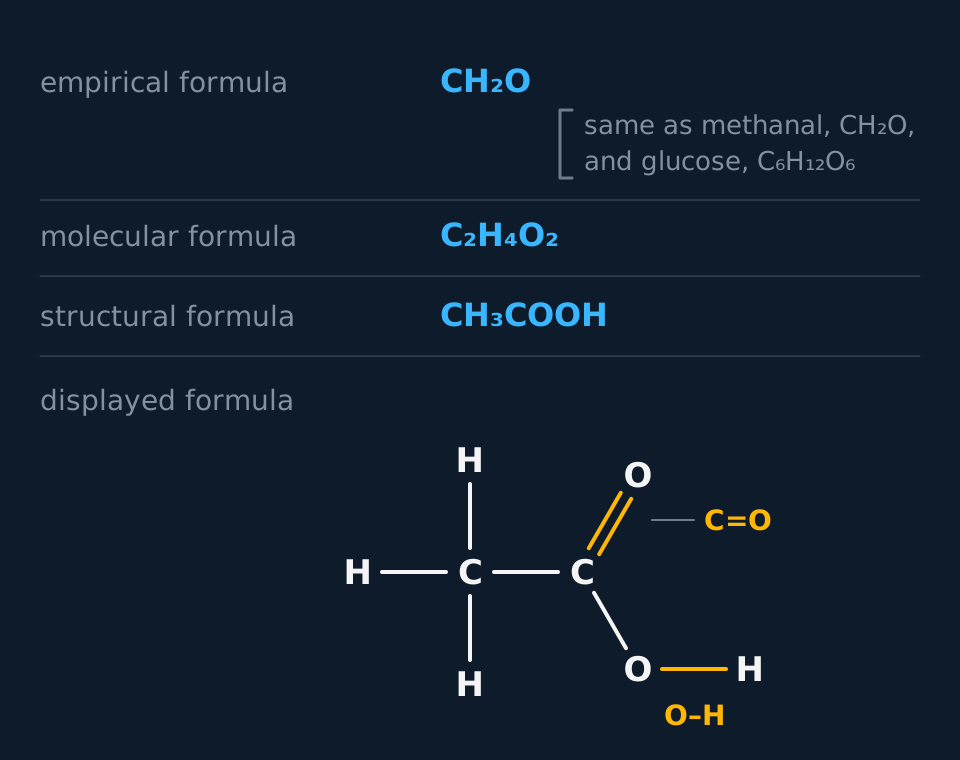
Describe the drawing
Four rows for ethanoic acid. The empirical formula CH2O, bracketed with the note that methanal and glucose share it; the molecular formula C2H4O2; the structural formula CH3COOH; and the displayed formula with every bond drawn: a carbon carrying three hydrogens joined to a second carbon that has a double bond to one oxygen and a single bond to an oxygen bonded to hydrogen, the C=O and O–H bonds picked out in amber.
Ionic compounds have only an empirical formula. A crystal of magnesium oxide is a lattice of Mg²⁺ and O²⁻ ions in a 1 : 1 ratio, with no molecules in it, so MgO is the formula unit and there is no molecular formula to find.
| Ethanoic acid | Methyl methanoate | Glucose | |
|---|---|---|---|
| Empirical formula | CH₂O | CH₂O | CH₂O |
| Molecular formula | C₂H₄O₂ | C₂H₄O₂ | C₆H₁₂O₆ |
| Structural formula | CH₃COOH | HCOOCH₃ | CH₂OH(CHOH)₄CHO |
| Carbon by mass | 40.0% | 40.0% | 40.0% |
| At room temperature | Liquid, boils at 118 °C | Liquid, boils at 32 °C | Solid |
Each formula down the table tells the compounds apart a little further. The empirical formula and the percentages separate none of the three. The molecular formula separates glucose from the other two. Only the structural formula separates the acid from the ester, which share every number above it and are structural isomers.
Each definition turns on one phrase. The empirical formula is the simplest whole-number ratio of atoms; 'simplest ratio' alone allows 1 : 1.5, which is not a formula. The molecular formula is the actual number of atoms of each element in a molecule; 'the formula of the molecule' says nothing about what makes it different from the empirical one.
- Empirical formula
- The simplest whole-number ratio of atoms of each element in a compound.
- Molecular formula
- The actual number of atoms of each element in one molecule of a compound.
- Structural formula
- The minimal detail that shows the arrangement of atoms in a molecule, group by group, such as CH₃CH₂OH.
- Displayed formula
- A formula showing the relative positioning of all the atoms in a molecule and every bond between them.
- Structural isomers
- Compounds with the same molecular formula but a different structural formula.
From masses to the empirical formula
An empirical formula is a ratio of atoms, and atoms are counted in moles, so the method turns each mass into moles and then compares the moles. Set it out as a grid, with one column for each element, so that every line can be checked.
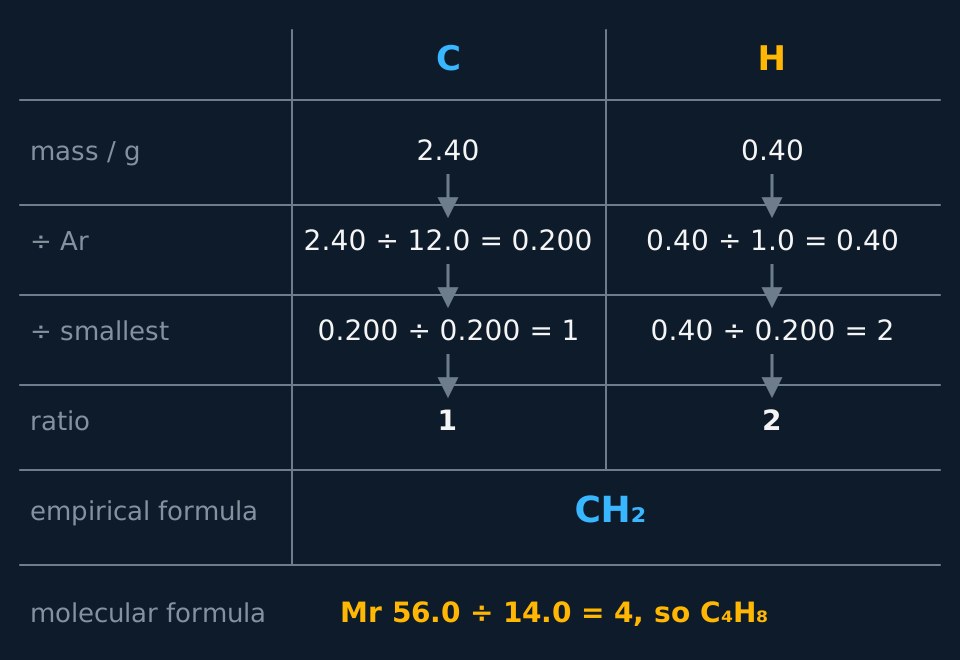
Describe the drawing
A grid with a column for carbon and a column for hydrogen and one row per step. Mass in grams: 2.40 and 0.40. Divide by Ar: 2.40 divided by 12.0 is 0.200, and 0.40 divided by 1.0 is 0.40. Divide by the smallest: 1 and 2. Ratio: 1 and 2, giving the empirical formula CH2. Beneath the grid: Mr 56.0 divided by 14.0 is 4, so the molecular formula is C4H8. Arrows run down each column.
The steps in order: write the mass of each element; divide each by its Ar to get moles of atoms; divide every answer by the smallest of them; read off the whole-number ratio. If one element's mass is not given, it is the total mass of the sample minus the masses of the others.
A hydrocarbon from its masses
A sample of a hydrocarbon contains 2.40 g of carbon and 0.40 g of hydrogen. Its relative molecular mass is 56.0. Find its empirical and molecular formulae.
Show the working
Moles of atoms: carbon 2.40 ÷ 12.0 = 0.200 mol; hydrogen 0.40 ÷ 1.0 = 0.40 mol.
Divide by the smaller, 0.200: carbon 0.200 ÷ 0.200 = 1; hydrogen 0.40 ÷ 0.200 = 2. The empirical formula is CH₂.
Empirical formula mass: 12.0 + 2 × 1.0 = 14.0. Units in one molecule: 56.0 ÷ 14.0 = 4.
Molecular formula: 4 × CH₂ = C₄H₈. That could be one of the butenes or a ring such as cyclobutane: isomers share a molecular formula, and the formula alone cannot say which this is.
The divide-by-smallest step does not always give whole numbers. An experimental value within about 0.1 of a whole number can be rounded: 2.03 is 2. A value close to 1.5, 1.33 or 1.25 cannot. Each is a whole number plus a half, a third or a quarter, and every number in the ratio must be multiplied by 2, 3 or 4 to clear it.
An iron oxide with 70.0% iron and 30.0% oxygen gives Fe 70.0 ÷ 55.8 = 1.254 and O 30.0 ÷ 16.0 = 1.875. Dividing by 1.254 gives 1 : 1.495. Rounding 1.495 to 1 would give FeO, which is a different oxide, 77.7% iron. Doubling gives 2 : 2.99, and the formula is Fe₂O₃.
The masses can come from an experiment in a crucible. Weigh a crucible and lid, add a coil of clean magnesium ribbon and weigh again, then heat strongly, lifting the lid a little now and then to let air in. When the ribbon no longer glows, heat to constant mass. The gain in mass is the oxygen that combined. From 0.240 g of magnesium giving 0.398 g of oxide, the oxygen is 0.158 g: Mg 0.240 ÷ 24.3 = 0.00988 mol, O 0.158 ÷ 16.0 = 0.00988 mol, a ratio of 1 : 1, and the formula is MgO.
The errors in that experiment all push the result in one direction. Lifting the lid too far lets white smoke of magnesium oxide escape, so the gain in mass is too small. Magnesium left unburned under the oxide coat adds no mass at all. Some magnesium reacts with nitrogen in the air to form magnesium nitride, Mg₃N₂, which adds less mass than the oxide would. Each gives too little oxygen per magnesium, and a ratio such as 1 : 0.85.
- Empirical formula mass
- The sum of the relative atomic masses of the atoms in the empirical formula.
From percentage composition
Analysis often reports percentages by mass. A percentage is the mass of that element in 100 g of the compound, so the percentages go straight into the grid as masses in grams. The molecular formula then needs Mr from somewhere else: the molecular ion peak in a mass spectrum, or the gas syringe method for a volatile compound.
A compound of carbon, hydrogen and oxygen
A compound contains 40.0% carbon, 6.7% hydrogen and 53.3% oxygen by mass. Its mass spectrum has a molecular ion peak at m/z = 60. Find its empirical and molecular formulae.
Show the working
Take 100 g: 40.0 g of carbon, 6.7 g of hydrogen and 53.3 g of oxygen. Check first: 40.0 + 6.7 + 53.3 = 100.0, so no element is missing.
Moles of atoms: C 40.0 ÷ 12.0 = 3.33; H 6.7 ÷ 1.0 = 6.7; O 53.3 ÷ 16.0 = 3.33.
Divide by the smallest, 3.33: C 1.00; H 2.01; O 1.00. 2.01 is within 0.1 of 2, so the ratio is 1 : 2 : 1 and the empirical formula is CH₂O.
Empirical formula mass: 12.0 + 2 × 1.0 + 16.0 = 30.0. The molecular ion gives Mr = 60, and 60 ÷ 30.0 = 2.
Molecular formula: C₂H₄O₂. Ethanoic acid and methyl methanoate both fit; an infrared spectrum, or fizzing with sodium carbonate for the acid, would tell them apart.
Two checks catch most errors. The percentages should add to 100, or very nearly. If they fall well short and the compound is organic, the missing mass is usually oxygen, found by subtraction. And Mr should come out as a whole-number multiple of the empirical formula mass. A multiple of 2.5 means the empirical formula is wrong, not that the molecule holds two and a half units.
A compound with no oxygen can still hide a trap. A hydrocarbon that is 92.3% carbon and 7.7% hydrogen gives C 7.69 and H 7.7, a ratio of 1 : 1, and an empirical formula of CH. Benzene, C₆H₆, and ethyne, C₂H₂, both fit. The percentages are identical, and only Mr decides.
For a volatile compound the gas syringe gives Mr, through pV = nRT, to within a few per cent. That is enough, because the molecular formula needs only the whole-number multiple, and a value of 1.97 or 2.04 is plainly 2.
A molecular formula from a vapour
A volatile liquid is 54.5% carbon, 9.1% hydrogen and 36.4% oxygen by mass. 0.220 g of it gives 77.0 cm³ of vapour at 373 K and 101 kPa. Find its molecular formula. R = 8.31 J K⁻¹ mol⁻¹.
Show the working
Moles of atoms in 100 g: C 54.5 ÷ 12.0 = 4.54; H 9.1 ÷ 1.0 = 9.1; O 36.4 ÷ 16.0 = 2.275.
Divide by 2.275: C 2.00; H 4.00; O 1.00. The empirical formula is C₂H₄O, with an empirical formula mass of 44.0.
Amount of vapour: n = pV ÷ RT = (1.01 × 10⁵ × 7.70 × 10⁻⁵) ÷ (8.31 × 373) = 7.777 ÷ 3099.6 = 2.509 × 10⁻³ mol.
Molar mass: M = 0.220 ÷ (2.509 × 10⁻³) = 87.7 g mol⁻¹, and 87.7 ÷ 44.0 = 1.99, which is 2.
Molecular formula: C₄H₈O₂, Mr 88.0, and the syringe value was 0.3% low, which does not matter. Butanoic acid has this formula but boils at 164 °C, so it could not all have been vapour at 373 K; an ester such as ethyl ethanoate, boiling at 77 °C, could.
The arithmetic also runs the other way, from a formula to its percentages. The percentage of an element is the mass of it in one formula unit divided by Mr, times 100. A farmer comparing nitrogen fertilisers needs exactly that. Ammonium nitrate, NH₄NO₃, has Mr = 80.0 and contains 2 × 14.0 = 28.0 of nitrogen, so it is 35.0% nitrogen. Urea, CO(NH₂)₂, has Mr = 60.0 and the same 28.0 of nitrogen, so it is 46.7% nitrogen, and a tonne of urea spreads a third as much nitrogen again as a tonne of ammonium nitrate.
- Percentage by mass
- The mass of an element in a compound as a percentage of the mass of the compound, equal to its mass in grams in 100 g.
- Hydrocarbon
- A compound that contains carbon and hydrogen only.
Combustion analysis
Most organic compounds contain carbon and hydrogen, and burning one in excess oxygen turns all of its carbon into carbon dioxide and all of its hydrogen into water. Weigh those two products and the masses of carbon and hydrogen in the sample follow. The percentages printed by a modern automatic analyser come from this idea.
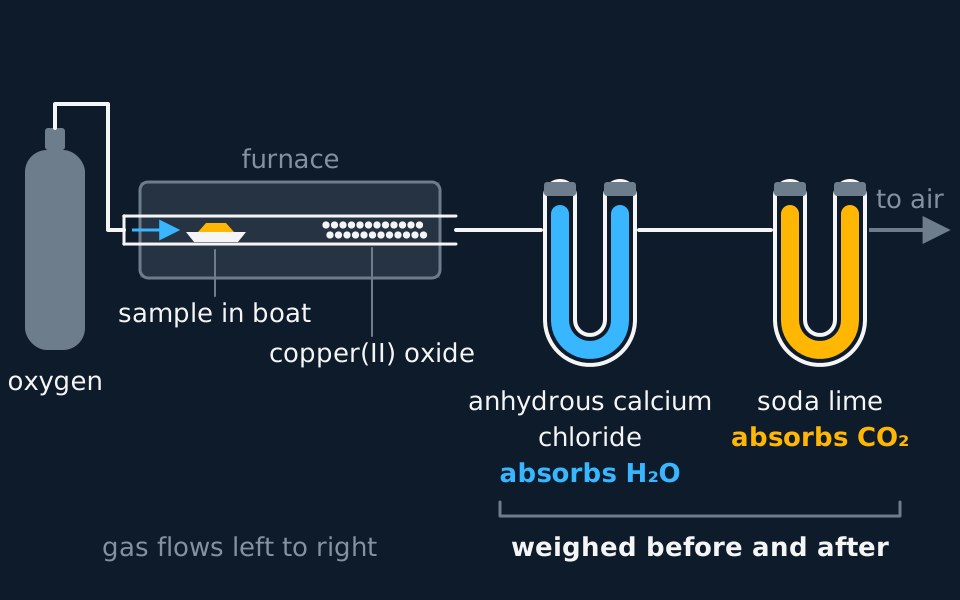
Describe the drawing
A combustion train drawn left to right. An oxygen cylinder feeds a silica tube running through a furnace; inside the tube is the sample in a porcelain boat and, downstream, a packing of copper(II) oxide to complete the oxidation. The gases then pass through a U-tube of anhydrous calcium chloride that absorbs water, then a U-tube of soda lime that absorbs carbon dioxide, and out to air. A bracket under both U-tubes says they are weighed before and after.
The order of the absorbers matters. Anhydrous calcium chloride absorbs water and nothing else. Soda lime, a mixture containing sodium and calcium hydroxides, absorbs carbon dioxide, but it absorbs water as well. With the soda lime first, its gain in mass would include the water and the carbon result would be too high. With the drying agent first, each tube gains only its own product.
The conversion uses the fraction of each product's mass that came from the element. In CO₂, 12.0 of the 44.0 mass units are carbon; in H₂O, 2 × 1.0 = 2.0 of the 18.0 are hydrogen. Oxygen cannot be found this way, because the oxygen in the products came partly from the oxygen gas. Its mass in the sample is found by difference: the mass of the sample minus the masses of carbon and hydrogen.
mass of C = mass of CO₂ × 12.0 ÷ 44.0; mass of H = mass of H₂O × 2.0 ÷ 18.0
The method depends on burning every atom of carbon to carbon dioxide. Carbon that leaves as carbon monoxide, or stays in the boat as soot, never reaches the soda lime, so the mass of carbon comes out low and the oxygen found by difference comes out high by the same amount. That is why the oxygen is in excess and why hot copper(II) oxide sits downstream of the sample, oxidising any carbon monoxide on its way past.
CuO(s) + CO(g) → Cu(s) + CO₂(g)
The sample must also be dry. Water in it is weighed in the calcium chloride tube with the water from combustion, and is counted as hydrogen that the compound does not contain.
TRY IT: From combustion products to a formula
0.230 g of a compound containing only carbon, hydrogen and oxygen burns completely to give 0.440 g of carbon dioxide and 0.270 g of water. Find its empirical formula.
Check your answer
Masses: carbon 0.440 × 12.0 ÷ 44.0 = 0.120 g; hydrogen 0.270 × 2.0 ÷ 18.0 = 0.0300 g; oxygen by difference 0.230 − 0.120 − 0.0300 = 0.080 g.
Moles of atoms: C 0.120 ÷ 12.0 = 0.0100; H 0.0300 ÷ 1.0 = 0.0300; O 0.080 ÷ 16.0 = 0.0050. Dividing by 0.0050 gives 2 : 6 : 1.
The empirical formula is C₂H₆O, which is ethanol or methoxymethane. It is also the molecular formula: a compound with n carbon atoms and only single bonds holds at most 2n + 2 hydrogens, so C₄H₁₂O₂ cannot exist.
- Combustion analysis
- Finding the masses of carbon and hydrogen in a compound by burning a weighed sample in excess oxygen and weighing the carbon dioxide and water formed.
In the exam
- An empirical formula calculation is marked step by step: one mark for dividing each mass or percentage by Ar, one for the ratio, one for the formula. A slip in the first step is carried forward, so set each step out as its own line.
- Round a ratio only when it is within about 0.1 of a whole number. A value near 1.5 or 1.33 means multiplying every term by 2 or 3; a scheme does not accept a formula reached by rounding 1.5.
- For a molecular formula, state the empirical formula mass and the multiplier before writing the formula; the formula alone, with no working, may lose the method mark.
- Oxygen in combustion analysis is found by difference. The order of the absorbers is explained by soda lime absorbing both water and carbon dioxide, so the water must be removed first.
Check yourself
A hydrocarbon is 85.7% carbon by mass and its molecular ion peak is at m/z = 42. Find its empirical and molecular formulae, and explain why the percentage alone could not have told it apart from cyclohexane, C₆H₁₂.
Answer
Hydrogen is 100 − 85.7 = 14.3%. In 100 g: C 85.7 ÷ 12.0 = 7.14 mol; H 14.3 ÷ 1.0 = 14.3 mol. Dividing by 7.14 gives 1 : 2.00, so the empirical formula is CH₂.
The empirical formula mass is 14.0, and 42 ÷ 14.0 = 3, so the molecular formula is C₃H₆: propene or cyclopropane.
Cyclohexane is also CH₂ in its simplest ratio, so it has exactly the same percentage composition. Only the relative molecular mass, here from the mass spectrum, separates compounds that share an empirical formula.
Questions
Question 16 marks
Describe how combustion analysis is used to find the empirical formula of a compound containing carbon, hydrogen and oxygen. Include the order of the absorbers and the conditions that make the result reliable.
Mark scheme
Indicative content
- a weighed, dry sample is burned in a stream of excess oxygen, so that all its carbon forms carbon dioxide and all its hydrogen forms water
- hot copper(II) oxide downstream of the sample oxidises any carbon monoxide to carbon dioxide, so that no carbon escapes unmeasured
- the gases pass first through a weighed tube of anhydrous calcium chloride, which absorbs only water, then through a weighed tube of soda lime
- soda lime absorbs carbon dioxide and water, so it must come second or its gain in mass would include water and the carbon would be too high
- mass of carbon = gain of the soda lime × 12.0 ÷ 44.0, mass of hydrogen = gain of the calcium chloride × 2.0 ÷ 18.0, and oxygen is the sample mass minus both
- each mass is divided by its Ar and by the smallest result to give the simplest whole-number ratio, which is the empirical formula
Levels
- Level 3 (5–6 marks) combustion in excess oxygen, the copper(II) oxide to convert carbon monoxide, the absorbers in the correct order with the reason the order matters, oxygen found by difference and the conversion of the three masses to the simplest ratio are all present; each stage is linked to why the result can be trusted
- Level 2 (3–4 marks) the two absorbers are named and their gains give carbon and hydrogen, with oxygen by difference; the order of the absorbers is not justified, the copper(II) oxide is absent, or the ratio is not completed
- Level 1 (1–2 marks) the compound is burned and the products absorbed, typically with the alkali first so that it takes up the water too, and the calculation is not set out
Question 24 marks
Calculate the molecular formula of a hydrocarbon that is 82.8% carbon and 17.2% hydrogen by mass and has a relative molecular mass of 58.0.
Mark scheme
- M1 in 100 g: C 82.8 ÷ 12.0 = 6.90 and H 17.2 ÷ 1.0 = 17.2
- M1 dividing by 6.90 gives 1 : 2.49, which is doubled to 2 : 5, so the empirical formula is C₂H₅; reject CH₂ or CH₃ from rounding 2.49
- M1 the empirical formula mass is 29.0, and 58.0 ÷ 29.0 = 2
- A1 the molecular formula is C₄H₁₀; allow error carried forward from a wrong empirical formula
Question 34 marks
Calculate the empirical formula of a compound of carbon, hydrogen and oxygen, given that 0.180 g of it burns completely to give 0.264 g of carbon dioxide and 0.108 g of water.
Mark scheme
- M1 mass of C = 0.264 × 12.0 ÷ 44.0 = 0.0720 g and mass of H = 0.108 × 2.0 ÷ 18.0 = 0.0120 g
- M1 mass of O = 0.180 − 0.0720 − 0.0120 = 0.0960 g
- M1 moles: C 0.00600, H 0.0120, O 0.00600, a ratio of 1 : 2 : 1
- A1 the empirical formula is CH₂O
All 17 questions with mark schemes, the other 14 set out in full on the question page.
Worth remembering
- Dividing the percentages by each other, not by Ar, gives a mass ratio, not a formula.
- Rounding 1.5 or 1.33 to the nearest whole number gives a different compound.
- A molecular formula written without the empirical formula mass and multiplier has no working to credit.
- Find oxygen in a combustion analysis by subtracting the masses of C and H from the sample's mass; part of the oxygen in the CO₂ and H₂O came from the air.
- Give any missing percentage to oxygen when the elements named fall short of 100.
CHECK YOUR PROGRESS
Rate how confident you are with each objective for this lesson. Ratings are saved in this browser, on this device, unless you sign in.
- Define empirical formula and molecular formula, and distinguish both from a structural formula.
- Calculate an empirical formula from the masses of the elements in a compound, or from its percentage composition by mass.
- Recognise ratios such as 1 : 1.5 and 1 : 1.33 that must be multiplied up, not rounded.
- Find a molecular formula from an empirical formula and a relative molecular mass.
- Use the masses of carbon dioxide and water from combustion analysis to find the masses of carbon, hydrogen and oxygen in a sample.
Open the full revision checklist to see every objective in the curriculum in one place.
Practise this lesson
Practise empirical and molecular formulae with 17 original questions and point-by-point mark schemes
WORKBOOK
The written questions from this topic, on paper with room to work, and a separate book of mark schemes. The question that is set on a diagram stays on this page, where the diagram can be drawn. Free to use; please do not redistribute or sell.
Used later in Naming and representing organic molecules · Putting the analysis together: structure from spectra