Chemistry › Carbonyls and carboxylic acids › Optical isomerism
Optical isomerism
Hold your hands palm to palm and they match; lay one on top of the other and they do not. A carbon atom with four different groups has the same property, and the two forms it can take rotate polarised light in opposite directions. Which form a reaction makes, and which form a drug is sold as, both follow from it.
Key terms Every definition in carbonyls and carboxylic acids, lesson by lesson
Before this Structural isomerism and E/Z isomerism – stereoisomers have the same structural formula and a different arrangement in space · Shapes of molecules and ions – a carbon with four bonding pairs is tetrahedral, 109.5°
COMMON MISCONCEPTION
Two molecules with the same bonds in the same order are the same molecule, so a mirror image is just the original turned round.
A carbon with four different groups has two arrangements that cannot be turned into each other, as a left hand cannot be turned into a right. The mirror image has the same bonds in the same order and is a different compound: it rotates plane-polarised light the opposite way.
What you should be able to do
- Identify a chiral centre in a structure as a carbon atom bonded to four different atoms or groups.
- Draw the two enantiomers of a chiral molecule in three dimensions, with wedge and dashed bonds, as mirror images.
- Describe how a pair of enantiomers affects plane-polarised light.
- Explain why a racemic mixture is optically inactive.
- Explain why nucleophilic addition to a planar carbonyl group gives a racemic mixture.
- Suggest why a drug is made as a single enantiomer, using thalidomide and ibuprofen as examples.
Four different groups on one carbon
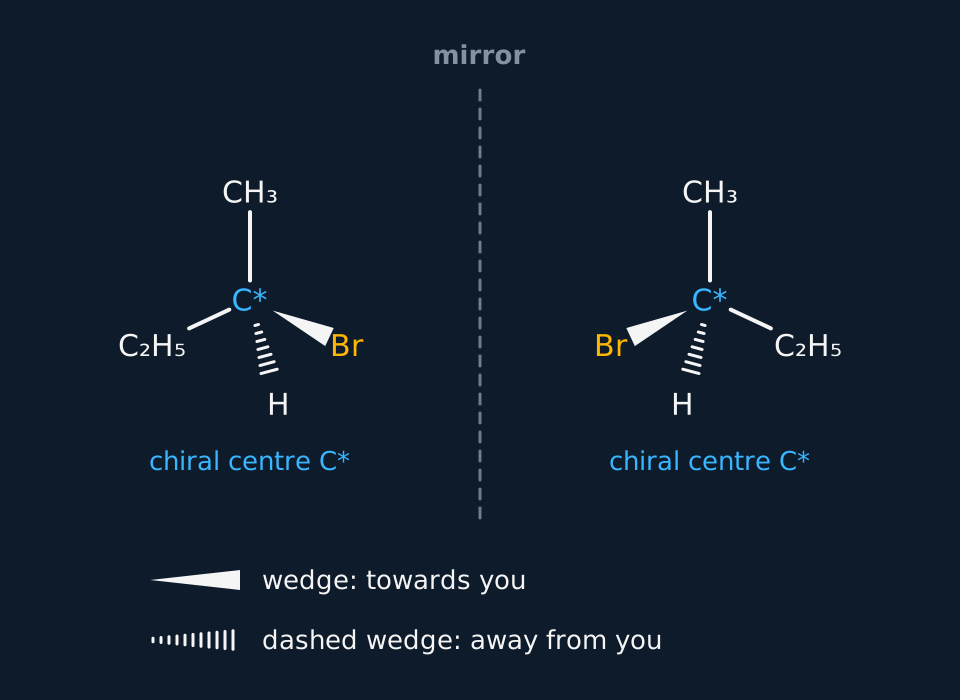
Butan-2-ol is CH₃CH(OH)CH₂CH₃. Its second carbon carries four different groups: a hydrogen atom, a hydroxyl group, a methyl group and an ethyl group. Those four groups sit at the corners of a tetrahedron, and there are exactly two ways to arrange four different things on the corners of a tetrahedron. The two arrangements are mirror images of each other.
A model kit shows the problem. Laid one on the other, the two models cannot be made to coincide: line up the OH and the H and the methyl and ethyl groups point the wrong way; swap those and the OH and H are wrong. No rotation makes them match, because turning a molecule cannot turn it into its reflection. A left and a right hand are related in just this way, and the word chiral comes from the Greek for hand.
Describe the drawing
Two drawings of 2-bromobutane either side of a vertical dashed mirror line. In each the chiral carbon C* has CH₃ straight up and C₂H₅ to one side as plain bonds in the plane of the page, Br on a solid wedge towards the viewer and H on a dashed wedge away from the viewer, both low on the other side. The right drawing is the exact reflection of the left, so the groups run the opposite way round and no rotation makes one drawing into the other.
The carbon carrying the four different groups is the chiral centre, sometimes called an asymmetric carbon, and it is marked with an asterisk in a structure. The two forms are enantiomers, and together they are an example of optical isomerism, a type of stereoisomerism: the structural formula is the same and only the arrangement in space differs.
Draw an enantiomer with two bonds in the plane of the paper as plain lines, one coming towards the reader as a solid wedge and one going away as a dashed wedge. Draw the second enantiomer as the reflection of the first in a vertical mirror line. A drawing that shows the four groups flat, at right angles, does not show chirality at all, because a flat drawing of a tetrahedral carbon loses the information about which group is in front.
- Chiral centre
- A carbon atom bonded to four different atoms or groups of atoms.
- Enantiomers
- Stereoisomers that are non-superimposable mirror images of each other.
- Optical isomerism
- Stereoisomerism that occurs when a molecule contains a chiral centre, giving two enantiomers.
- Stereoisomers
- Molecules with the same structural formula but a different arrangement of atoms in space.
Finding the chiral centre
Check each carbon in turn and ask what it is bonded to. Two kinds of carbon can be ruled out at once. A carbon in a CH₃ or CH₂ group has at least two identical hydrogens. A carbon in a double bond, C=C or C=O, has only three groups around it and is planar, so it has no mirror-image form.
For the carbons left, compare the four groups as whole groups, not as the first atom. In 3-methylhexane, CH₃CH₂CH(CH₃)CH₂CH₂CH₃, the third carbon carries H, CH₃, CH₂CH₃ and CH₂CH₂CH₃. Three of those begin with a carbon, but the groups differ further along, so all four are different and the carbon is chiral. In 3-methylpentane, CH₃CH₂CH(CH₃)CH₂CH₃, the same carbon carries two ethyl groups, and the molecule is not chiral.
Finding the chiral centres in 2-hydroxypropanoic acid
Lactic acid, 2-hydroxypropanoic acid, is CH₃CH(OH)COOH. It is made in muscles during hard exercise and when milk sours. Identify any chiral centre and say how many optical isomers the molecule has.
Show the working
Carbon 1 is the COOH carbon. It is double bonded to oxygen, so it has three groups around it and cannot be chiral.
Carbon 3 is the CH₃ carbon. It carries three hydrogen atoms, so it cannot be chiral.
Carbon 2 carries H, OH, CH₃ and COOH. All four are different, so carbon 2 is a chiral centre and is marked C*.
One chiral centre gives one pair of enantiomers, so lactic acid has two optical isomers. Muscle makes only one of them; sour milk contains the other as well.
Molecules with two or more chiral centres can have more than two stereoisomers. A question asks only that each chiral centre be identified, and one that asks how many chiral centres a drug molecule contains is answered by counting the carbons that pass the four-different-groups test, ring carbons included.
Amino acids are chiral too. Alanine, CH₃CH(NH₂)COOH, has H, NH₂, CH₃ and COOH on its central carbon. Every amino acid in a protein has a chiral centre except glycine, H₂NCH₂COOH, whose central carbon carries two hydrogens. Proteins are built from one enantiomer of each amino acid only, so the enzymes made from them are chiral too.
A ring carbon is tested by walking round the ring in each direction from it. If the two routes meet the same atoms in the same order, the two ring branches are identical groups and the carbon is not chiral; if they differ, they count as two different groups.
TRY IT: Which C₄H₉Cl is chiral
There are four structural isomers with the formula C₄H₉Cl: 1-chlorobutane, 2-chlorobutane, 1-chloro-2-methylpropane and 2-chloro-2-methylpropane. Identify the one that shows optical isomerism and explain your choice.
Check your answer
In 1-chlorobutane and 1-chloro-2-methylpropane the carbon bonded to chlorine is a CH₂Cl carbon with two hydrogens on it. In 1-chloro-2-methylpropane the CH carbon carries two methyl groups. In 2-chloro-2-methylpropane the C–Cl carbon carries three methyl groups. None of these carbons has four different groups.
In 2-chlorobutane, CH₃CHClCH₂CH₃, carbon 2 carries H, Cl, CH₃ and CH₂CH₃, which are four different groups. 2-Chlorobutane is the chiral isomer and exists as a pair of enantiomers.
Plane-polarised light and racemic mixtures
Enantiomers have the same melting point, the same boiling point, the same density and the same reactions with ordinary reagents. Every bond is the same, so nothing that depends only on bonds can tell them apart. One physical property does differ, and it is the one that gave optical isomerism its name.
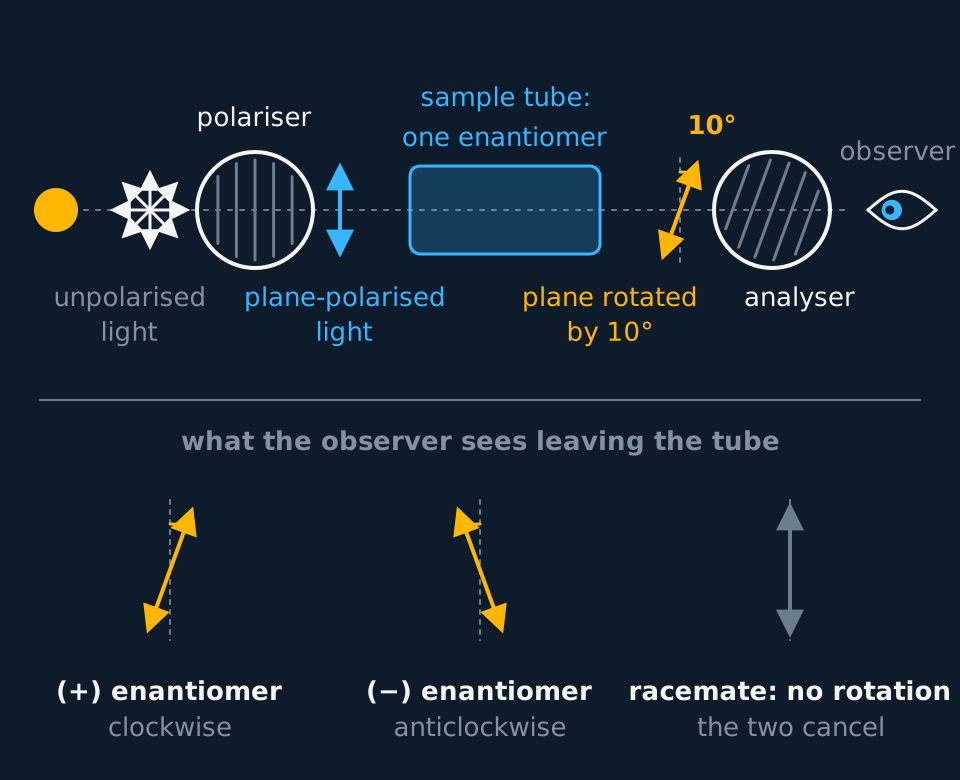
Light from a lamp vibrates in every plane at right angles to its direction of travel. A polarising filter lets through only the light vibrating in one plane, giving plane-polarised light. Pass that light through a solution of one enantiomer and the plane is turned, say 10° clockwise. A solution of the other enantiomer, at the same concentration in the same tube, turns it 10° anticlockwise. A substance that rotates the plane of plane-polarised light is optically active.
Describe the drawing
A beam of light runs left to right. Unpolarised light from a lamp, drawn as double-headed arrows in many planes, passes a polariser with vertical slits and leaves as one vertical plane of vibration. It passes a tube holding a solution of one enantiomer and leaves with the plane turned clockwise, marked 10 degrees, so the analyser beyond it is turned through the same angle before the light reaches the observer's eye. Below, the emerging plane for three samples: the (+) enantiomer turns it clockwise, the (−) enantiomer anticlockwise by the same angle, and a racemate not at all.
The instrument is a polarimeter. The rotation is measured by turning a second filter, the analyser, until the light passing through is brightest again. The size of the rotation depends on the concentration and the length of the tube; its direction depends only on which enantiomer is present. The enantiomer that turns the plane clockwise, seen by an observer looking towards the light source, is labelled (+); its mirror image is labelled (−). The sign is measured, not predicted from the drawing.
A mixture containing equal amounts of the two enantiomers is a racemic mixture, or racemate. For every molecule turning the plane one way, there is a molecule turning it the same amount the other way, so the rotations cancel and the mixture is optically inactive. A racemate still contains chiral molecules; the mixture as a whole shows no rotation.
- Plane-polarised light
- Light in which the vibrations occur in one plane only.
- Optically active
- Able to rotate the plane of plane-polarised light; the two enantiomers rotate it by equal amounts in opposite directions.
- Racemic mixture
- A mixture containing equal amounts of two enantiomers, which is optically inactive because their rotations cancel.
Why a carbonyl gives a racemate
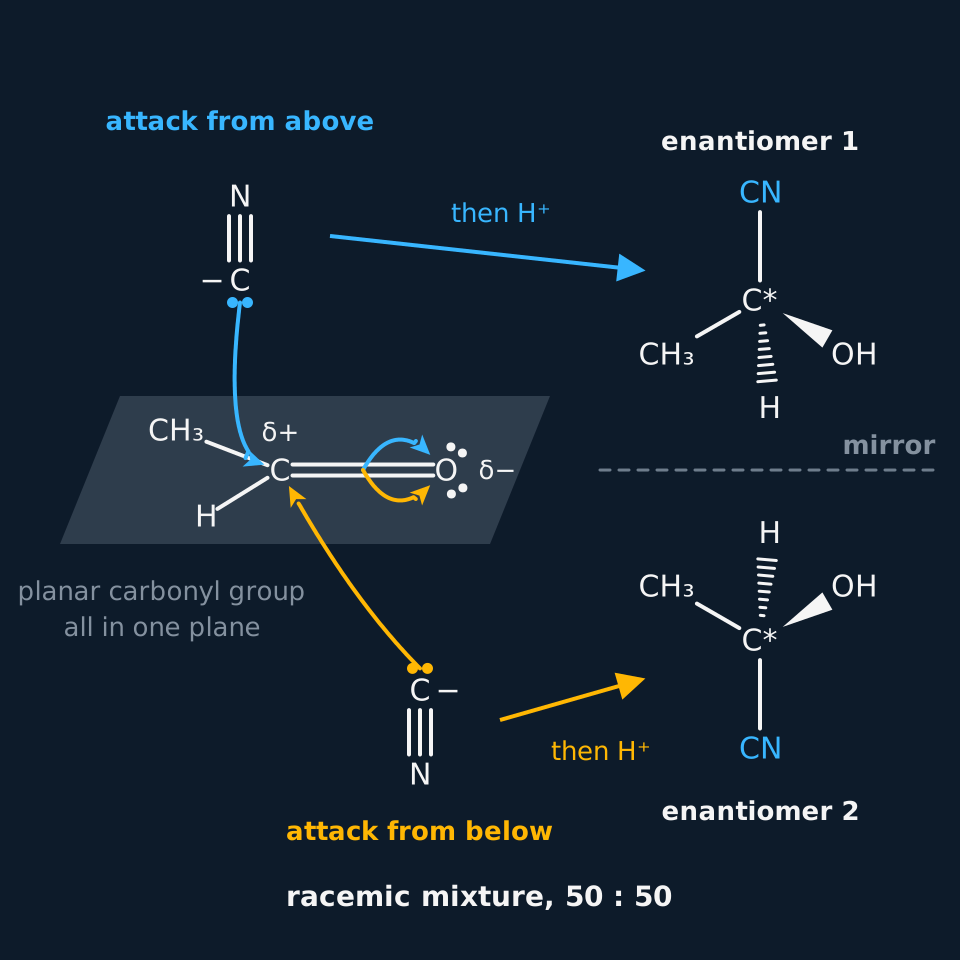
Ethanal reacts with hydrogen cyanide to give 2-hydroxypropanenitrile, CH₃CH(OH)CN. The product's middle carbon carries H, OH, CH₃ and CN, so it is a chiral centre. The ethanal it came from has no chiral centre: its carbonyl carbon is bonded to only three groups, H, CH₃ and O, and those three lie in one plane with bond angles of 120°.
The cyanide ion attacks the carbonyl carbon from above or below that plane. Nothing in a flask of ethanal favours one face over the other, so attack from above and attack from below happen equally often. Attack from one face gives one enantiomer; attack from the other face gives its mirror image. Across the many millions of molecules in a flask the two are made in equal amounts, and the product is a racemic mixture with no optical activity.
Describe the drawing
Ethanal's carbonyl group drawn lying in a shaded flat plane seen at an angle, with δ+ on carbon and δ− on oxygen. A cyanide ion above the plane on the left and another below it on the right each send a curly arrow from the lone pair on carbon to the carbonyl carbon, with a second arrow from the C=O bond to oxygen. After H⁺ is added, attack from above gives one enantiomer of 2-hydroxypropanenitrile with CN pointing up, and attack from below gives its reflection in a dashed mirror line, CN pointing down. Both faces are equally likely, so the product is a 50 : 50 racemic mixture.
The same reasoning applies to any reaction in which a nucleophile adds to a planar carbonyl carbon and creates a chiral centre. Reduction of butanone by sodium tetrahydridoborate(III) gives racemic butan-2-ol, since its carbonyl carbon is planar too and the product carbon carries H, OH, CH₃ and C₂H₅. Where the carbonyl carbon already carries two identical groups, as in propanone, the product has no chiral centre and the question of a racemate does not arise.
Living cells behave differently. An enzyme's active site is itself chiral, so it holds the planar substrate with one face exposed and the other buried, and the product is a single enantiomer. Muscle makes only one form of lactic acid for this reason.
In an answer, the three points that earn the marks are the planar carbonyl group, attack equally likely from above and below the plane, and equal amounts of the two enantiomers. 'Random attack' alone does not say that both faces are equally open, and 'a mixture of isomers' does not say that the amounts are equal.
Drugs as single enantiomers
A drug acts by fitting a receptor or an enzyme, and those are chiral. The two enantiomers of a drug can fit differently, so one may be active and the other inactive, or harmful. A synthesis that goes through a planar carbonyl gives a racemate, and the unwanted enantiomer then has to be separated out or the route changed to make one enantiomer only, which is expensive.
Thalidomide was sold from 1957 as a racemate, prescribed as a sedative and against morning sickness. One enantiomer is a sedative. The other causes severe limb defects in a developing fetus, and around ten thousand children were born affected before the drug was withdrawn in 1961. Selling only the sedative enantiomer would not have prevented the harm, because the two interconvert in the body and the racemate forms again. Thalidomide is now used, under strict controls, to treat leprosy and some cancers.
Ibuprofen is also sold as a racemate. Only one enantiomer relieves pain and inflammation, but the body converts much of the other into the active form, so the racemate works. A single-enantiomer version exists, acts faster at a lower dose, and costs more to make. The decision to separate is therefore one of cost against benefit, made drug by drug.
| Thalidomide | Ibuprofen | |
|---|---|---|
| Activity of one enantiomer | Sedative | Relieves pain and inflammation |
| Activity of the other | Causes fetal limb defects | Little activity, partly converted to the active form |
| Sold as | Racemate, 1957 to 1961 | Racemate, usually |
| Would a single enantiomer help | No: they interconvert in the body | Faster action at a lower dose, at higher cost |
Other boards: optical activity as evidence for a mechanism
Edexcel uses the polarimeter to show which mechanism a substitution followed; AQA does not. The test starts from one pure enantiomer of 2-bromobutane, which rotates plane-polarised light, warmed with aqueous sodium hydroxide. Both the SN2 and the SN1 mechanism give butan-2-ol, which is chiral, so the product's effect on the light is what tells the two routes apart.
In an SN2 reaction the hydroxide ion attacks the carbon from the side opposite the bromine, and the C–O bond forms as the C–Br bond breaks, in one step. The other three groups are pushed through to the far side, like an umbrella blown inside out, so the product has the opposite arrangement of groups to the reactant. This is inversion of configuration. Every molecule is inverted in the same way, so the product is a single enantiomer and the solution is still optically active.
In an SN1 reaction the C–Br bond breaks first and a carbocation forms. Its positive carbon is bonded to three groups and is planar, like a carbonyl carbon. The hydroxide ion then attacks either face with equal probability, the two enantiomers of butan-2-ol form in equal amounts, and the product is a racemic mixture that does not rotate the light, although the starting material did.
| SN2 | SN1 | |
|---|---|---|
| Steps | One: bond forms as the C–Br bond breaks | Two: C–Br breaks, then OH⁻ adds |
| Intermediate | None | Planar carbocation |
| Direction of attack | Opposite the leaving group only | Either face, equally |
| Product from one enantiomer | One enantiomer, inverted | Racemic mixture |
| Effect on plane-polarised light | Rotates it | No rotation |
A tertiary halogenoalkane reacts by SN1 and a primary one by SN2. A secondary one such as 2-bromobutane can do both at once, and its product is then partly racemised: it still rotates the light, but by less than a pure enantiomer would.
Reading a partly racemised product
A single enantiomer of 2-bromobutane is warmed with aqueous sodium hydroxide. Pure (−)-butan-2-ol rotates the plane by −12.0° in the tube used. The product, at the same concentration in the same tube, rotates it by −9.0°. Calculate the percentage of each enantiomer in the product and say what the result shows about the mechanism.
Show the working
Any racemic part gives no rotation, so all of the −9.0° comes from the excess of (−) over (+). Excess of (−) = 9.0 ÷ 12.0 × 100 = 75%.
The other 25% of the product is racemic, so it holds 12.5% of each enantiomer.
The product is 75 + 12.5 = 87.5% (−) and 12.5% (+).
A pure SN2 reaction would give one enantiomer, and a pure SN1 reaction a racemate with no rotation. Here 75% of the molecules reacted by SN2 with inversion and 25% by SN1 through the planar carbocation.
- Chiral
- Describes a molecule that cannot be superimposed on its mirror image, usually because it contains a chiral centre.
- Inversion of configuration
- The reversal of the arrangement of groups around a chiral centre when a nucleophile attacks from the side opposite the leaving group, as in an SN2 reaction.
In the exam
- The asterisk goes on the carbon atom itself. The scheme does not credit an asterisk placed on a group attached to it, or on the whole molecule.
- Enantiomers drawn as two 3D structures, each with a wedge and a dashed bond, as mirror images, earn the drawing mark. Two flat structures are rejected, because they do not show which group is in front.
- Optical activity is credited as rotating the plane of plane-polarised light, in opposite directions for the two enantiomers. 'Bend' or 'reflect' light is rejected.
- For why a racemate forms, the scheme awards three points: the carbonyl group is planar, attack is equally likely from either side, and so equal amounts of the two enantiomers form.
- Asked why a racemate is optically inactive, state that the equal and opposite rotations cancel; 'it has no chiral centre' is wrong, because every molecule in it is chiral.
Check yourself
A student reduces pentan-3-one, CH₃CH₂COCH₂CH₃, and pentan-2-one, CH₃COCH₂CH₂CH₃, separately with NaBH₄, and tests each product with a polarimeter. Neither rotates plane-polarised light. Explain both results.
Answer
Pentan-3-one gives pentan-3-ol, CH₃CH₂CH(OH)CH₂CH₃. Its third carbon carries two ethyl groups, so it is not a chiral centre and the product cannot be optically active.
Pentan-2-one gives pentan-2-ol, CH₃CH(OH)CH₂CH₂CH₃. Its second carbon carries H, OH, CH₃ and CH₂CH₂CH₃, so it is chiral.
The hydride ion attacked a planar carbonyl carbon equally from either face, so both enantiomers formed in equal amounts. Their rotations cancel and the racemic mixture shows no rotation, even though every molecule in it is chiral.
Questions
Question 16 marks
Explain, using 2-hydroxypropanoic acid (lactic acid) as the example, what optical isomerism is, how the two isomers are told apart, and why lactic acid made in muscle rotates plane-polarised light while lactic acid made in the laboratory from ethanal does not.
Mark scheme
Indicative content
- carbon 2 of CH₃CH(OH)COOH is bonded to four different groups, H, OH, CH₃ and COOH, so it is a chiral centre
- the molecule exists as two enantiomers, non-superimposable mirror images that differ only in the arrangement in space
- the enantiomers have identical physical and chemical properties with achiral reagents, so ordinary tests do not separate them
- they rotate the plane of plane-polarised light by equal amounts in opposite directions, measured with a polarimeter
- the laboratory route adds cyanide to the planar carbonyl of ethanal from either face equally, giving a racemate whose rotations cancel
- the enzyme in muscle has a chiral active site that exposes only one face of the substrate, so a single enantiomer forms and rotates the light
Levels
- Level 3 (5–6 marks) the chiral centre is identified with its four groups, the enantiomers are described as non-superimposable mirror images, the polarimeter test is given, and both sources are explained: attack on either face of the planar carbonyl giving a racemate in the laboratory, and the chiral active site of the enzyme giving one enantiomer
- Level 2 (3–4 marks) the chiral centre and the enantiomers are described and the polarimeter given; the racemate from ethanal or the single enantiomer from the enzyme is explained only in part
- Level 1 (1–2 marks) a chiral carbon or mirror-image isomers are mentioned; laboratory lactic acid is commonly said to be inactive because it has no chiral centre
Question 24 marks
Explain why the 2-hydroxypropanenitrile formed from ethanal with KCN followed by dilute acid is optically inactive, although its molecules are chiral.
Mark scheme
- B1 the carbonyl group in ethanal is planar, with three groups around the carbon at 120°
- B1 the cyanide ion can attack the carbonyl carbon from above or below the plane with equal probability
- B1 attack from the two faces gives the two enantiomers, so they form in equal amounts as a racemic mixture
- B1 the equal and opposite rotations of the two enantiomers cancel, so the mixture is optically inactive
Question 34 marks
Name the organic product when butanone is reduced by NaBH₄, and when pentan-3-one reacts with KCN followed by dilute acid, and explain whether a sample of each product rotates plane-polarised light.
Mark scheme
- B1 butanone gives butan-2-ol, CH₃CH(OH)CH₂CH₃
- B1 pentan-3-one gives 2-ethyl-2-hydroxybutanenitrile, CH₃CH₂C(OH)(CN)CH₂CH₃
- B1 butan-2-ol is chiral, but hydride attacks the planar C=O equally from either face, so the racemate does not rotate the light
- B1 the nitrile's central carbon carries two ethyl groups, so it is not chiral and cannot rotate the light
All 17 questions with mark schemes, the other 14 set out in full on the question page.
Worth remembering
- Compare whole groups, not first atoms: CH₂CH₃ and CH₂CH₂CH₃ are different groups.
- A CH₂, a CH₃ or a C=O carbon is never a chiral centre.
- Two flat drawings at right angles show no chirality; one wedge and one dashed bond each, as mirror images.
- Enantiomers rotate the plane of polarised light; they do not 'bend' or 'reflect' it.
- A racemate still holds chiral molecules; only the mixture is inactive.
CHECK YOUR PROGRESS
Rate how confident you are with each objective for this lesson. Ratings are saved in this browser, on this device, unless you sign in.
- Identify a chiral centre in a structure as a carbon atom bonded to four different atoms or groups.
- Draw the two enantiomers of a chiral molecule in three dimensions, with wedge and dashed bonds, as mirror images.
- Describe how a pair of enantiomers affects plane-polarised light.
- Explain why a racemic mixture is optically inactive.
- Explain why nucleophilic addition to a planar carbonyl group gives a racemic mixture.
- Suggest why a drug is made as a single enantiomer, using thalidomide and ibuprofen as examples.
Open the full revision checklist to see every objective in the curriculum in one place.
Practise this lesson
Practise optical isomerism with 17 original questions and point-by-point mark schemes
WORKBOOK
The questions from this topic, on paper with room to work, and a separate book of mark schemes. Free to use; please do not redistribute or sell.
Used later in Amino acids, proteins, enzymes and DNA