Chemistry › Carbonyls and carboxylic acids › Aldehydes and ketones: nucleophilic addition and the tests that tell them apart
Aldehydes and ketones: nucleophilic addition and the tests that tell them apart
Ethanal warmed with Tollens' reagent in a clean tube turns the inside of the glass to a mirror; propanone leaves the glass unchanged. Both contain the same polar C=O group, and both are attacked at its carbon by nucleophiles, but only the aldehyde has a hydrogen on that carbon to lose when it is oxidised.
Key terms Every definition in carbonyls and carboxylic acids, lesson by lesson
Before this Oxidation and elimination of alcohols – primary alcohols give aldehydes then acids, secondary alcohols give ketones · Reaction types, curly arrows and how a mechanism is written · Optical isomerism – a planar carbonyl attacked from either face gives a racemate
COMMON MISCONCEPTION
Hydride from NaBH₄ is just a hydrogen atom, so reduction is adding H₂ across the double bond as with an alkene.
A hydride ion is H⁻, a hydrogen with two electrons, and it is a nucleophile. It attacks the δ+ carbon of the C=O, which the electron-rich C=C of an alkene would never accept, and pushes the π pair onto the oxygen; a proton from water then completes the alcohol. The mechanism is nucleophilic addition, and it does not touch a C=C at all.
What you should be able to do
- Explain why the carbonyl group is polar and why its carbon is attacked by nucleophiles.
- Describe the Tollens' and Fehling's tests, the observations for an aldehyde and a ketone, and write the half-equations.
- Outline the nucleophilic addition mechanism for the reduction of an aldehyde or ketone by NaBH₄.
- Outline the nucleophilic addition mechanism for the reaction of KCN followed by dilute acid, and name the hydroxynitrile formed.
- Explain why the product of either addition can be a racemic mixture, and state the hazard of using cyanide.
- Describe the 2,4-dinitrophenylhydrazine test for a carbonyl compound and, for Edexcel and Cambridge, the triiodomethane test for a CH₃CO group.CAIE · Edexcel · OCR A
The carbonyl group
An aldehyde has the C=O group at the end of a chain, with at least one hydrogen on the carbonyl carbon: ethanal, CH₃CHO, and propanal, CH₃CH₂CHO. A ketone has the C=O group within the chain, with a carbon on each side: propanone, CH₃COCH₃, and butanone, CH₃COCH₂CH₃. Aldehyde names end in -al, ketone names in -one.
Oxygen is more electronegative than carbon, so the bonding electrons in C=O are pulled towards the oxygen. The oxygen carries a partial negative charge, δ−, and the carbon a partial positive charge, δ+. The oxygen also has two lone pairs. The carbon is bonded to three atoms and has no lone pair, so the three bonds lie in a plane at 120°.
The polarity shows in the physical properties. Butane, propanal and propanone all have Mr 58, but butane boils at −1 °C, propanal at 49 °C and propanone at 56 °C, because the polar carbonyl compounds have permanent dipole–dipole forces between their molecules. They have no O–H bond, so they cannot hydrogen bond to each other, and both boil well below propan-1-ol at 97 °C. Water can hydrogen bond to the lone pairs on the carbonyl oxygen, so the small members mix with water.
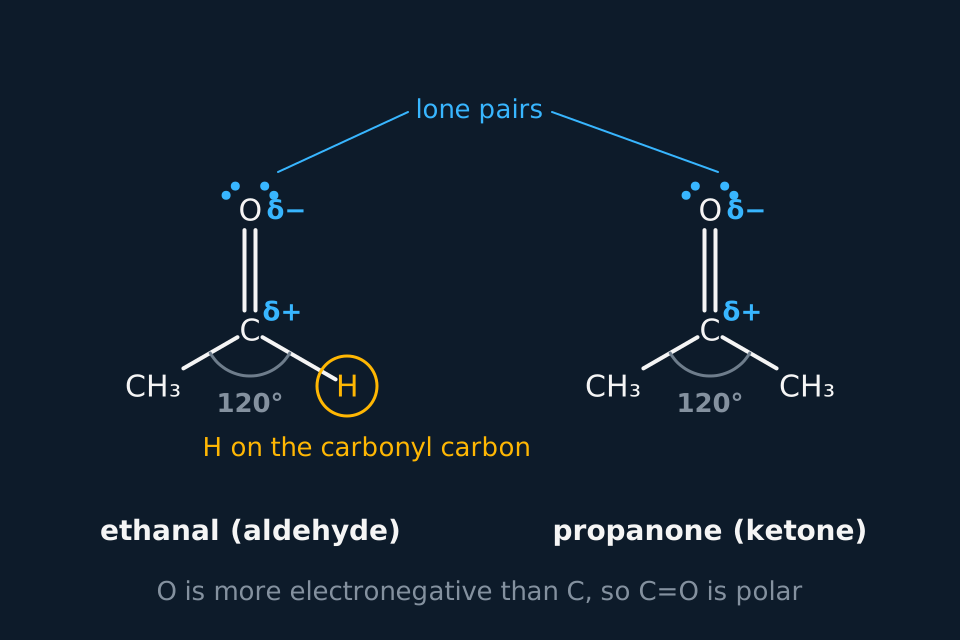
Describe the drawing
Ethanal on the left and propanone on the right, each drawn with the C=O double bond pointing up from the carbonyl carbon. The carbon carries δ+ and the oxygen δ− with two lone pairs, and the three bonds round the carbon are marked 120° apart. In ethanal the carbonyl carbon holds CH₃ and a circled hydrogen, which makes it an aldehyde; in propanone it holds two CH₃ groups, which makes it a ketone.
The C=O bond is a σ bond and a π bond. The π bond is the weaker of the two and its electrons are the ones that move in a reaction. A nucleophile, a species with a lone pair that it donates to form a new covalent bond, is attracted to the δ+ carbon. As it bonds, the π electrons move onto the oxygen. That is nucleophilic addition, and it is the reaction type of the carbonyl group, in the way that electrophilic addition is the reaction type of the C=C bond. The C=C bond is non-polar and electron-rich, so it attracts electrophiles; the C=O bond is polar with an electron-poor carbon, so it attracts nucleophiles.
- Nucleophile
- An electron pair donor: a species with a lone pair that it uses to form a new covalent bond.
- Nucleophilic addition
- A reaction in which a nucleophile attacks the δ+ carbon of a C=O bond and two molecules join to give one product.
Tollens' and Fehling's: oxidising the aldehyde
An aldehyde is easily oxidised to a carboxylic acid, because the hydrogen on its carbonyl carbon can be replaced by OH. A ketone has no such hydrogen, and oxidising it would mean breaking a C–C bond, which mild oxidising agents cannot do. Two mild oxidising agents use that difference as a test.
Tollens' reagent is made by adding a drop of sodium hydroxide to silver nitrate solution, then dilute ammonia until the brown precipitate of silver oxide just dissolves. It contains the complex ion [Ag(NH₃)₂]⁺. Warmed in a water bath with an aldehyde, the silver(I) is reduced to silver metal, which coats the clean glass as a silver mirror. With a ketone the solution stays colourless. The reagent is made fresh and poured away after use, because on standing it forms an explosive solid.
[Ag(NH₃)₂]⁺(aq) + e⁻ → Ag(s) + 2NH₃(aq)Reduction of the silver(I) complex
CH₃CHO(aq) + H₂O(l) → CH₃COOH(aq) + 2H⁺(aq) + 2e⁻Oxidation of ethanal. In the alkaline reagent the acid is present as the ethanoate ion.
Fehling's solution is a blue solution of copper(II) ions, kept in solution in alkali by a complexing agent. Warmed with an aldehyde, the copper(II) is reduced to copper(I) and a brick-red precipitate of copper(I) oxide, Cu₂O, forms. With a ketone the solution stays blue. Benedict's solution is a similar alkaline copper(II) reagent and gives the same result.
Both tests are done in a beaker of hot water from a kettle, never over a Bunsen flame, because aldehydes and ketones are volatile and flammable. The Tollens' tube must be clean and grease-free or the silver comes down as a grey-black precipitate instead of a mirror. A negative result is only meaningful if the test works, so a tube with a known aldehyde is run alongside the unknown.
Cu²⁺(aq) + e⁻ → Cu⁺(aq)The copper(I) ions precipitate as Cu₂O in the alkaline solution
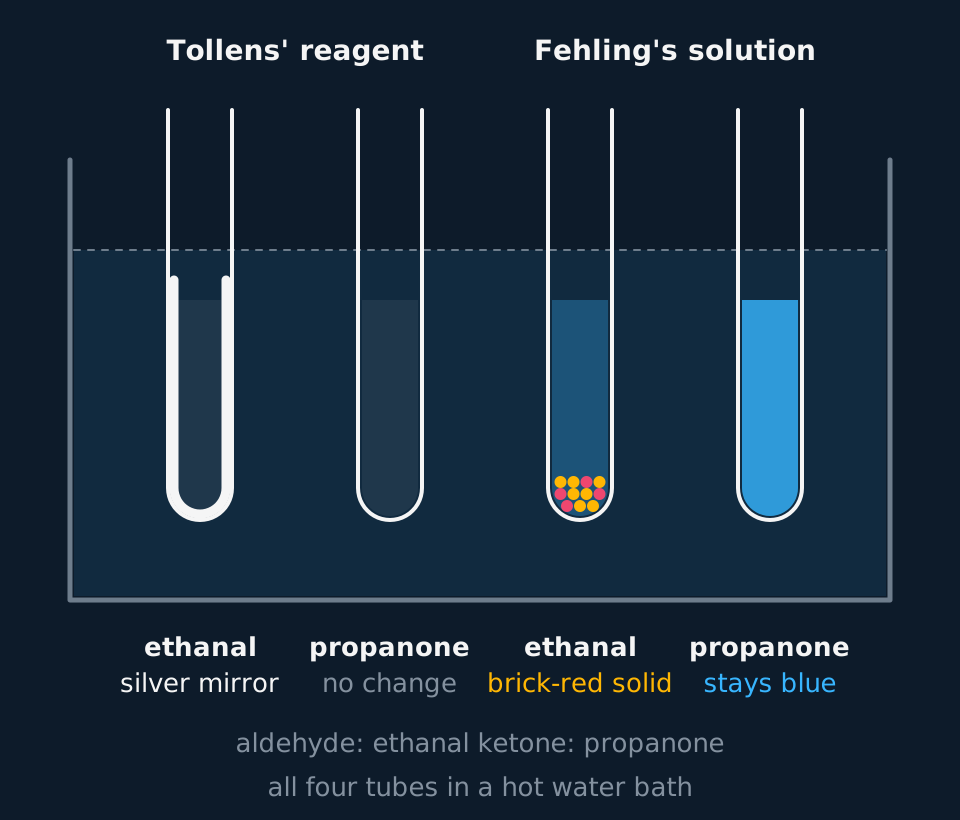
Describe the drawing
Four test tubes standing in a beaker of hot water. The first, Tollens' reagent warmed with ethanal, has its inside wall coated with a bright silver mirror. The second, Tollens' reagent with propanone, holds a colourless solution with no change. The third, Fehling's solution with ethanal, has a brick-red solid settled at the bottom under a paler blue solution. The fourth, Fehling's solution with propanone, is still a clear deep blue.
The overall reaction of either test is often written with [O] for the oxidising agent: CH₃CHO + [O] → CH₃COOH. The same oxidation happens with acidified potassium dichromate(VI), which turns from orange to green, but that reagent also oxidises primary and secondary alcohols, so it does not distinguish an aldehyde as cleanly.
| Tollens' reagent | Fehling's solution | |
|---|---|---|
| What it contains | [Ag(NH₃)₂]⁺ in ammonia solution | Cu²⁺ complexed in alkali, blue |
| Condition | Warm in a water bath | Warm in a water bath |
| With an aldehyde | Silver mirror on the glass | Brick-red precipitate of Cu₂O |
| With a ketone | No change, stays colourless | No change, stays blue |
| What is reduced | Ag⁺ to Ag | Cu²⁺ to Cu⁺ |
An observation names what is seen: a silver mirror, a brick-red precipitate. 'Positive result' or 'aldehyde present' is the inference, not the observation, and scores no observation mark. A ketone's result is written too: 'no change' or 'stays blue' completes the test, where a blank leaves the answer half done.
- Tollens' reagent
- A solution of diamminesilver(I) ions, [Ag(NH₃)₂]⁺, which is reduced to a silver mirror when warmed with an aldehyde but not with a ketone.
- Fehling's solution
- An alkaline solution of copper(II) ions that gives a brick-red precipitate of Cu₂O when warmed with an aldehyde but not with a ketone.
Reduction by NaBH₄
Sodium tetrahydridoborate(III), NaBH₄, reduces aldehydes to primary alcohols and ketones to secondary alcohols. It is used in water or ethanol at room temperature. The reducing agent is written [H] in the overall equation.
CH₃CHO(aq) + 2[H] → CH₃CH₂OH(aq)Ethanal to ethanol, a primary alcohol
CH₃COCH₃(aq) + 2[H] → CH₃CH(OH)CH₃(aq)Propanone to propan-2-ol, a secondary alcohol
NaBH₄ acts as a source of the hydride ion, H⁻: a hydrogen atom with two electrons, a lone pair. The hydride ion is the nucleophile. It does not touch a C=C bond, because an electron-rich double bond repels another electron pair donor, so NaBH₄ reduces the C=O of an unsaturated aldehyde and leaves its C=C alone. Hydrogen with a nickel catalyst would reduce both. Propenal, CH₂=CHCHO, therefore gives prop-2-en-1-ol, CH₂=CHCH₂OH, with NaBH₄, and propan-1-ol with hydrogen and nickel.
The reduction runs the oxidation of alcohols backwards. A primary alcohol is oxidised to an aldehyde and the aldehyde is reduced back to the primary alcohol; a secondary alcohol is oxidised to a ketone and the ketone is reduced back to the secondary alcohol. The carbon skeleton is unchanged in both directions.
The mechanism has two steps. In the first, an arrow starts on the lone pair of the hydride ion and ends on the δ+ carbonyl carbon. A second arrow starts on the C=O double bond and ends on the oxygen, as the π electrons move away. The intermediate is an alkoxide ion with a negative charge on the oxygen. In the second step, an arrow from a lone pair on that O⁻ goes to a hydrogen of a water molecule, and the O–H bond in water breaks to leave hydroxide.
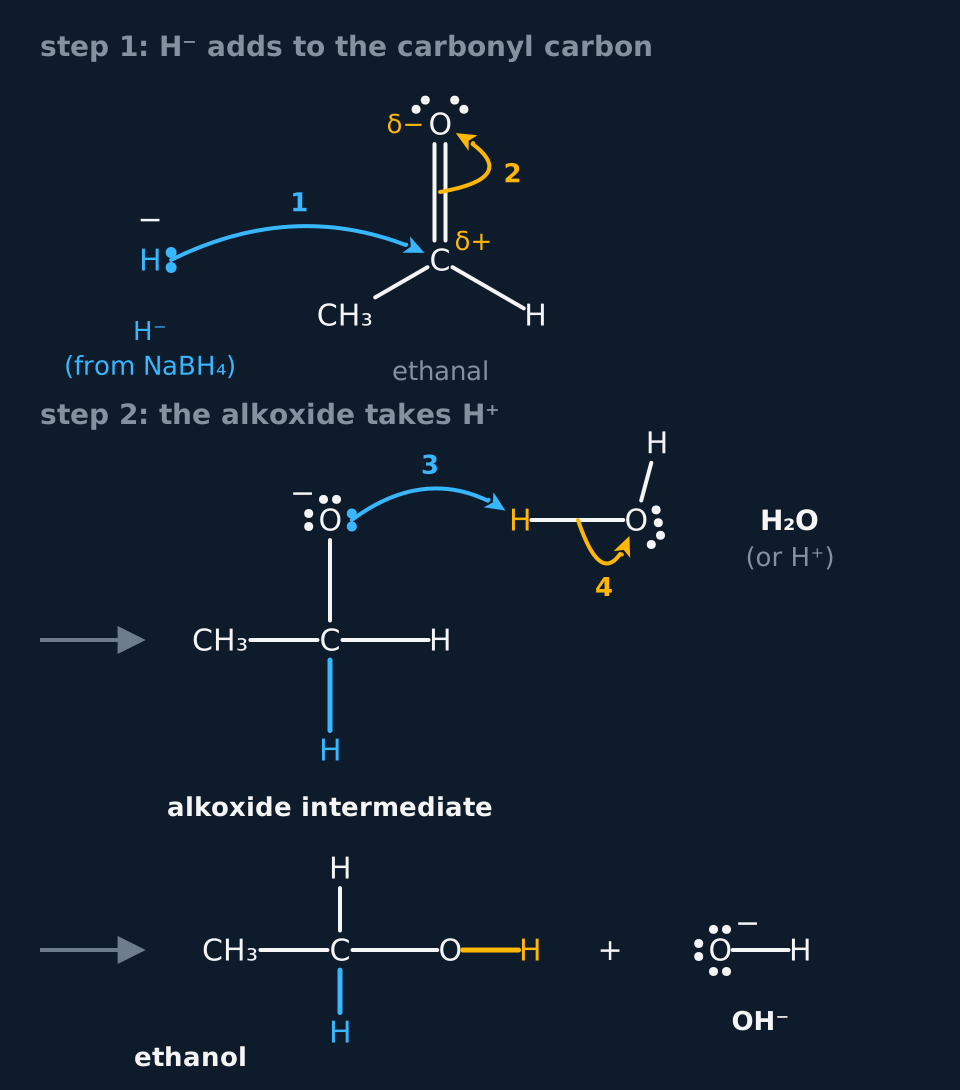
Describe the drawing
A two-step mechanism. In step 1 a hydride ion from sodium tetrahydridoborate, drawn as H with a lone pair and a negative charge, sits left of ethanal, whose carbonyl carbon carries δ+ and oxygen δ−. Arrow 1 runs from the hydride's lone pair to the carbonyl carbon; arrow 2 runs from the middle of the C=O bond onto oxygen. In step 2 the alkoxide intermediate, a tetrahedral carbon with an O⁻ carrying three lone pairs, sends arrow 3 from an oxygen lone pair to a hydrogen of a water molecule, and arrow 4 moves that H–O bonding pair onto the water's oxygen. The products are ethanol and a hydroxide ion.
Writing the mechanism for propanone with NaBH₄
Outline the mechanism for the reduction of propanone by NaBH₄, and name the product.
Show the working
Draw propanone with the C=O bond displayed, δ+ on the carbon and δ− on the oxygen. Draw H⁻ with a lone pair and its negative charge.
Arrow 1 from the lone pair on H⁻ to the carbonyl carbon. Arrow 2 from the middle of the C=O double bond to the oxygen atom.
Draw the intermediate: the central carbon now bonded to two CH₃ groups, a hydrogen and an oxygen carrying a lone pair and a negative charge.
Arrow 3 from a lone pair on O⁻ to an H of H₂O, and arrow 4 from the H–O bond in water to its oxygen. The product is propan-2-ol, CH₃CH(OH)CH₃, and OH⁻ is released.
Cyanide and hydroxynitriles
Potassium cyanide followed by dilute acid adds HCN across the C=O bond and gives a hydroxynitrile, a molecule with an OH group and a C≡N group on the same carbon. The reaction is useful because it adds a carbon atom to the chain. Propanal gives 2-hydroxybutanenitrile; propanone gives 2-hydroxy-2-methylpropanenitrile. The nitrile carbon is carbon 1 in the name.
CH₃CH₂CHO(l) + HCN(aq) → CH₃CH₂CH(OH)CN(aq)Overall equation; in the flask the cyanide ion comes from KCN
The nucleophile is the cyanide ion, :C≡N⁻. It has a lone pair on its carbon, and the arrow starts from that carbon lone pair, not from nitrogen. Arrow 1 goes from the lone pair on the carbon of CN⁻ to the δ+ carbonyl carbon; arrow 2 from the C=O bond to the oxygen. The alkoxide intermediate then takes H⁺ from the acid: arrow 3 starts on a lone pair of O⁻ and ends on the H⁺.
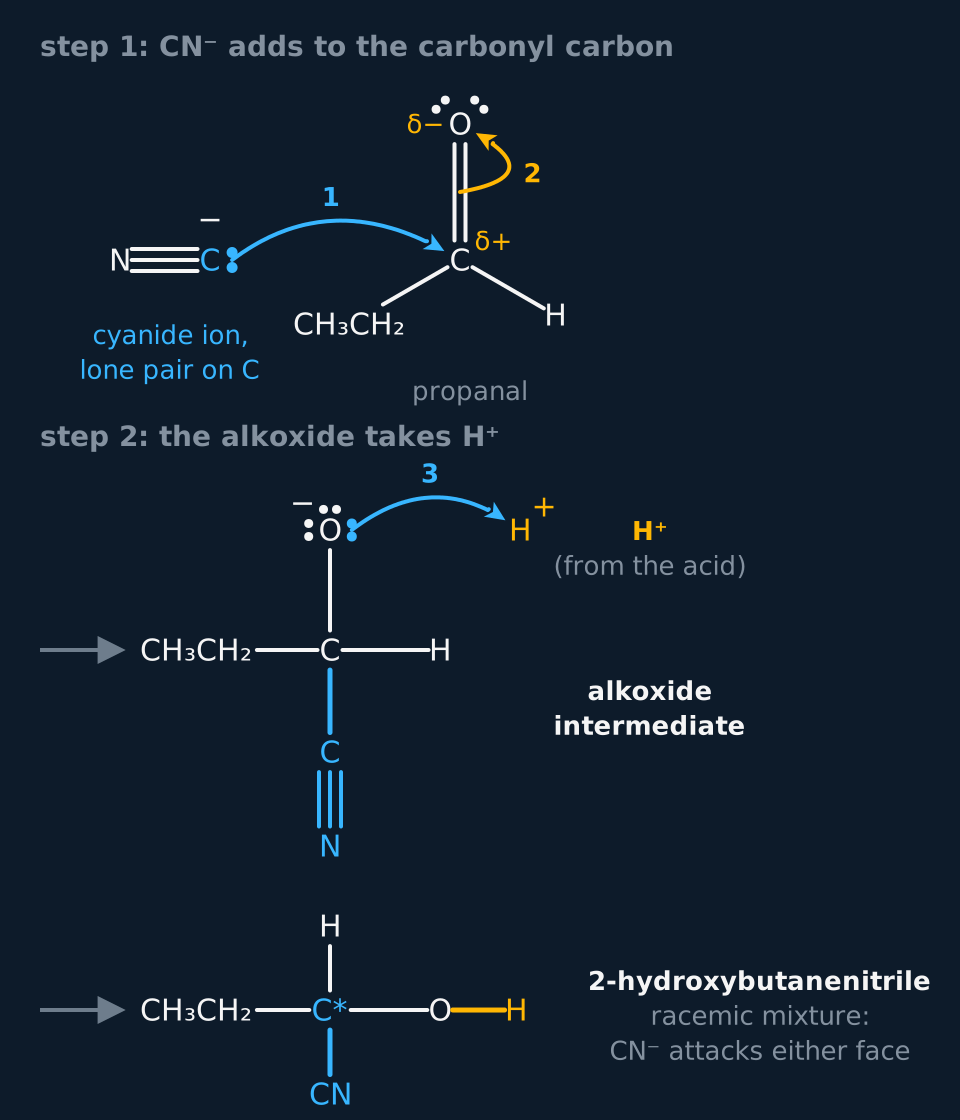
Describe the drawing
A two-step mechanism. In step 1 the cyanide ion, drawn as C≡N with a lone pair and the negative charge on carbon, faces propanal, whose carbonyl carbon is δ+ and oxygen δ−. Arrow 1 runs from the lone pair on the cyanide carbon to the carbonyl carbon; arrow 2 runs from the C=O bond onto oxygen. In step 2 the alkoxide intermediate, a tetrahedral carbon bonded to CH₃CH₂, H, CN and an O⁻ with three lone pairs, sends arrow 3 from an oxygen lone pair to an H⁺ ion from the acid. The product is 2-hydroxybutanenitrile with its chiral carbon marked C*, formed as a racemic mixture.

Describe the drawing
Nucleophilic addition of cyanide to propanal in three stages. First the cyanide ion, with its lone pair and negative charge on carbon, faces propanal, carbonyl carbon δ+ and oxygen δ−; arrow 1 runs from the cyanide carbon's lone pair to the carbonyl carbon and arrow 2 from the C=O bond onto the oxygen. Second, the alkoxide intermediate, its O⁻ carrying three lone pairs, sends arrow 3 to an H⁺ ion from the acid. Third, 2-hydroxybutanenitrile, its chiral carbon marked C*, formed as a racemic mixture.
KCN is used rather than HCN itself for two reasons. Hydrogen cyanide is a weak acid, so its solution contains few cyanide ions and the first step is slow. KCN is fully ionised and supplies them directly. HCN is also highly toxic and boils at 26 °C, so it escapes from a warm flask as a gas. KCN is toxic too, and with acid it releases HCN, so the reaction is carried out in a fume cupboard with the acid added carefully and the pH kept controlled.
The carbonyl carbon is planar, and the cyanide ion attacks it equally from above and below. If the product carbon carries four different groups, the two faces give the two enantiomers in equal amounts and the product is a racemic mixture. Every aldehyde except methanal gives a chiral hydroxynitrile, since the carbon ends up with H, OH, CN and the alkyl group. A ketone gives one only when its two alkyl groups differ: butanone does, propanone does not.
Hydroxynitriles are useful because the new carbon can be built on. Heating 2-hydroxypropanenitrile, the product from ethanal, with dilute acid hydrolyses the C≡N group to COOH and gives 2-hydroxypropanoic acid, lactic acid. Made this way it is racemic, the same compound the muscle makes as one enantiomer. A chemist who wants one enantiomer from this route has to separate the mixture or use a chiral catalyst that favours one face of the carbonyl.
- Hydroxynitrile
- A compound containing a hydroxyl group and a nitrile group, formed by nucleophilic addition of HCN to an aldehyde or ketone.
- Hydride ion
- H⁻, a hydrogen atom with an extra electron, which acts as a nucleophile through its lone pair; NaBH₄ is its source.
TRY IT: Butanone and cyanide
Butanone, CH₃COCH₂CH₃, is treated with KCN and then dilute acid. Name the product, and state and explain whether the product rotates plane-polarised light.
Check your answer
The product is 2-hydroxy-2-methylbutanenitrile, CH₃C(OH)(CN)CH₂CH₃. Its carbon 2 carries OH, CN, CH₃ and CH₂CH₃, so it is a chiral centre.
The carbonyl group of butanone is planar, so the cyanide ion attacks from either face with equal probability. Equal amounts of the two enantiomers form, their rotations cancel, and the product does not rotate plane-polarised light.
Other boards: 2,4-DNP, triiodomethane and LiAlH₄
Tollens' and Fehling's tell an aldehyde from a ketone, but neither shows that a carbonyl group is there in the first place. OCR, Edexcel and Cambridge examine a test that does; AQA does not. 2,4-Dinitrophenylhydrazine, 2,4-DNP or Brady's reagent, is used as a solution in methanol and sulfuric acid. A few drops of any aldehyde or ketone give a yellow or orange precipitate at room temperature. Carboxylic acids and esters give none, although they contain C=O, because a lone pair on their second oxygen atom feeds electron density towards the carbonyl carbon and makes it less δ+.
The precipitate is a 2,4-dinitrophenylhydrazone, formed by addition across the C=O bond followed by loss of water. Each aldehyde and ketone gives a different hydrazone with its own sharp melting point, so the precipitate does a second job: it identifies the compound. It is filtered off, recrystallised from the minimum volume of hot ethanol, dried, and its melting point measured and compared with a data table. Recrystallising matters, because impurities lower the melting point and spread it over several degrees.
| Silver mirror with Tollens' | Melting point of 2,4-DNP derivative / °C | |
|---|---|---|
| Propanal, CH₃CH₂CHO | Yes | 155 |
| Butanal, CH₃CH₂CH₂CHO | Yes | 123 |
| Propanone, CH₃COCH₃ | No | 126 |
| Butanone, CH₃COCH₂CH₃ | No | 115 |
| Pentan-2-one, CH₃COCH₂CH₂CH₃ | No | 144 |
| Pentan-3-one, CH₃CH₂COCH₂CH₃ | No | 156 |
Edexcel and Cambridge also examine the triiodomethane test, once called the iodoform test. The compound is warmed with iodine solution and aqueous sodium hydroxide. A pale yellow precipitate of triiodomethane, CHI₃, with an antiseptic smell, shows a CH₃CO– group: a methyl ketone, or ethanal, the only aldehyde that has one. All three hydrogens of the methyl group are replaced by iodine, then the C–C bond to the carbonyl carbon breaks, leaving a carboxylate ion with one carbon fewer.
CH₃COCH₃(aq) + 3I₂(aq) + 4NaOH(aq) → CHI₃(s) + CH₃COONa(aq) + 3NaI(aq) + 3H₂O(l)Propanone gives triiodomethane and sodium ethanoate
Alkaline iodine is also an oxidising agent, so an alcohol it can oxidise to a CH₃CO– compound gives the precipitate as well: ethanol, which is oxidised to ethanal, and any secondary alcohol with the group CH₃CH(OH)–, such as propan-2-ol. Propan-1-ol, propanal and pentan-3-one give no precipitate. The test is decisive where Tollens' is no help, between two ketones such as pentan-2-one and pentan-3-one.
Identifying a ketone from its derivative
Compound Z, C₅H₁₀O, gives a yellow or orange precipitate with 2,4-DNP and no silver mirror with Tollens' reagent. The recrystallised derivative melts at 143 to 144 °C. Identify Z using the table, and give a test that would confirm it.
Show the working
The yellow or orange precipitate shows a carbonyl group. No silver mirror shows that Z is not an aldehyde, so Z is a ketone.
The ketones in the table with the formula C₅H₁₀O are pentan-2-one, derivative 144 °C, and pentan-3-one, derivative 156 °C. The measured 143 to 144 °C matches pentan-2-one.
Pentan-2-one, CH₃COCH₂CH₂CH₃, has a CH₃CO– group and pentan-3-one does not. Warming Z with iodine and sodium hydroxide gives a pale yellow precipitate of CHI₃, which confirms that Z is pentan-2-one.
Edexcel and Cambridge also use lithium tetrahydridoaluminate(III), LiAlH₄; AQA names only NaBH₄. LiAlH₄ is a more powerful source of hydride ions and reacts violently with water, giving off hydrogen, so it is used in dry ether and dilute acid is added only once the reduction is over, to protonate the alkoxide. It reduces aldehydes and ketones exactly as NaBH₄ does, and it also reduces carboxylic acids to primary alcohols, which NaBH₄ cannot.
- 2,4-Dinitrophenylhydrazine
- A reagent that gives a yellow or orange precipitate with any aldehyde or ketone; the melting point of the purified precipitate identifies the compound.
- Derivative
- A solid made from an unknown compound by a reaction of its functional group, whose melting point is compared with data to identify the compound.
- Triiodomethane test
- Warming with iodine and aqueous alkali; a pale yellow precipitate of CHI₃ shows a CH₃CO– group, or a CH₃CH(OH)– group that is oxidised to one.
In the exam
- Each curly arrow in a mechanism earns its mark only if it starts at a lone pair or a bond. The scheme credits the lone pair on H⁻ or on the carbon of CN⁻, the δ+ and δ− on C=O, and the negative charge on the intermediate's oxygen.
- For the second step of the NaBH₄ mechanism, the scheme allows the arrow from O⁻ to go to H₂O or to H⁺. With water, the arrow breaking the O–H bond is also needed for the mark.
- A test is described by the reagent, the condition (warm) and the observation for both possibilities: silver mirror or no change; brick-red precipitate or stays blue. 'Goes red' without 'precipitate' does not describe the solid that forms.
- The hazard of KCN is that HCN, a toxic gas, forms when cyanide meets acid, so the reaction is done in a fume cupboard; 'cyanide is dangerous' alone is not credited.
- Asked why KCN is used rather than HCN, answer that HCN is a weak acid giving few CN⁻ ions, while KCN supplies them fully.
Check yourself
Compound X, C₃H₆O, gives a silver mirror with Tollens' reagent. Identify X, give the product of its reduction by NaBH₄, and give the product of its reaction with KCN and then acid, saying which of the two products is formed as a racemate.
Answer
A silver mirror means X is an aldehyde. The only aldehyde with the formula C₃H₆O is propanal, CH₃CH₂CHO.
NaBH₄ reduces propanal to propan-1-ol, CH₃CH₂CH₂OH. Its carbon bonded to OH carries two hydrogens, so it is not chiral.
KCN then acid gives 2-hydroxybutanenitrile, CH₃CH₂CH(OH)CN. Carbon 2 carries H, OH, CN and C₂H₅, so it is chiral, and attack from either face of the planar C=O gives a racemic mixture.
Questions
Question 16 marksAQA · Edexcel · CAIE
Describe how Tollens' reagent and Fehling's solution can each be used to distinguish propanal from propanone. Give the observations and the relevant equations.
Mark scheme
Indicative content
- each compound is warmed in a water bath with freshly made Tollens' reagent, which contains the [Ag(NH₃)₂]⁺ ion
- propanal gives a silver mirror on the inside of the tube, while propanone gives no change and the solution stays colourless
- the silver complex is reduced: [Ag(NH₃)₂]⁺ + e⁻ → Ag + 2NH₃; allow Ag⁺ + e⁻ → Ag
- warmed with Fehling's solution, propanal gives a brick-red precipitate while propanone leaves the solution blue; allow red or orange-red precipitate
- the copper(II) is reduced, Cu²⁺ + e⁻ → Cu⁺, and copper(I) oxide, Cu₂O, precipitates in the alkaline solution
- propanal is oxidised, CH₃CH₂CHO + H₂O → CH₃CH₂COOH + 2H⁺ + 2e⁻ or with [O]; propanone has no H on its carbonyl carbon and is not oxidised
Levels
- Level 3 (5–6 marks) both tests are described with their observations for both compounds, the half-equations for the reduction of silver and of copper(II) are given, the oxidation of propanal is written, and the answer explains why propanone does not react
- Level 2 (3–4 marks) both tests give the silver mirror and the brick-red precipitate for propanal and no change for propanone; only one equation is right, or the answer does not say why propanone resists oxidation
- Level 1 (1–2 marks) one test is described with its positive result, often with the observations of the two tests swapped; no equations and no reason propanone does not react
Question 25 marks
Outline the mechanism for the reaction of propanone with KCN followed by dilute acid, and name the organic product.
Mark scheme
- B1 curly arrow from the lone pair on the carbon of CN⁻ to the carbonyl carbon
- B1 curly arrow from the C=O double bond to the oxygen atom
- B1 intermediate (CH₃)₂C(CN)O⁻ with the negative charge on oxygen
- B1 curly arrow from a lone pair on O⁻ to H⁺
- B1 the product is 2-hydroxy-2-methylpropanenitrile
Question 34 marks
Outline the mechanism for the reduction of propanal by NaBH₄. Show the hydride ion as the nucleophile and water as the source of the second hydrogen.
Mark scheme
- B1 curly arrow from the lone pair on H⁻ to the carbonyl carbon
- B1 curly arrow from the C=O double bond to the oxygen atom
- B1 intermediate CH₃CH₂CH₂O⁻ drawn with the negative charge on oxygen
- B1 curly arrow from a lone pair on O⁻ to an H of H₂O, with an arrow from the O–H bond to the water's oxygen, giving propan-1-ol
All 18 questions with mark schemes, the other 15 set out in full on the question page.
Worth remembering
- Hydride is H⁻ with a lone pair, not a hydrogen atom, and NaBH₄ leaves a C=C bond alone.
- The cyanide arrow starts on the carbon's lone pair, never on the nitrogen.
- A test needs the reagent, 'warm', and what both an aldehyde and a ketone show.
- 'Positive result' is not an observation: write silver mirror or brick-red precipitate.
- No chiral product carbon, no racemate: propanone with cyanide gives one compound only.
CHECK YOUR PROGRESS
Rate how confident you are with each objective for this lesson. Ratings are saved in this browser, on this device, unless you sign in.
- Explain why the carbonyl group is polar and why its carbon is attacked by nucleophiles.
- Describe the Tollens' and Fehling's tests, the observations for an aldehyde and a ketone, and write the half-equations.
- Outline the nucleophilic addition mechanism for the reduction of an aldehyde or ketone by NaBH₄.
- Outline the nucleophilic addition mechanism for the reaction of KCN followed by dilute acid, and name the hydroxynitrile formed.
- Explain why the product of either addition can be a racemic mixture, and state the hazard of using cyanide.
- Describe the 2,4-dinitrophenylhydrazine test for a carbonyl compound and, for Edexcel and Cambridge, the triiodomethane test for a CH₃CO group.CAIE · Edexcel · OCR A
Open the full revision checklist to see every objective in the curriculum in one place.
Practise this lesson
WORKBOOK
The written questions from this topic, on paper with room to work, and a separate book of mark schemes. The question that is set on a diagram stays on this page, where the diagram can be drawn. Free to use; please do not redistribute or sell.
Used later in Acylation: acyl chlorides and acid anhydrides · Planning a synthetic route