Chemistry › Electrochemistry › Commercial cells, rechargeable cells and fuel cells
Commercial cells, rechargeable cells and fuel cells
An AA battery, the cell in a phone and the fuel cell in a hydrogen bus are each a pair of half-cells, and each EMF comes from the same subtraction of electrode potentials. They differ in what happens when the reactants run out: one is thrown away, one is recharged and one is refuelled. Electrolysis runs redox chemistry the other way, with an external supply forcing a reaction that would not go on its own.
Key terms Every definition in electrochemistry, lesson by lesson
Before this Electrode potentials and the standard hydrogen electrode – E°cell = E°right − E°left · The electrochemical series and predicting feasibility – the half-equation with the more positive E° goes forwards
COMMON MISCONCEPTION
A hydrogen fuel cell causes no pollution, because the only thing that comes out of it is water.
The cell itself gives out only water, but the hydrogen has to be made. Most is produced from methane and steam, which releases carbon dioxide, and the rest by electrolysis using whatever generated the electricity. The cell also needs a platinum catalyst, mined and refined, and the hydrogen is stored in high-pressure tanks.
What you should be able to do
- Distinguish non-rechargeable, rechargeable and fuel cells by what happens to their reactants.
- Write the electrode reactions of the lithium-ion cell during discharge and during charging, and calculate its EMF from given data.
- Write the half-equations and overall equation for the hydrogen–oxygen fuel cell in alkaline and in acidic conditions, and explain why the EMF is the same in both.
- Deduce the electrode reactions and EMF of an unfamiliar cell from electrode potential data.
- Evaluate the benefits and risks to society of lithium-ion cells and of hydrogen fuel cells.
- Calculate the mass liberated in electrolysis from Q = It and the Faraday constant.CAIE
Three kinds of cell
Every cell on sale is a pair of half-cells driven by a feasible redox reaction, with an EMF given by E°cell = E°right − E°left. What separates them is what happens to the reactants. The two AA cells in a television remote, each marked 1.5 V, are thrown away when they are flat. The cell in a phone, marked 3.7 V, is plugged in every night for years. A hydrogen bus carries a tank of hydrogen, and the fuel cell under its floor delivers a current for as long as there is hydrogen in the tank.
In a non-rechargeable cell the reaction runs once. The zinc–carbon cell in a cheap AA battery has a zinc case as its negative electrode, oxidised to Zn²⁺ as the cell discharges, and manganese(IV) oxide packed round a carbon rod as its positive electrode. The zinc case is used up and the products spread through the paste, so a current passed backwards cannot rebuild the electrodes.
A rechargeable cell is built so that the products stay where they form, as solids on the electrodes. A charger with a voltage greater than the cell's EMF then pushes electrons the other way, drives the cell reaction in reverse and regenerates the reactants. The lithium-ion cell and the lead–acid car battery work this way.
A fuel cell is not charged at all. Its reactants, a fuel and oxygen from the air, are supplied continuously from outside, and its products leave as they form. The electrodes and the electrolyte are not used up, so the cell runs for as long as fuel is supplied and never needs to be recharged. That phrase, 'reactants supplied continuously', is the reason to give.
| Non-rechargeable | Rechargeable | Fuel cell | |
|---|---|---|---|
| Example | Zinc–carbon AA cell | Lithium-ion phone cell; lead–acid car battery | Hydrogen–oxygen fuel cell in a bus |
| Where the reactants are | Inside the cell, used once | Inside the cell, regenerated on charging | Supplied from outside, continuously |
| Where the products go | Stay in the cell | Stay on the electrodes as solids | Leave the cell |
| When the reactants run out | Discarded or recycled | Recharged from an external supply | Refuelled |
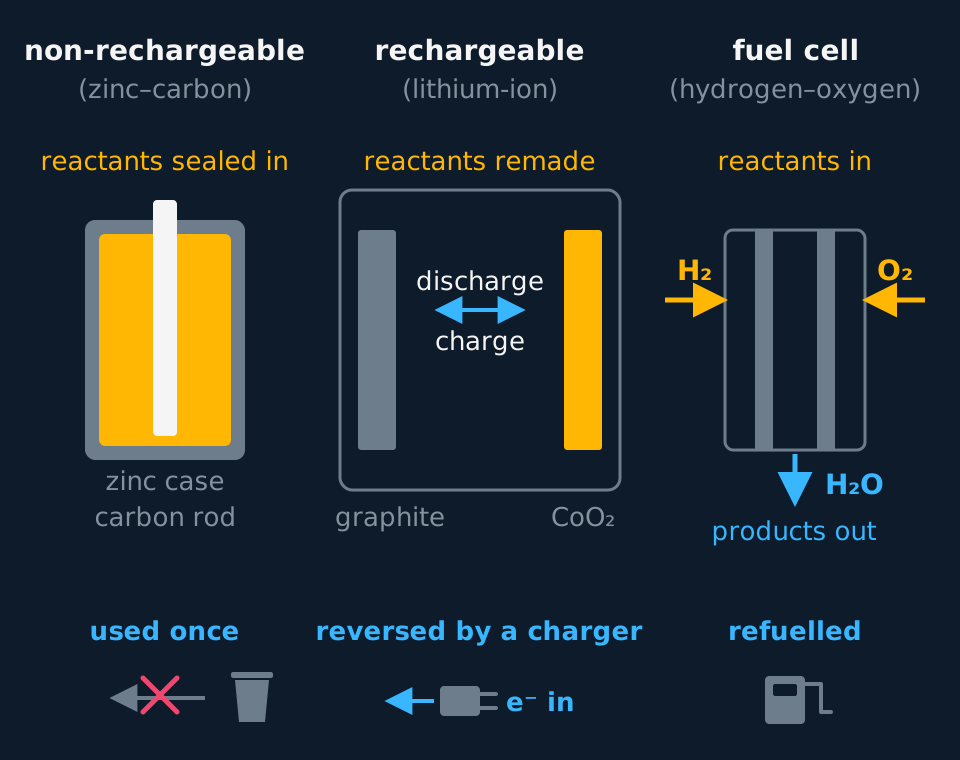
Describe the drawing
Three cells side by side, each with two electrodes. On the left, a non-rechargeable zinc–carbon cell with a zinc case and a carbon rod, its reactants sealed inside, a crossed-out reverse arrow and a bin: used once. In the centre, a rechargeable lithium-ion cell with graphite and CoO₂ electrodes and a two-way arrow between discharge and charge, with a plug feeding electrons back in: reversed by a charger. On the right, a hydrogen–oxygen fuel cell with arrows bringing hydrogen in on one side and oxygen on the other and an arrow taking water out at the bottom, and a fuel pump: refuelled.
- Non-rechargeable cell
- A cell in which the reaction cannot be reversed, so the cell is discarded when its reactants are used up.
- Rechargeable cell
- A cell in which the reaction can be reversed by applying an external voltage greater than its EMF, regenerating the reactants.
- Fuel cell
- A cell that generates an electric current from a fuel and oxygen supplied continuously from outside, and does not need to be electrically recharged.
The lithium-ion cell
Phones, laptops and electric cars run on lithium-ion cells. Lithium is the strongest reducing agent in the electrochemical series, E°(Li⁺/Li) = −3.04 V, and the lightest metal, so a lithium cell gives a large EMF from a small mass. Lithium reacts with water, so the electrolyte is a lithium salt dissolved in an organic solvent. The Li⁺ ions in it are not in water and carry no (aq) state symbol.
The negative electrode is lithium, held as atoms between the layers of a graphite electrode. The positive electrode is cobalt(IV) oxide, CoO₂, on a metal foil. The electrode reactions are written in a simplified form. During discharge lithium atoms are oxidised at the negative electrode and the Li⁺ ions travel through the electrolyte. At the positive electrode each Li⁺ enters the cobalt oxide as an electron arrives through the external circuit, and cobalt is reduced from +4 to +3. Write the product as Li⁺[CoO₂]⁻; LiCoO₂ is the same compound.
Li(s) → Li⁺ + e⁻Negative electrode, during discharge: oxidation.
Li⁺ + CoO₂(s) + e⁻ → Li⁺[CoO₂]⁻(s)Positive electrode, during discharge: reduction. The product is lithium cobalt oxide, also written LiCoO₂.
Li(s) + CoO₂(s) → Li⁺[CoO₂]⁻(s)Overall, during discharge.
Charging reverses both reactions. The charger pushes electrons into the graphite, Li⁺ ions leave the cobalt oxide, cross the electrolyte and are reduced back to lithium atoms between the graphite layers. Both electrodes are solids that hold the lithium within their structure, so the reactions can be reversed hundreds of times.
Li⁺[CoO₂]⁻(s) → Li⁺ + CoO₂(s) + e⁻Positive electrode, during charging.
Li⁺ + e⁻ → Li(s)Negative electrode, during charging.
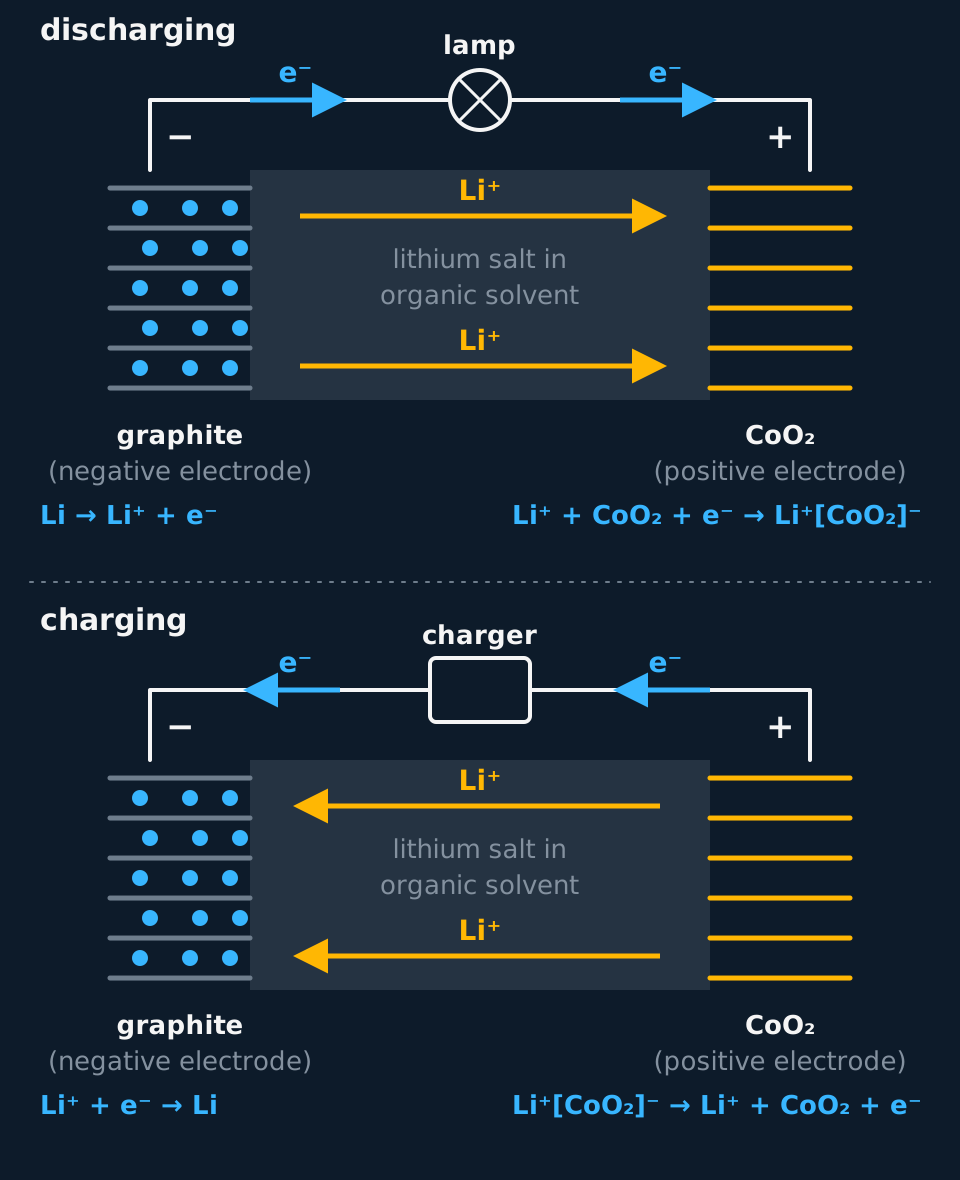
Describe the drawing
Two panels, discharging above and charging below. Each shows a graphite electrode on the left with lithium atoms between its layers, marked negative, a layered CoO₂ electrode on the right, marked positive, and an electrolyte between them of a lithium salt in an organic solvent. Discharging, electrons run through a lamp in the external circuit from graphite to CoO₂ and Li⁺ ions cross the electrolyte the same way; the equations are Li to Li⁺ plus e⁻ and Li⁺ plus CoO₂ plus e⁻ to Li⁺[CoO₂]⁻. Charging, a charger replaces the lamp and every arrow is reversed, with the equations reversed too, while the electrode signs stay the same.
The EMF of a lithium-ion cell
The electrode potentials for a lithium-ion cell are: Li⁺ + CoO₂ + e⁻ → Li⁺[CoO₂]⁻, E = +0.56 V; Li⁺ + e⁻ → Li, E = −3.04 V. Calculate the EMF of the cell, and write the overall reaction during charging.
Show the working
The cobalt oxide half-equation has the more positive potential, so it is the positive electrode and goes on the right.
EMF = E right − E left = (+0.56) − (−3.04) = +3.60 V.
During discharge the more positive half-equation goes forwards and the lithium one backwards: Li + CoO₂ → Li⁺[CoO₂]⁻. Charging is the reverse, Li⁺[CoO₂]⁻ → Li + CoO₂. On its own that reaction has an EMF of −3.60 V and is not feasible, so it is driven by an external supply of more than 3.60 V.
The lead–acid battery under the bonnet of a petrol car is the older rechargeable cell. The negative electrode is lead, the positive electrode lead(IV) oxide, and the electrolyte sulfuric acid. On discharge both electrodes turn into lead(II) sulfate, a solid that stays on the plates, so the car's alternator can drive the reaction back again.
Pb(s) + SO₄²⁻(aq) → PbSO₄(s) + 2e⁻Negative electrode, during discharge. E° for the PbSO₄/Pb couple is −0.36 V.
PbO₂(s) + 4H⁺(aq) + SO₄²⁻(aq) + 2e⁻ → PbSO₄(s) + 2H₂O(l)Positive electrode, during discharge. E° = +1.69 V.
Each cell gives 1.69 − (−0.36) = 2.05 V, and six in series make a 12 V battery. Sulfuric acid is used up and water is formed as the battery discharges, so the density of the acid falls, and a garage tests the state of charge by measuring it.
The hydrogen–oxygen fuel cell
The hydrogen–oxygen fuel cell carries out the reaction of hydrogen burning in air, 2H₂ + O₂ → 2H₂O, without a flame. The energy that combustion would release as heat is released instead as electrons pushed round a circuit.
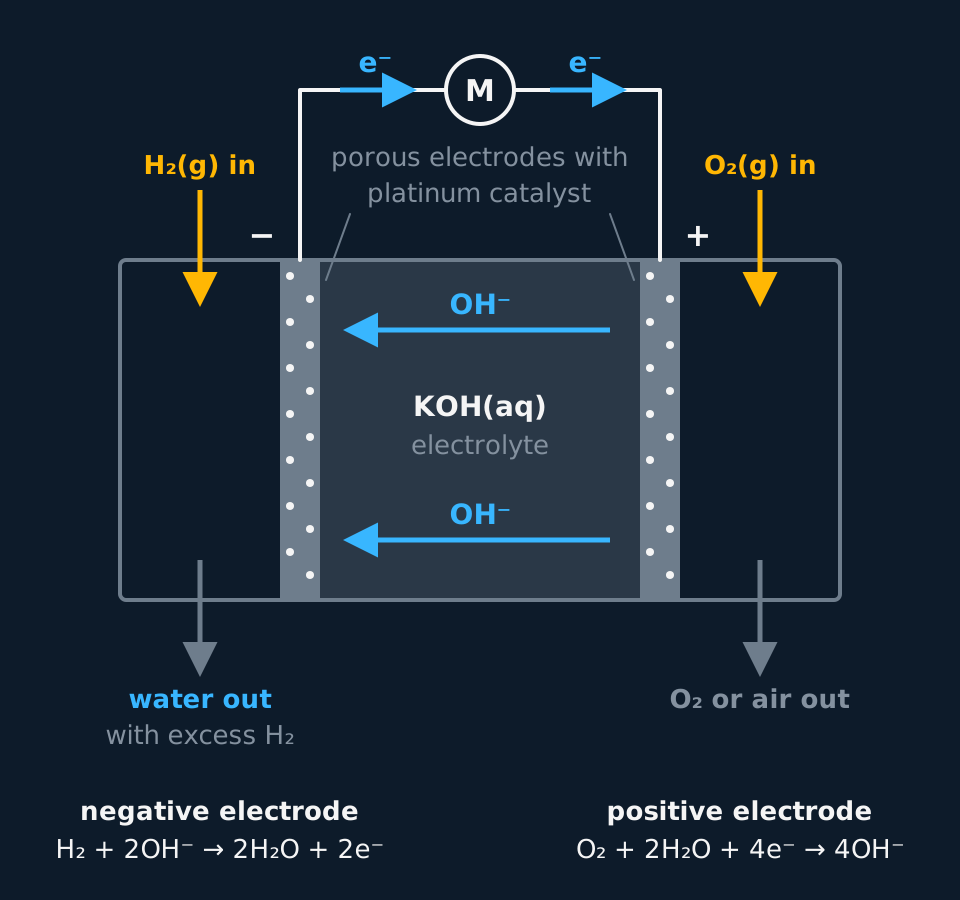
Describe the drawing
A rectangular alkaline fuel cell in cross-section. Hydrogen enters a chamber on the left at the top, and excess hydrogen leaves at the bottom carrying the water formed there. Oxygen or air enters a chamber on the right and leaves at the bottom. Between the chambers are two porous electrodes speckled with platinum catalyst, separated by potassium hydroxide electrolyte, across which hydroxide ions move from right to left. An external circuit with a motor joins the electrodes, with electrons flowing from the hydrogen electrode, negative, to the oxygen electrode, positive. Beneath are the half-equations H₂ + 2OH⁻ → 2H₂O + 2e⁻ and O₂ + 2H₂O + 4e⁻ → 4OH⁻.
The alkaline fuel cell has concentrated potassium hydroxide solution as its electrolyte, between two porous electrodes coated with a platinum catalyst. Hydrogen is supplied to one electrode and oxygen, or air, to the other. At the negative electrode hydrogen is oxidised and combines with hydroxide ions. At the positive electrode oxygen is reduced to hydroxide ions, which move through the electrolyte to the hydrogen side.
H₂(g) + 2OH⁻(aq) → 2H₂O(l) + 2e⁻Negative electrode. Its reduction half-equation, 2H₂O(l) + 2e⁻ → H₂(g) + 2OH⁻(aq), has E° = −0.83 V.
O₂(g) + 2H₂O(l) + 4e⁻ → 4OH⁻(aq)Positive electrode. E° = +0.40 V.
2H₂(g) + O₂(g) → 2H₂O(l)Overall, once the first half-equation is doubled and the hydroxide ions and two water molecules cancel.
Many fuel-cell vehicles use an acidic electrolyte instead, a polymer membrane that conducts H⁺ ions. The half-equations change, because H⁺ and not OH⁻ now carries the charge, but the overall reaction does not.
H₂(g) → 2H⁺(aq) + 2e⁻Negative electrode. E° = 0.00 V.
O₂(g) + 4H⁺(aq) + 4e⁻ → 2H₂O(l)Positive electrode. E° = +1.23 V.
One reaction, two electrolytes
Calculate the EMF of the hydrogen–oxygen fuel cell with an alkaline electrolyte and with an acidic electrolyte, using the E° values for the half-equations given, and explain why the two answers are the same.
Show the working
Alkaline. The oxygen half-equation is the more positive, so it is on the right: EMF = (+0.40) − (−0.83) = +1.23 V.
Acidic. EMF = (+1.23) − (0.00) = +1.23 V.
Each pair of half-equations adds to the same overall reaction, 2H₂(g) + O₂(g) → 2H₂O(l). Going from acid to alkali lowers both electrode potentials by the same 0.83 V, because each half-equation involves one H⁺ or one OH⁻ for every electron. The difference between them, which is the EMF, does not change.
Both cells give 1.23 V under standard conditions. A working fuel cell delivering a current gives less, typically about 0.7 V, and fuel cells are built as stacks of many cells in series to reach a useful voltage.
The electrodes of a cell are named here as positive and negative. Where anode and cathode are used, the anode is the electrode at which oxidation happens and the cathode the electrode at which reduction happens. In a cell delivering a current the anode is therefore negative, which is the reverse of electrolysis, where the anode is the positive electrode.
- Electrolyte
- The ionic solution, melt or solid between the electrodes of a cell, through which ions move to complete the circuit.
- Anode
- The electrode at which oxidation takes place; in a cell delivering a current it is the negative electrode.
- Cathode
- The electrode at which reduction takes place; in a cell delivering a current it is the positive electrode.
Deducing the reactions in an unfamiliar cell
Questions on cells not named in the course supply the half-equations and their potentials, and the reactions are worked out from them. The reasoning is the same every time. During discharge the half-equation with the more positive E° goes forwards at the positive electrode and the other goes backwards at the negative electrode. The electrons are balanced and the half-equations added, and anything that appears on both sides cancels. On charging, both half-equations reverse.
TRY IT: The nickel–cadmium cell
A rechargeable nickel–cadmium cell has these electrode reactions. Cd(OH)₂(s) + 2e⁻ → Cd(s) + 2OH⁻(aq), E° = −0.88 V. NiO(OH)(s) + H₂O(l) + e⁻ → Ni(OH)₂(s) + OH⁻(aq), E° = +0.52 V. Calculate the EMF, write the overall equation for discharge, and give the change in the oxidation state of nickel.
Check your answer
The nickel half-equation is more positive, so the nickel electrode is positive and on the right: EMF = (+0.52) − (−0.88) = +1.40 V.
On discharge the nickel half-equation goes forwards, doubled to take two electrons, and the cadmium one goes backwards: Cd(s) + 2OH⁻(aq) → Cd(OH)₂(s) + 2e⁻. Adding and cancelling the two hydroxide ions gives Cd(s) + 2NiO(OH)(s) + 2H₂O(l) → Cd(OH)₂(s) + 2Ni(OH)₂(s).
Nickel goes from +3 in NiO(OH) to +2 in Ni(OH)₂, and is reduced; cadmium goes from 0 to +2. Every product is a solid that stays on its electrode, so the cell can be recharged. Cadmium is toxic, and lithium-ion cells have largely replaced this one.
Benefits and risks to society
Lithium-ion cells made the smartphone and the electric car possible, because no other rechargeable cell stores as much energy for its mass. Recharging one cell hundreds of times also produces far less waste than buying and discarding non-rechargeable cells. The risks come from the same chemistry. The organic solvent in the electrolyte is flammable, and a damaged or overcharged cell can overheat and catch fire; airlines carry spare lithium batteries in the cabin, where a fire would be seen, and not in the hold.
Lithium and cobalt have to be mined. Much of the world's cobalt comes from the Democratic Republic of the Congo, some from small mines with poor safety and child labour, and lithium extracted from brine in South America uses large volumes of water in dry regions. Spent cells are hard to dismantle safely, and many still end up in general waste.
A hydrogen fuel cell converts a larger fraction of its fuel's energy into electrical work than a petrol engine does, because it does not go through combustion and heat. Its only product at the point of use is water, and it needs refuelling, which takes minutes, not recharging.
The drawbacks lie with the hydrogen. It is a flammable gas of very low density, so it is stored at high pressure or as a liquid below −253 °C, in heavy tanks, and a leak is a fire risk. Most hydrogen is made from methane by steam reforming, which releases carbon dioxide, and hydrogen made by electrolysis is only as clean as the electricity used to make it. The electrodes need a platinum catalyst, which is rare and expensive.
The claim that a fuel-cell car produces no pollution is true only at the exhaust pipe. Whether it is cleaner than a petrol car depends on where its hydrogen came from.
Other boards: methanol fuel cells and electrolysis
OCR and Edexcel call a commercial cell a storage cell. Edexcel also asks for fuel cells that run on hydrogen-rich fuels such as methanol, a liquid kept in an ordinary tank. In the direct methanol fuel cell methanol in water is oxidised all the way to carbon dioxide at the negative electrode, H⁺ ions cross a polymer membrane, and oxygen is reduced at the positive electrode as in the acidic hydrogen cell.
CH₃OH(l) + H₂O(l) → CO₂(g) + 6H⁺(aq) + 6e⁻Negative electrode. Its reduction half-equation has E° = +0.02 V.
The direct methanol fuel cell
CO₂(g) + 6H⁺(aq) + 6e⁻ → CH₃OH(l) + H₂O(l), E° = +0.02 V. O₂(g) + 4H⁺(aq) + 4e⁻ → 2H₂O(l), E° = +1.23 V. Calculate the EMF of the cell, show that the electrons match the change in the oxidation state of carbon, and write the overall equation.
Show the working
The oxygen half-equation is more positive, so the oxygen electrode is positive and on the right: EMF = (+1.23) − (+0.02) = +1.21 V.
In CH₃OH carbon is −2; in CO₂ it is +4. A rise of 6 matches the six electrons released per methanol molecule.
Doubling the methanol half-equation and tripling the oxygen one gives twelve electrons each; adding and cancelling gives 2CH₃OH(l) + 3O₂(g) → 2CO₂(g) + 4H₂O(l), the equation for burning methanol.
The carbon brings drawbacks. The cell gives out carbon dioxide, and most methanol is made from natural gas. Carbon monoxide formed part-way through the oxidation blocks the platinum, so a platinum–ruthenium catalyst is needed, and methanol crossing the membrane lowers the working voltage.
| Hydrogen–oxygen fuel cell | Direct methanol fuel cell | |
|---|---|---|
| Fuel and its storage | Gas, at high pressure or as a liquid below −253 °C | Liquid at room temperature, in a tank or cartridge |
| Electrons per molecule of fuel | 2 | 6 |
| Standard EMF | 1.23 V | 1.21 V |
| Products | Water only | Carbon dioxide and water |
| Catalyst at the negative electrode | Platinum | Platinum with ruthenium, to resist carbon monoxide |
Cambridge examines electrolysis, in which an external supply drives a redox reaction that is not feasible on its own. Two inert electrodes, graphite or platinum, dip into a molten or dissolved ionic compound. The cathode, joined to the negative terminal, is where cations gain electrons and are reduced; the anode, joined to the positive terminal, is where anions lose electrons and are oxidised. Reduction at the cathode holds in a cell and in electrolysis alike; only the signs swap.
A molten salt gives the metal at the cathode and the non-metal at the anode. In water the species with the more positive E° is discharged, so a reactive metal's ion leaves hydrogen at the cathode, sulfate and nitrate leave oxygen at the anode, and a concentrated halide gives the halogen.
The amount liberated depends on the charge passed. A current I for a time t carries charge Q = It, in coulombs when I is in amperes and t in seconds. One mole of electrons carries the Faraday constant, F = 96 500 C mol⁻¹, which is the Avogadro constant L multiplied by the charge on one electron, e. For a product that takes n electrons per particle, the moles liberated are Q/(nF).
Q = ItQ in C, I in A, t in s.
F = Lee = 1.60 × 10⁻¹⁹ C.
Copper deposited by a current
A current of 0.50 A is passed through copper(II) sulfate solution for 30 minutes. Calculate the mass of copper deposited on the cathode. F = 96 500 C mol⁻¹; Ar(Cu) = 63.5.
Show the working
t = 30 × 60 = 1800 s, so Q = It = 0.50 × 1800 = 900 C.
Moles of electrons = Q/F = 900 ÷ 96 500 = 9.33 × 10⁻³ mol.
Cu²⁺(aq) + 2e⁻ → Cu(s), so n = 2 and moles of copper = 9.33 × 10⁻³ ÷ 2 = 4.66 × 10⁻³ mol.
Mass = 4.66 × 10⁻³ × 63.5 = 0.296 g, which is 0.30 g to the two significant figures of the current.
- Electrolysis
- The decomposition of an ionic compound, molten or in solution, by an electric current from an external supply.
- Faraday constant
- The charge carried by one mole of electrons, 96 500 C mol⁻¹, equal to Le.
In the exam
- Write the lithium-ion half-equations as the scheme prints them: Li → Li⁺ + e⁻ at the negative electrode and Li⁺ + CoO₂ + e⁻ → Li⁺[CoO₂]⁻ at the positive electrode during discharge, both reversed for charging.
- In the alkaline fuel cell the hydrogen half-equation includes hydroxide: H₂ + 2OH⁻ → 2H₂O + 2e⁻. H₂ → 2H⁺ + 2e⁻ is the acidic cell's half-equation, and the scheme does not accept it for the alkaline one.
- The reason a fuel cell needs no recharging is that its reactants are supplied continuously from outside the cell; the answer must say so.
- An evaluation of hydrogen fuel cells sets the benefits (water the only product at the point of use, higher efficiency than combustion, no recharging) against the drawbacks (storing a flammable gas, hydrogen mostly made from fossil fuels, a platinum catalyst) and ends on a judgement; the scheme does not award the top level without one.
- For an unfamiliar cell, the more positive half-equation goes forwards at the positive electrode during discharge; reverse both half-equations for charging.
Check yourself
A zinc–air cell, used in hearing aids, has these electrode reactions. ZnO(s) + H₂O(l) + 2e⁻ → Zn(s) + 2OH⁻(aq), E° = −1.26 V. O₂(g) + 2H₂O(l) + 4e⁻ → 4OH⁻(aq), E° = +0.40 V. The cell is sold with a sticker over small holes in its case, removed just before use. Calculate the EMF, write the overall equation, and explain whether the cell is a fuel cell.
Answer
The oxygen half-equation is more positive, so the air electrode is positive and on the right: EMF = (+0.40) − (−1.26) = +1.66 V.
Zinc is oxidised, so its half-equation is reversed and doubled to give four electrons: 2Zn(s) + 4OH⁻(aq) → 2ZnO(s) + 2H₂O(l) + 4e⁻. Adding the oxygen half-equation and cancelling hydroxide ions and water gives 2Zn(s) + O₂(g) → 2ZnO(s).
Oxygen enters from the air through the holes, which is why they are sealed until the cell is used. The cell takes one reactant from outside, as a fuel cell does, but its zinc is held inside and is used up, so it is a non-rechargeable cell and not a fuel cell.
Questions
Question 16 marks
Evaluate the use of hydrogen fuel cells in place of petrol engines to power cars.
Mark scheme
Indicative content
- the only product at the point of use is water, so the car emits no carbon dioxide, carbon monoxide or nitrogen oxides
- a fuel cell converts a larger fraction of the fuel's energy into useful work than combustion in an engine, because it does not go through heat
- the cell is refuelled in minutes, like a petrol car, and needs no electrical recharging from a supply
- hydrogen is flammable and has a low density, so it must be stored at high pressure or as a liquid at very low temperature
- most hydrogen is made from methane by steam reforming, releasing carbon dioxide, and electrodes need an expensive platinum catalyst
- a judgement: the overall benefit depends on how the hydrogen is made, and is large only if it comes from electrolysis using renewable electricity
Levels
- Level 3 (5–6 marks) advantages and disadvantages are both covered with the chemistry behind each: water as the only product at the point of use, the efficiency and quick refuelling, the storage problem, the carbon dioxide from steam reforming and the platinum cost, with a judgement that depends on how the hydrogen is made
- Level 2 (3–4 marks) two advantages and a drawback are given with some chemistry, and a conclusion; where the hydrogen comes from, or how it is stored, is not raised, or the judgement does not follow
- Level 1 (1–2 marks) fuel cells are called pollution-free because they make only water, with no thought for how the hydrogen is made or stored
Question 25 marksCAIE
Calculate a value for the Avogadro constant, L, from the results in the table. A student passed a steady current between copper electrodes in copper(II) sulfate solution and weighed the cathode before and after. Charge on one electron = 1.60 × 10⁻¹⁹ C; Ar(Cu) = 63.5.
| Measurement | Value |
|---|---|
| Current | 0.200 A |
| Time | 60.0 min |
| Mass of cathode before | 25.412 g |
| Mass of cathode after | 25.648 g |
Mark scheme
- M1 Q = It = 0.200 × 3600 = 720 C
- M1 copper deposited = 0.236 g, so moles of Cu = 0.236 ÷ 63.5 = 3.72 × 10⁻³ mol
- M1 Cu²⁺ + 2e⁻ → Cu, so moles of electrons = 2 × 3.72 × 10⁻³ = 7.43 × 10⁻³ mol
- M1 number of electrons = Q ÷ e = 720 ÷ 1.60 × 10⁻¹⁹ = 4.50 × 10²¹, and L = 4.50 × 10²¹ ÷ 7.43 × 10⁻³
- A1 L = 6.05 × 10²³ mol⁻¹, to three significant figures; allow 6.06 × 10²³ from rounded working
Question 34 marksAQA
Give the half-equation at each electrode of a lithium-ion cell during discharge, and at each electrode while it is being charged.
Mark scheme
- B1 discharge, negative electrode: Li → Li⁺ + e⁻
- B1 discharge, positive electrode: Li⁺ + CoO₂ + e⁻ → Li⁺[CoO₂]⁻ (allow LiCoO₂)
- B1 charging, positive electrode: Li⁺[CoO₂]⁻ → Li⁺ + CoO₂ + e⁻
- B1 charging, negative electrode: Li⁺ + e⁻ → Li; ignore state symbols
All 20 questions with mark schemes, the other 17 set out in full on the question page.
Worth remembering
- A fuel cell described as 'recharged' has been confused with a rechargeable cell.
- Use hydroxide ions, not H⁺, in the alkaline cell's half-equations; H₂ → 2H⁺ + 2e⁻ belongs to the acidic cell.
- Giving Li⁺ an (aq) state symbol ignores the organic solvent in the electrolyte.
- Reverse both half-equations for charging, so that the electrons still have somewhere to go.
- 'No pollution' is true only at the point of use; the hydrogen's source decides the rest.
CHECK YOUR PROGRESS
Rate how confident you are with each objective for this lesson. Ratings are saved in this browser, on this device, unless you sign in.
- Distinguish non-rechargeable, rechargeable and fuel cells by what happens to their reactants.
- Write the electrode reactions of the lithium-ion cell during discharge and during charging, and calculate its EMF from given data.
- Write the half-equations and overall equation for the hydrogen–oxygen fuel cell in alkaline and in acidic conditions, and explain why the EMF is the same in both.
- Deduce the electrode reactions and EMF of an unfamiliar cell from electrode potential data.
- Evaluate the benefits and risks to society of lithium-ion cells and of hydrogen fuel cells.
- Calculate the mass liberated in electrolysis from Q = It and the Faraday constant.CAIE
Open the full revision checklist to see every objective in the curriculum in one place.
Practise this lesson
WORKBOOK
The written questions from this topic, on paper with room to work, and a separate book of mark schemes. The 2 questions that are set on a diagram stay on this page, where the diagram can be drawn. Free to use; please do not redistribute or sell.