Physics › Electricity › EMF and internal resistance
EMF and internal resistance
Electromotive force is the energy a source transfers to each coulomb passing through it, and a real cell carries an internal resistance r. The terminal pd is then V = ε − Ir, the lost volts growing with the current. Plot terminal pd against current: the intercept is ε and the gradient is −r.

Choose your exam board to show the notes and questions relevant to your specification. You can change this setting at any time, and content for other boards remains available.
Builds on Circuits and Kirchhoff's laws.
IN THIS TOPIC
- Define emf as the energy given to each unit of charge, ε = E/Q, and keep it distinct from terminal pd.
- Work circuits where r cannot be neglected, using ε = I(R + r) and V = ε − Ir.
- Determine ε and r from a graph of terminal pd against current.
COMMON MISCONCEPTION
A 1.5 V battery gives you 1.5 volts.
A 1.5 V cell gives each coulomb 1.5 J, but some is dissipated in the cell's internal resistance, so the terminal pd V = ε − Ir is below 1.5 V whenever current flows.
What emf actually is
The electromotive force of a source is the energy it gives to each coulomb of charge passing through it.
It is measured in volts, that is joules per coulomb, in the same way as pd. Despite the name, emf is not a force. Emf is the energy per unit charge supplied by the source; the terminal pd, below, is the energy per unit charge delivered to the external circuit.
The resistance inside
The chemicals and electrodes inside a real cell have a resistance of their own. Model the cell as an ideal source of emf in series with a small internal resistance r, both inside the case.
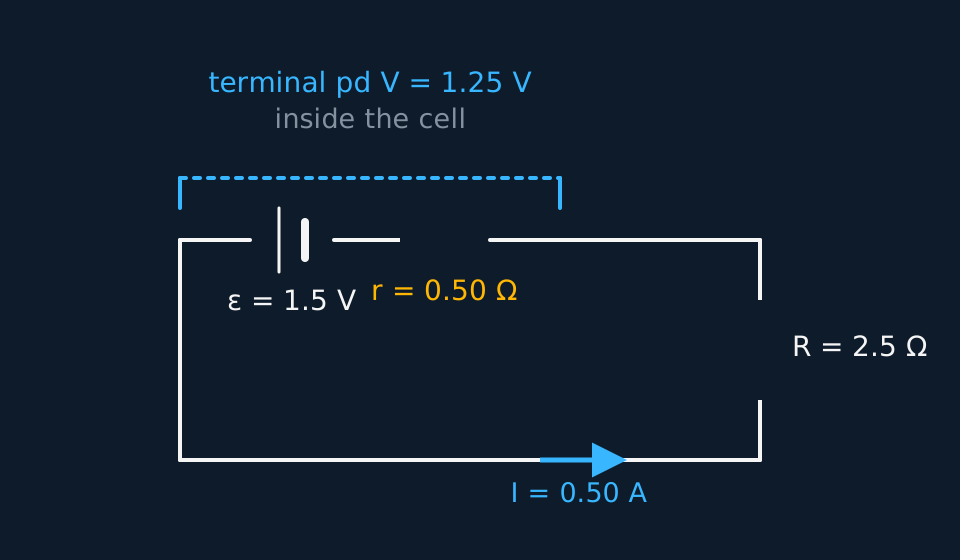
The emf is shared between the external resistance and the internal resistance.
What appears across the cell's terminals, the terminal pd, is the emf minus the part spent inside, V = ε − Ir. That same quantity is also IR, the pd across the external circuit.
Both equations describe the circuit drawn above. Its cell has ε = 1.5 V and r = 0.50 Ω, and the resistor outside is 2.5 Ω, so ε = I(R + r) gives I = 1.5/(2.5 + 0.50) = 0.50 A. Then V = ε − Ir = 1.5 − 0.50 × 0.50 = 1.25 V, which is also IR = 0.50 × 2.5 = 1.25 V. A cell marked 1.5 V puts 1.25 V across its resistor, and the quarter of a volt missing from the label is spent inside the case.
Lost volts
The difference Ir is called the lost volts: the energy per unit charge transferred inside the cell, which raises the cell's internal energy rather than being delivered to the circuit. The lost volts increase with current, so the larger the current a cell supplies, the further its terminal pd falls below its emf. Car headlights dim while the starter motor turns because the starter draws a large current, so Ir is large and the terminal pd, which is shared by every other component, is reduced.
The terminal pd equals the emf only when the current is zero. A high-resistance voltmeter across an unused cell reads very nearly the full emf, because it draws almost no current and the lost volts are therefore almost zero.
Finding the emf and internal resistance from a graph
Vary the external resistance, record the terminal pd and the current, and plot V against I. The model equation V = ε − Ir is already the equation of a straight line. Set it beside y = c + mx, with V for y and I for x: the constant term c is ε and the coefficient of x is −r. So the intercept on the V axis is the emf and the gradient is minus the internal resistance, and one set of readings yields both.
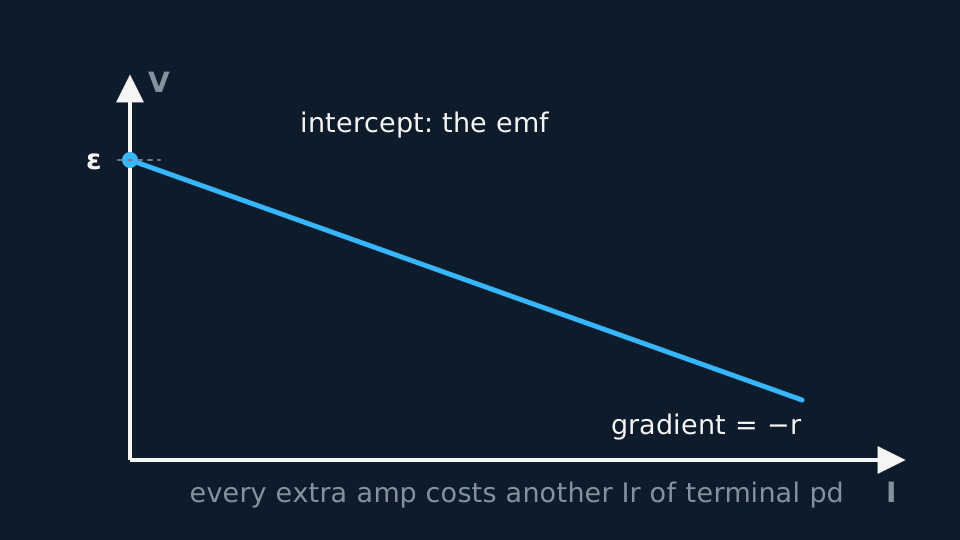
That line belongs to the same cell as the circuit earlier on this page, ε = 1.5 V and r = 0.50 Ω, and the circuit is one point on it. With R = 2.5 Ω the cell sits at I = 0.50 A and V = 1.25 V. Make R smaller and the point slides down the line to the right, because the current rises and the lost volts rise with it; make R larger and the point climbs back towards the intercept. The intercept and the gradient are properties of the cell, and the resistor outside decides only where along the line the circuit sits.
The graph gives the emf without a direct measurement. Any real voltmeter draws a small current, so a direct reading is slightly below the emf; extrapolating the line to I = 0 gives ε with the lost volts removed, and the gradient gives r from the same set of readings. Required practical 6 is this experiment, with a variable resistor stepping the current and a dozen or so V and I pairs plotted by hand.
WORKED EXAMPLE
Reading the line
A cell's V–I graph is a straight line cutting the V axis at 1.58 V and falling to 1.10 V at a current of 2.0 A. Find the emf and the internal resistance.
Compare the equation with the line first. V = ε − Ir has the form y = c + mx, so the intercept gives ε and the gradient gives −r.
Read the intercept straight off, ε = 1.58 V. The gradient is (1.10 − 1.58)/2.0 = −0.24 V A−1, so r = 0.24 Ω, quoted positive with the gradient described as negative.
Both values are typical of a single dry cell: an emf a little above 1.5 V and an internal resistance of a fraction of an ohm.
Those two numbers now describe the cell on their own, so the loop equation can predict the cell's behaviour in a circuit outside the range plotted. Across a 5.0 Ω resistor, ε = I(R + r) gives I = 1.58/(5.0 + 0.24) = 0.30 A.
GUIDED PRACTICE
The algebra-only route
A cell delivers a terminal pd of 1.35 V at 0.50 A, and 1.20 V at 1.25 A. Write V = ε − Ir once for each reading, subtract one equation from the other, and find r and then ε.
Show the working
Subtracting eliminates ε. From 1.35 − 1.20 = r × (1.25 − 0.50) comes 0.15 = 0.75r, so r = 0.20 Ω.
Substitute back into either reading. ε = 1.35 + 0.50 × 0.20 = 1.45 V, and the other reading agrees, 1.20 + 1.25 × 0.20 = 1.45 V. That agreement is the built-in check.
INDEPENDENT PRACTICE
The short circuit
A cell of emf 4.5 V and internal resistance 1.5 Ω is accidentally short-circuited by a wire of negligible resistance. Find the current, the terminal pd, and state where the energy is going.
Show the working
With R = 0 the loop equation ε = I(R + r) collapses to ε = Ir, giving I = 4.5/1.5 = 3.0 A.
Terminal pd is then V = ε − Ir = 4.5 − 3.0 × 1.5 = 0 V. All of the emf appears as lost volts inside the cell.
All of the power, P = εI = 13.5 W, is dissipated in the cell's internal resistance, which is why a short-circuited cell becomes hot enough to be hazardous. The working treats r as constant; at currents of this size a real cell only approximates that, although exam questions assume it.
The emf and internal resistance questions page carries a set of plotted readings with a line of best fit drawn through them, to be turned into a gradient and an intercept and then into the current through a stated resistor. That question is the circuit, the two equations, the graph and the calculation in one place.
ASSESSMENT FOCUS
- From a V–I graph the intercept gives ε and the gradient gives minus r. Quote r as a positive resistance and describe the gradient as negative.
- Terminal pd equals the emf only when I = 0. A high-resistance voltmeter across an isolated cell reads very nearly ε for that reason.
- The cell's r sits in series with everything outside it, so the loop equation is ε = I(R + r) and never ε = IR.
- Lost volts means Ir, which is not a fixed value for a given cell: doubling the current doubles the lost volts.
- Despite its name, emf is an energy per unit charge, measured in volts. Define it as energy per unit charge, not as a force.
CHECK YOURSELF
A battery of emf 9.0 V and internal resistance 0.60 Ω drives a 4.4 Ω resistor. Find the current, the terminal pd, and the lost volts.
Show a hint
The emf drives the current through both resistances; the terminal pd is the external share.
Show the answer
Current first. = 9.0 / (4.4 + 0.60) = 1.8 A.
Terminal pd is V = IR = 1.8 × 4.4 = 7.9 V, and ε − Ir gives the same.
Lost volts, Ir = 1.8 × 0.60 = 1.1 V. The 9.0 V emf is shared as 7.9 V across the external resistor and 1.1 V inside the cell.
The emf is the energy per coulomb the cell supplies.
The terminal pd is what is left after the internal resistance.
The difference, Ir, grows with the current.
WORKBOOK
Printable practice for this topic: original exam-style questions with room to work, and a fully worked answer book. Free to use; please do not redistribute or sell.
Or read them with their mark schemes on the EMF and internal resistance questions page.
WHERE TO GO NEXT
- Required practical 6: EMF and internal resistance of a cell puts this topic in the lab, and the written papers ask about it.
- Gradients and areas under graphs is the maths this lesson leans on, worked through step by step.
- Rearranging equations is the maths this lesson leans on, worked through step by step.
USED LATER IN
CHECK YOUR PROGRESS
Rate how confident you feel with each objective for this lesson. Ratings are saved in this browser, on this device, unless you sign in.
- Define emf as the energy given to each unit of charge, ε = E/Q, and keep it distinct from terminal pd.
- Work circuits where r cannot be neglected, using ε = I(R + r) and V = ε − Ir.
- Determine ε and r from a graph of terminal pd against current.
Open the full revision checklist to track your progress across the whole unit.