Chemistry › Electrochemistry › The electrochemical series and predicting feasibility
The electrochemical series and predicting feasibility
Put the standard electrode potentials in order and they become a ranking of oxidising and reducing agents, from lithium, which gives up electrons more readily than anything else in the table, to fluorine, which takes them most strongly. Any two half-equations in the series predict which way electrons will pass between them and whether a reaction is feasible. The prediction is about direction, not rate, and it holds under standard conditions.
Key terms Every definition in electrochemistry, lesson by lesson
Before this Electrode potentials and the standard hydrogen electrode – E° and E°cell = E°right − E°left · Dynamic equilibrium, Le Chatelier's principle and industrial compromise – how an equilibrium responds to a change in concentration
COMMON MISCONCEPTION
If E°cell is positive, the reaction happens as soon as the chemicals are mixed.
A positive E°cell says the reaction is feasible, not that it is fast. Acidified manganate(VII) should oxidise water by 0.28 V and sits unchanged in a burette for hours, because the activation energy is high. E° values are also for standard conditions, 1.00 mol dm⁻³ and 298 K, and a change of concentration changes the EMF.
What you should be able to do
- Use a table of E° values to rank species as oxidising and reducing agents.
- Predict whether a redox reaction is feasible from the sign of E°cell, and write the overall equation from two half-equations.
- Use the anticlockwise rule to read the direction of a reaction from a pair of half-equations.
- Explain why a reaction predicted to be feasible may not be observed, in terms of activation energy and non-standard conditions.
- Predict how a change in concentration alters an electrode potential and the EMF of a cell, using Le Chatelier's principle.
- Calculate an electrode potential with the Nernst equation and ΔG° from E°cell, and relate E°cell to ln K.CAIE · Edexcel
The series as a ranking
Gold lies in a river bed unchanged for thousands of years, while a freshly cut surface of sodium tarnishes in seconds. Both facts are in the same table. List standard electrode potentials in order, each half-equation written as a reduction, and the list is the electrochemical series.
| Half-equation | E° / V |
|---|---|
| Li⁺(aq) + e⁻ ⇌ Li(s) | −3.04 |
| K⁺(aq) + e⁻ ⇌ K(s) | −2.93 |
| Na⁺(aq) + e⁻ ⇌ Na(s) | −2.71 |
| Mg²⁺(aq) + 2e⁻ ⇌ Mg(s) | −2.37 |
| Al³⁺(aq) + 3e⁻ ⇌ Al(s) | −1.66 |
| Zn²⁺(aq) + 2e⁻ ⇌ Zn(s) | −0.76 |
| Fe²⁺(aq) + 2e⁻ ⇌ Fe(s) | −0.44 |
| 2H⁺(aq) + 2e⁻ ⇌ H₂(g) | 0.00 |
| Cu²⁺(aq) + 2e⁻ ⇌ Cu(s) | +0.34 |
| I₂(aq) + 2e⁻ ⇌ 2I⁻(aq) | +0.54 |
| Fe³⁺(aq) + e⁻ ⇌ Fe²⁺(aq) | +0.77 |
| Ag⁺(aq) + e⁻ ⇌ Ag(s) | +0.80 |
| Br₂(aq) + 2e⁻ ⇌ 2Br⁻(aq) | +1.09 |
| Cr₂O₇²⁻(aq) + 14H⁺(aq) + 6e⁻ ⇌ 2Cr³⁺(aq) + 7H₂O(l) | +1.33 |
| Cl₂(g) + 2e⁻ ⇌ 2Cl⁻(aq) | +1.36 |
| Au³⁺(aq) + 3e⁻ ⇌ Au(s) | +1.50 |
| MnO₄⁻(aq) + 8H⁺(aq) + 5e⁻ ⇌ Mn²⁺(aq) + 4H₂O(l) | +1.51 |
| F₂(g) + 2e⁻ ⇌ 2F⁻(aq) | +2.87 |
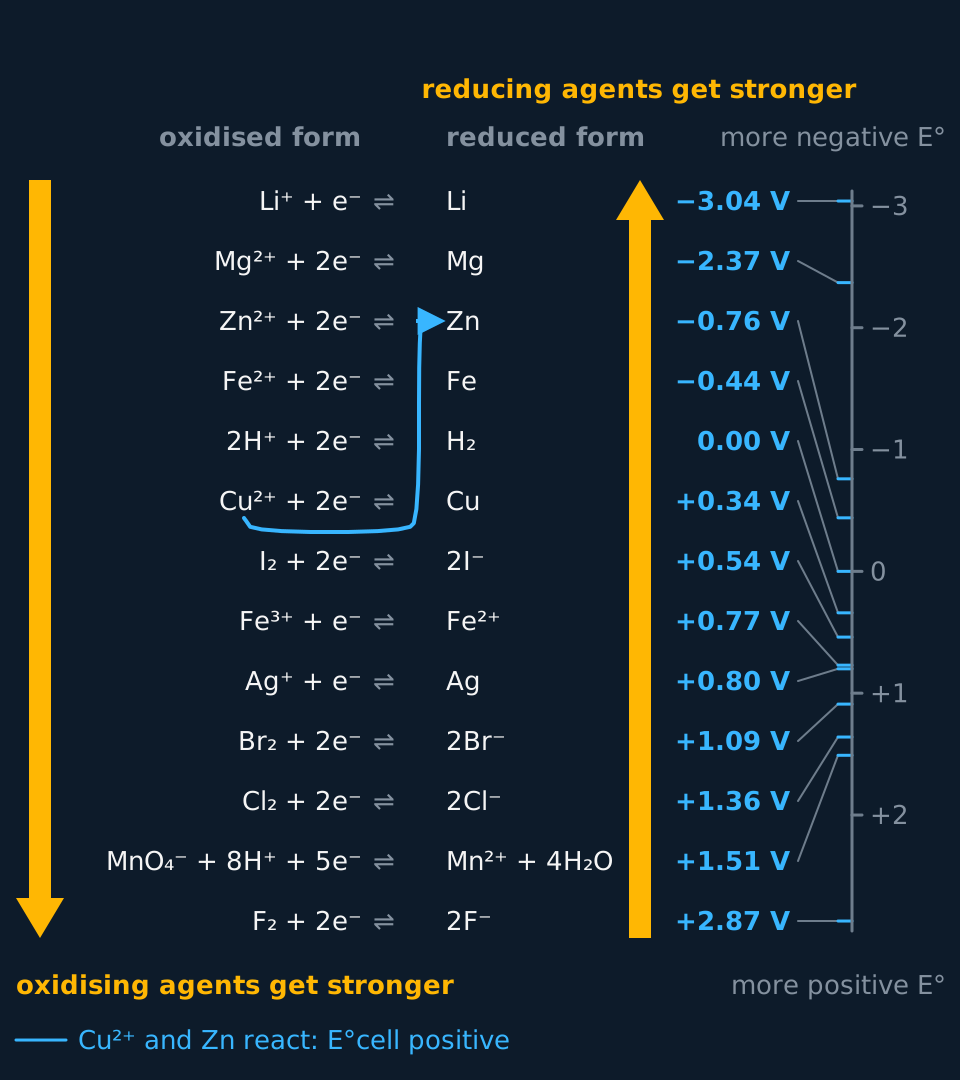
The table reads in two directions. On the left of each half-equation is an oxidised form. The further down the table it sits, the more positive its E° and the more readily it gains electrons, so fluorine and manganate(VII) are powerful oxidising agents and Li⁺ and K⁺ oxidise almost nothing. On the right is a reduced form. The further up it sits, the more negative its E° and the more readily it gives electrons away, so lithium and potassium are powerful reducing agents and F⁻ and Cl⁻ are very weak ones.
The two rankings run in opposite directions because they describe the same equilibria. A metal that gives up its electrons easily forms an ion with little pull on them, and an ion with a strong pull on electrons comes from an element that holds on to them. Sodium, near the top, is found in nature only as Na⁺ in compounds; gold, near the bottom, is found as the metal.
Describe the drawing
The electrochemical series as a table against a vertical E° scale, most negative at the top. Thirteen half-equations run from Li⁺/Li at −3.04 V through Mg, Zn, Fe, hydrogen at 0.00, Cu at +0.34, iodine, Fe³⁺/Fe²⁺, Ag, bromine, chlorine and manganate(VII) at +1.51, to F₂/F⁻ at +2.87 V, each joined to its place on a scale drawn to proportion. Oxidised forms are on the left, reduced forms on the right. A broad arrow down the left reads oxidising agents get stronger, and one up the right reads reducing agents get stronger. A curved arrow from Cu²⁺ on the left runs up to Zn on the right, marking a reaction that goes because E°cell is positive.
Name the species exactly when ranking. Chlorine, Cl₂, is the oxidising agent; chloride, Cl⁻, is the reducing agent of the same couple. 'Chlorine is a weak reducing agent' mixes the two forms up.
- Electrochemical series
- A list of half-equations written as reductions, in order of their standard electrode potentials.
- Oxidising agent
- A species that accepts electrons from another species and is itself reduced.
- Reducing agent
- A species that donates electrons to another species and is itself oxidised.
Predicting the direction of a reaction
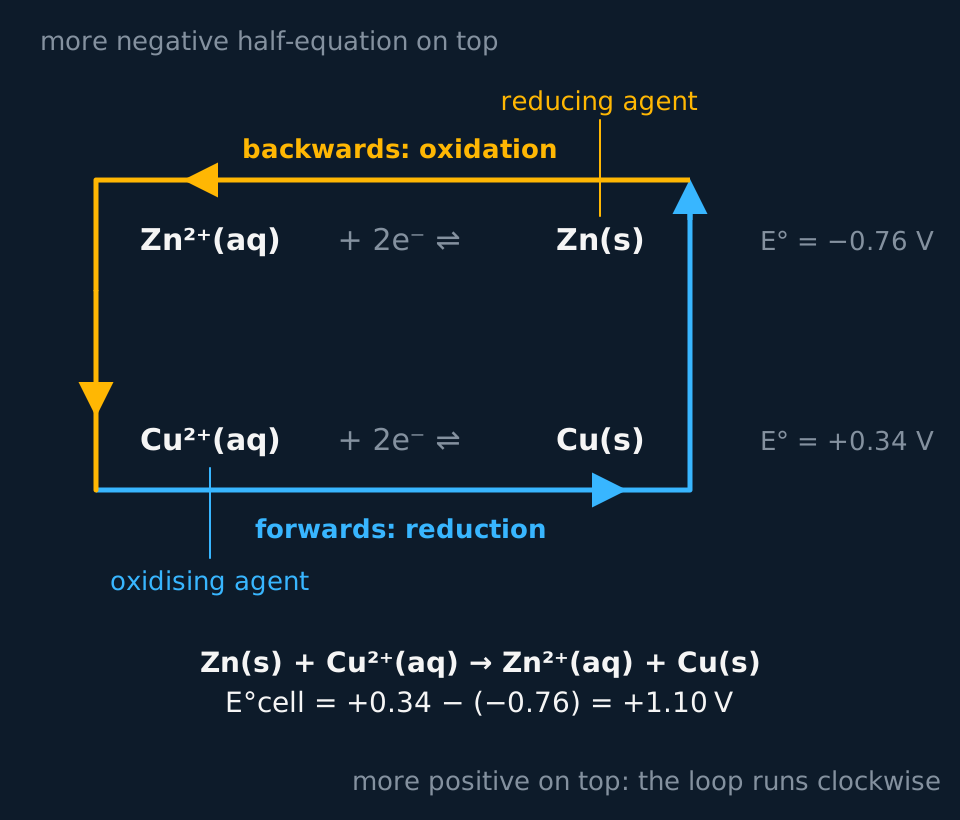
Of any two half-equations from the series, the one with the more positive E° goes forwards, as written, and gains electrons. The one with the less positive E° goes backwards and gives them up. The arithmetic gives the same answer: put the half-cell being reduced on the right, and E°cell = E°right − E°left comes out positive.
The same test works when a question names the reaction. Take the half-cell in which reduction happens as the right-hand electrode and calculate E°cell. If it is positive, the reaction is feasible under standard conditions. If it is negative, the reaction as written is not feasible, and the reverse reaction is. The scheme credits 'feasible'; 'the reaction happens' claims something E° cannot show.
Describe the drawing
Two half-equations written one above the other: Zn²⁺ plus two electrons in equilibrium with Zn, E° −0.76 V, on top, and Cu²⁺ plus two electrons in equilibrium with Cu, E° +0.34 V, below. A loop of arrows runs anticlockwise: right along the lower equation from Cu²⁺ to Cu, labelled forwards: reduction, up to Zn, left along the upper equation to Zn²⁺, labelled backwards: oxidation, and down again. Cu²⁺ is marked as the oxidising agent and Zn as the reducing agent. Beneath, Zn plus Cu²⁺ gives Zn²⁺ plus Cu with E°cell +1.10 V, and a note that with the more positive equation on top the loop runs clockwise.
The anticlockwise rule is a way of seeing the same thing in a pair of half-equations. Write the two with the more negative one on top. Start at the bottom left and trace an anticlockwise loop: along the lower equation to the right, up, and along the upper equation to the left. The species met in order are the oxidising agent, the product of its reduction, the reducing agent and the product of its oxidation. On a table printed with the most positive value at the top, the loop runs clockwise instead, so check the order before using it.
The overall equation comes from the two half-equations as any redox equation does: reverse the one that goes backwards, multiply until the electrons match, and add. The E° values are never multiplied, because a potential does not depend on how many electrons are written.
Halogens and iron(II) ions
Use E° values to predict which of chlorine, bromine and iodine oxidise Fe²⁺ to Fe³⁺ under standard conditions, and write the equation for each feasible reaction. E°(Fe³⁺/Fe²⁺) = +0.77 V, E°(Cl₂/Cl⁻) = +1.36 V, E°(Br₂/Br⁻) = +1.09 V, E°(I₂/I⁻) = +0.54 V.
Show the working
For Fe²⁺ to be oxidised, the halogen must be reduced, so the halogen half-cell is on the right and the iron half-cell on the left: E°cell = E°(halogen) − 0.77.
Chlorine: 1.36 − 0.77 = +0.59 V, feasible. Bromine: 1.09 − 0.77 = +0.32 V, feasible. Iodine: 0.54 − 0.77 = −0.23 V, not feasible.
The iron half-equation has one electron and each halogen half-equation two, so the iron is doubled: Cl₂(aq) + 2Fe²⁺(aq) → 2Cl⁻(aq) + 2Fe³⁺(aq), and Br₂(aq) + 2Fe²⁺(aq) → 2Br⁻(aq) + 2Fe³⁺(aq).
The negative value for iodine predicts the reverse reaction: Fe³⁺ oxidises I⁻ to I₂, with E°cell = +0.23 V. Iron(III) chloride solution added to potassium iodide solution turns it brown with iodine, which confirms the prediction.
Acidified dichromate(VI) and chloride ions
Predict whether acidified potassium dichromate(VI) oxidises chloride ions to chlorine under standard conditions, and compare it with acidified manganate(VII). E°(Cr₂O₇²⁻/Cr³⁺) = +1.33 V, E°(Cl₂/Cl⁻) = +1.36 V, E°(MnO₄⁻/Mn²⁺) = +1.51 V.
Show the working
For chloride to be oxidised, dichromate must be reduced, so the dichromate half-cell is on the right: E°cell = 1.33 − 1.36 = −0.03 V.
The value is negative, so the reaction is not feasible under standard conditions. Chlorine's E° is the more positive, so Cl₂ is a slightly stronger oxidising agent than dichromate(VI).
For manganate(VII), E°cell = 1.51 − 1.36 = +0.15 V, which is feasible: 2MnO₄⁻(aq) + 16H⁺(aq) + 10Cl⁻(aq) → 2Mn²⁺(aq) + 8H₂O(l) + 5Cl₂(g). Manganate(VII) titrations are acidified with sulfuric acid and not hydrochloric acid for this reason: the manganate would oxidise chloride ions as well as the substance being analysed, and the titre would be too large.
−0.03 V is very close to zero. With concentrated hydrochloric acid and heat, conditions are far from standard and dichromate(VI) does release chlorine. The closer E°cell is to zero, the smaller the change in conditions needed to reverse the prediction.
The test applies when one species appears in both half-equations. Copper(I) ions are reduced in Cu⁺(aq) + e⁻ ⇌ Cu(s), E° = +0.52 V, and oxidised in the reverse of Cu²⁺(aq) + e⁻ ⇌ Cu⁺(aq), E° = +0.15 V. E°cell = 0.52 − 0.15 = +0.37 V, so copper(I) ions in water are not stable: white copper(I) sulfate dissolves to give a blue solution and a precipitate of copper. One species is both oxidised and reduced, which is disproportionation.
2Cu⁺(aq) → Cu(s) + Cu²⁺(aq)
- Feasible
- Able to take place; a redox reaction is feasible under standard conditions when E°cell, calculated with the half-cell in which reduction occurs on the right, is positive.
- Disproportionation
- A redox reaction in which the same element in one species is simultaneously oxidised and reduced.
When a feasible reaction is not seen
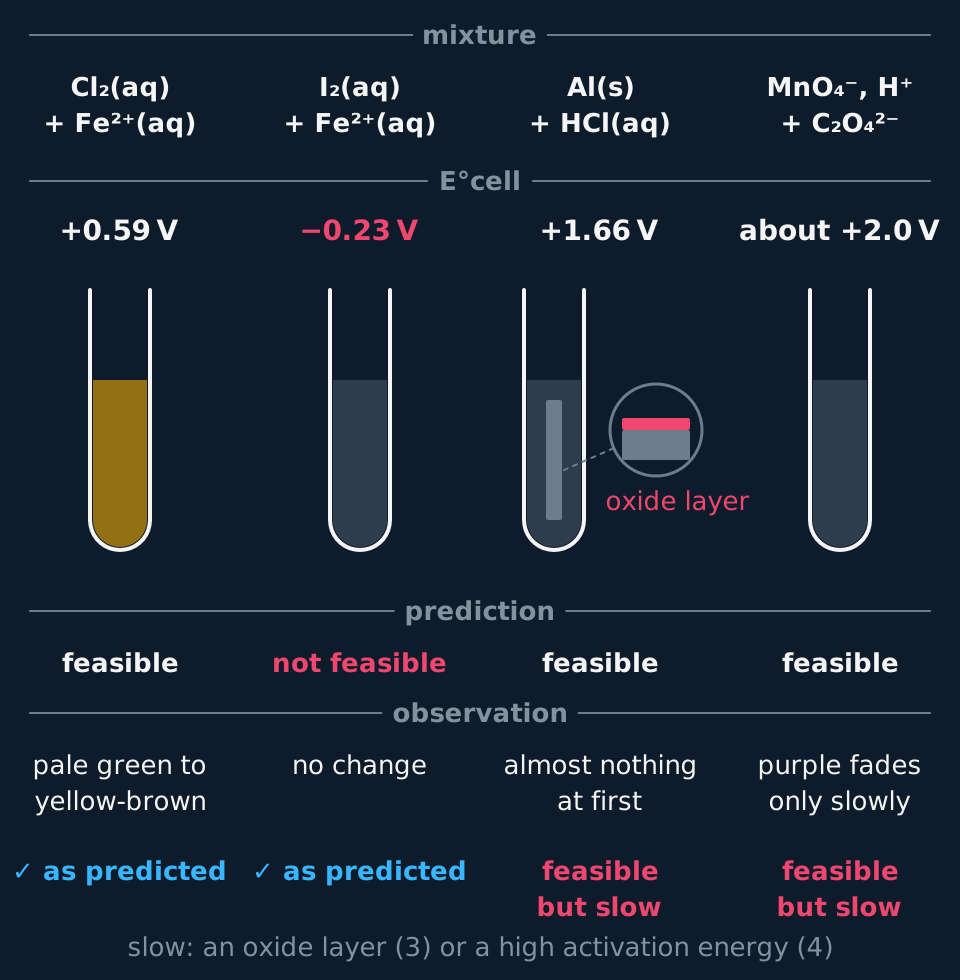
A positive E°cell means a reaction is energetically possible. It says nothing about how fast the reaction goes, because E° comes from the energies of reactants and products and not from the activation energy between them. A mixture of hydrogen and oxygen has E°cell = +1.23 V for forming water, and it sits unchanged in a balloon until a spark arrives.
Aluminium is the everyday case. E°(Al³⁺/Al) = −1.66 V, more negative than zinc, so the reduction of H⁺ in dilute acid by aluminium is even more feasible than by zinc, and an aluminium pan might be expected to dissolve in vinegar. It does not, because a layer of aluminium oxide a few nanometres thick covers the metal and keeps the acid off it. Once sodium hydroxide solution has dissolved the layer, the metal underneath reacts vigorously, giving off hydrogen.
Manganate(VII) and ethanedioate ions are a third example. E°cell for the reaction is large and positive, yet at room temperature the purple colour fades only slowly, and the titration is done warm for that reason. Mixtures like these are kinetically stable: the reaction is feasible but its rate is too low to observe.
The second limit is that E° values apply under standard conditions. Concentrations of exactly 1.00 mol dm⁻³ are rare outside a data book, and a reaction run with concentrated reagents, or hot, can go the other way from the prediction when E°cell is small, as dichromate and hot concentrated hydrochloric acid show.
Describe the drawing
Four test tubes in a row, each labelled above with its mixture and E°cell and below with the prediction and what is seen. Chlorine water with iron(II), E°cell +0.59 V, feasible, pale green turns yellow-brown, as predicted. Iodine with iron(II), E°cell −0.23 V, not feasible, no change, as predicted. Aluminium foil in dilute hydrochloric acid, +1.66 V, feasible, but almost nothing happens at first, with a magnified inset showing the oxide layer on the foil. Acidified manganate(VII) with ethanedioate, about +2.0 V, feasible, but the purple fades only slowly. The last two are marked feasible but slow.
- Kinetically stable
- Describes a mixture that does not react at a measurable rate although the reaction is feasible, because the activation energy is high.
Concentration and the electrode potential
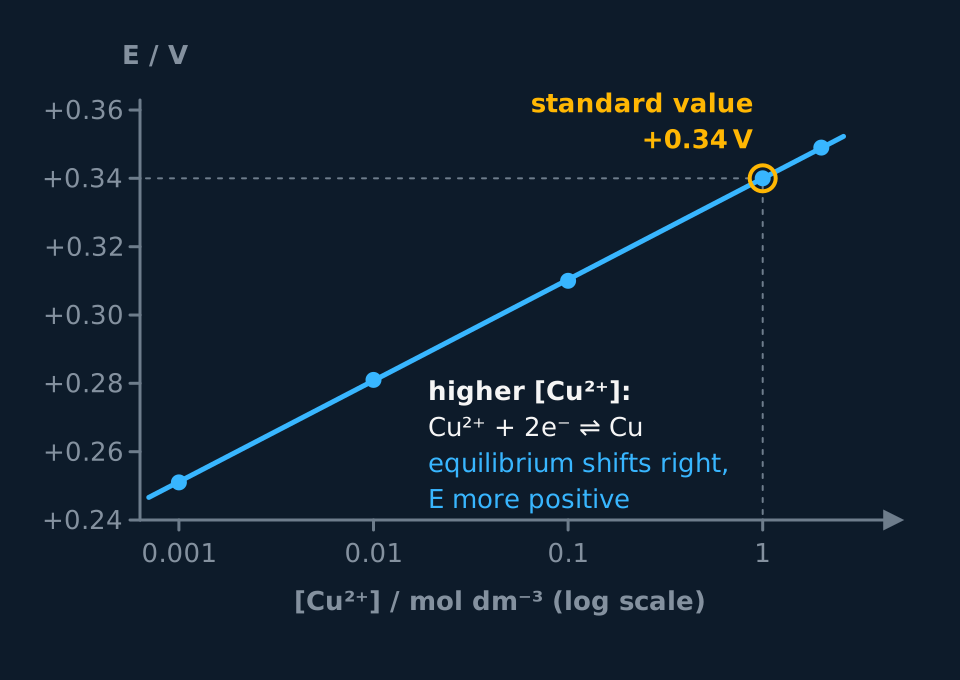
Each electrode potential belongs to an equilibrium, and an equilibrium responds to a change in concentration. In the copper half-cell, Cu²⁺(aq) + 2e⁻ ⇌ Cu(s), raising [Cu²⁺] above 1.00 mol dm⁻³ shifts the position to the right. The electrode takes electrons more readily and its potential becomes more positive than +0.34 V. Lowering [Cu²⁺] shifts the equilibrium to the left and the potential becomes less positive.
Describe the drawing
A graph of the electrode potential of the copper half-cell, from +0.24 to +0.36 V, against copper(II) concentration on a logarithmic axis from 0.001 to above 1 mol dm⁻³. The points lie on a straight line rising from left to right, about 0.03 V for every tenfold rise in concentration. A dashed line at +0.34 V meets the line at 1.00 mol dm⁻³, marked as the standard value. A note says that at higher [Cu²⁺] the equilibrium Cu²⁺ + 2e⁻ ⇌ Cu shifts right and E becomes more positive.
The reasoning extends to a whole cell. In the zinc–copper cell, anything that makes the right-hand electrode more positive, or the left-hand one more negative, raises the EMF. A more concentrated copper(II) sulfate solution raises it. A more concentrated zinc sulfate solution lowers it, because a higher [Zn²⁺] shifts Zn²⁺(aq) + 2e⁻ ⇌ Zn(s) to the right and makes the zinc electrode less negative.
The same shifts make a cell go flat. As the zinc–copper cell delivers a current, [Cu²⁺] falls and [Zn²⁺] rises. Both changes lower the EMF, and the current stops when the two electrode potentials are equal, which is when the cell reaction has reached equilibrium.
For a half-equation that includes H⁺, the hydrogen ion concentration counts too. Raising [H⁺] shifts Cr₂O₇²⁻(aq) + 14H⁺(aq) + 6e⁻ ⇌ 2Cr³⁺(aq) + 7H₂O(l) to the right and makes dichromate(VI) a stronger oxidising agent, which is part of the reason hot concentrated hydrochloric acid gives chlorine with it. Temperature changes E as well, and standard values are quoted at 298 K.
An answer on concentration earns its marks in three steps: name the equilibrium, say which way it shifts, and say whether the electrode potential becomes more or less positive. Only the direction of the change is needed here, reasoned from Le Chatelier's principle.
TRY IT: Diluting one side of a cell
A zinc–copper cell set up with 1.00 mol dm⁻³ solutions reads 1.10 V. The copper(II) sulfate is replaced with 0.010 mol dm⁻³ copper(II) sulfate. Predict and explain the effect on the EMF, and state one change to the solutions that would raise the EMF above 1.10 V.
Check your answer
Lowering [Cu²⁺] shifts Cu²⁺(aq) + 2e⁻ ⇌ Cu(s) to the left, so the copper electrode takes electrons less readily and its potential becomes less positive than +0.34 V.
Copper is the right-hand electrode and the zinc electrode is unchanged, so E right − E left falls and the EMF drops below 1.10 V, to about 1.04 V.
The EMF rises above 1.10 V if [Cu²⁺] is raised above 1.00 mol dm⁻³, or if [Zn²⁺] is lowered below it, which makes the zinc electrode more negative.
Other boards: the Nernst equation and free energy
Cambridge asks how far an electrode potential moves as well as which way, and gives the answer by the Nernst equation, which at 298 K reads:
E = E° + (0.059 / z) log₁₀([oxidised form] / [reduced form])z is the number of electrons in the half-equation. Solids and water are left out of the concentration term.
For a metal in a solution of its ions the reduced form is the solid, so only the ion appears. The copper half-cell gives E = 0.34 + 0.0295 log₁₀[Cu²⁺]: at 1.00 mol dm⁻³ the logarithm is zero and E equals E°, and each tenfold change in [Cu²⁺] moves E by 0.0295 V, the slope of the copper graph. The sign agrees with Le Chatelier's principle: more of the oxidised form, more positive E.
An iron(III) and iron(II) mixture that is not standard
A solution contains Fe³⁺ at 0.050 mol dm⁻³ and Fe²⁺ at 0.50 mol dm⁻³, with a platinum electrode, at 298 K. E°(Fe³⁺/Fe²⁺) = +0.77 V and E°(I₂/I⁻) = +0.54 V. Calculate the electrode potential of the half-cell, and decide whether the mixture still oxidises iodide ions in a standard I₂/I⁻ half-cell.
Show the working
The half-equation is Fe³⁺(aq) + e⁻ ⇌ Fe²⁺(aq), so z = 1, the oxidised form is Fe³⁺ and the reduced form Fe²⁺.
E = 0.77 + (0.059 / 1) × log₁₀(0.050 / 0.50) = 0.77 + 0.059 × (−1) = +0.71 V.
Fe³⁺ is the species reduced, so the iron half-cell goes on the right against a standard iodine half-cell: E cell = 0.71 − 0.54 = +0.17 V. It is positive, so Fe³⁺ still oxidises I⁻, by a smaller margin than the standard +0.23 V.
Ten times more Fe²⁺ than Fe³⁺ moved E by only 0.059 V. A change in concentration reverses a prediction only when E°cell is small, a few tenths of a volt or less.
An EMF is also a measure of energy. One mole of electrons carries a charge of 96 500 C, the Faraday constant, F. When the equation as written moves n moles of electrons through a potential difference E°cell, the electrical work available is nFE°cell, and Cambridge links it to the standard free-energy change:
ΔG° = −nFE°cellWith F in C mol⁻¹ and E°cell in V, ΔG° comes out in J mol⁻¹.
The minus sign makes it the feasibility test in another form: a positive E°cell gives a negative ΔG°. The two differ in one way. ΔG° belongs to the equation as written, so doubling the equation doubles n and doubles ΔG°. E°cell is energy per unit of charge, the same however many electrons are written, and E° values are never multiplied for that reason.
Edexcel makes the same link through entropy and the equilibrium constant. Since ΔStotal = −ΔG/T and ΔG° = −RT ln K, both ΔStotal and ln K are proportional to E°cell. A large positive E°cell means a large positive total entropy change and a K so large that the reaction goes to completion. An E°cell close to zero means K close to 1, with reactants and products both present at equilibrium, so a change in concentration can push the reaction either way, as dichromate and chloride ions show.
| E°cell | ΔG° | ΔStotal | K | |
|---|---|---|---|---|
| Feasible | positive | negative | positive | greater than 1 |
| Not feasible | negative | positive | negative | less than 1 |
| Neither direction favoured | zero | zero | zero | equal to 1 |
Free energy and K for the zinc–copper cell
E°cell for Zn(s) + Cu²⁺(aq) → Zn²⁺(aq) + Cu(s) is +1.10 V. Calculate ΔG° for the reaction, and ln K at 298 K. F = 96 500 C mol⁻¹; R = 8.31 J K⁻¹ mol⁻¹.
Show the working
Each zinc atom gives two electrons to one Cu²⁺ ion, so n = 2 for the equation as written.
ΔG° = −nFE°cell = −2 × 96 500 × 1.10 = −212 300 J mol⁻¹ = −212 kJ mol⁻¹.
ln K = −ΔG° / RT = 212 300 / (8.31 × 298) = 85.7, so K is about 2 × 10³⁷.
At equilibrium [Cu²⁺] is negligible: zinc left in copper(II) sulfate removes all the blue colour. The first part is Cambridge's calculation; ln K is Edexcel's link.
- Nernst equation
- E = E° + (0.059/z) log₁₀([oxidised form] / [reduced form]) at 298 K, giving the electrode potential of a half-cell at concentrations that are not standard.
- Faraday constant
- The charge on one mole of electrons, 96 500 C mol⁻¹.
In the exam
- To justify a feasibility prediction, quote both E° values, say which is more positive and name the species that is reduced. A calculated E°cell with its sign is an equivalent justification, and the scheme will accept either.
- Rank oxidising agents by the species on the left of each half-equation and reducing agents by the species on the right: Cl₂ is a stronger oxidising agent than Br₂; Br⁻ is a stronger reducing agent than Cl⁻.
- An E° multiplied when its half-equation is doubled loses the calculation mark, even when the overall equation is right.
- For a feasible reaction that is not observed, the scheme credits either of two reasons: a high activation energy, so the rate is too low, or conditions that are not standard. 'The reaction is not feasible' contradicts the data and is not credited.
- For a change in concentration, name the equilibrium, say which way it shifts, and state whether the electrode potential becomes more or less positive.
Check yourself
E°(MnO₄⁻/Mn²⁺) = +1.51 V and E°(O₂/H₂O) = +1.23 V, for O₂(g) + 4H⁺(aq) + 4e⁻ ⇌ 2H₂O(l). Show that the E° values predict that acidified manganate(VII) should oxidise water, and explain why acidified manganate(VII) solution nevertheless keeps its colour in a burette for hours.
Answer
Water is oxidised to oxygen if manganate(VII) is reduced, so the manganate half-cell goes on the right: E°cell = 1.51 − 1.23 = +0.28 V. The value is positive, so the reaction is feasible: 4MnO₄⁻(aq) + 12H⁺(aq) → 4Mn²⁺(aq) + 6H₂O(l) + 5O₂(g).
The activation energy for the reaction is high, so at room temperature its rate is negligible. The solution is kinetically stable: E° predicts that the reaction can happen, not how fast it goes.
Over weeks, especially in light, a stock solution does slowly deposit brown manganese(IV) oxide. That is why manganate(VII) is kept in a brown bottle and standardised before an accurate titration.
Questions
Question 16 marks
Explain the observations in the three test-tube experiments described in the first table, using the E° values given in the second table, and write an equation for each reaction that takes place.
| Experiment | Observation |
|---|---|
| 1: chlorine water added to potassium bromide solution | colourless solution turns orange-yellow |
| 2: iron(III) chloride solution added to potassium iodide solution | solution turns brown |
| 3: iron(III) chloride solution added to potassium bromide solution | no change |
| Half-equation | E° / V |
|---|---|
| Cl₂(aq) + 2e⁻ ⇌ 2Cl⁻(aq) | +1.36 |
| Br₂(aq) + 2e⁻ ⇌ 2Br⁻(aq) | +1.09 |
| Fe³⁺(aq) + e⁻ ⇌ Fe²⁺(aq) | +0.77 |
| I₂(aq) + 2e⁻ ⇌ 2I⁻(aq) | +0.54 |
Mark scheme
Indicative content
- in experiment 1 chlorine is reduced and bromide is oxidised, and E°cell = 1.36 − 1.09 = +0.27 V, so the reaction is feasible
- Cl₂(aq) + 2Br⁻(aq) → 2Cl⁻(aq) + Br₂(aq); the orange-yellow colour is the bromine formed in the solution
- in experiment 2 iron(III) is reduced and iodide is oxidised, and E°cell = 0.77 − 0.54 = +0.23 V, so the reaction is feasible
- 2Fe³⁺(aq) + 2I⁻(aq) → 2Fe²⁺(aq) + I₂(aq), with the iron half-equation doubled and its E° not doubled; the brown colour is iodine
- in experiment 3, for Fe³⁺ to oxidise Br⁻, E°cell = 0.77 − 1.09 = −0.32 V, which is negative, so no reaction is feasible and nothing is seen
- the oxidising agents rank Cl₂ > Br₂ > Fe³⁺ > I₂, and each oxidises only the reduced forms of the couples with less positive E° values
Levels
- Level 3 (5–6 marks) all three experiments are explained with the correct E°cell for each, the two feasible reactions have balanced equations with the colour observed attributed to the product, the third is shown to be not feasible from its negative E°cell, and the order of oxidising power is drawn from the data
- Level 2 (3–4 marks) two experiments are explained with E°cell and an equation, or all three are taken on with one E°cell or one equation wrong or absent
- Level 1 (1–2 marks) one reaction is said to happen, with a colour noted; E° values are quoted and not combined, or the more negative value is taken as the stronger oxidising agent
Question 24 marks
Calculate E°cell for the reaction of acidified dichromate(VI) ions with iron(II) ions, and write the overall ionic equation. E°(Cr₂O₇²⁻/Cr³⁺) = +1.33 V; E°(Fe³⁺/Fe²⁺) = +0.77 V.
Mark scheme
- M1 dichromate(VI) is reduced, so its half-cell is on the right: E°cell = 1.33 − 0.77
- B1 the dichromate half-equation takes six electrons, so six Fe²⁺ ions are oxidised for each Cr₂O₇²⁻
- B1 Cr₂O₇²⁻(aq) + 14H⁺(aq) + 6Fe²⁺(aq) → 2Cr³⁺(aq) + 7H₂O(l) + 6Fe³⁺(aq); ignore state symbols
- A1 E°cell = +0.56 V
Question 34 marks
Explain why aluminium shows little reaction with dilute hydrochloric acid at room temperature, although E°(Al³⁺/Al) = −1.66 V predicts that it should react, and give one other reason why a reaction predicted from E° values may not be observed.
Mark scheme
- B1 E°(Al³⁺/Al) is more negative than E°(H⁺/H₂) = 0.00 V, so the reduction of H⁺ by aluminium is feasible, E°cell = +1.66 V
- B1 the aluminium is covered by a thin, unreactive layer of aluminium oxide that keeps the acid off the metal
- B1 so the rate is negligible; E° predicts whether a reaction can happen, not how fast it goes
- B1 the conditions may not be standard, so the actual electrode potentials differ from the E° values used; allow a high activation energy for a different reaction
All 21 questions with mark schemes, the other 18 set out in full on the question page.
Worth remembering
- Name the oxidised form as the oxidising agent: Cl₂ oxidises, Cl⁻ does not.
- Put the half-cell being oxidised on the left, so that E°right − E°left gives E°cell its proper sign.
- Multiplying E° by the coefficient used to balance electrons gives a wrong E°cell.
- 'Not feasible' is the wrong explanation for a feasible reaction that is slow; name the activation energy.
- Name the equilibrium and the way it shifts when a change of concentration moves an electrode potential.
CHECK YOUR PROGRESS
Rate how confident you are with each objective for this lesson. Ratings are saved in this browser, on this device, unless you sign in.
- Use a table of E° values to rank species as oxidising and reducing agents.
- Predict whether a redox reaction is feasible from the sign of E°cell, and write the overall equation from two half-equations.
- Use the anticlockwise rule to read the direction of a reaction from a pair of half-equations.
- Explain why a reaction predicted to be feasible may not be observed, in terms of activation energy and non-standard conditions.
- Predict how a change in concentration alters an electrode potential and the EMF of a cell, using Le Chatelier's principle.
- Calculate an electrode potential with the Nernst equation and ΔG° from E°cell, and relate E°cell to ln K.CAIE · Edexcel
Open the full revision checklist to see every objective in the curriculum in one place.
Practise this lesson
WORKBOOK
The written questions from this topic, on paper with room to work, and a separate book of mark schemes. The 3 questions that are set on a diagram stay on this page, where the diagram can be drawn. Free to use; please do not redistribute or sell.
Used later in Variable oxidation states: vanadium, chromium and manganate(VII) titrations