Chemistry › Transition metals › Variable oxidation states: vanadium, chromium and manganate(VII) titrations
Variable oxidation states: vanadium, chromium and manganate(VII) titrations
A yellow solution of vanadium(V) shaken with zinc in acid turns green, blue, green again and finally violet as the vanadium is reduced one step at a time to +2. Electrode potentials say how far a reducing agent can take it, and pH and ligands move those potentials. Manganate(VII), the purple ion that is its own indicator, turns the same chemistry into titrations for iron and ethanedioate.
Key terms Every definition in transition metals, lesson by lesson
Before this Redox titrations: manganate(VII) and thiosulfate – the method and the mole ratio from an equation · The electrochemical series and predicting feasibility – using E° values to decide whether a reaction occurs · Transition metal characteristics and complex formation – why the 3d and 4s electrons allow several oxidation states
COMMON MISCONCEPTION
The green colour partway through reducing vanadium(V) with zinc is vanadium(III), because vanadium(III) is green.
The first green is a mixture: yellow VO₂⁺, vanadium(V), still present alongside the blue VO²⁺, vanadium(IV), that zinc has just made. Yellow and blue together look green. The solution then turns pure blue, and only after that does the green of V³⁺ appear, followed by the violet of V²⁺.
What you should be able to do
- Describe the reduction of vanadium(V) to vanadium(II) by zinc in acid, with the species, oxidation states and colours.
- Use standard electrode potentials to explain how far a reducing agent can reduce a transition metal ion.
- Explain how pH and the ligand change the stability of an oxidation state, with iron(II) hydroxide in air and Tollens' reagent as examples.
- Describe a manganate(VII) titration of Fe²⁺ or ethanedioate, including the choice of acid and the end point.
- Calculate an amount, a concentration, a formula or a percentage from the results of a manganate(VII) titration.
Several states, several colours
Manganese is found in every oxidation state from +2 to +7: the very pale pink Mn²⁺ ion, brown manganese(IV) oxide, green manganate(VI) and purple manganate(VII). The 3d and 4s electrons are close in energy, so removing one more electron needs only a little more energy, and several states are stable enough to exist. Each state of a metal with a given set of ligands has its own colour, so a change of oxidation state is usually seen as a change of colour.
The highest states are never bare ions. A Mn⁷⁺ ion would have so high a charge density that it would pull electrons from anything near it; instead manganese(VII) is covalently bonded to four oxygen atoms in MnO₄⁻. The same holds for vanadium(V) in VO₂⁺ and chromium(VI) in Cr₂O₇²⁻ and CrO₄²⁻. The oxidation state comes from the formula in the usual way: in MnO₄⁻, x + 4(−2) = −1, so x = +7.
- Oxidation state
- The charge an atom would have if all its bonds were ionic, used to follow the electrons in a redox reaction.
- Oxidising agent
- A species that accepts electrons from another species and is itself reduced.
- Reducing agent
- A species that donates electrons to another species and is itself oxidised.
Vanadium: four states with zinc
Ammonium vanadate(V), NH₄VO₃, dissolves in acid to give the yellow VO₂⁺ ion, with vanadium at +5. Add powdered zinc and swirl, with the flask loosely plugged with cotton wool. Over about twenty minutes the solution turns green, then blue, then green again, then violet, and the vanadium ends at +2.
| Oxidation state | Species | Colour of solution |
|---|---|---|
| +5 | VO₂⁺ | Yellow |
| +4 | VO²⁺ | Blue |
| +3 | V³⁺ | Green |
| +2 | V²⁺ | Violet |
There are five colours for four states because the first green is not a new species. While VO₂⁺ is being reduced to VO²⁺ the tube holds yellow and blue ions together, and yellow and blue look green. When all the vanadium is VO²⁺ the solution is a clear blue; only the second green is V³⁺.
Zn(s) + 2VO₂⁺(aq) + 4H⁺(aq) → Zn²⁺(aq) + 2VO²⁺(aq) + 2H₂O(l)+5 to +4: yellow to blue
Zn(s) + 2VO²⁺(aq) + 4H⁺(aq) → Zn²⁺(aq) + 2V³⁺(aq) + 2H₂O(l)+4 to +3: blue to green
Zn(s) + 2V³⁺(aq) → Zn²⁺(aq) + 2V²⁺(aq)+3 to +2: green to violet
V²⁺ is oxidised by oxygen in the air back to V³⁺, so the flask is plugged: hydrogen from the zinc and acid fills the space above the solution while the plug lets gas escape. Pour the violet solution into an open beaker and it turns green within minutes.
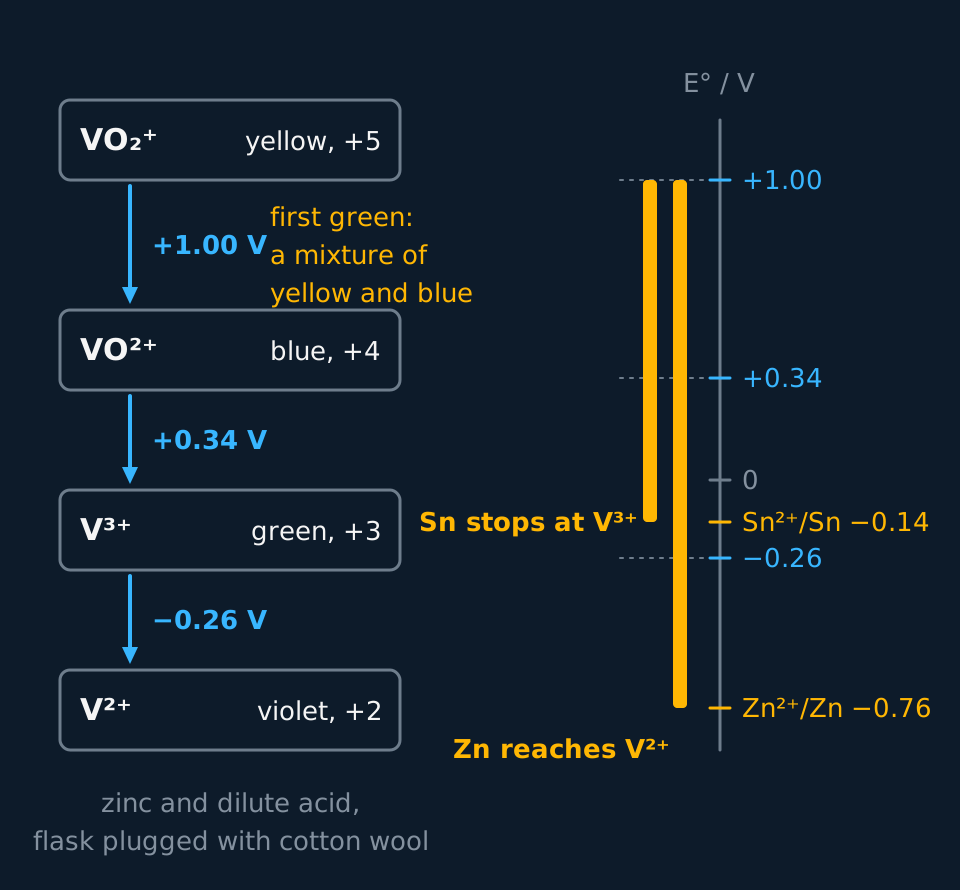
Describe the drawing
A ladder of four vanadium species from top to bottom: VO₂⁺ yellow at +5, VO²⁺ blue at +4, V³⁺ green at +3 and V²⁺ violet at +2. Downward arrows between the rungs carry the electrode potentials +1.00, +0.34 and −0.26 volts, and a note between the top two rungs says the first green seen is a mixture of yellow and blue. Beside it a vertical E° scale marks tin at −0.14 and zinc at −0.76 volts; a bar from zinc reaches past all three steps to V²⁺, while a bar from tin stops at V³⁺.
Zinc reaches the bottom because of the electrode potentials. Each vanadium half-equation has an E° value, and zinc's is more negative than all of them.
| Half-equation | E° / V |
|---|---|
| VO₂⁺(aq) + 2H⁺(aq) + e⁻ → VO²⁺(aq) + H₂O(l) | +1.00 |
| VO²⁺(aq) + 2H⁺(aq) + e⁻ → V³⁺(aq) + H₂O(l) | +0.34 |
| Sn²⁺(aq) + 2e⁻ → Sn(s) | −0.14 |
| V³⁺(aq) + e⁻ → V²⁺(aq) | −0.26 |
| Zn²⁺(aq) + 2e⁻ → Zn(s) | −0.76 |
A species on the right of a half-equation with a more negative E° can reduce a species on the left of one with a more positive E°. Zinc, at −0.76 V, is more negative than all three vanadium couples, so it reduces VO₂⁺, then VO²⁺, then V³⁺. For the last step E°cell = −0.26 − (−0.76) = +0.50 V, which is positive, so the reaction is feasible.
- E°cell
- The EMF of a cell under standard conditions, equal to E° of the couple being reduced minus E° of the couple being oxidised; a positive value means the reaction is feasible.
How far tin reduces vanadium(V)
Tin metal is added to an acidified solution of VO₂⁺. Use the E° values in the table to predict the final oxidation state and the final colour of the vanadium.
Show the working
Tin is oxidised to Sn²⁺, E° = −0.14 V. For each vanadium step, E°cell = E°(vanadium couple reduced) − E°(tin couple).
VO₂⁺ to VO²⁺: +1.00 − (−0.14) = +1.14 V, positive, so it happens. VO²⁺ to V³⁺: +0.34 − (−0.14) = +0.48 V, positive, so it happens.
V³⁺ to V²⁺: −0.26 − (−0.14) = −0.12 V, negative, so it does not happen.
Tin reduces the vanadium as far as +3 and stops. The final solution is green, V³⁺. E° values say whether a change is feasible under standard conditions; a slow reaction or very different concentrations can change what is seen.
Manganate(VII) titrations
Potassium manganate(VII) is a deep purple oxidising agent. In acid it is reduced to Mn²⁺, so pale that it looks colourless. Run it from a burette into an acidified solution of Fe²⁺ and each drop loses its colour as it mixes. At the end point, when the last Fe²⁺ has been oxidised, one more drop stays and the solution turns a permanent pale pink. The manganate(VII) is its own indicator.
MnO₄⁻(aq) + 8H⁺(aq) + 5Fe²⁺(aq) → Mn²⁺(aq) + 4H₂O(l) + 5Fe³⁺(aq)1 mol of MnO₄⁻ reacts with 5 mol of Fe²⁺.
2MnO₄⁻(aq) + 16H⁺(aq) + 5C₂O₄²⁻(aq) → 2Mn²⁺(aq) + 8H₂O(l) + 10CO₂(g)2 mol of MnO₄⁻ react with 5 mol of C₂O₄²⁻.
The acid is dilute sulfuric acid, in excess, because the half-equation needs eight H⁺ for every MnO₄⁻. Three other acids give wrong answers. Hydrochloric acid is oxidised by manganate(VII) to chlorine, so extra manganate(VII) is used and the titre is too large. Nitric acid is itself an oxidising agent and may oxidise some Fe²⁺, so the titre is too small. Ethanoic acid is weak and cannot supply enough H⁺; the manganate(VII) is then reduced only to manganese(IV) oxide, a brown precipitate, and the ratio in the equation no longer holds.
Ethanedioate is titrated hot, at about 60 °C, because the reaction is slow at room temperature until Mn²⁺, one of its products, builds up and catalyses it. The burette is read at the top of the meniscus, because the bottom cannot be seen through the purple solution.
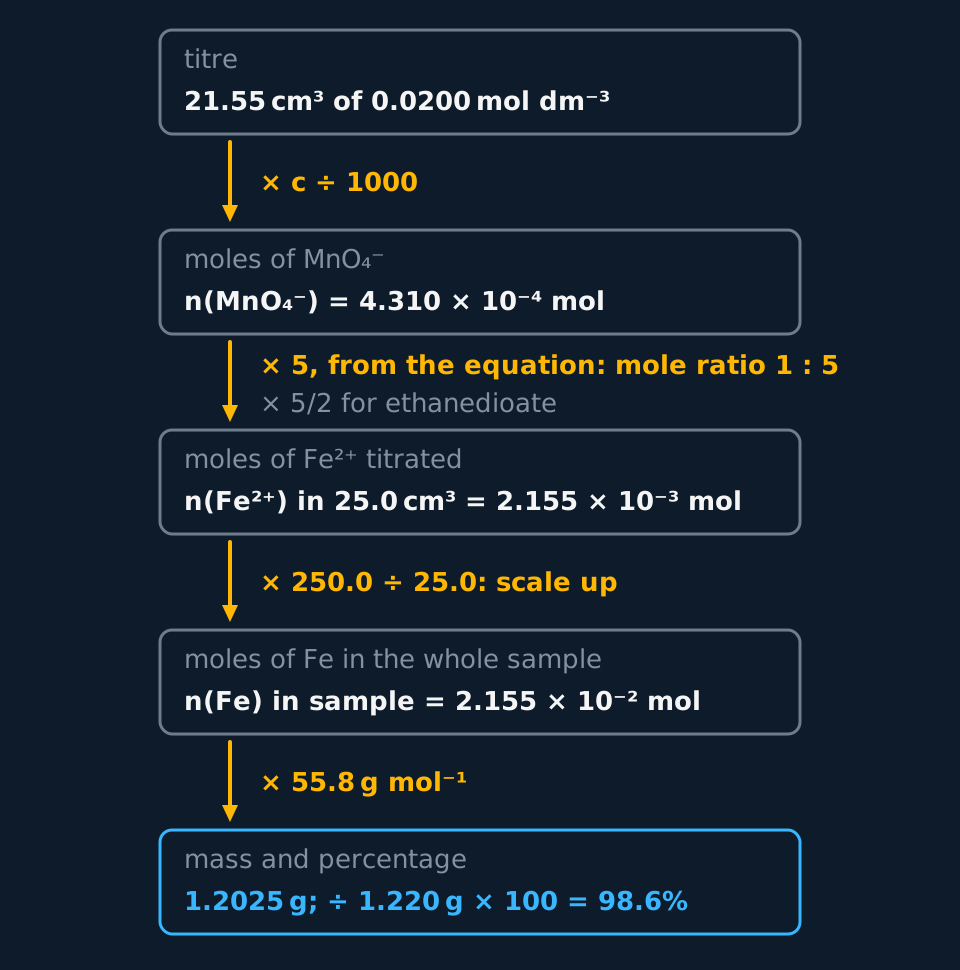
Describe the drawing
Five boxes stacked from top to bottom and joined by arrows, each arrow labelled with its operation. The titre of 21.55 cubic centimetres of 0.0200 molar manganate(VII), times concentration over 1000, gives 4.310 times ten to the minus four moles of MnO₄⁻; times five from the equation gives 2.155 times ten to the minus three moles of Fe²⁺ in 25.0 cubic centimetres; scaled up by 250 over 25 gives 2.155 times ten to the minus two moles of iron in the sample; times 55.8 gives 1.2025 grams, kept unrounded, which is 98.6 per cent of the 1.220 gram sample.
Two practical points decide the accuracy. Steel or an iron tablet is dissolved in dilute sulfuric acid, which gives Fe²⁺, and titrated soon after, because air slowly oxidises Fe²⁺ to Fe³⁺, which manganate(VII) does not react with, and the titre would come out low. A rough titre comes first, then accurate titres added a drop at a time near the end point, repeated until two agree within 0.10 cm³; the mean of the concordant titres goes into the calculation.
- End point
- The point in a titration at which a colour change shows that the reaction is just complete.
- Self-indicating titration
- A titration in which a reactant changes colour at the end point, so no separate indicator is needed.
- Concordant titres
- Titres that agree within 0.10 cm³ of each other; their mean is used in the calculation.
The percentage of iron in steel
A 1.220 g sample of steel wire is dissolved in excess dilute sulfuric acid, which turns the iron into Fe²⁺, and the solution is made up to 250.0 cm³. 25.0 cm³ portions are titrated with 0.0200 mol dm⁻³ potassium manganate(VII); the mean titre is 21.55 cm³. Calculate the percentage by mass of iron in the steel. Ar of Fe = 55.8.
Show the working
Moles of MnO₄⁻ in the titre = 0.0200 × 21.55 ÷ 1000 = 4.310 × 10⁻⁴ mol.
The equation gives 5 Fe²⁺ for each MnO₄⁻: moles of Fe²⁺ in 25.0 cm³ = 5 × 4.310 × 10⁻⁴ = 2.155 × 10⁻³ mol.
The flask held ten portions: moles of Fe in the sample = 2.155 × 10⁻³ × 250.0 ÷ 25.0 = 2.155 × 10⁻² mol.
Mass of iron = 2.155 × 10⁻² × 55.8 = 1.2025 g, kept unrounded for the next line.
Percentage = 1.2025 ÷ 1.220 × 100 = 98.6%, to three significant figures as the data allow. The rest of the steel is carbon and other metals.
Water of crystallisation in ethanedioic acid
1.600 g of hydrated ethanedioic acid, H₂C₂O₄·xH₂O, is dissolved and made up to 250.0 cm³. 25.0 cm³ portions are acidified, warmed to 60 °C and titrated with 0.0200 mol dm⁻³ potassium manganate(VII); the mean titre is 25.40 cm³. Calculate x.
Show the working
Moles of MnO₄⁻ = 0.0200 × 25.40 ÷ 1000 = 5.080 × 10⁻⁴ mol.
Ethanedioic acid reacts in the same ratio as the ethanedioate ion, 2 MnO₄⁻ to 5 H₂C₂O₄: moles of acid in 25.0 cm³ = 5.080 × 10⁻⁴ × 5 ÷ 2 = 1.270 × 10⁻³ mol.
In 250.0 cm³, and so in the 1.600 g weighed out: 1.270 × 10⁻² mol.
Mr of the hydrated acid = 1.600 ÷ 1.270 × 10⁻² = 126.0.
Mr of H₂C₂O₄ = 2(1.0) + 2(12.0) + 4(16.0) = 90.0, so the water contributes 126.0 − 90.0 = 36.0, and 36.0 ÷ 18.0 = 2. x = 2, and the formula is H₂C₂O₄·2H₂O.
TRY IT: Iron in a tablet
An iron tablet containing iron(II) sulfate is dissolved in dilute sulfuric acid and titrated with 0.0100 mol dm⁻³ potassium manganate(VII); the titre is 11.20 cm³. Calculate the mass of iron in the tablet, Ar of Fe = 55.8, and explain why dissolving it in hydrochloric acid instead would give a larger value.
Check your answer
Moles of MnO₄⁻ = 0.0100 × 11.20 ÷ 1000 = 1.120 × 10⁻⁴ mol, so moles of Fe²⁺ = 5 × 1.120 × 10⁻⁴ = 5.600 × 10⁻⁴ mol.
Mass of iron = 5.600 × 10⁻⁴ × 55.8 = 0.0312 g, which is 31.2 mg to three significant figures.
Manganate(VII) oxidises chloride ions to chlorine as well as oxidising Fe²⁺, so more of it is needed to reach the end point. The titre, and the mass of iron calculated from it, would be too large.
pH and the ligand change a redox potential
The E° of a couple depends on the pH and on the ligands round the metal, so an oxidation state that is stable in one solution can be easily oxidised in another. Iron(II) in acid is oxidised only slowly by air. The green precipitate of iron(II) hydroxide formed in alkali turns orange-brown on its surface within minutes as it becomes iron(III) hydroxide.
4[Fe(H₂O)₄(OH)₂](s) + O₂(g) → 4[Fe(H₂O)₃(OH)₃](s) + 2H₂O(l)Green precipitate to orange-brown, on standing in air
Electrode potentials put numbers on it. In acid the couple is Fe³⁺/Fe²⁺, E° = +0.77 V; in alkali it is Fe(OH)₃ + e⁻ → Fe(OH)₂ + OH⁻, E° = −0.56 V. Oxygen is a weaker oxidising agent in alkali too, +0.40 V for O₂ + 2H₂O + 4e⁻ → 4OH⁻ against +1.23 V in acid, but the iron couple falls further. E°cell for oxidation by air rises from +1.23 − 0.77 = +0.46 V in acid to +0.40 − (−0.56) = +0.96 V in alkali.
The reason is the hydroxide ions. In alkali, iron(III) is held as the very insoluble hydroxide, and removing Fe³⁺ from the couple in that way makes the reduction of iron(III) far less favourable. An iron(II) compound that gives up an electron more readily is a stronger reducing agent, which is all that 'more easily oxidised' means. In an answer, name the condition and the direction: 'in alkaline solution, the electrode potential is less positive, so iron(II) is oxidised more easily'.
The ligand matters too. Ammonia lowers the potential of silver(I): [Ag(NH₃)₂]⁺ + e⁻ → Ag + 2NH₃ has E° = +0.37 V, against +0.80 V for Ag⁺ + e⁻ → Ag. The diammine silver(I) ion of Tollens' reagent is therefore a weaker oxidising agent than the aqua Ag⁺ ion, but still strong enough to oxidise an aldehyde, and it is reduced to the silver mirror; a ketone is not oxidised.
RCHO(aq) + 2[Ag(NH₃)₂]⁺(aq) + 3OH⁻(aq) → RCOO⁻(aq) + 2Ag(s) + 4NH₃(aq) + 2H₂O(l)Silver(I) is reduced to silver, oxidation state 0, as the mirror.
| Couple | In acid or as the aqua ion | In alkali or with ammonia | Effect |
|---|---|---|---|
| Iron(III)/iron(II) | Fe³⁺/Fe²⁺, +0.77 V | Fe(OH)₃/Fe(OH)₂, −0.56 V | Iron(II) is oxidised by air far more easily in alkali |
| Silver(I)/silver | Ag⁺/Ag, +0.80 V | [Ag(NH₃)₂]⁺/Ag, +0.37 V | The ammine is a milder oxidising agent: enough for an aldehyde, not for a ketone |
Tollens' reagent is made fresh: silver nitrate solution, a drop of sodium hydroxide to give a brown precipitate of silver(I) oxide, then dilute ammonia until the precipitate just dissolves. Warmed gently with an aldehyde in a clean tube, it deposits a silver mirror on the glass. The mirror test is a redox test of the aldehyde, and the silver(I) complex is the oxidising agent.
- Standard electrode potential
- The EMF of a half-cell measured against the standard hydrogen electrode under standard conditions of 298 K, 100 kPa and 1.00 mol dm⁻³ solutions.
Other boards: chromium
OCR, Edexcel and Cambridge examine chromium; AQA does not name it, though its chemistry shows the effect of pH on a redox potential more clearly than any other metal. Orange dichromate(VI), Cr₂O₇²⁻, is reduced by zinc in acid first to green chromium(III) and then to blue chromium(II). Like V²⁺, Cr²⁺ is oxidised again by air, so it survives only in a flask closed to the air. The hexaaqua ion [Cr(H₂O)₆]³⁺ is itself violet; chromium(III) solutions look green because sulfate or chloride ions replace some of the water ligands.
Cr₂O₇²⁻(aq) + 14H⁺(aq) + 3Zn(s) → 2Cr³⁺(aq) + 7H₂O(l) + 3Zn²⁺(aq)Orange to green: +6 to +3
2Cr³⁺(aq) + Zn(s) → 2Cr²⁺(aq) + Zn²⁺(aq)Green to blue: +3 to +2
Chromium(III) also reacts with bases without any change of oxidation state. A few drops of sodium hydroxide remove three protons from the water ligands of [Cr(H₂O)₆]³⁺ and give a grey-green precipitate of chromium(III) hydroxide. Excess sodium hydroxide dissolves it to the dark green solution of [Cr(OH)₆]³⁻: the hydroxide is amphoteric, reacting with alkali as well as with acid. Ammonia gives the same precipitate, and a large excess of concentrated ammonia dissolves it slowly, by ligand substitution, to the purple solution of [Cr(NH₃)₆]³⁺. OCR and Edexcel examine all three steps.
[Cr(H₂O)₆]³⁺(aq) + 3OH⁻(aq) → [Cr(H₂O)₃(OH)₃](s) + 3H₂O(l)Green solution to grey-green precipitate
[Cr(H₂O)₃(OH)₃](s) + 3OH⁻(aq) → [Cr(OH)₆]³⁻(aq) + 3H₂O(l)The precipitate dissolves in excess to a dark green solution.
Going the other way, from +3 to +6, depends on the pH. In acid, the half-equation Cr₂O₇²⁻ + 14H⁺ + 6e⁻ → 2Cr³⁺ + 7H₂O has E° = +1.33 V, and the fourteen H⁺ ions in it mean that a high concentration of acid makes dichromate(VI) a strong oxidising agent, so chromium(III) is hard to oxidise. In alkali, with no H⁺ to drive the reduction, chromium(VI) is a weak oxidising agent and chromium(III) is oxidised easily. Excess sodium hydroxide gives [Cr(OH)₆]³⁻, and warm hydrogen peroxide oxidises that to yellow chromate(VI).
2[Cr(OH)₆]³⁻(aq) + 3H₂O₂(aq) → 2CrO₄²⁻(aq) + 2OH⁻(aq) + 8H₂O(l)Green solution to yellow solution, on warming
Acidifying the yellow chromate(VI) gives orange dichromate(VI). That step is not redox: chromium is +6 on both sides, and the change is an acid–base equilibrium.
2CrO₄²⁻(aq) + 2H⁺(aq) ⇌ Cr₂O₇²⁻(aq) + H₂O(l)Yellow to orange in acid; orange to yellow in alkali
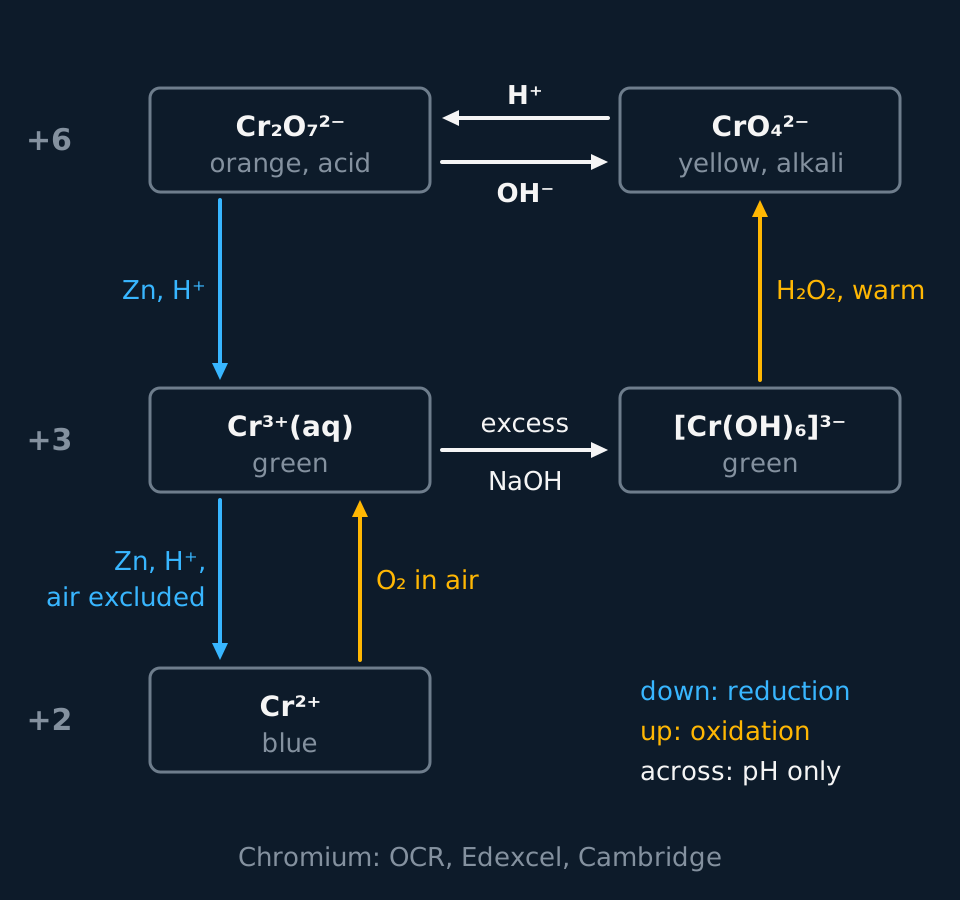
Describe the drawing
A map of chromium species with oxidation state increasing up the page. At +6, orange dichromate in acid and yellow chromate in alkali, joined by arrows labelled H⁺ leftwards and OH⁻ rightwards. At +3, green Cr³⁺ and green hexahydroxochromate(III), joined by an arrow labelled excess NaOH. At +2, blue Cr²⁺. Downward reduction arrows carry zinc and acid, the second with air excluded; upward oxidation arrows carry oxygen in air from Cr²⁺ and warm hydrogen peroxide from the hydroxo complex to chromate.
- Amphoteric
- Able to react both as an acid and as a base, as chromium(III) hydroxide does with acids and with excess sodium hydroxide.
In the exam
- The vanadium sequence is marked species by species: each needs its formula, oxidation state and colour. The scheme accepts 'green' for V³⁺ only at the third stage; the first green, a mixture of yellow VO₂⁺ and blue VO²⁺, is not V³⁺.
- A feasibility answer needs both E° values, the E°cell worked out, and the statement that a positive value means the reaction is feasible. A feasible reaction can still be too slow to see, and schemes credit that point where a question asks why nothing is observed.
- Manganate(VII) calculations are marked line by line, so set out the moles of MnO₄⁻, the ratio from the equation, the scale-up to the whole sample and the final mass or percentage separately. An error in one line is carried forward, and the later marks can still be awarded.
- For the choice of acid, the answer must say that sulfuric acid supplies H⁺ and is not oxidised, and give the effect of hydrochloric acid: Cl⁻ is oxidised to chlorine, so the titre is too large.
- Concordant titres agree within 0.10 cm³, and only those go into the mean. Averaging in the rough titre, or a titre that does not agree, loses the mean-titre mark.
Check yourself
Iodide ions are added to an acidified solution of VO₂⁺. Using E°(I₂/I⁻) = +0.54 V and the vanadium values in the table, explain how far the vanadium is reduced, and suggest a metal that would take it to V³⁺ but no further.
Answer
For VO₂⁺ to VO²⁺, E°cell = +1.00 − (+0.54) = +0.46 V. That is positive, so iodide reduces vanadium(V) to vanadium(IV).
For VO²⁺ to V³⁺, E°cell = +0.34 − (+0.54) = −0.20 V. That is negative, so iodide cannot reduce vanadium(IV), and the vanadium stops at VO²⁺. The blue colour is masked by the brown of the iodine formed.
A metal whose couple lies between +0.34 V and −0.26 V reduces VO²⁺ to V³⁺ but not V³⁺ to V²⁺. Tin, at −0.14 V, is one: it gives +0.48 V for the step to V³⁺ and −0.12 V for the step to V²⁺.
Questions
Question 16 marks
Calculate the value of x in hydrated iron(II) sulfate, FeSO₄·xH₂O. A student dissolves 3.475 g of the crystals in dilute sulfuric acid and makes the solution up to 250.0 cm³ in a volumetric flask. 25.0 cm³ portions are titrated with 0.0180 mol dm⁻³ potassium manganate(VII), and the titres are given in the table. Ar: Fe 55.8, S 32.1, O 16.0, H 1.0.
| Titration | Rough | 1 | 2 | 3 |
|---|---|---|---|---|
| Titre / cm³ | 14.30 | 14.15 | 13.85 | 13.95 |
Mark scheme
- M1 the concordant titres are 13.85 and 13.95 cm³, which agree within 0.10 cm³; the rough titre and 14.15 cm³ are left out, giving a mean of 13.90 cm³
- M1 moles of MnO₄⁻ in the mean titre = 0.0180 × 13.90 ÷ 1000 = 2.502 × 10⁻⁴ mol, using the concentration given
- M1 moles of Fe²⁺ in each 25.0 cm³ portion = 5 × 2.502 × 10⁻⁴ = 1.251 × 10⁻³ mol, from the 1 : 5 ratio in the equation
- M1 moles of FeSO₄·xH₂O in the 250.0 cm³ flask, and so in the 3.475 g weighed out, = 1.251 × 10⁻² mol
- M1 Mr of the hydrate = 3.475 ÷ 1.251 × 10⁻² = 277.8, of which FeSO₄ contributes 55.8 + 32.1 + 64.0 = 151.9
- A1 water contributes 277.8 − 151.9 = 125.9, and 125.9 ÷ 18.0 = 6.99, so x = 7; allow error carried forward from an incorrect mean titre
Question 25 marks
Calculate the percentage purity of a sample of sodium ethanedioate, Na₂C₂O₄ (Mr = 134.0). 2.00 g of the impure solid is dissolved and made up to 250.0 cm³; 25.0 cm³ portions are acidified, warmed and titrated with 0.0200 mol dm⁻³ potassium manganate(VII), and the mean titre is 23.50 cm³.
Mark scheme
- M1 moles of MnO₄⁻ = 0.0200 × 23.50 ÷ 1000 = 4.70 × 10⁻⁴ mol
- M1 moles of C₂O₄²⁻ in 25.0 cm³ = 4.70 × 10⁻⁴ × 5 ÷ 2 = 1.175 × 10⁻³ mol
- M1 moles in 250.0 cm³ = 1.175 × 10⁻² mol
- M1 mass of Na₂C₂O₄ = 1.175 × 10⁻² × 134.0 = 1.5745 g
- A1 percentage purity = 1.5745 ÷ 2.00 × 100 = 78.7%, to three significant figures
Question 35 marks
Suggest what goes wrong when a manganate(VII) titration of Fe²⁺ is acidified with hydrochloric acid, and when it is acidified with ethanoic acid, instead of with dilute sulfuric acid.
Mark scheme
- B1 dilute sulfuric acid supplies the H⁺ that the reduction of MnO₄⁻ to Mn²⁺ needs, and is not itself oxidised
- B1 manganate(VII) oxidises the chloride ions of hydrochloric acid to chlorine
- B1 so extra manganate(VII) is used and the titre is too large
- B1 ethanoic acid is a weak acid and does not supply enough H⁺ ions
- B1 MnO₄⁻ is then reduced only to manganese(IV) oxide, a brown precipitate, so the 1 : 5 ratio no longer holds
All 20 questions with mark schemes, the other 17 set out in full on the question page.
Worth remembering
- The first green when zinc reduces vanadium(V) is a yellow and blue mixture; calling it V³⁺ is wrong.
- Take E°cell as E°(reduced) − E°(oxidised), the species reduced first.
- Hydrochloric acid in a manganate(VII) titration gives a titre that is too large, because chloride is oxidised.
- The mole ratio for ethanedioate is 2 : 5, not 1 : 5; using the iron ratio doubles the amount of ethanedioate calculated.
- Give the reason with 'easier to oxidise in alkali': the E° of the couple is less positive at high pH.
CHECK YOUR PROGRESS
Rate how confident you are with each objective for this lesson. Ratings are saved in this browser, on this device, unless you sign in.
- Describe the reduction of vanadium(V) to vanadium(II) by zinc in acid, with the species, oxidation states and colours.
- Use standard electrode potentials to explain how far a reducing agent can reduce a transition metal ion.
- Explain how pH and the ligand change the stability of an oxidation state, with iron(II) hydroxide in air and Tollens' reagent as examples.
- Describe a manganate(VII) titration of Fe²⁺ or ethanedioate, including the choice of acid and the end point.
- Calculate an amount, a concentration, a formula or a percentage from the results of a manganate(VII) titration.
Open the full revision checklist to see every objective in the curriculum in one place.
Practise this lesson
WORKBOOK
The written questions from this topic, on paper with room to work, and a separate book of mark schemes. The 2 questions that are set on a diagram stay on this page, where the diagram can be drawn. Free to use; please do not redistribute or sell.