Chemistry › Kinetics › Collision theory, activation energy and the rate of reaction
Collision theory, activation energy and the rate of reaction
Particles react only when they collide with at least the activation energy and in the right orientation, and most collisions do neither. Concentration, pressure and surface area change how often particles collide; using up a reactant makes them collide less often, so every reaction slows as it goes. The gradient of a graph gives the rate at any moment.
Key terms Every definition in kinetics, lesson by lesson
Before this Enthalpy change, standard conditions and the definitions – reading an exothermic and an endothermic enthalpy profile · Gases and the ideal gas equation – the molar volume of a gas, 24.0 dm³ mol⁻¹ at room temperature and pressure · Concentration, volumetric solutions and titration calculations – amount in moles from concentration and volume
COMMON MISCONCEPTION
Heating, stirring, crushing and concentrating all speed a reaction up for the same reason: the particles hit each other harder.
Only heating makes collisions more energetic. Crushing a solid, raising a concentration or pressure, and stirring all raise the number of collisions per second at the same energy: the same fraction succeed, but there are more of them. A catalyst lowers the activation energy, so a larger fraction succeed.
What you should be able to do
- Define rate of reaction and give its units.
- State the two conditions a collision must meet to lead to a reaction, and explain why most collisions do not.
- Define activation energy and mark it, with ΔH, on the enthalpy profile of an exothermic and an endothermic reaction.
- Explain the effect of concentration, gas pressure and surface area on the rate of a reaction in terms of the frequency of collisions.
- Explain why the rate falls as a reaction proceeds, and calculate a rate from the gradient of a tangent to a graph.
Rate is a change per unit time
A reaction goes fastest at the start and slows as it proceeds, even when nothing outside the flask changes. Marble chips in dilute hydrochloric acid fizz hard for the first half-minute, give a trickle of bubbles after two minutes and stop after five, with marble still lying in the flask.
CaCO₃(s) + 2HCl(aq) → CaCl₂(aq) + H₂O(l) + CO₂(g)Marble is calcium carbonate. The carbon dioxide is what is collected, or the mass the open flask loses.
Describing that slowing needs a measure of how fast. The rate of reaction is the change in the concentration of a reactant or a product per unit time. Concentration is in mol dm⁻³ and time in seconds, so a rate is in mol dm⁻³ s⁻¹. A reactant's concentration falls and a product's rises, but the rate is quoted as a positive number either way.
In a laboratory the concentration is rarely measured directly. What is measured is something that changes in step with it: the volume of gas given off, the mass lost from an open flask, the colour of the solution. A rate can be quoted in those units, cm³ s⁻¹ or g s⁻¹, and converted to mol dm⁻³ s⁻¹ when the amounts are known. The rate at the moment the reactants are mixed, before any of them has been used up, is the initial rate, and it is the rate used to compare one set of conditions with another.
- Rate of reaction
- The change in the concentration of a reactant or a product per unit time, measured in mol dm⁻³ s⁻¹.
- Initial rate
- The rate of reaction at the start, when t = 0, found from the gradient of the tangent to a concentration–time graph at t = 0.
What a successful collision needs
Particles can react only if they meet. In a gas at room temperature a single molecule is struck by others several billion times a second, and in a solution the collisions are more frequent still. If every collision led to a reaction, every reaction between gases, or between ions in solution, would be over in a fraction of a second. Yet hydrogen and oxygen can sit mixed in a balloon for years. Almost all collisions achieve nothing: the particles bounce apart unchanged.
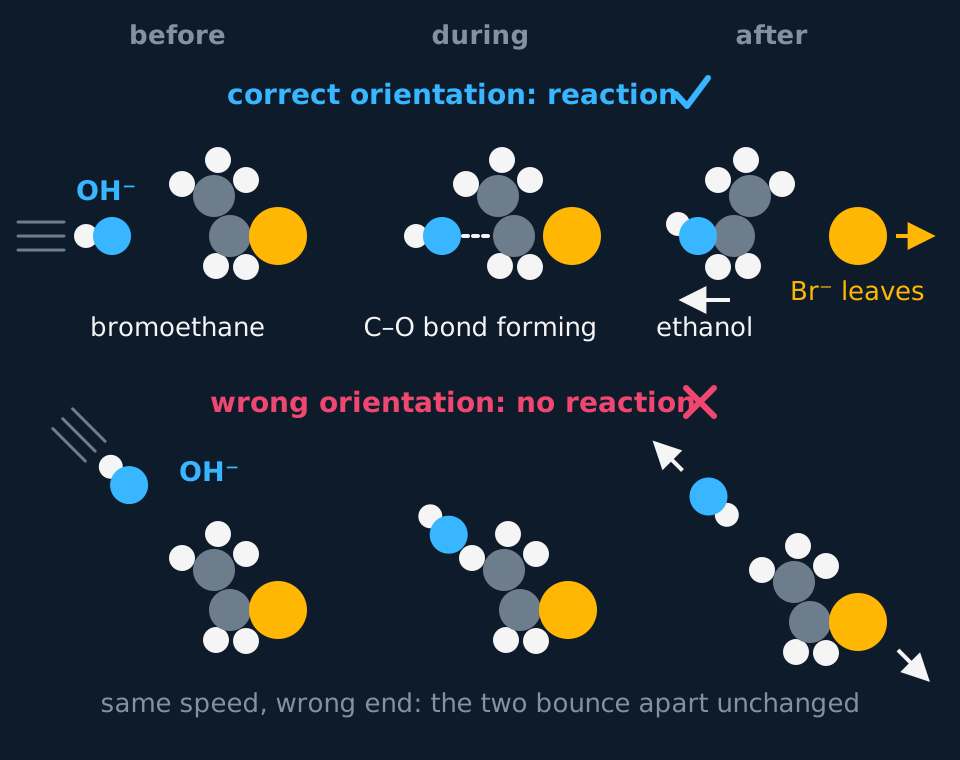
A collision leads to a reaction only when two conditions are met together. The particles must collide with energy at least equal to the activation energy, the minimum energy needed to stretch and break the bonds that have to break before new ones can form. And they must collide in the right orientation, with the parts of each particle that react facing one another. A collision that meets both conditions is a successful collision. Any other is a bounce.
Describe the drawing
Two rows of three panels, before, during and after, each showing a hydroxide ion meeting a space-filling bromoethane molecule. In the upper row, ticked, the hydroxide flies at the carbon bearing the bromine from the side opposite the bromine; a dashed C–O bond forms, and afterwards an ethanol molecule and a separate bromide ion move apart. In the lower row, crossed, a hydroxide with the same speed lines hits the methyl end of the molecule instead, and the two particles bounce apart unchanged.
Orientation matters most when only one small part of each particle can react. A hydroxide ion reacting with bromoethane must arrive at the carbon atom bonded to the bromine, on the side opposite the bromine. A hydroxide ion that strikes the methyl group at the other end, or the bromine atom itself, cannot form the new C–O bond however much energy the collision carries. Most of the surface of a bromoethane molecule is the wrong place to be hit.
Energy is the stricter of the two conditions. At room temperature only a tiny fraction of collisions carry enough energy, for many reactions fewer than one in a million, so a reaction can release a great deal of energy and still not be seen to happen. How that fraction is spread across the molecules, and why temperature changes it so sharply, is what the Maxwell–Boltzmann distribution shows.
- Activation energy
- The minimum energy that colliding particles must have for a reaction to take place.
- Successful collision
- A collision between particles that have at least the activation energy and are in the correct orientation, so that it leads to a reaction.
- Collision frequency
- The number of collisions between reactant particles per unit time in a given volume.
Activation energy on the profile
The gas tap on a laboratory bench lets methane out into the air, and nothing happens. Methane burning gives out 890 kJ for every mole, so the products are far lower in enthalpy than the reactants, and the mixture still needs a match. The flame gives a few molecules enough energy to react, and the energy they release raises their neighbours over the barrier in turn, so the flame keeps itself going once lit.
CH₄(g) + 2O₂(g) → CO₂(g) + 2H₂O(l)ΔcH = −890 kJ mol⁻¹. Strongly exothermic, and unreactive at room temperature until it is lit.
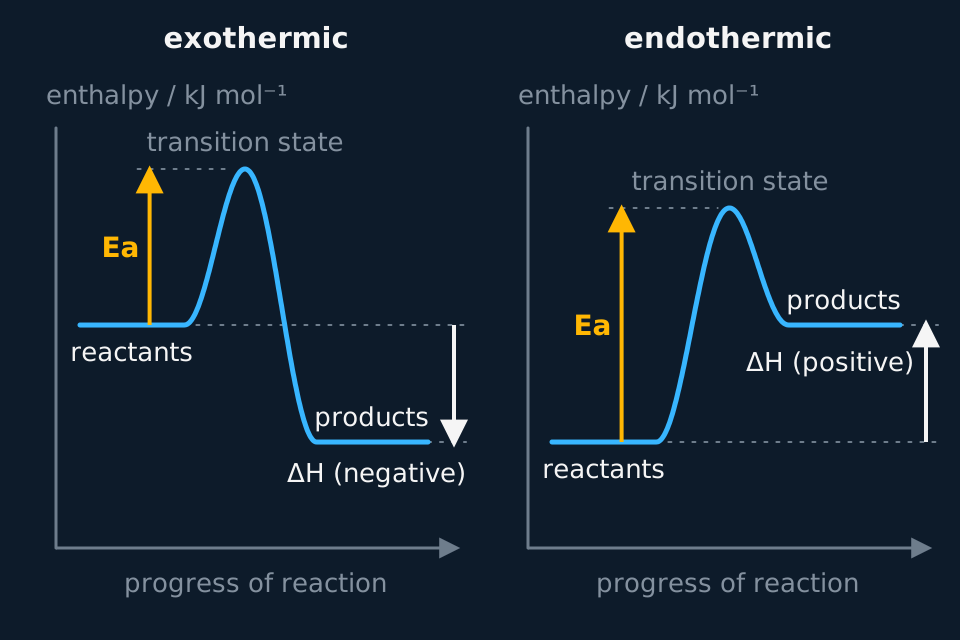
An enthalpy profile shows the barrier. Enthalpy runs up the vertical axis and the progress of the reaction along the horizontal one. The line starts at the reactants, climbs to a peak and falls to the products. The arrangement of atoms at the peak, with the old bonds partly broken and the new ones partly made, is the transition state. The activation energy is the height of the peak above the reactants, and ΔH is the difference between the reactants and the products.
Describe the drawing
Two enthalpy profiles side by side against progress of reaction. On the left, an exothermic reaction: a reactant line, a smooth hump up to the transition state, and a product line lower than the reactants. On the right, an endothermic reaction: a lower reactant line, a taller hump, and a product line above the reactants. On each, the activation energy is an upward arrow from the reactant level to the top of the hump, and the enthalpy change is an arrow from the reactant level to the product level, pointing down on the left and up on the right.
The mark scheme awards two details. The Ea arrow starts at the reactant line, not at the axis and not at the products, and ends level with the top of the peak. The ΔH arrow runs from the reactants to the products, so it points down for an exothermic reaction. For an endothermic reaction the products sit above the reactants, so the activation energy is always at least as large as ΔH.
Read from right to left, the same diagram is the profile of the reverse reaction. Its activation energy runs from the products up to the same peak. Hydrogen iodide decomposes with an activation energy of 183 kJ mol⁻¹ and ΔH = +9 kJ mol⁻¹, so hydrogen and iodine combine with an activation energy of 183 − 9 = 174 kJ mol⁻¹. For an exothermic forward reaction the sum goes the other way: the reverse barrier is the forward one plus the size of ΔH.
- Transition state
- The highest-energy arrangement of atoms on the route from reactants to products, in which bonds are partly broken and partly formed.
- Enthalpy profile
- A diagram of enthalpy against the progress of a reaction, showing the reactants, the transition state at the peak and the products, from which Ea and ΔH are read.
Concentration, pressure and surface area
Every factor that changes a rate works through one of two things: how often the particles collide, or what fraction of those collisions succeed. Concentration, pressure and surface area act only on the first.
Raising the concentration of a solution puts more reactant particles in each cubic decimetre. Each particle meets others more often, so there are more collisions per second. The same fraction of them have at least the activation energy, so there are more successful collisions per second, and the rate rises. With twice the concentration of acid, twice as many hydrogen ions strike each square millimetre of marble every second.
For a reaction between gases, raising the pressure does the same thing. Squeezing a gas into half the volume at the same temperature doubles its pressure and doubles the number of molecules in each cubic decimetre, so for a gas, pressure is concentration under another name. Pumping an unreactive gas such as argon into a fixed volume raises the total pressure but leaves the number of reactant molecules per cubic decimetre where it was, and the rate does not change.
When one reactant is a solid, only the particles on its surface can be hit. Breaking a lump into powder exposes particles that were buried inside, so the same mass presents a larger surface area to the solution or gas around it, and collisions are more frequent. A 1 cm cube of marble has a surface area of 6 cm². Cut into 1 mm cubes, the same marble has 60 cm². A sack of flour only smoulders in a fire; the same flour as a dust cloud in a mill burns so fast that it explodes.
None of the three changes the energy of a single collision. The fraction of collisions with at least the activation energy stays the same, and there are more collisions every second, so more successful ones. Temperature and catalysts are different: they change the fraction, and explaining them needs the Maxwell–Boltzmann distribution.
| More collisions per second | Larger fraction with at least Ea | |
|---|---|---|
| Higher concentration | Yes | No |
| Higher gas pressure | Yes | No |
| Larger surface area | Yes | No |
| Higher temperature | Yes, slightly | Yes, and this is the main effect |
| Catalyst | No | Yes, because Ea is lower |
An answer about concentration that says the particles 'collide harder' or 'have more energy' is describing temperature. The marks go to the chain: more particles in the same volume, so more frequent collisions, so more successful collisions per unit time.
Reading a rate from a graph
A reaction slows because its reactants are used up. In the marble and acid reaction the acid's concentration falls as it reacts. Fewer hydrogen ions per cubic decimetre means fewer collisions with the marble per second, and so fewer successful ones. The fizzing dies away, and it stops when the acid has gone even though marble remains: the acid is the limiting reactant.
Describe the drawing
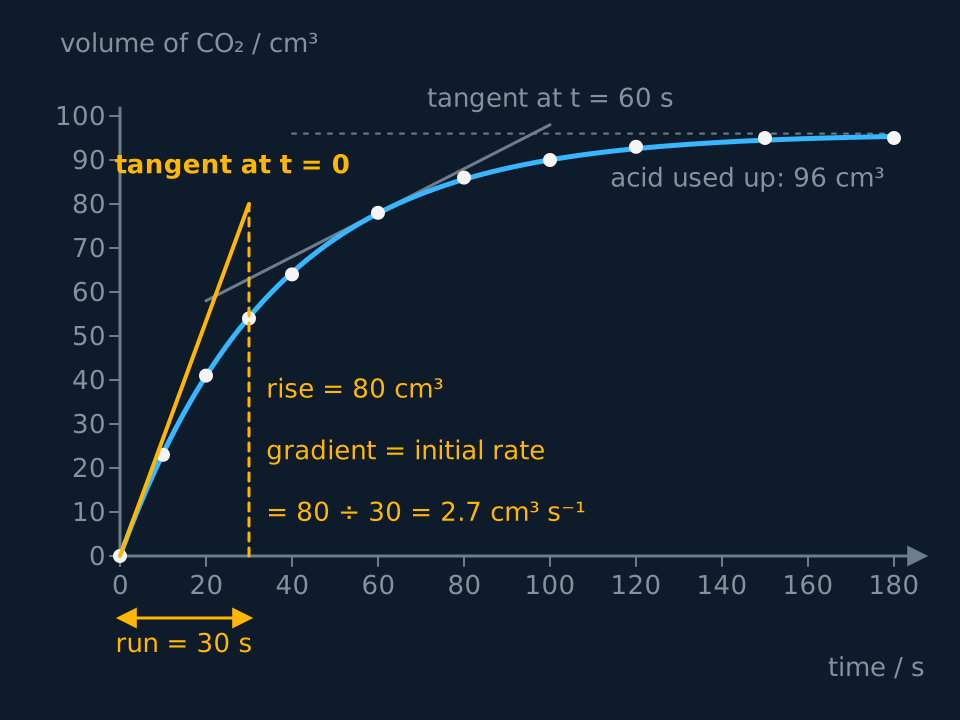
A graph of volume of carbon dioxide in cubic centimetres against time in seconds from 0 to 180. Eleven plotted points lie on a smooth cyan curve that rises steeply from the origin and levels off just under a dashed line at 96 cubic centimetres, where the acid is used up. A ruled amber tangent runs from the origin to 80 cubic centimetres at 30 seconds, with a dashed rise of 80 and a run of 30 marking its gradient, the initial rate. A fainter grey line touches the curve at 60 seconds with a much smaller gradient.
On a graph of the amount of product against time, the rate at any moment is the gradient of the curve at that moment. A straight stretch has one gradient. A curve has a different gradient at every point, found by ruling a tangent, a straight line that touches the curve at the chosen point without crossing it there, and dividing its rise by its run. On a graph of a reactant's concentration the curve falls and the gradient is negative; the rate is its size.
Read the gradient between two points on the tangent that are far apart, at least half the width of the grid. A short tangent, or two points close together, turns a small misreading of the grid into a large error in the gradient.
The initial rate from a tangent
20.0 cm³ of 0.400 mol dm⁻³ hydrochloric acid is added to excess marble chips, and the carbon dioxide is collected in a gas syringe. The volumes at 0, 10, 20, 30, 40 and 60 s are 0, 23, 41, 54, 64 and 78 cm³, and the reaction stops at 96 cm³. Find the initial rate in cm³ s⁻¹, and convert it to the rate at which the concentration of the acid falls. The molar volume is 24.0 dm³ mol⁻¹.
Show the working
Plot the points, draw a smooth curve through them, and rule a tangent at the origin that follows the curve's opening direction. This one passes through (0, 0) and (30, 80).
Gradient = (80 − 0) ÷ (30 − 0) = 2.67 cm³ s⁻¹. That is the initial rate of production of carbon dioxide, 2.7 cm³ s⁻¹ to two significant figures, matching the data.
In moles: 2.67 ÷ 24 000 = 1.11 × 10⁻⁴ mol s⁻¹ of CO₂. The equation uses two HCl for each CO₂, so the acid is used at 2.22 × 10⁻⁴ mol s⁻¹.
The acid occupies 20.0 cm³ = 0.0200 dm³, so its concentration falls at 2.22 × 10⁻⁴ ÷ 0.0200 = 1.1 × 10⁻² mol dm⁻³ s⁻¹ at the start.
A check from the final volume: 96 ÷ 24 000 = 4.00 × 10⁻³ mol of CO₂, which needs 8.00 × 10⁻³ mol of HCl, exactly the 0.0200 dm³ × 0.400 mol dm⁻³ that was added. The acid was the limiting reactant.
TRY IT: The rate one minute in
On the same graph, a tangent drawn at t = 60 s passes through (20, 58) and (100, 98). Find the rate at 60 s, compare it with the initial rate, and explain the difference.
Check your answer
Gradient = (98 − 58) ÷ (100 − 20) = 40 ÷ 80 = 0.50 cm³ s⁻¹. The mean rate over the first minute, 78 ÷ 60 = 1.3 cm³ s⁻¹, lies between this and the initial 2.7 cm³ s⁻¹.
The rate at 60 s is about a fifth of the initial rate. By then 78 of the 96 cm³ have been given off, so 81% of the acid has reacted and its concentration is down to about a fifth of its starting value. Fewer hydrogen ions in each cubic decimetre means fewer collisions with the marble per second, so fewer successful collisions per second.
Here the rate fell in proportion to the acid's concentration. That is not true of every reaction, and finding out how strongly a rate depends on each concentration is the work of the second year's rate equations.
A rate need not come from a tangent. The mean rate over an interval is the total change divided by the time it took, the gradient of the straight line joining two points on the curve rather than the tangent at one. Over a whole reaction it is far below the initial rate, because it includes the slow final stages.
A mean rate from mass loss
2.00 g of marble chips are added to 50.0 cm³ of 1.00 mol dm⁻³ hydrochloric acid in an open flask on a balance. In the first 30 s the mass falls by 0.33 g. Find the mean rate over those 30 s as the rate at which the concentration of the acid falls, and decide which reactant runs out. Mr of CO₂ = 44.0; Mr of CaCO₃ = 100.1.
Show the working
The mass lost is carbon dioxide: 0.33 ÷ 44.0 = 7.5 × 10⁻³ mol in 30 s, a mean rate of 7.5 × 10⁻³ ÷ 30 = 2.5 × 10⁻⁴ mol s⁻¹ of CO₂.
Two HCl react for each CO₂, so the acid is used at 5.0 × 10⁻⁴ mol s⁻¹. In 0.0500 dm³ its concentration falls at 5.0 × 10⁻⁴ ÷ 0.0500 = 1.0 × 10⁻² mol dm⁻³ s⁻¹, to two significant figures, as the 0.33 g allows.
Limiting reactant: 2.00 ÷ 100.1 = 0.0200 mol of CaCO₃ needs 0.0400 mol of HCl, and 0.0500 dm³ × 1.00 mol dm⁻³ = 0.0500 mol is present. The marble runs out first, and the flask will have lost 0.0200 × 44.0 = 0.880 g when the reaction stops.
The initial rate, from the tangent at t = 0 to a graph of mass lost against time, is higher than this mean, because the rate falls as acid and marble are used up.
- Mean rate
- The total change in the amount or concentration of a substance divided by the time interval over which it changed.
- Tangent
- A straight line that touches a curve at one point without crossing it there; its gradient is the rate at that moment.
Other boards: effective collisions and profile names
Cambridge words the collision conditions differently. A successful collision is an effective collision and any other is a non-effective one, and activation energy is the minimum energy needed for a collision to be effective. The marks are the same under either name, but a Cambridge answer uses the board's own term.
The enthalpy profile has a different name on each board. OCR calls it an enthalpy profile diagram, Edexcel a reaction profile and Cambridge a reaction pathway diagram. All three are drawn and marked the same way: Ea from the reactant level to the peak, ΔH from reactants to products.
In the exam
- The definition of activation energy needs the word minimum: 'the minimum energy needed for a reaction to occur'. 'The energy needed to start a reaction' is not credited.
- For concentration or pressure the scheme awards the chain in full: more particles in the same volume, more frequent collisions, more successful collisions per unit time. 'More collisions' alone is not a rate, and 'particles collide harder' is rejected as describing temperature.
- An Ea arrow is accepted only if it starts at the reactant line and ends level with the peak; one drawn from the axis or from the products is rejected, and the axes must be labelled enthalpy and progress of reaction.
- A rate read from a graph earns its method mark for the tangent's two points and the division, and the answer mark needs the unit: cm³ s⁻¹ from a volume graph, mol dm⁻³ s⁻¹ from a concentration graph. Schemes give a range for a tangent's gradient, so a careful tangent across half the grid lands inside it.
- In an explanation of why a reaction slows, the reactant being used up is credited only when it is linked to fewer collisions per unit time. 'The reaction runs out of energy' is rejected.
Check yourself
A student reacts 0.10 g of magnesium ribbon with 50 cm³ of 1.0 mol dm⁻³ hydrochloric acid, an excess. She repeats it with 0.10 g of magnesium powder, and again with the ribbon in 2.0 mol dm⁻³ acid. Both changes speed the reaction up. Her partner says both must work by giving the particles more energy. Explain what is wrong with that reasoning, and say whether the volume of hydrogen collected changes.
Answer
Neither change alters the energy of the particles. The temperature is the same, so the fraction of collisions with at least the activation energy is the same in all three runs.
Powder exposes more magnesium atoms to the acid, and the stronger acid has more hydrogen ions in each cubic decimetre. Both raise the number of collisions per second, so the number of successful collisions per second rises and so does the rate.
The volume of hydrogen is the same in all three runs. Magnesium is the limiting reactant, 0.10 g each time, so the same amount of hydrogen forms; it forms sooner.
Questions
Question 16 marks
Explain, using collision theory, the results of three experiments in which 1.0 g of calcium carbonate reacts with 50 cm³ of hydrochloric acid, an excess, at 20 °C. A: chips in 1.0 mol dm⁻³ acid. B: powder in 1.0 mol dm⁻³ acid. C: chips in 2.0 mol dm⁻³ acid. B and C both have a greater initial rate than A, and all three give the same final volume of carbon dioxide.
Mark scheme
Indicative content
- a reaction happens only when particles collide with at least the activation energy and in the correct orientation
- in B the powder has a larger surface area, so more calcium carbonate particles are exposed to the acid
- in C there are more hydrogen ions in each unit volume of the acid than in A
- in both B and C collisions are more frequent than in A, so there are more successful collisions per unit time
- the temperature is the same in all three, so the fraction of collisions with at least the activation energy is unchanged
- calcium carbonate is the limiting reactant and the same mass is used each time, so the same amount of carbon dioxide forms in all three
Levels
- Level 3 (5–6 marks) all three results are explained through collision theory: the condition for a successful collision, the larger surface area in B and the higher concentration in C both giving more frequent collisions, the unchanged fraction with the activation energy at the same temperature, and the same final volume from the same limiting mass of carbonate
- Level 2 (3–4 marks) the faster rates of B and C are put down to more frequent collisions from surface area and concentration; the condition for a successful collision, the unchanged temperature, or why the final volume is the same is left out
- Level 1 (1–2 marks) powder or stronger acid is said to react faster, typically because the particles have more energy, and the same final volume is not explained
Question 25 marks
Calculate the initial rate of reaction, and the rate 60 s after mixing, from the volumes of hydrogen in the table, collected when magnesium ribbon reacted with excess dilute hydrochloric acid. Plot the results and draw tangents to the curve.
| Time / s | Volume of hydrogen / cm³ |
|---|---|
| 0 | 0 |
| 10 | 21 |
| 20 | 36 |
| 30 | 47 |
| 40 | 55 |
| 60 | 65 |
| 80 | 70 |
| 120 | 74 |
Mark scheme
- M1 the points plotted with a smooth curve through them from the origin, levelling off near 75 cm³
- M1 a tangent ruled at t = 0 and its gradient found as rise divided by run between two widely separated points
- A1 initial rate = 2.5 cm³ s⁻¹; accept 2.2 to 2.8 cm³ s⁻¹
- M1 a second tangent ruled to touch the curve at t = 60 s, with its gradient found the same way
- A1 rate at 60 s = 0.34 cm³ s⁻¹ to two significant figures; accept 0.28 to 0.40 cm³ s⁻¹
Question 34 marks
State the two conditions that a collision between two reactant particles must meet for it to lead to a reaction, and explain why most collisions between gas molecules at room temperature do not lead to a reaction.
Mark scheme
- B1 the particles must collide with energy at least equal to the activation energy; reject 'enough energy' without reference to the activation energy
- B1 the particles must collide in the correct orientation, with the reacting parts facing each other
- B1 at room temperature most colliding particles have less energy than the activation energy, so the bonds that must break are not broken
- B1 many collisions are in the wrong orientation, so the reacting parts of the particles do not meet and they bounce apart unchanged
All 16 questions with mark schemes, the other 13 set out in full on the question page.
Worth remembering
- Put time into every collision answer, more frequent collisions or more collisions per second; 'more collisions' alone gives no rate.
- An answer that names only the energy condition is half an answer: a collision with enough energy in the wrong orientation is a bounce.
- Start an Ea arrow on the reactant line and end it at the peak; one from the axis or from the products measures nothing.
- 'Collide harder' or 'more energy' in an answer about concentration or surface area describes temperature and is rejected.
- Take tangent points at least half the grid apart; two points close together magnify a grid misreading.
CHECK YOUR PROGRESS
Rate how confident you are with each objective for this lesson. Ratings are saved in this browser, on this device, unless you sign in.
- Define rate of reaction and give its units.
- State the two conditions a collision must meet to lead to a reaction, and explain why most collisions do not.
- Define activation energy and mark it, with ΔH, on the enthalpy profile of an exothermic and an endothermic reaction.
- Explain the effect of concentration, gas pressure and surface area on the rate of a reaction in terms of the frequency of collisions.
- Explain why the rate falls as a reaction proceeds, and calculate a rate from the gradient of a tangent to a graph.
Open the full revision checklist to see every objective in the curriculum in one place.
Practise this lesson
WORKBOOK
The written questions from this topic, on paper with room to work, and a separate book of mark schemes. The 3 questions that are set on a diagram stay on this page, where the diagram can be drawn. Free to use; please do not redistribute or sell.
Used later in Measuring the rate of a reaction · Dynamic equilibrium, Le Chatelier's principle and industrial compromise · Entropy and Gibbs free-energy change · Rate equations, orders of reaction and the rate constant