Chemistry › Energetics › Enthalpy change, standard conditions and the definitions
Enthalpy change, standard conditions and the definitions
A reaction that warms its beaker has given heat to the surroundings, so the chemicals end with less enthalpy than they started with and ΔH is negative. The sign, the profile diagram with its activation energy, the standard conditions every tabulated value refers to, and the four standard enthalpy changes are set out here, each with its definition and its equation.
Key terms Every definition in energetics, lesson by lesson
Before this Formulae, equations and state symbols – balancing an equation and giving every species its state · The mole, the Avogadro constant and molar mass – converting a mass to an amount in moles · GCSE energy changes: exothermic and endothermic reactions and the reaction profile
COMMON MISCONCEPTION
The beaker got hot, so the reaction gained energy and ΔH must be positive.
ΔH is the enthalpy change of the chemicals, not of the beaker. A beaker that gets hot has received energy from the reaction, so the reacting system has lost it: the reaction is exothermic and ΔH is negative. A reaction that makes its beaker colder, such as ammonium nitrate dissolving, has a positive ΔH.
What you should be able to do
- Define enthalpy change, and give the sign of ΔH for an exothermic and an endothermic reaction with the reason for each.
- Draw and label an enthalpy profile diagram for each kind of reaction, marking ΔH and the activation energy.
- State the standard conditions and identify the standard state of an element or compound.
- Define the standard enthalpies of formation, combustion, neutralisation and reaction in the words a mark scheme uses.
- Write the equation that represents each standard enthalpy change, with one mole of the right substance and every state symbol.
- Calculate the heat released when a given mass of fuel burns, from its standard enthalpy of combustion.
Heat in and heat out
Every chemical change either gives heat to its surroundings or takes heat from them. Sodium hydroxide dissolving in water makes the test tube too warm to hold; ammonium nitrate dissolving makes the outside of the tube mist with condensation as it cools. A sports cold pack is ammonium nitrate and a pouch of water, kept apart until the pack is squeezed.
To keep the sign straight, separate the system, which is the reacting chemicals, from the surroundings, which is everything else: the water they are dissolved in, the beaker, the thermometer and the air. A thermometer in the solution reads the temperature of the surroundings. When it rises, energy has left the chemicals.
The heat content of a substance is its enthalpy, H. Nobody can measure H itself, but the change in it during a reaction can be measured, as heat transferred to or from the surroundings. That change is the enthalpy change, ΔH, and it is defined at constant pressure because a reaction in an open beaker runs at the pressure of the atmosphere. At constant pressure the heat transferred is the whole of the enthalpy change.
In an exothermic reaction the products have less enthalpy than the reactants. The difference is given out as heat, the surroundings warm up, and ΔH is negative. In an endothermic reaction the products have more enthalpy than the reactants, heat is taken in from the surroundings, the surroundings cool, and ΔH is positive. The sign always describes the chemicals, never the beaker. A hot beaker means a negative ΔH.
ΔH is quoted per mole, in kJ mol⁻¹, and its sign is always written. The thermal decomposition of calcium carbonate has ΔH = +178 kJ mol⁻¹, not 178. The plus sign says the reaction takes heat in, and a lime kiln has to be kept hot to supply it. A mark scheme does not credit 178 for an endothermic change, because without its sign the number does not say which way the heat went.
| Exothermic | Endothermic | |
|---|---|---|
| Heat transferred | From the chemicals to the surroundings | From the surroundings to the chemicals |
| Temperature of the surroundings | Rises | Falls |
| Products compared with reactants | Lower enthalpy | Higher enthalpy |
| Sign of ΔH | Negative | Positive |
| Examples | Combustion, neutralisation, respiration | Thermal decomposition of CaCO₃, photosynthesis, dissolving NH₄NO₃ |
- Enthalpy change, ΔH
- The heat energy change measured under conditions of constant pressure.
- Exothermic
- Describes a reaction in which heat energy is transferred to the surroundings, so ΔH is negative.
- Endothermic
- Describes a reaction in which heat energy is taken in from the surroundings, so ΔH is positive.
Enthalpy profile diagrams
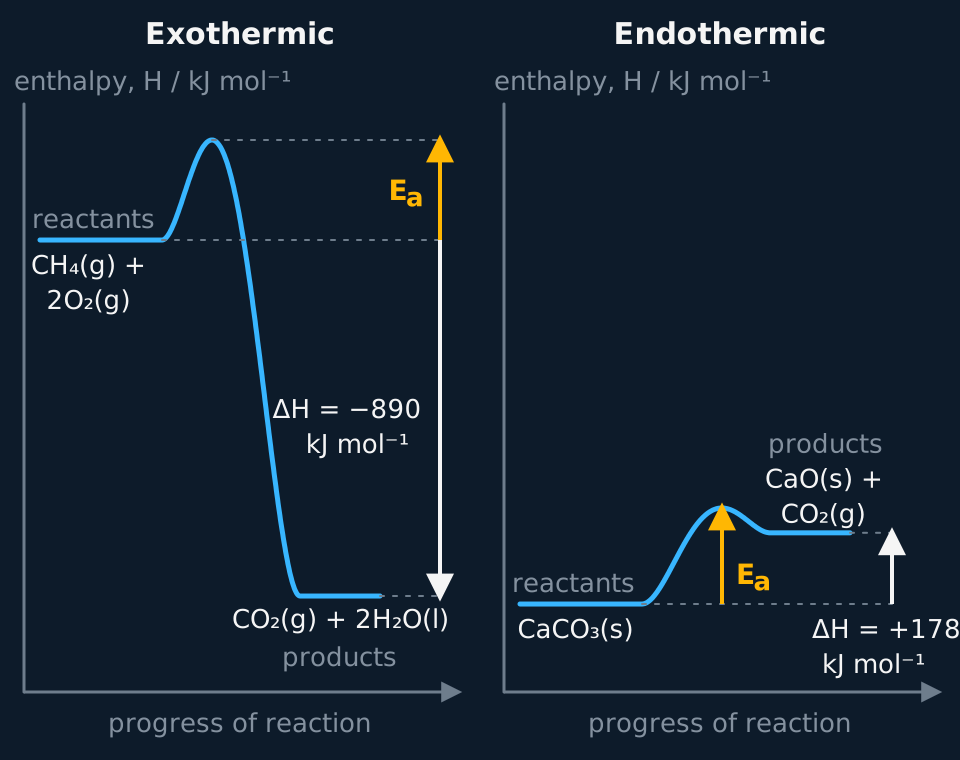
A gas hob does not light itself. Methane and oxygen can sit mixed in the air of a kitchen without reacting, although their combustion is strongly exothermic, because bonds in both molecules must start to break before new ones can form. A spark supplies that energy to a few molecules, and the heat from their reaction then supplies it to the next.
Describe the drawing
Two enthalpy profiles side by side on the same scale. On the left, exothermic, methane and oxygen start high, climb over a hump and fall to carbon dioxide and liquid water far below; an amber arrow up from the reactant level marks the activation energy and a white arrow down to the products marks ΔH = −890 kJ mol⁻¹. On the right, endothermic, calcium carbonate starts low, climbs a hump and settles at calcium oxide and carbon dioxide a little higher; both arrows point up from the reactant level, the ΔH arrow marking +178 kJ mol⁻¹.
An enthalpy profile diagram plots enthalpy against the progress of the reaction. The reactants sit at one level and the products at another, each labelled with its formula. Between them the line rises to a peak, because the partly broken arrangement on the way to products has more enthalpy than either. The height of that peak above the reactants is the activation energy, Ea.
Two arrows are drawn and both are measured from the reactant level. The activation energy arrow points up from the reactants to the peak. The ΔH arrow runs from the reactant level to the product level: down for an exothermic reaction, up for an endothermic one. In an endothermic reaction the activation energy is always at least as large as ΔH, since the peak cannot sit below the products.
- Activation energy
- The minimum energy that particles must have for a reaction to take place when they collide.
The two arrows answer different questions. ΔH says how much heat the reaction releases or absorbs once it has happened. Ea says how hard it is to start, and so how fast it goes at a given temperature. A mixture can have a large negative ΔH and still be stable for years if its activation energy is high: a sheet of paper in air is the everyday example. Such a mixture is energetically unstable but kinetically stable.
A catalyst provides a different route with a lower peak. It lowers Ea and leaves the reactant and product levels where they were, so ΔH is unchanged. Write that a catalyst provides an alternative route with a lower activation energy; 'gives the particles energy' describes heating, not catalysis.
- Kinetically stable
- Describes a mixture that does not react at a measurable rate because its activation energy is high, even though ΔH for its reaction is negative.
Standard conditions and standard states
The heat released when a mole of methane burns depends a little on the temperature and pressure, and a lot on whether the water formed ends up as a liquid or as steam. A value in a data book is only useful if everyone knows which conditions it refers to, so tabulated values are standard enthalpy changes, marked with the symbol °: ΔH°.
Standard conditions are a pressure of 100 kPa and a stated temperature, which is almost always 298 K (25 °C). Where solutions take part, their concentration is 1.00 mol dm⁻³. A value measured at another temperature is written with that temperature as a subscript, ΔH°₅₀₀ for 500 K.
Each substance also has a standard state: the physical state it is in at 100 kPa and 298 K. Oxygen and hydrogen are gases, water and bromine are liquids, and sodium chloride and iodine are solids. Carbon is a solid with more than one form, and its standard state is graphite, not diamond. An equation for a standard enthalpy change shows every substance in its standard state, so the water in a standard combustion is H₂O(l), not H₂O(g).
The difference is not small. Condensing a mole of steam to liquid water at 298 K releases 44 kJ, so the formation of H₂O(g) is −242 kJ mol⁻¹ and the formation of H₂O(l) is −286 kJ mol⁻¹. A value quoted without its state symbols cannot be used.
- Standard conditions
- A pressure of 100 kPa and a stated temperature, usually 298 K, with any solutions at 1.00 mol dm⁻³.
- Standard state
- The physical state of a substance at 100 kPa and 298 K, such as H₂O(l), O₂(g) and C(graphite).
The four standard enthalpy changes
Four standard enthalpy changes are defined, and each definition names exactly one mole of one substance. That single mole decides how the equation is balanced, and it is why fractions such as ½O₂ appear in them.
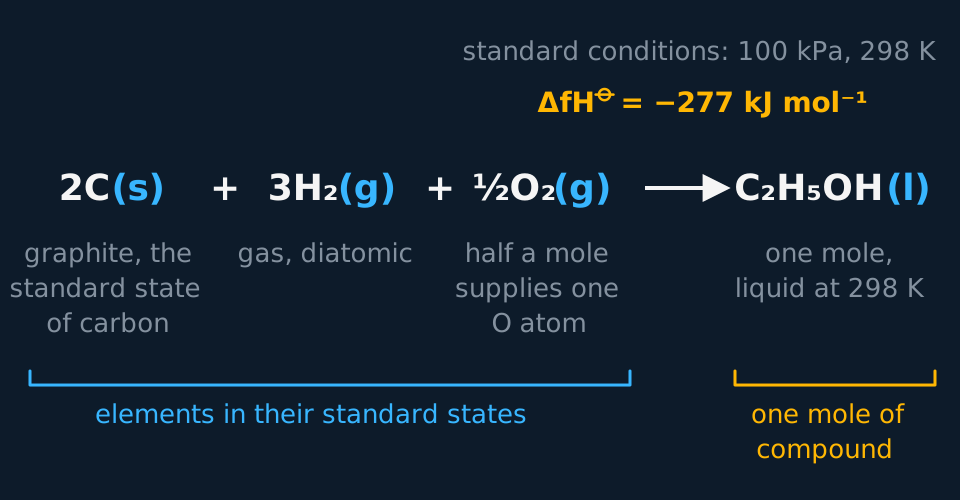
The standard enthalpy of formation, ΔfH°, makes one mole of a compound from its elements. The elements must be in their standard states, so carbon appears as C(s), meaning graphite, and oxygen as O₂(g), never as separate O atoms. For ethanol:
2C(s) + 3H₂(g) + ½O₂(g) → C₂H₅OH(l) ΔfH° = −277 kJ mol⁻¹One mole of ethanol, so half a mole of O₂ supplies its one oxygen atom.
Describe the drawing
The equation two C solid plus three H two gas plus half O two gas gives C two H five O H liquid, written large with every state symbol picked out in cyan. Notes under each reactant say carbon is graphite, hydrogen is a diatomic gas and half a mole of oxygen gives one O atom; under the product, one mole of liquid. The enthalpy of formation, minus 277 kilojoules per mole, sits above the arrow, and brackets mark the elements in their standard states and the one mole of compound.
No laboratory makes ethanol by passing hydrogen and oxygen over graphite. The equation defines the quantity; it does not describe a reaction anyone carries out. Most enthalpies of formation are found indirectly, with Hess's law. The enthalpy of formation of an element in its standard state is zero by definition, since making O₂(g) from O₂(g) changes nothing.
The standard enthalpy of combustion, ΔcH°, burns one mole of a substance completely in oxygen. Complete combustion means the carbon ends as CO₂ and the hydrogen as H₂O, and in the standard state that water is liquid:
C₂H₅OH(l) + 3O₂(g) → 2CO₂(g) + 3H₂O(l) ΔcH° = −1367 kJ mol⁻¹
Because the definition fixes one mole of the fuel, the oxygen is balanced last and often comes out as a fraction. Butane has four carbon atoms and ten hydrogen atoms, so one mole of it makes 4CO₂ and 5H₂O. Those hold thirteen oxygen atoms between them, which is six and a half moles of O₂.
C₄H₁₀(g) + 6½O₂(g) → 4CO₂(g) + 5H₂O(l) ΔcH° = −2877 kJ mol⁻¹Doubling to clear the fraction would burn two moles of butane, and the ΔH of that equation would be twice ΔcH°.
Combustion is always exothermic, so every ΔcH° is negative. An enthalpy of formation can have either sign. Most compounds have a negative ΔfH°, but a few, such as ethene at +52 kJ mol⁻¹ and nitrogen monoxide at +90 kJ mol⁻¹, have more enthalpy than the elements they are made from.
The standard enthalpy of neutralisation, ΔneutH°, is defined per mole of water formed, not per mole of acid. Sulfuric acid is diprotic, so one mole of it reacting with sodium hydroxide forms two moles of water and releases about twice the heat that one mole of hydrochloric acid does, but the enthalpy of neutralisation is about −57 kJ mol⁻¹ for both:
H⁺(aq) + OH⁻(aq) → H₂O(l) ΔneutH° = −57 kJ mol⁻¹The ionic equation for any strong acid with any strong alkali.
The enthalpy of neutralisation is therefore a property of the reaction between hydrogen ions and hydroxide ions, not of the particular acid. Hydrochloric acid with sodium hydroxide, and nitric acid with potassium hydroxide, both give −57 kJ mol⁻¹ to two significant figures, because the other ions present take no part. In a definition, write 'one mole of water formed'; 'one mole of acid' gives the wrong value for sulfuric acid and does not describe the quantity at all.
The standard enthalpy of reaction, ΔrH°, belongs to an equation rather than to a substance: it is the enthalpy change when the amounts in the equation, as written, react. Double the equation and ΔrH° doubles. For that reason ΔrH° is always quoted beside its equation.
- Standard enthalpy of formation, ΔfH°
- The enthalpy change when one mole of a compound is formed from its constituent elements, with all reactants and products in their standard states under standard conditions.
- Standard enthalpy of combustion, ΔcH°
- The enthalpy change when one mole of a substance is burned completely in oxygen, with all reactants and products in their standard states under standard conditions.
- Standard enthalpy of neutralisation, ΔneutH°
- The enthalpy change when solutions of an acid and an alkali react together under standard conditions to produce one mole of water.
- Standard enthalpy of reaction, ΔrH°
- The enthalpy change when the amounts of reactants shown in the equation react under standard conditions, with all substances in their standard states.
Which equations are standard enthalpies of formation
Four equations are given. Decide which one represents ΔfH° of its product, and say what is wrong with each of the others. (a) 2Na(s) + Cl₂(g) → 2NaCl(s); (b) H₂(g) + ½O₂(g) → H₂O(g); (c) CO(g) + ½O₂(g) → CO₂(g); (d) Na(s) + ½Cl₂(g) → NaCl(s).
Show the working
Check three things in turn: one mole of product, reactants that are elements, and every species in its standard state.
(a) forms two moles of NaCl. Its ΔH is twice ΔfH°, not ΔfH°.
(b) forms one mole of water from its elements, but as steam. The standard state of water is liquid, so this is not ΔfH° of water; it is about 44 kJ mol⁻¹ less exothermic.
(c) starts from carbon monoxide, which is a compound, so it is not a formation. It is the standard enthalpy of combustion of CO.
Only (d) represents ΔfH°: one mole of NaCl(s) from Na(s) and Cl₂(g), both in their standard states.
Ammonia: a value per equation and a value per mole
For N₂(g) + 3H₂(g) → 2NH₃(g), ΔrH° = −92 kJ mol⁻¹. Give ΔfH° of ammonia, and calculate the enthalpy change when 1.00 tonne of ammonia is formed from its elements. Mr of NH₃ = 17.0.
Show the working
The equation as written forms two moles of NH₃, so the −92 kJ belongs to two moles. ΔfH° is per mole of ammonia: −92 ÷ 2 = −46 kJ mol⁻¹, for ½N₂(g) + 1½H₂(g) → NH₃(g).
Amount of ammonia: 1.00 tonne = 1.00 × 10⁶ g, and 1.00 × 10⁶ ÷ 17.0 = 5.88 × 10⁴ mol.
Enthalpy change = 5.88 × 10⁴ × (−46) = −2.71 × 10⁶ kJ. The value of ΔrH° is given to two significant figures, so ΔH = −2.7 × 10⁶ kJ for the tonne.
Using −92 kJ for every mole of ammonia would double the answer. Halving ΔrH° to a per-mole value, or halving the amount to count equations, are the same step; doing neither is the error.
Enthalpies of combustion compared
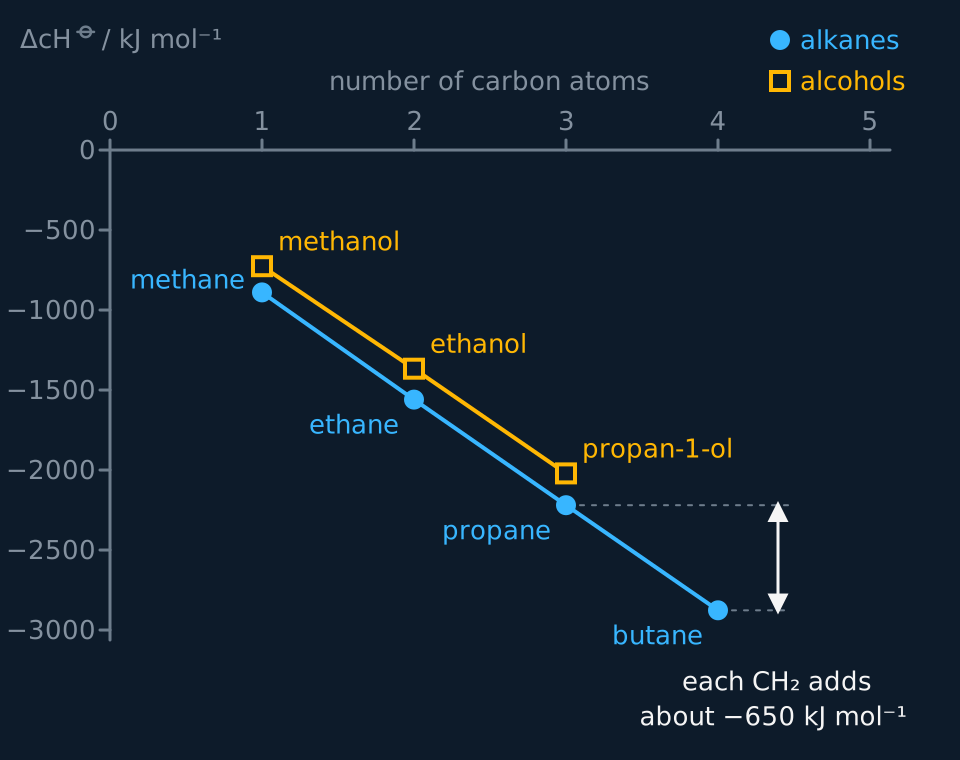
Enthalpies of combustion are among the easiest standard values to measure, and they are how fuels are compared. Down a homologous series each compound has one more CH₂ than the last, and the value grows by a nearly constant step.
| Compound | Formula | ΔcH° / kJ mol⁻¹ |
|---|---|---|
| Methane | CH₄(g) | −890 |
| Ethane | C₂H₆(g) | −1560 |
| Propane | C₃H₈(g) | −2220 |
| Butane | C₄H₁₀(g) | −2877 |
| Methanol | CH₃OH(l) | −726 |
| Ethanol | C₂H₅OH(l) | −1367 |
| Propan-1-ol | C₃H₇OH(l) | −2021 |
| Hydrogen | H₂(g) | −286 |
| Carbon (graphite) | C(s) | −394 |
Describe the drawing
A graph of standard enthalpy of combustion against number of carbon atoms, with the vertical axis running from zero at the top down to minus 3000. Alkanes from methane to butane are filled cyan circles on a straight line falling to the right; the primary alcohols methanol, ethanol and propan-1-ol are open amber squares on a parallel line a little above it. A bracket between propane and butane marks each CH two adding about minus 650 kilojoules per mole.
Two rows of the table are also enthalpies of formation. Burning a mole of hydrogen makes a mole of liquid water from its elements, so ΔcH°(H₂) and ΔfH°(H₂O, l) are the same equation and the same value, −286 kJ mol⁻¹. Burning graphite makes CO₂ from its elements, so ΔcH°(C) equals ΔfH°(CO₂), −394 kJ mol⁻¹.
The alcohol line sits 160 to 200 kJ mol⁻¹ above the alkane line. Methane and methanol both burn to one CO₂ and two H₂O, but methanol already has an oxygen atom bonded to its carbon. It starts partly oxidised, with less enthalpy than methane relative to the same products, so less heat is released when it burns. The same holds at every chain length.
A molar value converts to the heat from any mass of fuel through the amount in moles. The negative sign stays with ΔH; the heat released is quoted as a positive quantity.
TRY IT: Methane against hydrogen as a fuel
Use the table to calculate the heat released when 1.00 kg of methane burns completely, and the heat released per gram by methane and by hydrogen. Mr: CH₄ 16.0, H₂ 2.0.
Check your answer
Amount of methane = 1000 ÷ 16.0 = 62.5 mol. Heat released = 62.5 × 890 = 55 600 kJ, so ΔH = −5.56 × 10⁴ kJ for the kilogram.
Per gram, methane releases 890 ÷ 16.0 = 55.6 kJ g⁻¹ and hydrogen releases 286 ÷ 2.0 = 143 kJ g⁻¹.
Hydrogen releases about two and a half times as much heat per gram, because a mole of it has a mass of only 2.0 g. Per mole it releases less than a third as much as methane, and its only product is water.
Other boards: diagram names, standard pressure and four definitions
OCR, Edexcel and Cambridge set the definitions of the standard enthalpies of neutralisation and of reaction as questions in their own right, alongside formation and combustion. The wording is the one given here: neutralisation per mole of water formed, reaction for the amounts in the equation as written. On those papers a definition of neutralisation 'per mole of acid' is not credited.
Cambridge calls the profile a reaction pathway diagram, and Edexcel's specification calls it an enthalpy level diagram. The axes, the levels and the arrows are the same. A level diagram may show only the two levels and the ΔH arrow, with no hump between them; the hump and Ea are added when a question asks about the activation energy or a catalyst.
Cambridge states standard pressure as 101 kPa, one atmosphere, rather than 100 kPa. At this level the difference changes no calculated answer, but a Cambridge candidate asked for the standard conditions quotes 101 kPa and 298 K, the values in that syllabus.
In the exam
- A definition of ΔfH° or ΔcH° earns one mark for each of three parts: one mole of the named substance; formed from its elements, or burned completely in oxygen; and everything in its standard state under standard conditions. 'Under standard conditions' alone loses the third mark, since it says nothing about states.
- An equation for ΔfH° loses its mark if it makes two moles of product, writes O instead of O₂(g), or leaves a state symbol off any species. Fractions such as ½O₂(g) are accepted, and expected.
- Profile diagrams are marked on three things: axes labelled enthalpy and progress of reaction, formulae on the two levels, and both arrows starting at the reactant level. An Ea arrow drawn from the axis rather than the reactant line is rejected.
- In an explanation of the sign, say where the heat goes and what that means for the chemicals: heat is released to the surroundings, so the products have less enthalpy than the reactants. 'The beaker gains energy' with no mention of the chemicals does not answer it.
- A calculated heat for a mass of fuel is credited with its sign as ΔH, or as a positive 'heat released'. A negative 'heat released' is a contradiction and loses the final mark.
Check yourself
A student says that the standard enthalpy of combustion of carbon monoxide must be the same as the standard enthalpy of formation of carbon dioxide, since both reactions make CO₂. Explain whether she is right, and name a substance whose standard enthalpy of combustion does equal the standard enthalpy of formation of CO₂.
Answer
Write each equation. Combustion of CO: CO(g) + ½O₂(g) → CO₂(g). Formation of CO₂: C(s) + O₂(g) → CO₂(g).
The products match but the reactants do not. ΔfH° must start from elements in their standard states, and carbon monoxide is a compound. Part of the energy of forming CO₂ from carbon has already been released in making the CO, so its combustion releases less: −283 kJ mol⁻¹ against −394 kJ mol⁻¹.
She is wrong. The substance whose combustion equation is the formation equation of CO₂ is carbon itself, as graphite: ΔcH°(C, graphite) = ΔfH°(CO₂) = −394 kJ mol⁻¹.
Questions
Question 16 marks
Evaluate the claim that a reaction with a large negative ΔH must happen quickly when its reactants are mixed at room temperature. Refer in your answer to an enthalpy profile diagram and to one example.
Mark scheme
Indicative content
- ΔH is the gap between the reactant and product levels on the profile, so it measures how much heat is released, not how fast it is released
- the rate depends on the activation energy, which is the height of the peak above the reactant level on the same diagram
- if the activation energy is high, only a tiny fraction of colliding particles have enough energy to react at room temperature, so the reaction is slow
- a large negative ΔH and a high activation energy can occur together, because the depth of the products and the height of the peak are independent features of the profile
- methane and oxygen, with ΔcH° = −890 kJ mol⁻¹, do not react until a spark or flame supplies the activation energy; accept paper in air or any kinetically stable mixture
- the claim is therefore wrong: such a mixture is energetically unstable but kinetically stable, and ΔH alone cannot predict the rate of a reaction
Levels
- Level 3 (5–6 marks) ΔH and activation energy are both located on the profile and shown to be independent, the rate is linked to the activation energy through the fraction of particles able to react, a kinetically stable example is given, and the claim is judged wrong with the distinction between energetic and kinetic stability
- Level 2 (3–4 marks) rate is tied to activation energy rather than ΔH and an example is given; the profile is not used to show the two are independent, or the verdict is not put in terms of kinetic stability
- Level 1 (1–2 marks) the claim is accepted because a large negative ΔH means a lot of energy is released quickly, or activation energy is named with no profile and no example
Question 25 marks
Give the definition of the standard enthalpy of formation of a compound, and write the equation that represents the standard enthalpy of formation of propan-1-ol, C₃H₇OH(l), with every state symbol.
Mark scheme
- B1 the enthalpy change when one mole of the compound is formed
- B1 from its constituent elements
- B1 with all reactants and products in their standard states under standard conditions
- B1 3C(s) + 4H₂(g) + ½O₂(g) → C₃H₇OH(l), with the coefficients 3, 4 and ½ and one mole of propan-1-ol as the only product
- B1 state symbols (s) for carbon, (g) for hydrogen and oxygen and (l) for propan-1-ol; reject O(g) for oxygen
Question 34 marks
State the conditions of pressure and temperature to which a standard enthalpy change refers, and state the standard state of carbon, of bromine and of water.
Mark scheme
- B1 a pressure of 100 kPa; allow 101 kPa or one atmosphere
- B1 a stated temperature, which is usually 298 K; accept 25 °C
- B1 carbon as solid graphite, written C(s); reject diamond
- B1 bromine as a liquid, Br₂(l), and water as a liquid, H₂O(l); both are needed for the mark
All 18 questions with mark schemes, the other 15 set out in full on the question page.
Worth remembering
- Give ΔH a sign every time: '178 kJ mol⁻¹' for a decomposition says nothing about which way the heat went, and the scheme wants +178.
- A ΔH arrow drawn from the peak, or an Ea arrow from the axis, measures the wrong gap: both start on the reactant line.
- 'Under standard conditions' written in place of 'standard states' loses the third mark of a definition; it says nothing about states.
- Check a neutralisation definition against sulfuric acid: one mole of it forms two moles of water, so 'per mole of acid' gives double the value.
- Doubling a combustion equation to clear the ½O₂ burns two moles, and the ΔH written beside it is no longer ΔcH°.
CHECK YOUR PROGRESS
Rate how confident you are with each objective for this lesson. Ratings are saved in this browser, on this device, unless you sign in.
- Define enthalpy change, and give the sign of ΔH for an exothermic and an endothermic reaction with the reason for each.
- Draw and label an enthalpy profile diagram for each kind of reaction, marking ΔH and the activation energy.
- State the standard conditions and identify the standard state of an element or compound.
- Define the standard enthalpies of formation, combustion, neutralisation and reaction in the words a mark scheme uses.
- Write the equation that represents each standard enthalpy change, with one mole of the right substance and every state symbol.
- Calculate the heat released when a given mass of fuel burns, from its standard enthalpy of combustion.
Open the full revision checklist to see every objective in the curriculum in one place.
Practise this lesson
WORKBOOK
The written questions from this topic, on paper with room to work, and a separate book of mark schemes. The question that is set on a diagram stays on this page, where the diagram can be drawn. Free to use; please do not redistribute or sell.
Used later in Collision theory, activation energy and the rate of reaction · The Maxwell–Boltzmann distribution, temperature and catalysts · Dynamic equilibrium, Le Chatelier's principle and industrial compromise · Entropy and Gibbs free-energy change