Chemistry › Group 2 and Group 7 › Group 2 compounds: solubility, uses and the sulfate test
Group 2 compounds: solubility, uses and the sulfate test
Group 2 hydroxides become more soluble down the group and the sulfates less soluble, so magnesium hydroxide settles out of indigestion medicine while barium sulfate is insoluble enough to swallow for an X-ray. Those two trends account for the uses of the compounds, the test for sulfate ions with acidified barium chloride, and the precipitates that tell the Group 2 ions apart.
Key terms Every definition in Group 2 and Group 7, lesson by lesson
Before this Group 2: trends down the group and reactions with water · Formulae, equations and state symbols – writing an ionic equation and leaving out the spectator ions · The mole, the Avogadro constant and molar mass
COMMON MISCONCEPTION
Everything gets more soluble as you go down a group, so barium sulfate must dissolve better than magnesium sulfate.
The trend depends on the anion. Group 2 hydroxides become more soluble down the group, from sparingly soluble Mg(OH)₂ to Ba(OH)₂; the sulfates become less soluble, from MgSO₄, which dissolves freely, to BaSO₄, which is insoluble enough to be swallowed as a barium meal and to be the precipitate in the sulfate test.
What you should be able to do
- State the trends in solubility of the Group 2 hydroxides and sulfates, naming the least soluble compound in each series.
- Give a use for magnesium hydroxide, calcium hydroxide, calcium oxide, calcium carbonate and barium sulfate, and write the equation that explains each.
- Describe the test for sulfate ions, and explain why the barium chloride solution is acidified and why sulfuric acid cannot be the acid.
- Identify Mg²⁺, Ca²⁺, Sr²⁺ and Ba²⁺ in solution from their reactions with sodium hydroxide and with dilute sulfuric acid.
- Calculate reacting masses for the neutralisation and desulfurisation reactions.
- Describe and explain the trend in thermal stability of the Group 2 carbonates and nitrates, and compare it with Group 1.CAIE · Edexcel
Two solubility trends that run in opposite directions
Two families of Group 2 compounds change solubility in opposite directions down the group, and their uses follow from it. Milk of magnesia is a white suspension of magnesium hydroxide, which settles to the bottom of the bottle because so little of it dissolves. A patient about to have the gut X-rayed drinks a white slurry of barium sulfate. Barium ions are poisonous, and the patient comes to no harm because barium sulfate barely dissolves at all.
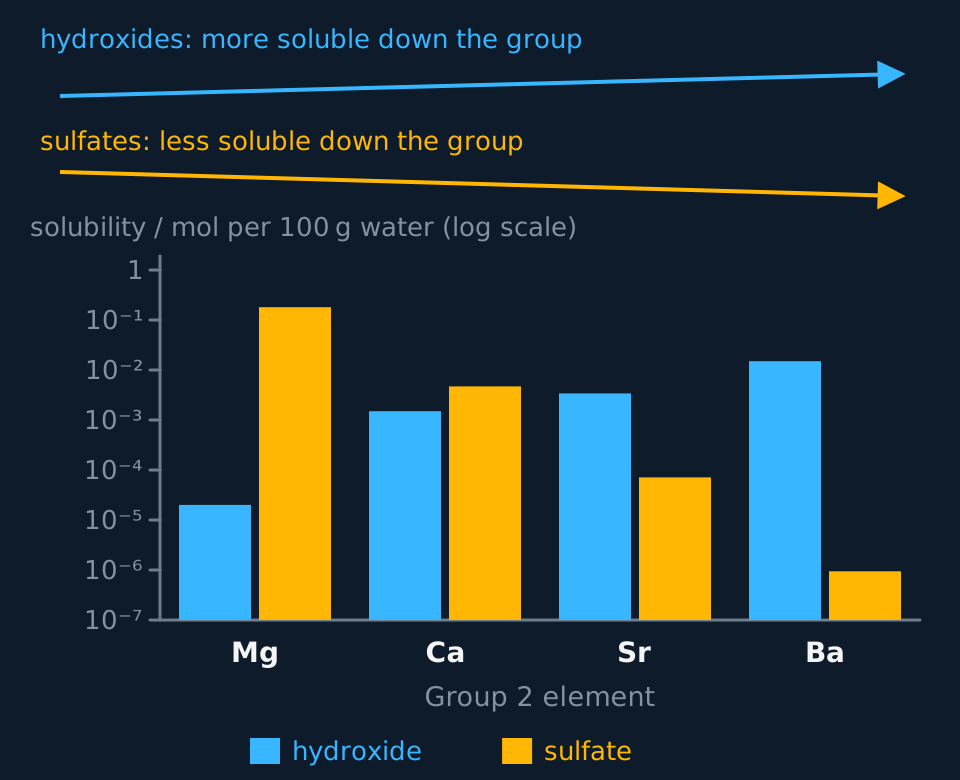
The hydroxides become more soluble down the group. Magnesium hydroxide is sparingly soluble, calcium hydroxide dissolves a little more (limewater is its saturated solution), and barium hydroxide dissolves readily. The sulfates become less soluble down the group. Magnesium sulfate is soluble, calcium sulfate is sparingly soluble, and barium sulfate is insoluble.
| Hydroxide: mol per 100 g water | Sulfate: mol per 100 g water | |
|---|---|---|
| Mg | 2.0 × 10⁻⁵ | 1.8 × 10⁻¹ |
| Ca | 1.5 × 10⁻³ | 4.7 × 10⁻³ |
| Sr | 3.4 × 10⁻³ | 7.1 × 10⁻⁵ |
| Ba | 1.5 × 10⁻² | 9.4 × 10⁻⁷ |
Describe the drawing
Paired bar chart of solubility in moles per 100 grams of water on a logarithmic axis from ten to the minus seven up to one, for magnesium, calcium, strontium and barium. The cyan hydroxide bars rise from 2 times 10 to the minus 5 for magnesium to 1.5 times 10 to the minus 2 for barium; the amber sulfate bars fall from 0.18 for magnesium to 9.4 times 10 to the minus 7 for barium. Arrows above say hydroxides become more soluble and sulfates less soluble down the group.
A more soluble hydroxide puts more hydroxide ions into solution, so the pH of a saturated solution rises down the group: about 10 for magnesium hydroxide, about 12 for calcium hydroxide and about 13 for barium hydroxide. The reasons for the two trends lie in the balance between lattice enthalpy and hydration enthalpy, and belong with thermodynamics. Here the trends are what is asked for, and a statement of each trend with the end members named, Mg(OH)₂ sparingly soluble and BaSO₄ insoluble, is the complete answer.
Limewater shows why the middle of the group is useful. Calcium hydroxide dissolves well enough to make a clear solution, about 0.02 mol dm⁻³, but calcium carbonate is insoluble. Bubble carbon dioxide through and the carbonate precipitates, turning the solution milky. A barium hydroxide solution would give the same result, and magnesium hydroxide would not dissolve enough to make a solution worth testing with.
Ca(OH)₂(aq) + CO₂(g) → CaCO₃(s) + H₂O(l)The limewater test for carbon dioxide.
- Sparingly soluble
- Dissolving only to a very small extent, so that most of the solid remains undissolved, as magnesium hydroxide does in water.
- Precipitate
- An insoluble solid formed when two solutions are mixed and ions in them combine.
What the compounds are used for
Each use follows from the solubility trends: a base that is not too soluble, a base that neutralises an acidic gas, or a salt so insoluble its toxic ion cannot escape.
Magnesium hydroxide is the active ingredient of milk of magnesia and of many indigestion tablets. Excess hydrochloric acid in the stomach causes the burning pain, and the hydroxide neutralises it. Because so little of it dissolves, the concentration of hydroxide ions in the medicine stays low and it is safe to swallow, which a soluble alkali such as barium hydroxide would not be.
Mg(OH)₂(s) + 2HCl(aq) → MgCl₂(aq) + 2H₂O(l)
What one antacid tablet neutralises
An indigestion tablet contains 0.500 g of magnesium hydroxide. Calculate the volume of 0.100 mol dm⁻³ hydrochloric acid it neutralises. Ar values: H 1.0, O 16.0, Mg 24.3.
Show the working
Mr(Mg(OH)₂) = 24.3 + 2 × (16.0 + 1.0) = 58.3, so amount of Mg(OH)₂ = 0.500 g ÷ 58.3 g mol⁻¹ = 8.576 × 10⁻³ mol.
The equation gives 2 mol of HCl for each mol of Mg(OH)₂, so amount of HCl = 2 × 8.576 × 10⁻³ = 1.715 × 10⁻² mol.
Volume = amount ÷ concentration = 1.715 × 10⁻² mol ÷ 0.100 mol dm⁻³ = 0.1715 dm³ = 172 cm³, to three significant figures.
Calcium hydroxide, slaked lime, is spread on fields whose soil has become too acidic for crops to grow well. It neutralises the acid and raises the pH of the soil.
Ca(OH)₂(s) + 2H⁺(aq) → Ca²⁺(aq) + 2H₂O(l)
Sodium hydroxide would neutralise the acid too, but it is very soluble, so a heavy dressing could swing the soil strongly alkaline and wash out quickly. Calcium hydroxide is only sparingly soluble, so it dissolves gradually, acts over months and cannot push the pH much above that of its own saturated solution. Powdered limestone, calcium carbonate, does the same job more slowly still. Some indigestion tablets also use calcium carbonate, which gives off carbon dioxide in the stomach as it neutralises the acid.
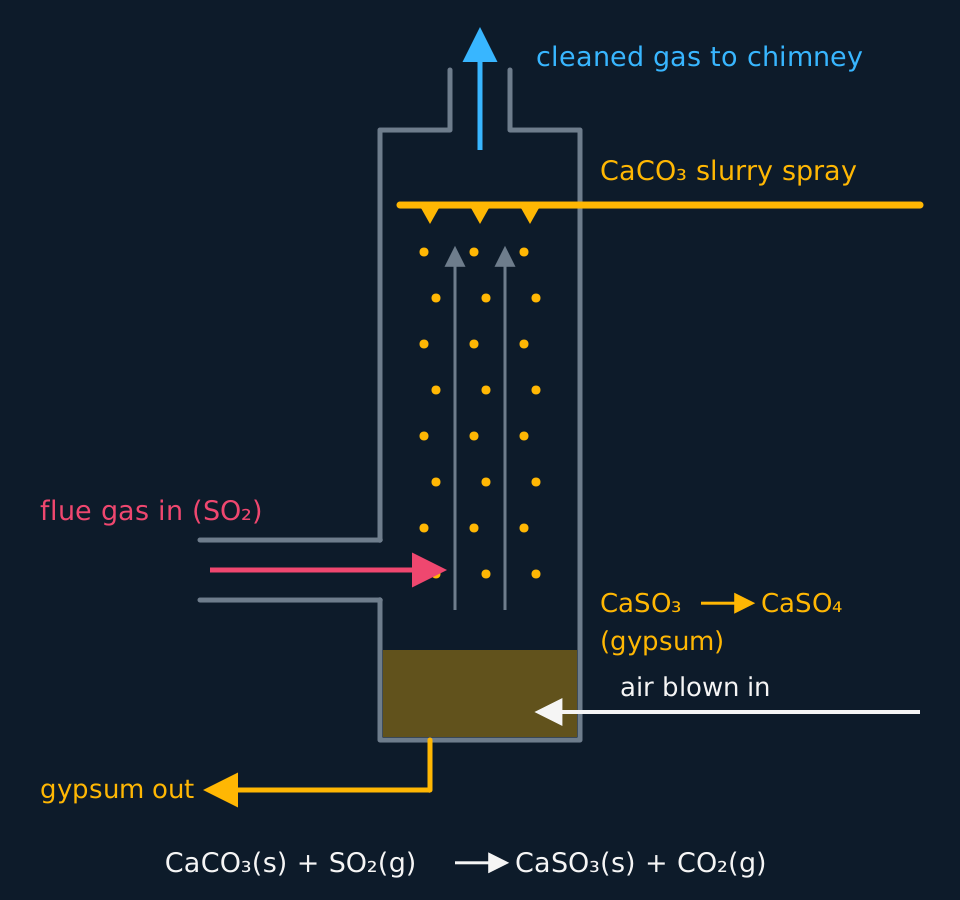
Calcium oxide and calcium carbonate remove sulfur dioxide from the flue gases of power stations that burn coal, a process called flue-gas desulfurisation. Sulfur dioxide is an acidic oxide and causes acid rain. Sprayed with a wet slurry of either base, it reacts to give calcium sulfite, and further oxidation in air gives calcium sulfate, sold as gypsum for plasterboard.
CaO(s) + SO₂(g) → CaSO₃(s)
CaCO₃(s) + SO₂(g) → CaSO₃(s) + CO₂(g)Limestone is cheaper than lime, but this route releases carbon dioxide.
Describe the drawing
A tall scrubber tower. Flue gas carrying sulfur dioxide enters through a duct at the bottom left and rises; a calcium carbonate slurry is sprayed down from nozzles near the top, and the cleaned gas leaves through the top to the chimney. The slurry collects in a sump at the bottom where air is blown in, oxidising calcium sulfite to calcium sulfate, gypsum, which is drawn off. The equation calcium carbonate plus sulfur dioxide gives calcium sulfite plus carbon dioxide runs beneath.
The calcium oxide is made in a lime kiln, where limestone is heated to about 900 °C and decomposes to calcium oxide and carbon dioxide. The kiln runs continuously, limestone fed in at the top and lime drawn off at the bottom, and the carbon dioxide it releases is the reason limestone and lime have the same carbon cost in desulfurisation.
CaCO₃(s) → CaO(s) + CO₂(g)
Barium sulfate is the barium meal. Barium atoms have many electrons and absorb X-rays strongly, so a gut lined with barium sulfate shows up white on the X-ray and its outline can be seen. Barium ions are toxic, and barium sulfate is safe only because it is insoluble: it passes through the gut and is excreted without the ions being absorbed.
- Flue-gas desulfurisation
- The removal of sulfur dioxide from the waste gases of a power station by reaction with a base such as calcium oxide or calcium carbonate.
- Neutralisation
- The reaction of an acid with a base, in which hydrogen ions react with hydroxide ions to form water.
Limestone for a power station
A coal-fired power station releases 1.20 tonnes of sulfur dioxide an hour. Calculate the mass of calcium carbonate needed each hour to remove it all. Ar values: C 12.0, O 16.0, S 32.1, Ca 40.1.
Show the working
Mr(SO₂) = 32.1 + 2 × 16.0 = 64.1, and Mr(CaCO₃) = 40.1 + 12.0 + 3 × 16.0 = 100.1.
Amount of SO₂ = 1.20 × 10⁶ g ÷ 64.1 g mol⁻¹ = 1.872 × 10⁴ mol.
CaCO₃(s) + SO₂(g) → CaSO₃(s) + CO₂(g) is 1 : 1, so 1.872 × 10⁴ mol of CaCO₃ is needed. Mass = 1.872 × 10⁴ mol × 100.1 g mol⁻¹ = 1.874 × 10⁶ g = 1.87 tonnes per hour, to three significant figures.
The same 1 : 1 ratio gives 1.872 × 10⁴ mol of CO₂ released, or 1.872 × 10⁴ × 44.0 = 8.24 × 10⁵ g, 0.824 tonnes an hour. Calcium oxide would release none at the scrubber, but making it from limestone releases the same carbon dioxide at the lime kiln instead.
The test for sulfate ions
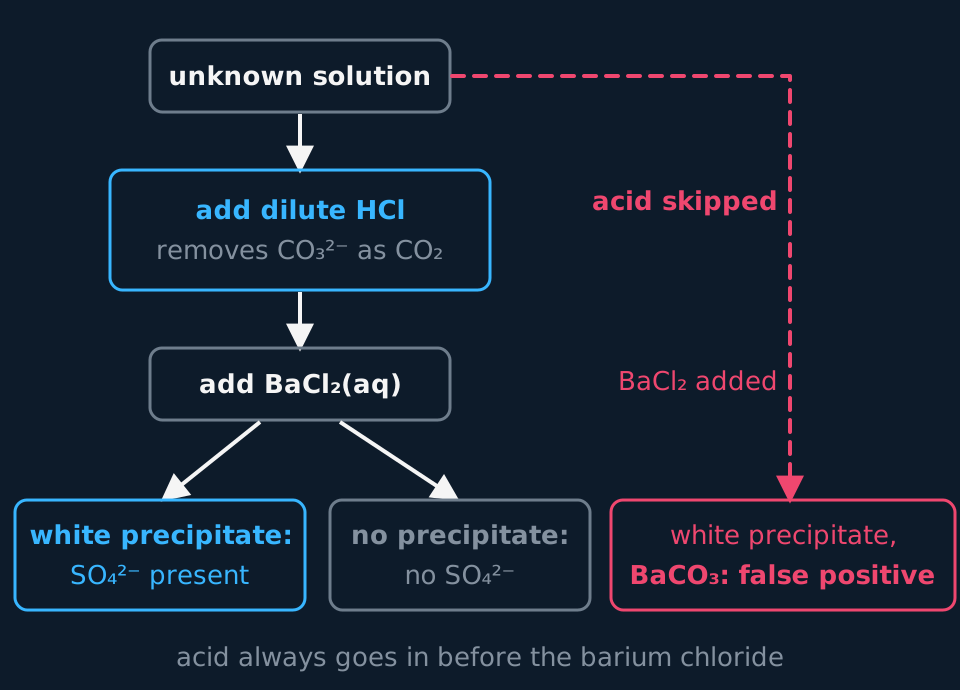
To find out whether a solution contains sulfate ions, add a few drops of dilute hydrochloric acid and then a few drops of barium chloride solution. A white precipitate of barium sulfate shows that sulfate ions are present. Barium sulfate is the least soluble of the Group 2 sulfates, which is what makes the test so sensitive.
Ba²⁺(aq) + SO₄²⁻(aq) → BaSO₄(s)The ionic equation. Chloride ions from the barium chloride and the metal ions from the sample are spectator ions and are left out.
The acid is there to remove carbonate ions. Barium carbonate is also a white solid, so without acid a solution of sodium carbonate would give a white precipitate and a false positive. The acid reacts with any carbonate ions first, turning them into carbon dioxide and water, and fizzing shows when that has happened. The acid removes sulfite ions too, as sulfur dioxide.
2H⁺(aq) + CO₃²⁻(aq) → CO₂(g) + H₂O(l)
Ba²⁺(aq) + CO₃²⁻(aq) → BaCO₃(s)The false positive the acid prevents.
Dilute hydrochloric or dilute nitric acid will do. Sulfuric acid cannot be used, because it adds sulfate ions of its own and would give a white precipitate whatever the sample contained. Where the same portion of solution is to be tested for halide ions afterwards, barium nitrate with nitric acid avoids adding chloride.
Read the result as the mark scheme words it. A white precipitate that forms after the acid has been added, and stays, means sulfate. Fizzing when the acid goes in means carbonate was there as well, which is a second result rather than a spoiled test. No precipitate means no sulfate, and the test is sensitive enough that a faint cloudiness still counts: barium sulfate comes out of solution at concentrations around a millionth of a mole per 100 g of water.
Describe the drawing
Flow chart of the sulfate test from top to bottom: unknown solution, then dilute hydrochloric acid, which removes carbonate as carbon dioxide, then barium chloride solution, ending in either a white precipitate meaning sulfate is present or no precipitate meaning no sulfate. A dashed coral side branch skips the acid and leads to a white precipitate of barium carbonate, a false positive.
- Spectator ion
- An ion present in the reaction mixture that is unchanged by the reaction and is left out of the ionic equation.
- Ionic equation
- An equation showing only the ions and other species that take part in a reaction, with spectator ions omitted.
Telling the Group 2 ions apart
The two solubility trends also identify the ions. Add sodium hydroxide solution and the hydroxide forms; whether it precipitates depends on how insoluble it is, so the precipitate is heaviest for magnesium and absent for barium. Add dilute sulfuric acid and the sulfate forms, and the pattern runs the other way.
| Ion | With sodium hydroxide solution | With dilute sulfuric acid |
|---|---|---|
| Mg²⁺ | White precipitate | No change |
| Ca²⁺ | Slight white precipitate | Slight white precipitate |
| Sr²⁺ | Very slight white precipitate, or none | White precipitate |
| Ba²⁺ | No change | Dense white precipitate |
Mg²⁺(aq) + 2OH⁻(aq) → Mg(OH)₂(s)
Sr²⁺(aq) + SO₄²⁻(aq) → SrSO₄(s)
The two reagents together separate all four ions. Magnesium is the only one with a clear hydroxide precipitate and no sulfate precipitate; barium is the reverse. Calcium gives a slight precipitate with both, so it is the hardest to call, and the result depends on the concentrations used.
Calcium's results follow from the two solubility trends. Calcium hydroxide and calcium sulfate are both sparingly soluble, near the middle of each trend, so with either reagent only a little solid comes out. With dilute solutions it may not come out at all, and a result of 'no change' for calcium with sodium hydroxide is not wrong, only less informative.
TRY IT: Three bottles without labels
Three bottles hold solutions of magnesium chloride, calcium chloride and barium chloride, but the labels have come off. Using only sodium hydroxide solution and dilute sulfuric acid, describe how to identify each, with the observations and one ionic equation.
Check your answer
Add dilute sulfuric acid to a sample of each. A dense white precipitate identifies barium chloride: Ba²⁺(aq) + SO₄²⁻(aq) → BaSO₄(s). Magnesium chloride gives no change, and calcium chloride at most a slight white precipitate.
Add sodium hydroxide solution to fresh samples of the other two. Magnesium chloride gives a white precipitate of magnesium hydroxide; calcium chloride gives only a slight one. The magnesium result is the clearer of the two, so it is the one to rely on.
Other boards: flame tests, and heating the carbonates and nitrates
Edexcel sets flame tests and asks why the colours appear, and its core practicals on inorganic unknowns, 7 and 15, use one as the first test on a solid. AQA's A level does not set them: its Group 2 ions are told apart by their precipitates with sodium hydroxide and with sulfuric acid. A nichrome wire is cleaned in concentrated hydrochloric acid, dipped in the solid and held in the hottest part of a blue Bunsen flame. Calcium gives an orange-red flame, strontium crimson and barium pale green; magnesium gives no colour.
The heat promotes electrons to higher energy levels, and as they fall back they emit light of particular frequencies, set by the gaps between the levels in that ion. Three Group 1 ions are worth knowing beside the Group 2 ones: lithium red, sodium yellow-orange and potassium lilac.
| Ion | Flame colour |
|---|---|
| Li⁺ | Red |
| Na⁺ | Yellow-orange |
| K⁺ | Lilac |
| Mg²⁺ | No colour |
| Ca²⁺ | Orange-red (brick red) |
| Sr²⁺ | Crimson |
| Ba²⁺ | Pale green (apple green) |
- Flame test
- A test in which a compound is heated in a flame and the colour of the light emitted identifies the metal ion present.
Edexcel and Cambridge examine what happens when the Group 2 carbonates and nitrates are heated, and Edexcel adds the Group 1 compounds; AQA and OCR do not set it. Every Group 2 carbonate decomposes to the oxide and carbon dioxide. Every Group 2 nitrate decomposes to the oxide, nitrogen dioxide and oxygen, and that one is easy to watch, because nitrogen dioxide is a brown gas.
MgCO₃(s) → MgO(s) + CO₂(g)
2Mg(NO₃)₂(s) → 2MgO(s) + 4NO₂(g) + O₂(g)Brown fumes of nitrogen dioxide; the oxygen relights a glowing splint.
The compounds become more stable to heat down the group. Magnesium carbonate decomposes at about 540 °C, well within a Bunsen flame; calcium carbonate needs about 900 °C, strontium carbonate about 1280 °C and barium carbonate about 1360 °C, beyond what a Bunsen burner gives. The nitrates follow the same order at lower temperatures.
The explanation is the cation's polarising power. A small ion with a 2+ charge has a high charge density. Beside a carbonate ion it pulls the anion's electron cloud towards itself, distorting it and weakening the C–O bonds inside it, so less energy is needed to break the carbonate into an oxide ion and carbon dioxide. Down the group the ion keeps its 2+ charge but grows, so its charge density falls, it distorts the carbonate ion less, and a higher temperature is needed. The large nitrate ion is distorted by the cation as well, so the nitrates show the same trend.
A Group 1 ion carries only a 1+ charge and is larger than the Group 2 ion in the same period, so it polarises the anion much less. Sodium carbonate and the carbonates below it do not decompose at Bunsen temperatures, and sodium nitrate loses only oxygen, leaving the nitrite with no brown gas. Lithium is the exception: Li⁺ is small enough to behave like a Group 2 ion, so lithium carbonate gives the oxide and carbon dioxide and lithium nitrate gives brown nitrogen dioxide.
2NaNO₃(s) → 2NaNO₂(s) + O₂(g)Sodium nitrate to sodium nitrite; no nitrogen dioxide forms.
| On heating | Group 2 compounds and lithium's | Group 1 compounds from sodium down |
|---|---|---|
| Carbonate | Oxide and carbon dioxide; less easily down Group 2 | No decomposition in a Bunsen flame |
| Nitrate | Oxide, nitrogen dioxide (brown) and oxygen | Nitrite and oxygen; no brown gas |
| Cation | 2+ (Li⁺ very small), high charge density | 1+ and larger, low charge density |
Comparing stabilities in the laboratory needs a fair test. The same amount in moles of each carbonate, about 0.005 mol, goes into identical boiling tubes, heated with the same blue Bunsen flame at the same height. A delivery tube dips into the same volume of limewater, and the time until the limewater turns milky measures how easily the carbonate decomposes. For the nitrates the time until brown gas appears is recorded, in a fume cupboard because nitrogen dioxide is toxic.
The delivery tube comes out of the limewater before the flame is taken away, or cooling gas draws limewater back into the hot tube.
- Thermal decomposition
- The breaking down of a compound into simpler substances by heating.
- Polarising power
- The ability of a cation to distort the electron cloud of a neighbouring anion; it increases with the charge of the cation and decreases with its size.
Other boards: Cambridge gas and anion tests
Cambridge's Paper 3 is a practical examination, and its qualitative analysis questions print notes listing the tests for gases and ions. A candidate still needs to know them, to choose the right test and to describe each result in the words of the notes. Limewater, damp red litmus, barium ions and silver nitrate are already familiar; hydrogen, oxygen, chlorine, sulfur dioxide and the nitrate ion are new.
| Gas | Test | Positive result |
|---|---|---|
| Hydrogen, H₂ | A lighted splint at the mouth of the tube | Squeaky pop |
| Oxygen, O₂ | A glowing splint in the gas | The splint relights |
| Carbon dioxide, CO₂ | Bubble the gas through limewater | White precipitate: the limewater turns milky |
| Ammonia, NH₃ | Damp red litmus paper in the gas | Turns blue |
| Chlorine, Cl₂ | Damp blue litmus paper in the gas | Turns red, then is bleached white |
| Sulfur dioxide, SO₂ | Bubble the gas through acidified aqueous potassium manganate(VII) | Purple to colourless |
2H₂(g) + O₂(g) → 2H₂O(l)The pop is a small explosion of hydrogen with the air at the mouth of the tube.
Two of the gas tests are redox reactions. Sulfur dioxide is a reducing agent: it reduces purple manganate(VII) ions to almost colourless Mn²⁺. The notes for the syllabus examined from 2025 print that test; older notes, and many books, use acidified dichromate(VI), reduced from orange to green Cr³⁺. Chlorine first turns damp litmus red, because it reacts with the water to give hydrochloric and chloric(I) acids, and then bleaches it, because chloric(I) acid is an oxidising agent. Each test needs the paper damp, since the gas must dissolve before it can act.
| Anion | Test | Positive result |
|---|---|---|
| Carbonate, CO₃²⁻ | Add dilute acid | Effervescence; the gas turns limewater milky |
| Sulfate, SO₄²⁻ | Add Ba²⁺(aq), then excess dilute strong acid | White precipitate, insoluble in the acid |
| Sulfite, SO₃²⁻ | Add Ba²⁺(aq), then excess dilute strong acid | White precipitate that dissolves in the acid |
| Chloride, bromide, iodide | Acidify with dilute nitric acid, add AgNO₃(aq), then NH₃(aq) | Cl⁻ white, soluble in NH₃(aq); Br⁻ cream, partially soluble; I⁻ yellow, insoluble |
| Nitrate, NO₃⁻ | Warm with NaOH(aq) and aluminium foil or Devarda's alloy | Ammonia given off: damp red litmus turns blue |
The nitrate test is a reduction. In hot alkali, aluminium reduces nitrogen from +5 in the nitrate ion to −3 in ammonia, which is then detected with damp red litmus. Ammonium ions give ammonia with sodium hydroxide alone, so the mixture is warmed with sodium hydroxide first, and only ammonia that appears after the aluminium is added shows nitrate. Devarda's alloy, of copper, aluminium and zinc, works faster than foil.
3NO₃⁻(aq) + 8Al(s) + 5OH⁻(aq) + 18H₂O(l) → 3NH₃(g) + 8[Al(OH)₄]⁻(aq)Nitrogen +5 to −3, eight electrons gained; aluminium 0 to +3.
The sulfate test here adds the acid after the barium ions rather than before, and reads the result from what the acid does. Barium sulfate stays; barium sulfite and barium carbonate dissolve, the sulfite giving sulfur dioxide and the carbonate fizzing. The halide notes describe silver bromide as partially soluble in dilute ammonia, and it dissolves in concentrated ammonia.
In the exam
- Asked why the barium chloride is acidified, the scheme awards 'to remove carbonate ions', or 'to stop barium carbonate precipitating'; 'to remove impurities' or 'to remove other ions' is not credited.
- Sulfuric acid is rejected as the acidifier because it adds sulfate ions, so a white precipitate forms whatever the sample contains. The answer must name the sulfate ions it adds.
- The barium meal answer needs two ideas: barium sulfate is insoluble, so toxic Ba²⁺ is not absorbed, and barium absorbs X-rays. 'Barium sulfate is not toxic' contradicts the chemistry and earns no credit.
- Write both desulfurisation equations with state symbols: CaO(s) + SO₂(g) → CaSO₃(s) and CaCO₃(s) + SO₂(g) → CaSO₃(s) + CO₂(g).
- Observation answers use 'white precipitate'. 'Goes cloudy' or 'goes white' does not say that a solid has formed, and the answer must.
Check yourself
A patient is given a barium meal of barium sulfate. A nurse suggests that barium carbonate, which is also insoluble in water, would work as well. Evaluate the suggestion.
Answer
Barium carbonate would show up on the X-ray, since it contains barium just as barium sulfate does, and it is insoluble in water.
The stomach contains hydrochloric acid, and carbonate ions react with acid: BaCO₃(s) + 2HCl(aq) → BaCl₂(aq) + CO₂(g) + H₂O(l). The barium chloride formed is soluble, so toxic Ba²⁺ ions would be released and absorbed into the blood.
Barium sulfate does not react with the acid and stays insoluble, so no Ba²⁺ is absorbed. The suggestion should be rejected: insolubility in water is not enough, and the compound must also stay insoluble in stomach acid.
Questions
Question 16 marks
Describe how sodium hydroxide solution and dilute sulfuric acid could be used to identify which of four solutions contains Mg²⁺, Ca²⁺, Sr²⁺ and Ba²⁺ ions. Give the expected observations and explain them.
Mark scheme
Indicative content
- add sodium hydroxide solution dropwise to a sample of each solution, and dilute sulfuric acid to a fresh sample of each
- with sodium hydroxide, Mg²⁺ gives a white precipitate, Ca²⁺ a slight white precipitate, and Sr²⁺ and Ba²⁺ little or none
- with dilute sulfuric acid, Ba²⁺ gives a dense white precipitate, Sr²⁺ a white precipitate, Ca²⁺ a slight one and Mg²⁺ none
- the hydroxide results follow because hydroxide solubility increases down the group, so magnesium hydroxide precipitates most
- the sulfate results follow because sulfate solubility decreases down the group, so barium sulfate precipitates most
- a correct ionic equation, such as Mg²⁺(aq) + 2OH⁻(aq) → Mg(OH)₂(s) or Ba²⁺(aq) + SO₄²⁻(aq) → BaSO₄(s)
Levels
- Level 3 (5–6 marks) both reagents are used on separate samples, the observations for all four ions with each reagent are given, both trends in solubility are used to explain them, and a correct ionic equation is written; the answer would let a student tell the four solutions apart
- Level 2 (3–4 marks) the observations with both reagents are mostly right and one solubility trend explains them; the other trend or the ionic equation is not there
- Level 1 (1–2 marks) a white precipitate is mentioned for one ion; the two solubility trends are often run the same way, with barium hydroxide called the least soluble
Question 24 marks
Describe the trends in solubility of the Group 2 hydroxides and sulfates shown in the bar chart, and explain how the hydroxide trend affects the pH of their saturated solutions.
Mark scheme
- B1 the hydroxides become more soluble down the group, Mg(OH)₂ being sparingly soluble
- B1 the sulfates become less soluble down the group, BaSO₄ being insoluble
- B1 a more soluble hydroxide puts a higher concentration of hydroxide ions into its saturated solution
- B1 so the pH of the saturated solution rises down the group, from about 10 for Mg(OH)₂ to about 13 for Ba(OH)₂
Question 34 marks
Give one use each of magnesium hydroxide, calcium hydroxide, calcium oxide and barium sulfate, and the property of each compound that makes it suitable.
Mark scheme
- B1 magnesium hydroxide treats indigestion: it neutralises excess stomach acid, and is sparingly soluble so the hydroxide concentration stays low
- B1 calcium hydroxide treats acidic soil: it is a base that neutralises the acid and raises the pH
- B1 calcium oxide removes sulfur dioxide from flue gases: it is a basic oxide that reacts with the acidic gas
- B1 barium sulfate is the barium meal: it is insoluble, so toxic Ba²⁺ is not absorbed, and barium absorbs X-rays
All 22 questions with mark schemes, the other 19 set out in full on the question page.
Worth remembering
- 'The hydroxides get more soluble' with no end member named is half an answer: Mg(OH)₂ sparingly soluble, Ba(OH)₂ soluble.
- Acidify a sulfate test with hydrochloric or nitric acid, never sulfuric, and say the acid removes carbonate.
- Explain a barium meal by the sulfate's insolubility in stomach acid as well as water: barium carbonate dissolves there and releases toxic Ba²⁺.
- Calcium is the ion to confirm with a second test: its precipitates are slight with both reagents.
- CO₂ written as a product of CaO + SO₂ is wrong: only the CaCO₃ route releases carbon dioxide.
CHECK YOUR PROGRESS
Rate how confident you are with each objective for this lesson. Ratings are saved in this browser, on this device, unless you sign in.
- State the trends in solubility of the Group 2 hydroxides and sulfates, naming the least soluble compound in each series.
- Give a use for magnesium hydroxide, calcium hydroxide, calcium oxide, calcium carbonate and barium sulfate, and write the equation that explains each.
- Describe the test for sulfate ions, and explain why the barium chloride solution is acidified and why sulfuric acid cannot be the acid.
- Identify Mg²⁺, Ca²⁺, Sr²⁺ and Ba²⁺ in solution from their reactions with sodium hydroxide and with dilute sulfuric acid.
- Calculate reacting masses for the neutralisation and desulfurisation reactions.
- Describe and explain the trend in thermal stability of the Group 2 carbonates and nitrates, and compare it with Group 1.CAIE · Edexcel
Open the full revision checklist to see every objective in the curriculum in one place.
Practise this lesson
WORKBOOK
The written questions from this topic, on paper with room to work, and a separate book of mark schemes. The 3 questions that are set on a diagram stay on this page, where the diagram can be drawn. Free to use; please do not redistribute or sell.
Used later in Halide ions, the silver nitrate test, concentrated sulfuric acid, and chlorine in water