Chemistry › Group 2 and Group 7 › Group 7: trends down the group and displacement reactions
Group 7: trends down the group and displacement reactions
The halogens run from a pale yellow gas to a grey-black solid, and their boiling points rise with the number of electrons in the molecule. Each atom is one electron short of a full shell, and the further that shell is from the nucleus, the weaker the pull on an incoming electron. So fluorine is the strongest oxidising agent and iodine the weakest, and a halogen displaces any halogen below it from a solution of its salt.
Key terms Every definition in Group 2 and Group 7, lesson by lesson
Before this Electronegativity, polarity and intermolecular forces – van der Waals forces and what makes them stronger · Half-equations and building redox equations · Group 2: trends down the group and reactions with water – for the radius and shielding argument
COMMON MISCONCEPTION
Iodine is the most reactive halogen because it is the biggest atom and has the most electrons.
A halogen reacts by gaining an electron, and the biggest atom gains one least readily: iodine's outer shell is furthest from the nucleus and most shielded. Fluorine is the most reactive halogen and the strongest oxidising agent. Chlorine displaces bromine and iodine from their salts; iodine displaces neither.
What you should be able to do
- Describe the state and colour of each halogen at room temperature, and explain the trend in boiling point using van der Waals forces.
- Explain the trends in atomic radius and electronegativity down Group 7.
- Explain why oxidising power decreases from fluorine to iodine.
- Predict the outcome of mixing a halogen with a halide solution, and write the ionic equation and half-equations with state symbols.
- Describe the colours of chlorine, bromine and iodine in water and in cyclohexane, and explain why the organic solvent is added.
- Explain the trends in bond enthalpy of the halogens and in the thermal stability of the hydrogen halides.CAIE
The halogens as elements
Down Group 7 the halogens change from gases to a solid, and their colours deepen. Chlorine is a pale green gas. Bromine is a dark red-brown liquid with an orange vapour above it. Iodine is a grey-black solid with a metallic shine, and on gentle warming it gives a purple vapour. Fluorine, a pale yellow gas, is too reactive to keep in a school at all. Each halogen exists as diatomic molecules, X₂, held by a single covalent bond.
Every halogen atom has seven electrons in its outer shell, in the configuration ns²np⁵. One more electron fills the p subshell, so in reactions a halogen atom gains an electron, forming a halide ion with a 1− charge, or shares one in a covalent bond.
All of them are hazardous. Chlorine attacks the lining of the lungs and was used as a weapon in 1915; bromine burns skin and its vapour is toxic; iodine stains and irritates. In school they are handled as dilute solutions: chlorine water, bromine water and iodine dissolved in potassium iodide solution. The halogens are non-polar and dissolve only slightly in water, but much more in a non-polar organic solvent such as cyclohexane, and the displacement tests use that solvent to collect and identify them.
| State at 20 °C | Colour | Electrons per molecule | Boiling point / °C | |
|---|---|---|---|---|
| F₂ | Gas | Pale yellow | 18 | −188 |
| Cl₂ | Gas | Pale green | 34 | −34 |
| Br₂ | Liquid | Red-brown | 70 | 59 |
| I₂ | Solid | Grey-black; purple vapour | 106 | 184 |
Boiling point, atomic radius and electronegativity
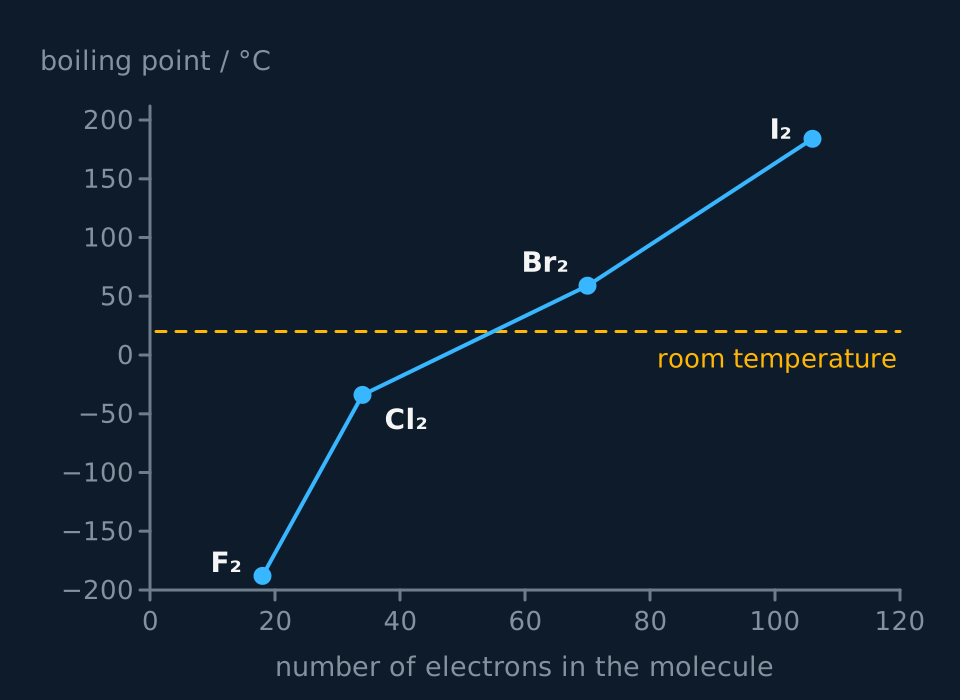
Boiling point rises steadily down the group, from −188 °C for fluorine to 184 °C for iodine. Boiling a halogen separates its molecules from each other; the covalent bond inside each molecule is not broken. What holds the molecules together are van der Waals forces, attractions between temporary dipoles that arise as the electrons move and then induce dipoles in neighbouring molecules.
The more electrons a molecule has, the larger the temporary dipoles that can form and the stronger the van der Waals forces between molecules. An iodine molecule has 106 electrons and a fluorine molecule 18, so much more energy is needed to separate iodine molecules, and the boiling point is higher. Name the force and where it acts: 'van der Waals forces between molecules', or 'induced dipole–dipole forces'. An answer that has the Br–Br or I–I bond breaking on boiling describes a different change altogether.
Describe the drawing
Boiling point in degrees Celsius plotted against the number of electrons in the molecule for the four halogens, joined point to point: fluorine, 18 electrons, minus 188; chlorine, 34, minus 34; bromine, 70, 59; iodine, 106, 184. The first segment is the steepest. A dashed line at 20 degrees marks room temperature, with fluorine and chlorine below it.
Atomic radius increases down the group, because each element has one more occupied shell than the one above. Electronegativity decreases: fluorine 4.0, chlorine 3.0, bromine 2.8, iodine 2.5 on the Pauling scale. A bonding pair of electrons is attracted to the nucleus of each atom, and in a larger atom the pair is further from the nucleus and more shielded from it by inner shells, so the attraction is weaker.
Beside Group 2 the trend runs the opposite way. The Group 2 metals melt at lower temperatures down the group because their metallic bonding weakens as the ions grow. The halogens boil at higher temperatures down the group because the forces being overcome are between molecules, and those grow with the number of electrons. A trend in a physical property only makes sense once the bonding is known.
- Van der Waals forces
- Attractions between molecules caused by temporary dipoles inducing dipoles in neighbouring molecules; also called induced dipole–dipole forces.
- Electronegativity
- The power of an atom to attract the pair of electrons in a covalent bond.
Why bromine is a liquid and chlorine a gas
At room temperature chlorine is a gas and bromine is a liquid. Explain the difference.
Show the working
Identify what has to be overcome. Both are simple molecular substances, so boiling separates whole molecules; the Cl–Cl and Br–Br bonds stay intact.
Compare the forces. A Br₂ molecule has 70 electrons and a Cl₂ molecule 34. More electrons give larger temporary dipoles, so the van der Waals forces between Br₂ molecules are stronger.
Conclude with energy. More energy is needed to overcome the forces between bromine molecules, so bromine boils at 59 °C, above room temperature, while chlorine boils at −34 °C, below it.
The halogens as oxidising agents
In most of their reactions halogen molecules gain electrons and become halide ions. Gaining electrons is reduction, so the halogen is reduced and the species it takes the electrons from is oxidised: the halogen is an oxidising agent.
Cl₂(aq) + 2e⁻ → 2Cl⁻(aq)The half-equation for chlorine acting as an oxidising agent; each chlorine atom goes from 0 to −1.
Oxidising power decreases down the group. The electron gained goes into the outer shell. In a fluorine atom that shell is close to the nucleus with only one filled shell inside it, so an incoming electron is strongly attracted. In an iodine atom it is the fifth shell, far from the nucleus and shielded by four filled shells, so the attraction is much weaker. Iodine gains an electron least readily and is the weakest oxidising agent.
Fluorine is so strong an oxidising agent that it oxidises water itself, releasing oxygen, and it reacts with almost every other element, including some of the noble gases. That is why it does not appear in school displacement tests: a solution of fluorine in water cannot be made. The order of the other three can be shown in a test tube, and displacement reactions are the evidence for it. Chlorine's strength has a use of its own: the chloric(I) acid it forms in water oxidises bacteria, and a small concentration keeps drinking water safe all the way to the tap.
Iodine is therefore the least reactive halogen, not the most. Being larger with more electrons is exactly what makes iodine less reactive as an oxidising agent: the electron it would gain is held further from the nucleus. In Group 2 the same size effect makes the lower metals more reactive, because there the reaction is the loss of electrons, not the gain.
Three halogens with the labels lost
Three bottles, A, B and C, hold chlorine water, bromine water and iodine solution, and three more hold their potassium halides, KA, KB and KC. A changes the colour of both KB and KC. B changes the colour of KC only. C changes neither. Identify A, B and C.
Show the working
A halogen oxidises the halide of any weaker halogen, so the number of halides each one reacts with ranks them. A reacts with two, B with one and C with none: oxidising power is A > B > C.
Oxidising power falls down the group, chlorine > bromine > iodine. So A is chlorine, B is bromine and C is iodine.
The colours confirm it. A with KB gives orange, bromine formed; A and B with KC both give brown, iodine formed; and in cyclohexane the KC tubes turn purple.
- Oxidising agent
- A species that accepts electrons from another species, and is itself reduced in doing so.
- Reduction
- The gain of electrons by a species, which lowers its oxidation state.
Displacement reactions
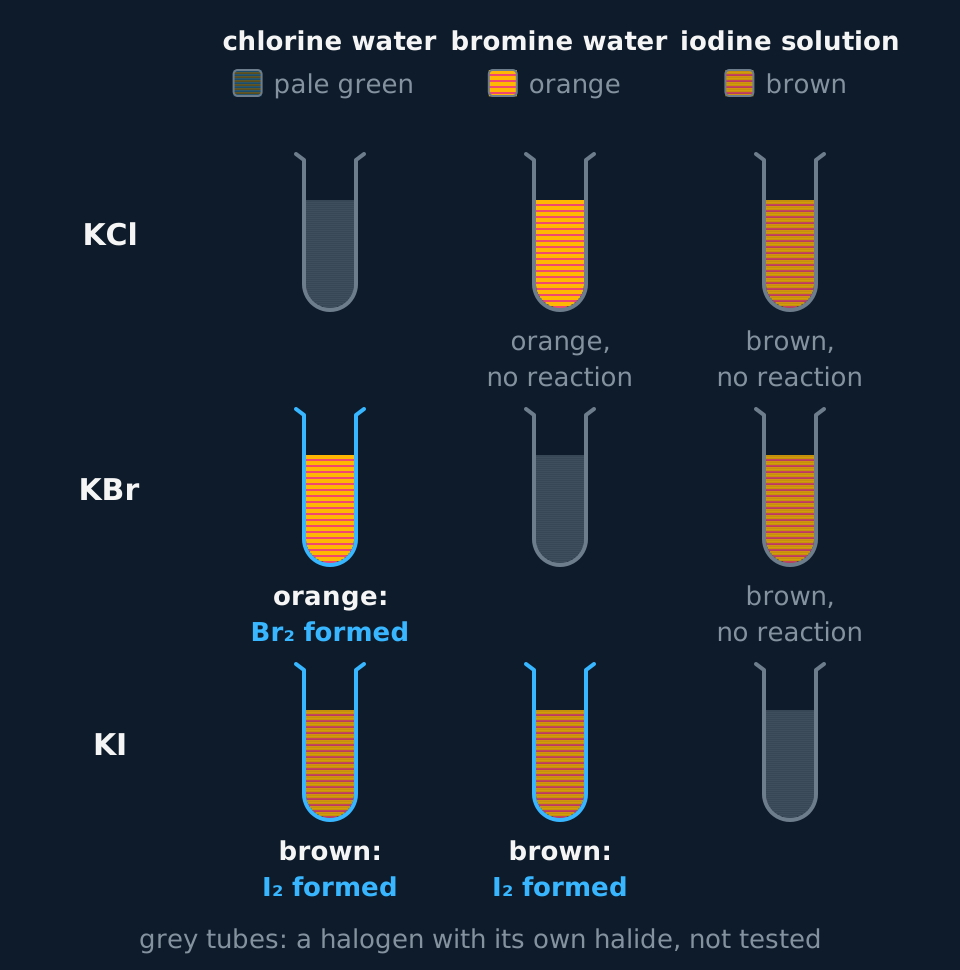
A halogen displaces any halogen below it in the group from a solution of its halide ions, and no halogen displaces one above it. Chlorine water turns colourless potassium bromide solution orange. Chlorine is the stronger oxidising agent, so it takes electrons from the bromide ions: chlorine is reduced to chloride ions and bromide ions are oxidised to bromine, which gives the colour.
Cl₂(aq) + 2Br⁻(aq) → 2Cl⁻(aq) + Br₂(aq)
Cl₂(aq) + 2I⁻(aq) → 2Cl⁻(aq) + I₂(aq)
Br₂(aq) + 2I⁻(aq) → 2Br⁻(aq) + I₂(aq)
The potassium ions are spectator ions and are left out of the ionic equations. Each equation is the sum of two half-equations: for the first, Cl₂(aq) + 2e⁻ → 2Cl⁻(aq) and 2Br⁻(aq) → Br₂(aq) + 2e⁻.
Describe the drawing
A three by three grid of test tubes, with chlorine water, bromine water and iodine solution across the top and potassium chloride, bromide and iodide down the side. The three tubes on the diagonal, each halogen with its own halide, are greyed out. Chlorine with potassium bromide turns orange as bromine forms; chlorine and bromine with potassium iodide turn brown as iodine forms. The other three tubes stay the colour of the halogen water added, with no reaction.
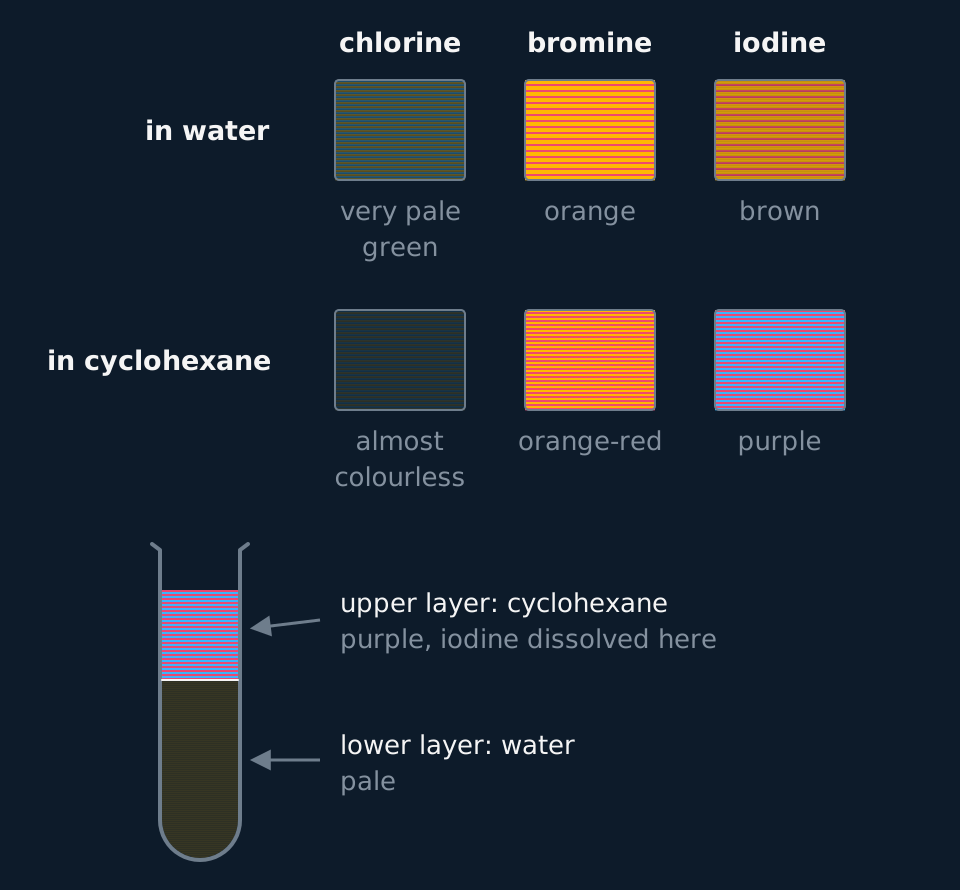
The colours in water are hard to tell apart. Bromine water is orange or yellow, and dilute iodine solution is brown fading to yellow, so a pale result can be either. Adding a few drops of cyclohexane and shaking settles it. The halogen, a non-polar molecule, moves into the organic solvent, which forms the upper layer: bromine is orange in cyclohexane and iodine is a clear purple. Chlorine is very pale green in water and almost colourless in cyclohexane.
The tubes where nothing happens need reading with care. Bromine water added to potassium chloride solution leaves an orange mixture, and that orange is the bromine that was added, diluted, not bromine that has been formed. A reaction shows as a change to a colour that was not there before, as when pale chlorine water turns potassium iodide brown. The bottles of halide solution are colourless, so a control tube of halogen water and pure water, side by side, shows what 'no reaction' looks like.
| Halogen | Colour in water | Colour in cyclohexane |
|---|---|---|
| Chlorine | Very pale green | Very pale green, almost colourless |
| Bromine | Orange (yellow when dilute) | Orange to red-brown |
| Iodine | Brown (yellow when dilute) | Purple |
Describe the drawing
Six colour swatches in two rows. In water, chlorine is very pale green, bromine orange and iodine brown, the last two close in shade. In cyclohexane, chlorine is almost colourless, bromine orange-red and iodine purple. Below, a test tube holds two layers: purple cyclohexane with the iodine in it on top, and a pale water layer underneath.
- Displacement reaction
- A reaction in which a more reactive element takes the place of a less reactive one in a compound or in solution.
- Half-equation
- An equation for either the oxidation or the reduction part of a redox reaction, showing the electrons lost or gained.
TRY IT: Chlorine water, iodide and cyclohexane
A student adds chlorine water to potassium iodide solution, then adds cyclohexane and shakes the tube. Describe what is seen in each layer, write the ionic equation, and state which species is oxidised.
Check your answer
Chlorine displaces iodine, so the aqueous solution turns brown. After shaking, the iodine moves into the cyclohexane, and the upper layer is purple; the lower aqueous layer becomes paler.
Cl₂(aq) + 2I⁻(aq) → 2Cl⁻(aq) + I₂(aq). Iodide ions lose electrons and go from −1 to 0, so they are oxidised; chlorine goes from 0 to −1 and is reduced, acting as the oxidising agent.
How much iodine a displacement makes
Excess bromine water is added to 20.0 cm³ of 0.150 mol dm⁻³ potassium iodide solution. Calculate the mass of iodine formed. Ar of I = 126.9.
Show the working
Amount of I⁻ = 20.0 cm³ ÷ 1000 × 0.150 mol dm⁻³ = 3.00 × 10⁻³ mol.
Br₂(aq) + 2I⁻(aq) → 2Br⁻(aq) + I₂(aq): two iodide ions give one iodine molecule, so amount of I₂ = 3.00 × 10⁻³ ÷ 2 = 1.50 × 10⁻³ mol.
Mr(I₂) = 2 × 126.9 = 253.8, so mass = 1.50 × 10⁻³ mol × 253.8 g mol⁻¹ = 0.381 g, to three significant figures. The bromine is in excess, so the iodide decides the amount.
Other boards: bond strength, the hydrogen halides and naming the forces
Cambridge examines the strength of the bonds in the halogen molecules and in the hydrogen halides, and the reactions of the halogens with hydrogen. AQA, OCR and Edexcel do not set these statements, although the same bond enthalpies appear in every board's energetics.
| X–X bond enthalpy / kJ mol⁻¹ | Reaction of X₂ with hydrogen | H–X bond enthalpy / kJ mol⁻¹ | |
|---|---|---|---|
| Fluorine | 158 | Explosive, even cold and in the dark | 562 |
| Chlorine | 243 | Explosive in sunlight; slow in the dark | 432 |
| Bromine | 193 | Needs heating with a platinum catalyst | 366 |
| Iodine | 151 | Slow and incomplete even when heated | 298 |
From chlorine to iodine the X–X bond gets weaker. The atoms are larger, so the bonding pair is further from both nuclei and more shielded from them, and the attraction holding the atoms together is smaller. Fluorine breaks the pattern: at 158 kJ mol⁻¹ its bond is weaker than chlorine's. The fluorine atoms are so small that the bond is very short, and the lone pairs on the two atoms are close enough to repel each other strongly, which cancels much of the attraction of the bonding pair. So little energy splits F₂ into atoms, which helps make fluorine so reactive.
Every halogen reacts with hydrogen to form the hydrogen halide, and the vigour falls down the group with oxidising power. The H–X bond also weakens from fluorine to iodine, because the larger halogen atom holds the shared pair further from its nucleus. So the thermal stability of the hydrogen halides falls: hydrogen fluoride and hydrogen chloride survive strong heating, but a red-hot wire pushed into a jar of hydrogen iodide gives purple fumes of iodine at once.
H₂(g) + Cl₂(g) → 2HCl(g)Each halogen reacts this way; for iodine the reaction is reversible.
2HI(g) ⇌ H₂(g) + I₂(g)Hydrogen iodide decomposing on a hot wire.
- Bond enthalpy
- The enthalpy change when one mole of a given covalent bond is broken, with all species in the gaseous state.
- Thermal stability
- The resistance of a compound to decomposition when it is heated.
Why iodine and hydrogen barely react
Use bond enthalpies to calculate ΔH for H₂(g) + X₂(g) → 2HX(g) for chlorine and for iodine, all as gases, and explain the difference. H–H = 436 kJ mol⁻¹; the other values are in the table.
Show the working
Chlorine. Bonds broken: H–H + Cl–Cl = 436 + 243 = 679 kJ mol⁻¹. Bonds made: 2 × H–Cl = 2 × 432 = 864 kJ mol⁻¹. ΔH = 679 − 864 = −185 kJ mol⁻¹.
Iodine. Bonds broken: H–H + I–I = 436 + 151 = 587 kJ mol⁻¹. Bonds made: 2 × H–I = 2 × 298 = 596 kJ mol⁻¹. ΔH = 587 − 596 = −9 kJ mol⁻¹.
The I–I bond is the weakest to break, but the H–I bond is far weaker than H–Cl, so very little energy is released when it forms. With so small an enthalpy change the reverse reaction goes as well, and hydrogen iodide splits back into hydrogen and iodine on heating.
The forces between halogen molecules carry different names on different papers. AQA uses van der Waals forces and induced dipole–dipole forces, and accepts dispersion or London forces. OCR and Edexcel call them London forces, and Cambridge calls them instantaneous dipole–induced dipole forces. The halogens are the standard example on every paper, because their boiling points depend on nothing else.
In the exam
- Boiling point answers earn their marks for more electrons, stronger van der Waals forces between molecules, and more energy to overcome them. Any mention of covalent bonds breaking on boiling gets no credit for that part.
- The scheme for oxidising power awards the electron gained entering a shell further from the nucleus, more shielding, and weaker attraction. 'Iodine is less reactive' restates the trend without explaining it.
- Displacement equations are ionic, with state symbols where asked. Potassium or sodium ions on both sides are spectators and are cancelled out, and the charges must then balance.
- Describe colours with the solvent: 'orange in cyclohexane' or 'brown solution'. A colour without the solvent is ambiguous for bromine and iodine.
- Electronegativity is a property of an atom in a covalent bond. An answer that explains it as attracting electrons to form an ion describes electron affinity instead.
Check yourself
Astatine, At, is below iodine in Group 7. Predict whether astatine would displace iodine from potassium iodide solution, and whether chlorine would displace astatine from a solution of astatide ions. Explain each prediction and write any equation.
Answer
Astatine would not displace iodine. It is below iodine, so its outer shell is further from the nucleus and more shielded, and it attracts an incoming electron less strongly. It is a weaker oxidising agent than iodine and cannot take electrons from iodide ions.
Chlorine would displace astatine. Chlorine is a much stronger oxidising agent, so it oxidises astatide ions to astatine and is itself reduced to chloride ions.
Cl₂(aq) + 2At⁻(aq) → 2Cl⁻(aq) + At₂(aq). Astatide goes from −1 to 0 and is oxidised; chlorine goes from 0 to −1 and is reduced.
Questions
Question 16 marks
Explain how the reactions of chlorine water, bromine water and iodine solution with solutions of potassium chloride, bromide and iodide show the order of oxidising power of the halogens. Include observations and equations.
Mark scheme
Indicative content
- chlorine water turns potassium bromide orange and potassium iodide brown, so chlorine oxidises both bromide and iodide ions
- bromine water turns potassium iodide brown, so bromine oxidises iodide, but it causes no colour change with potassium chloride
- iodine solution reacts with neither chloride nor bromide, and the mixtures stay the colour of the iodine solution added
- a halogen displaces only the halogens below it, so oxidising power decreases in the order Cl₂ > Br₂ > I₂
- a correct ionic equation with state symbols, such as Cl₂(aq) + 2Br⁻(aq) → 2Cl⁻(aq) + Br₂(aq), with no potassium ions shown
- the trend arises because the electron gained enters a shell further from the nucleus and more shielded down the group, so it is less strongly attracted
Levels
- Level 3 (5–6 marks) all the observations are given for the three halogens with the three halide solutions, including where nothing happens, the order of oxidising power is deduced from them, a correct ionic equation is written, and the trend is explained through the distance and shielding of the electron gained
- Level 2 (3–4 marks) the chlorine and bromine results are given and the order deduced with an equation; the iodine results, the state symbols, or the reason the oxidising power falls down the group is absent
- Level 1 (1–2 marks) chlorine is said to displace bromide or iodide with a colour change; the trend is usually explained by the halogen losing electrons more easily down the group
Question 24 marks
State the physical state and colour at room temperature of chlorine, bromine and iodine, and the colour of iodine vapour.
Mark scheme
- B1 chlorine is a pale green gas; allow yellow-green
- B1 bromine is a red-brown (dark orange-brown) liquid
- B1 iodine is a grey-black solid; allow shiny black
- B1 iodine vapour is purple; allow violet
Question 34 marks
Explain why the boiling points of the halogens increase from fluorine to iodine, and why the Br–Br bond is not broken when bromine boils.
Mark scheme
- B1 the molecules get larger, with more electrons, down the group
- B1 so the van der Waals forces between molecules get stronger; accept induced dipole–dipole, London or dispersion forces
- B1 more energy is needed to overcome these forces between molecules
- B1 boiling separates whole Br₂ molecules from one another, and the covalent bond within each molecule is far stronger than the forces between them
All 18 questions with mark schemes, the other 15 set out in full on the question page.
Worth remembering
- 'The Br–Br bond breaks on boiling' describes a different change: only the induced dipole–dipole forces (van der Waals forces) between molecules are overcome.
- Oxidising power is about gaining an electron; do not borrow the Group 2 argument about losing one.
- A displacement equation with K⁺ still on both sides is unfinished: cancel the spectators and check that the charges balance.
- An orange tube is not a reaction until it has changed colour; compare it with a control.
- Give every colour with its solvent: bromine and iodine look alike in water.
CHECK YOUR PROGRESS
Rate how confident you are with each objective for this lesson. Ratings are saved in this browser, on this device, unless you sign in.
- Describe the state and colour of each halogen at room temperature, and explain the trend in boiling point using van der Waals forces.
- Explain the trends in atomic radius and electronegativity down Group 7.
- Explain why oxidising power decreases from fluorine to iodine.
- Predict the outcome of mixing a halogen with a halide solution, and write the ionic equation and half-equations with state symbols.
- Describe the colours of chlorine, bromine and iodine in water and in cyclohexane, and explain why the organic solvent is added.
- Explain the trends in bond enthalpy of the halogens and in the thermal stability of the hydrogen halides.CAIE
Open the full revision checklist to see every objective in the curriculum in one place.
Practise this lesson
WORKBOOK
The questions from this topic, on paper with room to work, and a separate book of mark schemes. Free to use; please do not redistribute or sell.