Chemistry › Redox › Half-equations and building redox equations
Half-equations and building redox equations
Purple manganate(VII) reaching a pale green iron(II) solution loses its colour as fast as it lands. Every redox reaction can be split into an oxidation half and a reduction half, each written with its electrons. Four steps balance any half-equation in acid, and matching the electrons joins two halves into one equation.
Key terms Every definition in redox, lesson by lesson
Before this Oxidation states and the rules for assigning them – oxidation as loss of electrons and a rise in oxidation state · Formulae, equations and state symbols – balancing an equation and writing an ionic equation
COMMON MISCONCEPTION
Balancing a redox equation just means getting the same atoms on both sides, and the charges look after themselves.
Charge balances separately, and it is the electrons that balance it. Each half-equation is balanced for atoms with H₂O and H⁺, then for charge by adding electrons; the two halves are scaled so the electrons given equal those taken, and then added. In 2MnO₄⁻ + 6H⁺ + 5H₂O₂ → 2Mn²⁺ + 5O₂ + 8H₂O each side carries +4.
What you should be able to do
- Write a half-equation for a simple oxidation or reduction, with the electrons on the correct side.
- Construct a half-equation in acidic solution by balancing atoms, then oxygen with H₂O, hydrogen with H⁺ and charge with electrons.
- Combine two half-equations into an overall redox equation by matching the numbers of electrons, and balance an equation directly from changes in oxidation number.
- Write a half-equation in alkaline solution by balancing as in acid and then adding OH⁻ to both sides.
- Identify the species oxidised and the species reduced in an overall equation, and recognise spectator ions.
- Explain disproportionation using the reactions of chlorine with water and with cold dilute sodium hydroxide.
Two halves of one reaction
Every redox reaction can be split into two halves, one for the oxidation and one for the reduction. Purple manganate(VII) ions oxidising pale green iron(II) ions in acid show why that helps. The purple vanishes as it mixes in and the solution turns from very pale green to very pale yellow: manganate(VII) has been reduced to almost colourless Mn²⁺, and iron(II) has been oxidised to iron(III).
Writing that as one equation straight off is hard, because so much changes at once. It is far easier to write what happens to each reactant separately, as two half-equations, one for the oxidation and one for the reduction, and then add them. Each half-equation shows electrons as a reactant or a product.
A displacement reaction shows the idea most plainly. Zinc powder stirred into blue copper(II) sulfate solution turns the solution colourless and leaves a brown deposit of copper. Zinc atoms each lose two electrons, Zn(s) → Zn²⁺(aq) + 2e⁻, and copper(II) ions each gain two, Cu²⁺(aq) + 2e⁻ → Cu(s). Added together, the electrons cancel and leave Zn(s) + Cu²⁺(aq) → Zn²⁺(aq) + Cu(s). The sulfate ions are in the solution before and after and take no part.
The simplest half-equations involve one element changing charge.
Fe²⁺(aq) → Fe³⁺(aq) + e⁻Oxidation: electrons appear on the right.
Cl₂(aq) + 2e⁻ → 2Cl⁻(aq)Reduction: electrons appear on the left.
The side the electrons are on says which process it is. Electrons as a product means electrons lost, so oxidation. Electrons as a reactant means electrons gained, so reduction. Electrons carry no state symbol, because they are not free in solution: they pass directly from one species to the other.
A half-equation has to balance in two ways. The atoms must balance, as in any equation, and so must the total charge. In the chlorine equation the left has 0 + 2(−1) = −2 and the right has 2(−1) = −2. Checking the charge catches most errors in redox equations, because an equation can have every atom balanced and still be wrong.
- Half-equation
- An equation for either the oxidation or the reduction part of a redox reaction, balanced for atoms and charge, with electrons shown.
- Spectator ion
- An ion present in the reaction mixture that is unchanged by the reaction and is left out of the ionic equation.
- Ionic equation
- An equation showing only the species that take part in the reaction, with spectator ions left out, balanced for atoms and charge.
Writing a half-equation in acidic solution
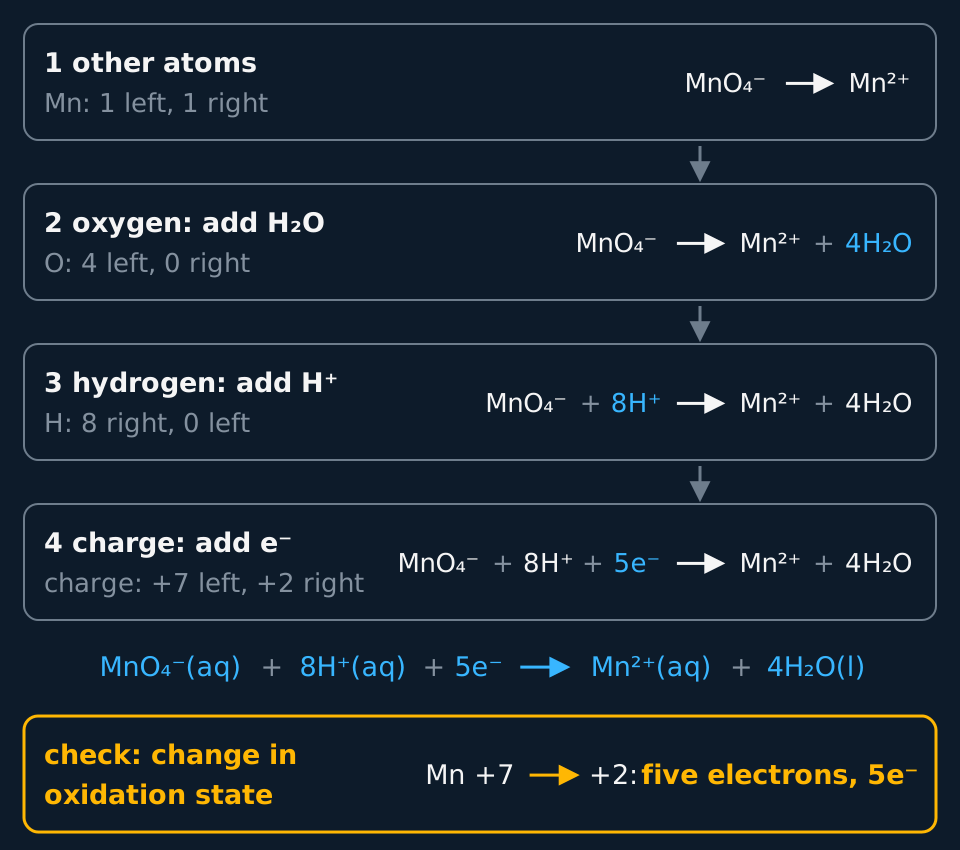
Manganate(VII) does not simply gain electrons and stay intact. The manganese starts in MnO₄⁻ bonded to four oxygens and finishes as Mn²⁺ bonded to none. The oxygen has to go somewhere, and in acid it ends up as water, with H⁺ ions supplying the hydrogen. Four steps, always in this order, deal with that.
Describe the drawing
A vertical flow of four boxes for the reduction of manganate(VII) to manganese(II) in acid. Box 1 balances atoms other than oxygen and hydrogen, and manganese already balances. Box 2 adds four H₂O to the right for the four oxygens. Box 3 adds eight H⁺ to the left. Box 4 notes a charge of +7 on the left and +2 on the right and adds five electrons to the left. The finished half-equation with state symbols follows, and an amber check box confirms manganese falls from +7 to +2, five electrons.
First, balance every atom other than oxygen and hydrogen. Second, balance oxygen by adding H₂O to the side short of oxygen. Third, balance hydrogen by adding H⁺ to the side short of hydrogen. Fourth, balance the charge by adding electrons to the more positive side. The electrons always go in last, because until the atoms are fixed there is no telling what the charge on each side is.
The manganate(VII) half-equation
Write the half-equation for the reduction of MnO₄⁻ to Mn²⁺ in acidic solution.
Show the working
Start from the two species: MnO₄⁻ → Mn²⁺. Step 1: there is one Mn on each side, so manganese is already balanced.
Step 2: the left has four O and the right has none, so add four H₂O to the right: MnO₄⁻ → Mn²⁺ + 4H₂O.
Step 3: the right now has eight H and the left none, so add eight H⁺ to the left: MnO₄⁻ + 8H⁺ → Mn²⁺ + 4H₂O.
Step 4: the charge on the left is −1 + 8 = +7 and on the right is +2. Five electrons on the left bring it down to +2. The half-equation is MnO₄⁻(aq) + 8H⁺(aq) + 5e⁻ → Mn²⁺(aq) + 4H₂O(l).
Check against oxidation states: manganese falls from +7 to +2, a gain of five electrons, which is the five in the equation. The electrons are on the left, so this is a reduction.
The oxidation-state check at the end is worth doing every time. The number of electrons in a half-equation equals the change in oxidation state multiplied by the number of atoms that change. Dichromate(VI) has two chromium atoms each falling from +6 to +3, so its half-equation must have six electrons.
Cr₂O₇²⁻(aq) + 14H⁺(aq) + 6e⁻ → 2Cr³⁺(aq) + 7H₂O(l)Orange dichromate(VI) to green chromium(III).
The same four steps work for an oxidation, where oxygen is gained rather than lost. Sulfur dioxide is oxidised to sulfate ions in acid. Sulfur balances already. The right has four O and the left two, so two H₂O go on the left. That puts four H on the left, so four H⁺ go on the right. The charge is 0 on the left and −2 + 4 = +2 on the right, so two electrons go on the right.
SO₂(aq) + 2H₂O(l) → SO₄²⁻(aq) + 4H⁺(aq) + 2e⁻Sulfur rises from +4 to +6: two electrons, on the right.
Water and H⁺ can end up on either side; the steps decide where. If a half-equation finishes with electrons on the right, it is an oxidation, whatever the species involved.
A harder case has hydrogen in the product as well as in the water. Nitrate ions in acid can be reduced right down to ammonium ions, and the same four steps, taken strictly in order, handle it.
A harder half-equation: nitrate(V) to ammonium
Write the half-equation for the reduction of NO₃⁻ to NH₄⁺ in acidic solution, and check it against the change in oxidation state.
Show the working
Step 1: one N on each side, so nitrogen balances: NO₃⁻ → NH₄⁺.
Step 2: three O on the left and none on the right, so add 3H₂O to the right: NO₃⁻ → NH₄⁺ + 3H₂O.
Step 3: the right now holds four H in the ammonium ion and six in the water, ten in all, so add 10H⁺ to the left: NO₃⁻ + 10H⁺ → NH₄⁺ + 3H₂O. Counting only the water's hydrogen here gives 6H⁺ and an equation that will not balance.
Step 4: the charge is −1 + 10 = +9 on the left and +1 on the right, so eight electrons go on the left: NO₃⁻(aq) + 10H⁺(aq) + 8e⁻ → NH₄⁺(aq) + 3H₂O(l).
Check: nitrogen falls from +5 in NO₃⁻ to −3 in NH₄⁺, a change of eight, which is the eight electrons, on the left for a reduction.
| Step | Balance | Add | MnO₄⁻ → Mn²⁺ | NO₃⁻ → NH₄⁺ |
|---|---|---|---|---|
| 1 | Atoms other than O and H | The species themselves | Mn already balanced | N already balanced |
| 2 | Oxygen | H₂O to the side short of O | 4H₂O on the right | 3H₂O on the right |
| 3 | Hydrogen | H⁺ to the side short of H | 8H⁺ on the left | 10H⁺ on the left |
| 4 | Charge | e⁻ to the more positive side | +7 against +2: 5e⁻ on the left | +9 against +1: 8e⁻ on the left |
| Check | Oxidation state | Nothing | Mn +7 to +2: five electrons | N +5 to −3: eight electrons |
Combining half-equations
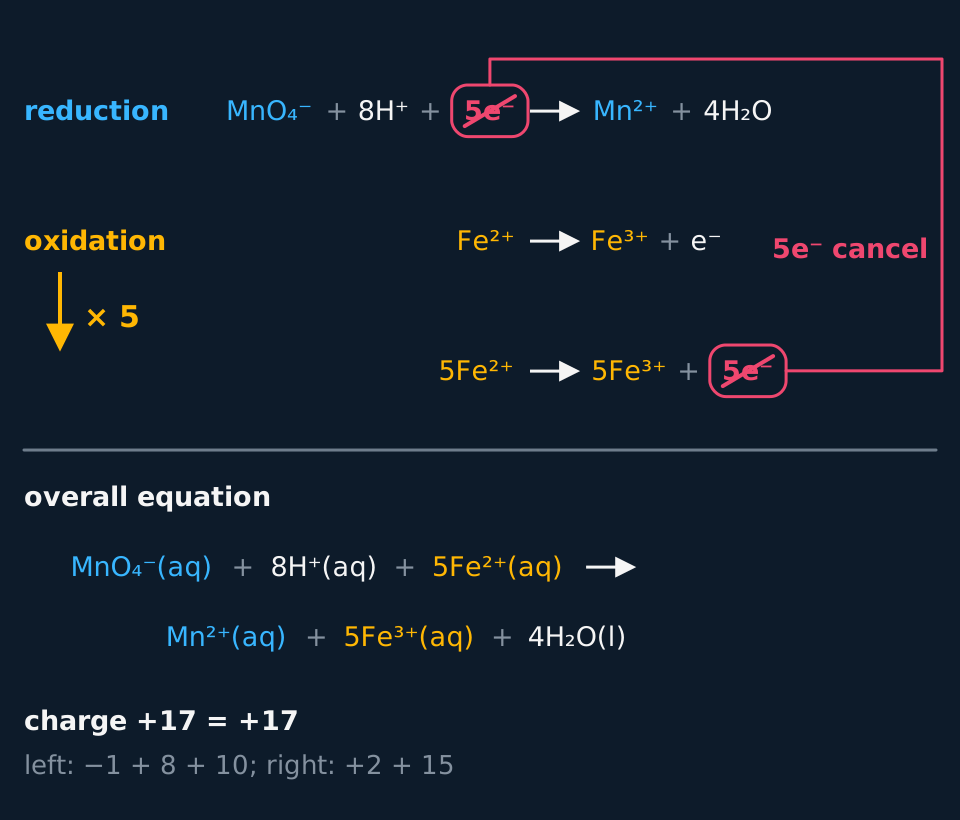
In a redox reaction, every electron released by the reducing agent is taken up by the oxidising agent. When the two half-equations are added, the electrons must cancel exactly. So before adding, multiply one or both half-equations until they show the same number of electrons.
Describe the drawing
Two half-equations stacked. The reduction, in cyan: MnO₄⁻ plus 8H⁺ plus 5e⁻ gives Mn²⁺ plus 4H₂O. The oxidation, in amber: Fe²⁺ gives Fe³⁺ plus e⁻, multiplied by five to give 5Fe²⁺ to 5Fe³⁺ plus 5e⁻. The 5e⁻ on the left of the first line and on the right of the third are circled, struck through and joined by a bracket labelled cancel. Under a rule, the overall equation MnO₄⁻ plus 8H⁺ plus 5Fe²⁺ gives Mn²⁺ plus 5Fe³⁺ plus 4H₂O, with a charge of +17 on each side.
Manganate(VII) and iron(II)
Write the overall equation for the reaction of acidified manganate(VII) ions with iron(II) ions.
Show the working
The two half-equations are MnO₄⁻ + 8H⁺ + 5e⁻ → Mn²⁺ + 4H₂O, and Fe²⁺ → Fe³⁺ + e⁻.
The manganate half takes five electrons and the iron half releases one, so multiply the iron half by five: 5Fe²⁺ → 5Fe³⁺ + 5e⁻.
Add the two and cancel the five electrons from each side: MnO₄⁻(aq) + 8H⁺(aq) + 5Fe²⁺(aq) → Mn²⁺(aq) + 5Fe³⁺(aq) + 4H₂O(l).
Check the charge: left is −1 + 8 + 10 = +17, right is +2 + 15 = +17. The 1 : 5 ratio of manganate to iron is the ratio used in every manganate titration of iron(II).
Dichromate(VI) and iodide
Acidified potassium dichromate(VI) oxidises iodide ions to iodine. Write the overall ionic equation, and state which species is oxidised.
Show the working
The reduction half is Cr₂O₇²⁻ + 14H⁺ + 6e⁻ → 2Cr³⁺ + 7H₂O. The oxidation half needs two iodide ions to make one I₂: 2I⁻ → I₂ + 2e⁻.
Six electrons against two: multiply the iodide half by three to give 6I⁻ → 3I₂ + 6e⁻.
Add and cancel: Cr₂O₇²⁻(aq) + 14H⁺(aq) + 6I⁻(aq) → 2Cr³⁺(aq) + 3I₂(aq) + 7H₂O(l). The charge is −2 + 14 − 6 = +6 on the left and 2 × 3 = +6 on the right.
Iodide ions are oxidised, from −1 to 0. Chromium is reduced, from +6 to +3. Potassium ions from the dichromate and sulfate ions from the acid take no part, so they are spectator ions and are left out.
Sometimes H⁺ or H₂O appears on both sides after adding. Cancel the smaller number from each side, as with any species, so that the final equation shows each one only once.
Half-equations are not the only route to a balanced equation. Changes in oxidation number give a quicker route when the half-equations are not asked for. The total rise in oxidation number must equal the total fall, because the electrons lost by one species are the electrons gained by the other.
Balancing from oxidation numbers: copper and concentrated nitric acid
Copper reacts with concentrated nitric acid to give Cu²⁺ ions, brown nitrogen dioxide, NO₂, and water. Balance the ionic equation using changes in oxidation number.
Show the working
Copper rises from 0 to +2, a rise of 2. Nitrogen falls from +5 in NO₃⁻ to +4 in NO₂, a fall of 1.
The rise and the fall must match, so one copper atom needs two nitrate ions: Cu + 2NO₃⁻ → Cu²⁺ + 2NO₂.
Balance oxygen and hydrogen as in a half-equation. The left has six O and the right four, so add 2H₂O to the right, and then 4H⁺ to the left.
Cu(s) + 4H⁺(aq) + 2NO₃⁻(aq) → Cu²⁺(aq) + 2NO₂(g) + 2H₂O(l). The charge is 4 − 2 = +2 on the left and +2 on the right. The one-to-two ratio belongs to NO₂ only: dilute acid gives a different nitrogen product, a different fall in oxidation number, and so a different ratio.
TRY IT: Copper and dilute nitric acid
Copper dissolves in dilute nitric acid to give Cu²⁺ ions and nitrogen monoxide, NO. Write the two half-equations and the overall ionic equation.
Check your answer
Oxidation: Cu(s) → Cu²⁺(aq) + 2e⁻. For the reduction, nitrogen goes from +5 in NO₃⁻ to +2 in NO, so three electrons. Balance O with 2H₂O on the right, then H with 4H⁺ on the left: NO₃⁻(aq) + 4H⁺(aq) + 3e⁻ → NO(g) + 2H₂O(l).
The lowest common multiple of 2 and 3 is 6. Multiply the copper half by three and the nitrate half by two, then add: 3Cu(s) + 8H⁺(aq) + 2NO₃⁻(aq) → 3Cu²⁺(aq) + 2NO(g) + 4H₂O(l).
Charge check: 8 − 2 = +6 on the left, 3 × 2 = +6 on the right.
Disproportionation
Chlorine is added to drinking water in Britain, leaving well under one part per million in the water that reaches the tap. It reacts with the water, and the reaction has an unusual feature: chlorine is both oxidised and reduced.
Cl₂(g) + H₂O(l) ⇌ HCl(aq) + HClO(aq)Chlorine at 0 goes to −1 in HCl and to +1 in HClO.
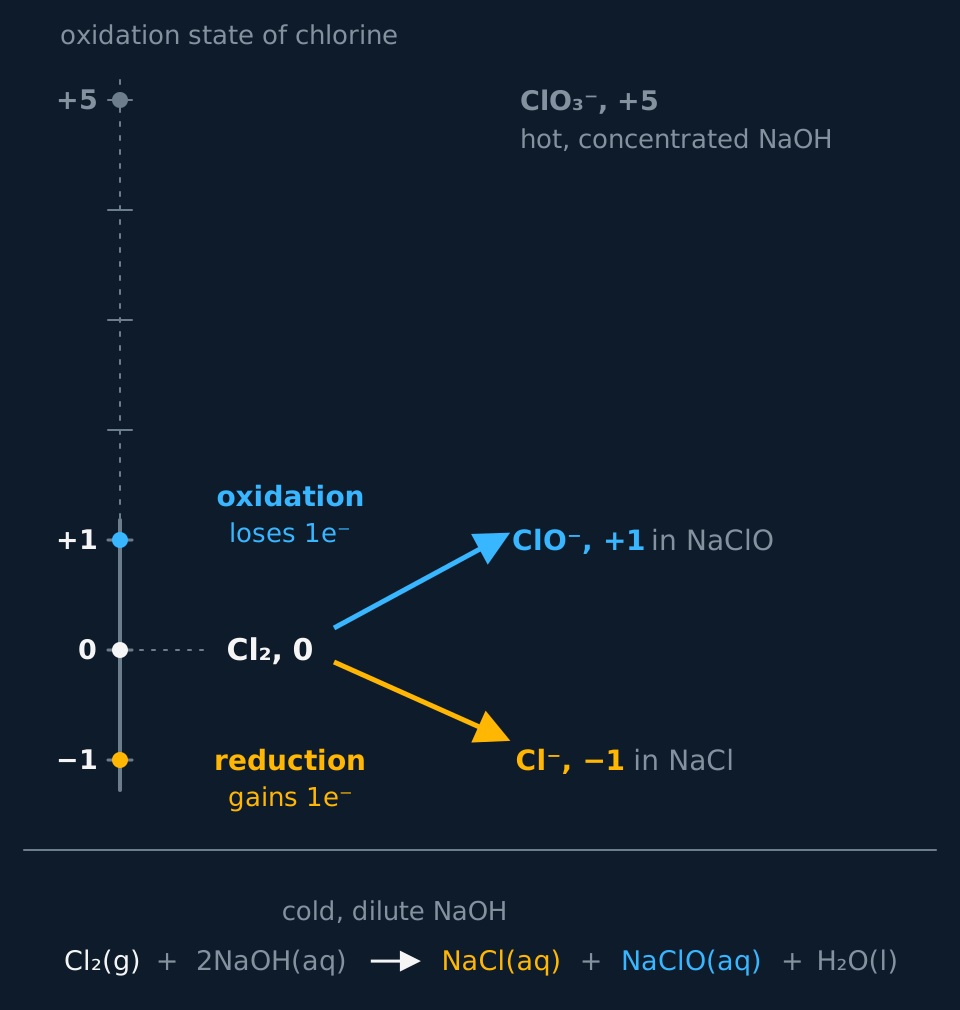
One chlorine atom of each Cl₂ molecule falls from 0 to −1 and is reduced; the other rises from 0 to +1 and is oxidised. A reaction in which one element in a single species is simultaneously oxidised and reduced is a disproportionation. Chloric(I) acid, HClO, is the species that kills bacteria. The reaction is reversible and only a small fraction of the chlorine reacts.
Chlorine is toxic, and it reacts with organic matter in water to form small amounts of chlorinated hydrocarbons, some of which are suspected carcinogens. Water companies use it anyway, at low concentration, because the alternative is untreated water carrying cholera and typhoid, and the risk from those is far greater. Ozone and ultraviolet light also disinfect, but they leave nothing behind to protect the water on its way through the pipes, so chlorine is still added at the end.
Describe the drawing
A vertical axis of chlorine's oxidation state from −1 to +1, with a faint extension up to +5. Cl₂ sits at 0. A cyan arrow rises to ClO⁻, in NaClO, at +1, labelled oxidation, loses one electron; an amber arrow falls to Cl⁻, in NaCl, at −1, labelled reduction, gains one electron. ClO₃⁻ is marked in grey at +5 for hot concentrated sodium hydroxide. Below, the equation for cold dilute sodium hydroxide, Cl₂ plus 2NaOH gives NaCl plus NaClO plus H₂O, coloured to match.
With cold, dilute sodium hydroxide the same split happens, and the hydroxide removes the acids as they form, so the reaction goes to completion. The product is a solution of sodium chloride and sodium chlorate(I), which is household bleach.
Cl₂(g) + 2NaOH(aq) → NaCl(aq) + NaClO(aq) + H₂O(l)Chlorine at 0 goes to −1 in NaCl and to +1 in NaClO.
Disproportionation is not confined to chlorine. Hydrogen peroxide decomposing to water and oxygen is one, with oxygen going from −1 to −2 and to 0. Copper(I) ions in aqueous solution are another: 2Cu⁺(aq) → Cu(s) + Cu²⁺(aq), which is why copper(I) sulfate cannot be kept as a solution.
- Disproportionation
- A redox reaction in which the same element in one species is simultaneously oxidised and reduced.
- Chloric(I) acid
- HClO, the weak acid formed when chlorine reacts with water, in which chlorine has an oxidation state of +1.
- Chlorate(I) ion
- The ClO⁻ ion, in which chlorine has an oxidation state of +1; its sodium salt is the active ingredient of bleach.
- Overall redox equation
- The equation formed by adding an oxidation half-equation and a reduction half-equation with equal numbers of electrons, so that the electrons cancel.
Other boards: half-equations in alkali, and hot alkali
OCR, among its chromium interconversions, and Edexcel, in 15.22, both set the oxidation of chromium(III) to chromate(VI) by hydrogen peroxide in alkaline solution, and that needs a half-equation balanced in alkali. In alkali there is almost no H⁺, so a half-equation with H⁺ in it does not describe what happens. Balance it as if in acid, then add one OH⁻ to both sides for every H⁺, and combine each H⁺ with an OH⁻ on the same side to make H₂O.
Chromium(III) to chromate(VI) in alkali
Write the half-equation for the oxidation of [Cr(OH)₆]³⁻ to chromate(VI), CrO₄²⁻, in alkaline solution.
Show the working
Steps 1 to 3, as in acid: chromium balances; the left has six O and the right four, so add 2H₂O to the right; the left then has six H and the right four, so add 2H⁺ to the right.
Step 4: the charge is −3 on the left and −2 + 2 = 0 on the right, so three electrons go on the right: [Cr(OH)₆]³⁻ → CrO₄²⁻ + 2H₂O + 2H⁺ + 3e⁻. Chromium rises from +3 to +6, which is the three electrons.
Add 2OH⁻ to both sides. On the right, 2H⁺ and 2OH⁻ make 2H₂O: [Cr(OH)₆]³⁻(aq) + 2OH⁻(aq) → CrO₄²⁻(aq) + 4H₂O(l) + 3e⁻.
Check: the charge is −5 on each side, and there are eight O and eight H on each side. Combined with H₂O₂ + 2e⁻ → 2OH⁻, the overall equation is 2[Cr(OH)₆]³⁻(aq) + 3H₂O₂(aq) → 2CrO₄²⁻(aq) + 2OH⁻(aq) + 8H₂O(l), and the dark green solution turns yellow.
Edexcel and Cambridge also set the reaction of chlorine with hot, concentrated sodium hydroxide; AQA and OCR ask only for the cold, dilute one. In hot, concentrated alkali the chlorate(I) itself disproportionates further, and the products are chloride and chlorate(V): 3Cl₂(g) + 6NaOH(aq) → 5NaCl(aq) + NaClO₃(aq) + 3H₂O(l). The five-to-one ratio of chloride to chlorate(V) comes from the electrons: one chlorine atom rising from 0 to +5 releases five, and five chlorine atoms falling from 0 to −1 take one each.
| Cold, dilute NaOH | Hot, concentrated NaOH | |
|---|---|---|
| Chlorine-containing products | NaCl and NaClO | NaCl and NaClO₃ |
| Oxidation states of chlorine | 0 → −1 and +1 | 0 → −1 and +5 |
| Ratio of chloride to the oxidised product | 1 : 1 | 5 : 1 |
| Use of the product | Bleach and disinfectant | Sodium chlorate(V), an oxidising agent once sold as weedkiller |
| Boards that set it | All four | Edexcel and Cambridge |
- Chlorate(V) ion
- The ClO₃⁻ ion, in which chlorine has an oxidation state of +5; formed with chloride when chlorine reacts with hot, concentrated alkali.
In the exam
- A half-equation is balanced only when atoms and charge both balance. The scheme awards the electron mark for the right number of electrons on the right side, so add them last, after the atoms are fixed.
- Leave electrons out of an overall equation. Electrons left after adding mean the multipliers were wrong, and the scheme does not award the equation mark.
- Name what is oxidised and what is reduced as species, with the oxidation states before and after: 'iodide ions are oxidised from −1 to 0'. 'Iodine is oxidised' names the product and is not credited.
- For disproportionation, give the starting oxidation state and both final ones, and say which change is oxidation and which is reduction; 'chlorine is oxidised and reduced' alone earns only part of the credit.
- Put state symbols on every species in an overall equation and none on e⁻, which are not free in solution.
Check yourself
Hydrogen peroxide decolourises acidified potassium manganate(VII), and a gas that relights a glowing splint is given off. Write the two half-equations and the overall equation, and explain why hydrogen peroxide acts here as a reducing agent when it is more often described as an oxidising agent.
Answer
The gas is oxygen, so hydrogen peroxide is oxidised: oxygen goes from −1 to 0. Balanced with H⁺ and charge, H₂O₂(aq) → O₂(g) + 2H⁺(aq) + 2e⁻. The reduction is MnO₄⁻(aq) + 8H⁺(aq) + 5e⁻ → Mn²⁺(aq) + 4H₂O(l).
Five electrons against two, so multiply the manganate half by two and the peroxide half by five. Ten electrons cancel, and 10H⁺ produced cancels against 16H⁺ used, leaving 6H⁺: 2MnO₄⁻(aq) + 6H⁺(aq) + 5H₂O₂(aq) → 2Mn²⁺(aq) + 5O₂(g) + 8H₂O(l). Both sides carry a charge of +4.
Oxygen at −1 in a peroxide sits between −2 and 0, so it can be reduced or oxidised. Which happens depends on what it meets. Manganate(VII) is a powerful enough oxidising agent to take electrons from the peroxide, which is oxidised to oxygen. With a reducing agent such as iodide ions the roles reverse: the peroxide takes the electrons and is reduced to water.
Questions
Question 16 marks
Explain, using half-equations and oxidation states, how the overall equation is built for the oxidation of ethanol, CH₃CH₂OH, to ethanal, CH₃CHO, by acidified potassium dichromate(VI), and state what is seen.
Mark scheme
Indicative content
- the dichromate(VI) half-equation is Cr₂O₇²⁻ + 14H⁺ + 6e⁻ → 2Cr³⁺ + 7H₂O, with each chromium falling from +6 to +3
- the ethanol half-equation is CH₃CH₂OH → CH₃CHO + 2H⁺ + 2e⁻, balanced for hydrogen with H⁺ and for charge with electrons
- the mean oxidation state of carbon rises from −2 in ethanol to −1 in ethanal, two carbons giving two electrons in all, so ethanol is oxidised
- the ethanol half-equation is multiplied by three so that both halves carry six electrons, which then cancel when the two are added
- after cancelling 6H⁺ from each side the overall equation is Cr₂O₇²⁻ + 8H⁺ + 3CH₃CH₂OH → 2Cr³⁺ + 3CH₃CHO + 7H₂O, with a charge of +6 on each side
- the solution turns from orange, the colour of Cr₂O₇²⁻, to green, the colour of Cr³⁺, as the dichromate(VI) is reduced; reject 'yellow to green'
Levels
- Level 3 (5–6 marks) both half-equations are correct with the oxidation state changes, the electrons are balanced by multiplying the ethanol half-equation by three, the overall equation is given with the H⁺ cancelled and the charge balanced, and the colour change from orange to green is stated
- Level 2 (3–4 marks) both half-equations are correct and the overall equation is attempted; the electrons are left unbalanced, H⁺ is not cancelled, or the oxidation states or colour change are absent
- Level 1 (1–2 marks) one half-equation is right or the colour change is stated, often the wrong way round as green to orange, with no overall equation
Question 24 marks
Give the half-equations for the oxidation of iodide ions to iodine and for the reduction of hydrogen peroxide to water in acid, and combine them into an overall ionic equation.
Mark scheme
- B1 2I⁻(aq) → I₂(aq) + 2e⁻
- B1 H₂O₂(aq) + 2H⁺(aq) + 2e⁻ → 2H₂O(l)
- B1 both halves carry two electrons, so they are added as they stand and the electrons cancel
- B1 H₂O₂(aq) + 2H⁺(aq) + 2I⁻(aq) → I₂(aq) + 2H₂O(l); ignore state symbols
Question 34 marks
Explain why the reaction of chlorine with cold, dilute sodium hydroxide is described as disproportionation. Include an equation.
Mark scheme
- B1 Cl₂(g) + 2NaOH(aq) → NaCl(aq) + NaClO(aq) + H₂O(l)
- B1 chlorine falls from 0 in Cl₂ to −1 in NaCl, which is reduction
- B1 chlorine rises from 0 in Cl₂ to +1 in NaClO, which is oxidation
- B1 the same element in the same species, Cl₂, is both oxidised and reduced, which is disproportionation
All 20 questions with mark schemes, the other 17 set out in full on the question page.
Worth remembering
- Add the electrons last, once the atoms balance and the charge on each side is known.
- Count every H on a side at step 3, the H in NH₄⁺ as well as the water's.
- Electrons left over in an overall equation mean the multipliers were wrong, and the equation mark is not awarded.
- 'Iodine is oxidised' names the product; the species oxidised is the iodide ion, −1 to 0.
- 'Chlorine is oxidised and reduced' alone earns only part of the credit; give 0 to −1 and 0 to +1 and say which is which.
CHECK YOUR PROGRESS
Rate how confident you are with each objective for this lesson. Ratings are saved in this browser, on this device, unless you sign in.
- Write a half-equation for a simple oxidation or reduction, with the electrons on the correct side.
- Construct a half-equation in acidic solution by balancing atoms, then oxygen with H₂O, hydrogen with H⁺ and charge with electrons.
- Combine two half-equations into an overall redox equation by matching the numbers of electrons, and balance an equation directly from changes in oxidation number.
- Write a half-equation in alkaline solution by balancing as in acid and then adding OH⁻ to both sides.
- Identify the species oxidised and the species reduced in an overall equation, and recognise spectator ions.
- Explain disproportionation using the reactions of chlorine with water and with cold dilute sodium hydroxide.
Open the full revision checklist to see every objective in the curriculum in one place.
Practise this lesson
WORKBOOK
The questions from this topic, on paper with room to work, and a separate book of mark schemes. Free to use; please do not redistribute or sell.
Used later in Electrode potentials and the standard hydrogen electrode · Group 7: trends down the group and displacement reactions · Oxidation and elimination of alcohols