Chemistry › Rate equations › Rate equations, orders of reaction and the rate constant
Rate equations, orders of reaction and the rate constant
A rate equation says how the rate of a reaction depends on the concentration of each substance, and it can only be found by experiment. The powers in it are the orders, and the constant in front, k, has units that change with the overall order. The shapes of the rate–concentration and concentration–time graphs follow from the order, and so does the effect of any change in concentration.
Key terms Every definition in rate equations, lesson by lesson
Before this Collision theory, activation energy and the rate of reaction – rate as change in concentration per unit time, read from a gradient · Measuring the rate of a reaction – following a reaction by a property that changes as it goes
COMMON MISCONCEPTION
The orders in the rate equation are the numbers in front of each substance in the balanced equation.
Orders are found by experiment and cannot be read from the equation. Hydrogen reacts 1 : 1 with iodine and with bromine, yet the first rate is first order in each and the second is half order in bromine. The orders describe the slow step of the mechanism, which the balanced equation does not show.
What you should be able to do
- Write a rate equation from given orders, and identify the order with respect to each reactant and the overall order.
- Explain why the orders in a rate equation cannot be read from the balanced equation.
- Calculate a rate constant from a rate and the concentrations, and deduce its units for any overall order from zero to three.
- Sketch the rate–concentration and concentration–time graphs for a reactant that is zero, first or second order, and identify the order from the shape of each.
- Calculate the new rate when the concentrations of the reactants are changed by given factors.
Rate, measured and written down
The rate of a reaction depends on the concentrations of the substances in it, and only an experiment can say how. The acid-catalysed reaction of propanone with iodine shows this. As the iodine is used up, its pale brown colour fades over about ten minutes. With twice the concentration of propanone the colour goes in half the time, and the same is true with twice the concentration of acid. With twice the concentration of iodine the mixture starts a darker brown and takes twice as long to lose its colour: the iodine is removed at the same rate as before, and there is twice as much of it to remove.
CH₃COCH₃(aq) + I₂(aq) → CH₃COCH₂I(aq) + H⁺(aq) + I⁻(aq)Catalysed by H⁺(aq). The rate depends on the concentrations of propanone and of acid, and not on the concentration of iodine.
Iodine is a reactant and appears in the equation, yet its concentration has no effect on the rate. The acid is not used up at all, since it is a catalyst, yet its concentration does. A balanced equation could not have predicted either fact.
The rate of reaction is the change in the concentration of a reactant or a product per unit time. Concentration is in mol dm⁻³ and time is in seconds, so a rate is in mol dm⁻³ s⁻¹. For a reactant the concentration falls, but the rate is quoted as a positive number.
Which substance the rate is quoted for matters when the coefficients differ. In 2N₂O₅(g) → 4NO₂(g) + O₂(g), every 2 mol of N₂O₅ that decompose make 4 mol of NO₂ and 1 mol of O₂. If [N₂O₅] falls at 1.0 × 10⁻⁵ mol dm⁻³ s⁻¹, then [NO₂] rises at 2.0 × 10⁻⁵ and [O₂] at 5.0 × 10⁻⁶ mol dm⁻³ s⁻¹. The three numbers describe one reaction, so a rate given for one substance is converted to another by the mole ratio. That is the only job the coefficients do here: they fix the ratio between these rates, and they do not fix the orders.
How the rate depends on each concentration is summed up in a rate equation. For a reaction between A and B it takes this form:
rate = k[A]ᵐ[B]ⁿSquare brackets mean concentration in mol dm⁻³. The powers m and n are the orders; k is the rate constant.
The power m is the order of reaction with respect to A, and n the order with respect to B. The overall order is m + n. At A level the order with respect to any one substance is 0, 1 or 2. For the propanone reaction the rate equation is rate = k[CH₃COCH₃][H⁺]: first order with respect to propanone, first order with respect to H⁺, zero order with respect to iodine, and second order overall. A zero-order substance is left out, because any concentration raised to the power 0 is 1. Use the phrase 'order with respect to' in an answer, with the reactant named: 'the order is 1' does not say what it belongs to.
- Rate of reaction
- The change in the concentration of a reactant or a product per unit time, measured in mol dm⁻³ s⁻¹.
- Rate equation
- An expression, found by experiment, of the form rate = k[A]ᵐ[B]ⁿ, showing how the rate depends on the concentration of each substance.
- Order with respect to a reactant
- The power to which the concentration of that reactant is raised in the rate equation.
- Overall order
- The sum of the powers of all the concentration terms in the rate equation.
- Zero order
- A reactant is zero order when changing its concentration has no effect on the rate; it does not appear in the rate equation.
- Rate constant, k
- The constant of proportionality in the rate equation; it is fixed at a given temperature and increases as the temperature rises.
The rate constant is constant only while the temperature is. Change a concentration and the rate changes, but k does not. Raise the temperature and k itself becomes larger, by an amount the Arrhenius equation gives. A catalyst also changes k, because it provides a different route with a lower activation energy.
Orders come from experiment
A balanced equation records how many moles of each substance react overall. It says nothing about how the reaction happens. Most reactions go in a sequence of steps, and the rate is controlled by the slowest of them. The rate equation therefore reflects the slow step and the steps before it, and those are rarely the same as the overall equation.
NO₂(g) + CO(g) → NO(g) + CO₂(g)Below about 500 K, rate = k[NO₂]². Second order in NO₂ and zero order in CO, although each has a coefficient of 1.
2N₂O₅(g) → 4NO₂(g) + O₂(g)rate = k[N₂O₅]. First order, although the coefficient is 2.
Three things can happen. A reactant in the equation can be missing from the rate equation, as carbon monoxide and iodine are. The order can differ from the coefficient, as it does for N₂O₅ and for hydrogen. And a substance that is not in the overall equation at all can appear, as the H⁺ catalyst does.
| Reaction | Rate equation | Orders match the coefficients |
|---|---|---|
| NO₂ + CO | rate = k[NO₂]² | No: CO is absent, NO₂ is second order |
| 2N₂O₅ → 4NO₂ + O₂ | rate = k[N₂O₅] | No: first order, coefficient 2 |
| 2NO + 2H₂ → N₂ + 2H₂O | rate = k[NO]²[H₂] | Only for NO; H₂ is first order, coefficient 2 |
| 2NO + O₂ → 2NO₂ | rate = k[NO]²[O₂] | Yes, but only by coincidence |
| Propanone + iodine, H⁺ catalyst | rate = k[CH₃COCH₃][H⁺] | No: iodine is absent and H⁺ is not in the equation |
The reaction of nitrogen monoxide with oxygen needs care. Its two reactants happen to give orders equal to their coefficients, and nothing in the equation could have said so in advance. The order of each reactant is a measured quantity, found by changing its concentration and seeing what the rate does, from initial rates or from one run followed to the end.
Zero, first and second order
Each order gives its own pair of graphs, and an exam question can start from either one.
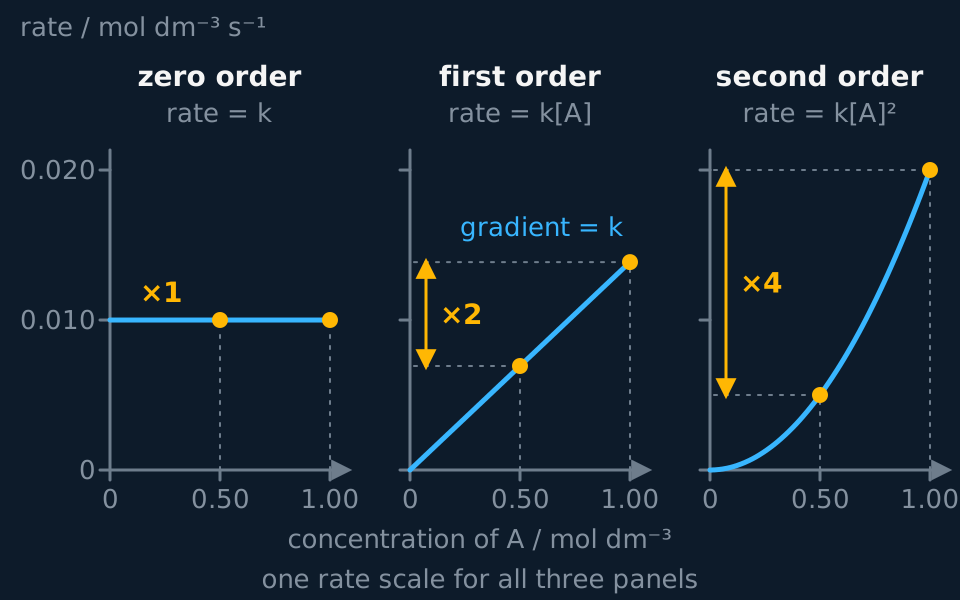
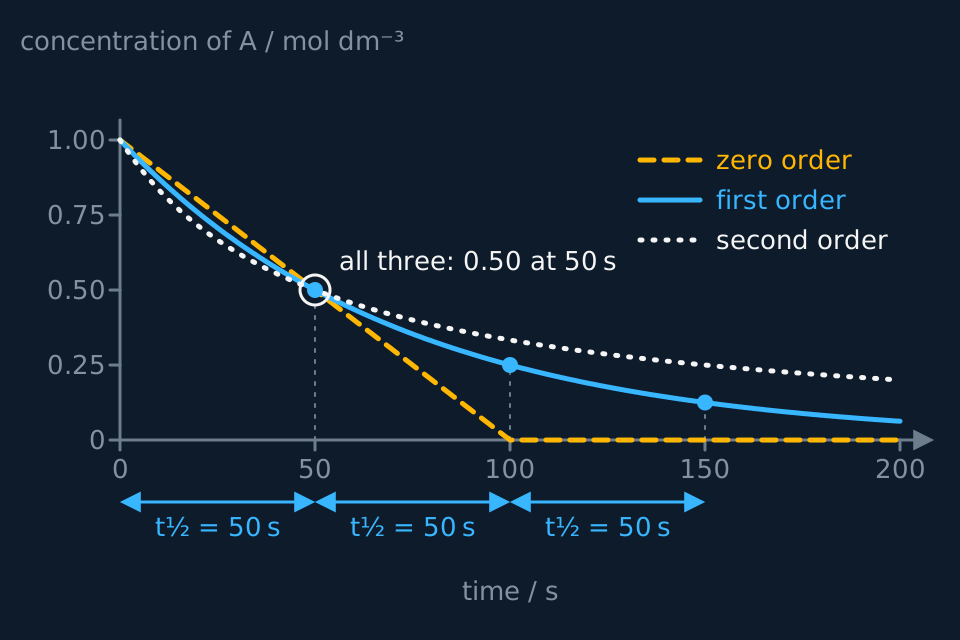
If a reactant is zero order, its concentration does not affect the rate. Doubling it leaves the rate unchanged, so a graph of rate against concentration is a horizontal line. During a run the rate stays the same as the reactant is used up, so its concentration falls in a straight line with a gradient of −k until it runs out. Ammonia decomposing on a hot tungsten wire behaves this way at high pressure: the surface is fully covered, and adding more gas cannot make it decompose any faster.
If a reactant is first order, the rate is directly proportional to its concentration. Doubling it doubles the rate, and the rate–concentration graph is a straight line through the origin with a gradient equal to k. During a run the rate falls in step with the concentration, so the concentration–time curve falls steeply at first and then more gently. It takes the same time to halve whatever the starting concentration: the half-life is constant.
If a reactant is second order, the rate is proportional to the square of its concentration. Doubling it multiplies the rate by 4 and tripling it by 9. The rate–concentration graph curves upwards from the origin, and a plot of rate against [A]² is a straight line. Set beside a first-order reaction with the same first half-life, its concentration–time curve drops faster at the start and levels off more slowly later, because the rate falls away with the square of what is left. Each half-life is twice as long as the one before.
Describe the drawing
Three small graphs of initial rate against the concentration of A, on one shared rate scale. Zero order is a horizontal line at 0.010, so the rate is the same at 0.50 and 1.00 mol per cubic decimetre, marked times one. First order is a straight line through the origin whose gradient is k, so doubling the concentration doubles the rate, marked times two. Second order is a parabola through the origin rising from 0.0050 to 0.020, marked times four.
Describe the drawing
Concentration of A against time for three reactions that all start at 1.00 and all reach 0.50 mol per cubic decimetre at 50 seconds, where the curves cross. The amber dashed zero-order line falls straight to zero at 100 seconds. The cyan first-order curve halves every 50 seconds, with three equal half-life brackets marked under the time axis. The white dotted second-order curve falls most slowly after 50 seconds and is still at 0.20 at 200 seconds.
| Order | Doubling [A] multiplies the rate by | Rate against [A] | [A] against time |
|---|---|---|---|
| 0 | 1 (no change) | Horizontal line | Straight line falling to zero |
| 1 | 2 | Straight line through the origin | Curve with a constant half-life |
| 2 | 4 | Curve rising more and more steeply from the origin | Curve with each half-life twice the last |
The two kinds of graph are read differently. From a rate–concentration graph the order is read off the shape directly. From a concentration–time graph it is read from the gradient: a constant gradient means zero order, and a falling gradient means first or second order, which the half-lives then separate.
- First order
- A reactant is first order when the rate is directly proportional to its concentration: doubling the concentration doubles the rate.
- Second order
- A reactant is second order when the rate is proportional to the square of its concentration: doubling the concentration multiplies the rate by four.
- Half-life, t½
- The time taken for the concentration of a reactant to fall to half of its starting value.
The same graphs give k. Where A is the only substance in the rate equation, a first-order rate–concentration graph has the form y = mx, so its gradient is k. A second-order curve has no single gradient, so rate is plotted against [A]² instead, and the gradient of that straight line is k. For zero order the rate–concentration line is horizontal at a height equal to k, and the concentration–time line falls with a gradient of −k.
Second order and k from a plot of rate against [A]²
For a reaction with A alone in the rate equation: [A] = 0.25, rate 1.25 × 10⁻³; [A] = 0.50, rate 5.0 × 10⁻³; [A] = 0.75, rate 1.13 × 10⁻²; [A] = 1.00, rate 2.0 × 10⁻², with [A] in mol dm⁻³ and rate in mol dm⁻³ s⁻¹. Deduce the order and find k.
Show the working
From 0.50 to 1.00, [A] doubles and the rate rises by 2.0 × 10⁻² ÷ 5.0 × 10⁻³ = 4. Since 2² = 4, the reaction is second order in A.
Square each concentration: 0.0625, 0.25, 0.5625 and 1.00. Rate ÷ [A]² is 0.020 every time, so the graph of rate against [A]² is a straight line through the origin.
Its gradient is k = 2.0 × 10⁻² ÷ 1.00 = 0.020. Units: (mol dm⁻³ s⁻¹) ÷ (mol dm⁻³)² = mol⁻¹ dm³ s⁻¹.
k = 0.020 mol⁻¹ dm³ s⁻¹, to two significant figures.
The units of k
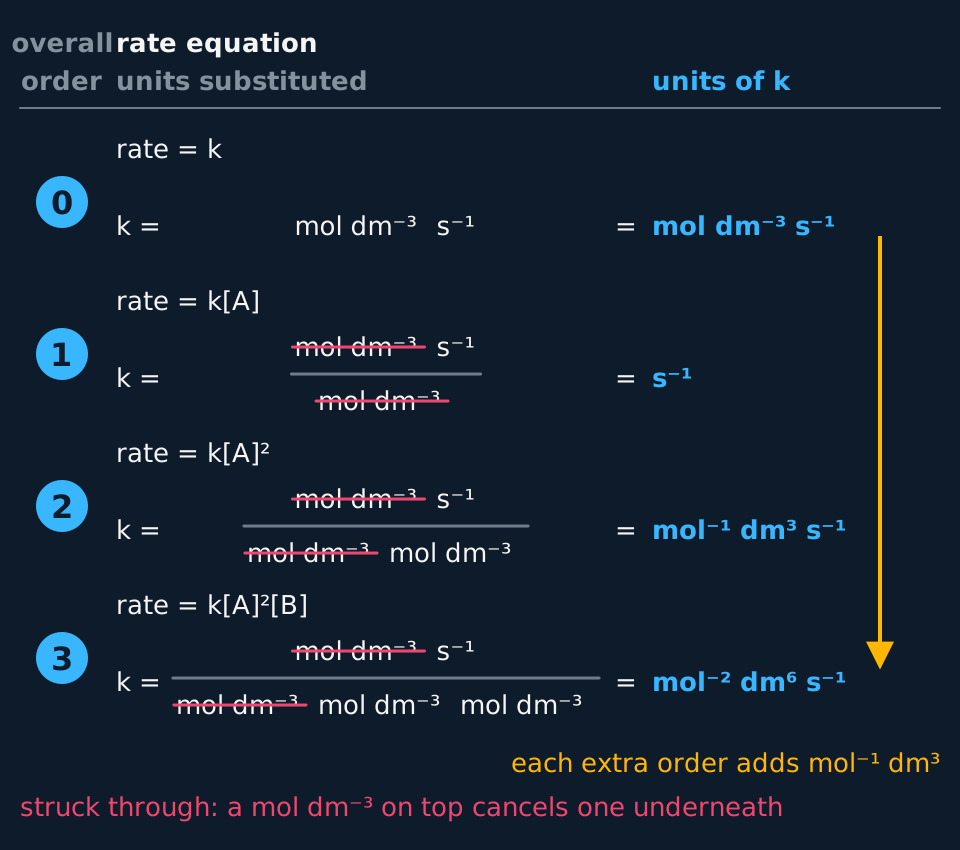
The units of k depend on the overall order, so they are worked out each time from the rate equation and never learnt as a list. Rearrange the rate equation to make k the subject, write in the units of every quantity, and cancel.
The units of k for a reaction that is second order overall
Ethyl ethanoate is hydrolysed by hydroxide ions: CH₃COOC₂H₅(aq) + OH⁻(aq) → CH₃COO⁻(aq) + C₂H₅OH(aq). The rate equation is rate = k[CH₃COOC₂H₅][OH⁻]. With 0.020 mol dm⁻³ of ester and 0.050 mol dm⁻³ of hydroxide, the initial rate is 1.1 × 10⁻⁴ mol dm⁻³ s⁻¹. Calculate k and give its units.
Show the working
Rearrange: k = rate ÷ ([CH₃COOC₂H₅][OH⁻]).
Substitute the numbers: k = 1.1 × 10⁻⁴ ÷ (0.020 × 0.050) = 1.1 × 10⁻⁴ ÷ 1.0 × 10⁻³ = 0.11.
Substitute the units: (mol dm⁻³ s⁻¹) ÷ (mol dm⁻³ × mol dm⁻³). One mol dm⁻³ cancels from top and bottom, leaving s⁻¹ ÷ mol dm⁻³, which is mol⁻¹ dm³ s⁻¹.
k = 0.11 mol⁻¹ dm³ s⁻¹, to two significant figures, matching the rate and the concentrations.
Describe the drawing
A four-row ladder for overall orders 0, 1, 2 and 3. Each row gives the rate equation, then k equals the units of rate, mol per cubic decimetre per second, divided by one mol per cubic decimetre for each order, with the cancelling pair struck through in coral. The units of k on the right are mol dm⁻³ s⁻¹, then s⁻¹, then mol⁻¹ dm³ s⁻¹, then mol⁻² dm⁶ s⁻¹, and an amber arrow down the right shows each extra order adding mol⁻¹ dm³.
The pattern is a check, not a shortcut. For zero order k has the units of a rate, mol dm⁻³ s⁻¹. For first order it is s⁻¹. For second order it is mol⁻¹ dm³ s⁻¹, and for third order mol⁻² dm⁶ s⁻¹. A rate constant whose units do not fit the rate equation beside it has been worked out wrongly.
The order in which the units are written does not matter: mol⁻¹ dm³ s⁻¹ and dm³ mol⁻¹ s⁻¹ are the same units. What matters is the power on each one, and a minus sign dropped from mol⁻¹ turns a second-order k into nonsense.
Changing the concentrations
At a fixed temperature k does not change, so the effect of changing the concentrations can be found without knowing k at all. Raise the factor for each substance to the power of its order, and multiply the results together.
The rate constant, then the rate with two concentrations changed
Nitrogen monoxide reacts with hydrogen at 1100 K: 2NO(g) + 2H₂(g) → N₂(g) + 2H₂O(g), with rate = k[NO]²[H₂]. When [NO] = 6.0 × 10⁻³ mol dm⁻³ and [H₂] = 2.0 × 10⁻³ mol dm⁻³, the rate is 2.9 × 10⁻⁵ mol dm⁻³ s⁻¹. Calculate k with its units. Then calculate the rate when [NO] is tripled and [H₂] is halved.
Show the working
Rearrange: k = rate ÷ ([NO]²[H₂]).
Substitute: [NO]² = (6.0 × 10⁻³)² = 3.6 × 10⁻⁵, and 3.6 × 10⁻⁵ × 2.0 × 10⁻³ = 7.2 × 10⁻⁸. So k = 2.9 × 10⁻⁵ ÷ 7.2 × 10⁻⁸ = 403.
Units: (mol dm⁻³ s⁻¹) ÷ (mol dm⁻³)³. Two lots of mol dm⁻³ are left underneath, so the units are mol⁻² dm⁶ s⁻¹, as they must be for third order overall. k = 4.0 × 10² mol⁻² dm⁶ s⁻¹ to two significant figures.
New rate: NO is second order, so tripling it multiplies the rate by 3² = 9. H₂ is first order, so halving it multiplies the rate by 0.5. Together, 9 × 0.5 = 4.5.
New rate = 4.5 × 2.9 × 10⁻⁵ = 1.3 × 10⁻⁴ mol dm⁻³ s⁻¹ to two significant figures. The answer comes from the factors alone; k would give the same result the long way.
Some changes move every concentration at once. Halving the volume of a gas mixture doubles the concentration of every gas in it, so for rate = k[NO]²[O₂] the rate rises by 2² × 2 = 8. Diluting a solution with an equal volume of water halves every concentration, so a reaction that is second order overall runs at a quarter of its rate, and one that is first order overall at a half.
TRY IT: Units and a factor from one rate equation
A reaction has rate = k[A][B]². Give the units of k. Then give the factor by which the rate changes when [A] is halved and [B] is doubled at the same temperature.
Check your answer
The overall order is 1 + 2 = 3. k = rate ÷ ([A][B]²), so its units are (mol dm⁻³ s⁻¹) ÷ (mol dm⁻³)³ = mol⁻² dm⁶ s⁻¹.
Halving [A], first order, multiplies the rate by 0.5. Doubling [B], second order, multiplies it by 2² = 4.
Together 0.5 × 4 = 2: the rate doubles, although one concentration went down.
Other boards: k from a gradient and from a half-life
OCR names the gradient of a first-order rate–concentration graph as a way of finding the rate constant, and its papers usually print the units of k as dm³ mol⁻¹ s⁻¹, with the dm³ first. The quantity is the same; only the order of writing differs.
OCR and Cambridge also find k for a first-order reaction from its half-life, using k = ln 2 ÷ t½ = 0.693 ÷ t½. The first-order reaction in the figures has a half-life of 50 s, so k = 0.693 ÷ 50 = 0.0139 s⁻¹, the gradient of its rate–concentration line. The relation holds only for first order, because only then is the half-life the same whatever the starting concentration.
In the exam
- Orders come from the data or the rate equation. Where a question asks why they cannot be read from the balanced equation, the scheme wants two ideas: the rate equation is found by experiment, and it reflects the slow step of the mechanism.
- The units of k carry their own mark, separate from the value. The scheme accepts them in any order, so mol⁻¹ dm³ s⁻¹ and dm³ mol⁻¹ s⁻¹ both score, but a wrong power on any unit does not.
- When concentrations change, raise each factor to the power of its order and multiply. Halving a gas volume or adding an equal volume of water changes every concentration at once.
- On a sketch, a zero-order concentration–time graph is a straight line, a first-order one a curve with equal half-lives, and a second-order rate–concentration graph a curve rising from the origin. A second-order line drawn straight is not credited.
- k changes with temperature and with a catalyst, not with concentration; an answer that says a higher concentration raises k earns no credit for that point.
Check yourself
A reaction 2X + Y → Z has the rate equation rate = k[X][Y]². A student says that because X has the larger coefficient, doubling [X] must have the bigger effect on the rate. Evaluate the claim, and give the factor by which the rate changes when [X] is doubled and when [Y] is doubled.
Answer
The claim is wrong, because it takes the orders from the balanced equation. The coefficients say how many moles react overall; the orders are measured, and here they are given in the rate equation.
X is first order, so doubling [X] doubles the rate. Y is second order, so doubling [Y] multiplies the rate by 2² = 4.
Y, with the smaller coefficient, has the bigger effect. The mismatch suggests the slow step of the mechanism involves two particles of Y and one of X, and that the second X reacts in a faster step later.
Questions
Question 16 marks
Describe the rate–concentration graph and the concentration–time graph for a reactant that is zero order, first order and second order, and explain the shape of each concentration–time graph.
Mark scheme
Indicative content
- zero order: rate against concentration is a horizontal line, because the rate does not depend on the concentration
- zero order: concentration against time is a straight line with a constant negative gradient, because the reactant is used at a steady rate
- first order: rate against concentration is a straight line through the origin with a gradient of k
- first order: concentration against time is a curve with a constant half-life, because the rate falls in proportion to the concentration
- second order: rate against concentration is a curve rising ever more steeply from the origin, rate proportional to concentration squared
- second order: concentration against time is a curve whose half-lives double in turn, because the rate falls with the square of the concentration
Levels
- Level 3 (5–6 marks) all six graphs are described correctly and the shape of each concentration–time graph is explained from how the rate changes with concentration, including the constant half-life of first order and the lengthening half-lives of second order
- Level 2 (3–4 marks) the three rate–concentration graphs are right and two concentration–time graphs are explained; the third is not, or half-lives are never used
- Level 1 (1–2 marks) one or two graphs are described, often with the first-order concentration–time graph drawn as a straight line falling to zero
Question 24 marks
State what is meant by the order of reaction with respect to a reactant and by the overall order of a reaction, and give the units of the rate constant for reactions that are first order and second order overall.
Mark scheme
- B1 the order with respect to a reactant is the power to which its concentration is raised in the rate equation
- B1 the overall order is the sum of the powers of all the concentration terms in the rate equation
- B1 first order overall: s⁻¹, since (mol dm⁻³ s⁻¹) ÷ (mol dm⁻³) leaves s⁻¹
- B1 second order overall: mol⁻¹ dm³ s⁻¹; accept the units in any order, such as dm³ mol⁻¹ s⁻¹
Question 34 marks
Deduce the order with respect to A, the rate equation and the value of k, with its units, from the initial rates in the table. A is the only reactant.
| [A] / mol dm⁻³ | Initial rate / mol dm⁻³ s⁻¹ |
|---|---|
| 0.10 | 2.5 × 10⁻⁴ |
| 0.20 | 2.5 × 10⁻⁴ |
| 0.40 | 2.5 × 10⁻⁴ |
Mark scheme
- B1 the rate is the same whatever [A], so the reaction is zero order with respect to A
- B1 rate = k, or rate = k[A]⁰
- M1 k equals the rate, since [A]⁰ = 1
- A1 k = 2.5 × 10⁻⁴ mol dm⁻³ s⁻¹, the units of a rate
All 22 questions with mark schemes, the other 19 set out in full on the question page.
Worth remembering
- An order written without its reactant, or a rate equation without k, is incomplete: rate = k[A]ᵐ[B]ⁿ, every term named.
- A coefficient of 2 in the equation says nothing about the order; only the rate equation does.
- Each concentration factor is raised to the power of its own order, then the factors are multiplied, never added.
- Units of k worked out for the wrong overall order are wrong even when the value is right: s⁻¹ for first, mol⁻¹ dm³ s⁻¹ for second.
- Raising a concentration raises the rate and leaves k alone; only temperature or a catalyst changes k.
CHECK YOUR PROGRESS
Rate how confident you are with each objective for this lesson. Ratings are saved in this browser, on this device, unless you sign in.
- Write a rate equation from given orders, and identify the order with respect to each reactant and the overall order.
- Explain why the orders in a rate equation cannot be read from the balanced equation.
- Calculate a rate constant from a rate and the concentrations, and deduce its units for any overall order from zero to three.
- Sketch the rate–concentration and concentration–time graphs for a reactant that is zero, first or second order, and identify the order from the shape of each.
- Calculate the new rate when the concentrations of the reactants are changed by given factors.
Open the full revision checklist to see every objective in the curriculum in one place.
Practise this lesson
WORKBOOK
The written questions from this topic, on paper with room to work, and a separate book of mark schemes. The 4 questions that are set on a diagram stay on this page, where the diagram can be drawn. Free to use; please do not redistribute or sell.
Used later in The Arrhenius equation and the rate-determining step