Chemistry › Rate equations › The Arrhenius equation and the rate-determining step
The Arrhenius equation and the rate-determining step
The rate constant rises steeply with temperature, and the Arrhenius equation says by how much. A graph of ln k against 1/T is a straight line whose gradient gives the activation energy. The rate equation also says which particles meet in the slowest step of a mechanism, which is how the SN1 and SN2 hydrolysis of halogenoalkanes are told apart.
Key terms Every definition in rate equations, lesson by lesson
Before this The Maxwell–Boltzmann distribution, temperature and catalysts – the fraction of collisions with energy above Ea · Rate equations, orders of reaction and the rate constant – k is fixed at a given temperature · Halogenoalkanes: nucleophilic substitution and rates of hydrolysis – the mechanism with hydroxide ions
COMMON MISCONCEPTION
The slowest step must be the last step, because the reaction cannot finish until it has happened.
The slow step can be any step in the mechanism. The rate equation shows which: the species in it, with their orders, are the ones in the slow step and any step before it. A reactant that appears only after the slow step has no effect on the rate and is absent from the rate equation, however many moles of it react.
What you should be able to do
- Explain how the Arrhenius equation accounts for the effect of temperature and of activation energy on the rate constant.
- Calculate the activation energy from the gradient of a graph of ln k against 1/T, and the pre-exponential factor from a point on the line.
- Calculate the activation energy from rate constants at two temperatures.
- Deduce the rate equation from a mechanism with a given slow step, and propose a mechanism consistent with a given rate equation.
- Explain the different rate equations for the hydrolysis of primary and tertiary halogenoalkanes in terms of the SN2 and SN1 mechanisms.
Temperature and the rate constant
The rate constant is constant only at one temperature. Milk that sours in an afternoon on a warm kitchen table lasts a week in a fridge at 4 °C, and nothing about the concentrations has changed: the reactions of the bacteria are slower in the cold. In a rate equation the concentrations are the same at both temperatures, so what has changed is k.
The Arrhenius equation gives the dependence:
k = Ae^(−Ea/RT)Ea in J mol⁻¹, R = 8.31 J K⁻¹ mol⁻¹, T in kelvin. A has the same units as k.
The exponential part, e^(−Ea/RT), is the fraction of collisions with at least the activation energy, the area beyond Ea on a Maxwell–Boltzmann distribution. It is always less than 1 and usually very much less: for Ea = 50 kJ mol⁻¹ at 298 K it is about 2 × 10⁻⁹. The pre-exponential factor, A, accounts for how often particles collide and how many collisions have the right orientation.
Two things follow from the equation. Raising T makes −Ea/RT less negative, so the exponential and k both rise. And a larger Ea gives a smaller k at any temperature and also makes k more sensitive to temperature. Warming from 298 K to 308 K multiplies k by 1.9 when Ea is 50 kJ mol⁻¹, and by 3.7 when Ea is 100 kJ mol⁻¹. The old rule that a rise of 10 °C doubles the rate holds only for activation energies near 50 kJ mol⁻¹.
- Activation energy, Ea
- The minimum energy that colliding particles must have for a reaction to take place.
- Arrhenius equation
- k = Ae^(−Ea/RT), relating the rate constant to the activation energy and the absolute temperature.
- Pre-exponential factor, A
- The constant in the Arrhenius equation, with the same units as k, related to the frequency of collisions with the correct orientation.
The ln k against 1/T graph
Taking natural logarithms of both sides turns the exponential into a straight line:
ln k = ln A − Ea/RTCompare with y = mx + c: y is ln k, x is 1/T, the gradient m is −Ea/R and the intercept c is ln A.
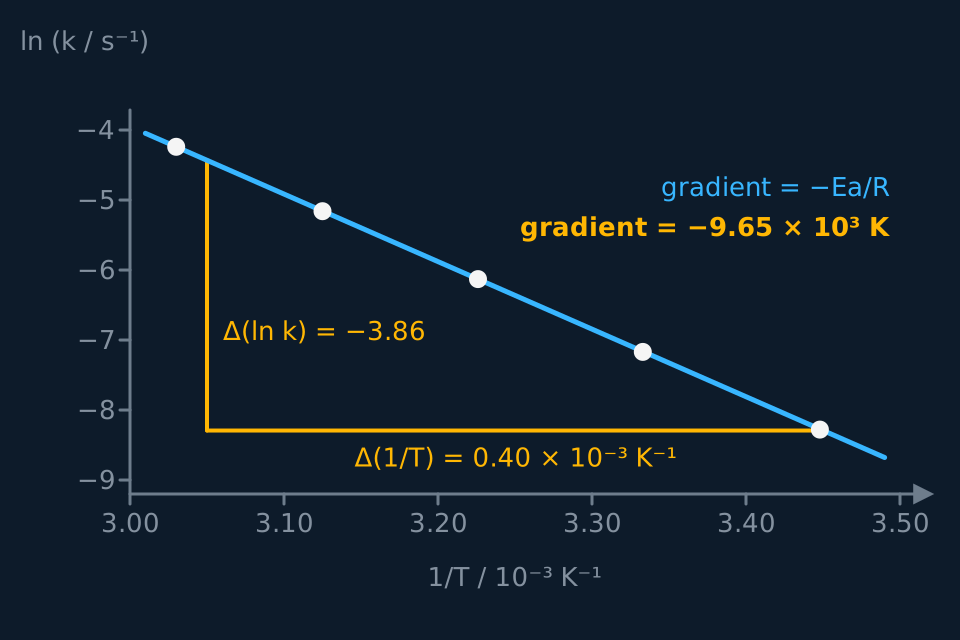
So k is measured at five or six temperatures, ln k is plotted against 1/T, and the gradient of the best-fit line is −Ea/R. Where the concentrations are the same in every run, rate is proportional to k, so ln(rate) or ln(1/t) from a clock reaction gives a line with the same gradient. Only the intercept changes.
Describe the drawing
Five points of ln k against one over T, from 3.03 to 3.45 thousandths of a reciprocal kelvin, lying on a straight cyan line that falls from left to right. A large amber gradient triangle under the line spans 1/T from 3.05 to 3.45, with a fall in ln k of 3.86 over a run of 0.40, giving a gradient of minus 9.65 thousand kelvin, which equals minus Ea over R.
Ea and A from the gradient of the graph
For a first-order reaction, the graph of ln k against 1/T has a gradient of −9.65 × 10³ K. The line passes through 1/T = 3.226 × 10⁻³ K⁻¹, ln k = −6.13. Calculate the activation energy, and the pre-exponential factor A.
Show the working
Gradient = −Ea/R, so Ea = −gradient × R = 9.65 × 10³ K × 8.31 J K⁻¹ mol⁻¹ = 8.02 × 10⁴ J mol⁻¹.
Divide by 1000 to give Ea = +80.2 kJ mol⁻¹, to three significant figures as the gradient was given. The kelvin in the gradient cancels the K⁻¹ in R, leaving J mol⁻¹.
The intercept is at 1/T = 0, far off the drawn axes, so ln A is found from a point on the line: ln A = ln k + Ea/RT = −6.13 + (9.65 × 10³ × 3.226 × 10⁻³) = −6.13 + 31.13 = 25.0.
A = e^25.0 = 7.2 × 10¹⁰ s⁻¹. The reaction is first order, so A has the units of a first-order k.
When only two rate constants are known, the same equation is written out twice, once for each temperature, and one is subtracted from the other. ln A cancels, leaving ln(k₂/k₁) = (Ea/R)(1/T₁ − 1/T₂).
Ea from two rate constants, then a prediction
A first-order reaction has k = 1.4 × 10⁻⁴ s⁻¹ at 300 K and k = 5.6 × 10⁻⁴ s⁻¹ at 320 K. Calculate the activation energy, then the rate constant at 340 K.
Show the working
ln(k₂/k₁) = ln(5.6 × 10⁻⁴ ÷ 1.4 × 10⁻⁴) = ln 4.0 = 1.386.
1/T₁ − 1/T₂ = 1/300 − 1/320 = 3.333 × 10⁻³ − 3.125 × 10⁻³ = 2.083 × 10⁻⁴ K⁻¹.
Ea = R × 1.386 ÷ 2.083 × 10⁻⁴ = 8.31 × 1.386 ÷ 2.083 × 10⁻⁴ = 5.53 × 10⁴ J mol⁻¹, so Ea = 55 kJ mol⁻¹ to two significant figures, the precision of the rate constants.
At 340 K, using the unrounded Ea: Ea/R = 6654 K, and 1/300 − 1/340 = 3.922 × 10⁻⁴ K⁻¹. ln(k₃/k₁) = 6654 × 3.922 × 10⁻⁴ = 2.610, so k₃/k₁ = e^2.610 = 13.6.
k₃ = 13.6 × 1.4 × 10⁻⁴ = 1.9 × 10⁻³ s⁻¹. A rise of 40 K has made the reaction about fourteen times faster.
Every temperature in these calculations is in kelvin. Left in degrees Celsius, 25 °C gives 1/T = 0.040 against the correct 1/298 = 3.36 × 10⁻³ K⁻¹, the points no longer lie on a straight line, and 0 °C would give no value at all. The equation is written for absolute temperature because the fraction of collisions above Ea depends on the energy of the particles, which is proportional to T in kelvin.
A catalyst lowers Ea, and the equation shows what that is worth. If A is unchanged, cutting Ea from 80 to 60 kJ mol⁻¹ at 298 K multiplies k by e^(20 000 ÷ (8.31 × 298)) = e^8.08, about 3200. On an Arrhenius plot the catalysed reaction gives a line with a shallower gradient, −7.22 × 10³ K in place of −9.63 × 10³ K, lying above the uncatalysed line at every temperature. An enzyme that lowers Ea by 40 kJ mol⁻¹ speeds a reaction at room temperature by a factor of about 10⁷.
The rate-determining step
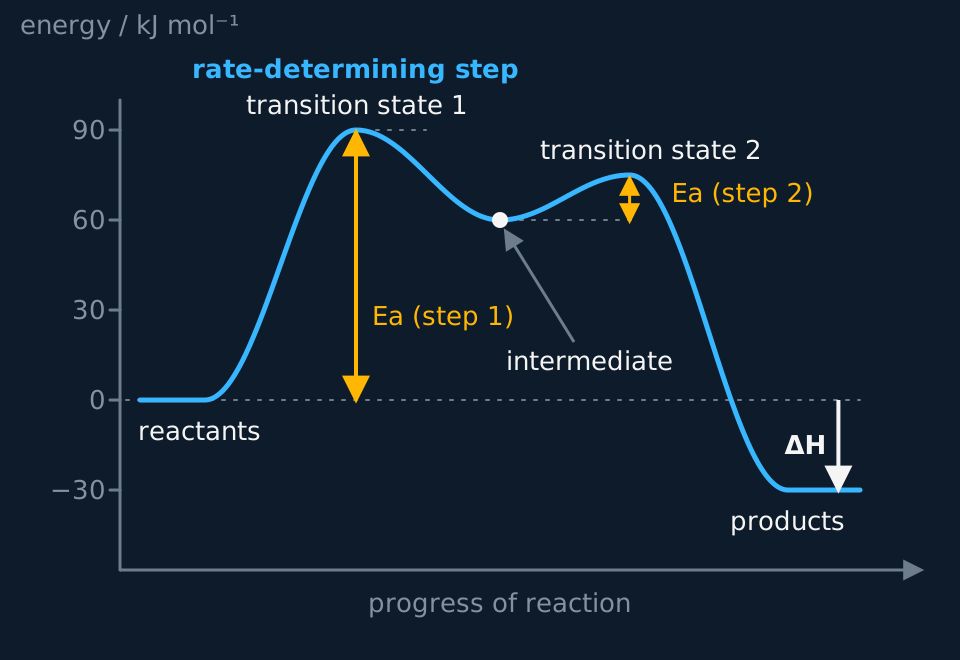
Most reactions go in several steps, and the sequence of steps is the mechanism. The slowest step, the one with the highest activation energy, limits the rate of the whole reaction, as a slow hot-food counter limits a canteen queue however many tills are open. It is the rate-determining step. Define it as the slowest step: 'the first step' is wrong as often as it is right.
Describe the drawing
An energy profile with two humps. Reactants at 0 kilojoules per mole climb a tall first hump to transition state 1 at plus 90, labelled the rate-determining step, drop into a trough at plus 60 where the intermediate sits, climb a small second hump to transition state 2 at plus 75, and fall to products at minus 30. Amber arrows mark Ea for step 1, 90, and Ea for step 2, 15 from the trough, and a white arrow marks Delta H.
The rate equation shows which particles take part in the rate-determining step. A substance that appears only in fast steps after it is zero order, because however fast it reacts, it has to wait for the slow step. A substance that reacts in or before the slow step appears in the rate equation, and its order is the number of its particles involved up to and including that step.
That last phrase matters when the slow step uses an intermediate, a species made in one step and used up in a later one. An intermediate never appears in the rate equation. The reactants that formed it in the earlier fast step appear instead.
- Reaction mechanism
- The sequence of steps by which a reaction takes place, which add up to the overall equation.
- Rate-determining step
- The slowest step in a reaction mechanism, which limits the overall rate of the reaction.
- Intermediate
- A species formed in one step of a mechanism and used up in a later step, so it does not appear in the overall equation.
- Transition state
- The arrangement of highest energy along a single step, in which bonds are partly broken and partly formed; it cannot be isolated.
The rate equation from a two-step mechanism
Nitrogen dioxide reacts with fluorine: 2NO₂(g) + F₂(g) → 2NO₂F(g). The proposed mechanism is step 1, NO₂ + F₂ → NO₂F + F (slow); step 2, NO₂ + F → NO₂F (fast). Show that the steps give the overall equation, and deduce the rate equation. Then deduce the rate equation for 2NO(g) + Br₂(g) → 2NOBr(g), whose mechanism is step 1, NO + Br₂ → NOBr₂ (fast); step 2, NOBr₂ + NO → 2NOBr (slow).
Show the working
Add the steps: 2NO₂ + F₂ + F → 2NO₂F + F. The F atom is made in step 1 and used in step 2, so it cancels, leaving the overall equation. F is an intermediate.
Step 1 is slow and involves one NO₂ and one F₂. The second NO₂ reacts only in the fast step after it, so it adds nothing to the order: rate = k[NO₂][F₂], first order in each although the overall equation has 2NO₂.
For the second reaction the slow step is step 2, NOBr₂ + NO. NOBr₂ is an intermediate, so it cannot appear; it was made in step 1 from one NO and one Br₂, and those take its place.
Counting particles up to and including the slow step gives two NO and one Br₂: rate = k[NO]²[Br₂], third order overall.
The same reasoning runs backwards. The iodination of propanone is first order in propanone and in H⁺, and zero order in iodine. So one propanone molecule and one hydrogen ion react in or before the slow step, which makes an intermediate, and iodine reacts with that intermediate in a fast step later. A proposed mechanism must meet two tests: its steps add up to the overall equation, and its slow step contains exactly the particles the rate equation calls for.
The accepted mechanism for the iodination passes both tests, and it shows the difference between an intermediate and a catalyst in one place.
CH₃COCH₃(aq) + H⁺(aq) ⇌ (CH₃)₂C=OH⁺(aq)Step 1, fast. A lone pair on the oxygen accepts a hydrogen ion.
(CH₃)₂C=OH⁺(aq) → CH₃C(OH)=CH₂(aq) + H⁺(aq)Step 2, slow. A hydrogen ion is lost from a carbon atom, giving the enol.
CH₃C(OH)=CH₂(aq) + I₂(aq) → CH₃COCH₂I(aq) + H⁺(aq) + I⁻(aq)Step 3, fast. The C=C bond of the enol reacts with iodine.
The slow step uses the protonated propanone, an intermediate, which was made from one propanone molecule and one hydrogen ion; those two take its place, giving rate = k[CH₃COCH₃][H⁺]. Iodine reacts only in step 3, after the slow step, so it is zero order. Adding the three steps and cancelling gives the overall equation.
Two kinds of species cancel in that addition, and the order in which they appear tells them apart. An intermediate is made first and used later: the protonated propanone and the enol. A catalyst is used first and given back later: the H⁺ taken in step 1 is released in step 2, so it is present at the start and at the end. A catalyst can appear in the rate equation, as H⁺ does here; an intermediate never can.
- Catalyst
- A substance that increases the rate of a reaction by providing an alternative route of lower activation energy; it is used in one step of a mechanism and regenerated in a later one, so it is chemically unchanged at the end.
TRY IT: Proposing a mechanism from a rate equation
Below about 500 K, NO₂(g) + CO(g) → NO(g) + CO₂(g) has rate = k[NO₂]². Propose a two-step mechanism consistent with this, and identify the intermediate.
Check your answer
The rate equation has two NO₂ and no CO, so the slow step is a collision between two NO₂ molecules: NO₂ + NO₂ → NO₃ + NO (slow).
CO must react in a fast second step, and the steps must add to the overall equation: NO₃ + CO → NO₂ + CO₂ (fast).
Adding gives NO₂ + CO → NO + CO₂ once the NO₂ made in step 2 is cancelled against one used in step 1. NO₃ is the intermediate.
SN1 and SN2 hydrolysis
Two bromobutanes react with aqueous hydroxide ions to give alcohols, and their overall equations have the same form. Their rate equations do not. For 1-bromobutane, a primary halogenoalkane, rate = k[CH₃CH₂CH₂CH₂Br][OH⁻]. For 2-bromo-2-methylpropane, a tertiary one, rate = k[(CH₃)₃CBr], with hydroxide zero order. The orders say that the two react by different mechanisms.
Describe the drawing
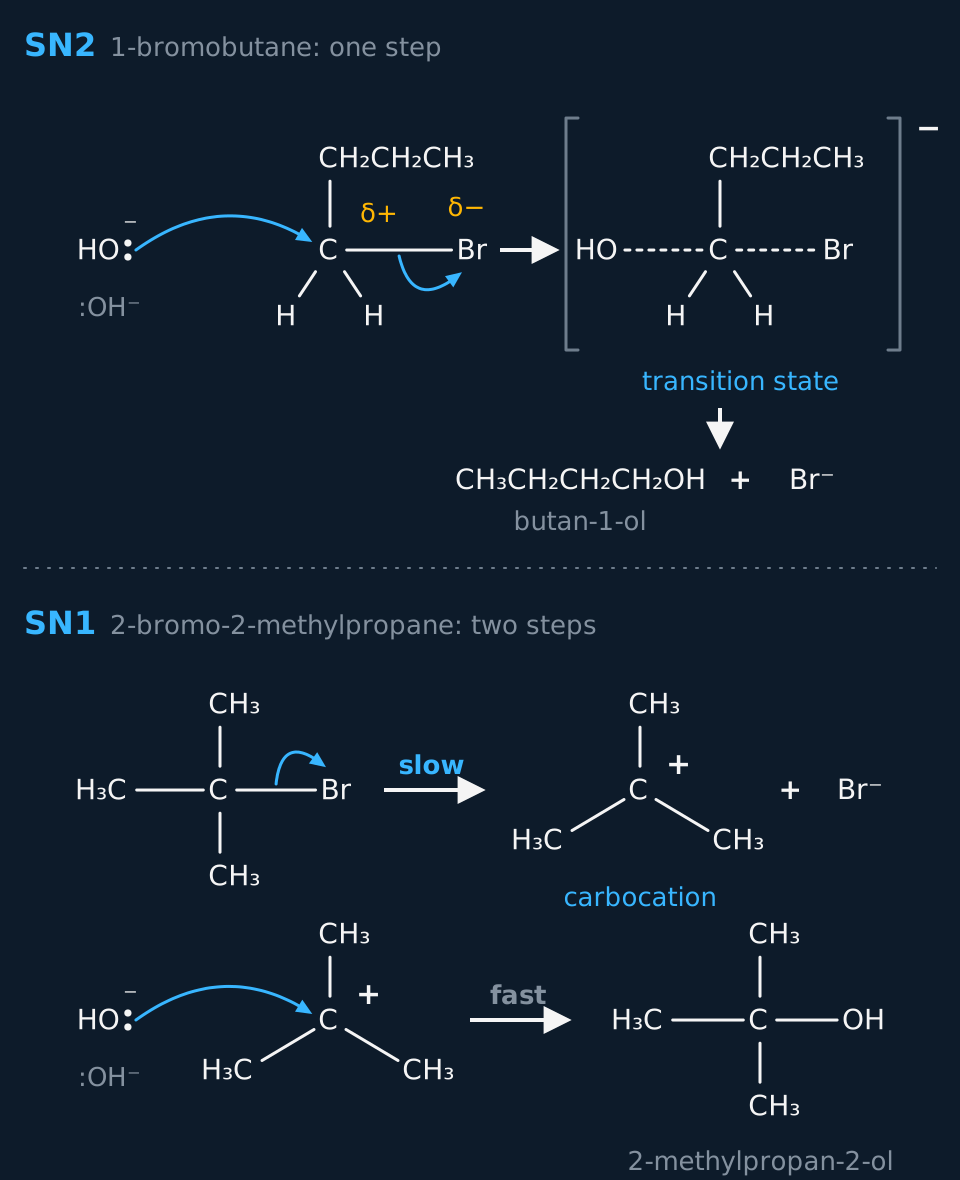
Two mechanisms. Top, SN2: a lone pair on the oxygen of a hydroxide ion sends a curly arrow to the delta-plus carbon of 1-bromobutane from the side opposite the bromine, while a second arrow moves the C–Br bonding pair onto the delta-minus bromine. A bracketed, negatively charged transition state shows HO and Br both partly bonded to the carbon, and it gives butan-1-ol and bromide. Bottom, SN1: in a slow first step the C–Br bond of 2-bromo-2-methylpropane breaks to give a planar tertiary carbocation and bromide; in a fast second step a hydroxide lone pair attacks the positive carbon to give 2-methylpropan-2-ol.
The primary halogenoalkane reacts in one step. The hydroxide ion's lone pair attacks the δ+ carbon from the side opposite the bromine, and the C–Br bond breaks as the C–O bond forms. Both particles are in this single, rate-determining step, so the reaction is first order in each. This is SN2: substitution, nucleophilic, with two particles in the rate-determining step.
The tertiary halogenoalkane reacts in two. First the C–Br bond breaks heterolytically, both electrons going to bromine, to leave a tertiary carbocation. This step is slow. The hydroxide ion then bonds to the carbocation in a fast second step. Only the halogenoalkane is in the slow step, so only it appears in the rate equation. This is SN1, with one particle in the rate-determining step.
(CH₃)₃CBr(aq) → (CH₃)₃C⁺(aq) + Br⁻(aq)Step 1, slow.
(CH₃)₃C⁺(aq) + OH⁻(aq) → (CH₃)₃COH(aq)Step 2, fast.
Why the tertiary compound takes the two-step route: its three methyl groups push electron density towards the positive carbon, which stabilises the carbocation and lowers the barrier to forming it. The same three groups crowd the carbon atom and block the hydroxide ion's approach from the far side. A primary carbocation has no such stabilisation, and a primary carbon is open to attack, so SN2 is the lower-energy route.
Describe the drawing
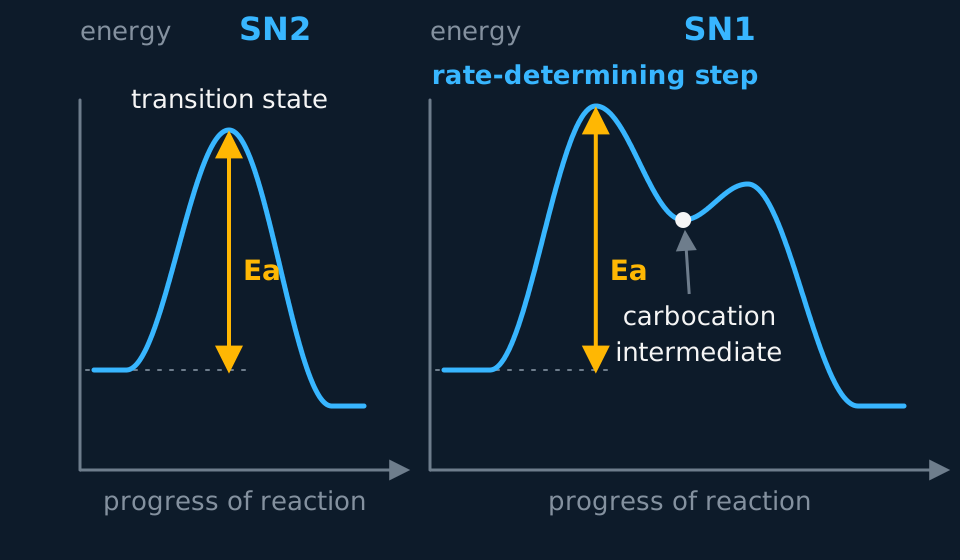
Two energy profiles side by side, each from a halogenoalkane and hydroxide to an alcohol and bromide a little lower in energy. The SN2 profile has a single hump with the transition state at its top and Ea marked under it. The SN1 profile has a high first hump, labelled the rate-determining step with its Ea marked, then a trough well above the reactants where the carbocation intermediate sits, then a much lower second hump down to the products.
| SN2 | SN1 | |
|---|---|---|
| Typical halogenoalkane | Primary | Tertiary |
| Number of steps | One | Two |
| Rate equation | rate = k[RX][OH⁻] | rate = k[RX] |
| Overall order | Second | First |
| Intermediate | None; a transition state only | A carbocation |
| What decides the route | Unhindered carbon, unstable carbocation | Stable carbocation, crowded carbon |
- SN2
- Nucleophilic substitution in one step, in which the nucleophile and the halogenoalkane are both in the rate-determining step, so the reaction is second order.
- SN1
- Nucleophilic substitution in two steps, in which the carbon–halogen bond breaks heterolytically in the slow first step to give a carbocation, so only the halogenoalkane is in the rate equation.
A secondary halogenoalkane such as 2-bromobutane sits between the two. Its carbocation is less stable than a tertiary one, and its carbon is more crowded than a primary one, so both routes run at once. The rate is the sum of an SN1 part, k₁[RX], and an SN2 part, k₂[RX][OH⁻], and fits neither simple rate equation.
Other boards: core practical 14, the activation energy by experiment
Edexcel sets the measurement of Ea as core practical 14, whose method follows. Edexcel and Cambridge name the two halogenoalkane mechanisms SN1 and SN2 and expect both to be drawn; AQA and OCR can give the two rate equations as data to interpret, but do not require the names. Edexcel's specification names the iodination of propanone as its mechanism deduced from a rate equation, and Cambridge asks for an intermediate or a catalyst to be identified in a given mechanism.
The usual reaction for core practical 14 is sodium thiosulfate with hydrochloric acid, which makes a fine precipitate of sulfur. The time t for the precipitate to hide a cross drawn under the flask is the time to make a fixed amount of sulfur, so 1/t is proportional to the rate. With the same starting concentrations in every run, the rate is proportional to k, and ln(1/t) against 1/T gives a line whose gradient is −Ea/R. An iodine clock, timed at several temperatures, serves equally well.
Na₂S₂O₃(aq) + 2HCl(aq) → 2NaCl(aq) + SO₂(g) + S(s) + H₂O(l)The sulfur clouds the mixture and hides the cross.
| Step | What to do | Why |
|---|---|---|
| 1 | Measure 10.0 cm³ of 0.10 mol dm⁻³ sodium thiosulfate and 40.0 cm³ of water into a conical flask, and 5.0 cm³ of 1.0 mol dm⁻³ hydrochloric acid into a boiling tube | The same amounts in every run, so that only the temperature changes |
| 2 | Stand both in a water bath at about 20 °C until each reads the bath temperature | The mixture starts at the temperature of the run |
| 3 | Put the flask on a cross drawn on paper, add the acid, swirl, and start the stopclock | Time zero is the moment of mixing |
| 4 | Stop the clock when the cross can no longer be seen from above, and read the temperature of the mixture | The same amount of sulfur hides the cross each time; the mean of the starting and final temperatures is the one recorded |
| 5 | Repeat at about 30, 40, 50 and 60 °C, and repeat each temperature | Five temperatures fix the line, and repeats show the scatter |
These results are idealised; real ones scatter a little about the line.
| T / °C | T / K | t / s | 1/T / 10⁻³ K⁻¹ | ln(1/t) |
|---|---|---|---|---|
| 20 | 293 | 200 | 3.413 | −5.30 |
| 30 | 303 | 99 | 3.300 | −4.60 |
| 40 | 313 | 51 | 3.195 | −3.93 |
| 50 | 323 | 28 | 3.096 | −3.33 |
| 60 | 333 | 15 | 3.003 | −2.71 |
Ea from the thiosulfate results
Use the results to find the activation energy of the reaction between sodium thiosulfate and hydrochloric acid.
Show the working
Plot ln(1/t) against 1/T and draw the best-fit straight line. It falls from left to right, because 1/T is largest at the lowest temperature.
Read two points far apart on the line, not two data points: (3.000 × 10⁻³ K⁻¹, −2.71) and (3.400 × 10⁻³ K⁻¹, −5.22).
Gradient = (−5.22 − (−2.71)) ÷ (3.400 × 10⁻³ − 3.000 × 10⁻³) = −2.51 ÷ 4.00 × 10⁻⁴ = −6.28 × 10³ K.
Ea = −gradient × R = 6.28 × 10³ × 8.31 = 5.22 × 10⁴ J mol⁻¹, which is 52 kJ mol⁻¹ to two significant figures, the precision of the times.
Two errors matter most. At 60 °C the run lasts about 15 s, so a reaction time of half a second is a large percentage of t, and the warm mixture cools while it reacts, which is why the mean of the starting and final temperatures is used. Judging when the cross disappears is subjective: one person should judge every run, or a light sensor under the flask can replace the eye. Sulfur dioxide is toxic and can bring on an asthma attack, so work in a ventilated room, wear eye protection, and follow the school's risk assessment for disposing of the mixtures.
In the exam
- Ea = −gradient × R, with the gradient in K. The scheme accepts Ea in J mol⁻¹ or kJ mol⁻¹ provided the unit matches the number; a negative Ea, from dropping the minus sign of the gradient, is not credited.
- Every temperature goes in kelvin. A value worked with T in °C is wrong at every later step, and the scheme awards only the method marks that came before the error.
- Where a question asks for A, substitute a point from the line into ln A = ln k + Ea/RT rather than reading an intercept far off the axes.
- On a Deduce question about a mechanism, state that the species in the rate equation are those in the rate-determining step or in steps before it, and replace any intermediate by the reactants that formed it.
- A proposed mechanism is checked in writing on two counts: the steps add to the overall equation, and the slow step contains exactly the particles in the rate equation. The rate-determining step is the slowest step; 'the first step' is not accepted as its definition.
Check yourself
The reaction 2A + B → C has rate = k[A]². A student proposes the mechanism A + B → AB (slow), then AB + A → C (fast). Evaluate the proposal, and suggest a mechanism that fits the rate equation.
Answer
The steps add up correctly to 2A + B → C, so the first test is passed.
The slow step contains one A and one B. That mechanism predicts rate = k[A][B], first order in each, which is not the rate equation measured. The proposal is rejected.
The slow step must involve two A and no B, for example A + A → A₂ (slow), then A₂ + B → C (fast). The steps add to the overall equation, B reacts only after the slow step, and the rate equation is rate = k[A]², as measured.
Questions
Question 16 marksEdexcel · CAIE
Explain how the rate equations for the hydrolysis of 1-bromobutane and of 2-bromo-2-methylpropane by hydroxide ions show that they react by different mechanisms, and describe each mechanism.
Mark scheme
Indicative content
- 1-bromobutane has rate = k[C₄H₉Br][OH⁻], so both the halogenoalkane and hydroxide are in the rate-determining step
- 2-bromo-2-methylpropane has rate = k[(CH₃)₃CBr], so only the halogenoalkane is in the rate-determining step
- SN2: the hydroxide lone pair attacks the δ+ carbon from the side opposite the bromine
- SN2: the C–Br bond breaks as the C–O bond forms, in one step through a single transition state
- SN1: the C–Br bond breaks heterolytically in a slow first step to give a tertiary carbocation and Br⁻
- SN1: the hydroxide ion bonds to the carbocation in a fast second step, so hydroxide is zero order
Levels
- Level 3 (5–6 marks) both rate equations are read correctly to say which species are in the rate-determining step, and both mechanisms are described in full, the one-step SN2 attack from the side opposite the bromine with a single transition state, and the two-step SN1 with the slow heterolysis to a tertiary carbocation and the fast attack by hydroxide; the answer links each mechanism back to its rate equation
- Level 2 (3–4 marks) the rate equations are matched to the two mechanisms and both are outlined; the answer does not say which species are in the rate-determining step, or one mechanism lacks its key step
- Level 1 (1–2 marks) one mechanism is named or the rate equations are said to differ; the overall order is commonly taken as the number of steps in the mechanism
Question 26 marks
Explain how the mechanism of the acid-catalysed iodination of propanone accounts for its rate equation, rate = k[CH₃COCH₃][H⁺], and identify the intermediates and the catalyst in it.
Mark scheme
Indicative content
- in the first, fast step a lone pair on the oxygen of propanone accepts H⁺, giving protonated propanone, (CH₃)₂C=OH⁺
- the second step, loss of H⁺ from a carbon atom of the protonated propanone to give the enol, is slow and rate-determining
- the protonated propanone is an intermediate, so it cannot appear in the rate equation; the one propanone and one H⁺ that made it take its place
- iodine reacts with the C=C bond of the enol only in the fast third step, after the rate-determining step, so it is zero order
- the protonated propanone and the enol are both intermediates: each is made in one step and used up in a later one
- H⁺ is the catalyst: it is used in step 1 and given back in step 2, so it is in the rate equation but not in the overall equation
Levels
- Level 3 (5–6 marks) all three steps are described with their relative speeds, the rate equation is derived from the slow step with the intermediate replaced by the species that formed it, the zero order in iodine is explained from its place after the rate-determining step, and both intermediates and the catalyst are identified with the reasons
- Level 2 (3–4 marks) the slow step is identified and the rate equation explained from it, with the intermediates or the catalyst named; why iodine is zero order, or why an intermediate cannot appear in the rate equation, is not explained
- Level 1 (1–2 marks) H⁺ is called the catalyst or the slow step said to set the rate; iodine is usually put in the rate equation because it is a reactant in the overall equation
Question 35 marksAQA · OCR A · Edexcel
Calculate the activation energy of the reaction between sodium thiosulfate and hydrochloric acid from the results in the table, obtained by timing the disappearance of a cross at four temperatures with the same concentrations in every run.
| Temperature / °C | Time for the cross to disappear / s |
|---|---|
| 25 | 310 |
| 35 | 134 |
| 45 | 61 |
| 55 | 29 |
Mark scheme
- M1 temperatures converted to kelvin and 1/T calculated: 3.356 × 10⁻³ K⁻¹ at 298 K and 3.049 × 10⁻³ K⁻¹ at 328 K
- M1 ln(1/t) calculated: −5.74 for 310 s and −3.37 for 29 s
- M1 gradient of ln(1/t) against 1/T = (−3.37 − (−5.74)) ÷ (3.049 × 10⁻³ − 3.356 × 10⁻³) = −7.7 × 10³ K
- M1 Ea = −gradient × R = 7.7 × 10³ × 8.31; error carried forward from M3
- A1 Ea = 64 kJ mol⁻¹, two significant figures; allow 62 to 66 kJ mol⁻¹ from a best-fit line through all four points
All 22 questions with mark schemes, the other 19 set out in full on the question page.
Worth remembering
- Convert to kelvin before plotting ln k against 1/T; a temperature in °C throws every point off the line.
- Dropping the minus sign of the gradient gives a negative Ea, which is not credited; Ea = −gradient × R.
- 'The first step' as the definition of the rate-determining step is wrong as often as it is right; it is the slowest step.
- Replace an intermediate in a rate equation with the reactants that formed it.
- A slow step holding one A and one B cannot give rate = k[A]²; the slow step must hold exactly the particles the rate equation names.
CHECK YOUR PROGRESS
Rate how confident you are with each objective for this lesson. Ratings are saved in this browser, on this device, unless you sign in.
- Explain how the Arrhenius equation accounts for the effect of temperature and of activation energy on the rate constant.
- Calculate the activation energy from the gradient of a graph of ln k against 1/T, and the pre-exponential factor from a point on the line.
- Calculate the activation energy from rate constants at two temperatures.
- Deduce the rate equation from a mechanism with a given slow step, and propose a mechanism consistent with a given rate equation.
- Explain the different rate equations for the hydrolysis of primary and tertiary halogenoalkanes in terms of the SN2 and SN1 mechanisms.
Open the full revision checklist to see every objective in the curriculum in one place.
Practise this lesson
WORKBOOK
The written questions from this topic, on paper with room to work, and a separate book of mark schemes. The 4 questions that are set on a diagram stay on this page, where the diagram can be drawn. Free to use; please do not redistribute or sell.