Chemistry › Redox › Redox titrations: manganate(VII) and thiosulfate
Redox titrations: manganate(VII) and thiosulfate
A redox titration finds how much of a reducing or oxidising agent is present by reacting it with a solution of known concentration. Manganate(VII) is its own indicator, turning the flask pale pink at the end point; iodine and thiosulfate need starch. The calculation runs from titre to moles to the mass of iron in a tablet or the percentage of copper in brass.
Key terms Every definition in redox, lesson by lesson
Before this Half-equations and building redox equations – the MnO₄⁻ and Fe²⁺ equation and its 1 : 5 ratio · Concentration, volumetric solutions and titration calculations – moles from concentration and volume, and concordant titres
COMMON MISCONCEPTION
Any acid will do to acidify a manganate(VII) titration, so the hydrochloric acid on the side bench is fine.
Use dilute sulfuric acid. Manganate(VII) is a strong enough oxidising agent to oxidise chloride ions to chlorine, so with hydrochloric acid some of the manganate is used up by the acid itself and the titre is too large. Nitric acid is an oxidising agent and would react with the iron(II). Sulfate ions do neither.
What you should be able to do
- Describe how to carry out a manganate(VII) titration, including why it needs no indicator and why it is acidified with dilute sulfuric acid.
- Use the 1 : 5 and 2 : 5 ratios to calculate the amount of iron(II) or ethanedioate from a manganate(VII) titre.
- Describe an iodine–thiosulfate titration, including the colour changes and the point at which starch is added.
- Calculate the mass of iron in a tablet and the percentage of copper in an alloy from titration results.
- Calculate a percentage purity, and apply the same chain to a redox system given in a question.
- Explain how a thiosulfate solution is standardised against potassium iodate(V), and how dichromate(VI) differs from manganate(VII) as a titrant.
Manganate(VII) titrations
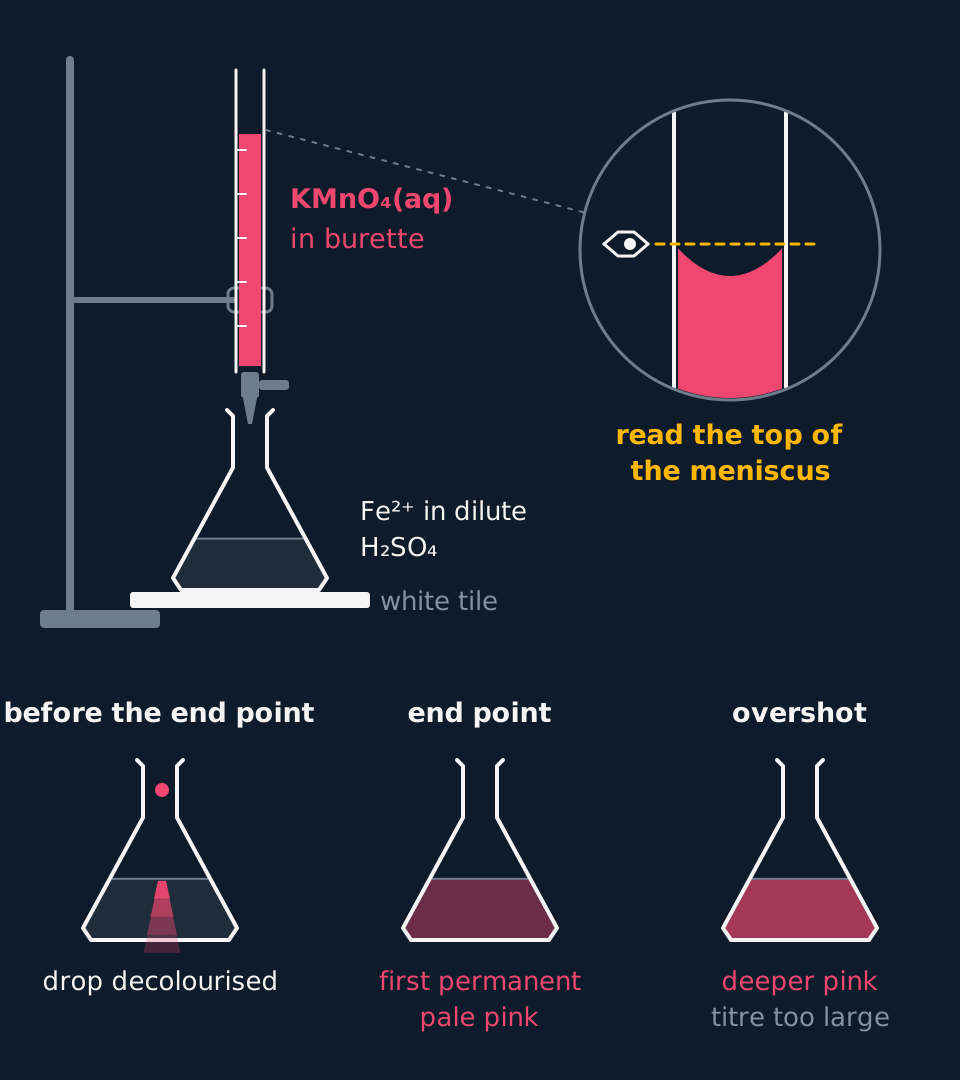
Potassium manganate(VII) measures a reducing agent directly. An iron supplement tablet contains iron(II) sulfate, and its solution in dilute sulfuric acid, in a conical flask, decolourises each drop of purple manganate(VII) run in from a burette, as the manganate is reduced to almost colourless Mn²⁺. When the last of the iron(II) has gone, the next drop has nothing to react with and the solution in the flask turns pale pink.
Describe the drawing
Left, a burette of deep purple potassium manganate(VII) clamped above a conical flask of iron(II) in dilute sulfuric acid standing on a white tile. Right, a magnified inset of the burette shows an eye level with the top of the meniscus, where the liquid meets the glass. Below, three flasks from the same titration: before the end point a nearly colourless solution with a purple drop fading as it lands; at the end point the whole solution pale pink; overshot, a clearly deeper pink.
That first permanent pale pink is the end point, and it comes from the reagent itself. Manganate(VII) titrations are self-indicating: no indicator is added. The purple solution is so intense that the bottom of the meniscus cannot be seen in the burette, so readings are taken from the top of the meniscus, at the start and at the end alike.
The equation fixes the ratio the whole calculation depends on.
MnO₄⁻(aq) + 8H⁺(aq) + 5Fe²⁺(aq) → Mn²⁺(aq) + 5Fe³⁺(aq) + 4H₂O(l)One mole of manganate(VII) oxidises five moles of iron(II).
The acid has to be dilute sulfuric acid. Hydrochloric acid contains chloride ions, which manganate(VII) oxidises to chlorine. Some manganate is then used up on the chloride as well as the iron, the titre is too large, and the iron content comes out too high. Nitric acid is itself an oxidising agent and would oxidise some of the iron(II) before the titration began, giving a titre too small. Ethanoic acid is a weak acid and cannot supply enough H⁺. Without enough acid, manganate(VII) is reduced only as far as manganese(IV) oxide, a brown precipitate, the ratio is no longer 1 : 5, and the end point is masked.
Ethanedioate ions, C₂O₄²⁻, from ethanedioic acid or sodium ethanedioate, are the other reducing agent titrated this way. Each ion releases two electrons and becomes two molecules of carbon dioxide, so the ratio is two manganate to five ethanedioate.
2MnO₄⁻(aq) + 16H⁺(aq) + 5C₂O₄²⁻(aq) → 2Mn²⁺(aq) + 10CO₂(g) + 8H₂O(l)Warm the flask to about 60 °C before titrating.
The ethanedioate reaction is slow at room temperature, so the flask is warmed to about 60 °C first. The first few drops still take a while to decolourise; after that the reaction speeds up, because the Mn²⁺ it produces catalyses it. A reaction catalysed by one of its own products is autocatalysed.
- Redox titration
- A titration in which the reaction between the solution in the burette and the solution in the flask is a redox reaction.
- Self-indicating
- Describes a titration in which a reagent's own colour change shows the end point, so no separate indicator is added.
- End point
- The point in a titration at which the indicator, or the reagent itself, first shows a permanent colour change.
- Autocatalysis
- Catalysis of a reaction by one of its own products, so the rate increases as the product builds up.
Iron in a tablet: from titre to mass
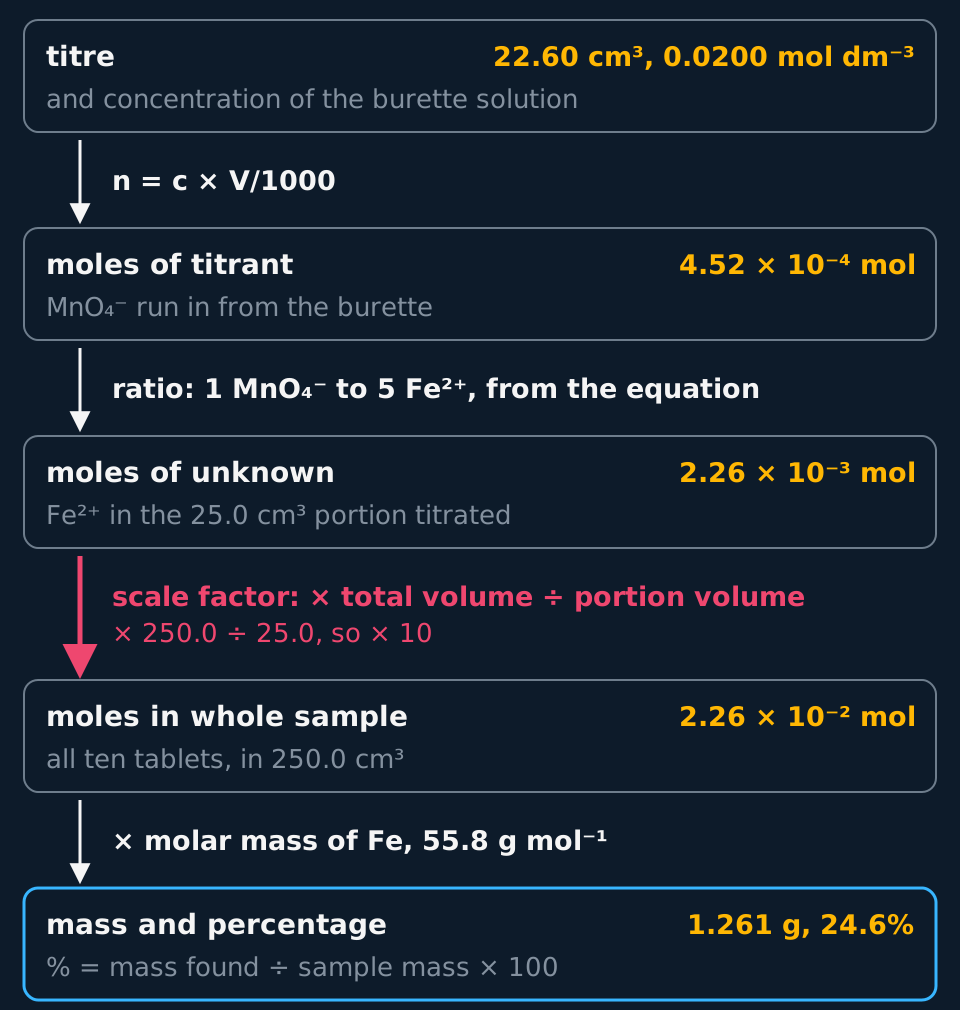
Every titration calculation follows the same chain, whichever reaction it is. Moles of the known solution come from its concentration and the titre. The equation's ratio converts that to moles of the unknown in the flask. Scaling up from the portion titrated to the whole sample gives the total, and a molar mass turns that into a mass.
Describe the drawing
Five boxes stacked in a column and joined by downward arrows, each arrow labelled with the one operation it needs. Titre and concentration, 22.60 cm³ of 0.0200 mol dm⁻³, become moles of titrant by n = c × V/1000, 4.52 × 10⁻⁴ mol; the mole ratio of one manganate to five iron gives 2.26 × 10⁻³ mol of iron(II) in the portion; a coral scale-factor arrow, times ten from 25.0 to 250.0 cm³, gives 2.26 × 10⁻² mol in the whole sample; times the molar mass gives 1.261 g, 24.6% of the tablets' mass.
Edexcel sets this titration as its core practical 11, and AQA assesses the same pipette and burette technique through required practical 1. The tablets are weighed, crushed and dissolved in dilute sulfuric acid, and the solution is made up to 250.0 cm³ in a volumetric flask with distilled water, every rinsing carried into the flask.
The bench method is the acid–base one with three changes. Rinse the burette with the manganate(VII) solution and fill it, reading the top of the meniscus. Pipette 25.0 cm³ of the iron(II) solution into a conical flask and add about 10 cm³ of dilute sulfuric acid, an excess, measured roughly with a measuring cylinder because its exact volume does not enter the calculation. Stand the flask on a white tile, run in the manganate with swirling, and add it drop by drop as the pink starts to linger. Repeat until two or more titres are concordant.
| Titration | Rough | 1 | 2 | 3 |
|---|---|---|---|---|
| Final reading / cm³ | 23.40 | 22.75 | 45.30 | 22.90 |
| Initial reading / cm³ | 0.00 | 0.10 | 22.75 | 0.30 |
| Titre / cm³ | 23.40 | 22.65 | 22.55 | 22.60 |
Iron in a supplement tablet
Ten iron tablets, total mass 5.12 g, are dissolved in dilute sulfuric acid and the solution made up to 250.0 cm³ in a volumetric flask. 25.0 cm³ portions are titrated with 0.0200 mol dm⁻³ potassium manganate(VII), with the burette readings in the table of titres. Calculate the mass of iron in one tablet and the percentage of iron by mass in the tablets. Ar of Fe is 55.8.
Show the working
Mean titre. The rough titre is left out. Titres 1, 2 and 3 lie within 0.10 cm³ of one another, so all three are concordant: (22.65 + 22.55 + 22.60) ÷ 3 = 22.60 cm³.
Moles of MnO₄⁻ in the titre: 0.0200 × 22.60/1000 = 4.52 × 10⁻⁴ mol.
From the equation, 1 MnO₄⁻ reacts with 5 Fe²⁺, so moles of Fe²⁺ in 25.0 cm³ = 5 × 4.52 × 10⁻⁴ = 2.26 × 10⁻³ mol.
The 25.0 cm³ portion is one tenth of the 250.0 cm³ made up, so the ten tablets contained 2.26 × 10⁻² mol of iron. Mass = 2.26 × 10⁻² × 55.8 = 1.261 g, so one tablet contains 0.126 g, or 126 mg, of iron.
Percentage of iron by mass = 1.261/5.12 × 100 = 24.6%. The data are given to three significant figures, so both answers are too.
The manganate oxidises iron(II) only. Any iron already oxidised to iron(III) before the titration is not counted: the method gives the iron(II) content, and the tablet is dissolved and titrated straight away rather than left in air.
Iron(II) solutions are slowly oxidised by oxygen from the air, so a solution made up the day before gives a titre that is too small. Potassium manganate(VII) solution is not a primary standard either: it slowly oxidises traces of organic matter in the water and decomposes in light, so it is kept in a brown bottle and its concentration checked against a weighed sample of sodium ethanedioate or ammonium iron(II) sulfate.
- Titre
- The volume of solution added from the burette to reach the end point.
- Concordant titres
- Titres that agree with one another to within 0.10 cm³, which are the ones used to calculate the mean.
- Primary standard
- A substance pure and stable enough that a solution of accurately known concentration can be made by weighing it and dissolving it to a known volume.
Iodine and thiosulfate
Many oxidising agents are measured indirectly, by letting them liberate iodine from an excess of potassium iodide and then titrating that iodine with sodium thiosulfate. The amount of iodine formed depends only on how much oxidising agent there was, and thiosulfate reacts with iodine cleanly and quickly.
I₂(aq) + 2S₂O₃²⁻(aq) → 2I⁻(aq) + S₄O₆²⁻(aq)Two moles of thiosulfate for every mole of iodine.
The iodine is reduced back to iodide; the thiosulfate is oxidised to tetrathionate, with the mean oxidation state of sulfur rising from +2 to +2.5. Thiosulfate goes in the burette, iodine solution in the flask.
Describe the drawing
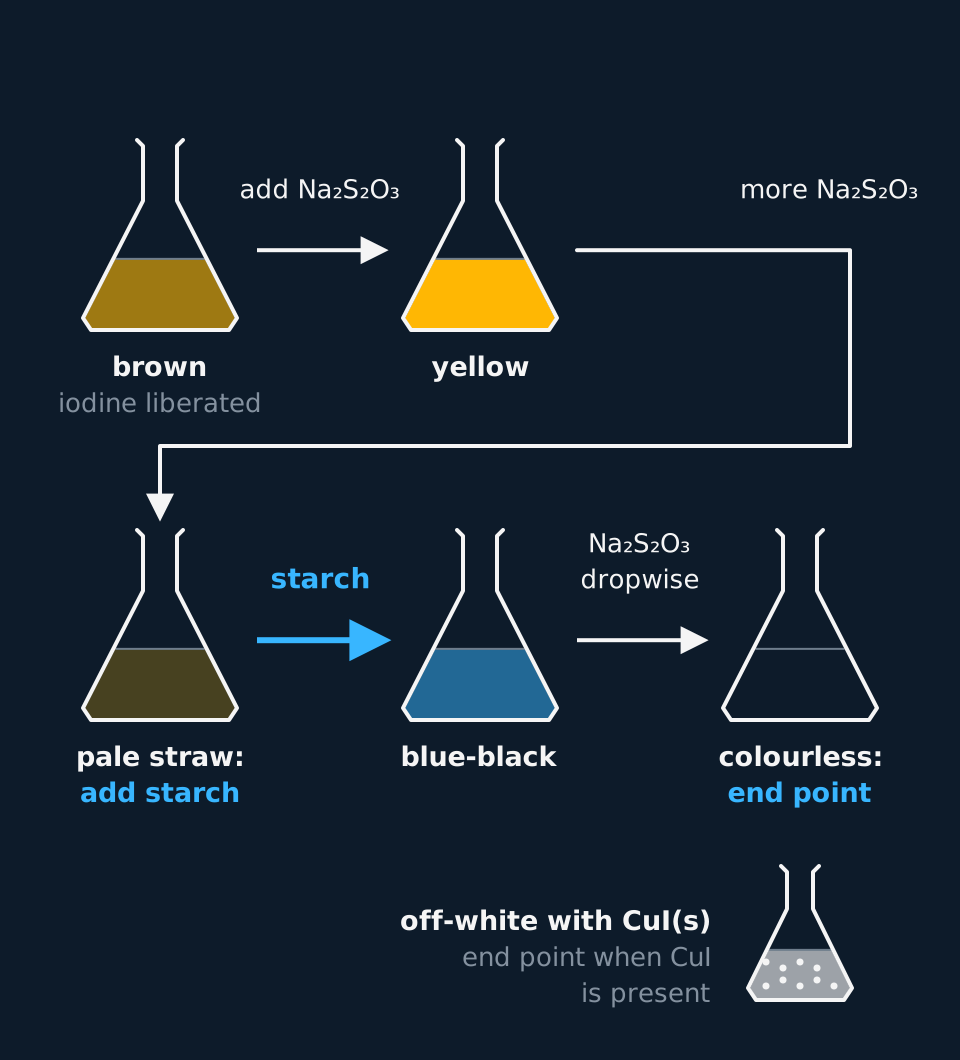
Six conical flasks showing the colours of an iodine and thiosulfate titration in order. A brown flask of liberated iodine; an arrow for adding sodium thiosulfate leads to a yellow flask; more thiosulfate leads on to a pale straw flask, where starch is added and the next flask is dark blue-black; thiosulfate added dropwise then leaves a colourless flask at the end point. A smaller sixth flask below holds an off-white suspension, the end point when copper(I) iodide is present.
The colour of iodine itself is a poor end point. The solution starts brown and fades through yellow to a very pale straw, and the last trace of yellow is hard to see. Starch makes it sharp: with iodine it forms an intense blue-black complex, and the end point is the drop at which the blue-black vanishes and the solution goes colourless.
The starch is added near the end point, when the solution is pale straw, and not at the start. With a lot of iodine present, the starch holds iodine in the complex and gives it up only slowly, so the blue-black colour lingers past the true end point and the titre comes out too large.
Copper in brass
A 0.635 g sample of brass is dissolved in nitric acid, the solution neutralised, and made up to 250.0 cm³. A 25.0 cm³ portion is added to excess potassium iodide. The iodine liberated needs 13.20 cm³ of 0.0500 mol dm⁻³ sodium thiosulfate. Calculate the percentage by mass of copper in the brass. Ar of Cu is 63.5.
Show the working
Copper(II) oxidises iodide, and is itself reduced to a white precipitate of copper(I) iodide: 2Cu²⁺(aq) + 4I⁻(aq) → 2CuI(s) + I₂(aq). Two Cu²⁺ give one I₂.
One I₂ reacts with two S₂O₃²⁻. Putting the two ratios together, 2Cu²⁺ gives I₂, which needs 2S₂O₃²⁻, so Cu²⁺ and S₂O₃²⁻ are in a 1 : 1 ratio.
Moles of S₂O₃²⁻ = 0.0500 × 13.20/1000 = 6.60 × 10⁻⁴ mol, which is also the moles of Cu²⁺ in 25.0 cm³. The whole 250.0 cm³ held 6.60 × 10⁻³ mol.
Mass of copper = 6.60 × 10⁻³ × 63.5 = 0.419 g. Percentage = 0.419/0.635 × 100 = 66.0%, to three significant figures.
At the end point of the copper titration the flask is not colourless but off-white, because the copper(I) iodide precipitate is still there. The end point is the disappearance of the blue-black colour, leaving that off-white suspension. The neutralising step before adding iodide matters too: nitric acid left over would oxidise some iodide itself and inflate the result.
Household bleach is analysed by the iodine route too. In acid, chlorate(I) ions oxidise iodide to iodine, so one ClO⁻ gives one I₂, which needs two S₂O₃²⁻. Bleach is far too concentrated to titrate as it comes, so 10.0 cm³ is first diluted to 250.0 cm³ in a volumetric flask. The moles found in the whole 250.0 cm³ all came from those 10.0 cm³, and dividing by 0.0100 dm³ gives the concentration of the bleach.
ClO⁻(aq) + 2I⁻(aq) + 2H⁺(aq) → Cl⁻(aq) + I₂(aq) + H₂O(l)Chlorine falls from +1 to −1; two iodide ions rise from −1 to 0.
Sodium thiosulfate solution slowly decomposes on standing, so its concentration is checked against potassium iodate(V), KIO₃, which is a primary standard. A weighed amount of iodate is added to excess acidified potassium iodide, and the iodine it releases is titrated. One IO₃⁻ gives three I₂, which need six S₂O₃²⁻, so the ratio of iodate to thiosulfate is 1 : 6.
IO₃⁻(aq) + 5I⁻(aq) + 6H⁺(aq) → 3I₂(aq) + 3H₂O(l)Iodine +5 in iodate and −1 in iodide both finish at 0.
- Standard solution
- A solution whose concentration is known accurately, used to find the concentration of another.
Percentage purity and unfamiliar reactions
A percentage purity calculation is the same chain with one extra line at the end: the mass of the substance found by titration, divided by the mass of sample weighed out, multiplied by 100. Impurities that do not react with the titrant are invisible to the titration, which is what makes it a measure of purity.
- Percentage purity
- The mass of the pure substance in a sample, as found by analysis, divided by the mass of the sample, multiplied by 100.
TRY IT: Purity of sodium ethanedioate
1.50 g of impure sodium ethanedioate, Na₂C₂O₄, is dissolved and made up to 250.0 cm³. A 25.0 cm³ portion, acidified and warmed to 60 °C, needs 21.85 cm³ of 0.0200 mol dm⁻³ potassium manganate(VII). Calculate the percentage purity. Mr of Na₂C₂O₄ is 134.0.
Check your answer
Moles of MnO₄⁻ = 0.0200 × 21.85/1000 = 4.37 × 10⁻⁴ mol. The ratio is 2 MnO₄⁻ to 5 C₂O₄²⁻, so moles of C₂O₄²⁻ = 4.37 × 10⁻⁴ × 5/2 = 1.0925 × 10⁻³ mol in 25.0 cm³.
In 250.0 cm³ there are 1.0925 × 10⁻² mol, with a mass of 1.0925 × 10⁻² × 134.0 = 1.464 g.
Percentage purity = 1.464/1.50 × 100 = 97.6%, to three significant figures.
Questions often give a redox system not met before, such as dichromate(VI) with iron(II), or hydrogen peroxide with manganate(VII). The chemistry is new but the method is not. Find the mole ratio, from the equation if it is given or from the electrons if it is not, and run the chain. Dichromate takes six electrons and iron(II) gives one, so one Cr₂O₇²⁻ oxidises six Fe²⁺.
Dichromate(VI) differs from manganate(VII) in three ways a question can test. Solid potassium dichromate(VI) is a primary standard, so its solution is made up by weighing. Its colour change, orange to green, is too gradual to show one drop in excess, so a redox indicator such as sodium diphenylamine sulfonate is added. And it is a weaker oxidising agent than manganate(VII), too weak to oxidise chloride ions under titration conditions, so an iron sample can be dissolved in hydrochloric acid when dichromate is the titrant.
The electron count also works backwards. If 2.50 × 10⁻³ mol of a metal ion is oxidised by 5.00 × 10⁻⁴ mol of manganate(VII), the manganate took 5 × 5.00 × 10⁻⁴ = 2.50 × 10⁻³ mol of electrons. That is one electron per metal ion, so the metal's oxidation state rose by one. A question can use this to ask for the oxidation state a metal finishes in.
| Manganate(VII) | Iodine–thiosulfate | |
|---|---|---|
| In the burette | KMnO₄(aq) | Na₂S₂O₃(aq) |
| Indicator | None: self-indicating | Starch, added near the end point |
| End point | First permanent pale pink | Blue-black colour disappears |
| Conditions | Excess dilute sulfuric acid; warm for ethanedioate | Excess potassium iodide in the flask |
| Used to measure | Reducing agents: Fe²⁺, C₂O₄²⁻, H₂O₂ | Oxidising agents that liberate iodine: Cu²⁺, ClO⁻, IO₃⁻ |
Other boards: methanoic acid, and the titrations each board names
Cambridge sets by name the oxidation of methanoic acid, HCOOH, by acidified manganate(VII), to carbon dioxide and water. Its carbon rises from +2 to +4, so each molecule gives two electrons, HCOOH → CO₂ + 2H⁺ + 2e⁻, and the ratio is again two manganate to five. Other carboxylic acids resist oxidation; methanoic acid does not, because its carbon still carries a hydrogen atom, as an aldehyde's does, and it reduces Tollens' and Fehling's reagents too.
2MnO₄⁻(aq) + 6H⁺(aq) + 5HCOOH(aq) → 2Mn²⁺(aq) + 5CO₂(g) + 8H₂O(l)Carbon +2 to +4: two electrons per molecule.
OCR names both titrations, manganate(VII) with iron(II) and iodine with thiosulfate, in 5.2.3, and Edexcel names them in 14.18 and 14.19, with its core practical 11 as the bench version. AQA names only the manganate(VII) titrations, and an AQA question that uses iodine and thiosulfate gives the equations it needs. The calculation chain is the same on every board's paper.
In the exam
- Describing a manganate(VII) titration, give the end point as 'colourless to pale pink' and state that no indicator is needed. The scheme does not accept 'clear' for colourless.
- Explaining the choice of acid, the scheme's mark is for chloride ions being oxidised to chlorine, so more manganate is used and the titre is too high. 'Hydrochloric acid reacts with the manganate' alone is not credited.
- In an iodine–thiosulfate method, starch is added when the solution is pale yellow or straw-coloured, and the end point is blue-black to colourless.
- Each link of a titration calculation carries a method mark: moles of titrant, the ratio, the scale factor, the mass. With error carried forward, a slip in one link costs only that link if every line is shown. Give the answer to the significant figures of the data, with its unit.
- The mean titre uses concordant titres only, within 0.10 cm³ of each other. A mean that includes the rough titre is not awarded the mark.
Check yourself
A student titrates an iron(II) solution with manganate(VII) but acidifies the flask with dilute hydrochloric acid instead of sulfuric acid. Her titre is 24.10 cm³; a partner using sulfuric acid gets 22.60 cm³ with the same solutions. Explain the difference, and say which result should be used for the iron content.
Answer
Manganate(VII) is a strong enough oxidising agent to oxidise chloride ions to chlorine. In the hydrochloric acid flask, some of each drop of manganate is reduced by chloride as well as by iron(II).
More manganate is therefore needed before the iron(II) is used up and the pink colour stays, so her titre is larger by about 1.5 cm³. Calculated with the 1 : 5 ratio, her result overstates the iron by about 7%.
The 22.60 cm³ titre should be used. Sulfate ions are not oxidised by manganate(VII), so every mole of manganate in that titre reacted with iron(II), which is what the 1 : 5 ratio assumes.
Questions
Question 16 marks
Calculate the mass of iron in one tablet, in mg, and the percentage of iron by mass in the tablets. Five iron(II) sulfate tablets, total mass 2.85 g, are dissolved in dilute sulfuric acid and made up to 100.0 cm³. 10.0 cm³ portions are titrated with 0.00500 mol dm⁻³ potassium manganate(VII), with the burette readings given in the table. Ar of Fe is 55.8.
| Titration | Rough | 1 | 2 | 3 |
|---|---|---|---|---|
| Final reading / cm³ | 22.05 | 21.55 | 43.20 | 21.60 |
| Initial reading / cm³ | 0.00 | 0.20 | 21.55 | 0.15 |
| Titre / cm³ | 22.05 | 21.35 | 21.65 | 21.45 |
Mark scheme
- M1 titres 1 and 3 are concordant, within 0.10 cm³, so the mean titre is (21.35 + 21.45) ÷ 2 = 21.40 cm³; the rough titre and titre 2 are left out
- M1 moles of MnO₄⁻ in the mean titre = 0.00500 × 21.40 ÷ 1000 = 1.070 × 10⁻⁴ mol
- M1 moles of Fe²⁺ in each 10.0 cm³ portion = 5 × 1.070 × 10⁻⁴ = 5.350 × 10⁻⁴ mol, from the 1 : 5 ratio in the equation
- M1 the 100.0 cm³ of solution from five tablets holds ten times as much, 5.350 × 10⁻³ mol, so one tablet holds 1.070 × 10⁻³ mol of iron
- A1 mass of iron in one tablet = 1.070 × 10⁻³ × 55.8 = 0.0597 g, which is 59.7 mg to three significant figures
- A1 percentage of iron = 5.350 × 10⁻³ × 55.8 ÷ 2.85 × 100 = 10.5%, to three significant figures; error carried forward from the mean titre
Question 25 marks
Calculate the concentration, in g dm⁻³, of a hydrogen peroxide solution from the results given in the table. The acidified, diluted solution reacts with manganate(VII): 2MnO₄⁻ + 6H⁺ + 5H₂O₂ → 2Mn²⁺ + 5O₂ + 8H₂O.
| Quantity | Value |
|---|---|
| Hydrogen peroxide solution diluted | 10.0 cm³ made up to 250.0 cm³ |
| Portion titrated | 25.0 cm³ |
| Concentration of KMnO₄ | 0.0200 mol dm⁻³ |
| Mean titre of KMnO₄ | 21.20 cm³ |
| Mr of H₂O₂ | 34.0 |
Mark scheme
- M1 moles of MnO₄⁻ = 0.0200 × 21.20/1000 = 4.24 × 10⁻⁴ mol
- M1 moles of H₂O₂ in 25.0 cm³ = 4.24 × 10⁻⁴ × 5/2 = 1.06 × 10⁻³ mol
- M1 moles in 250.0 cm³, which all came from 10.0 cm³ of the original, = 1.06 × 10⁻² mol
- M1 concentration of the original = 1.06 × 10⁻² ÷ 0.0100 = 1.06 mol dm⁻³
- A1 1.06 × 34.0 = 36.0 g dm⁻³, to three significant figures
Question 35 marks
Calculate the percentage purity of a sample of copper(II) sulfate crystals, CuSO₄·5H₂O (Mr 249.6). 2.60 g of the sample is dissolved and made up to 250.0 cm³. 25.0 cm³ portions are added to excess potassium iodide, and the iodine liberated is titrated with 0.0500 mol dm⁻³ sodium thiosulfate, with the burette readings given in the table.
| Titration | Rough | 1 | 2 | 3 |
|---|---|---|---|---|
| Final reading / cm³ | 20.90 | 20.85 | 41.30 | 21.40 |
| Initial reading / cm³ | 0.00 | 0.50 | 20.85 | 1.00 |
| Titre / cm³ | 20.90 | 20.35 | 20.45 | 20.40 |
Mark scheme
- M1 titres 1, 2 and 3 are concordant, so the mean titre is 20.40 cm³, the rough titre being left out
- M1 moles of S₂O₃²⁻ = 0.0500 × 20.40/1000 = 1.02 × 10⁻³ mol
- M1 Cu²⁺ : S₂O₃²⁻ is 1 : 1, so 1.02 × 10⁻³ mol of Cu²⁺ in 25.0 cm³ and 1.02 × 10⁻² mol in 250.0 cm³
- M1 mass of CuSO₄·5H₂O = 1.02 × 10⁻² × 249.6 = 2.546 g
- A1 percentage purity = 2.546/2.60 × 100 = 97.9%, to three significant figures; error carried forward from M1
All 22 questions with mark schemes, the other 19 set out in full on the question page.
Worth remembering
- Read the top of the meniscus at both ends in a manganate(VII) burette; the purple hides the bottom.
- 'Clear' for the flask before the end point is not accepted; the word is colourless.
- Add starch at pale straw; added at the start it holds iodine in the complex and makes the titre too large.
- Leaving out the scale factor from the 25.0 cm³ portion to the 250.0 cm³ flask gives a tenth of the mass.
- A mean that includes the rough titre, or a titre outside 0.10 cm³ of the others, is not awarded the mark.
CHECK YOUR PROGRESS
Rate how confident you are with each objective for this lesson. Ratings are saved in this browser, on this device, unless you sign in.
- Describe how to carry out a manganate(VII) titration, including why it needs no indicator and why it is acidified with dilute sulfuric acid.
- Use the 1 : 5 and 2 : 5 ratios to calculate the amount of iron(II) or ethanedioate from a manganate(VII) titre.
- Describe an iodine–thiosulfate titration, including the colour changes and the point at which starch is added.
- Calculate the mass of iron in a tablet and the percentage of copper in an alloy from titration results.
- Calculate a percentage purity, and apply the same chain to a redox system given in a question.
- Explain how a thiosulfate solution is standardised against potassium iodate(V), and how dichromate(VI) differs from manganate(VII) as a titrant.
Open the full revision checklist to see every objective in the curriculum in one place.
Practise this lesson
WORKBOOK
The written questions from this topic, on paper with room to work, and a separate book of mark schemes. The 6 questions that are set on a diagram stay on this page, where the diagram can be drawn. Free to use; please do not redistribute or sell.
Used later in Finding orders from initial rates, half-lives and graphs · Variable oxidation states: vanadium, chromium and manganate(VII) titrations