Maths › Algebra and functions › Polynomials and the factor theorem
Polynomials and the factor theorem
The factor theorem states that if f(a) = 0 then (x − a) is a factor, which is the usual first step in factorising a cubic. Algebraic division or comparing coefficients then splits off the remaining quadratic, so a cubic with rational roots comes out as three brackets multiplied together.
Builds on Quadratic functions.
IN THIS TOPIC
- Divide a polynomial by a linear expression of the form (ax ± b), quotient and remainder included.
- Use the factor theorem to find factors, fix unknown coefficients, and factorise a cubic completely.
- Simplify rational expressions by factorise-and-cancel and by algebraic division.
- Expand a product of polynomial brackets and collect like terms, and use an expansion to check a division.
COMMON MISCONCEPTION
To test whether (x − 2) is a factor, evaluate f(−2).
Substitute the value that makes the bracket zero. (x − 2) vanishes at x = 2, so the test is f(2), and the factor theorem says (x − a) is a factor exactly when f(a) = 0. For a divisor (ax − b) the value is x = b/a, so (2x − 1) is tested at x = 1/2.
Dividing polynomials
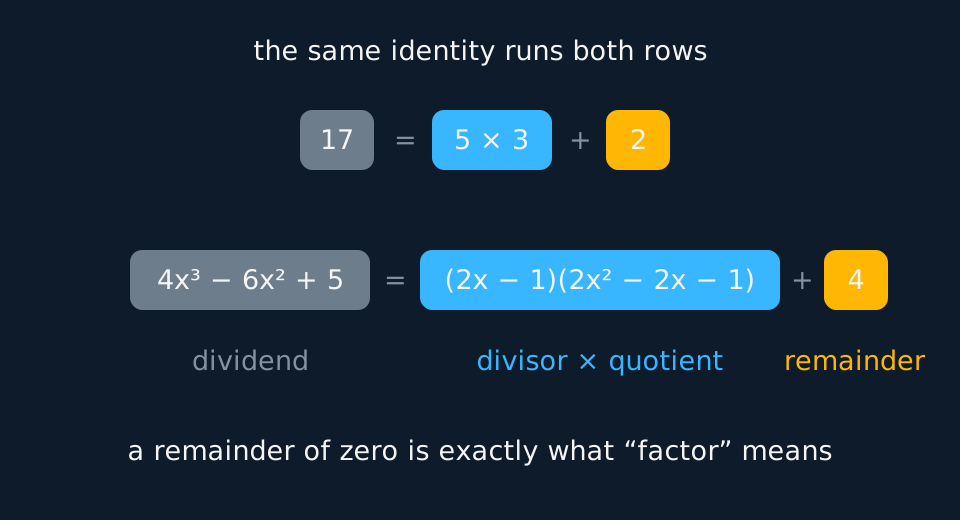
A polynomial is a sum of whole-number powers of x, and the familiar moves of expanding, collecting and factorising all still apply at degree three and above. The new tool is algebraic division. Dividing f(x) by a linear expression produces a quotient and a remainder, tied together by the identity f(x) = divisor × quotient + remainder. Whole numbers work the same way. 17 ÷ 5 gives quotient 3 and remainder 2, because 17 = 5 × 3 + 2.
WORKED EXAMPLE
Division by (ax − b), remainder and all
Divide 4x3 − 6x2 + 5 by (2x − 1).
Write the dividend with every power present, 4x3 − 6x2 + 0x + 5, so that each column has something in it.
Divide leading terms in turn. 4x3 ÷ 2x = 2x2; multiply back, subtract, and repeat to get −2x, then −1, with 4 left over.
The quotient is 2x2 − 2x − 1 and the remainder is 4. One expansion checks it, since (2x − 1)(2x2 − 2x − 1) + 4 = 4x3 − 6x2 + 5.
Include the 0x term: without it the later subtractions are performed in the wrong columns and the quotient is wrong.
When the remainder comes out as zero, the divisor is a factor and the division has split the polynomial into a product. The next result predicts that outcome without making you do the division at all.
The factor theorem
Substituting x = a into f(x) = (x − a) × quotient + remainder makes the bracket vanish and leaves f(a) = remainder. So the remainder on dividing by (x − a) is simply f(a), and in particular
Watch Polynomials, part 2: find coefficients and simplify on the InkPhysics YouTube channel
which is the factor theorem. It is not in the formulae booklet, so it must be learnt and stated. Note the sign: the bracket (x − 2) is zero at x = 2, so testing it means evaluating f(2). For a divisor (2x − 1), substitute the value making the bracket zero, here x = 1/2.
WORKED EXAMPLE
A cubic with a hidden square
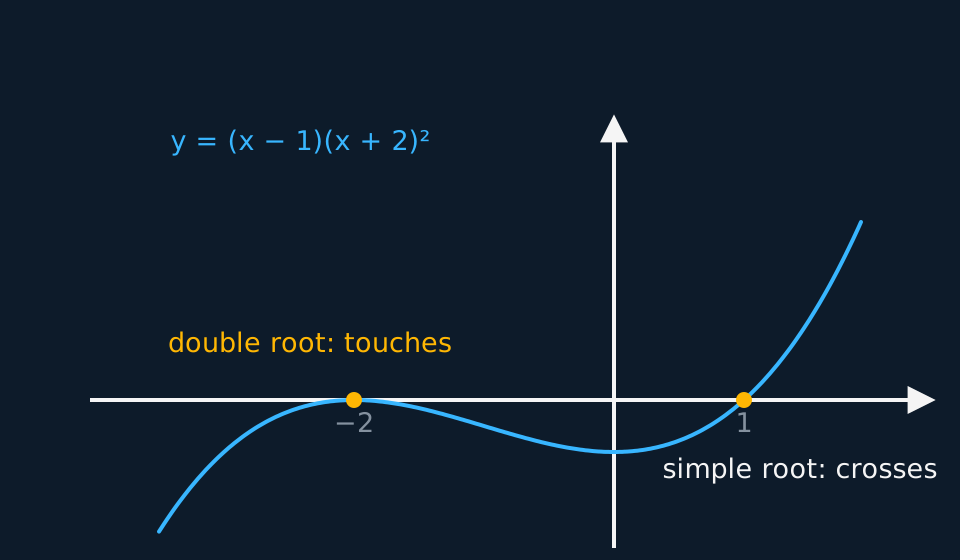
Factorise completely f(x) = x3 + 3x2 − 4.
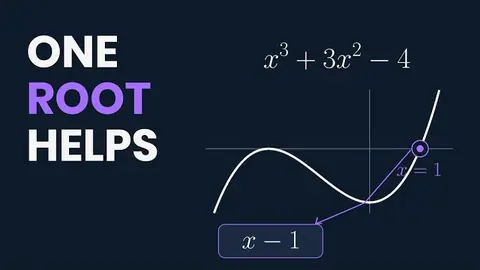
Test the integer factors of the constant term. f(1) = 1 + 3 − 4 = 0, so (x − 1) is a factor.
Divide. x3 + 3x2 − 4 = (x − 1)(x2 + 4x + 4), and that quadratic is a perfect square.
So f(x) = (x − 1)(x + 2)2, a simple root at 1 and a repeated root at −2.
Any integer root of a polynomial with integer coefficients and leading coefficient 1 divides the constant term, so the candidates here are ±1, ±2 and ±4.
GUIDED PRACTICE
A leading coefficient joins in
Show that (2x − 1) is a factor of f(x) = 2x3 − x2 − 8x + 4, and factorise f(x) completely, before opening the working.
Show the working
The bracket is zero at x = 1/2, and f(1/2) = 1/4 − 1/4 − 4 + 4 = 0, so (2x − 1) is a factor.
Divide, or spot the grouping 2x3 − x2 − 8x + 4 = x2(2x − 1) − 4(2x − 1) = (2x − 1)(x2 − 4).
The difference of two squares finishes it. f(x) = (2x − 1)(x − 2)(x + 2).
A complete answer to a show-that question gives the substitution, states that the result is zero, and names the factor theorem in the conclusion.
Rational expressions
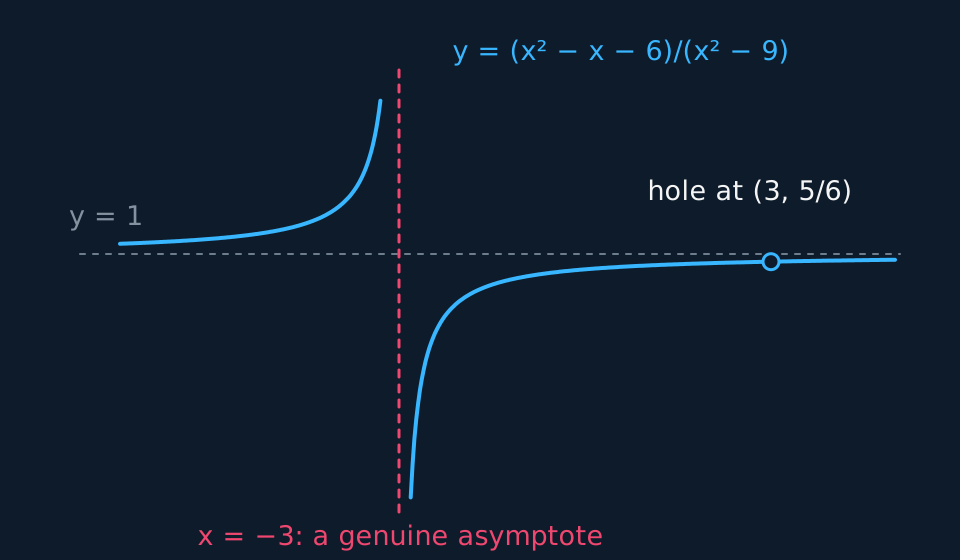
An algebraic fraction simplifies the way a numerical one does. Factorise top and bottom, then cancel any factor they share. For (x2 − x − 6)/(x2 − 9), factorising gives (x − 3)(x + 2) over (x − 3)(x + 3), and cancelling the common factor leaves (x + 2)/(x + 3) for x ≠ 3. Only whole factors cancel: individual terms such as the x2 terms, or the 6 against the 9, cannot be cancelled.
Describe the drawing
The graph of the simplified curve x plus 2 over x plus 3, dashed vertical asymptote at minus 3 where the surviving factor makes the curve blow up, and an open circle at 3, five sixths where the cancelled shared factor leaves a single missing point: cancelling simplifies the algebra but the hole it leaves is part of the answer.
When the numerator's degree reaches the denominator's, the fraction is improper, and algebraic division rewrites it as a polynomial plus a proper remainder term. Dividing gives (2x2 + 3x − 4)/(x − 1) = 2x + 5 + 1/(x − 1), a form used later in curve sketching and integration.
INDEPENDENT PRACTICE
An unknown coefficient
(x + 3) is a factor of f(x) = x3 + ax2 − x + 6. Find a, and factorise f(x) as far as possible with real factors.
Show the working
The factor theorem at x = −3 gives −27 + 9a + 3 + 6 = 0, so 9a = 18 and a = 2.
Divide by (x + 3). x3 + 2x2 − x + 6 = (x + 3)(x2 − x + 2).
Check the quadratic before hunting any further. Its discriminant is 1 − 8 = −7, negative, so it has no real roots and (x + 3)(x2 − x + 2) is as far as real factorisation goes.
The discriminant determines when to stop factorising. Every cubic with real coefficients has at least one real root, but it need not have three.
ASSESSMENT FOCUS
- Write the dividend with every power present, inserting 0x terms, before dividing, so that each subtraction is performed in the correct column.
- State the factor theorem check in full: the substitution, the value zero, and the conclusion. A “show that” question requires that reasoning, not only the result.
- For a factor (ax − b), substitute x = b/a, the value that makes the bracket zero.
- Candidate integer roots divide the constant term. Write that list out and test the values in order.
- Cancel whole factors only, never terms. When asked to interpret a division, quote f(x) = divisor × quotient + remainder and point at the piece the question wants.
CHECK YOURSELF
Show that (x + 1) is a factor of f(x) = x3 − 7x − 6, and hence factorise f(x) completely.
Show a hint
f(−1) first; then divide and factorise the quadratic quotient.
Show the answer
f(−1) = −1 + 7 − 6 = 0, so by the factor theorem (x + 1) is a factor.
Dividing gives x3 − 7x − 6 = (x + 1)(x2 − x − 6), and that quadratic factorises.
f(x) = (x + 1)(x − 3)(x + 2), with three simple roots; expanding the product confirms the factorisation.
Divide f(x) by (x − a) and the remainder is f(a). A remainder of zero names a factor.
One root found by the factor theorem, one division, and the remaining quadratic factorised or solved by the formula.
WORKBOOK
Printable practice for this topic: original exam-style questions with room to work, and a fully worked answer book. Free to use; please do not redistribute or sell.
Or read them with their worked answers on the polynomials and the factor theorem questions page.
CHECK YOUR PROGRESS
Rate how confident you feel with each objective for this lesson. Ratings are saved in this browser, on this device, unless you sign in.
- Divide a polynomial by a linear expression of the form (ax ± b), quotient and remainder included.
- Use the factor theorem to find factors, fix unknown coefficients, and factorise a cubic completely.
- Simplify rational expressions by factorise-and-cancel and by algebraic division.
- Expand a product of polynomial brackets and collect like terms, and use an expansion to check a division.
Open the full revision checklist to see every objective in the course in one place.