Maths › Complex numbers › Modulus, argument and loci
Modulus, argument and loci
The modulus of z = x + iy is its distance from the origin. For z ≠ 0, the argument is its direction from the positive real axis. In this course the principal argument lies in (−π, π]. A locus equation translates a condition on distance or direction into a circle, line, half-line or region on an Argand diagram.
Builds on Complex arithmetic and the Argand diagram and Radians, arcs and small angles.
IN THIS TOPIC
- Find the modulus and argument of a complex number in every quadrant.
- Convert between x + yi and modulus-argument form, read the shorthands [r, θ] and r cis θ, and multiply and divide in that form.
- Sketch and describe circles, perpendicular bisectors and half-lines.
- Shade the region satisfying an inequality in z.
COMMON MISCONCEPTION
The argument of z is tan⁻¹(y/x), whatever the quadrant z is in.
tan⁻¹(y/x) returns a value in (−π/2, π/2), which covers the first and fourth quadrants only. For −1 + i it gives −π/4, and the point sits in the second quadrant, so the argument is 3π/4. Plot the point first, then adjust the inverse tangent into the principal interval (−π, π] used here; the origin has no argument at all.
Length and angle
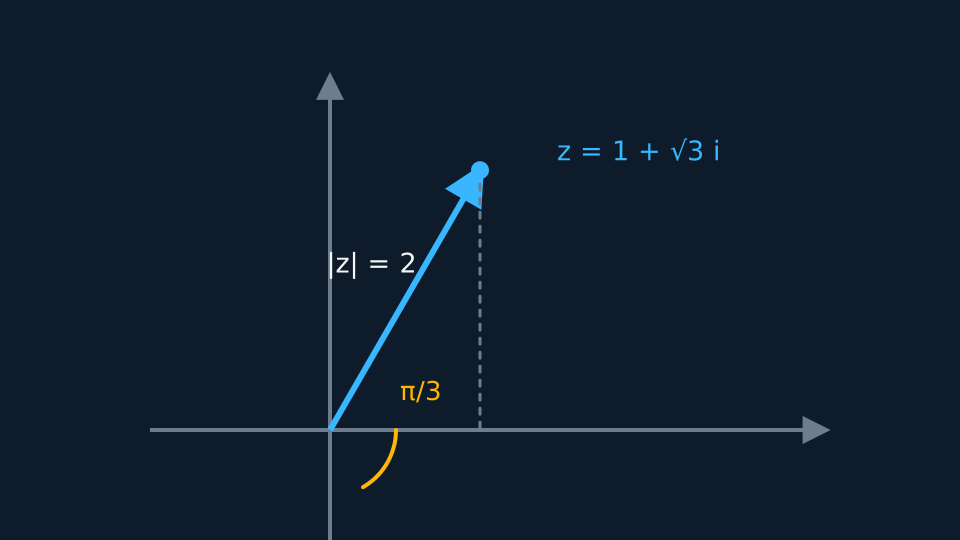
For z = x + iy ≠ 0, |z| = √(x2 + y2). In this course the principal argument is taken in (−π, π]; other sources may use a different principal interval. Plot the point to determine the quadrant. The origin has modulus 0 and no argument. Modulus and argument together determine the point, and the conversion is the trigonometry of one right-angled triangle:
with r = |z| and θ = arg z. Check the current formula booklet for your awarding organisation; whether or not the result is supplied, you must know when it applies and how to derive it if the question asks for a proof. The calculator's tan⁻¹(y/x) returns a value in (−π/2, π/2), so for a number such as −1 + i it gives −π/4, which must be corrected to 3π/4 for a point in the second quadrant. Plot the point and adjust the inverse tangent accordingly.
Two shorthands for the same form are used by some awarding organisations, including OCR, and should be recognised on sight. One is the square bracket [r, θ], the modulus and the argument in that order. The other is r cis θ, in which cis abbreviates cos + i sin. Each denotes r(cos θ + i sin θ), so 2 cis(π/3) and [2, π/3] both denote the number 1 + √3 i in the figure below. Convert either into the form the working needs.
Multiplying in modulus-argument form
Multiplication has a direct geometric description: moduli multiply and arguments add. Division divides the moduli and subtracts the arguments. A product that is laborious in x + yi form is often short in modulus-argument form.
Two conditions apply. Neither number may be zero, since zero has no argument; and the sum or difference of two arguments may lie outside the principal interval −π < θ ≤ π, in which case add or subtract 2π to return it to that interval before quoting it. In general the rule for arguments holds only modulo 2π.
WORKED EXAMPLE
A product done both ways
Find (1 + √3 i)(√3 + i), using modulus-argument form, and check directly.
Both factors have modulus 2, and the arguments are π/3 and π/6. So the product has modulus 4 and argument π/3 + π/6 = π/2, which makes it 4i.
Directly: (1 + √3 i)(√3 + i) = √3 + i + 3i + √3 i2 = (√3 − √3) + 4i = 4i, as claimed.
Multiplying by a complex number scales by its modulus and rotates by its argument. Here the rotation carried the product onto the imaginary axis.
After adding two arguments the result may lie outside the principal interval, so subtract 2π to return it to (−π, π] before quoting it.
Loci on the Argand diagram
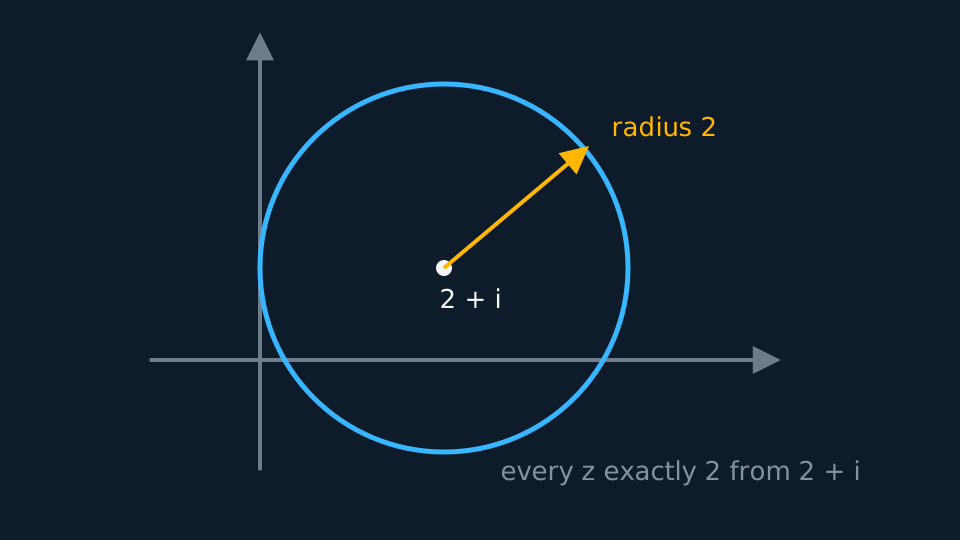
An equation in z defines a set of points, a locus, and three forms occur in this course. |z − a| = r says 'distance from a is r', a circle of centre a and radius r. |z − a| = |z − b| says 'equidistant from a and b', giving the perpendicular bisector of the segment joining them. arg(z − a) = θ says 'the direction from a is θ', a half-line from a at angle θ, with a itself excluded, since z = a would ask for the argument of zero.
GUIDED PRACTICE
Reading three loci
Describe the loci |z − 4| = 3, |z| = |z − 2i|, and arg(z − 1) = π/4.
Show the working
|z − 4| = 3 is a circle of centre 4, the point (4, 0), and radius 3.
|z| = |z − 2i| gives the points equidistant from 0 and 2i, the horizontal line through i, with equation y = 1 on the diagram.
arg(z − 1) = π/4 is a half-line starting at 1, which is excluded, directed at π/4 to the real axis. State the centre and radius, or the two fixed points, when describing a locus.
Regions defined by inequalities
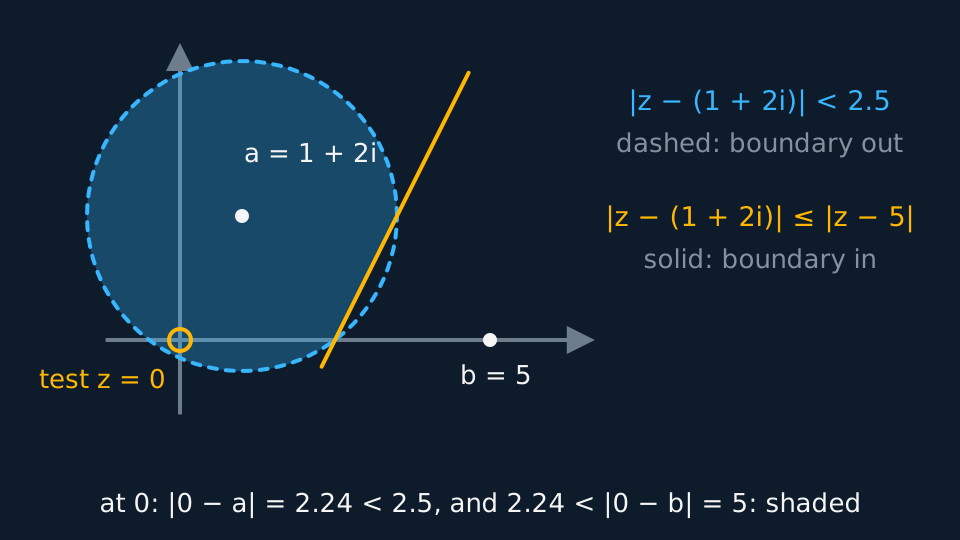
Replacing the equals sign by an inequality gives a region. |z − a| < r is the interior of the circle and |z − a| > r the exterior. |z − a| ≤ |z − b| is the half plane containing a, bounded by the perpendicular bisector, with the boundary included. Where two conditions are combined, draw each boundary first, decide which side is required by testing one convenient point such as the origin, then shade the intersection. Draw strict boundaries dashed and inclusive boundaries solid. A region defined by an argument condition excludes the point at which the argument is undefined.
Describe the drawing
An Argand diagram carrying the dashed circle of the strict inequality, centre one plus two i and radius two point five, and the solid perpendicular bisector of one plus two i and five, with the overlap of the open disc and the half plane shaded: the origin, ringed as the test point, is two point two four from a, closer than the radius and closer than it is to b, so it sits inside the shaded region.
ASSESSMENT FOCUS
- Report arguments in radians in the principal interval (−π, π] used here, and plot the point before using an inverse tangent.
- Treat [r, θ] and r cis θ as modulus-argument form written short. Expand either one before computing with it.
- Convert to modulus-argument form before multiplying or dividing, and convert back only if asked.
- Read the centre from what is subtracted. z − (2 + i) means centre 2 + i, not −2 − i.
- A half-line locus excludes its endpoint. Say so when describing arg(z − a) = θ.
- For regions, test the origin to decide which side you want, and mark strict boundaries dashed.
CHECK YOURSELF
Sketch the locus |z − 3i| = 3, and state its centre and radius. Where does it meet the axes?
Show a hint
Read the centre from the subtraction, then think about how far the circle reaches.
Show the answer
A circle of centre 3i, the point (0, 3), and radius 3. It meets the imaginary axis at 0 and 6i, and touches the real axis only at the origin, since the centre sits exactly one radius above it.
Modulus is distance from the origin; for z ≠ 0 the argument is the angle from the positive real axis, taken here in (−π, π] and read from a sketch.
Products multiply moduli and add arguments; quotients divide and subtract.
|z − a| = r is a circle, |z − a| = |z − b| a bisector, arg(z − a) = θ a half-line.
WORKBOOK
Printable practice for this topic: original exam-style questions with room to work, and a fully worked answer book. Free to use; please do not redistribute or sell.
Or read them with their worked answers on the modulus, argument and loci questions page.
USED LATER IN
CHECK YOUR PROGRESS
Rate how confident you feel with each objective for this lesson. Ratings are saved in this browser, on this device, unless you sign in.
- Find the modulus and argument of a complex number in every quadrant.
- Convert between x + yi and modulus-argument form, read the shorthands [r, θ] and r cis θ, and multiply and divide in that form.
- Sketch and describe circles, perpendicular bisectors and half-lines.
- Shade the region satisfying an inequality in z.
Open the full revision checklist to see every objective in the course in one place.