Maths › Differentiation › Tangents, turning points and curve behaviour
Tangents, turning points and curve behaviour
Use derivatives to form tangent and normal equations, locate and classify stationary points, describe increasing and decreasing intervals, and solve optimisation problems with a contextual final answer.
Builds on Differentiating powers of x and Straight lines.
IN THIS TOPIC
- Find equations of tangents and normals at a point on a curve.
- Locate stationary points and classify them with the second derivative.
- State the intervals on which a curve is increasing or decreasing.
- Use convex, concave and point of inflection correctly, and know what f'' = 0 does and does not prove.
- Solve practical maximisation and minimisation problems, domain included.
COMMON MISCONCEPTION
f''(x) = 0 means x is a point of inflection.
A point of inflection requires a change of concavity, which f''(a) = 0 alone does not establish: x4 has f''(0) = 0 and a minimum at the origin. Test whether concavity changes across a, or test the sign of f' on either side. Where f'' exists at a point of inflection it is zero there, but it need not exist at all, as y = ∛x at the origin shows.
Tangents and normals
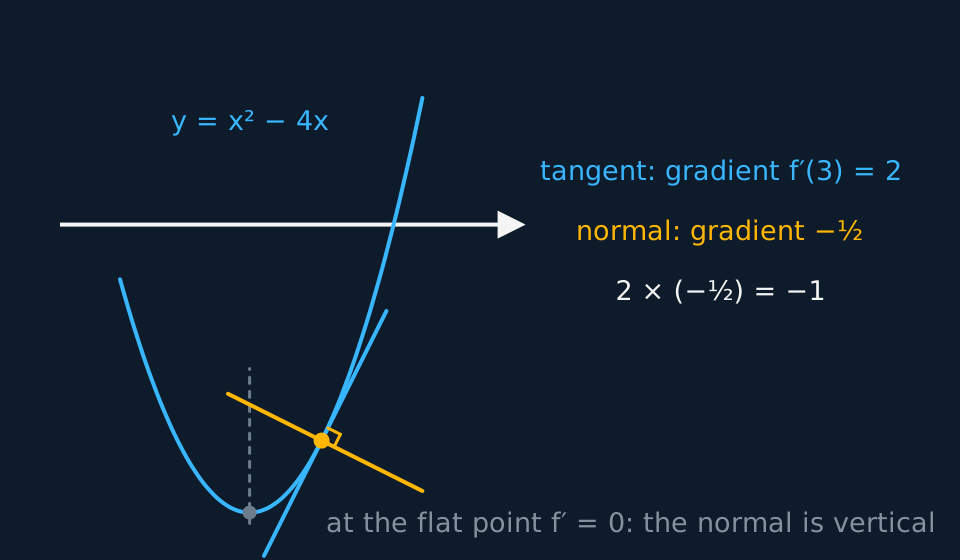
Evaluating the derivative at a point gives a gradient, and the equations of both lines then follow from point-gradient form. The tangent at (a, f(a)) has gradient f'(a). The normal is perpendicular to it, so when f'(a) is non-zero its gradient is the negative reciprocal −1/f'(a), and both lines pass through the point itself. At a stationary point the tangent is horizontal and the reciprocal breaks down: the normal there is the vertical line x = a.
WORKED EXAMPLE
Both lines at one point
Find the equations of the tangent and the normal to y = x2 − 4x at the point where x = 3.
The point is (3, −3), and dy/dx = 2x − 4 gives gradient 2 there.
Tangent: y + 3 = 2(x − 3), so y = 2x − 9.
Normal: gradient −½, so y + 3 = −½(x − 3), which is y = −x/2 − 3/2.
The calculus in this question is a single evaluation of the derivative; point-gradient form supplies both equations.
Stationary points, classified
Where f'(x) = 0 the tangent is horizontal and the point is a stationary point. Where f'' is defined and non-zero there, it classifies the point: if f''(a) > 0 the gradient is increasing through zero, so the point is a minimum; if f''(a) < 0 it is a maximum. Give the y-coordinate as well as the x-coordinate, since a stationary point is a point on the curve.
GUIDED PRACTICE
Find and classify
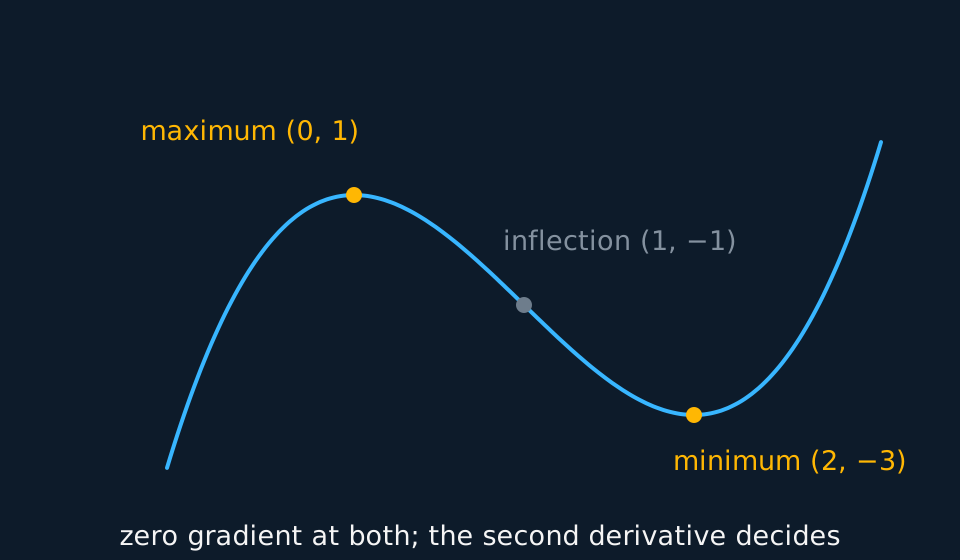
Find the stationary points of y = x3 − 3x2 + 1 and classify each, before opening the working.
Show the working
dy/dx = 3x2 − 6x = 3x(x − 2), zero at x = 0 and x = 2, giving the points (0, 1) and (2, −3).
The second derivative is 6x − 6. At x = 0 it is −6, so (0, 1) is a maximum; at x = 2 it is +6, so (2, −3) is a minimum.
The curve has a point of inflection at x = 1, where 6x − 6 changes sign, as the figure shows.
Stationary values of a rational function can also be found without differentiating. Set the function equal to k and clear the fraction; the values of k for which the resulting quadratic in x has a repeated root are the stationary values, and the repeated root gives the x-coordinate. Graphs, proportion and transformations works that method through. It applies where a question excludes calculus, and it also gives the range of the function, which differentiation does not.
Increasing, decreasing, convex, concave
On an interval where f'(x) > 0 the function is increasing, and where f'(x) < 0 it is decreasing. These derivative conditions are sufficient rather than necessary: x3 is increasing on every interval although f'(0) = 0. Where f''(x) > 0 the curve is convex, bending upwards, and where f''(x) < 0 it is concave. A point of inflection is a point at which the curve changes between convex and concave.
The condition f''(a) = 0 does not by itself classify a stationary point. Test whether concavity changes across a, or test the sign of f' on either side. For example, x4 has f''(0) = 0 but a minimum at the origin. Where f'' exists at a point of inflection it is zero there, but it need not exist at all: y = ∛x has a point of inflection at the origin where neither f' nor f'' is defined.
Optimisation in context
Practical maximum and minimum questions follow one method. Write the quantity to be optimised as a function of one variable, state the domain the context allows, differentiate, solve f'(x) = 0, classify the stationary points, reject any outside the domain, and give the answer in context with units.
INDEPENDENT PRACTICE
The open box
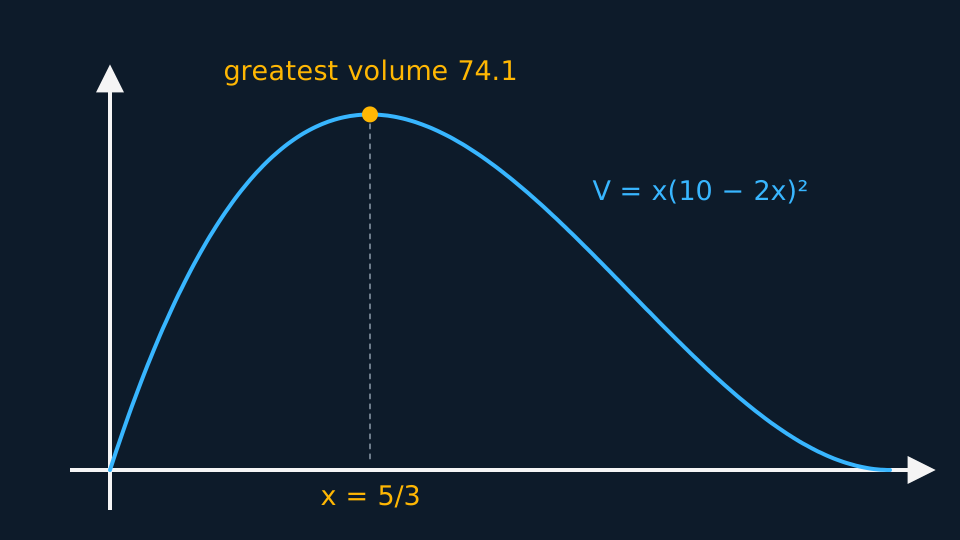
Squares of side x cm are cut from the corners of a 10 cm square of card, and the sides fold up into an open box. Show that the volume is V = x(10 − 2x)2, and find the value of x that makes V greatest.
Show the working
The base is a (10 − 2x) square and the height is x, so V = x(10 − 2x)2, valid for 0 < x < 5.
Expanding and differentiating, or factorising directly, dV/dx = (10 − 2x)(10 − 6x), zero at x = 5 and x = 5/3. Only the second lies inside the domain, since x = 5 leaves no base at all.
d2V/dx2 at x = 5/3 is negative, so the volume is greatest at x = 5/3 cm, where V = 2000/27 ≈ 74.1 cm3.
A complete answer states the domain 0 < x < 5 and gives the reason for rejecting x = 5.
ASSESSMENT FOCUS
- Tangent gradient is f'(a), normal gradient is its negative reciprocal when f'(a) ≠ 0, and both lines then come out of point-gradient form. A horizontal tangent has the vertical normal x = a.
- Solve f'(x) = 0 fully and find the y-coordinates too. A stationary point is a point, never a bare x-value.
- Classify with the sign of f'' and state the conclusion: “f''(2) = 6 > 0, so minimum”.
- f''(a) = 0 classifies nothing by itself. Test whether concavity changes across a, or test the sign of f' on either side.
- Increasing and decreasing require an interval in the answer, written as an inequality in x rather than a single value.
- In practical problems state the domain, reject stationary points outside it with a reason, and give the answer in context, with units.
CHECK YOURSELF
The curve y = x3 − 12x has two stationary points. Find and classify them, and state the interval on which the curve is decreasing.
Show a hint
Factorise the derivative, then read signs.
Show the answer
dy/dx = 3x2 − 12 = 3(x − 2)(x + 2), zero at x = ±2, giving (−2, 16) and (2, −16).
f'' = 6x, negative at −2, so (−2, 16) is a maximum; positive at 2, so (2, −16) is a minimum.
Between the roots the derivative is negative, so the curve is decreasing on −2 < x < 2.
The tangent at (a, f(a)) has gradient f'(a); the normal has gradient −1/f'(a) when f'(a) ≠ 0, and is the line x = a when f'(a) = 0; stationary points solve f'(x) = 0.
The sign of f''(a) classifies a stationary point where it is non-zero; a point of inflection requires a change of concavity, which f''(a) = 0 alone does not establish.
WORKBOOK
Printable practice for this topic: original exam-style questions with room to work, and a fully worked answer book. Free to use; please do not redistribute or sell.
Or read them with their worked answers on the tangents, turning points and curve behaviour questions page.
USED LATER IN
CHECK YOUR PROGRESS
Rate how confident you feel with each objective for this lesson. Ratings are saved in this browser, on this device, unless you sign in.
- Find equations of tangents and normals at a point on a curve.
- Locate stationary points and classify them with the second derivative.
- State the intervals on which a curve is increasing or decreasing.
- Use convex, concave and point of inflection correctly, and know what f'' = 0 does and does not prove.
- Solve practical maximisation and minimisation problems, domain included.
Open the full revision checklist to see every objective in the course in one place.