Maths › Differentiation › The product, quotient and chain rules
The product, quotient and chain rules
The chain, product and quotient rules differentiate composite functions, products and quotients respectively. Together they differentiate combinations of functions that cannot be rewritten as sums of powers of x.
Builds on Differentiating trig, exponentials and logs.
IN THIS TOPIC
- Differentiate composite functions with the chain rule.
- Differentiate products and quotients with their rules, laid out cleanly.
- Use the booklet derivatives of sec x, cosec x and cot x.
- Combine the rules on nested expressions like cos2 x, tan2 2x and e3x/x.
COMMON MISCONCEPTION
The derivative of a quotient is the quotient of the derivatives.
The quotient rule is (u'v − uv')/v2, with the minus in the middle and v ≠ 0. For y = e3x/x it gives e3x(3x − 1)/x2, so the gradient at x = 1 is 2e3 ≈ 40.2, while dividing the two derivatives gives 3e3 ≈ 60.3. One substituted value separates them.
The chain rule
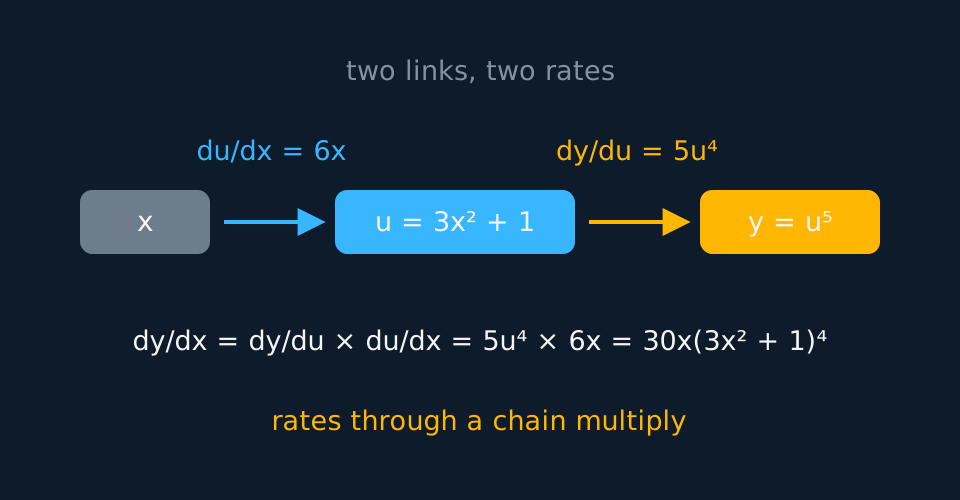
A function inside a function is a chain of two stages, and rates through a chain multiply.
Here u names the inner function. In practice the rule reads as an instruction: differentiate the outside, leaving the inside untouched, then multiply by the inside's derivative.
WORKED EXAMPLE
Outside first, then inside
Differentiate y = (3x2 + 1)5.
Set u = 3x2 + 1, so y = u5, giving dy/du = 5u4 and du/dx = 6x.
Multiply: dy/dx = 5u4 × 6x = 30x(3x2 + 1)4.
The substitution u can be done mentally with practice. Where working is required, write u out.
Products and quotients
For a product of two functions, (uv)' = u'v + uv'. For a quotient the order of the terms in the numerator matters, and the rule is given in the formulae booklet.
The minus sign in the numerator is part of the rule, and v2 requires v ≠ 0. Differentiating numerator and denominator separately and dividing gives a different function, as substituting one value shows.
WORKED EXAMPLE
One product and one quotient
Differentiate y = 2x4 sin x, and then y = e3x/x.
Product rule: u = 2x4, v = sin x gives dy/dx = 8x3 sin x + 2x4 cos x.
Quotient rule: u = e3x, v = x gives (3e3x × x − e3x × 1)/x2 = e3x(3x − 1)/x2.
At x = 1 the gradient of the quotient is 2e3 ≈ 40.2, while dividing the two derivatives gives 3e3 ≈ 60.3, so the two are not equal.
Give the quotient answer factorised with e3x outside the bracket: the stationary points can then be read from the factors.
GUIDED PRACTICE
A square of a function
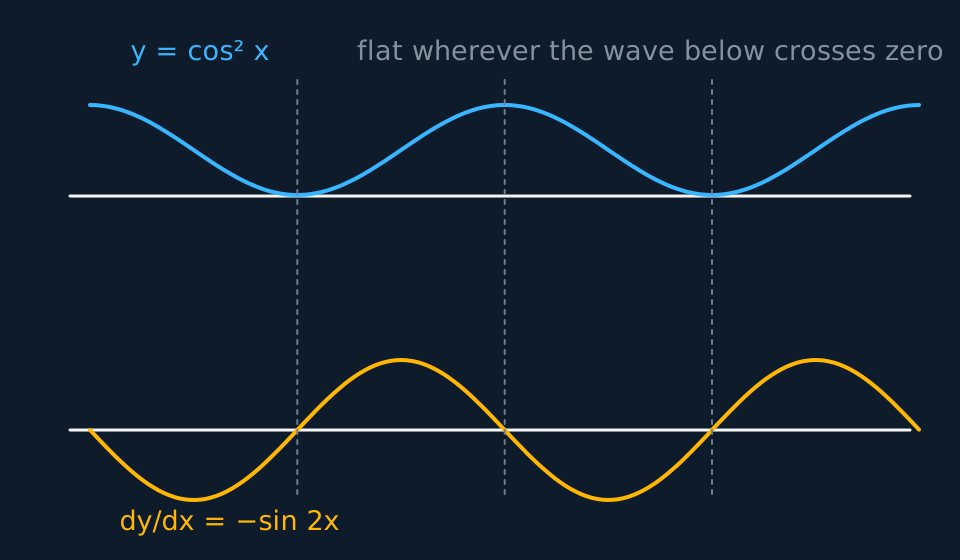
Differentiate y = cos2 x, giving the answer as a single trig term, before opening the working.
Show the working
Chain rule with u = cos x: y = u2, so dy/dx = 2u × u' = 2 cos x × (−sin x).
The double angle formula folds it: dy/dx = −sin 2x.
A squared trigonometric function is a composite with the square as the outer function, and a double angle formula often simplifies the resulting derivative.
Booklet derivatives, and combining the rules
Three further derivatives are given in the formulae booklet: sec x differentiates to sec x tan x, cosec x to −cosec x cot x, and cot x to −cosec2 x, each where the function is defined. They need not be memorised, since the booklet is available.
For expressions requiring more than one rule, work from the outside in, applying one rule per line and carrying each constant factor. Applying two rules in a single step is where factors are most often dropped.
INDEPENDENT PRACTICE
Rules within rules
Differentiate y = tan2 2x.
Show the working
Two applications of the chain rule: y = u2 with u = tan 2x, and u' = 2 sec2 2x.
dy/dx = 2u × u' = 2 tan 2x × 2 sec2 2x = 4 tan 2x sec2 2x.
The factor 2 from the square and the factor 2 from the inner angle arise at different stages, so apply one rule per line and record both.
ASSESSMENT FOCUS
- Chain rule: outside differentiated with the inside untouched, times the inside's derivative. Name u when working is being marked.
- Product rule is symmetric, quotient rule is ordered: u'v − uv', minus in the middle, all over v squared.
- Choose the rule according to how the expression is built, as a composite, a product or a quotient, and name the rule used.
- Factorise the answer. Equivalent forms are equally correct, but e3x(3x − 1)/x2 shows the stationary points directly, which a later part of the question may require.
- The derivatives of sec x, cosec x and cot x are given in the formulae booklet; quote them from it rather than from memory.
- For nested expressions apply one rule per line, outside in, and carry every constant factor.
CHECK YOURSELF
Differentiate y = x2 ln x, and find the gradient where x = e.
Show a hint
Product rule, and ln e is 1.
Show the answer
Product rule: dy/dx = 2x ln x + x2 × (1/x) = 2x ln x + x.
At x = e: 2e × 1 + e = 3e ≈ 8.15.
The term x2 × (1/x) simplifies to x, which is required for the final form, and the working assumes x > 0, the domain of ln x.
The chain rule multiplies the two rates; the product rule is u'v + uv'; the quotient rule is (u'v − uv')/v2, for v ≠ 0.
Select the rule from the structure of the expression, name the inner function u, and factorise the answer.
WORKBOOK
Printable practice for this topic: original exam-style questions with room to work, and a fully worked answer book. Free to use; please do not redistribute or sell.
Or read them with their worked answers on the product, quotient and chain rules questions page.
USED LATER IN
CHECK YOUR PROGRESS
Rate how confident you feel with each objective for this lesson. Ratings are saved in this browser, on this device, unless you sign in.
- Differentiate composite functions with the chain rule.
- Differentiate products and quotients with their rules, laid out cleanly.
- Use the booklet derivatives of sec x, cosec x and cot x.
- Combine the rules on nested expressions like cos2 x, tan2 2x and e3x/x.
Open the full revision checklist to see every objective in the course in one place.