Maths › Further algebra and series › Roots of polynomials
Roots of polynomials
A polynomial's coefficients determine the symmetric functions of its roots. Their sum, their product and other symmetric combinations can all be found without solving the equation.
Builds on Polynomials and the factor theorem and Complex arithmetic and the Argand diagram.
IN THIS TOPIC
- Read the sum and product of roots straight from a polynomial's coefficients.
- Evaluate symmetric functions such as α² + β² + γ² without finding any root.
- Build a new polynomial whose roots are a transformation of the old ones.
- Solve a cubic or quartic with real coefficients when one complex root is given.
COMMON MISCONCEPTION
To find the sum of the roots of a cubic you must first solve the cubic.
Expanding a(z − α)(z − β)(z − γ) and comparing coefficients gives α + β + γ = −b/a, with the signs alternating through the later relations. For z3 + 2z2 − 5z + 1 = 0 the sum is −2 and the pairwise sum is −5, whatever the roots themselves are, so α2 + β2 + γ2 = 4 + 10 = 14. Divide by the leading coefficient first when a ≠ 1.
Coefficients and roots
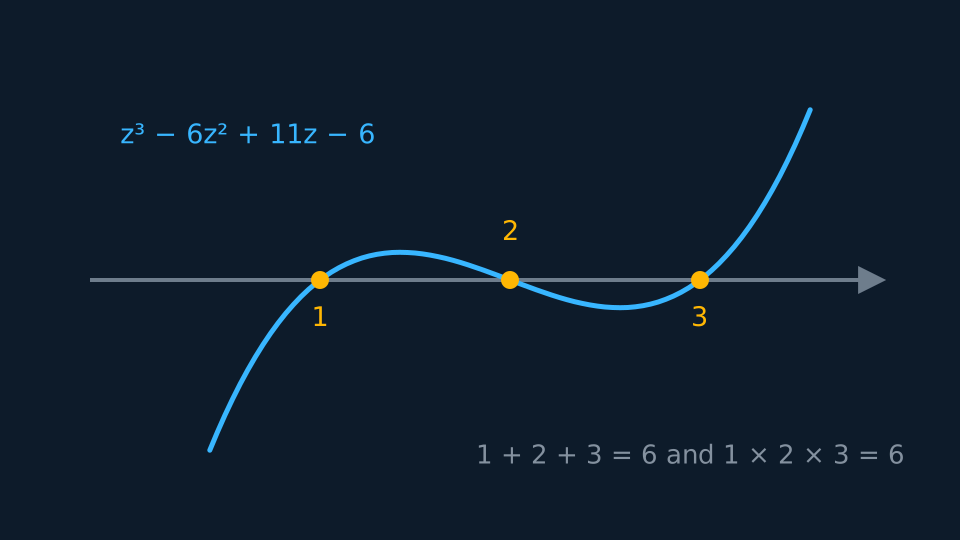
Write a cubic as a(z − α)(z − β)(z − γ) and expand. The z2 coefficient collects −a(α + β + γ), the z coefficient collects the pairwise products, and the constant collects −aαβγ. Comparing with az3 + bz2 + cz + d gives three relations:
Check the current formula booklet for your awarding organisation. Whether or not these relations are supplied, you must know when they apply and how to derive them from the expansion. For a quadratic there are two relations, α + β = −b/a and αβ = c/a. For a quartic there is a fourth relation, with the signs continuing to alternate. None of this requires the equation to be solved.
WORKED EXAMPLE
Symmetric functions without solving
The cubic z³ + 2z² − 5z + 1 = 0 has roots α, β, γ. Find α² + β² + γ².
From the coefficients, α + β + γ = −2 and αβ + αγ + βγ = −5.
Square the sum: (α + β + γ)² = α² + β² + γ² + 2(αβ + αγ + βγ).
So α² + β² + γ² = (−2)² − 2(−5) = 14.
The individual roots are irrational, but the symmetric combination is determined by the coefficients alone.
New equations from old
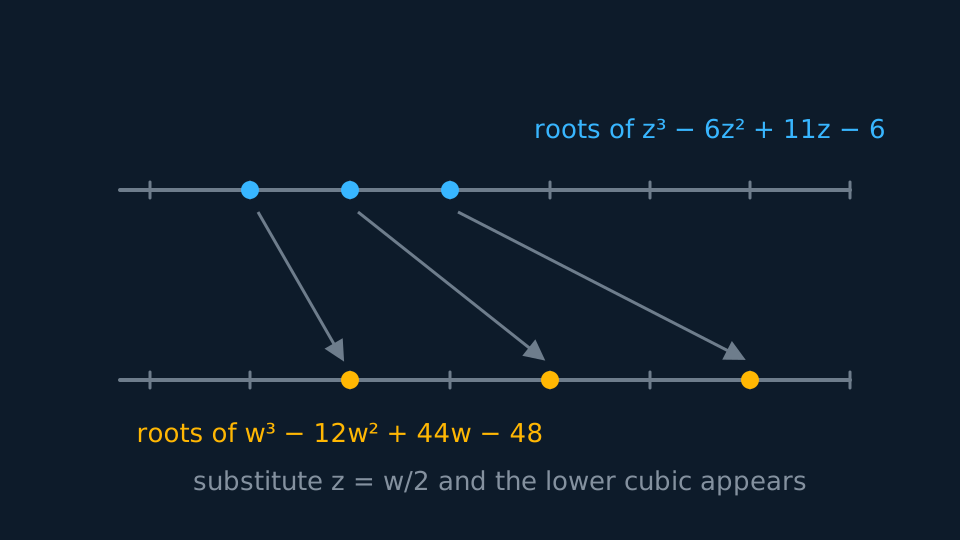
A common requirement is to find, from an equation with roots α and β, an equation with roots 2α and 2β. Use substitution: if w = 2z then z = w/2, and substituting z = w/2 into the original equation gives a polynomial in w whose roots are the doubled ones. Alternatively, compute the new sum and product from the old ones and rebuild the polynomial.
WORKED EXAMPLE
Squared roots from a quadratic
z² − 5z + 3 = 0 has roots α, β. Find a quadratic with roots α², β².
New sum: α² + β² = (α + β)² − 2αβ = 25 − 6 = 19.
New product: α²β² = (αβ)² = 9.
A quadratic is z² − (sum)z + (product), so z² − 19z + 9 = 0.
GUIDED PRACTICE
Doubled roots of a cubic
z³ − 6z² + 11z − 6 = 0 has roots α, β, γ. Find a cubic with roots 2α, 2β, 2γ.
Show the working
Substitute z = w/2: w³/8 − 6w²/4 + 11w/2 − 6 = 0.
Multiply through by 8: w³ − 12w² + 44w − 48 = 0.
Check with the known roots 1, 2, 3. The doubled set 2, 4, 6 has sum 12, pairwise sum 8 + 12 + 24 = 44 and product 48. Both routes agree.
Using one complex root
For a polynomial with real coefficients, every non-real root occurs with its complex conjugate. One complex root of a cubic therefore gives two roots, and the third follows from the sum or the product of the roots without factorising. The same argument reduces a quartic to a quadratic.
WORKED EXAMPLE
A cubic from one root
Given that 2 + 3i is a root of z³ − 5z² + 17z − 13 = 0, solve the equation.
The coefficients are real, so 2 − 3i is a root as well.
Sum of roots = 5, and (2 + 3i) + (2 − 3i) = 4, so the third root is 1.
The roots are 1, 2 + 3i, 2 − 3i. Check the product: 1 × (4 + 9) = 13, which matches −d/a.
The alternative method multiplies the conjugate pair into the real quadratic factor z² − 4z + 13 and divides. Both are valid; the sum-of-roots route requires less algebra. The conjugate result requires real coefficients, so it does not apply to an equation such as z² − (2 + i)z + 5 = 0.
ASSESSMENT FOCUS
- Obtain the signs from the expansion rather than from memory: the sum is −b/a and the signs alternate from there.
- Divide by the leading coefficient first when a ≠ 1, so that the root sums read straight off the coefficients.
- For α² + β² + γ², quote the identity (Σα)² − 2Σαβ.
- For transformed roots, state the substitution w = f(z) explicitly before rearranging.
- Given one complex root, write down its conjugate in the first line and state that the coefficients are real.
CHECK YOURSELF
The equation 2z³ − 4z² + 3z − 7 = 0 has roots α, β, γ. Write down α + β + γ and αβγ.
Show a hint
Divide every coefficient by 2 before reading anything off.
Show the answer
Dividing by 2 gives z³ − 2z² + (3/2)z − 7/2 = 0, so α + β + γ = 2 and αβγ = 7/2. The pairwise sum, if asked, is 3/2.
Expand a(z − α)(z − β)…: root sums and products sit in the coefficients, signs alternating.
For transformed roots, substitute z in terms of w, or rebuild from the new sum and product.
Real coefficients force complex roots into conjugate pairs.
WORKBOOK
Printable practice for this topic: original exam-style questions with room to work, and a fully worked answer book. Free to use; please do not redistribute or sell.
Or read them with their worked answers on the roots of polynomials questions page.
CHECK YOUR PROGRESS
Rate how confident you feel with each objective for this lesson. Ratings are saved in this browser, on this device, unless you sign in.
- Read the sum and product of roots straight from a polynomial's coefficients.
- Evaluate symmetric functions such as α² + β² + γ² without finding any root.
- Build a new polynomial whose roots are a transformation of the old ones.
- Solve a cubic or quartic with real coefficients when one complex root is given.
Open the full revision checklist to see every objective in the course in one place.