Maths › Further calculus › Volumes of revolution
Volumes of revolution
A slice perpendicular to the axis of rotation forms a disc or washer. About the x-axis, its area is π(R² − r²), where R and r are radial distances from the axis. Integrate this cross-sectional area over the stated interval, splitting where the boundary or radius changes.
Builds on Definite integrals and areas and Areas and the limit of a sum.
IN THIS TOPIC
- Use V = π∫y² dx for rotation about the x-axis, with the right limits.
- Swap to V = π∫x² dy for rotation about the y-axis.
- Subtract solids for a region between two curves, and handle parametric curves.
- Check answers against known solids such as cones.
COMMON MISCONCEPTION
For a region between two curves, subtract the curves first and square after: V = π∫(youter − yinner)² dx.
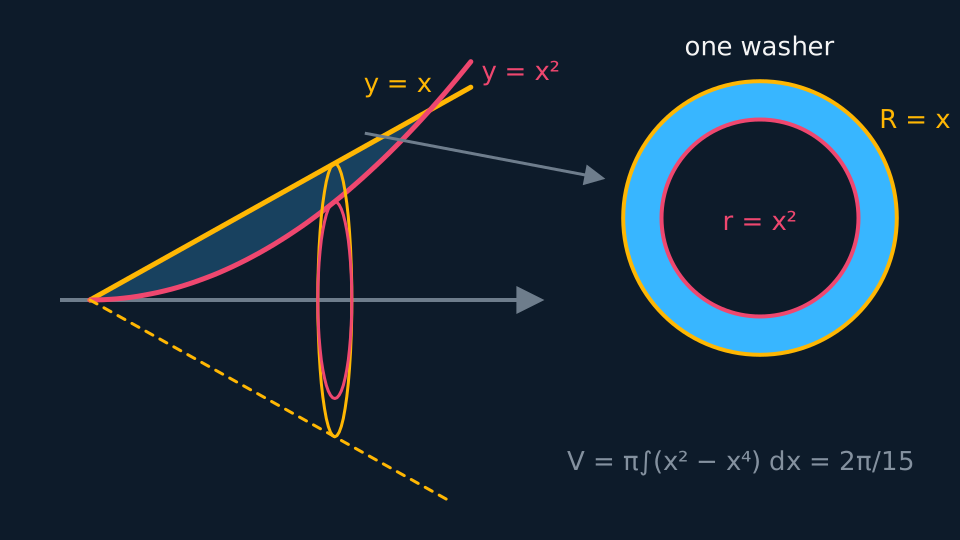
Each slice is a washer, so the two radii are squared separately: dV = π(R2 − r2) dx with R ≥ r ≥ 0, and the square of a difference is not the difference of the squares. Between y = x and y = x2 from 0 to 1 the volume is π∫(x2 − x4) dx = 2π/15, where squaring the difference would give π/30.
Slicing into discs
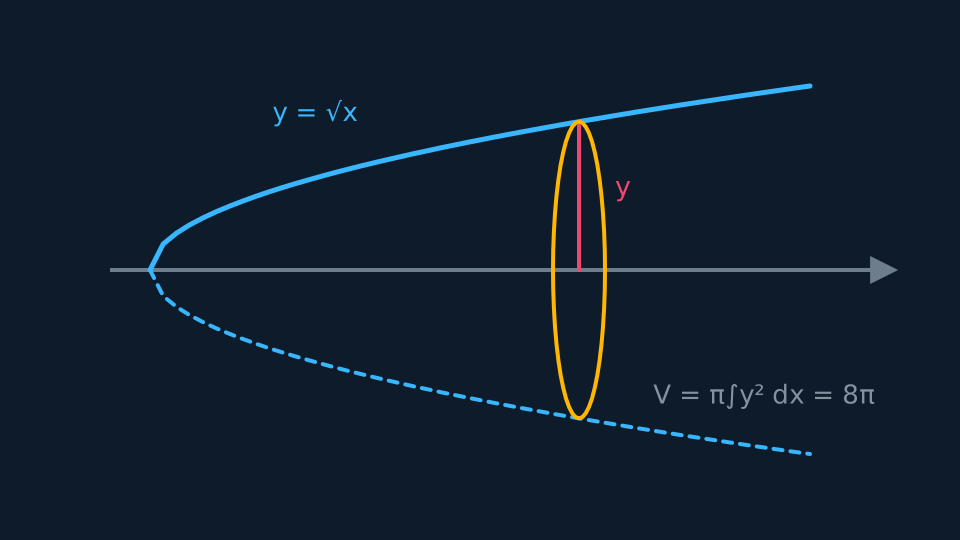
Rotate the region under y = f(x) about the x-axis. Each vertical strip becomes a thin disc whose radius is the distance |y| from the axis and whose thickness is dx, so its volume is πy² dx and:
Check the current formula booklet for your awarding organisation; whether or not a volume formula is supplied, you must know when it applies and how to derive it. Slicing perpendicular to the y-axis instead gives V = π∫x² dy, with limits taken on the y-axis. The quantity squared is the radial distance from the axis of rotation, which matters as soon as two curves are involved.
WORKED EXAMPLE
A curve made solid
The region under y = √x from x = 0 to 4 is rotated fully about the x-axis. Find the volume.
V = π∫y² dx = π∫x dx from 0 to 4.
= π[x²/2] = π × 8 = 8π.
Squaring removes the square root before integration, as it does for any curve of the form y = √(g(x)).
Checking against known solids, and the y-axis
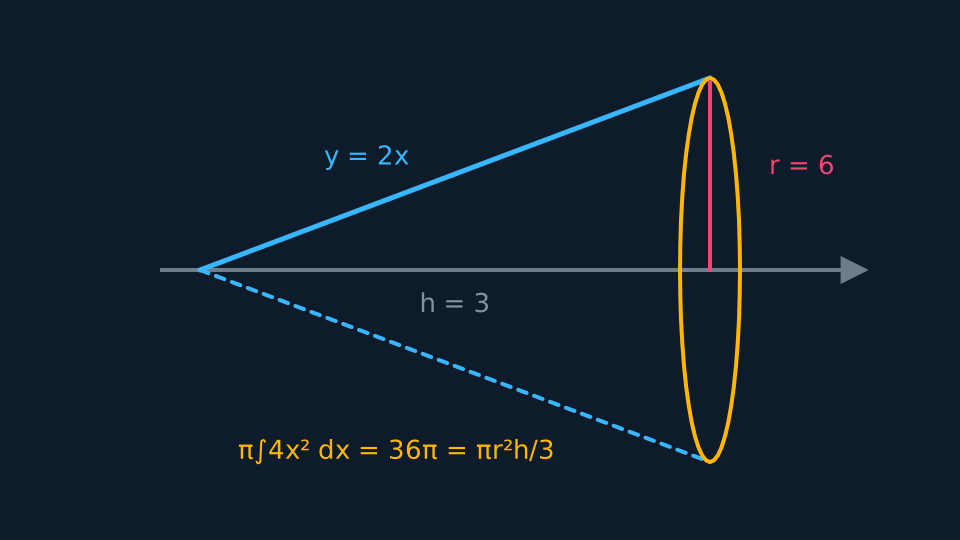
Rotating y = 2x from x = 0 to 3 produces a cone. V = π∫4x² dx = 36π, which matches πr²h/3 with r = 6 and h = 3. Use a known solid to check the integral whenever the curve is a straight line.
WORKED EXAMPLE
About the y-axis instead
The region between y = x², the y-axis and y = 4 is rotated about the y-axis. Find the volume.
The radius is now x, and x² = y on the curve.
V = π∫x² dy = π∫y dy from 0 to 4 = π × 8 = 8π.
The value matches the first example because this region is the first one reflected in y = x, so the solid is the same, now with limits on y and radius x.
GUIDED PRACTICE
A cone by integration
By rotating y = 3x between x = 0 and x = 2 about the x-axis, verify the cone volume formula for r = 6, h = 2.
Show the working
V = π∫9x² dx from 0 to 2 = π[3x³] = 24π.
The formula gives πr²h/3 = π × 36 × 2/3 = 24π.
The two values agree.
Washers and parametric curves
A region between two curves generates a solid with a hole. About the x-axis, use radii measured perpendicular to the axis. Where R(x) ≥ r(x) ≥ 0, dV = π(R² − r²) dx. If the region crosses the axis or the outer radius changes, split the integral. When the region between y = x and y = x² from 0 to 1 is rotated about the x-axis, both curves are non-negative there and x ≥ x², so R = x and r = x², giving π∫(x² − x⁴) dx = π(1/3 − 1/5) = 2π/15. Square each radius separately: the square of a difference is not the difference of the squares.
Describe the drawing
The sliver between the line y equals x and the parabola y equals x squared shaded on the left, with its dashed mirror image below the axis, and one slice pulled out on the right as a washer: an amber outer rim of radius x from the line, a coral inner hole of radius x squared from the parabola, and navy showing through the middle. Squaring each radius separately and subtracting gives pi times the integral of x squared minus x to the fourth, which is 2 pi over 15.
WORKED EXAMPLE
A parametric volume
The curve x = t², y = t³ for 0 ≤ t ≤ 1 is rotated about the x-axis. Find the volume generated.
Change the variable in π∫y² dx. Here dx = 2t dt.
V = π∫ t⁶ × 2t dt from t = 0 to 1 = 2π∫ t⁷ dt.
= 2π[t⁸/8] = π/4.
Convert the limits to values of t when you replace dx; an integral in t must carry t-limits.
ASSESSMENT FOCUS
- Square the radius before integrating: integrating y and squaring afterwards gives a different value.
- About the y-axis, express x² in terms of y and use y-limits.
- Give answers as exact multiples of π unless the question asks for a decimal.
- For a region between two curves, use π∫(R² − r²) dx with R and r the radial distances, and split the integral where the region crosses the axis or the outer radius changes.
CHECK YOURSELF
The region under y = 2x from x = 0 to 3 is rotated about the x-axis. Find the volume, and name the solid.
Show a hint
π∫4x² dx, then compare with πr²h/3.
Show the answer
V = π∫4x² dx from 0 to 3 = π[4x³/3] = 36π. The solid is a cone with base radius 6 and height 3, and πr²h/3 gives the same 36π.
About the x-axis, V = π∫y² dx between x-limits, with the radius measured perpendicular to the axis; square first, then integrate.
About the y-axis, V = π∫x² dy between y-limits, with x² rewritten in terms of y.
For a washer, dV = π(R² − r²) dx with R ≥ r ≥ 0; split the integral where the region crosses the axis or the outer radius changes.
Parametric curves: substitute for y² and dx, and change the limits to t.
WORKBOOK
Printable practice for this topic: original exam-style questions with room to work, and a fully worked answer book. Free to use; please do not redistribute or sell.
Or read them with their worked answers on the volumes of revolution questions page.
USED LATER IN
CHECK YOUR PROGRESS
Rate how confident you feel with each objective for this lesson. Ratings are saved in this browser, on this device, unless you sign in.
- Use V = π∫y² dx for rotation about the x-axis, with the right limits.
- Swap to V = π∫x² dy for rotation about the y-axis.
- Subtract solids for a region between two curves, and handle parametric curves.
- Check answers against known solids such as cones.
Open the full revision checklist to see every objective in the course in one place.