Maths › Further Pure 1 › The t-formulae
The t-formulae
With t = tan(θ/2), sine, cosine and dθ become rational functions of t. Transform the integrand or equation, change any limits, and check odd multiples of π separately because the substitution does not reach them.
Builds on Compound angles and the harmonic form and Reciprocal and inverse trigonometric functions.
IN THIS TOPIC
- Derive sin θ, cos θ and tan θ in terms of t = tan(θ/2), and quote them without hesitating.
- Prove trig identities by converting every term to t.
- Turn a cos x + b sin x = c into a quadratic in t and solve it.
- Check every odd multiple of π in the stated interval by hand, since the substitution does not reach them.
COMMON MISCONCEPTION
sin θ, cos θ and tan θ are three independent quantities; no single variable can carry all three.
One value of t = tan(θ/2) fixes all three ratios. The double angle formulae give sin θ = 2t/(1 + t²), cos θ = (1 − t²)/(1 + t²) and tan θ = 2t/(1 − t²), so an equation in the three ratios becomes a quadratic in the single variable t. The substitution reaches no odd multiple of π, where t is undefined, so those angles are checked by hand.
One variable, three ratios
Put t = tan(θ/2) and the double angle formulae do everything else. Start from sin θ = 2 sin(θ/2)cos(θ/2) and cos θ = 2cos²(θ/2) − 1, then use cos²(θ/2) = 1/(1 + t²). Both ratios fall out in one step.
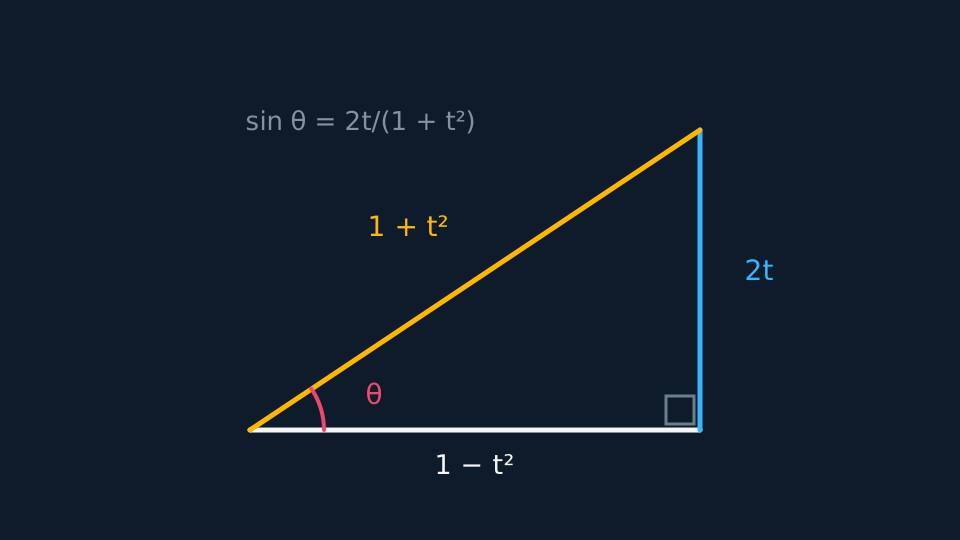
Check the current formula booklet for your awarding organisation. Whether or not the result is supplied, you must know when it applies and how to derive it if the question asks for a proof. One value of t determines all three ratios. The same three expressions can be read off a right-angled triangle with legs 2t and 1 − t² and hypotenuse 1 + t², since (2t)² + (1 − t²)² = (1 + t²)². Treat that triangle as a signed mnemonic rather than a genuine figure: outside 0 < θ < π/2 the legs 2t and 1 − t² can be negative, and the formulae keep the signs right even where no such triangle can be drawn.
WORKED EXAMPLE
A spot check at a known angle
Verify the t-formulae at θ = π/3.
t = tan(π/6) = 1/√3, so t² = 1/3 and 1 + t² = 4/3.
sin θ = (2/√3)/(4/3) = (2/√3)(3/4) = √3/2, correct.
cos θ = (2/3)/(4/3) = 1/2, correct. One value of t has produced both ratios exactly.
Identities, once everything is in t
To prove an identity, convert both sides to t and simplify each until the two expressions agree. Work on the side with more terms first. Every denominator that appears is 1 + t² or 1 − t², so clear the fractions early.
Take (1 − cos θ)/sin θ. The numerator becomes 1 − (1 − t²)/(1 + t²), which is 2t²/(1 + t²). The denominator is 2t/(1 + t²). Dividing, the 1 + t² cancels and what remains is t, so (1 − cos θ)/sin θ = tan(θ/2).
Because t = tan(θ/2) is undefined at odd multiples of π, check every excluded angle in the stated interval separately whenever the original equation or identity is defined there. The formulae themselves remain valid at every angle at which t exists.
Equations that become quadratics
In a cos x + b sin x = c, substitute the t-formulae and multiply through by 1 + t². The result is a quadratic in t. Solve it, recover x = 2 arctan t, and bring the angles into the demanded interval.
WORKED EXAMPLE
A double root that means tangency
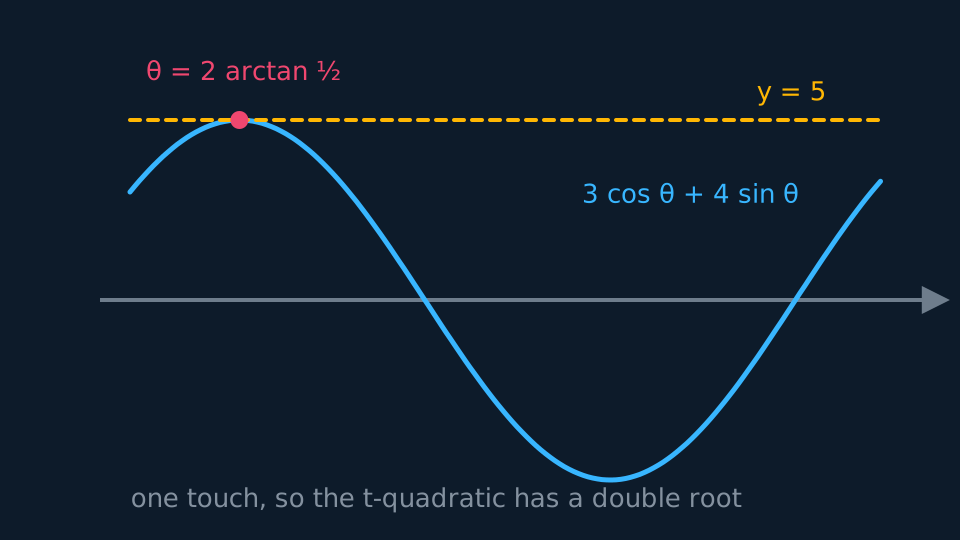
Solve 3 cos θ + 4 sin θ = 5 for 0 ≤ θ < 2π.
Substitute: 3(1 − t²) + 8t = 5(1 + t²), so 8t² − 8t + 2 = 0, which is 2(2t − 1)² = 0.
The repeated root t = 1/2 gives θ = 2 arctan(1/2) ≈ 0.927.
The root had to be repeated. Since √(3² + 4²) = 5, the level y = 5 is the maximum value of 3 cos θ + 4 sin θ, so the line touches the curve rather than crossing it, and there is one solution in the interval.
GUIDED PRACTICE
A two-solution equation
Solve cos θ + sin θ = 1 for 0 ≤ θ < 2π, using the t-formulae, and state any value of θ the substitution cannot see.
Show the working
Substitute: (1 − t²) + 2t = 1 + t², so 2t² − 2t = 0 and t = 0 or 1.
t = 0 gives θ = 0; t = 1 gives θ = π/2. Both check, since 1 + 0 and 0 + 1 each equal 1.
θ = π is the one odd multiple of π in the interval, and the substitution does not reach it. Substituting it into the original equation gives −1 + 0 ≠ 1, so it is not a solution. The check is part of the method whether or not it adds a root.
ASSESSMENT FOCUS
- Quote all three t-formulae before substituting, and derive them when the question asks for a derivation.
- Multiply through by 1 + t² early. That factor is never zero, so no solutions are created or lost.
- Check every odd multiple of π lying in the stated interval separately, whenever the original equation or identity is defined there; the substitution does not produce them.
- Recover angles with x = 2 arctan t, then adjust into the demanded interval before writing the final line.
- In a proof, stop when both sides are the same expression in t and state that they agree.
CHECK YOURSELF
Given t = tan(θ/2) = 1/3, find sin θ and cos θ exactly.
Show a hint
1 + t² = 10/9; substitute into the two formulae.
Show the answer
sin θ = (2/3)/(10/9) = 3/5 and cos θ = (8/9)/(10/9) = 4/5, the sides of a 3-4-5 triangle.
With t = tan(θ/2): sin θ = 2t/(1 + t²), cos θ = (1 − t²)/(1 + t²), tan θ = 2t/(1 − t²).
a cos x + b sin x = c becomes a quadratic in t. Solve it, then take x = 2 arctan t.
The substitution reaches no odd multiple of π, so check each one lying in the stated interval by hand.
WORKBOOK
Printable practice for this topic: original exam-style questions with room to work, and a fully worked answer book. Free to use; please do not redistribute or sell.
Or read them with their worked answers on the t-formulae questions page.
USED LATER IN
CHECK YOUR PROGRESS
Rate how confident you feel with each objective for this lesson. Ratings are saved in this browser, on this device, unless you sign in.
- Derive sin θ, cos θ and tan θ in terms of t = tan(θ/2), and quote them without hesitating.
- Prove trig identities by converting every term to t.
- Turn a cos x + b sin x = c into a quadratic in t and solve it.
- Check every odd multiple of π in the stated interval by hand, since the substitution does not reach them.
Open the full revision checklist to see every objective in the course in one place.