Physics › Mechanics › Projectile motion
Projectile motion
A projectile runs two motions at once, constant velocity horizontally and free-fall acceleration vertically, and time is all they share. Every problem therefore resolves the launch velocity, finds the time in one direction and spends it in the other. Air resistance lowers the path, shortens the range and steepens the descent.
Choose your exam board to show the notes and questions relevant to your specification. You can change this setting at any time, and content for other boards remains available.
Builds on Motion graphs and the SUVAT equations.
The maths behind it: Projectiles on InkMaths.
IN THIS TOPIC
- Explain the independence of horizontal and vertical motion in a uniform gravitational field.
- Solve projectile problems by treating the two directions separately, linked only by time.
- Describe qualitatively how air resistance changes a projectile's trajectory.
COMMON MISCONCEPTION
Something must keep pushing a projectile forwards.
Nothing pushes a projectile along. With air resistance neglected the only force is gravity, straight down, so horizontal velocity stays constant. Motion needs no force to continue, only to change.
Independent horizontal and vertical motion
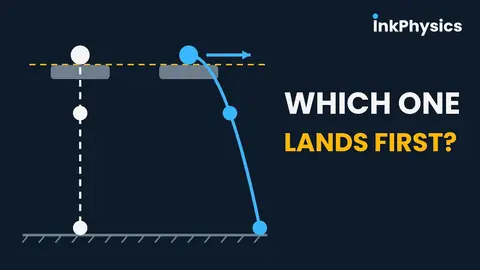
Once a projectile leaves your hand, ignoring air resistance, exactly one force acts on it. Its weight, straight down. Nothing pushes it forward, and nothing has to, because motion continues perfectly well without a force. Out of that comes the central fact of the topic, that the horizontal and vertical motions are independent.

Describe the drawing
One ball dropped, one launched sideways, released at the same instant. The amber dashed line joins them and never tilts: their vertical motions are the same motion. On the launched ball, the horizontal velocity arrow never changes while the vertical one grows steadily from nothing, which is free fall at g. Faded strobes freeze the story for the dwell.
Drop one ball and launch another horizontally at the same instant, and they hit the ground together. The launched ball's sideways speed does nothing to its fall. Horizontally it moves at constant velocity; vertically it accelerates at g like anything else in free fall.
Solving the two problems
Every projectile question is the same procedure. Resolve the initial velocity into components. Treat the vertical motion as constant acceleration, a = g downward, using the SUVAT equations. Treat the horizontal motion as constant speed, distance = speed × time. The single shared quantity is time, so almost every problem finds t from one direction and spends it in the other.
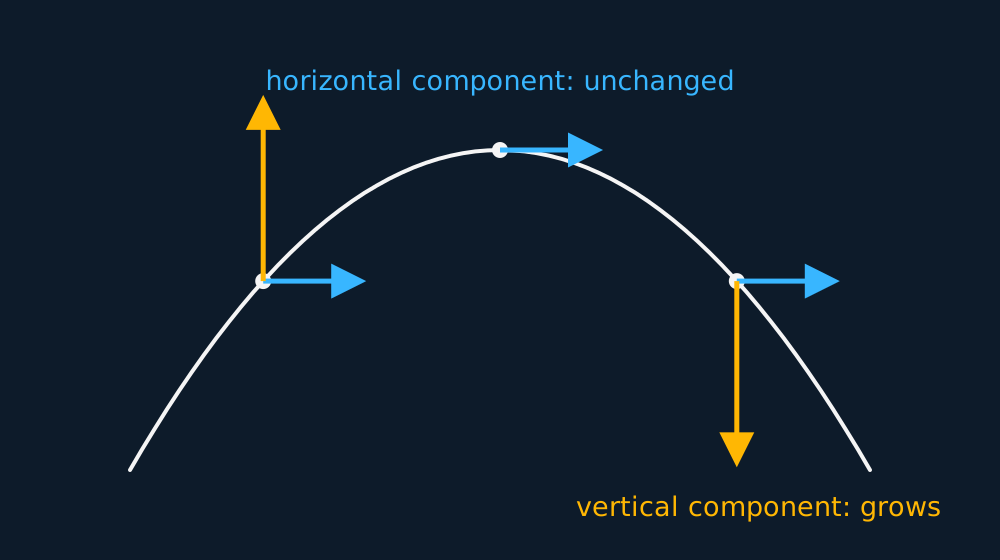
The velocity picture follows from that. The horizontal component is identical at every point of the flight, while the vertical one passes through zero at the apex. At the top of the arc the projectile is still moving horizontally, so the velocity at the highest point is not zero; it equals the horizontal component.
WORKED EXAMPLE
The full two-column method
A ball is struck from level ground at 25 m s−1, 30° above the horizontal. Find its time of flight and its range. Take g = 9.81 m s−2.
Draw it before you calculate anything, then resolve the launch velocity. Across, 25 cos 30° = 21.7 m s−1. Up, 25 sin 30° = 12.5 m s−1. Both columns share the same time t.
The flight time lives in the vertical column. Landing at launch height means the vertical displacement is zero, so s = ut + ½at2 with s = 0 gives t = 2 × 12.5/9.81 = 2.55 s.
Now spend that time in the horizontal column, where there is no acceleration. Range = 21.7 × 2.55 = 55 m to two significant figures.
Check the size of the answer: a hard strike carries a ball tens of metres rather than hundreds, and a flight time near 2.5 s is consistent with that. All the inputs were in SI units, so the range comes out in metres.
GUIDED PRACTICE
How high does the same ball go?
Same launch: 25 m s−1 at 30°, so the vertical component is 12.5 m s−1 and at the top the vertical velocity is zero. Choose the vertical SUVAT equation with no t in it, solve for the height, then compare with the working.
Show the working
With v = 0, u = 12.5 and a = −9.81, the equation without t is , so 0 = 12.52 − 2 × 9.81 × s.
s = 156.25/19.62 = 8.0 m. As a check, a rough climb of about 1.3 s at an average vertical speed near 6 m s−1 gives about the same height.
INDEPENDENT PRACTICE
A ramp and a landing
A stunt rider leaves a ramp at 18 m s−1, 40° above the horizontal, and lands at the same height. How far away is the landing? Work it through completely.
Show the working
Resolve first. Across, 18 cos 40° = 13.8 m s−1. Up, 18 sin 40° = 11.6 m s−1.
In the vertical column, s = 0 gives t = 2 × 11.6/9.81 = 2.36 s.
In the horizontal column, range = 13.8 × 2.36 = 33 m to two significant figures. The two columns never mixed. Only t crossed between them.
What air resistance does
A qualitative account is all that is asked for. Air resistance opposes the motion and increases with speed, so it reduces the horizontal velocity throughout the flight and acts against the motion during both the ascent and the descent.
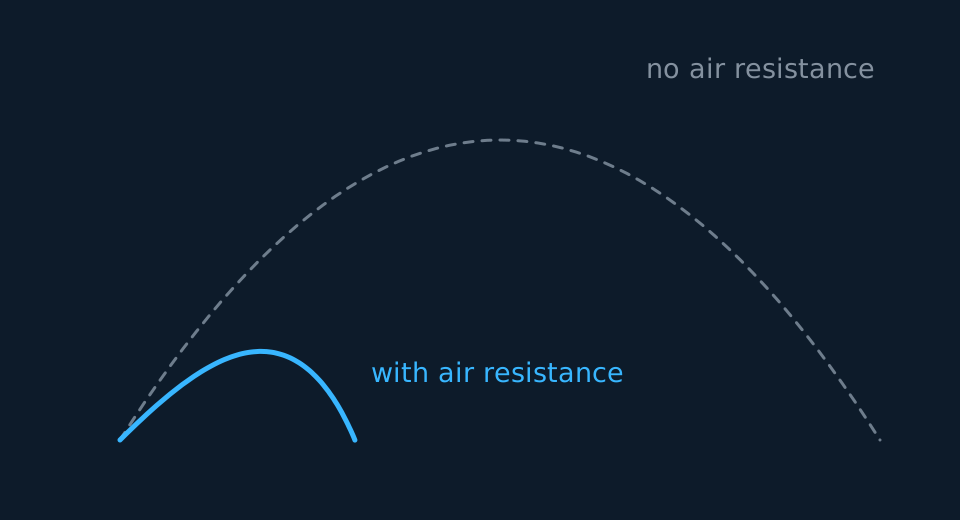
The resulting trajectory is lower and shorter than the ideal parabola, and it loses its symmetry. The descent is steeper than the ascent because the horizontal velocity has been reduced by then. The same reasoning sets a vehicle's top speed: the resistive force increases with speed until it equals the driving force, and that speed is the maximum.
ASSESSMENT FOCUS
- Start by resolving the launch velocity and ruling two columns, horizontal and vertical. Do not combine a horizontal and a vertical quantity in one equation.
- The horizontal direction has no acceleration. Never put g in it, never use SUVAT there, and remember distance is just speed times time.
- At the apex the vertical velocity is zero but the speed is not, because the horizontal component is unchanged.
- For air resistance, give three effects: lower maximum height, shorter range, and a descent steeper than the ascent.
CHECK YOURSELF
A ball rolls off a table 1.25 m high at 4.0 m s−1. How long is it in the air, and how far from the table does it land?
Show a hint
The fall time comes from the vertical motion alone. The sideways speed has nothing to do with it.
Show the answer
Vertically, with s = 1.25 m gives , so t = 0.50 s.
Horizontally, a constant 4.0 m s−1 for 0.50 s gives a range of 4.0 × 0.50 = 2.0 m.
The vertical motion gives the time of flight; the horizontal motion then uses that time to give the range.
Across, constant velocity.
Down, constant acceleration.
Time is the only thing the two columns share.
WORKBOOK
Printable practice for this topic: original exam-style questions with room to work, and a fully worked answer book. Free to use; please do not redistribute or sell.
Or read them with their mark schemes on the projectile motion questions page.
WHERE TO GO NEXT
- Trigonometry and resolving vectors is the maths this lesson leans on, worked through step by step.
USED LATER IN
CHECK YOUR PROGRESS
Rate how confident you feel with each objective for this lesson. Ratings are saved in this browser, on this device, unless you sign in.
- Explain the independence of horizontal and vertical motion in a uniform gravitational field.
- Solve projectile problems by treating the two directions separately, linked only by time.
- Describe qualitatively how air resistance changes a projectile's trajectory.
Open the full revision checklist to track your progress across the whole unit.