Physics › Engineering physics › Moment of inertia and rotational kinetic energy
Moment of inertia and rotational kinetic energy
Mass measures reluctance to accelerate along a line, and the moment of inertia does that job in rotation, summing mr² over the body. Distance from the axis counts squared, so a flywheel carries its mass at the rim. A turning body stores rotational kinetic energy ½Iω², so doubling the spin rate quadruples the store.
Choose your exam board to show the notes and questions relevant to your specification. You can change this setting at any time, and content for other boards remains available.
Rotational motion and moment of inertia, part 2 of 2. Part 1 is Rotational motion and the angular equations.
Builds on Rotational motion and the angular equations and Work, energy and power.
IN THIS TOPIC
- Say what moment of inertia measures and how mass distribution changes it, using values you are given.
- Calculate rotational kinetic energy with half I omega squared, including for flywheels storing energy.
COMMON MISCONCEPTION
How hard something is to set spinning depends only on its mass.
Mass alone does not decide it. The moment of inertia sums mr2, so where the mass sits counts squared: a light hoop with everything at the rim can resist spin-up more than a heavier disc whose mass hugs the axis.
Moment of inertia
In F = ma, mass measures the reluctance to accelerate. Rotation has its own reluctance, and it is not mass alone. Push a roundabout at its rim with children sitting at the edge and it is hard to start turning; move the same children close to the centre and the same push spins it up easily. The mass has not changed. Its distribution has.
The quantity doing mass's job is the moment of inertia I. Cut the body into particles, multiply each mass by the square of its distance from the axis, and add:
which the booklet compresses with a capital sigma, standing for the sum over every particle. The unit is kg m2. The square is the key point. Mass twice as far from the axis counts four times over, so pushing material out to the rim raises I far faster than adding material at the middle.
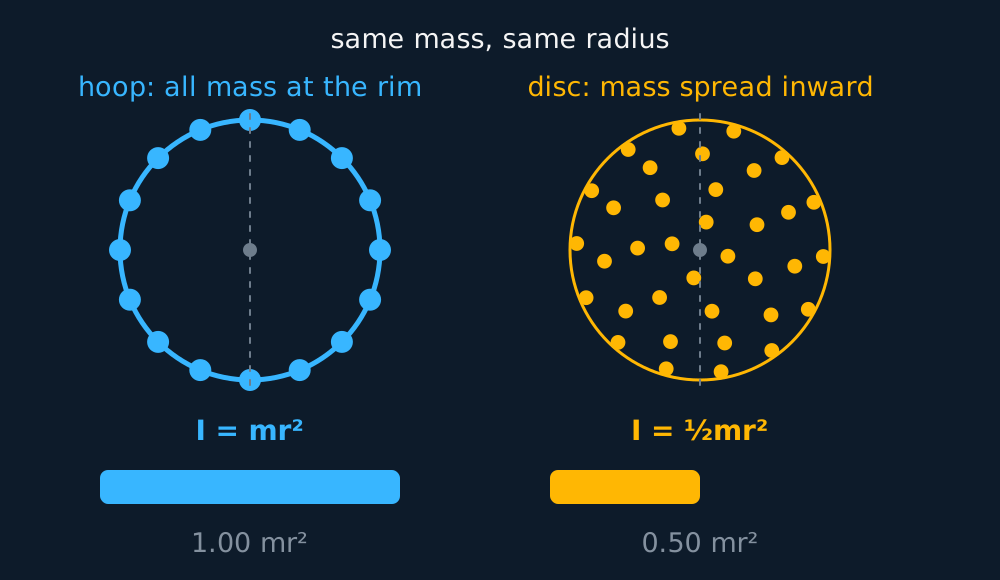
A light hoop can resist spin-up more than a heavy compact disc, because r2 weights distance so heavily. You are never asked to derive I for a shape. Questions give you the value, or the formula for it, and your job is to use it, plus one idea in words, that mass concentrated far from the axis means a large I and mass concentrated close to the axis means a small one.
GUIDED PRACTICE
Two masses on a light rod
Two 0.40 kg masses sit at the ends of a light rod, each 0.30 m from the central axis, spinning at 5.0 rad s−1. Find the moment of inertia and state what happens to I if the masses slide halfway in.
Show the working
I = 2 × 0.40 × 0.302 = 0.072 kg m2. The rod is light, so only the masses count.
At 0.15 m each r2 falls by a factor of four, so I drops to a quarter, 0.018 kg m2. Halving the distance does far more than halving would suggest.
Rotational kinetic energy and the flywheel
A rotating body stores kinetic energy even though its centre of mass does not move, because every particle in it is moving. Adding the half m v squared of each particle, with v = ωr, gives
the exact twin of half m v squared with I for m and ω for v. A machine built to exploit this is the flywheel, a wheel made deliberately hard to spin up, with its mass pushed out to the rim where r2 works hardest. Spin it fast and it becomes an energy store.
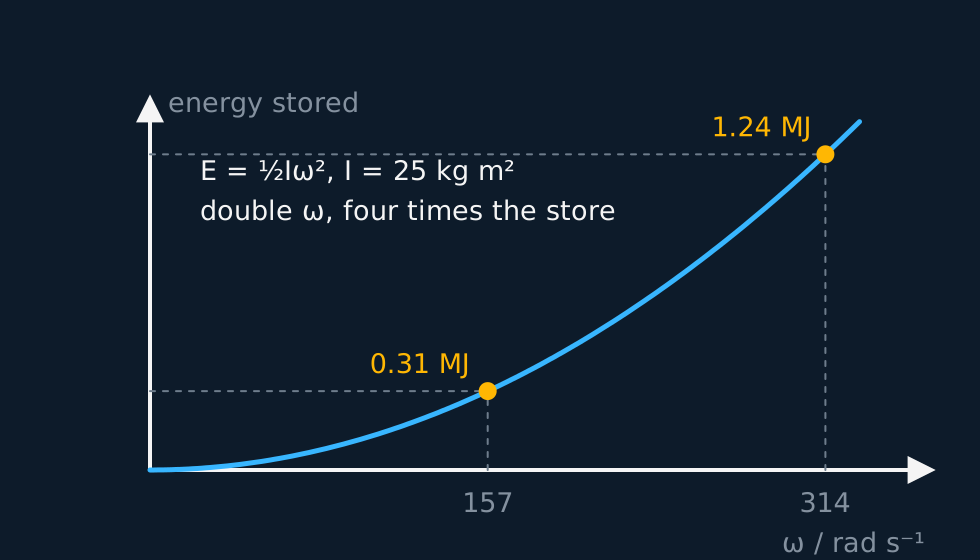
Because , spin rate matters more than mass. Doubling the spin rate quadruples the store, so modern flywheel batteries are modest discs spun to tens of thousands of revolutions per minute in a vacuum, on magnetic bearings, feeding braking energy back to trams and grid-scale stores smoothing out demand spikes.
| Linear quantity | Rotational twin |
|---|---|
| displacement s | angular displacement θ |
| velocity v | angular velocity ω |
| acceleration a | angular acceleration α |
| mass m | moment of inertia I |
| kinetic energy = ½mv2 | Ek = ½Iω2 |
| force F | torque T |
| momentum mv | angular momentum Iω |
Every linear quantity has a rotational analogue. The last two rows, torque and angular momentum, are covered in the lessons on torque and angular acceleration and on angular momentum and rotational power.
INDEPENDENT PRACTICE
The flywheel as a battery
A flywheel is a uniform disc of mass 140 kg and radius 0.60 m, for which I = ½mr2, spun at 3000 revolutions per minute. Find the energy it stores, and how long it could supply 5.0 kW.
Show the working
I = ½ × 140 × 0.602 = 25.2 kg m2, and ω = 3000 × 2π/60 = 314 rad s−1.
Ek = ½ × 25.2 × 3142 = 1.2 × 10⁶ J.
At 5.0 kW that lasts t = 1.24 × 10⁶/5000 ≈ 250 s, about four minutes. A 140 kg flywheel holds only about 0.35 kW h, so real designs increase ω rather than mass.
ASSESSMENT FOCUS
- Moment of inertia can be answered in words, without algebra. It measures resistance to angular acceleration, and it depends on how far the mass sits from the axis, with r squared. You will be given I or its formula, never asked to derive it.
- A flywheel answer states the design point, mass concentrated at the rim to maximise I, and the energy point, Ek ∝ ω2, so spin rate matters more than mass.
- If a question gives a diameter, halve it. Feeding a diameter into r2 multiplies both I and Ek by four.
- Energy answers still need ω in rad s−1, so the 2π/60 conversion comes first whenever a spin rate arrives in rev min−1.
CHECK YOURSELF
Two 1.2 kg masses sit at the ends of a light rod, each 0.25 m from the central axis, and the arrangement spins at 8.0 rad s−1. Find the moment of inertia and the kinetic energy stored, and state what happens to that energy if the spin rate doubles.
Show a hint
Sum mr2 over the two masses, then half I omega squared, then look at the square.
Show the answer
I = Σmr2 = 2 × 1.2 × 0.252 = 0.15 kg m2. The rod is light, so only the masses count.
Ek = ½Iω2 = ½ × 0.15 × 8.02 = 4.8 J.
Doubling ω quadruples the store to 19.2 J, because Ek ∝ ω2 while I has not changed.
I sums mr² over the body, so distance from the axis counts squared.
A spinning body stores ½Iω², so doubling the spin rate quadruples the stored energy.
Or read them with their mark schemes on the rotational motion and the angular equations questions page.
CHECK YOUR PROGRESS
Rate how confident you feel with each objective for this lesson. Ratings are saved in this browser, on this device, unless you sign in.
- Say what moment of inertia measures and how mass distribution changes it, using values you are given.
- Calculate rotational kinetic energy with half I omega squared, including for flywheels storing energy.
Open the full revision checklist to track your progress across the whole unit.