Physics › Engineering physics › Rotational motion and the angular equations
Rotational motion and the angular equations
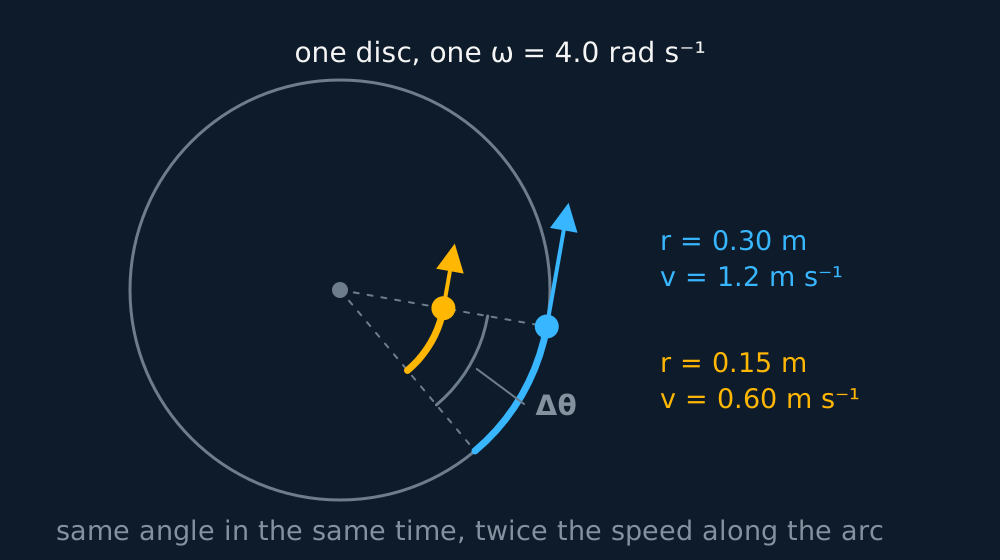
Angular displacement, angular velocity and angular acceleration describe a turning body in radians, and four SUVAT-shaped equations link them. Every point of a rigid body shares one angular velocity. What differs from point to point is the radius, and v = ωr gives each point its own speed.

Choose your exam board to show the notes and questions relevant to your specification. You can change this setting at any time, and content for other boards remains available.
Rotational motion and moment of inertia, part 1 of 2. Part 2 is Moment of inertia and rotational kinetic energy.
Builds on Circular motion.
IN THIS TOPIC
- Describe rotation with angular displacement, angular velocity and angular acceleration, in radians.
- Solve uniform angular acceleration problems with the four angular equations of motion.
COMMON MISCONCEPTION
Every point on a spinning wheel moves at the same speed, because the wheel turns as one piece.
Every point shares the same angular velocity, not the same speed: v = ωr, so a rim point outruns one near the hub in exact proportion to its radius.
Angles instead of metres
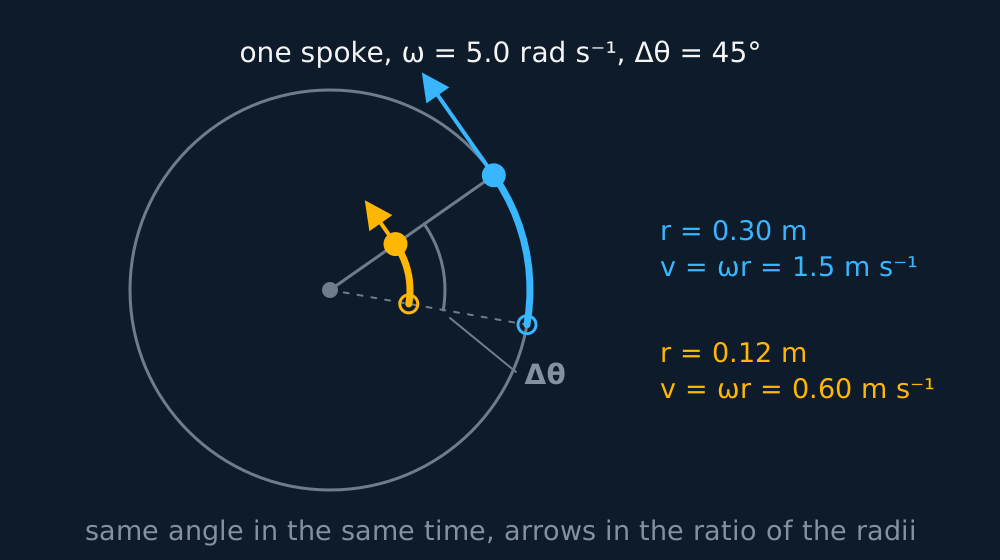
Take any rigid body turning about a fixed axis, a wheel, a drum, a turbine, and every particle in it sweeps the same angle in the same time. That shared angle is what rotational motion measures. The angular displacement θ is the angle turned, in radians. The angular velocity ω is the rate it is swept out, , in rad s−1, and the angular acceleration α is the rate ω changes, , in rad s−2.
Describe the drawing
A wheel with one spoke drawn at two instants, dashed where it started and solid where it is now. Two marked points ride the spoke, one at 0.12 metres and one at 0.30 metres from the axis, and both sweep the same 45 degree angle in the same time. The velocity arrow on the outer point is exactly two and a half times as long as the inner one, the ratio of the radii, because v equals omega r.
A point at radius r links the angular and linear descriptions. It moves along its arc at speed , straight from the circular motion work, and when the rotation rate changes its speed along the arc changes too:
so the rim of a wheel gains speed at αr along its own circle while the axle goes nowhere; that αr is the tangential acceleration, and a point moving in a circle also carries the centripetal ω2r towards the axis. Every point shares one ω and one α. What differs from point to point is r, and with it the speed.
For constant α, the four SUVAT equations return with θ in place of s, and in place of u and v, and α in place of a. All four are printed in the booklet:
Solve them exactly as you solved SUVAT. List the five quantities, mark what you know, pick the equation missing the one you do not want.
WORKED EXAMPLE
A drum spinning up
A washing machine drum accelerates uniformly from rest to its spin speed of 1200 revolutions per minute in 4.0 s. Find the angular acceleration and the number of revolutions made.
Convert first. 1200 rev min−1 = 1200 × 2π/60 = 126 rad s−1.
α = (ω2 − ω1)/t = 126/4.0 = 31 rad s−2.
θ = (ω1 + ω2)t/2 = 126 × 4.0/2 = 251 rad, and 251/2π = 40 revolutions.
Convert revolutions to radians first in every one of these questions. One revolution is 2π radians, and rev min−1 needs dividing by 60 as well.
Moment of inertia has moved to the next part of this lesson.
Rotational kinetic energy and the flywheel has moved to the next part of this lesson.
ASSESSMENT FOCUS
- Convert revolutions before anything else. One revolution is 2π rad, so N rev min−1 is N × 2π/60 rad s−1. A speed left in rev min−1 makes every later line wrong by the factor 2π/60.
- Angular SUVAT is marked exactly like linear SUVAT. List θ, ω1, ω2, α, t, pick the equation missing the unwanted one, and quote it before substituting.
- ω and α belong to the whole body; r belongs to the point. So v = ωr and a = αr change with the point chosen, while every angular answer is one number for the whole wheel.
- If a question gives a diameter, halve it before v = ωr or a = αr. The rim of a 0.90 m wheel sits at 0.45 m, and feeding the diameter in doubles both answers.
CHECK YOURSELF
A potter's grindstone accelerates uniformly from rest to 30 rad s−1 in 12 s. Find the angular acceleration, the angle turned in that time, and the number of revolutions that angle represents.
Show a hint
Two angular SUVAT equations, then convert the radians back to revolutions.
Show the answer
α = (ω2 − ω1)/t = 30/12 = 2.5 rad s−2.
θ = ω1t + αt2/2 = 0 + 2.5 × 122/2 = 180 rad.
Revolutions = 180/2π = 29 revolutions to two significant figures.
Rotational kinematics has direct analogues of s, v and a in θ, ω and α, and for constant α the four equations take the same algebraic form as SUVAT.
One body, one ω and one α: what differs from point to point is r, and v = ωr with a = αr gives each point its own speed.
WORKBOOK
Printable practice for this topic: original exam-style questions with room to work, and a fully worked answer book. Free to use; please do not redistribute or sell.
Or read them with their mark schemes on the rotational motion and the angular equations questions page.
WHERE TO GO NEXT
- Gradients and areas under graphs is the maths this lesson leans on, worked through step by step.
USED LATER IN
CHECK YOUR PROGRESS
Rate how confident you feel with each objective for this lesson. Ratings are saved in this browser, on this device, unless you sign in.
- Describe rotation with angular displacement, angular velocity and angular acceleration, in radians.
- Solve uniform angular acceleration problems with the four angular equations of motion.
Open the full revision checklist to track your progress across the whole unit.