Physics › Nuclear physics › Half-life and nuclear instability
Half-life and nuclear instability
Counting halvings on a decay curve gives a half-life, and so does the gradient −λ of a straight-line graph of ln N against time. That value decides what an isotope is good for, from carbon dating to the storage of waste, and position on the N against Z graph predicts the decay mode.
Choose your exam board to show the notes and questions relevant to your specification. You can change this setting at any time, and content for other boards remains available.
Radioactive decay and half-life, part 2 of 2. Part 1 is Radioactive decay and the decay constant.
Builds on Radioactive decay and the decay constant and Stable and unstable nuclei.
IN THIS TOPIC
- Determine a half-life from decay curves and from log graphs.
- Predict the decay mode of a nuclide from its position on the N against Z graph.
- Write balanced decay equations, and account for gamma emission from an excited state.
COMMON MISCONCEPTION
Emitting a gamma photon turns a nucleus into a different element.
A gamma photon changes no element: emission alters neither proton nor nucleon number, it only sheds excess energy from an excited nucleus. Alpha and beta decays are the transmutations; gamma is the settling that follows them.
Reading decay data
The decay law has two equivalent forms, N = N0e−λt and successive halving, with T½ = ln 2/λ relating the half-life to the decay constant. Here the equations are used in reverse: a detector records scattered, real data, and the half-life is determined from it.
From a decay curve, read the half-life directly. Find the time for the activity to halve, then check it again from a different starting point, because a genuine exponential halves in the same time everywhere along its length.
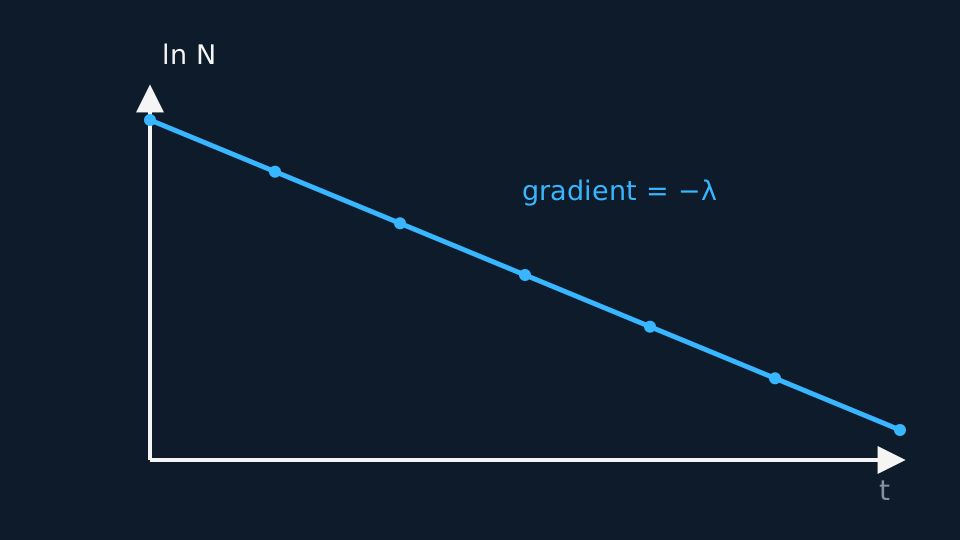
For scattered data the better tool is the promised twin of the capacitor practical. Taking natural logs gives ln N = ln N0 − λt, a straight line of ln N against t with gradient −λ. Straightness is the evidence the decay is exponential, and the gradient gives λ, from which T½ = ln 2/λ follows. Symbol for symbol, this is the RP9 analysis with λt in place of t/RC.
GUIDED PRACTICE
A half-life from a table
A counter records corrected activities of 1200, then 300 counts per minute, sixteen minutes apart. Find the half-life.
Show the working
1200 down to 300 is a fall to one quarter, so two half-lives have passed.
So T½ = 16/2 = 8.0 minutes. Counting halvings before reaching for logarithms turns many decay questions into arithmetic.
Half-life at work
The half-life sets the applications, because it fixes how long a source stays significantly active. Radioactive waste must be stored securely for many half-lives of its longest-lived components, which for some isotopes means centuries: after ten half-lives about a thousandth of the activity remains, and regulations are written in exactly those terms.
Living things hold a known fraction of carbon-14, maintained for as long as they exchange carbon with the air. After an organism dies, it no longer exchanges carbon with its environment. The remaining carbon-14 activity can therefore be used to estimate the time since death, with T½ = 5730 years. The same method with far longer-lived isotopes dates rocks.
Choosing an isotope for a job is mostly choosing a half-life. Too short and the source fades before the work is done; too long and it lingers as a hazard after the work is over. That trade-off returns with technetium-99m below, where six hours is precisely the point.
INDEPENDENT PRACTICE
Dating a fire
Charcoal from an ancient hearth shows a carbon-14 activity one quarter that of living wood. Estimate the age of the fire. (T½ = 5730 years.)
Show the working
One quarter remaining means two half-lives since the wood stopped exchanging carbon.
Age ≈ 2 × 5730 = 11 000 years, a hearth from the end of the last ice age. The measurement dates the moment the wood stopped exchanging carbon, not the moment it was burned.
Which nuclei decay, and how
Plot every stable nuclide as a point with proton number Z across and neutron number N up, and they hug a narrow stable band, with N roughly equal to Z for light nuclei and bending neutron-rich as Z grows. Extra neutrons add strong-force glue without adding proton repulsion, and that is the reason for the bend.
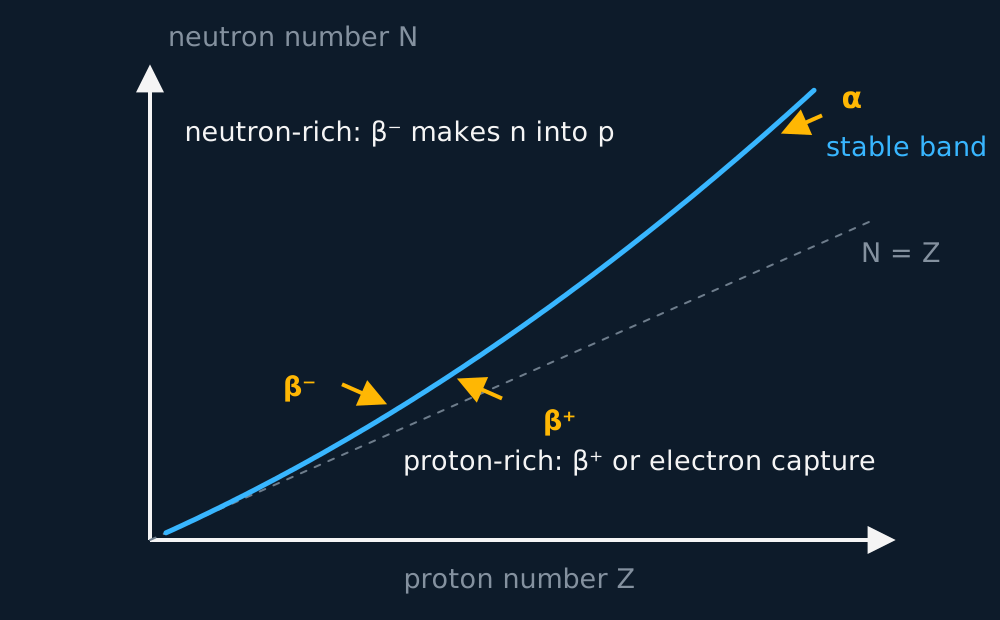
Position on the map predicts the decay. Neutron-rich nuclei, above the band, undergo β⁻ decay, in which a neutron becomes a proton, so N falls by 1 and Z rises by 1. ⁹⁰Sr becomes ⁹⁰Y, Z climbing from 38 to 39, plus e⁻ and an antineutrino e. Proton-rich nuclei, below the band, travel the other way by β⁺ decay or by electron capture, each turning a proton into a neutron. The heaviest nuclei shed bulk instead. In α decay, ²²⁶Ra becomes ²²²Rn with Z falling from 88 to 86, plus ⁴He, so A drops by 4 and Z by 2. In every equation, A and Z balance across the arrow.
WORKED EXAMPLE
Writing the equation, and checking it twice
Cobalt-60, with 27 protons and 60 nucleons, decays by beta-minus emission to an isotope of nickel. Write the equation for the decay.
A neutron becomes a proton, so Z rises from 27 to 28, nickel, while A stays at 60. The electron leaves with an antineutrino.
⁶⁰Co → ⁶⁰Ni + e⁻ + e, with proton numbers 27 = 28 − 1 across the bottom and nucleon numbers 60 = 60 + 0 across the top.
Balance twice, top and bottom, and write the antineutrino in. Without it the lepton numbers do not balance, and the two balances are the check the equation carries with it.
Decay often leaves the daughter in an excited state. Nuclei have energy levels much as atoms do, drawn as nuclear energy level diagrams, and the drop to the ground state emits a γ photon. Medicine exploits one such state deliberately. Technetium-99m is a long-lived excited state that emits gamma alone, with a six hour half-life. Injected as a tracer, its photons escape the body to a camera, and within a couple of days the activity has fallen to almost nothing.
ASSESSMENT FOCUS
- Before reaching for logarithms, count halvings. 1200 down to 300 is two half-lives, 800 down to 50 is four, and a fall to a thousandth is ten, since 2¹⁰ = 1024. Whole numbers of half-lives can be counted without logarithms.
- For a half-life from a log graph the gradient is −λ, so read its magnitude and use T½ = ln 2/λ. Quote the straightness of the line as your evidence that the decay is exponential.
- Every measured count rate includes background. Subtract the background, measured with the source removed, before any half-life determination begins: the background does not decay, so an uncorrected rate is not exponential and the half-life read from it is too long.
- State the position on the N against Z graph first, then the decay. Above the band means neutron-rich and β⁻; below means proton-rich and β⁺ or electron capture; the heaviest nuclei shed alphas. Then give the changes in N and Z.
- Decay equations balance twice. Nucleon numbers across the top, proton numbers across the bottom, and the antineutrino written in for β⁻.
- Technetium-99m answers want three properties. Gamma only, so it leaves the body without heavy ionisation. A six hour half-life, long enough to image and short enough to clear. Emission from an excited nuclear state.
- Waste and dating answers both come down to half-life arithmetic with a sentence of context. Say what fixes the starting activity, the end of carbon exchange at death for dating and the moment of sealing for waste, and then count the halvings.
CHECK YOURSELF
A detector near a sealed source reads 3240 counts per minute; with the source removed it reads 40 counts per minute. Twenty-four minutes later, with the source back in place, it reads 240 counts per minute. Find the half-life of the source. The nuclide lies above the stable band on the N against Z graph: predict its decay mode, and state what happens to its neutron number and proton number.
Show a hint
Correct both readings for background, count the halvings, then read the decay mode off the map.
Show the answer
Corrected rates: 3240 − 40 = 3200 and 240 − 40 = 200 counts per minute. 3200 down to 200 is a fall to one sixteenth, so four half-lives have passed.
T½ = 24/4 = 6.0 minutes.
Above the band the nucleus is neutron-rich, so it undergoes β⁻ decay: a neutron becomes a proton, N falls by 1 and Z rises by 1, stepping the nuclide back towards the stable band.
A genuine exponential halves in the same time everywhere along its length.
ln N against t is a straight line: the gradient is −λ, and the straightness is the evidence that the decay is exponential.
Above the band β⁻, below it β⁺ or electron capture, the heaviest shed alphas, and gamma changes neither N nor Z.
Or read them with their mark schemes on the radioactive decay and the decay constant questions page.
WHERE TO GO NEXT
- Exponentials and logarithms is the maths this lesson leans on, worked through from GCSE.
CHECK YOUR PROGRESS
Rate how confident you feel with each objective for this lesson. Ratings are saved in this browser, on this device, unless you sign in.
- Determine a half-life from decay curves and from log graphs.
- Predict the decay mode of a nuclide from its position on the N against Z graph.
- Write balanced decay equations, and account for gamma emission from an excited state.
Open the full revision checklist to track your progress across the whole unit.