Physics › Nuclear physics › Nuclear radius and density
Nuclear radius and density
The distance of closest approach of an alpha particle gives an upper limit for nuclear radius, and electron diffraction gives the radius itself. Both point to R = R₀A^(1/3), with R₀ about 1.2 fm from the gradient of R against A^(1/3). Nuclear volume is then proportional to nucleon number, so all nuclei have about the same density.
Choose your exam board to show the notes and questions relevant to your specification. You can change this setting at any time, and content for other boards remains available.
Builds on Rutherford scattering and the nuclear model and Coulomb's law and electric field strength and Wave-particle duality and Classification of particles.
IN THIS TOPIC
- Estimate a nuclear radius from the closest approach of an alpha particle using energy conservation.
- Describe radius determination by electron diffraction and sketch the intensity against angle graph.
- Use R = R₀A^(1/3) and show that it makes nuclear density the same for every nucleus.
COMMON MISCONCEPTION
Bigger nuclei are packed tighter, so heavy elements have denser nuclei.
Nuclear density is the same for all nuclei: R = R₀A1/3 makes volume proportional to nucleon number, so every nucleus has a density of about 2 × 10¹⁷ kg m⁻³.
How close can an alpha get?
As the alpha particle approaches the positively charged nucleus, kinetic energy is converted to electric potential energy. At the distance of closest approach, its radial kinetic energy is zero, so all of the initial kinetic energy has become electric potential energy. With the Coulomb potential energy from the electric fields unit,

Describe the drawing
The alpha runs at the nucleus and climbs the Coulomb hill, its kinetic bar draining into the potential bar exactly as fast as it climbs. At the dashed line the kinetic bar hits zero, the alpha stops for an instant, and everything runs backwards. Equating the initial KE to the potential energy at that stop is how the closest-approach estimate of nuclear size is made.
Rearrange for rmin and put numbers in for a 5.0 MeV alpha meeting gold. The charges are 2e and 79e, and Ek = 5.0 × 106 × 1.60 × 10-19 = 8.0 × 10⁻¹³ J, giving rmin = 8.99 × 109 × 158 × (1.60 × 10-19)2 / (8.0 × 10⁻¹³) = 4.5 × 10⁻¹⁴ m.
Treat that number as an upper limit. The alpha stops short of the surface and never probes inside, so the true radius must be smaller. A more direct measurement is needed.
GUIDED PRACTICE
Closest approach to silver
A 4.8 MeV alpha particle heads straight at a silver nucleus (Z = 47). Using energy conservation, find the distance of closest approach.
Show the working
At the stop, all the kinetic energy has become electric potential energy, so Ek = (1/4πε0) × 2e × 47e/r.
r = 8.99 × 109 × 2 × 47 × (1.60 × 10−19)2/(4.8 × 106 × 1.60 × 10−19) = 2.8 × 10⁻¹⁴ m.
An upper estimate, as always with this method. The alpha stopped at the electrical wall, still short of the nuclear surface itself.
Electron diffraction
Electron diffraction gives a more direct radius measurement, from the angular position of the first minimum. Electrons are leptons and feel no strong force, so they probe charge alone. By wave-particle duality a beam of them diffracts off a nucleus much as light diffracts at a small circular aperture: the nucleus is a round charge distribution, not a literal aperture, but the pattern is the same in kind. To make the de Broglie wavelength λ = h/p comparable to a nucleus, the electrons must carry energies of hundreds of MeV.
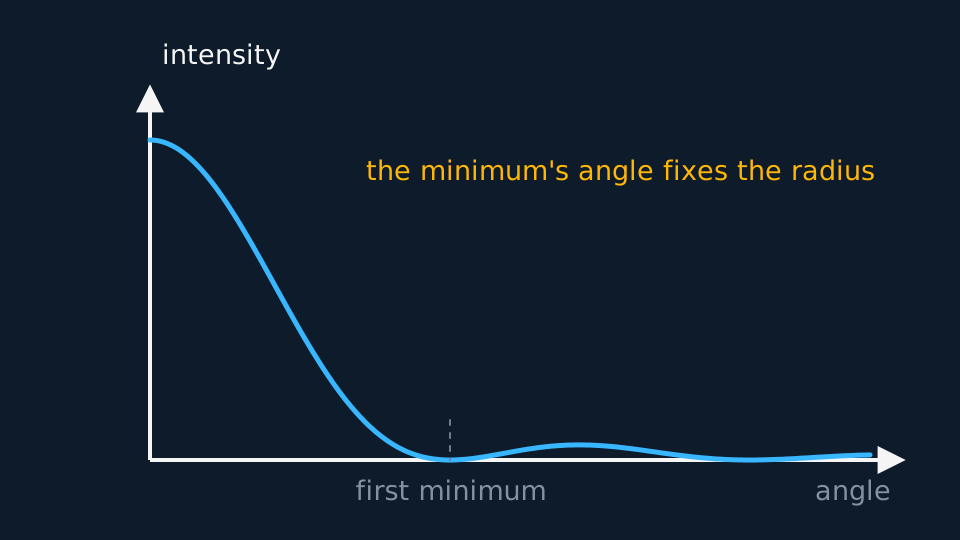
The pattern has the single-slit shape. A strong central maximum, a first minimum at an angle set by λ and the nuclear size, then faint ripples. For the round charge distribution the first minimum sits at , the circular-aperture result with 2R for the diameter, so measure that angle and the radius follows. These are the reliable results, a few femtometres or 10-15 m, set against 4.5 × 10⁻¹⁴ m from closest approach and around 10-10 m for the atom. The nucleus is smaller than its atom by a factor of ten thousand or more.
One rule for every radius
Measure many nuclides this way and a single pattern emerges. Radius grows as the cube root of nucleon number A, never in proportion to A itself.
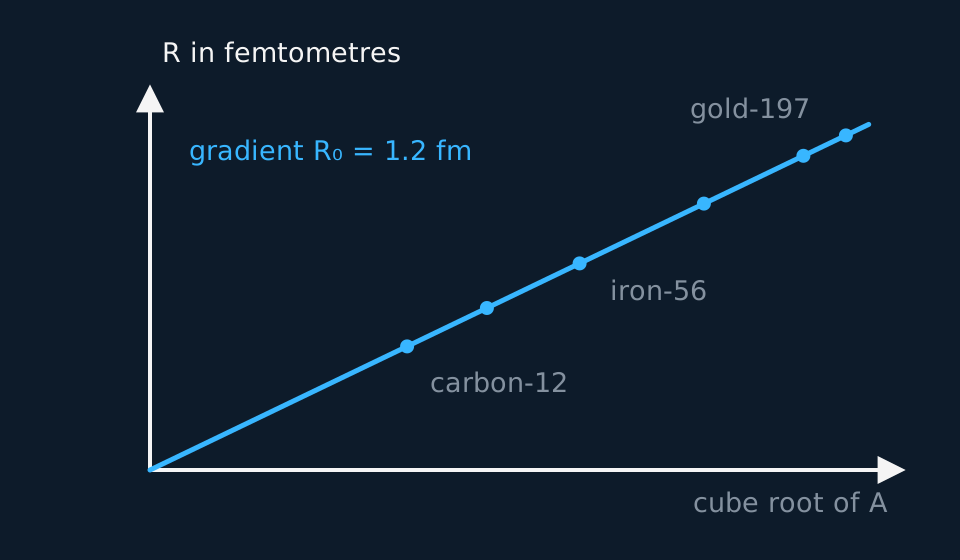
Plot R against A1/3 and the data fall on a straight line through the origin, whose gradient is the constant R0, about 1.2 fm from electron diffraction. That is how the equation is found from experiment, and it gives an order-of-magnitude radius in one line. Gold, with A = 197, gives R = 1.2 × 1971/3 ≈ 7 fm.
WORKED EXAMPLE
Lead against aluminium, no constants needed
How many times larger is a lead-208 nucleus than an aluminium-26 nucleus?
Take the ratio so R0 cancels, giving RPb/RAl = (208/26)1/3.
208/26 = 8, and the cube root of 8 is exactly 2, so lead's nucleus has twice the radius.
Eight times the nucleons, twice the radius, and so eight times the volume.
One density for every nucleus
Cube the radius law and a simple result follows. Nuclear volume is (4/3)πR3 = (4/3)πR03A, directly proportional to A, so volume is proportional to the number of nucleons. Mass is close to Au, with u the atomic mass unit, so in the density m/V the nucleon number cancels away.
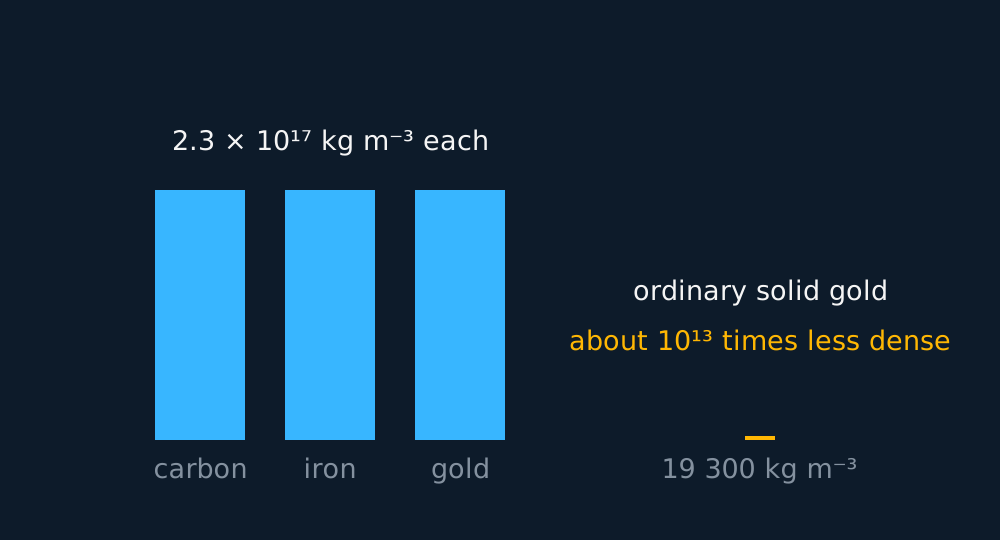
On this model every nucleus, hydrogen to uranium, shares one density near 2.3 × 10¹⁷ kg m-3. Heavier nuclei are bigger, not denser. The radius law itself is an approximation at its best for medium and heavy nuclei, and the lightest nuclei stray furthest from it, so read the constant density as a broad experimental rule rather than an exact theorem. Solid gold manages 1.9 × 10⁴ kg m-3, some 1013 times less, because an atom is mostly empty space, with almost all its mass in the tiny nucleus.
ASSESSMENT FOCUS
- Closest approach is an energy argument, so state it as one: initial kinetic energy equals electric potential energy at the distance of closest approach. Set them equal before any algebra begins.
- Charges in Coulomb's equation are 2e and Ze, never 2 and Z. Dropping one factor of e, or squaring the wrong bracket, changes the answer by many orders of magnitude.
- Say why electrons are the probe of choice. They feel no strong force to complicate the measurement, and their de Broglie wavelength can be made femtometre-sized. Both reasons are needed.
- Closest approach overestimates; electron diffraction is the reliable determination. Comparison questions want that verdict with its reason attached.
- For density, show the cancellation. Volume is proportional to A, mass is proportional to A, so the ratio is a constant. Quote about 2 × 10¹⁷ kg m⁻³ to one significant figure.
CHECK YOURSELF
Take R₀ = 1.2 fm. Find the radius of an iron-56 nucleus, and then its density, given the atomic mass unit u = 1.661 × 10⁻²⁷ kg. Comment on how the density would differ for gold-197.
Show a hint
Radius first from the cube-root law; then mass over the volume of a sphere.
Show the answer
R = R0A1/3 = 1.2 × 561/3 = 1.2 × 3.83 = 4.6 fm.
Mass = 56u = 9.3 × 10⁻²⁶ kg; volume = (4/3)π(4.59 × 10-15)3 = 4.1 × 10-43 m3.
ρ = 9.3 × 10⁻²⁶ / (4.1 × 10-43) = 2.3 × 10¹⁷ kg m-3, and gold's comes out the same, because A cancels.
R = R₀A^(1/3), so nuclear volume simply counts nucleons.
On the radius law, medium and heavy nuclei share one density near 2 × 10¹⁷ kg m⁻³; the lightest stray furthest from it.
Closest approach only ever overestimates; electron diffraction measures.
WORKBOOK
Printable practice for this topic: original exam-style questions with room to work, and a fully worked answer book. Free to use; please do not redistribute or sell.
Or read them with their mark schemes on the nuclear radius and density questions page.
WHERE TO GO NEXT
- Combining uncertainties is the maths this lesson leans on, worked through step by step.
CHECK YOUR PROGRESS
Rate how confident you feel with each objective for this lesson. Ratings are saved in this browser, on this device, unless you sign in.
- Estimate a nuclear radius from the closest approach of an alpha particle using energy conservation.
- Describe radius determination by electron diffraction and sketch the intensity against angle graph.
- Use R = R₀A^(1/3) and show that it makes nuclear density the same for every nucleus.
Open the full revision checklist to track your progress across the whole unit.