Physics › Particles › Antimatter and photons
Antimatter and photons
Every particle has an antiparticle of equal mass and equal rest energy, with charge and the other quantum numbers reversed. Annihilation turns a pair at rest into two photons; electron-positron pair production needs one photon of at least 1.022 MeV and a nearby nucleus. Photon energy is E = hf = hc/λ, often quoted in MeV.
Choose your exam board to show the notes and questions relevant to your specification. You can change this setting at any time, and content for other boards remains available.
Builds on The photoelectric effect and the photon.
IN THIS TOPIC
- Compare particles and antiparticles by mass, charge and rest energy in MeV.
- Use the photon model E = hf = hc/λ, moving between joules and electronvolts.
- Describe annihilation, and calculate the minimum energy or frequency of each photon.
- Describe pair production, including the threshold energy and the job the nearby nucleus does.
- Work in MeV and GeV, and on Edexcel in MeV/c2 and GeV/c2, converting to and from SI units.
COMMON MISCONCEPTION
Antimatter is science fiction.
Antimatter is real and routinely produced: every particle has an antiparticle with the same mass and opposite values of charge and the other quantum numbers, a neutral particle's antiparticle being neutral too, and annihilation and pair production are observed in experiments.
The mirror world
For every type of particle there is an antiparticle of identical mass, identical rest energy and opposite charge. Four pairs are named on the specification. The positron partners the electron, and there is an antiproton, an antineutron, and an antineutrino for the neutrino.
Two of those four need a footnote, because charge is not always what tells the pair apart. A neutron is uncharged and so is an antineutron, so “opposite charge” there means zero against zero. What is genuinely reversed is the other quantum numbers, baryon number for the neutron pair and lepton number for the neutrino pair. Say opposite charge and opposite quantum numbers and the statement covers every pair, charged or not.
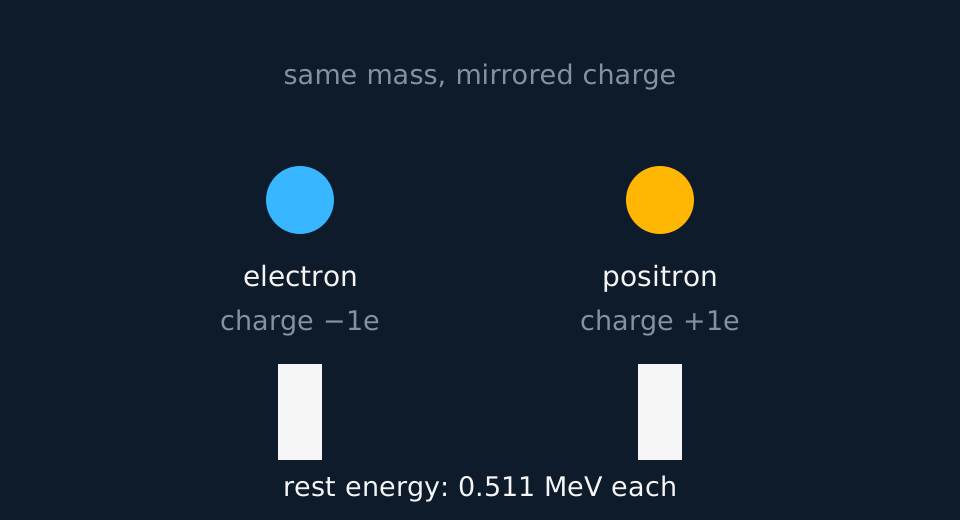
Rest energy is the energy equivalent of a particle's mass, quoted in MeV and printed for the common particles in the data booklet. An electron or positron sits at 0.511 MeV, a proton at about 938 MeV. Those printed values are what you use, so no mass has to be turned into an energy here. None of this is science fiction either. Positrons come out of beta-plus decay and go to work every day in hospital PET scanners.
Two prefixes carry this whole unit, so pin them down now. One MeV is 106 eV and one GeV is 109 eV, which puts an electron's 0.511 MeV, a proton's 938 MeV and the several GeV a collider gives a beam on one ruler. Reaching SI is the same multiplication by 1.60 × 10⁻¹⁹ that the electronvolt always needs, so J and J, and dividing by that number brings a joule figure back. Keep the direction straight by the size of the answer, because a particle energy of 1013 J is the conversion run backwards.
The photon
Electromagnetic radiation travels as photons carrying
an energy that grows with frequency and shrinks with wavelength.
WORKED EXAMPLE
The energy of an X-ray photon
Find the energy of an X-ray photon of wavelength 0.10 nm, in joules and electronvolts.
E = hc/λ = (6.63 × 10−34 × 3.00 × 108)/(1.0 × 10−10) = 2.0 × 10⁻¹⁵ J.
Divide by 1.60 × 10⁻¹⁹ to reach the natural unit, about 12 keV.
Landmarks make that number mean something. A visible photon carries a few eV and an X-ray photon a few thousand, while the gamma photons of the next section run to millions. Wavelength down, energy up.
Annihilation and pair production
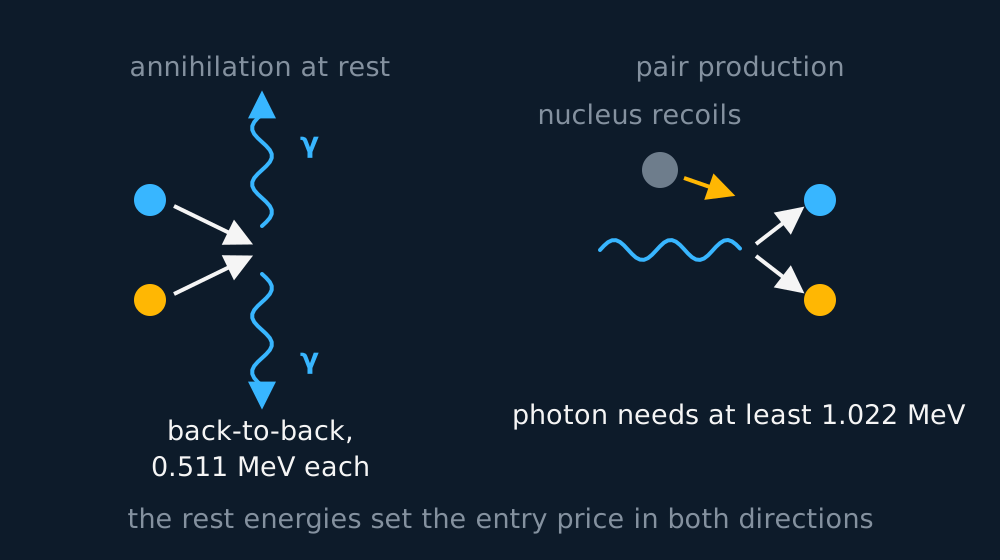
When a particle meets its antiparticle they annihilate. Both vanish, and their entire energy, rest energy included, leaves as photons. Take the case every question sets, a particle and antiparticle meeting with almost no kinetic energy. Their total momentum is then very nearly zero, one photon could never balance that, and the products are two photons of equal energy leaving in opposite directions. Each carries one full rest energy, so 0.511 MeV apiece is the floor for an electron and a positron.
Let the pair arrive fast and the conservation laws still hold, but they no longer force that tidy picture. The two photons then share the energy unevenly and open out at an angle instead of going back to back. Equal and opposite is the near-rest result, not a universal law, and it is the near-rest result a PET scanner relies on.
Describe the drawing
Two panels. Annihilation at rest: an electron and positron meet and two gamma photons leave back-to-back in exactly opposite directions, nought point five one one mega-electronvolts each. Pair production: one photon of at least one point nought two two mega-electronvolts becomes an electron-positron pair beside a nucleus, which recoils to conserve momentum.
Pair production runs the same film backwards. One sufficiently energetic photon converts into a particle-antiparticle pair, almost always while passing a nucleus, which takes the recoil that momentum conservation demands. The photon must supply at least both rest energies together, so at least 2 × 0.511 = 1.022 MeV for an electron-positron pair; that figure treats the recoiling nucleus as heavy enough to take momentum while taking almost no energy, which is the approximation every exam question makes. The excess above threshold goes almost entirely to the pair's kinetic energy. A photon carrying less than the threshold energy produces no pair at all.
The restriction is on a lone photon rather than on the process, so the photon needs some nearby body to take the spare momentum. A nucleus is the usual candidate and the only one A-level asks about. Two photons meeting head on can also make a pair between them, with no third body anywhere, and accelerator experiments have seen it happen.
GUIDED PRACTICE
A proton-antiproton pair
A proton's rest energy is 938.3 MeV. Find the minimum photon energy needed to produce a proton-antiproton pair, in MeV and joules.
Show the working
The photon must supply both rest energies, so 2 × 938.3 = 1876.6 MeV.
In SI units, 1876.6 × 106 × 1.60 × 10−19 = 3.0 × 10⁻¹⁰ J. That threshold is about 1800 times the electron pair's, so proton pairs belong to accelerators while electron pairs turn up wherever ordinary gamma photons do.
INDEPENDENT PRACTICE
Why the nucleus must be there
A single photon travelling through empty space can never create an electron-positron pair, however much energy it carries, and in practice the conversion happens close to a nucleus. Using a conservation law, explain what the nucleus is for.
Show the working
A photon carries momentum as well as energy. If all its energy became a stationary pair, momentum would simply vanish; if the pair moved, energy and momentum could not both balance for the photon alone.
The nearby nucleus recoils, carrying off the spare momentum while absorbing almost no energy, because it is so much more massive. Without some second body, the two conservation laws cannot hold together for one photon.
Masses in MeV/c², an Edexcel unit
Masses written in MeV/c2 and GeV/c2, and the conversion between those units and kilograms, are Edexcel content. The other three boards quote particle masses in kilograms and rest energies in MeV.
The unit looks like a category error until you see what is being divided. Rearrange E = mc2 into , and an energy divided by c2 is a mass. So a particle whose rest energy is 0.511 MeV has a mass of 0.511 MeV/c2, and the two numbers are the same number by construction. Above a thousand MeV the same trick reads GeV/c2, which makes a proton 0.938 GeV/c2. Nothing is being approximated. The unit is built so that reading a rest energy off the booklet and calling it a mass is exactly legal.
Getting to kilograms is therefore two steps and no new physics. Turn the MeV into joules, then divide by c2, so one MeV/c2 comes to 1.60 × 10⁻¹³/(9.00 × 1016) = 1.78 × 10⁻³⁰ kg. Going the other way, multiply the mass in kilograms by c2 to get a rest energy in joules and divide by 1.60 × 10⁻¹⁹ to reach electronvolts.
WORKED EXAMPLE
One mass, converted both ways
A muon's mass is 106 MeV/c2. Give it in kilograms. Then take the neutron's mass of 1.675 × 10⁻²⁷ kg and give it in GeV/c2. Take c = 3.00 × 10⁸ m s−1.
Downwards first. Convert to joules and divide by c2: m = 106 × 1.60 × 10−13/(9.00 × 1016) = 1.9 × 10⁻²⁸ kg, a couple of hundred times the electron's mass, which is what a muon is.
Upwards next, and run the same two steps in reverse. E = mc2 = 1.675 × 10−27 × 9.00 × 1016 = 1.51 × 10⁻¹⁰ J, and dividing by 1.60 × 10⁻¹⁹ gives 9.4 × 10⁸ eV, so the neutron is 0.94 GeV/c2.
Check that against the booklet, which prints the neutron's rest energy as 939.6 MeV. A mass in MeV/c2 and a rest energy in MeV are one statement in two forms, and the third figure only wanders because c and the electronvolt conversion were each rounded to three figures.
ASSESSMENT FOCUS
- Give the antiparticle comparison in one sentence, same mass and rest energy, equal and opposite charge. All three properties are expected, and dropping rest energy is the common omission. For the neutron and neutrino pairs, where both members are uncharged, add that the other quantum numbers are reversed.
- When the pair annihilates at rest, which is what these questions always mean, the products are two photons travelling in opposite directions, to conserve momentum, each carrying at least 0.511 MeV for an electron and positron. A single photon is not an answer here, because one photon cannot carry away zero total momentum.
- Pair production needs at least 1.022 MeV for an electron-positron pair, and it needs a nucleus close by to absorb the recoil. A lone photon in empty space cannot conserve energy and momentum at the same time while making a pair.
- Rest energies come printed in the data booklet, so quote them and derive nothing. AQA asks for no E = mc2 calculation here at all, while Edexcel does use it, both for creating and annihilating pairs and for masses written in MeV/c2. Convert MeV to joules with 1.60 × 10⁻¹⁹ before h gets anywhere near the working.
- For Edexcel's mass units, remember that the number does not change. A rest energy of 938 MeV is a mass of 938 MeV/c2, and only the conversion to kilograms needs arithmetic. Multiply by 1.60 × 10⁻¹³ to reach joules, then divide by c2, and reverse both steps coming back.
CHECK YOURSELF
A slow electron and a slow positron annihilate. Find the minimum frequency of each photon produced. (Electron rest energy 0.511 MeV; h = 6.63 × 10⁻³⁴ J s.)
Show a hint
One rest energy per photon; convert MeV to joules first.
Show the answer
Each photon carries at least one rest energy, and 0.511 MeV = 0.511 × 106 × 1.60 × 10−19 = 8.18 × 10⁻¹⁴ J.
Minimum frequency, = 8.18 × 10⁻¹⁴ / (6.63 × 10⁻³⁴) = 1.2 × 10²⁰ Hz.
A frequency like that puts the photons in the gamma region, and detecting the two of them back to back is precisely how a PET scanner locates an annihilation inside a patient.
Same mass, opposite charge and opposite quantum numbers, every particle.
Rest energy sets the threshold in both directions.
WORKBOOK
Printable practice for this topic: original exam-style questions with room to work, and a fully worked answer book. Free to use; please do not redistribute or sell.
Or read them with their mark schemes on the antimatter and photons questions page.
CHECK YOUR PROGRESS
Rate how confident you feel with each objective for this lesson. Ratings are saved in this browser, on this device, unless you sign in.
- Compare particles and antiparticles by mass, charge and rest energy in MeV.
- Use the photon model E = hf = hc/λ, moving between joules and electronvolts.
- Describe annihilation, and calculate the minimum energy or frequency of each photon.
- Describe pair production, including the threshold energy and the job the nearby nucleus does.
- Work in MeV and GeV, and on Edexcel in MeV/c2 and GeV/c2, converting to and from SI units.
Open the full revision checklist to track your progress across the whole unit.