Physics › Quantum phenomena › Collisions of electrons with atoms
Collisions of electrons with atoms
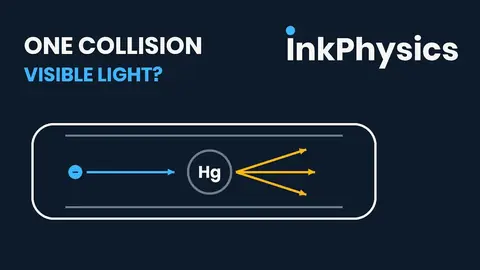
An atom hit by a free electron takes exactly one energy-level gap, which is excitation, or enough to free an electron, which is ionisation. Anything less leaves the collision elastic. A fluorescent tube uses both processes, then turns the resulting ultraviolet into visible light with a phosphor coating. Level diagrams are labelled in electronvolts.
Choose your exam board to show the notes and questions relevant to your specification. You can change this setting at any time, and content for other boards remains available.
Builds on Prefixes, labels and unit conversions.
IN THIS TOPIC
- Distinguish excitation from ionisation in collisions between electrons and atoms.
- Explain how excitation and ionisation operate inside a fluorescent tube.
- Use the electronvolt, converting between eV and joules in both directions.
COMMON MISCONCEPTION
Any collision can nudge an atom just a little.
An atom cannot absorb just any amount of energy: its energy levels are discrete, so it accepts only the exact energy of a gap between levels; anything less leaves it unchanged.
All or nothing
The electrons in an atom occupy fixed energy levels, so an atom can only accept energy in exact level-sized amounts. A free electron colliding with one therefore has two productive options. In excitation the collision hands over exactly the gap to a higher level, promoting an atomic electron, and the incident electron flies on with the energy left over. In ionisation the collision supplies at least enough to free an atomic electron from the atom altogether.

Describe the drawing
An atom's electron sits on the ground rung. A slow electron arrives carrying less than the gap: it bounces away with exactly what it brought, because the atom cannot accept part of a rung. A faster one carries more than enough: the bound electron jumps the full gap at the instant of impact, the projectile leaves with the change, and moments later the atom relaxes, dropping the electron back and posting the gap's worth of energy out as a single photon.
Offer the atom less than its smallest available gap and no internal excitation can occur, because its electrons cannot take up an amount smaller than the first excitation energy. The collision is elastic: the electron scatters with its kinetic energy all but unchanged, since the atom, thousands of times heavier, takes only a negligible recoil.
The fluorescent tube
The standard application chains both processes together. A high pd across the tube accelerates free electrons; ionisation by collision keeps the mercury vapour supplied with those free electrons. Collisions also excite mercury atoms, which promptly de-excite and emit photons, mostly ultraviolet.
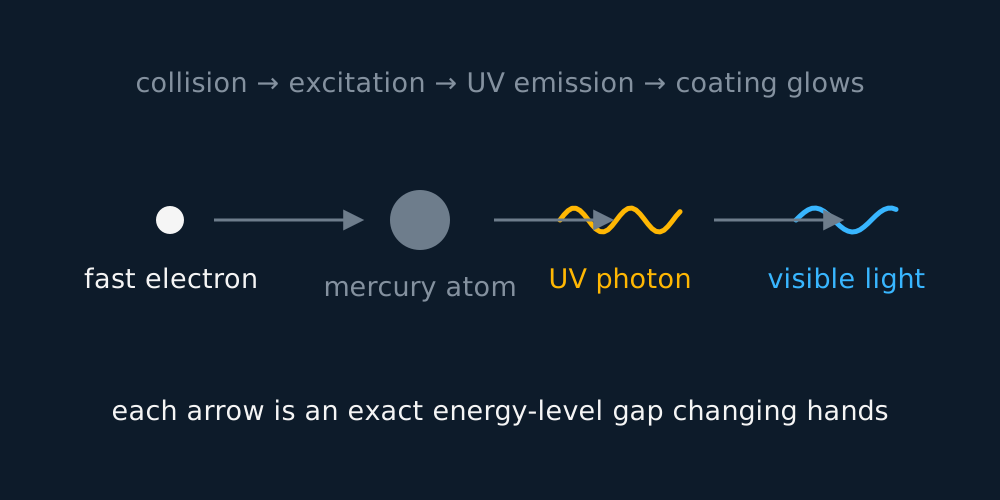
Ultraviolet is no use for lighting a kitchen, so the tube's inner phosphor coating absorbs the UV photons, its own electrons climbing and then descending in smaller steps, re-emitting the energy as visible light.
The electronvolt
Atomic energies are tiny in joules, so atomic physics uses a unit of its own. One electronvolt is the energy gained by an electron accelerated through a pd of one volt, and 1 eV = 1.60 × 10⁻¹⁹ J. That definition doubles as a mental shortcut. An electron crossing 500 V gains 500 eV, with nothing to calculate.
Fluent conversion both ways is expected. Multiply by 1.60 × 10⁻¹⁹ to reach joules; divide to come back. Level diagrams are labelled in eV, while h and the SI formulae take joules, so the conversion is needed throughout this unit.
WORKED EXAMPLE
Can this electron excite this atom?
An electron is accelerated from rest through 5.0 V and strikes a mercury atom whose first excited state sits 4.9 eV above the ground state. What can happen?
The electron gains exactly 5.0 eV, read straight off the accelerating pd, which is 5.0 × 1.60 × 10−19 = 8.0 × 10⁻¹⁹ J.
5.0 eV clears the 4.9 eV gap, so the collision can excite the atom and the electron flies on with 0.1 eV. Accelerate the same electron through 4.5 V and it cannot excite the atom at all, because the atom takes the exact gap or takes nothing.
The excited atom then returns the 4.9 eV as a photon of frequency f = 4.9 × 1.60 × 10−19/(6.63 × 10−34) = 1.2 × 10¹⁵ Hz. That is ultraviolet, at about 250 nm, so the tube still needs its phosphor coating before it makes light you can see.
ASSESSMENT FOCUS
- Give the definitions exactly. Excitation moves an electron to a higher energy level; ionisation removes it from the atom. “Gaining energy” describes both and distinguishes neither.
- The fluorescent tube has five stages: acceleration by the pd, excitation of mercury by collision, ultraviolet emission as the atom de-excites, absorption by the coating, and visible re-emission. Include the ultraviolet stage, since without it the account never reaches visible light.
- An electron accelerated through V volts gains V electronvolts, so use the shortcut and convert only when the question asks for joules. Multiply by 1.60 × 10⁻¹⁹ going to joules and divide coming back. An atomic process quoted at 1019 eV means the conversion ran the wrong way.
- When a collision offers less than the smallest gap, name the outcome. The collision is elastic and the atom absorbs nothing.
CHECK YOURSELF
In a fluorescent tube, describe the energy story that turns the kinetic energy of a free electron into visible light. Name each process.
Show a hint
There are four energy transfers, one of which produces ultraviolet rather than visible light.
Show the answer
The tube's pd accelerates a free electron, giving it kinetic energy. A collision excites a mercury atom, transferring one exact level gap.
The atom de-excites almost at once, emitting the gap as an ultraviolet photon (hf equal to the gap).
The phosphor coating absorbs that ultraviolet, and its own electrons de-excite in smaller steps, emitting visible photons.
Atoms accept exact gaps, or nothing.
A fluorescent tube chains ionisation, excitation, ultraviolet emission and phosphor re-emission.
WORKBOOK
Printable practice for this topic: original exam-style questions with room to work, and a fully worked answer book. Free to use; please do not redistribute or sell.
Or read them with their mark schemes on the collisions of electrons with atoms questions page.
CHECK YOUR PROGRESS
Rate how confident you feel with each objective for this lesson. Ratings are saved in this browser, on this device, unless you sign in.
- Distinguish excitation from ionisation in collisions between electrons and atoms.
- Explain how excitation and ionisation operate inside a fluorescent tube.
- Use the electronvolt, converting between eV and joules in both directions.
Open the full revision checklist to track your progress across the whole unit.