Physics › Quantum phenomena › Energy levels and photon emission
Energy levels and photon emission
A glowing gas emits a line spectrum rather than a continuous one, evidence that the electrons in an atom occupy discrete energy levels. One electron falling between two levels emits one photon carrying exactly the gap, hf = E₁ − E₂, and each element's own set of levels gives it a characteristic line spectrum.
Choose your exam board to show the notes and questions relevant to your specification. You can change this setting at any time, and content for other boards remains available.
Builds on Collisions of electrons with atoms and Diffraction gratings.
IN THIS TOPIC
- Interpret line spectra as evidence for transitions between discrete energy levels.
- Use hf = E1 − E2 for photon emission, with levels quoted in J or eV.
- Explain why each element's line spectrum is unique.
COMMON MISCONCEPTION
An atom can emit any colour it likes.
An atom cannot emit any colour: each emitted photon's energy hf must equal the gap between two discrete energy levels, so only certain wavelengths appear, giving a line spectrum.
The evidence: lines, not rainbows
Pass the light from a glowing gas, hydrogen in a discharge tube say, through a diffraction grating and no rainbow appears. You get a line spectrum, a handful of sharp bright colours with darkness between them.
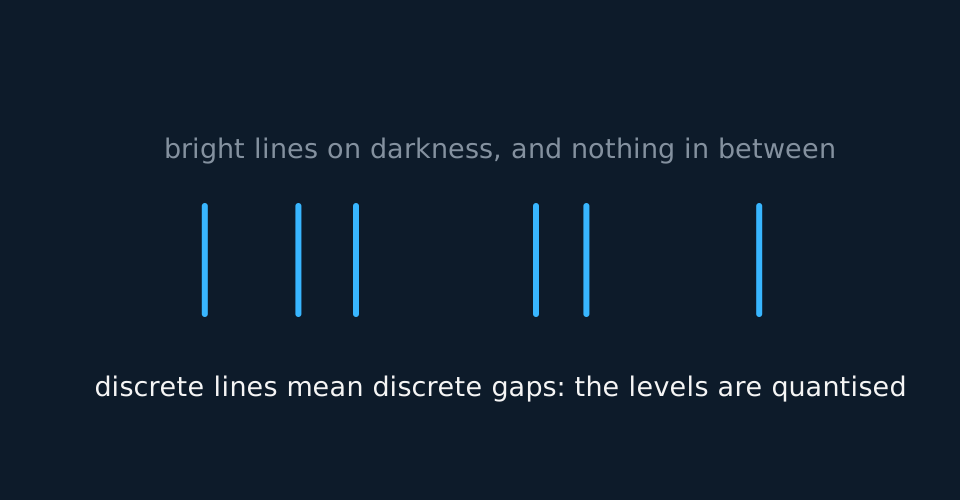
Each line is light of one photon energy, so the atom emits only certain exact energies. The only explanation is that the electron's possible energies inside the atom are discrete levels, and light comes out only when an electron drops from one level to another.
The transition equation
When an electron falls from a level of energy E1 to a lower level E2, the atom emits one photon carrying exactly the difference.
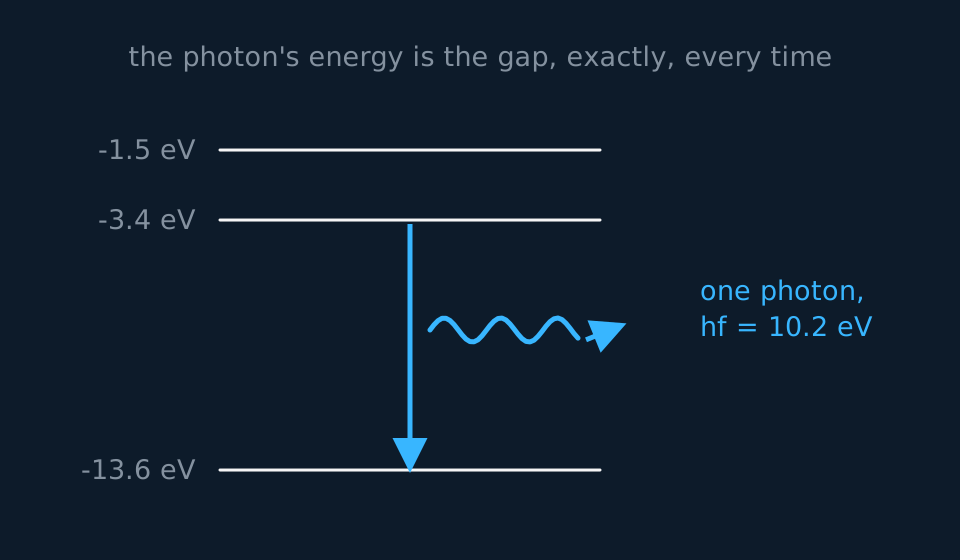
Level energies are measured relative to zero at the ionisation limit, so bound states have negative energies, and the ground state is the lowest energy level. The subtraction in hf = E1 − E2 handles the signs by itself and always delivers a positive photon energy. Levels may be quoted in joules or in electronvolts; convert any in eV to joules before using h.
WORKED EXAMPLE
A red line, predicted
In hydrogen an electron falls from the −1.51 eV level to the −3.40 eV level. Find the photon's frequency and wavelength, and place it in the spectrum.
The photon carries the gap. ΔE = 3.40 − 1.51 = 1.89 eV = 3.02 × 10⁻¹⁹ J, and the subtraction has to come out positive, which is the check on getting it the right way round.
f = ΔE/h = 3.02 × 10⁻¹⁹/(6.63 × 10−34) = 4.6 × 10¹⁴ Hz.
λ = c/f = 660 nm, deep red, and a real line of the hydrogen spectrum.
Line spectra identify elements
Every element has its own set of levels, so every element has its own set of gaps and its own set of lines. That characteristic line spectrum identifies the element. Measuring the lines in starlight identifies, from Earth, the elements present in a star.
The same levels absorb as they emit, so the dark lines of an absorption spectrum sit at positions matching emission lines. The match is not a complete mirror: a cool gas absorbs mainly from the levels its electrons actually occupy, the ground state above all, so some emission lines have no absorption twin.
GUIDED PRACTICE
Counting the lines
An atom has exactly three energy levels. How many different spectral lines can it emit? Draw the level diagram in your head and count the downward arrows.
Show the working
Each pair of levels gives one possible drop. Top to middle, top to bottom, middle to bottom, so three transitions, and if the two gaps are different sizes those are three different photon energies: three lines.
Count transitions and count lines separately, because they are not always the same number. Space the three levels equally and the top-to-middle drop releases exactly what the middle-to-bottom drop releases, so those two photons land at the same wavelength: three transitions, two lines. The top-to-bottom photon carries the sum of the other two, so it can never coincide with either.
With four levels there are six transitions, because every extra level adds one for each level below it, and six distinct lines so long as no two gaps happen to match.
INDEPENDENT PRACTICE
The cost of escape
Hydrogen's ground state sits at −13.6 eV. Find the maximum wavelength of a photon that can ionise a ground-state hydrogen atom.
Show the working
Ionisation means lifting the electron from −13.6 eV all the way to zero, so the photon must carry at least 13.6 eV, which is 2.18 × 10⁻¹⁸ J.
Maximum wavelength goes with minimum energy, so λ = hc/E = (6.63 × 10−34 × 3.00 × 108)/(2.18 × 10−18) = 91 nm, deep in the ultraviolet. A photon of longer wavelength carries less than 13.6 eV and cannot ionise the atom.
ASSESSMENT FOCUS
- “Explain how line spectra provide evidence for energy levels” wants the full chain. Sharp lines mean only certain photon energies. Each photon energy equals a level difference. The levels are therefore discrete.
- One transition makes one photon, carrying exactly the gap. Two small drops make two photons and never one photon of the combined energy.
- Level energies are negative, and the ground state is the most negative of all. “Lowest level” means deepest in the well, not smallest in magnitude.
- Put the levels into joules before h gets involved in hf = E1 − E2. Substituting eV straight into that equation gives a frequency only 1.60 × 10⁻¹⁹ times its true value.
- A bigger gap means a higher frequency, so transitions down to the ground state give the most energetic photons and often land in the ultraviolet.
CHECK YOURSELF
In hydrogen, an electron falls from the −3.4 eV level to the −13.6 eV ground state. Find the frequency of the emitted photon. (h = 6.63 × 10⁻³⁴ J s.)
Show a hint
Gap first, in eV; then joules; then h.
Show the answer
Take the gap first. = (−3.4) − (−13.6) = 10.2 eV, and the signs have taken care of themselves.
Convert it. 10.2 × 1.60 × 10−19 = 1.63 × 10⁻¹⁸ J.
Then = 1.63 × 10⁻¹⁸ / (6.63 × 10⁻³⁴) = 2.5 × 10¹⁵ Hz. That sits in the ultraviolet, as a drop to the ground state usually does.
Discrete lines mean discrete gaps.
Discrete gaps mean discrete levels.
One transition makes exactly one photon.
WORKBOOK
Printable practice for this topic: original exam-style questions with room to work, and a fully worked answer book. Free to use; please do not redistribute or sell.
Or read them with their mark schemes on the energy levels and photon emission questions page.
USED LATER IN
CHECK YOUR PROGRESS
Rate how confident you feel with each objective for this lesson. Ratings are saved in this browser, on this device, unless you sign in.
- Interpret line spectra as evidence for transitions between discrete energy levels.
- Use hf = E1 − E2 for photon emission, with levels quoted in J or eV.
- Explain why each element's line spectrum is unique.
Open the full revision checklist to track your progress across the whole unit.