Physics › Waves › Diffraction gratings
Diffraction gratings
A grating replaces two slits with thousands, and its maxima are sharper and brighter because the light from every slit has to arrive in step. The grating equation d sin θ = nλ locates each order, with d the slit spacing found from the number of lines per millimetre. A sine cannot exceed one, so only a few orders exist.
Choose your exam board to show the notes and questions relevant to your specification. You can change this setting at any time, and content for other boards remains available.
Builds on Interference and Young's double slit.
IN THIS TOPIC
- Explain why many slits give sharper and brighter maxima than two.
- Use , getting d from the number of lines per millimetre.
- Work out the highest order that can exist, and give uses of gratings.
COMMON MISCONCEPTION
Adding thousands more slits should smear the pattern into a blur.
More slits sharpen the maxima, not smear them: away from the exact angle the many contributions fall out of step and cancel, leaving light only where d sin θ = nλ.
From two slits to thousands
A diffraction grating is a plate ruled with hundreds of slits per millimetre. Light leaving all of them overlaps, and the condition for a maximum is far stricter with many slits than with two. At most angles, the thousands of contributions arrive with a scatter of phases and cancel almost perfectly. Only at a few special angles does every slit's light arrive exactly in step, and there the maxima are brighter, fed by every slit at once, and much sharper, because even a tiny step away from the exact angle restores the cancellation.
The grating equation
The special angles come from the path difference between neighbouring slits, whose centres sit a distance d apart, the grating spacing. Light leaving adjacent slits at angle to the normal differs in path by . Every slit stays in step with every other only when that difference is a whole number of wavelengths.
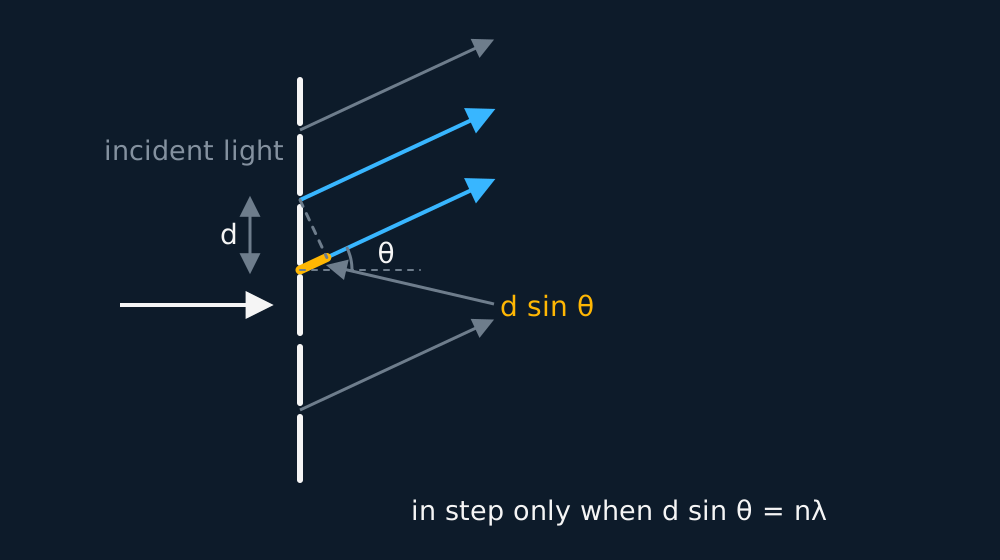
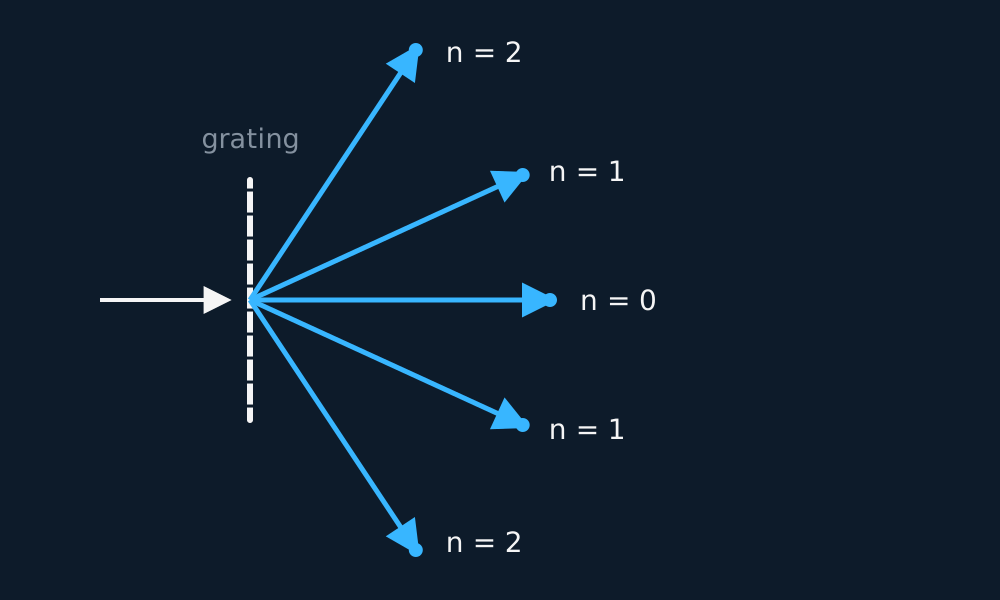
The whole number n is the order of the maximum. Zero order is the straight-through beam, first order the pair either side of it, and so on outwards. Gratings are labelled in lines per millimetre, so d is one millimetre shared out between that many lines.
Feed N in lines per metre and d comes out in metres. A grating of 600 lines per mm is 6.00 × 10⁵ lines per metre, giving m.
Orders, and the one that cannot exist
Rearranged, , and a sine can never exceed 1. That alone caps the pattern: orders exist only while , so the highest order is the whole-number part of . Beyond it, the geometry has no angle to offer.
WORKED EXAMPLE
Monochromatic light of wavelength 550 nm falls on a grating with 600 lines per mm. Find the angle of the first-order maximum, and the highest order visible.
= (1.0 × 10− 3) / 600 = 1.67 × 10− 6 m.
For the first order, = (550 × 10− 9) / (1.67 × 10− 6) = 0.330, so = 19.3°.
Now the cap. = 3.03, so n = 3 works, needing = 0.990, while n = 4 would need 1.32. The third order is the last one visible, out at a steep 81.9°.
GUIDED PRACTICE
A wavelength from the second order
Light through a 600 lines-per-millimetre grating puts its second-order maximum at 42.5°. Find d from the line count, then the wavelength.
Show the working
d = 1/600 mm = 1.67 × 10⁻⁶ m.
With n = 2, λ = d sin θ/n = 1.67 × 10−6 × 0.676/2 = 5.6 × 10⁻⁷ m, so 560 nm, green. Forget to divide by the order and you land on a wavelength no visible light has.
INDEPENDENT PRACTICE
Why gratings make rainbows
White light passes through a 400 lines-per-millimetre grating. Find the first-order angles for violet (400 nm) and red (700 nm), and the angular width of the first-order spectrum.
Show the working
d = 2.5 × 10⁻⁶ m. Violet: sin θ = 0.16, θ = 9.2°. Red: sin θ = 0.28, θ = 16.3°.
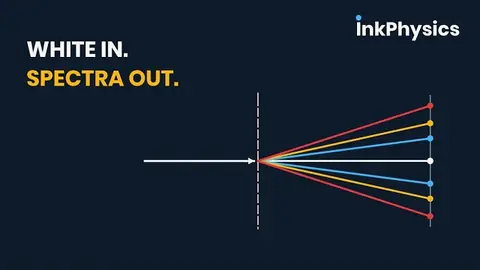
The spectrum spans about 7°, violet innermost. Longer wavelengths diffract to larger angles, which is the reverse of the order a prism produces.
Because the maxima are so sharp, their angles can be measured precisely, and the grating equation then delivers to matching precision. A grating splits light into line spectra, which lets a chemist identify an element from the wavelengths it emits and lets an astronomer identify the elements present in a star from its spectrum.
ASSESSMENT FOCUS
- Finding d is the step to take carefully. Convert the millimetre to metres first, then divide by the number of lines. For 600 lines per mm, d = (1.0 × 10− 3)/600, and the answer should land near 10− 6 m.
- For the highest order, work out and take the whole-number part. An order is a whole number, so n = 3.03 is not an order, and rounding up to 4 names one the geometry cannot supply. When comes out above 1 the order does not exist, and that is the answer to give.
- Grating maxima are sharper and brighter than double-slit fringes. The sharpness is the reason a grating measures wavelength well.
- Check the mode. An angle of 19.3° arriving as 0.336 means the calculator is in radians.
CHECK YOURSELF
Light of wavelength 550 nm falls on a grating with 300 lines per mm. Find (a) the angle of the first-order maximum and (b) the highest order that can be seen.
Show a hint
Find d first, and remember that sin can never pass 1.
Show the answer
(a) = (1.0 × 10− 3) / 300 = 3.33 × 10− 6 m. Then = (550 × 10− 9) / (3.33 × 10− 6) = 0.165, so = 9.5°.
(b) = 6.06, so the largest whole n with is n = 6. That sixth order sits far out at 81.9°, almost along the grating itself.
d sin θ = nλ.
sin θ can never pass 1, and that caps n.
WORKBOOK
Printable practice for this topic: original exam-style questions with room to work, and a fully worked answer book. Free to use; please do not redistribute or sell.
Or read them with their mark schemes on the diffraction gratings questions page.
WHERE TO GO NEXT
- Required practical 2: interference: double slit and diffraction grating puts this topic in the lab, and the written papers ask about it.
- Trigonometry and resolving vectors is the maths this lesson leans on, worked through step by step.
USED LATER IN
CHECK YOUR PROGRESS
Rate how confident you feel with each objective for this lesson. Ratings are saved in this browser, on this device, unless you sign in.
- Explain why many slits give sharper and brighter maxima than two.
- Use , getting d from the number of lines per millimetre.
- Work out the highest order that can exist, and give uses of gratings.
Open the full revision checklist to track your progress across the whole unit.