Chemistry › Alkenes and alcohols › Addition polymers
Addition polymers
Open the double bond in thousands of alkene molecules and join them end to end, and the result is a carrier bag, a drainpipe or the coating on a frying pan. One rule draws the repeating unit from the monomer and recovers the monomer from the chain. The strong C–C and C–H bonds of the chain explain both what polyalkenes are good for and why they are so hard to get rid of.
Key terms Every definition in alkenes and alcohols, lesson by lesson
Before this Alkenes: structure, electrophilic addition and Markovnikov's rule – the π bond that opens · Electronegativity, polarity and intermolecular forces – van der Waals and permanent dipole–dipole forces · Reacting masses, percentage yield and atom economy
COMMON MISCONCEPTION
Poly(ethene) is ethene molecules joined together, so it still has double bonds and should decolourise bromine water.
The double bonds are what join the molecules. Each π bond opens to make two new single bonds to the neighbouring units, so the polymer chain is –CH₂–CH₂–CH₂–CH₂– with no C=C left anywhere. Poly(ethene) is saturated, so it is unreactive: it does not decolourise bromine water and it does not rot.
What you should be able to do
- Draw the repeating unit of an addition polymer from its monomer, with brackets, extended bonds and n.
- Identify the monomer from a section of an addition polymer chain.
- Explain the properties and uses of poly(ethene), poly(propene), PVC and PTFE in terms of their chains and the forces between them.
- Explain how a plasticiser makes PVC flexible.
- Explain why polyalkenes are unreactive and non-biodegradable, and evaluate landfill, incineration and recycling as ways of dealing with the waste.
- Explain how a photodegradable polymer breaks down, and compare it with a biodegradable one.CAIE · OCR A
One bond opens, thousands join
A carrier bag, a milk bottle, a crate, a drainpipe, the insulation on a cable and the coating of a non-stick pan are all made from alkenes. Each is an addition polymer: a chain of thousands of carbon atoms, made by opening the double bond in each of thousands of small molecules and joining them end to end.
The small molecule is the monomer, and the long molecule made from it is the polymer. In addition polymerisation the π bond of each monomer breaks, and its two electrons are used to form σ bonds to the monomers on either side. Nothing else is produced, so the polymer has the same empirical formula as the monomer and the atom economy is 100%.
nCH₂=CH₂(g) → –[CH₂–CH₂]ₙ–(s)Poly(ethene). The n on the left is the number of monomer molecules; the n on the right is the number of repeating units in one chain.
A chain of poly(ethene) has no double bonds. Every carbon in it has four single bonds, so the polymer is saturated, and in its chemistry it behaves like a very long alkane. It does not decolourise bromine water. The name keeps the monomer in brackets for that reason: poly(ethene) is a polymer made from ethene, not a polymer containing ethene.
A sample of polymer is not one compound. Its chains grow and stop at random, so they have a range of lengths, and the relative molecular mass quoted for a polymer is an average. A typical poly(ethene) chain holds somewhere between several thousand and a hundred thousand carbon atoms. Because the chains differ, a polymer softens over a range of temperatures instead of melting sharply.
The conditions vary with the polymer wanted. Low-density poly(ethene) is made at high pressure with a trace of oxygen to start a radical chain reaction, and gives branched chains that pack loosely. High-density poly(ethene) is made at low pressure with a Ziegler–Natta catalyst, and gives unbranched chains that pack closely, so it is stiffer and softens at a higher temperature. Neither mechanism is examined.
Why polymerising ethene releases heat
Use mean bond enthalpies to estimate the enthalpy change of polymerisation per mole of ethene. C=C 612 kJ mol⁻¹; C–C 347 kJ mol⁻¹.
Show the working
Bonds broken: in each monomer only the C=C bond breaks. The four C–H bonds are still there in the polymer, so they cancel. Energy in = +612 kJ mol⁻¹.
Bonds made: each monomer gives one C–C bond between its own two carbons, and one C–C bond joining it to the next unit. A chain of n units has n links of each kind, ignoring the two ends, so two C–C bonds form per monomer. Energy out = 2 × 347 = 694 kJ mol⁻¹.
ΔH = 612 − 694 = −82 kJ mol⁻¹. Polymerisation is exothermic: one π bond is traded for a stronger σ bond. Measured values are close to −100 kJ mol⁻¹, the usual gap between mean bond enthalpies and a real molecule, and the heat has to be carried away or the reactor overheats.
- Monomer
- A small molecule that joins with many others of the same kind to form a polymer.
- Polymer
- A long-chain molecule made by joining many monomer molecules together.
- Addition polymerisation
- The joining of many unsaturated monomer molecules, by opening their double bonds, to form a polymer and no other product.
Repeating units and monomers
A polymer chain is too long to draw, so it is written as its repeating unit: the smallest part of the chain that, repeated, gives the whole. For an addition polymer made from one alkene, it is two carbons long. They are the two carbons that formed the double bond of one monomer.
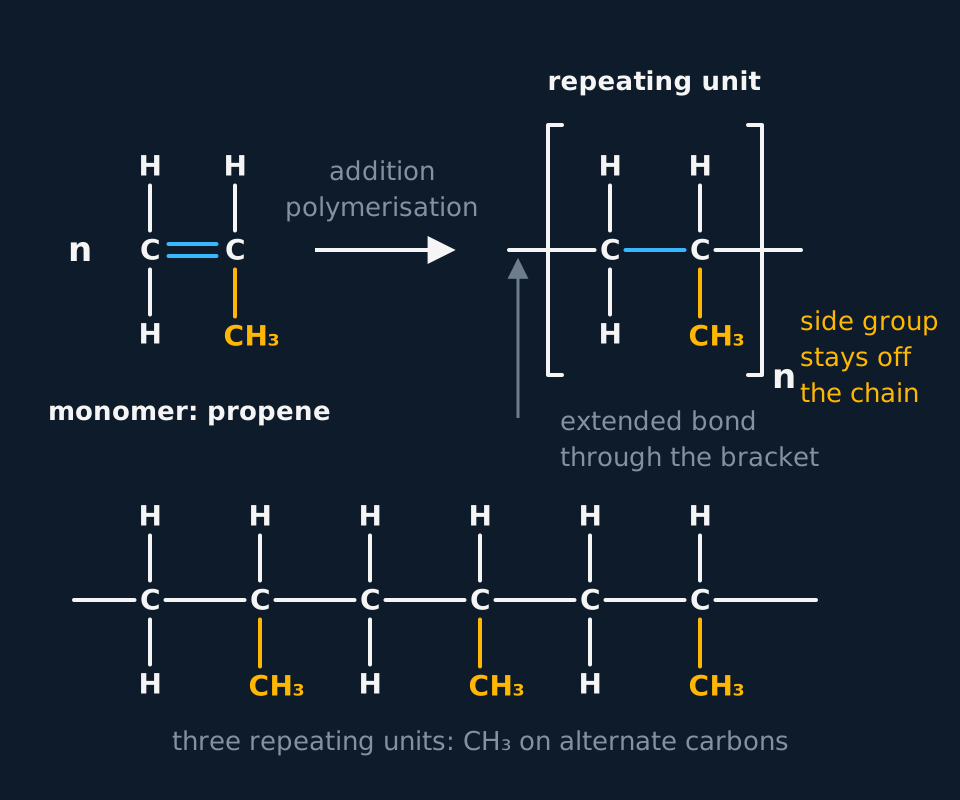
Describe the drawing
Left, propene drawn displayed with its carbon-carbon double bond, two hydrogens on the left carbon, and a hydrogen above and a methyl group below on the right carbon, with n in front. An arrow labelled addition polymerisation leads to the repeating unit: the same two carbons joined by a single bond, the same side groups, and a bond running out from each carbon through a square bracket, with n after the closing bracket. Beneath, a chain of three repeating units with methyl groups on alternate carbons.
Three steps take a monomer to its repeating unit. Draw the two carbons of the double bond side by side with a single bond between them. Put every other group on those carbons above or below, where it was, as a side group. Then draw a bond out from each carbon through a square bracket, and write n after the closing bracket. For propene, CH₂=CHCH₃, the repeating unit is –[CH₂–CH(CH₃)]–.
An answer that puts three carbons in the main chain, –CH₂–CH₂–CH₂–, has drawn the methyl group into the backbone. The CH₃ was never part of the double bond, so it cannot be part of the chain. In poly(propene) it hangs off every second carbon.
Going backwards uses the same rule. Find two neighbouring carbons in the main chain that, with their side groups, repeat along it; draw them with a double bond between them; keep the side groups where they were. A section reading –CH₂–CHCl–CH₂–CHCl–CH₂–CHCl– repeats every two carbons as CH₂–CHCl, so the monomer is CH₂=CHCl, chloroethene.
- Repeating unit
- The smallest group of atoms in a polymer chain that, repeated, gives the whole chain; for an addition polymer, the two carbons of the monomer's double bond with their side groups.
The repeating unit of poly(phenylethene)
Phenylethene, CH₂=CHC₆H₅, is the monomer of polystyrene. Give the repeating unit of poly(phenylethene), and calculate the relative molecular mass of a chain of 2500 repeating units.
Show the working
The double bond joins the CH₂ carbon to the CH carbon that carries the benzene ring. Those two carbons become the main chain, joined by a single bond.
The C₆H₅ group was not part of the double bond, so it hangs off the second carbon as a side group. The repeating unit is –[CH₂–CH(C₆H₅)]–, with a bond out through each bracket and n after the closing bracket.
The repeating unit has the same atoms as the monomer, C₈H₈, so its relative mass is (8 × 12.0) + (8 × 1.0) = 104.0. A chain of 2500 units has Mr = 2500 × 104.0 = 2.60 × 10⁵.
The monomer of poly(methyl 2-methylpropenoate)
Acrylic sheet, sold as Perspex, is a polymer whose main chain alternates between a CH₂ carbon and a carbon carrying a CH₃ group and a COOCH₃ group. Identify and name the monomer.
Show the working
The pattern repeats every two carbons: a CH₂, then a carbon carrying CH₃ and COOCH₃. The repeating unit is –[CH₂–C(CH₃)(COOCH₃)]–.
Put the double bond back between those two carbons and keep the side groups where they were. The monomer is CH₂=C(CH₃)COOCH₃.
Name it from the acid. The three-carbon chain with the double bond and the COO group is propenoate, the methyl on carbon 2 makes it 2-methylpropenoate, and the CH₃ on the oxygen makes it the methyl ester. The monomer is methyl 2-methylpropenoate. The ester group is never involved in the double bond, so it survives polymerisation unchanged as a side group.
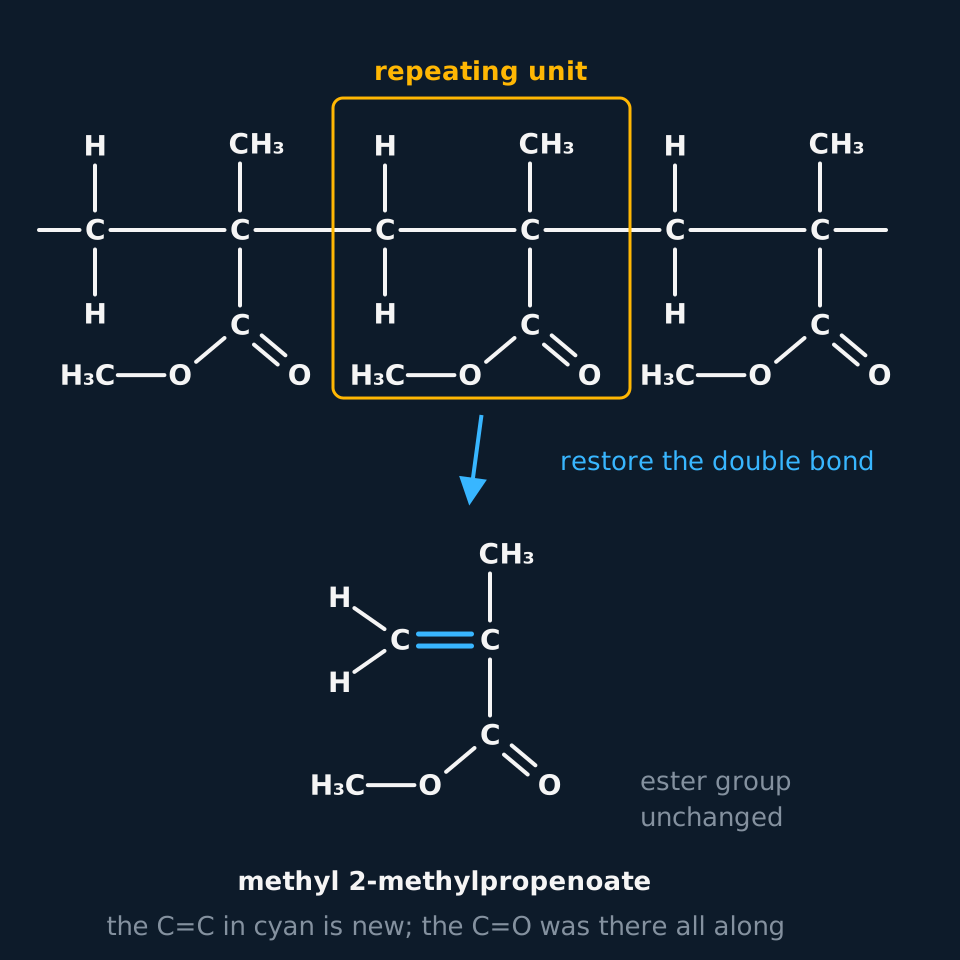
Describe the drawing
A section of poly(methyl 2-methylpropenoate) drawn as six main-chain carbons, alternately CH₂ and a carbon carrying a methyl group above and an ester group below, the ester drawn as a carbon double-bonded to oxygen and single-bonded to an oxygen carrying a methyl group. One CH₂ and its neighbouring substituted carbon are boxed as the repeating unit. An arrow leads down to the monomer, methyl 2-methylpropenoate, with the restored carbon-carbon double bond in cyan and the ester group unchanged.
Four polyalkenes and what decides their uses
The chains in a polyalkene are held to each other only by intermolecular forces. The chains are long, so each one touches its neighbours at thousands of points, and the total attraction is large even though each contact is weak. How closely the chains pack, and how polar their side groups are, decide how strong, stiff and heat-resistant the plastic is.
| Polymer | Monomer | Properties that matter | Uses |
|---|---|---|---|
| Poly(ethene) | Ethene, CH₂=CH₂ | Flexible (low density) or stiff (high density); unreactive; an electrical insulator | Carrier bags and film; milk bottles and washing-up bowls |
| Poly(propene) | Propene, CH₂=CHCH₃ | Stiffer and softens at a higher temperature than poly(ethene); tough; can be drawn into fibres | Crates, food containers, rope, carpet fibres |
| Poly(chloroethene), PVC | Chloroethene, CH₂=CHCl | Rigid and hard without plasticiser, flexible with it; does not rot | Window frames and drainpipes; with plasticiser, cable insulation and flooring |
| PTFE | Tetrafluoroethene, CF₂=CF₂ | Very low friction; almost nothing sticks to it; stable to about 260 °C | Non-stick pan coatings, plumber's tape, bearings |
Poly(ethene) chains are non-polar, so the forces between them are van der Waals forces, the induced dipole–dipole attractions found between all molecules. In PVC each C–Cl bond is polar, because chlorine is more electronegative than carbon, so neighbouring chains also attract through permanent dipole–dipole forces. The chains hold each other more firmly and slide less easily, and unplasticised PVC is rigid enough for a window frame.
A plasticiser is a small molecule mixed into the polymer. Its molecules sit between the chains and push them further apart, which weakens the intermolecular forces between the chains, so the chains slide over each other and the material bends. Plasticised PVC is soft enough for a cable sheath or a raincoat. The plasticiser is not bonded to the chains, so over years it slowly migrates out, and old flexible PVC goes stiff and brittle.
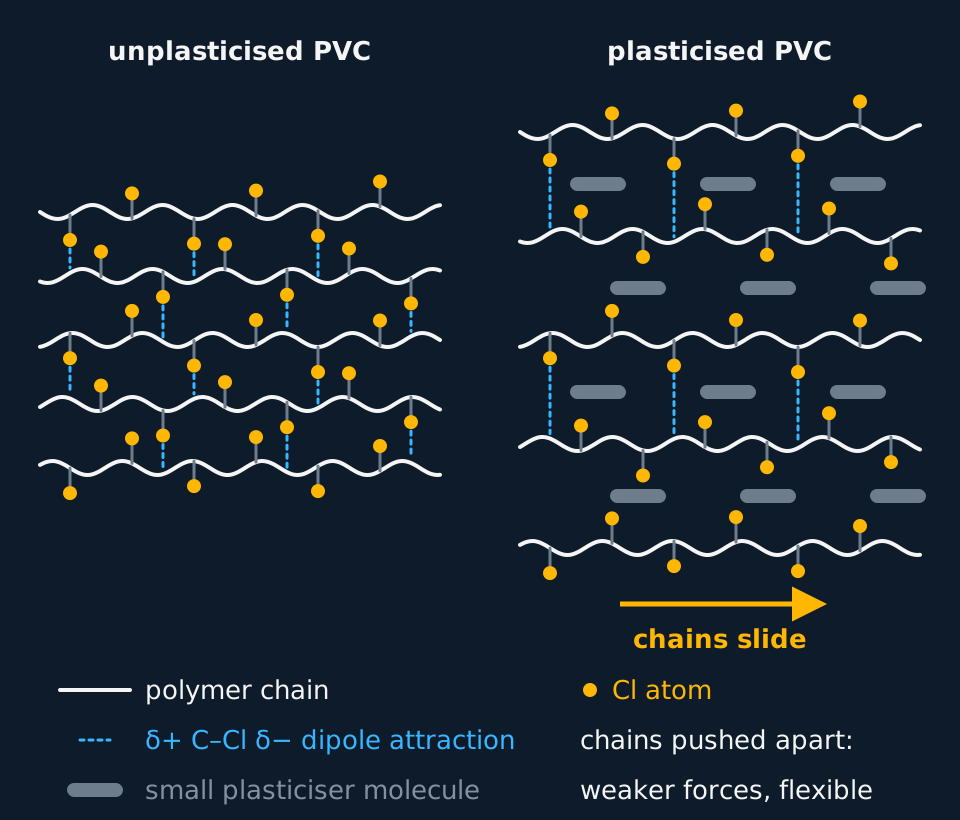
Describe the drawing
Two panels of PVC chains drawn as wavy lines carrying small chlorine atoms. Left, unplasticised PVC: five chains packed close together, with many short dashed dipole-dipole attractions between C–Cl bonds on neighbouring chains. Right, plasticised PVC: the same five chains spaced further apart with small plasticiser molecules drawn as short rods between them, fewer and longer dashed attractions, and an arrow showing a chain sliding past its neighbour.
Poly(propene) has a methyl group on every second carbon. When the methyl groups all lie on the same side of the chain, the chains pack regularly, and the polymer is stiffer and tougher than poly(ethene) and can be spun into fibres strong enough for rope.
PTFE is poly(tetrafluoroethene): every hydrogen of poly(ethene) replaced by fluorine. The C–F bond is the strongest single bond that carbon forms, and the fluorine atoms make a tight sheath around the carbon chain. Little can react with it and almost nothing sticks to it, so it lines frying pans.
- Van der Waals forces
- Weak attractions between all molecules, caused by temporary dipoles inducing dipoles in neighbouring molecules.
- Plasticiser
- A small molecule added to a polymer that gets between the chains, pushes them apart and weakens the forces between them, so the polymer becomes flexible.
Why polyalkenes last, and what can be done with them
The properties that make polyalkenes useful make them hard to get rid of. The chains are saturated and contain only C–C and C–H bonds, which are strong and almost non-polar. There is no double bond for an electrophile, no polar bond for a nucleophile and no functional group that an enzyme can recognise, so bacteria and fungi cannot break the chains down. Polyalkenes are non-biodegradable: a poly(ethene) bag buried in the ground is still there decades later.
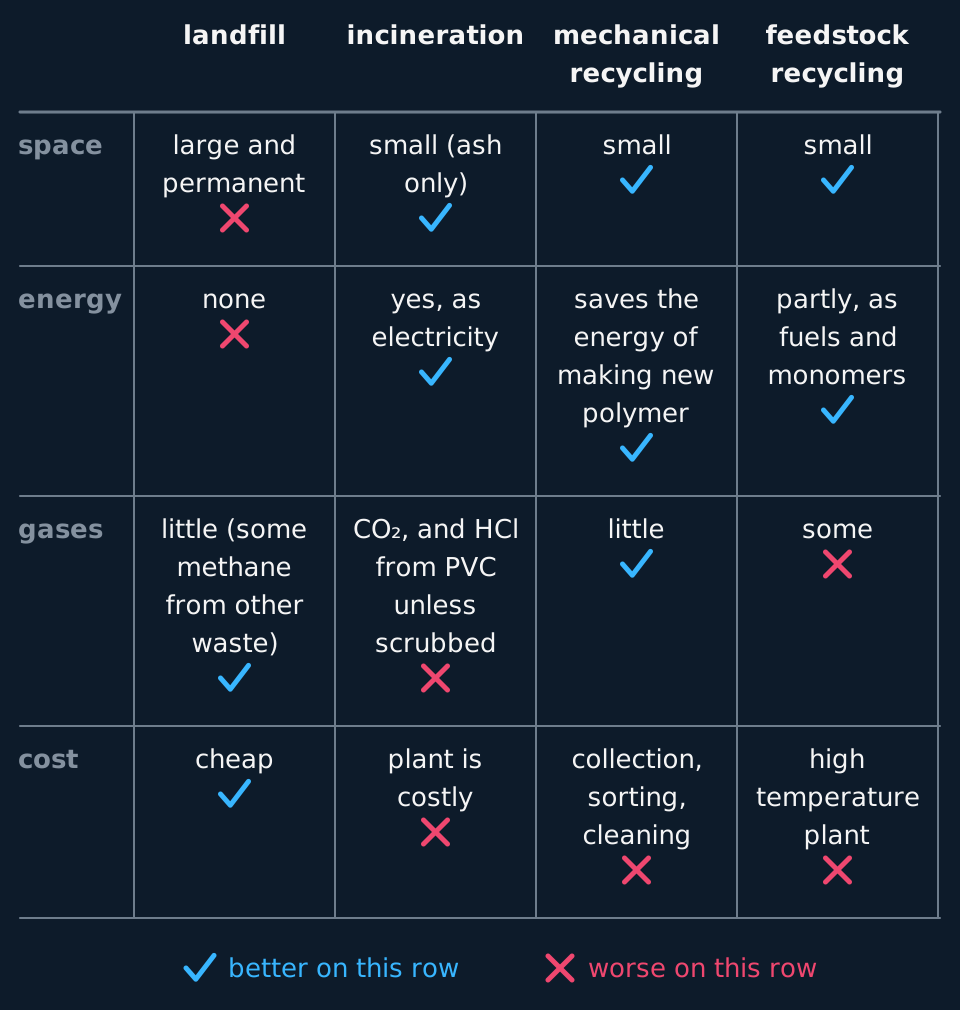
Describe the drawing
A grid comparing four routes for waste polymer, landfill, incineration, mechanical recycling and feedstock recycling, on four rows: space used, energy recovered, gases released, and cost and effort. Landfill uses much space and recovers no energy but is cheap. Incineration needs little space and makes electricity but releases carbon dioxide and, from PVC, hydrogen chloride unless scrubbed. Mechanical recycling saves energy but needs collection, sorting and cleaning. Feedstock recycling partly recovers fuels and monomers in a costly plant. Each cell has a tick or a cross and no route has ticks on every row.
Landfill is cheap and needs little processing, but the plastic occupies space for centuries, suitable sites are running out, and the energy and the carbon in the polymer are lost. Incineration releases the energy stored in the chains, which can generate electricity, and greatly reduces the volume of waste. It releases carbon dioxide, and burning PVC also gives hydrogen chloride, which is removed from the flue gases by passing them through a base such as calcium oxide before they leave the chimney.
CaO(s) + 2HCl(g) → CaCl₂(s) + H₂O(l)Removing hydrogen chloride from the gases made when PVC is incinerated.
Recycling saves crude oil and the energy needed to make new polymer. Mechanical recycling sorts the waste by polymer type, washes it, shreds it and melts it to be moulded again. Mixed or dirty plastic gives a weaker product, and each cycle shortens the chains. Feedstock recycling heats the polymer to crack it back into small molecules, which can be used to make new polymers or fuels.
Sorting comes first, and density does much of it. Shredded mixed plastic dropped into water separates: poly(ethene) and poly(propene), with densities of about 0.90 to 0.96 g cm⁻³, float, while poly(phenylethene), about 1.05 g cm⁻³, and PVC, about 1.4 g cm⁻³, sink. Automated lines also shine infrared radiation on each piece and read its absorption spectrum, which picks out, for example, the C–Cl bonds of PVC.
Biodegradable polymers avoid the problem rather than managing it. Polyesters such as poly(lactic acid), made from plant starch, have polar ester links in the chain that water and enzymes can hydrolyse. They are condensation polymers. They cost more, are weaker for some uses, and break down only in the warm, wet conditions of industrial composting. In an evaluation, name the bond that is broken, the ester link, rather than saying the plastic 'rots'.
- Biodegradable
- Able to be broken down by microorganisms in the environment into small molecules such as carbon dioxide and water.
- Feedstock recycling
- Heating waste polymer to crack it into small molecules that are used to make new polymers or fuels.
TRY IT: Hydrogen chloride from a kilogram of PVC
A council incinerates 1.00 kg of poly(chloroethene) waste. Assuming all the chlorine in the polymer leaves as hydrogen chloride, calculate the mass of hydrogen chloride produced and the mass of calcium oxide needed to remove it. Ar: H 1.0, C 12.0, O 16.0, Cl 35.5, Ca 40.1.
Check your answer
Each repeating unit, –[CH₂–CHCl]–, has Mr = (2 × 12.0) + (3 × 1.0) + 35.5 = 62.5 and holds one chlorine atom. 1000 g ÷ 62.5 g mol⁻¹ = 16.0 mol of repeating units, so 16.0 mol of HCl forms.
Mass of HCl = 16.0 mol × 36.5 g mol⁻¹ = 584 g.
CaO reacts with HCl in a 1 : 2 ratio, so 8.00 mol of CaO is needed: 8.00 mol × 56.1 g mol⁻¹ = 449 g. Nearly half a kilogram of base is used for every kilogram of PVC burned.
Other boards: London forces and photodegradable polymers
OCR and Edexcel call van der Waals forces London forces, and Cambridge calls them instantaneous dipole–induced dipole forces. The chemistry is the same: a temporary dipole in one chain induces a dipole in its neighbour. Use the board's own name in an answer.
OCR and Cambridge also examine photodegradable polymers, which break down in light. Poly(ethene) absorbs almost none of the ultraviolet in sunlight, so a few carbonyl groups, C=O, are built into the chain by copolymerising ethene with a little carbon monoxide or a ketone that carries a C=C bond. Each C=O absorbs ultraviolet, and the energy breaks a C–C bond beside it. Ultraviolet at 300 nm carries about 400 kJ per mole of photons, more than the 347 kJ mol⁻¹ of a C–C bond. The chains snap into shorter pieces, and the plastic turns brittle and crumbles.
Photodegradation has two limits. It needs light, so a bag buried in landfill or under other rubbish stays whole. And the pieces it gives are still poly(ethene), only shorter: unless microorganisms then digest them, they persist as small fragments of plastic. It suits items that are bound to end up outdoors, such as the rings that hold drinks cans together and mulch film on fields.
| Biodegradable polymer | Photodegradable polymer | |
|---|---|---|
| Example | Poly(lactic acid), a polyester | Poly(ethene) with C=O groups in the chain |
| What breaks the chain | Hydrolysis by water and enzymes from microorganisms | Ultraviolet light absorbed by C=O groups |
| Bond broken | The polar C–O bond of an ester link | A C–C bond next to a C=O group |
| Conditions needed | Warm, wet, microbe-rich: industrial composting | Exposure to sunlight |
| What is left | Small molecules, ending as CO₂ and water | Short polymer fragments, unless microbes digest them |
- Photodegradable
- Able to be broken down by light, usually ultraviolet absorbed by groups such as C=O built into the polymer chain.
In the exam
- A repeating unit earns its mark only with a bond out through each bracket and n after the closing one; a structure drawn with a C=C in the chain, or a side group in the backbone, loses it.
- Identifying a monomer: take two main-chain carbons, put the double bond between them and keep every side group where it was. Schemes accept a displayed or a condensed formula for the monomer.
- For a plasticiser the scheme awards the idea that its molecules get between the chains and push them apart, weakening the intermolecular forces so the chains slide. 'Makes it softer' alone is not credited.
- Explain non-biodegradability by the bonds: the chains are saturated, with strong, non-polar C–C and C–H bonds, so they are unreactive.
- An evaluation of disposal needs an advantage and a disadvantage of each route; for incinerating PVC, credit goes to naming hydrogen chloride and how it is removed.
Check yourself
A section of a polymer chain reads –CH(CH₃)–CH(CH₃)–CH(CH₃)–CH(CH₃)–. Identify the monomer, state whether the monomer shows E/Z isomerism, and say whether the polymer decolourises bromine water.
Answer
Every main-chain carbon carries one CH₃ and one H, so the pattern repeats every two carbons: the repeating unit is –[CH(CH₃)–CH(CH₃)]–.
Putting the double bond back between those two carbons gives CH₃CH=CHCH₃, but-2-ene. Each carbon of its double bond carries two different groups, H and CH₃, so it has E and Z isomers. Either isomer gives a polymer with this formula.
The polymer has only single bonds in its chain. It is saturated and does not decolourise bromine water; the monomer does.
Questions
Question 16 marksOCR A · Edexcel
Evaluate the ways in which waste poly(ethene) and poly(chloroethene), PVC, can be dealt with after use, including feedstock recycling and burning for energy.
Mark scheme
Indicative content
- both polymers have saturated chains of strong, non-polar bonds, so they are unreactive and non-biodegradable, and in landfill they last for centuries with their carbon wasted
- sorted, cleaned poly(ethene) can be remelted and moulded into new objects, saving crude oil and energy, but the sorting costs money and a little PVC spoils a batch
- feedstock recycling heats the waste to break the chains into small molecules, such as alkenes, that become raw materials for new polymers and other chemicals
- feedstock recycling accepts mixed and dirty plastic that cannot be remelted, though the cracking plant needs energy and capital to run
- burning for energy uses the energy stored in the polymer to generate electricity and cuts the volume of waste, but releases carbon dioxide, and carbon monoxide if combustion is incomplete
- burning PVC also gives hydrogen chloride, which is toxic and acidic and is removed from the waste gases by a base such as calcium oxide before they are released
Levels
- Level 3 (5–6 marks) remelting, feedstock recycling and burning for energy are each weighed against landfill, feedstock recycling is explained as breaking the chains into small molecules that become new raw materials, and the HCl from PVC is removed with a base; the judgement matches each method to the kind of waste it suits, such as clean poly(ethene) to remelting and mixed waste to feedstock recycling
- Level 2 (3–4 marks) most of the methods are weighed on both sides and PVC is singled out for its hydrogen chloride; typically feedstock recycling is treated as remelting under another name, or the HCl is noted with no means of removing it, and the conclusion picks one method for all waste
- Level 1 (1–2 marks) a few separate statements about disposal, often that the plastic rots slowly in landfill or that PVC burns as cleanly as poly(ethene); no method is set against another
Question 24 marks
Calculate the number of repeating units in a poly(propene) chain of relative molecular mass 2.52 × 10⁵, and give its repeating unit as a condensed formula with brackets and n. Mr of propene is 42.0.
Mark scheme
- B1 the repeating unit is –[CH₂–CH(CH₃)]–, two carbons in the main chain with CH₃ as a side group
- B1 a bond extends out through each bracket, and n is written after the closing bracket
- M1 the repeating unit has the same Mr as the monomer, so number of units = 2.52 × 10⁵ ÷ 42.0
- A1 6.00 × 10³ repeating units, to three significant figures
Question 34 marks
Explain why unplasticised PVC is more rigid than poly(ethene), and give one use of unplasticised and one of plasticised PVC, with the property that suits each.
Mark scheme
- B1 the C–Cl bonds in PVC are polar, so there are permanent dipole–dipole forces between the chains as well as van der Waals forces
- B1 the stronger forces hold the chains more firmly in place, so they slide past each other less easily; reject 'bonds between chains'
- B1 unplasticised PVC is used for window frames or drainpipes, because it is rigid and does not rot
- B1 plasticised PVC is used for cable insulation or flooring, because it is flexible and an electrical insulator
All 21 questions with mark schemes, the other 18 set out in full on the question page.
Worth remembering
- A polymer drawn with a C=C still in the chain is wrong: every double bond opened.
- A side group drawn into the backbone loses the repeating-unit mark.
- A monomer named from the polymer with the brackets left in is not a monomer: restore the double bond.
- PVC's rigidity comes from permanent dipoles between C–Cl bonds, not from the chlorine 'bonding' chains together.
- Poly(ethene) is unreactive because its bonds are strong and non-polar, not because it is 'stable'.
CHECK YOUR PROGRESS
Rate how confident you are with each objective for this lesson. Ratings are saved in this browser, on this device, unless you sign in.
- Draw the repeating unit of an addition polymer from its monomer, with brackets, extended bonds and n.
- Identify the monomer from a section of an addition polymer chain.
- Explain the properties and uses of poly(ethene), poly(propene), PVC and PTFE in terms of their chains and the forces between them.
- Explain how a plasticiser makes PVC flexible.
- Explain why polyalkenes are unreactive and non-biodegradable, and evaluate landfill, incineration and recycling as ways of dealing with the waste.
- Explain how a photodegradable polymer breaks down, and compare it with a biodegradable one.CAIE · OCR A
Open the full revision checklist to see every objective in the curriculum in one place.
Practise this lesson
Practise addition polymers with 21 original questions and point-by-point mark schemes
WORKBOOK
The written questions from this topic, on paper with room to work, and a separate book of mark schemes. The 2 questions that are set on a diagram stay on this page, where the diagram can be drawn. Free to use; please do not redistribute or sell.
Used later in Condensation polymers and the disposal of polymers