Chemistry › Alkenes and alcohols › Alcohols: hydration, fermentation and classification
Alcohols: hydration, fermentation and classification
Ethanol is made in two ways: by yeast fermenting sugar in a vat, slowly and from a crop that grows back, or by steam adding to ethene from crude oil, quickly and pure. Which is better depends on what is being weighed. The alcohols themselves are classified by the carbon that carries the OH group, and held together by hydrogen bonds.
Key terms Every definition in alkenes and alcohols, lesson by lesson
Before this Alkenes: structure, electrophilic addition and Markovnikov's rule – carbocations and the addition of water · Electronegativity, polarity and intermolecular forces – hydrogen bonding · Dynamic equilibrium, Le Chatelier's principle and industrial compromise – choosing a temperature and a pressure · Reacting masses, percentage yield and atom economy
COMMON MISCONCEPTION
Ethanol from sugar cane is carbon neutral, so burning it in a car adds no carbon dioxide to the air at all.
Burning it adds carbon dioxide; the claim is that the cane absorbed the same amount while growing. Even that balance ignores the diesel in the tractors, the fertiliser, the fermentation heating and the distillation, all of which release carbon dioxide that no cane took in, and any forest cleared to plant the cane.
What you should be able to do
- Classify an alcohol as primary, secondary or tertiary from its structure or its name.
- Explain the boiling points and solubilities of alcohols in terms of hydrogen bonding.
- State and justify the conditions for making ethanol by fermentation and by the hydration of ethene, and outline the mechanism of acid-catalysed hydration.
- Compare the two routes to ethanol on rate, purity, cost, energy and renewability.
- Write the equations that support the claim that bioethanol is carbon neutral, and give the reasons the claim is not fully valid.
- Describe the reaction of an alcohol with sodium, and explain why ethanol is a weaker acid than water.CAIE
Primary, secondary and tertiary
Four alcohols share the formula C₄H₉OH. Warm each with orange acidified potassium dichromate(VI) and three of them turn it green; the fourth leaves it orange. What separates them is the carbon that carries the OH group, and how many other carbons are joined to it.
An alcohol contains the hydroxyl group, OH, bonded to a saturated carbon atom. Alcohols with one OH group and no ring have the general formula CₙH₂ₙ₊₁OH. The name ends in -ol, with a number for the carbon carrying the OH where there is a choice: propan-1-ol, CH₃CH₂CH₂OH, and propan-2-ol, CH₃CH(OH)CH₃.
An alcohol is primary when the carbon carrying the OH is joined to one other carbon, secondary when it is joined to two, and tertiary when it is joined to three. Methanol, CH₃OH, has no other carbon at all and is counted as primary. The hydrogens give the same answer: the carbon carrying the OH has two hydrogens in a primary alcohol, one in a secondary and none in a tertiary. That count of hydrogens decides how each class is oxidised.
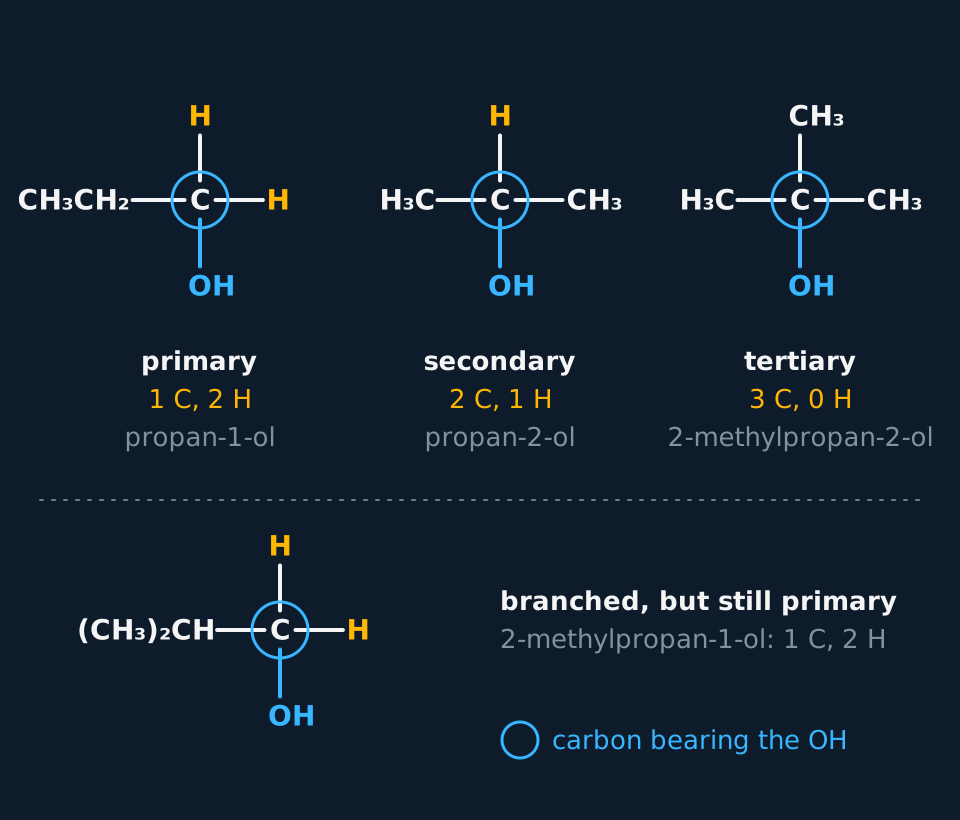
Describe the drawing
Three alcohols displayed around the carbon bearing the OH, which is circled. Propan-1-ol: the circled carbon is bonded to one carbon and two hydrogens, primary. Propan-2-ol: two carbons and one hydrogen, secondary. 2-methylpropan-2-ol: three carbons and no hydrogen, tertiary. Below, 2-methylpropan-1-ol, whose circled carbon is bonded to one carbon and two hydrogens, labelled branched, but still primary.
| Alcohol | Condensed formula | Carbons on the C–OH carbon | Class |
|---|---|---|---|
| Butan-1-ol | CH₃CH₂CH₂CH₂OH | 1 | Primary |
| 2-Methylpropan-1-ol | (CH₃)₂CHCH₂OH | 1 | Primary |
| Butan-2-ol | CH₃CH₂CH(OH)CH₃ | 2 | Secondary |
| 2-Methylpropan-2-ol | (CH₃)₃COH | 3 | Tertiary |
2-Methylpropan-1-ol is the one to check. Its chain is branched, but the branch is one carbon away from the OH. The carbon carrying the OH is a CH₂ joined only to the CH of the branch, so the alcohol is primary. Classify by the carbon carrying the OH and nothing else.
- Alcohol
- A compound containing the hydroxyl group, OH, bonded to a saturated carbon atom.
- Primary alcohol
- An alcohol in which the carbon bonded to the OH group is bonded to one other carbon atom (or none, in methanol).
- Secondary alcohol
- An alcohol in which the carbon bonded to the OH group is bonded to two other carbon atoms.
- Tertiary alcohol
- An alcohol in which the carbon bonded to the OH group is bonded to three other carbon atoms.
Hydrogen bonding: boiling points and solubility
Ethanol, Mr 46.0, boils at 78 °C. Propane, Mr 44.0, boils at −42 °C. Molecules of nearly the same mass and size have van der Waals forces of about the same strength, so a difference of 120 °C has to come from something ethanol has and propane does not: the O–H bond.
Oxygen is far more electronegative than hydrogen, so the O–H bond is strongly polar, Oδ−–Hδ+. The δ+ hydrogen of one ethanol molecule is attracted to a lone pair on the oxygen of a neighbouring molecule, forming a hydrogen bond. Hydrogen bonds are the strongest intermolecular forces, and they must be overcome, as well as the van der Waals forces, before ethanol boils. Name them as hydrogen bonds between alcohol molecules; 'the OH group is polar' starts the explanation without finishing it, and 'breaking O–H bonds' describes a reaction, not boiling.
| Alcohol | Boiling point / °C | Solubility in water at 20 °C |
|---|---|---|
| Methanol | 65 | Mixes in all proportions |
| Ethanol | 78 | Mixes in all proportions |
| Propan-1-ol | 97 | Mixes in all proportions |
| Butan-1-ol | 118 | About 7 g per 100 g of water |
| Pentan-1-ol | 138 | About 2 g per 100 g of water |
| Hexan-1-ol | 157 | About 0.6 g per 100 g of water |
Along the series the boiling point rises by about 20 °C for each CH₂ added. Each molecule still has one OH group, so the hydrogen bonding stays about the same, while the van der Waals forces grow with the length of the chain.
Branching works the other way. Butan-1-ol boils at 118 °C, but its tertiary isomer, 2-methylpropan-2-ol, boils at 82 °C. Both have one OH group and the same Mr, 74.0. The branched molecule is nearly spherical, so it touches its neighbours over a smaller surface, the van der Waals forces between molecules are weaker, and less energy is needed to separate them.
Short-chain alcohols mix with water because their OH groups form hydrogen bonds with water molecules, about as strong as the hydrogen bonds each liquid gives up. The hydrocarbon part of the chain cannot hydrogen bond. As it lengthens, it pushes apart more water molecules that were hydrogen bonded to each other and gets back only weak van der Waals attractions, so the solubility falls. By hexan-1-ol the chain dominates, and the alcohol floats on water as a separate layer.
- Hydrogen bond
- An attraction between a δ+ hydrogen atom bonded to nitrogen, oxygen or fluorine and a lone pair on a nitrogen, oxygen or fluorine atom of a neighbouring molecule.
Fermentation
Ethanol is made on a large scale by two routes: the fermentation of sugars from crops, and the hydration of ethene, the addition of steam to ethene from crude oil. In fermentation, yeast in a warm sugar solution, with the air kept out, turns glucose into ethanol and carbon dioxide. Enzymes in the yeast catalyse the change. It is how wine and beer are made, and how most of the world's fuel ethanol is made, from sugar cane in Brazil and from maize in the United States.
C₆H₁₂O₆(aq) → 2CH₃CH₂OH(aq) + 2CO₂(g)Fermentation, catalysed by enzymes in yeast.
Each condition has a reason. The temperature is kept between 30 and 40 °C, typically 35 °C: below that the enzymes work slowly, and above it they begin to denature and the rate falls. Air is excluded, because with oxygen present yeast respires aerobically and turns the glucose into carbon dioxide and water instead, and bacteria from the air can oxidise the ethanol to ethanoic acid. The glucose is in aqueous solution, and the process runs as a batch: a vat is filled, left for several days, emptied and cleaned.
Fermentation stops when the ethanol reaches about 15% by volume, because at that concentration the ethanol kills the yeast. The mixture is filtered and the ethanol is concentrated by fractional distillation, which is where most of the energy in the process is spent.
- Fermentation
- The conversion of glucose into ethanol and carbon dioxide by enzymes in yeast, in the absence of air.
Ethanol from a kilogram of glucose
Calculate the maximum mass of ethanol that can be made by fermenting 1.00 kg of glucose, and the percentage atom economy of fermentation for ethanol.
Show the working
Mr of glucose, C₆H₁₂O₆ = (6 × 12.0) + (12 × 1.0) + (6 × 16.0) = 180.0. Mr of ethanol, C₂H₅OH = (2 × 12.0) + (6 × 1.0) + 16.0 = 46.0.
Amount of glucose = 1000 g ÷ 180.0 g mol⁻¹ = 5.556 mol. Each glucose gives two ethanol, so 11.11 mol of ethanol forms, with a mass of 11.11 mol × 46.0 g mol⁻¹ = 511 g.
Atom economy = mass of desired product ÷ total mass of products × 100 = (2 × 46.0) ÷ 180.0 × 100 = 51.1%. Nearly half the mass of the glucose leaves as carbon dioxide.
Hydration of ethene
The second route, the hydration of ethene, starts from ethene cracked from crude oil. Ethene and steam are passed over a catalyst of phosphoric acid, H₃PO₄, on a silica support, at about 300 °C and 60 to 70 atm.
CH₂=CH₂(g) + H₂O(g) ⇌ CH₃CH₂OH(g)ΔH = −45 kJ mol⁻¹
The conditions are a compromise. The forward reaction is exothermic, so a lower temperature would give a higher equilibrium yield, but the rate would be too slow; 300 °C gives an acceptable yield at an acceptable rate. Two moles of gas become one, so a higher pressure moves the equilibrium to the right and raises the rate. Above about 70 atm the cost of the plant and of compressing the gas outweighs the gain, and ethene begins to polymerise. Excess steam pushes the equilibrium further to the right.
Only about 5% of the ethene is converted on each pass over the catalyst. The ethanol is condensed out and the unreacted ethene is recycled, so the overall conversion reaches about 95%. The process runs continuously, gives ethanol that needs little purification, and has an atom economy of 100%, because ethanol is the only product.
The phosphoric acid supplies H⁺, and the mechanism is electrophilic addition followed by the loss of H⁺. The π pair of ethene forms a bond to an H⁺ ion, giving the carbocation CH₃C⁺H₂. A lone pair on the oxygen of a water molecule forms a bond to the positive carbon, giving the protonated alcohol CH₃CH₂OH₂⁺, with the positive charge on oxygen. The pair in one O–H bond then moves onto the oxygen and H⁺ is released. The H⁺ used in the first step is returned in the last, so the acid is a catalyst.
Other alkenes hydrate the same way, and the carbocation decides the product. Propene gives propan-2-ol, because H⁺ adds to the CH₂ end to make the secondary carbocation, and 2-methylpropene gives the tertiary alcohol 2-methylpropan-2-ol. Hydration therefore makes secondary and tertiary alcohols well, but a primary alcohol other than ethanol comes only as the minor product.
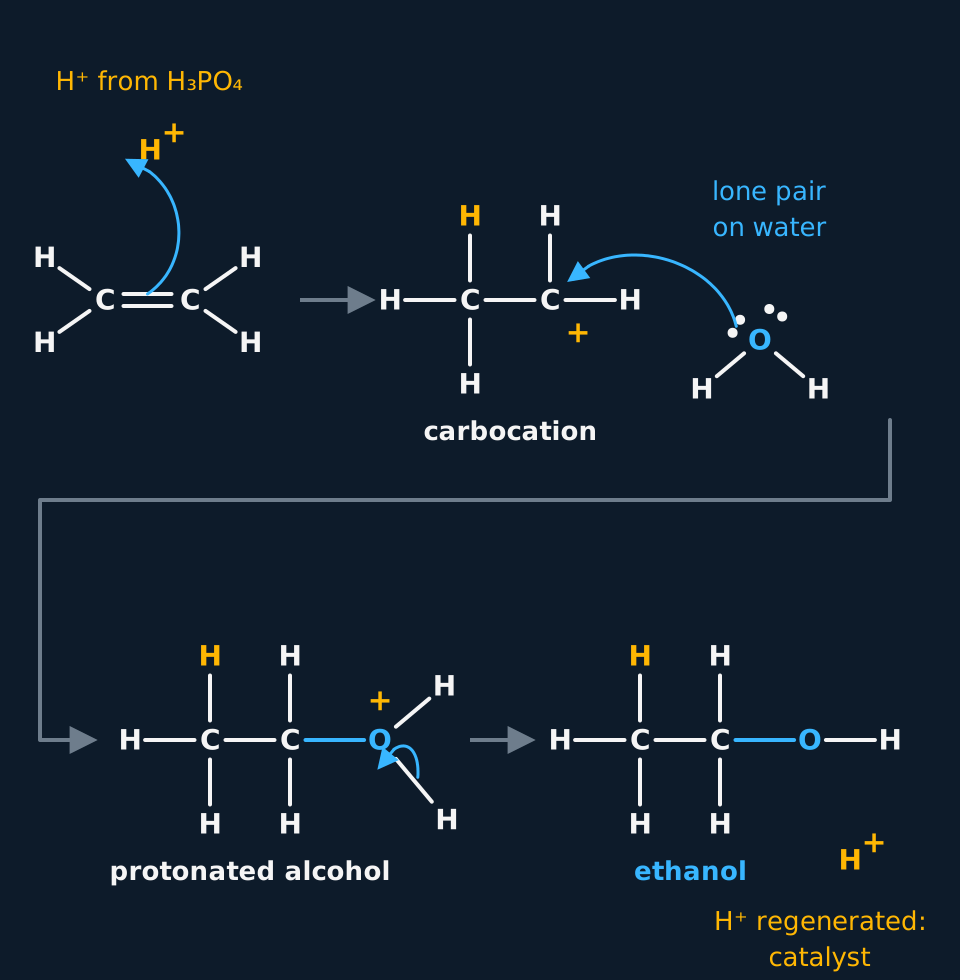
Describe the drawing
Acid-catalysed hydration of ethene in three steps. Ethene meets an H⁺ ion from phosphoric acid and a curly arrow runs from the double bond to H⁺, giving a carbocation with the positive charge on the carbon not bonded to the new hydrogen. A water molecule's lone pair sends a second arrow to that positive carbon, giving protonated ethanol with the positive charge on an oxygen that now has three bonds. A third arrow runs from one O–H bond onto the oxygen, releasing H⁺, so the products are ethanol and the regenerated catalyst.
- Hydration
- The addition of water across a carbon–carbon double bond, as when ethene and steam form ethanol.
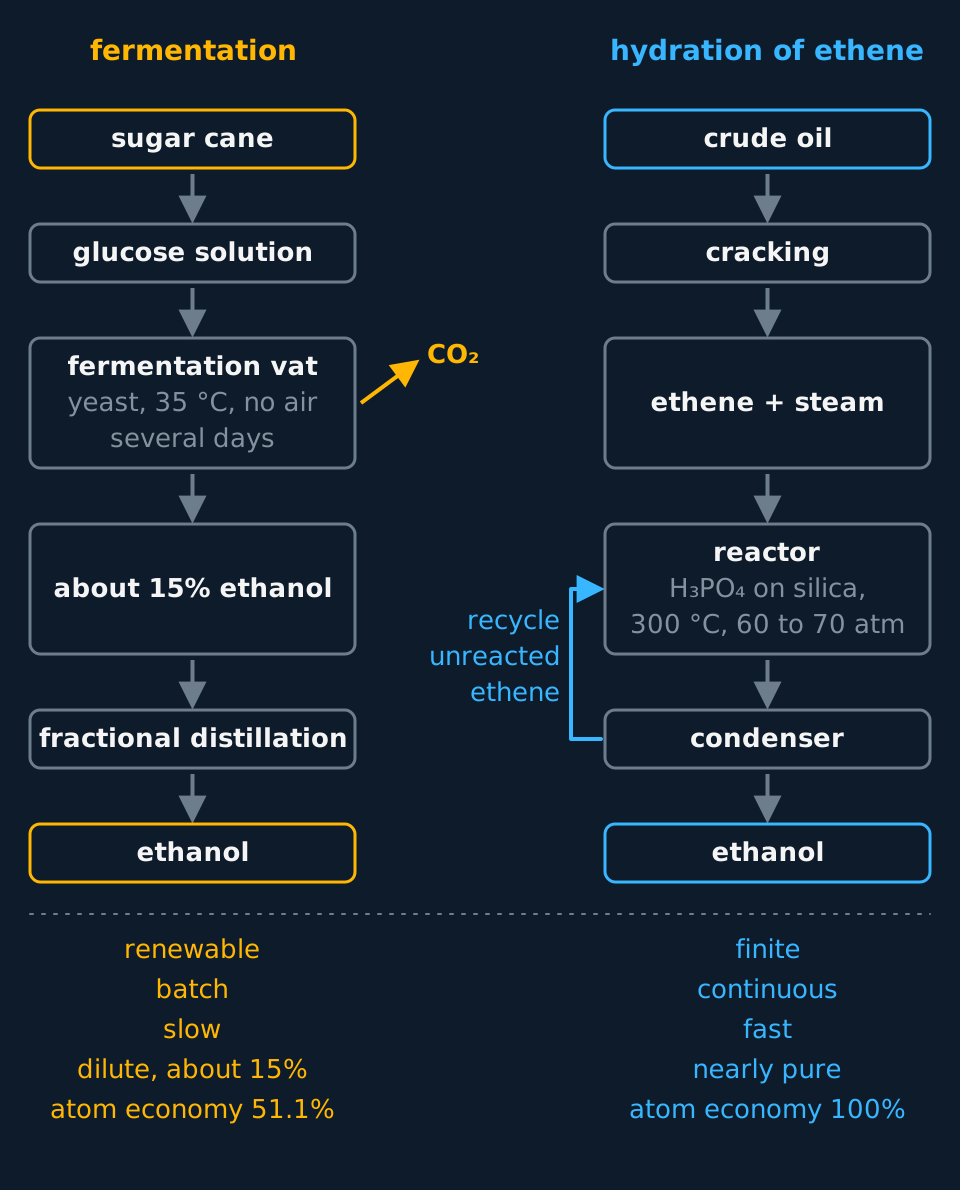
Describe the drawing
Two flow lines side by side, each six steps long. Fermentation: sugar cane, glucose solution, a fermentation vat with yeast at 35 °C and no air for several days giving off carbon dioxide, about 15% ethanol, fractional distillation, ethanol. Hydration: crude oil, cracking, ethene and steam, a reactor with phosphoric acid on silica at 300 °C and 60 to 70 atmospheres, a condenser with unreacted ethene recycled to the reactor, ethanol. A strip below compares renewable with finite, batch with continuous, slow with fast, dilute with nearly pure, and atom economy 51.1% with 100%.
| Fermentation | Hydration of ethene | |
|---|---|---|
| Raw material | Sugars from crops: renewable | Ethene from crude oil: finite |
| Conditions | Yeast, 30 to 40 °C, no air, aqueous | H₃PO₄ catalyst, 300 °C, 60 to 70 atm |
| Type of process | Batch | Continuous |
| Rate | Slow: several days | Fast |
| Product | About 15% ethanol in water; needs fractional distillation | Nearly pure ethanol |
| Atom economy | 51.1% | 100% |
| Costs | Cheap equipment, low temperature; energy for distillation | Expensive plant; energy for high temperature and pressure |
Neither route wins outright. A country with the land and climate for sugar cane, such as Brazil, makes fuel ethanol by fermentation and spends nothing on crude oil to do it. A country with a petrochemical industry and cheap ethene makes industrial ethanol by hydration. As crude oil runs down and its price rises, fermentation becomes more competitive.
Two routes to a tonne of ethanol
A plant must make 1.00 tonne of ethanol. Calculate the mass of ethene used by hydration, if 95.0% of the ethene is converted overall, and the mass of glucose used by fermentation, if all of it is fermented. Calculate also the mass of carbon dioxide fermentation releases. Mr: ethanol 46.0, ethene 28.0, glucose 180.0, CO₂ 44.0.
Show the working
Amount of ethanol = 1.00 × 10⁶ g ÷ 46.0 g mol⁻¹ = 2.174 × 10⁴ mol.
Hydration gives one ethanol per ethene, but only 95.0% of the ethene ends as ethanol: 2.174 × 10⁴ ÷ 0.950 = 2.288 × 10⁴ mol of ethene, with a mass of 2.288 × 10⁴ × 28.0 = 6.41 × 10⁵ g = 0.641 tonne.
Fermentation gives two ethanol per glucose: 2.174 × 10⁴ ÷ 2 = 1.087 × 10⁴ mol of glucose, with a mass of 1.087 × 10⁴ × 180.0 = 1.96 × 10⁶ g = 1.96 tonnes.
Two CO₂ form with every two ethanol, so 2.174 × 10⁴ mol of CO₂, with a mass of 2.174 × 10⁴ × 44.0 = 9.57 × 10⁵ g = 0.957 tonne. The masses check: 1.96 tonnes of glucose gives 1.00 tonne of ethanol and 0.957 tonne of carbon dioxide. Fermentation needs three times the mass of raw material that hydration does.
Bioethanol and carbon neutrality
A biofuel is a fuel produced from renewable biological material. Ethanol made by fermentation is one, and standard petrol in the UK contains up to 10% of it. The claim that bioethanol is carbon neutral rests on three equations. The crop takes carbon dioxide from the air as it grows, fermentation releases some of it, and burning the ethanol releases the rest.
6CO₂(g) + 6H₂O(l) → C₆H₁₂O₆(aq) + 6O₂(g)Photosynthesis: six CO₂ taken in for each glucose.
C₆H₁₂O₆(aq) → 2CH₃CH₂OH(aq) + 2CO₂(g)Fermentation: two CO₂ given out.
2CH₃CH₂OH(l) + 6O₂(g) → 4CO₂(g) + 6H₂O(l)Combustion of the two ethanol molecules: four CO₂ given out.
Six molecules of carbon dioxide are taken in for every glucose, and two plus four are given out. On the equations alone, the net change is zero.
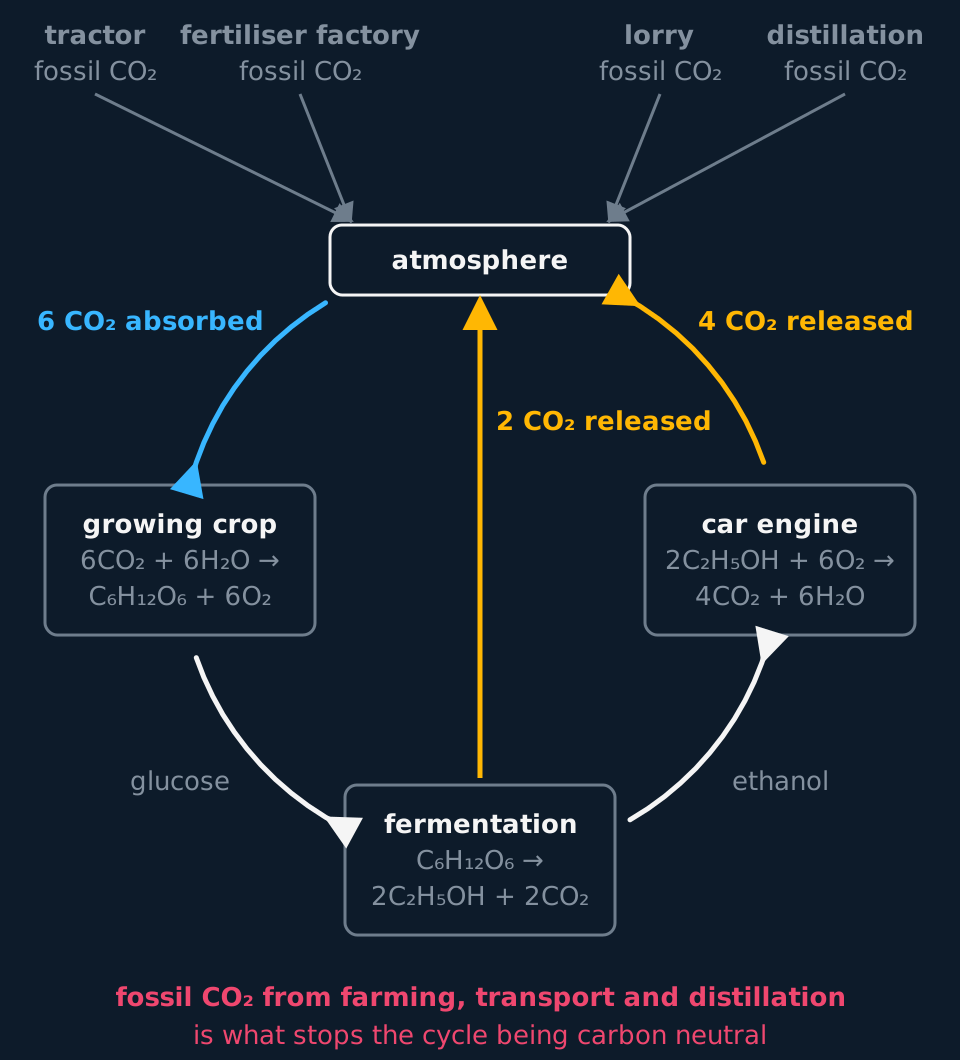
Describe the drawing
A cycle of four boxes joined by curved arrows: the atmosphere at the top, a growing crop on the left absorbing six carbon dioxide by photosynthesis, a fermentation vat at the bottom releasing two carbon dioxide as glucose becomes ethanol, and a car engine on the right burning the ethanol and releasing four carbon dioxide. Six in balances two plus four out. Four grey arrows from a tractor, a fertiliser factory, a lorry and a distillation column add fossil carbon dioxide to the atmosphere from outside the cycle.
In practice it is not zero. Fossil fuels are burned to plough, plant and harvest the crop, to make the fertiliser it needs, to transport it, and above all to heat the fractional distillation that concentrates the ethanol. Each of those releases carbon dioxide that the crop never absorbed. Clearing forest for new fields releases more. And land used for fuel crops is land not used to grow food, which raises the price of food where the two compete.
- Biofuel
- A fuel produced from renewable biological material, such as crops.
- Carbon neutral
- Describing an activity that has no net annual carbon emissions to the atmosphere.
TRY IT: Testing a fuel supplier's claim
A fuel supplier says its bioethanol 'puts no carbon dioxide into the atmosphere'. Use equations to explain the basis of the claim, and evaluate it.
Check your answer
The claim is based on the three equations: photosynthesis takes in 6CO₂ for each C₆H₁₂O₆; fermentation gives out 2CO₂; burning the two CH₃CH₂OH gives out 4CO₂. Six in, six out.
As worded, the claim is false. Burning the fuel does put carbon dioxide into the atmosphere, four molecules for every glucose fermented. What the equations show is that the same amount was taken out of the atmosphere a few months earlier.
Even the net claim fails, because fossil fuels are burned in farming, fertiliser production, transport and distillation. Bioethanol emits less net carbon dioxide than petrol, but it is not carbon neutral.
Other boards: alcohols and sodium
Cambridge also sets the reaction of alcohols with sodium, and asks why ethanol is a weaker acid than water. Sodium reacts with both, but at very different rates: a small piece sinks in ethanol and fizzes steadily, shrinking over a few minutes, while the same piece in water floats, melts into a ball and races across the surface. Both give hydrogen, and in both the O–H bond breaks.
2CH₃CH₂OH(l) + 2Na(s) → 2CH₃CH₂O⁻Na⁺(s) + H₂(g)Sodium ethoxide dissolves in the excess ethanol and is left as a white solid when the ethanol evaporates.
The product is an ionic salt of the ethoxide ion, CH₃CH₂O⁻, which is to ethanol what the hydroxide ion is to water. Sodium is oxidised to Na⁺, and the hydrogen of the O–H group is reduced to H₂. Every alcohol does the same: propan-1-ol gives sodium propoxide, CH₃CH₂CH₂O⁻Na⁺. Fizzing with sodium shows an O–H group, but water and carboxylic acids give it too, so it only identifies an alcohol when the sample is dry and not acidic.
Ethanol reacts more gently because it is a weaker acid than water: it gives up H⁺ less readily. The reason is in the ion left behind. The ethyl group releases electron density towards the oxygen, the inductive effect that stabilises carbocations, so the negative charge on the oxygen of CH₃CH₂O⁻ is more concentrated than on OH⁻. A concentrated negative charge attracts H⁺ more strongly, so ethoxide holds on to the proton and ethanol releases it less. Both are far weaker acids than ethanoic acid, and neither turns blue litmus red.
- Alkoxide ion
- The anion RO⁻ formed when an alcohol loses the hydrogen of its OH group, as in sodium ethoxide, CH₃CH₂O⁻Na⁺.
In the exam
- Classify an alcohol by counting the carbons joined to the carbon that carries the OH: one for primary, two for secondary, three for tertiary.
- Each fermentation condition earns a mark only with its reason: 35 °C balances rate against denaturing the enzymes; air is excluded to prevent aerobic respiration and the oxidation of ethanol to ethanoic acid. 'Anaerobic' is accepted for 'no air'.
- For carbon neutrality, schemes award a mark for each of the three equations and one for the count, six CO₂ in and two plus four out. The evaluation mark needs a named use of fossil fuel, in farming, transport or distillation; 'it is not carbon neutral' alone is ignored.
- A comparison of fermentation with the hydration of ethene sets the two routes against each other point by point: renewable against finite, batch against continuous, slow against fast, dilute against nearly pure. A list of facts about one route is not a comparison.
- Boiling points are explained by hydrogen bonds between alcohol molecules, named as such. An answer about breaking O–H bonds is rejected, since no covalent bond breaks on boiling.
Check yourself
2-Methylbutan-2-ol, (CH₃)₂C(OH)CH₂CH₃, is wanted from an alkene and steam. Classify the alcohol, and suggest an alkene that gives it as the major product, explaining your choice.
Answer
The carbon carrying the OH is joined to three carbons, two CH₃ groups and a CH₂, so the alcohol is tertiary.
The OH must end up on that carbon, so the H⁺ must add to the carbon next to it, leaving the positive charge where the OH is to go. 2-Methylbut-2-ene, (CH₃)₂C=CHCH₃, works: H⁺ adds to the CH carbon and leaves the tertiary carbocation (CH₃)₂C⁺CH₂CH₃.
That tertiary carbocation is more stable than the secondary one the other way round would give, so it forms faster, and water bonds to it to give 2-methylbutan-2-ol as the major product. 2-Methylbut-1-ene, CH₂=C(CH₃)CH₂CH₃, gives the same tertiary carbocation and would also work.
Questions
Question 16 marksAQA · Edexcel
Evaluate the claim that ethanol produced by fermentation is a carbon neutral fuel. Include equations in your answer.
Mark scheme
Indicative content
- photosynthesis, 6CO₂(g) + 6H₂O(l) → C₆H₁₂O₆(aq) + 6O₂(g), absorbs six molecules of CO₂ for each glucose the crop makes
- fermentation, C₆H₁₂O₆(aq) → 2CH₃CH₂OH(aq) + 2CO₂(g), releases two molecules of CO₂ for each glucose fermented
- combustion, 2CH₃CH₂OH(l) + 6O₂(g) → 4CO₂(g) + 6H₂O(l), releases four molecules of CO₂ when the two ethanol burn
- the 2 + 4 = 6 molecules of CO₂ released equal the 6 absorbed in photosynthesis, which is the basis of the claim
- but fossil fuels are burned in farming, making fertiliser, transporting the crop and in the fractional distillation, releasing CO₂ the crop did not absorb
- so the claim is not fully valid: bioethanol gives lower net CO₂ emissions than petrol but is not carbon neutral; ignore answers about cost
Levels
- Level 3 (5–6 marks) all three equations are correct and balanced, the six molecules of carbon dioxide absorbed are shown to equal the two plus four released, the fossil-fuel inputs of farming, fertiliser, transport and distillation are identified, and the claim is judged partly valid with the reason
- Level 2 (3–4 marks) the photosynthesis and combustion equations are given and the carbon dioxide balance is argued; the fermentation equation or the molecule count is incomplete, or fossil-fuel inputs are listed without a judgement following from them
- Level 1 (1–2 marks) the claim is accepted because the crop absorbs the carbon dioxide released on burning, with one equation or none and no thought for the fuel used in farming, transport or distillation
Question 24 marksAQA
Calculate the percentage yield of ethanol from a fermentation, using the results given in the table.
| Quantity | Value |
|---|---|
| Mass of glucose fermented | 2.50 kg |
| Volume of solution after fermentation | 10.0 dm³ |
| Ethanol in the solution, by volume | 12.0% |
| Density of ethanol | 0.789 g cm⁻³ |
| Mr: glucose, ethanol | 180.0, 46.0 |
Mark scheme
- M1 volume of ethanol = 0.120 × 10 000 cm³ = 1200 cm³, so mass = 1200 × 0.789 = 947 g
- M1 amount of glucose = 2500 ÷ 180.0 = 13.89 mol, giving 2 × 13.89 = 27.78 mol of ethanol
- M1 maximum mass of ethanol = 27.78 × 46.0 = 1278 g; error carried forward from the amount of ethanol
- A1 percentage yield = 947 ÷ 1278 × 100 = 74.1%, to three significant figures
Question 34 marksAQA
Compare the production of ethanol by fermentation with its production by the hydration of ethene.
Mark scheme
- B1 fermentation uses a renewable raw material, sugar from crops, while hydration uses ethene from crude oil, which is finite
- B1 fermentation is a slow batch process, while hydration is fast and continuous
- B1 fermentation gives dilute ethanol, about 15%, that must be concentrated by fractional distillation, while hydration gives nearly pure ethanol
- B1 fermentation needs only a low temperature and cheap equipment but has an atom economy of 51.1%, while hydration needs high temperature and pressure in costly plant but has an atom economy of 100%
All 22 questions with mark schemes, the other 19 set out in full on the question page.
Worth remembering
- Classify by the carbon carrying the OH, never by the length or branching of the chain.
- Boiling is about hydrogen bonds between molecules; no O–H bond breaks.
- A fermentation condition stated without its reason earns half the answer.
- The hydration conditions are a compromise: say what a lower temperature would gain and what it would cost.
- 'Carbon neutral' without the three equations and a fossil-fuel input is an assertion, not an evaluation.
CHECK YOUR PROGRESS
Rate how confident you are with each objective for this lesson. Ratings are saved in this browser, on this device, unless you sign in.
- Classify an alcohol as primary, secondary or tertiary from its structure or its name.
- Explain the boiling points and solubilities of alcohols in terms of hydrogen bonding.
- State and justify the conditions for making ethanol by fermentation and by the hydration of ethene, and outline the mechanism of acid-catalysed hydration.
- Compare the two routes to ethanol on rate, purity, cost, energy and renewability.
- Write the equations that support the claim that bioethanol is carbon neutral, and give the reasons the claim is not fully valid.
- Describe the reaction of an alcohol with sodium, and explain why ethanol is a weaker acid than water.CAIE
Open the full revision checklist to see every objective in the curriculum in one place.
Practise this lesson
WORKBOOK
The written questions from this topic, on paper with room to work, and a separate book of mark schemes. The question that is set on a diagram stays on this page, where the diagram can be drawn. Free to use; please do not redistribute or sell.